
![[+]](https://www.futuretimeline.net/images/buttons/expand-symbol.gif)
|
|
|
|
|
|
2026-2031
The Martian Moons Exploration probe collects and returns samples
Martian Moons Exploration (MMX) is a robotic space probe developed by the Japan Aerospace Exploration Agency (JAXA) to bring back the first ever samples from Mars' largest moon, Phobos. The mission includes collaboration from NASA, the European Space Agency, and Centre National d'Études Spatiales, which provide scientific instruments and technical expertise. The U.S. contributes a neutron and gamma-ray spectrometer, while Europe provides a near-infrared spectrometer and flight-dynamics support to plan the complex orbital and landing manoeuvres.
Originally planned for 2024, JAXA rescheduled the mission to the 2026 launch window.* MMX arrives at Mars in 2027, lands on Phobos and collects around 10 g (0.35 oz) of regolith samples. It also conducts flybys of Deimos and monitors aspects of the Martian environment. A small surface rover, developed by CNES and the German Aerospace Center (DLR), deploys onto Phobos to study its mechanical properties and surface composition. Operating in gravity thousands of times weaker than Earth's, the rover moves cautiously across the moon's dusty terrain, providing context for the returned samples.
The material is delivered back to Earth in 2031.* Laboratory analysis helps to determine whether Phobos formed from captured asteroid material or from debris produced by an ancient impact on Mars, while also improving understanding of the Martian system and informing future crewed exploration.
2026-2027
The world's first trillionaire
The concentration of wealth at the very top of society continues to accelerate through the mid- to late-2020s. At some point during this period,** Elon Musk becomes the world's first trillionaire when estimates of his personal net worth exceed $1 trillion. Even if the status only holds for a single day, it marks a symbolic milestone in the scale of modern fortunes, placing one individual's paper wealth on a level previously associated with entire national economies. This figure reflects extreme equity valuations and future-oriented market expectations rather than income or cash generation on anything like a comparable scale.
Musk reaches this point through an unusually broad and volatile portfolio of ventures. Tesla still accounts for much of the short-term movement in his net worth, while SpaceX and Starlink provide a secondary growth engine that investors increasingly treat as strategic infrastructure rather than speculative startups. Alongside these are xAI, Neuralink, and The Boring Company, which operate more like high-risk R&D bets than mature profit centres. Social media platform X (formerly Twitter) functions less as a conventional business and more as a permanent global publicity platform, greatly amplifying Musk's influence and visibility even as its heavy debt load complicates any simple picture of profitability. Markets price this collection less like a traditional conglomerate and more as a highly leveraged bet on multiple future technologies at once.
His public image, however, continues to generate controversy over the same period. Throughout the 2020s, Elon Musk aligns himself more openly with far-right political narratives and remains a deeply polarising figure. His name also appears in unsealed documents related to Jeffrey Epstein, prompting renewed scrutiny and further questions, even in the absence of any criminal allegations. These factors weigh on consumer sentiment and valuation multiples, particularly for Tesla, and they introduce greater volatility into his fortune. Yet the overall trend continues upward.* Investors focus on scale, growth potential and strategic relevance, and Musk's wealth does not depend on a single company or market.
This milestone arrives more than a decade earlier than forecasts made in the mid-2010s, which placed the first trillionaire in the late 2030s.* Several structural changes have pulled the timeline forward. AI-driven revaluations dramatically increased the perceived future earnings of technology firms, even amid mounting fears of a technology bubble. Private company valuations continue to jump in large steps during funding rounds and tender offers, and global capital increasingly tolerates extreme concentration at the top.
The emergence of a trillionaire does not end with Musk. The same forces propelling his fortune create a pathway for additional trillionaires in the 2030s, particularly among founders whose wealth compounds through platform dominance and AI-driven scalability. Figures such as Mark Zuckerberg remain among the most plausible candidates if markets continue to reward scale, data, and AI-driven productivity at anything like their current pace. Whether such extreme concentrations of wealth are viewed as a testament to innovation or as a symptom of deepening inequality remains a point of growing debate.

2026
First crewed flight of NASA's Orion spacecraft
In 2026,* NASA conducts a first human flight of the Orion Multi-Purpose Crew Vehicle (MPCV). This test, Artemis II, follows the uncrewed Artemis I in 2022 and the Earth-orbiting prototype in 2014. These missions form part of the agency's longer-term plan for sending humans to the Moon and Mars.
Artemis II is placed in high Earth orbit by a super heavy-lift rocket for two days. During this time, its crew performs checks of the life support systems and conducts an in-space rendezvous demonstration using the spent Interim Cryogenic Propulsion Stage (ICPS) as a target.
The spacecraft then fires its main engine to begin a translunar injection manoeuvre, sending it on a lunar free return trajectory. This involves a lunar flyby with a mission duration of 10 days – passing within 10,300 km (6,400 mi) of the Moon's surface – before returning to Earth. This mission is the first crewed spacecraft to travel beyond Earth orbit since Apollo 17 in 1972. The four-person crew includes a Canadian Space Agency (CSA) astronaut, the first Canadian to travel beyond low Earth orbit.
Artemis II is followed by Artemis III later in the decade, which delivers a human crew to the Moon's south polar region. Two astronauts, including the first woman on the lunar surface, spend roughly a week there before returning to Earth.
NASA's proposed timeline includes a total of 11 Artemis missions – running until at least 2035 – with potential for Orion to be used on Mars missions beyond then in combination with a Deep Space Habitat module for additional space and supplies.
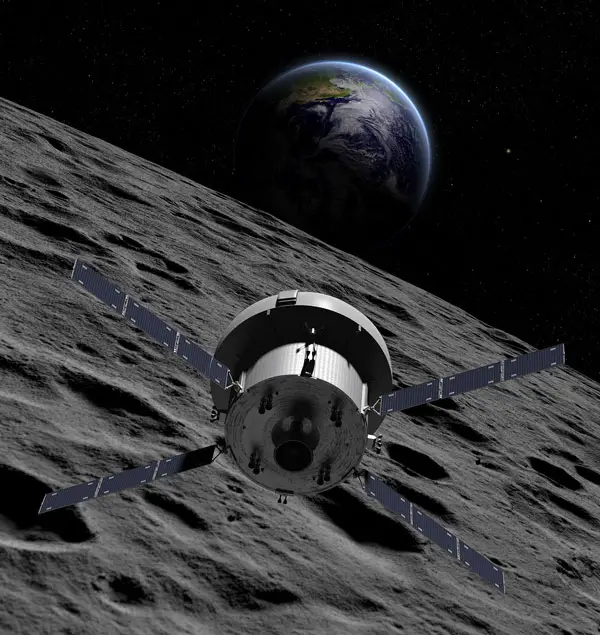
Artemis 2 in 2024. Credit: NASA
Italy hosts the Winter Olympics
The 2026 Winter Olympics take place from 6th February to 22nd February 2026, in the Italian cities of Milan and Cortina d'Ampezzo. Italy had beaten another joint bid from Swedish cities Stockholm–Åre, by 47–34 votes, at the 134th Session of the International Olympic Committee (IOC) held in Lausanne, Switzerland, on 24th June 2019. This marks the fourth time that the Olympic Games have been won by Italy, the first time they are hosted in Milan, and is also the first Olympic Games featuring two host cities in its name. It occurs on the 20th anniversary of the 2006 Winter Olympics in Turin and the 70th anniversary of the 1956 Winter Olympics in Cortina d'Ampezzo.

Construction of the Sagrada Família is complete
The Sagrada Família is a massive, privately-funded Roman Catholic church that has been under construction in Barcelona since 1882. Considered the masterwork of renowned Spanish architect Antoni Gaudí (1852–1926), the project's vast scale and idiosyncratic design have made it one of Spain's top tourist attractions, visited by millions of people each year. Construction of the building is finally completed this year, the 100th anniversary of Gaudí's death.*
Robotic hands nearing human capabilities
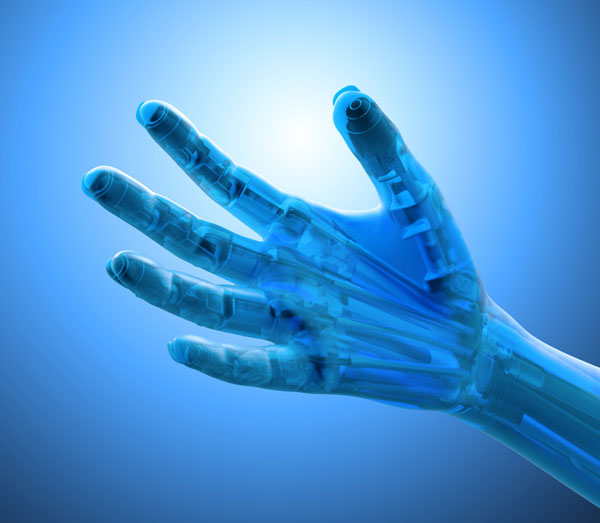
In recent years, advances in artificial intelligence, sensing, and bio-inspired engineering have opened new possibilities for machines operating in homes, hospitals and workplaces. One of the most challenging areas in robotics has been reliable object manipulation. Industrial robots mastered repetitive tasks decades ago, but unstructured, real-world environments demand far greater adaptability. Everyday objects vary in size, shape, texture, rigidity and weight, requiring continuous adjustment rather than pre-programmed motions.
Robotic hands in the 2010s demonstrated increasingly sophisticated feats: picking up fragile items, catching thrown objects, folding laundry, pouring drinks and preparing simple meals. Yet true human-level dexterity remained elusive. The human hand combines more than twenty degrees of freedom, dense networks of tactile receptors and seamless coordination with vision and cognition. Mechanical constraints, limited sensing and rigid control systems prevented earlier robots from fully replicating this capability.
By the mid-2020s, however, substantial progress has narrowed the gap.** New multi-fingered robotic hands incorporate high-resolution tactile "skin" with thousands of sensing elements, allowing machines to detect slip, pressure distribution and surface texture in real time. Flexible electronics, improved actuators and lightweight materials enable smoother and more compliant motion. Advances in machine learning allow robots to combine vision and touch, training on large datasets to refine grip strategies and perform complex in-hand manipulation tasks. In laboratory settings, some systems now demonstrate dexterity approaching that of a human hand across carefully selected tasks.
Despite this progress, challenges remain. Robots still struggle with highly deformable objects such as cables, fabrics and irregular organic materials, and reliability outside controlled conditions is limited. Nevertheless, the convergence of tactile sensing, improved hardware and AI-driven control is marking a decisive shift. Robotic hands are no longer confined to rigid industrial routines but are becoming adaptable tools capable of nuanced interaction. As these systems mature through the late 2020s and early 2030s, they play a central role in enabling more capable humanoid robots and service machines, expanding the range of tasks that automated systems can perform safely alongside humans.
The FIFA World Cup is hosted jointly in Canada, Mexico and the United States
The 23rd FIFA World Cup, held in the summer of 2026, is the first tournament hosted by more than two countries. It takes place in Canada, Mexico and the United States, who won the rights to host the contest at the FIFA Congress in Moscow on 13th June 2018, beating a rival bid from Morocco. The 2026 tournament is the biggest World Cup ever held, after FIFA approved an expansion from 32 teams to 48. A total of 80 matches are played – 60 in the US (including all eight matches from the quarter-finals onward), while Canada and Mexico host 10 matches each. The final takes place at the 85,000-capacity MetLife Stadium in East Rutherford, New Jersey.*

United States Semiquincentennial
4 July 2026 marks the 250th anniversary of the United States Declaration of Independence, a milestone known as the Semiquincentennial.* Celebrations and commemorative events are organised nationwide, with public programming, exhibitions, parades and cultural activities designed to honour the nation's history and achievements. The United States Semiquincentennial Commission, established by Congress in 2016 and supported by initiatives such as America250, continues to coordinate festivities in historic locations including Boston, Philadelphia, New York and Charleston, alongside local and state celebrations.
Federal legislation authorises the issuance of special commemorative coins and postage, and a series of redesigned circulating coins for 2026 highlights the Semiquincentennial era. Various organisations, museums, and cultural institutions organise exhibitions, educational programmes, and public engagement initiatives highlighting the nation's founding and evolution.
Living-history and Revolutionary War reenactment events are held in key regions, with community and historical organisations staging dramatic portrayals of episodes such as Washington's crossing of the Delaware as part of America250 programming.
The anniversary unfolds amid broader political and cultural debates over national identity and historical interpretation. Separate initiatives such as the presidential Freedom 250 campaign and the White House Task Force on Celebrating America's 250th Birthday reflect differing visions for the celebration, and public discussions continue over how history is presented in public spaces and popular narratives.
The Semiquincentennial follows the Bicentennial of 1976 and is, itself, followed by the Tricentennial of 4th July 2076.

Declaration of Independence, by John Trumbull
A quantum computer with 10,000+ qubits
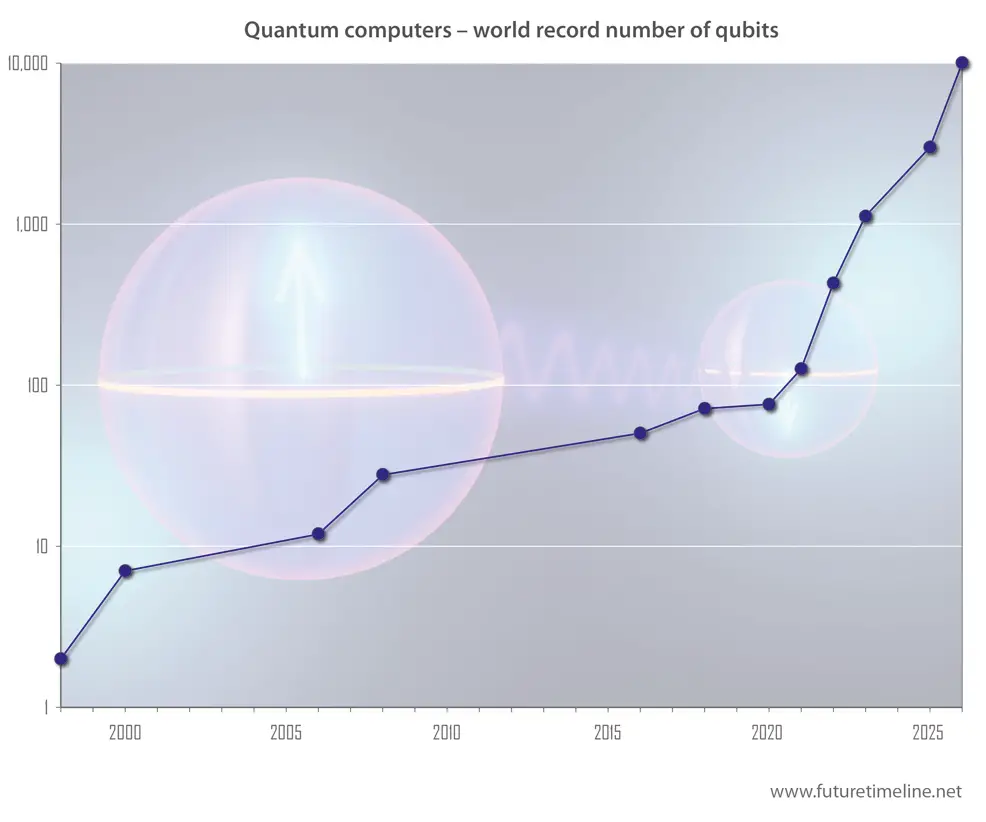
This year sees the deployment of the first quantum computer to break the 10,000-qubit barrier.* Quantum computers are a relatively new and emerging alternative to traditional or "classical" computing, able to perform calculations of truly astronomical size and complexity. These numbers are many orders of magnitude higher than allowed by classical computing and would otherwise take billions of years for even the world's fastest supercomputers to work with.
Quantum computers achieve this feat by using quantum bits (qubits), the quantum equivalent of bits, which take advantage of a strange physical phenomenon known as superposition. Unlike the much simpler bits of classical computing, which are limited to binary states of either one (1) or zero (0), qubits can have multiple values simultaneously. By combining more and more qubits together, this creates an exponential cascade of branching possibilities, allowing countless solutions to be explored in parallel.
To maintain the delicate state of superposition, however, quantum computers must be kept under extreme conditions. This includes operating them within environments that are meticulously isolated from all forms of external interference, such as electromagnetic fields, vibrations, and temperature fluctuations. Specifically, these machines often require cooling to near absolute zero (-273.15°C or -459.67°F), the point at which atomic activity nearly ceases, to keep the integrity of the qubits' quantum states. Such conditions are critical to prevent decoherence, a process where the quantum states of the qubits are disrupted by the environment and lose their quantum properties, effectively rendering the calculation process ineffective.
For the first two decades of the 21st century, progress in boosting qubit numbers had been somewhat slow, in part due to the difficulty in preserving the coherence needed for superposition. But new techniques developed in the 2020s enabled quantum computing to reach an inflection point, with a rapid scaling up. IBM, for example, announced a 127-qubit processor called "Eagle" in 2021, followed soon afterwards by a 256-qubit device from Boston-based startup QuEra and even larger systems over the next few years. IBM debuted "Condor", its first processor to feature 1,000+ qubits, at the end of 2023.
These efforts are dwarfed by a 10,000+ qubit machine developed in 2026, the most powerful quantum computer ever built. The order of magnitude increase in qubit count is accompanied by 100 logical qubits. These are error-corrected qubits with fidelities exceeding physical qubits. Unlike their physical counterparts, which are individual qubits prone to errors from decoherence and other quantum noise, logical qubits are formed by encoding the quantum information of whole clusters of physical qubits into a single, fault-tolerant unit.
By grouping multiple physical qubits to form one logical qubit, more complex and lengthy calculations are possible with a greatly reduced error rate. The 100 logical qubits of this new machine are stable and reliable enough to solve real-world problems with unprecedented precision and efficiency, beyond the reach of classical computers and the earlier generations of quantum machines. This will soon lead to the discovery of new drugs, chemicals, and materials, for example, while transforming cryptography and improving the accuracy of models and simulations in fields such as climate change.
Until recently, the number of physical qubits had been the prime consideration for evaluating a quantum computer's performance. But with deep logical circuits demonstrated by this machine, alongside rival efforts of this time, physical qubits are becoming less important, with attention and focus now increasingly shifted to logical, error-corrected qubits.*
50TB hard drives
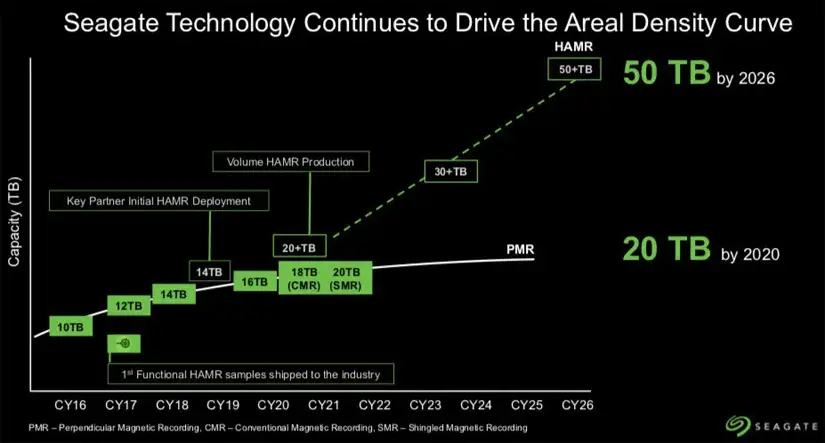
During the 2010s, solid state drives (SSDs) became the preferred choice for running computer operating systems and applications, due to their much greater speed than traditional spinning hard drives. However, the latter still had a role to play in archiving/backups and general storage. As such, they did not disappear and continued to form a part of computing ecosystems. Ongoing research and development led to huge capacities, with 20 terabytes (TB) emerging by the start of the next decade, based on shingled magnetic recording (SMR) technology.
An even greater innovation – heat assisted magnetic recording (HAMR) – boosted capacities still further. This technology involved tiny spots on the drive platter being heated to 450°C (842°F) and then cooled back down to room temperature in less than a nanosecond.* During this process, the spots would become more receptive to magnetic effects, allowing data to be written to much smaller spaces than with conventional magnetic recording (CMR). Additionally, new drives with multiple actuators enabled the vast volumes of data to be read at speeds matching or exceeding current HDDs, making them practical for everyday use.
Initially starting with around 20TB, these new HAMR drives quickly expanded in capacity over the next several years, reaching 50TB by 2026.* Although the gap is closing in terms of worldwide byte shipments, conventional hard drives continue to lead over SSDs for some time to come, thanks to their affordability and greater capacities. The global "datasphere", or the amount of digital data worldwide, has increased from 33 zettabytes in 2018 to over 200 zettabytes by 2026 and continues to grow exponentially.*
BepiColombo arrives in orbit around Mercury
BepiColombo is a joint mission between the European and Japanese space agencies. It is only the third mission to study Mercury at close range and only the second to enter into orbit around the planet. Consisting of a rocket component and two science probes, the mission performs a total of nine flybys around Earth, Venus and Mercury before orbital insertion in November 2026.* It is the most comprehensive on-location study of Mercury ever performed, with 12 specific objectives:
- What can be learned from Mercury about the composition of the solar nebula and the formation of the planetary system?
- Why is Mercury's normalised density markedly higher than that of all other terrestrial planets, Moon included?
- Is the core of Mercury liquid or solid?
- Is Mercury tectonically active today?
- Why does such a small planet possess an intrinsic magnetic field, while Venus, Mars and the Moon do not have any?
- Why do spectroscopic observations not reveal the presence of any iron, while this element is supposedly the major constituent of Mercury?
- Do the permanently shadowed craters of the polar regions contain sulphur or water ice?
- Is the unseen hemisphere of Mercury markedly different from that imaged by Mariner 10?
- What are the production mechanisms of the exosphere?
- In the absence of any ionosphere, how does the magnetic field interact with the solar wind?
- Is Mercury's magnetised environment characterised by features reminiscent of aurorae, radiation belts and magnetospheric substorms observed at Earth?
- Since the advance of Mercury's perihelion was explained in terms of space-time curvature, can we take advantage of the proximity of the Sun to test general relativity with improved accuracy?
The European contribution, Mercury Planetary Orbiter (MPO), studies the surface and internal composition, while the Japanese probe, known as the Mercury Magnetosphere Orbiter (MMO), analyses the magnetosphere and atmosphere. A new form of ion engine is used for the propulsion system. BepiColombo was originally planned for a 2014 launch with 2020 arrival at Mercury, but faced a number of delays. The mission concludes in 2029.
Hydrogen-based steelmaking reaches industrial scale
Hydrogen-based steel production is now advancing beyond pilot and early demonstration projects into industrial-scale deployment, as companies bring the first commercial greenfield facilities and other first-of-a-kind plants into operation. Together, these developments mark a significant step toward decarbonising one of the world's most carbon-intensive industries.
In Boden, northern Sweden, Stegra is building what it describes as the world's first large-scale, fully integrated greenfield steel plant designed from the outset to operate using green hydrogen rather than coal. Scheduled to begin production in 2026,* it uses renewable electricity to power large electrolysers that generate hydrogen for direct iron reduction, followed by steelmaking in electric arc furnaces.* Compared with conventional blast furnace routes, this process reduces carbon dioxide emissions from iron reduction by more than 95%, with overall emissions falling by 80–90% relative to traditional integrated steel plants.
Stegra, founded in 2020, had originally been named H2 Green Steel before rebranding itself. The company secured €6.5 billion in financing, which included over €300 million from the European Investment Bank, along with permits for a large greenfield development aimed explicitly at industrial-scale output rather than demonstration volumes. Construction began in 2022, with major civil works and installation of core process units progressing over the next few years. Long-term offtake agreements with European customers in sectors such as automotive and construction support the project, positioning the Boden plant as one of the first explicitly commercial hydrogen-based steelmaking facilities.
Alongside this greenfield approach, another initiative called HYBRIT (Hydrogen Breakthrough Ironmaking Technology) – also in Sweden – continues to develop hydrogen-based steelmaking through pilot and demonstration projects focused on replacing coal in existing supply chains. By the mid-2020s, HYBRIT's pilot plant in Luleå had produced more than 5,000 tonnes of hydrogen-reduced sponge iron, achieving metallisation levels of 99% and demonstrating improved handling and aging characteristics compared with blast furnace iron. These results validated hydrogen direct reduction under real operating conditions and laid the groundwork for larger-scale deployment.
In 2026, HYBRIT moves into a new phase as a first-of-a-kind plant in Gällivare, Sweden, is scheduled to begin operations.* This facility aims to produce around 1.2 million tonnes of hydrogen-reduced sponge iron per year once fully ramped, supported by a large electrolyser with a capacity in the region of 500 MW. Although the project retains its demonstration status, it operates at an industrial scale and aims to supply fossil-free iron to downstream electric arc furnaces, where it is then melted and converted into finished steel. This enables the gradual replacement of coal-based iron in the operations of global steelmaker SSAB, among other companies.
Looking toward the end of the decade, both initiatives outline major expansion plans. Stegra targets annual production of 5 million tonnes of green steel by 2030, while HYBRIT plans to scale hydrogen-reduced sponge iron output at Gällivare to about 2.7 million tonnes per year by the same date. Together, these trajectories represent the opening phase of a much broader transition, as hydrogen-based steelmaking begins to move from early industrial deployment toward wider commercial adoption in countries around the world.

Grand Theft Auto VI is launched
In November 2026,* Rockstar Games launches Grand Theft Auto VI (GTA 6), arguably the most highly-anticipated video game of the last 10 years. Building upon the monumental success of GTA 5 – which became the second best-selling game of all time, behind only Minecraft – GTA 6 introduces groundbreaking new features that elevate the open-world genre to new heights.
Set in the reimagined Vice City (a fictionalised version of Miami), the game offers an expansive and immersive environment. Players can explore a dynamic world with unprecedented interactivity, which includes the ability to enter approximately 40% of buildings and experience advanced destruction physics in 60% of smaller structures. This level of detail, combined with a map surpassing GTA 5 in both size and diversity, creates a more realistic and engaging experience than even the likes of Red Dead Redemption 2, enhancing the series' hallmark of open-world freedom.
GTA 6 introduces two protagonists, Jason and Lucia, whose intertwined narratives provide a fresh perspective on the franchise's storytelling. As with previous titles in the series, gameplay revolves around a mix of high-stakes robberies, intense combat scenarios, strategic meetings, and a variety of missions that blend action, stealth, and exploration.
The launch of GTA 6 – initially on the PlayStation 5 and Xbox Series X/S – not only continues the legacy of its predecessor but also sets new standards in the gaming industry. With its innovative features, expansive world-building, and truly next-generation graphics, it once again redefines player expectations and solidifies Rockstar Games' position at the forefront of interactive entertainment.
« 2025 |
⇡ Back to top ⇡ |
2027 » |
If you enjoy our content, please consider sharing it:
References
1 Japan to Delay Mars Moon Exploration by 2 Years to 2026, The Japan News:
https://japannews.yomiuri.co.jp/science-nature/science/20231206-154061/
Accessed 21st January 2024.
2 MMX - Martian Moons eXploration, JAXA:
https://www.mmx.jaxa.jp/en/
Accessed 21st January 2024.
3 "Polymarket odds for Elon Musk trillionaire before 2027 have risen to 72%."
See Beyond Rockefeller: Polymarket Traders Bet SpaceX IPO Will Make Elon Musk The Richest Human In History And First Trillionaire, Benzinga:
https://www.benzinga.com/markets/prediction-markets/26/02/50462366/
Accessed 6th February 2026.
4 The world's first trillionaire is coming. Here's what it will mean, Quartz:
https://qz.com/first-trillionaire-elon-musk-jeff-bezos-jensen-huang-net-worth
Accessed 6th February 2026.
5 Bloomberg Billionaire's Index - Elon Musk, Bloomberg:
https://www.bloomberg.com/billionaires/profiles/elon-r-musk/
Accessed 6th February 2026.
6 Article from 2014.
World could see first trillionaire in 25 years, The Telegraph:
https://www.telegraph.co.uk/finance/10808915/World-could-see-first-trillionaire-in-25-years.html
Accessed 6th February 2026.
7 Artemis II, Wikipedia:
https://en.wikipedia.org/wiki/Artemis_II
Accessed 26th December 2024.
8 Sagrada
Família, Wikipedia:
http://en.wikipedia.org/wiki/Sagrada_Fam%C3%ADlia
Accessed 15th August 2010.
9 Robot hands with human capabilities, ARIA:
https://aria.org.uk/insights/robot-hands-with-human-capabilities/
Accessed 14th February 2026.
10 Embedding high-resolution touch across robotic hands enables adaptive human-like grasping, Nature:
https://www.nature.com/articles/s42256-025-01053-3
Accessed 14th February 2026.
11 World Cup 2026: Canada, US & Mexico joint bid wins right to host tournament, BBC:
https://www.bbc.co.uk/sport/football/44464913
Accessed 13th June 2018.
12 United States Semiquincentennial, Wikipedia:
https://en.wikipedia.org/wiki/United_States_Semiquincentennial
Accessed 18th February 2026.
13 QuEra Computing Releases a Groundbreaking Roadmap for Advanced Error-Corrected Quantum Computers, Pioneering the Next Frontier in Quantum Innovation, QuEra:
https://www.quera.com/press-releases/quera-computing
Accessed 10th February 2024.
14 Error-Corrected Computers, QuEra:
https://www.quera.com/qec
Accessed 10th February 2024.
15 HAMR | Creating the Future, YouTube:
https://www.youtube.com/watch?v=aUHAd36BDTc
Accessed 9th December 2019.
16 Seagate is planning 50TB drives for 2026, The Tech Report:
https://techreport.com/news/3466913/seagate-50tb-hard-drive-roadmap/
Accessed 9th December 2019.
17 Are Hard Drives DISAPPEARING?, YouTube:
https://www.youtube.com/watch?v=7Ue0J-4qxDM
Accessed 9th December 2019.
18 BepiColombo, Wikipedia:
https://en.wikipedia.org/wiki/BepiColombo
Accessed 26th December 2024.
19 "Stegra's first steel production lines will go live in 2026 using recycled steel scrap as raw material, with green hydrogen-based iron and steelmaking beginning shortly thereafter..."
See Stegra's green hydrogen plant takes shape in Boden, Stegra:
https://stegra.com/news-and-stories/green-hydrogen-plant-takes-shape
Accessed 5th January 2026.
20 €3.5 billion "green steel" project to go ahead, Future Timeline Blog:
https://futuretimeline.net/blog/2022/11/4-green-steel-future-technology.htm
Accessed 5th January 2026.
21 Goodbye, Coal! This Project Makes Steel With Green Hydrogen, SNEC H2+:
https://www.snec-h2.com/article/goodbye-coal-this-project-makes-steel-with-green-hydrogen
Accessed 5th January 2026.
22 Grand Theft Auto VI, Wikipedia:
https://en.wikipedia.org/wiki/Grand_Theft_Auto_VI
Accessed 12th February 2026.
 |
|||||||||||||||||||||||||||||||
|
Latest predictions |
Timeline » 21st century |
Blogs » AI & Robotics |
Features » |
About us
|
|||||||||||||||||||||||||||
|
|
|||||||||||||||||||||||||||||||


