![[+]](https://www.futuretimeline.net/images/buttons/expand-symbol.gif)
|
|
|
|
|
|
2070
Islam is the world's dominant religion
By 2070, Islam has overtaken Christianity to become the dominant religion.* More than a quarter of the world's population was Muslim by the 2020s* and this growth continued in subsequent decades. Most of the increase has occurred in sub-Saharan Africa with its high fertility rates, although these are beginning to stabilise now.* While the numbers of non-religious have continued to increase, when measured as a percentage of the global population their share has declined from 16.4% in 2010, to 13.2% in 2050 and less than 12% in 2070. Christians and Muslims each comprise about 32.3% by 2070, with Christians set to reach 33.8% and Muslims 34.9% by 2100.* India has overtaken Indonesia as the country with the largest number of Muslims – though India's even larger population of Hindus continue to outnumber Muslims in the region.*

© Aiconimage | Dreamstime.com
Fusion power is widespread
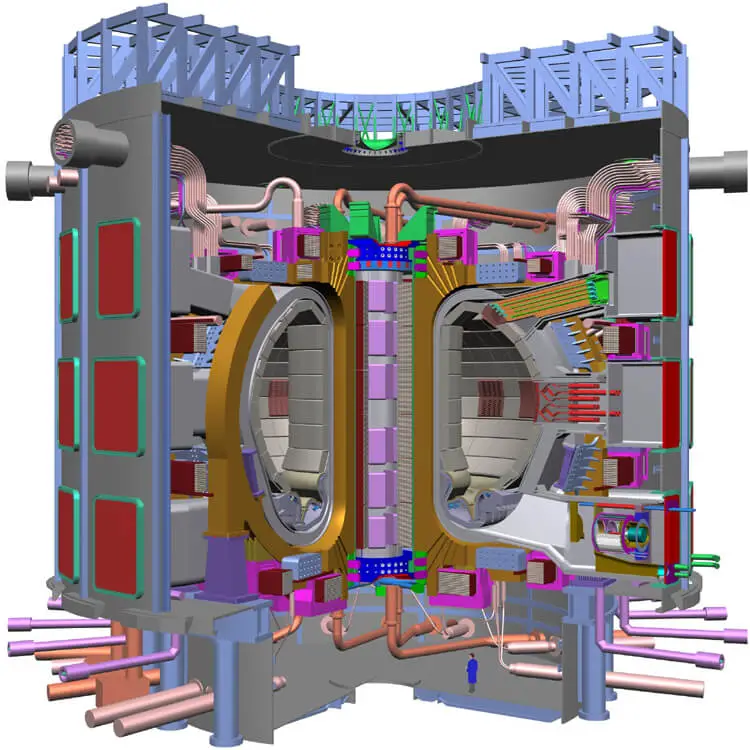
Most leading countries now have at least one fusion plant either commercially operational, or in the process of construction.* These reactors offer a clean, safe and abundant supply of energy.
Fully automated homes
Buildings in developed nations have become highly automated and self-sufficient. In addition to robots, a typical new home now includes the following:
A localised power supply. Energy can be generated by the building itself, via a combination of photovoltaics and piezoelectric materials. Walls, roofs and windows can absorb almost all wavelengths of light from the Sun with organic solar technology, turning it into heat and electricity. Friction generated by the occupant's footsteps – and various other kinetic processes – can also produce energy. This is converted and stored in any number of ways, from hydrogen to batteries. In countries where sunlight is less frequent, microturbines may be used in place of solar.
On-site water production and waste management. Rain is captured by external guttering, then stored and converted into drinking water using nanofiltration systems. This is especially useful in regions prone to drought (which includes a substantial portion of the world by this time). If local water is in short supply, houses can serve as miniature reservoirs and filtration systems. Meanwhile, plastics and other kitchen waste can be placed in recycling machines, ground into extremely fine powder, then later re-used in nanofabricators.
A multi-layered building envelope which provides a variety of dynamic effects. Windows can self-adjust their size and position – as well as their opacity – to optimise the level of natural light. In some of the more upmarket properties, the entire façade can morph its texture and appearance. Depending on the tastes of the occupant, this could transform into an art deco style, a classic Victorian building, or something entirely different. This form of "programmable matter" can even be designed by the occupant themselves and changed on demand.
Air purification systems. Air within the home is kept fresh, purified and completely free of dust and microbes.
Interactive surfaces. Holographic generators cover the whole interior of the property – including walls, doors, worktop surfaces, mirrors and shower cubicles. These intelligent surfaces can track the position of the occupant and display information whenever and wherever necessary. A person can read emails, see news reports and access the online world using virtually any surface in the house as a touch screen or mind control interface.* Detailed, real-time information on their health, personal lifestyle and daily schedules can also be displayed. This system has a variety of other functions, e.g. it can be used to locate personal items which may have been misplaced.
Intelligent/self-maintaining appliances. Appliances that don't repair or maintain themselves in some way have become largely obsolete by now. It is very rare for a human engineer to be called to the house.
A modest size. The world is becoming an ever more crowded place, with available land continuing to shrink due to overpopulation and environmental decline. In city centres, apartments tend to be highly minimalist and compact, with small footprints utilising every inch of space. Full immersion virtual reality is one method of adapting to this. Another is flexible room layouts that reconfigure themselves on demand. In earlier decades, this was achieved in some homes by using a sliding wall system.* Today, it can be done with morphable materials.

2072
Advanced nanotech clothing
Decades have now passed since the first appearance of nanotech clothing. During that time it has made extraordinary improvements in utility, power and sophistication. Modern fabrics have built upon the abilities of previous generations, perfecting many of the technologies involved. Today, a complex blend of nanotechnology, biotechnology, claytronics, metamaterials and other components has yielded a type of clothing previously confined to the realm of science fiction. Though mostly restricted to specialised personnel, government forces and elites, a number of these suits are finding their way into the mainstream.
Construction via self-assembling nanotechnology has been around for a number of decades. Until now, the process was only practical using bulky and/or conspicuous machinery, nanofabricators, or objects suspended in tanks of catalytic fluids.* However, recent advances in nanorobotics have allowed for more subtle and rapid construction of macro-scale objects in a more compact form-factor and with less impact on Earth's natural resources. As happened with early nanotech adoption in the 2020s, one of the easiest and most common applications has been in fabrics. Today, a high-end home "closet" may consist of simply a thin surface or pad built into the wall or floor, concealing a mass of nanobots and molecular building materials. A user can stand on or touch this surface and issue instructions to the machine (through voice command or virtual telepathy) for what to create. Each nanobot is then programmed with the final clothing design and set into motion.
The process begins with each nanobot organising and categorising each building molecule, based on the aggregate material needed and where each piece will be located in the finished product. The nanobots – also called "foglets" – then begin interlocking with themselves, forming a basic "skeleton" on which building molecules can be attached.*
As more and more nanobots and molecules are added on, thousands of individual fibres begin to form out of the machine's surface. These grow up and around the person's body, crossing each other to create a weave pattern, before finally taking the shape of traditional clothing. The result is a basic structure around which nanobots then construct the more advanced and customised features. Depending on the outfit's function, the original fibres can be interlaced with photovoltaics, piezoelectric nanowire, carbon nanotubes, metamaterials, claytronics or any number of other useful materials. Tiny electronic devices can be added for communication or medical purposes. This whole process is completed in a matter of seconds.
With such detail and control, fabric of this nature confers the wearer an array of conveniences. In earlier decades, this technology was limited to relatively simple functions, like colour and texture modifications.* Today, it is almost indistinguishable from magic. Complete wardrobes are no longer necessary, since one garment performs the function of many, transforming into an endless variety of styles and shapes. Most outfits are self-cleaning, self-fragrancing and rarely if ever need to be washed.** They can instantly adjust themselves in emergencies – becoming harder than steel to stop a knife or bullet; cushion-like in the event of accidents or falls. If a person is injured, the fabric can administer life-saving drugs and medical nanobots, or contract to seal a wound.* A drowning person can be made safe. Fire-fighters and other rescue workers are completely protected from hazards such as fire or radiation. This is also useful in space, protecting people from sudden changes in air pressure, micrometeorites, cosmic rays and other hazards. Medical devices included in these outfits monitor for disease at all times, catching the earliest signs of cancer or infection and alerting the wearer before any damage is done.* Whatever power is needed for the various functions is supplied by a combination of piezoelectric and photovoltaic components embedded throughout the clothing material.
Some of these aforementioned comforts had already been available in earlier decades, but were simpler and fewer – usually limited to just one, or a small number within each item of clothing. Today, however, all of them can be fully integrated and combined together into a single suit, created and maintained via swarms of intelligent foglets. As this technology evolves further, it becomes a permanent part of some peoples' physiology, almost like a second skin.*
Click to view animation

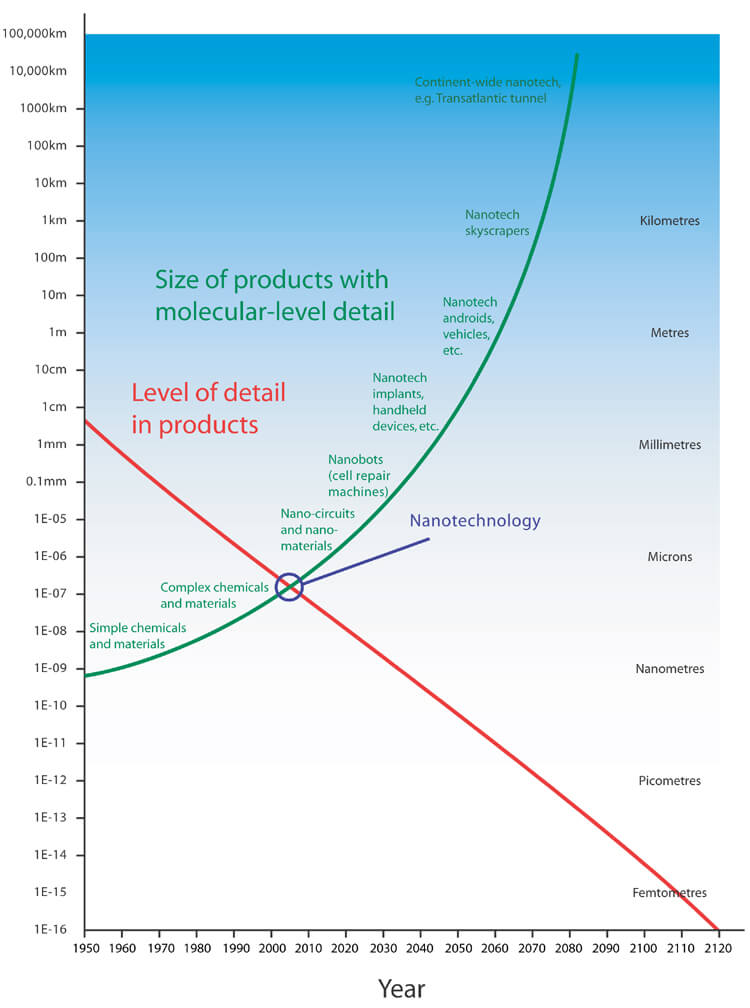
Picotechnology is becoming practical
Technology on the scale of trillionths of a metre (10-12) is becoming practical now.* Known as "picotechnology", this is orders of magnitude smaller than nanotechnology of earlier decades.* Among other applications, it allows the structure and properties of individual atoms to be altered via manipulation of energy states within electrons. This can produce metastable states with highly unusual properties, creating new and exotic forms of matter.

2073
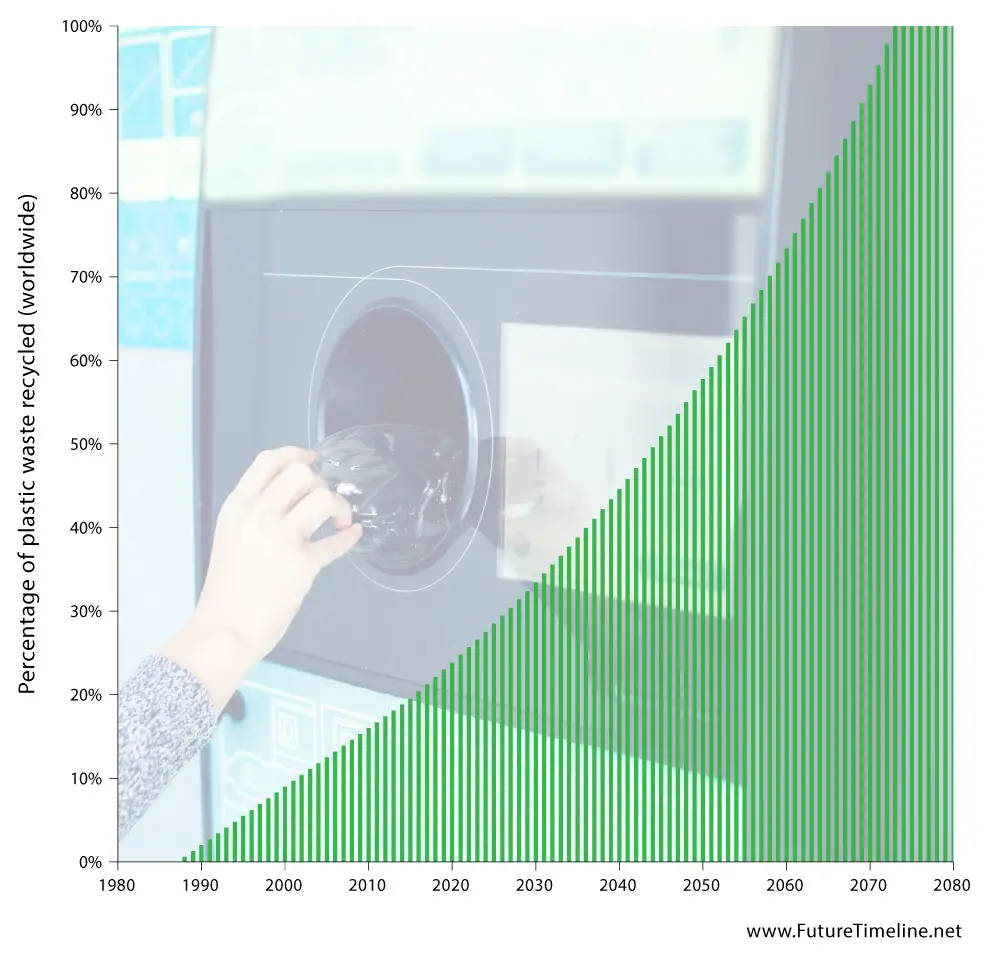
Plastic recycling rates are approaching 100% worldwide
By the early 2070s, plastic recycling is ubiquitous globally. Although some of the most rural and isolated areas still lack the required infrastructure and facilities, they now represent a negligible percentage.
Belgian chemist Leo Baekeland invented the world's first synthetic plastic, Bakelite, in 1907. Improvements in chemical technology led to an explosion of new types of plastic, with mainstream adoption beginning in the 1940s and 50s. Production expanded at a phenomenal rate during the second half of the 20th century – from two million tons annually in 1950, to more than 200 million tons each year by 2000. With no end in sight to this upward trajectory and in light of concerns over its slow decomposition after disposal, as well as its toxicity, recycling emerged as a solution from the 1980s onwards. This was more environmentally friendly than incineration, or waste-to-energy methods, which had also begun some years before.
However, even with both recycling and waste-to-energy systems in place, handling the mountains of plastic waste generated each year was proving to be a formidable challenge. Researchers noted the appearance of a "Great Pacific garbage patch", a gyre of marine debris in the north central Pacific Ocean estimated to contain over 1.8 trillion plastic fragments. By the early 21st century, this was having a substantial impact on seabirds, fish and other life in the food chain with implications for human health too. In 2019, plastic even appeared at the bottom of the Mariana Trench, during a deep ocean expedition. Scientists calculated that plastic waste could exceed fish biomass by 2050, unless major international efforts reversed this trend.
More ominously, plastic pollution was found to harm the growth, photosynthesis and oxygen production of Prochlorococcus – the ocean's most abundant photosynthetic bacteria – responsible for 10% of oxygen breathed by humans.
This bleak picture was reinforced by wildlife television documentaries, such as those narrated by the popular naturalist David Attenborough, broadcasting the uncomfortable reality to millions of viewers. The public was becoming more and more awake to the scale and urgency of this crisis.
Recycling proved to be surprisingly popular, with a growing number of countries willing to introduce policies. In addition to routine collections of household waste by local governments, more ambitious measures were being adopted at regional and national levels. Gradually, the percentage of discarded plastic began to fall, while the recycled proportion increased. This trend continued through the 21st century.*
Japan was among the world leaders in plastic recycling. Its plastic waste utilisation rate increased from 39% in 1996, to 73% in 2006 and then 90% by the end of the 2010s. This figure approached 100% by the mid-2020s, making Japan one of the first nations to recycle essentially all of its plastic waste. Key to Japan's success was the passing of several recycling laws from the late 1990s onwards, mandating businesses and consumers to separate plastic waste, along with public awareness and education campaigns on the benefits of recycling. This occurred in response to a shortage of landfill space, with Japan being a relatively crowded nation of high population density. New technology also helped to convert an increasingly wide range of waste products into reusable items, such as PET bottles.
European Union (EU) member states were making progress too, with more than 40% of their plastic packaging waste recycled in 2016, easily surpassing the EU's minimum target of 22.5%. Among EU member states, the Czech Republic ranked on the top with a recycling rate of 51% in 2014, followed closely by Germany, the Netherlands, Sweden and Ireland. The European Circular Economy Package (CEP) targets were set at 50% by 2025 and 55% by 2030 – alongside a goal of 100% for packaging, specifically – with a ban on various other single-use products made of plastic where alternatives existed.*
In the UK, charges were introduced for plastic carrier bags, leading to a nearly 90% drop in single-use bags. The manufacture and sale of cosmetics and personal care products with microbeads (solid plastic particles of less than a millimetre in their largest dimension) was banned, followed by plastic straws and cotton buds. Dozens of companies, including supermarket giant Asda, signed up to the UK Plastics Pact aiming to cut plastic pollution by 2025. Meanwhile, the government pledged to eradicate all "avoidable" plastic waste throughout the country by 2042.*
In the United States, no federal law existed to mandate recycling, with state and local governments introducing their own requirements. Only around 10% of plastic was recycled as of 2020, but a long-term plan by the American Chemistry Council proposed 100% of plastics packaging to be re-used, recycled or recovered by 2040. To achieve this, plastic resin producers would focus on six key areas: designing new products for greater efficiency, recycling and reuse; developing new technologies and systems for collecting, sorting, recycling and recovering materials; making it easier for more consumers to participate in recycling and recovery programs; expanding the types of plastics collected and repurposed; aligning products with key end markets; and expanding awareness that used plastics are valuable resources awaiting their next use.
With increasing pressure from both consumers and governments, hundreds of the world's leading packaging brands committed to ensure that 100% of their plastic packaging could be reused, recycled or composted by 2025.* This momentum was sustained into the 2030s and beyond, spreading to recently developed economies with higher incomes, now able to afford the necessary waste management infrastructure. Regions in Africa, the Middle East and Southeast Asia were rapidly catching up with the West, and viewed environmental protection as a higher priority than before. In the 2010s, some had already begun to turn away foreign waste shipments, dumped on them from far away.**
An increase in public recycling bins, plastic bottle banks, reverse vending machines (with voucher or cash incentives), office workplace recycling schemes and other such measures all contributed to the ongoing, upward trend in global recycling. At the same time, new production methods were allowing bioplastics to be manufactured without the need for fossil fuels and to biodegrade easily. Thanks to advances in science and technology, this was becoming possible even for some types of plastic that had traditionally been regarded as extremely difficult to break down, convert and reuse. Automation, robotics, AI and machine learning helped to improve the filtering and sorting capabilities at waste treatment plants. However, even low-tech solutions were able to combat the plastic problem: supermarkets in Thailand and Vietnam, for example, used banana leaves as a packaging alternative.* By 2050, most countries had either substantially reduced or even eliminated plastic entering landfills.
This left the problem of incineration, which had grown in parallel with recycling at a similar rate during the late 20th and early 21st century. New regulations and international treaties to restrict emissions from plastic incineration were combining with even greater improvements in waste collection and separation. This led to the percentage of recycled plastic overtaking that of incinerated material. Networks of orbiting satellites – equipped with powerful sensors and ultra-high resolution and zoom capabilities – kept a watchful eye on ground activities, to monitor emissions and ensure compliance. Gradually, plastic waste incineration disappeared from both developed and developing countries as the economic, social and environmental benefits made more and more sense.*
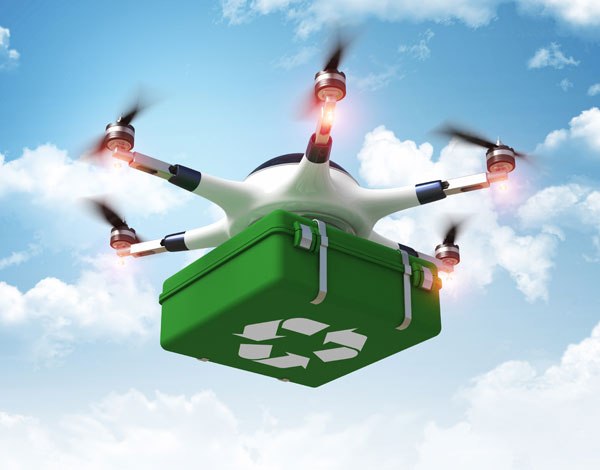
Other advances have emerged in recent years. Among them are a new generation of domestic appliances for dealing with household waste, now able to deconstruct and recycle a seemingly infinite variety of plastic products. Inexpensive, compact and easy to use, these are typically desktop machines in the same form-factor as a 3D printer, offering the dual functions of assembly and disassembly. As well as being popular in the home, they are found in many public venues and workplaces. Alongside these high-tech machines are regular drone and robotic patrols in towns and cities, which can identify and pick up discarded litter – often within a matter of minutes. The world of 2073 is a cleaner and tidier place.
Challenges remain outside human-inhabited areas, however. The world's oceans, for example, remain in a dire state, being much more difficult to access and taking longer to restore. Those fragments of plastic that lie undiscovered will persist in ecosystems for another 500 years.
2075-2080
The first space elevator is becoming operational
The idea of a space elevator had been around as early as 1895, when Russian scientist Konstantin Tsiolkovsky first explored the concept.* Inspired by the newly-built Eiffel Tower, he described a free-standing structure reaching from ground level into geostationary orbit. Rising some 36,000 km (22,000 mi) above the equator and following the direction of Earth's rotation, it would have an orbital period of exactly one day and thus be maintained in a fixed position.
A number of more detailed proposals emerged in the mid-late 20th century, as the Space Race got underway and manned trips to Earth orbit became increasingly routine. It was hoped that a space elevator could drastically reduce the cost of getting into orbit – revolutionising access to near-Earth space, the Moon, Mars and beyond. However, the upfront investment and level of technology required meant that such a project was rendered impractical for now, confining it to the realm of science fiction.
By the early decades of the 21st century, the concept was being taken more seriously, due to progress being made with carbon nanotubes. These cylindrical molecules offered ways of synthesising an ultra-strong material with sufficiently high tensile strength and sufficiently low density for the elevator cable. However, they could only be produced at extremely small scales. In 2004, the record length for a single-wall nanotube was just 4 cm. Although highly promising, further research would be needed to refine the manufacturing process.
It was not until the 2040s* that material for a practical, full-length cable became technically feasible, with the required tensile strength of 130 gigapascals (GPa). Even then, design challenges persisted – such as how to nullify dangerous vibrations in the cable, triggered by gravitational tugs from the Moon and Sun, along with pressure from gusts of solar wind.**
Major legal and financial hurdles also needed to be overcome – requiring international agreements on safety, security and compensation in the event of an accident or terrorist incident. The insurance arrangements were of particular concern, given the potential for large-scale catastrophe if something went wrong. In the interim, smaller experimental structures were built, demonstrating the basic concept at lower altitudes. These would eventually pave the way to a larger and more advanced design.
Click to enlarge
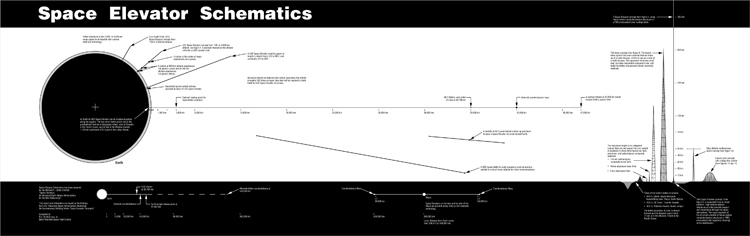
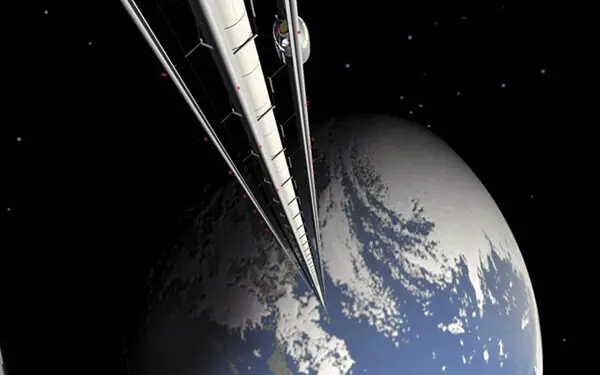
By the late 2070s,*** following 15 years of construction,* a space elevator reaching from the Earth's surface into geostationary orbit has become fully operational. The construction process involves placing a spacecraft at a fixed position – 35,786 km (22,236 mi) above the equator – then gradually extending a tether down to "grow" the cable towards Earth. It also extends upwards from this point – to over 47,000 km (29,204 mi) – a height at which objects can escape the pull of gravity altogether. A large counterweight is placed at this outer end to keep it taut. Locations that are most suitable as ground stations include French Guiana, Central Africa, Sri Lanka and Indonesia.
As with most forms of transport and infrastructure in the late 21st century, the space elevator is controlled by artificial intelligence, which constantly monitors and maintains the structure throughout. If necessary, robots can be dispatched to fix problems in the cable or other components, from ground level to the cold vacuum of space. This is rarely required, however, due to the efficiency and safety mechanisms in the design.
A major space boom is now underway, as people and cargo can be delivered to orbit at vastly reduced costs, compared with traditional launches. Over 1,000 tons of material can be lifted in a single day, greater than the weight of the International Space Station, which took over a decade to build at the start of the century.*
Although relatively slow – taking several days to fully ascend* – the ride is much smoother than conventional rockets, with no high-G forces or explosives. Upon leaving the atmosphere and reaching Low Earth Orbit, between 160 km (99 mi) and 2,000 km (1,200 mi), cargo or passengers can be transferred to enter their own orbit around Earth. Alternatively, they can be jettisoned beyond geosynchronous orbit, in craft moving at sufficient speed to escape the planet's gravity, travelling onward to more remote destinations such as the Moon or Mars.
In the decades ahead, additional space elevators become operational above Earth, the Moon, Mars and elsewhere in the Solar System,* with a considerable reduction in costs and technical risks. Construction is also made easier by lower gravity: 0.16 g for the Moon and 0.38 g on Mars. Further into the future, space elevators are rendered obsolete by teleportation and similar technologies.
2075
Conventional meat consumption is declining globally
During the early 21st century, concerns over the environmental, ethical and health impacts of conventional meat production encouraged a gradual shift in consumer attitudes. Plant-based diets became increasingly common, especially in wealthier countries, where consumers enjoyed greater access to alternatives and placed growing importance on animal welfare, climate change and personal health. Meat consumption began to stagnate across many high-income countries, while some regions experienced outright declines.
For several decades, however, rising demand elsewhere outweighed these changes. Population growth, urbanisation and increasing prosperity drove greater consumption of meat and other animal products across much of Asia, Africa and Latin America. Upper-middle-income countries accounted for much of the growth during the first half of the century, with consumption in this group reaching a peak around the middle of the century. Lower-middle-income and poorer countries continued to increase their consumption for much longer, as rising incomes made animal products affordable to hundreds of millions of additional households.
At the same time, food technology underwent a profound transformation. Plant-based meat alternatives improved steadily in taste, texture and nutritional quality, while manufacturers lowered their costs and expanded production. Fermentation technologies added another important source of protein, fats and other ingredients. Biomass fermentation supplied substantial quantities of food directly, while precision fermentation produced specialised components that improved both plant-based and cultivated products.
Cultivated meat developed more slowly at first. High production costs, difficult scale-up, regulatory barriers and limited manufacturing capacity restricted the industry during the 2020s and 2030s. By the middle decades of the 21st century, however, improvements in cell lines, growth media, bioreactors, automation and factory designs had transformed the economics of cellular agriculture. Production expanded rapidly during the following decades, as companies built increasingly large facilities across Asia, Europe, North America and other regions.
By 2075, these technologies have pushed conventional meat past a historic turning point. Conventional livestock farming now supplies only about half of global meat-equivalent consumption, compared with around 85% in 2050 and around 99% in 2025. Cultivated meat supplies close to 30% in 2075, while plant-based alternatives provide around 12% and fermentation-derived products almost 9%. The balance differs widely between countries, but the worldwide direction has become unmistakable: conventional meat consumption has peaked and now continues to fall.**
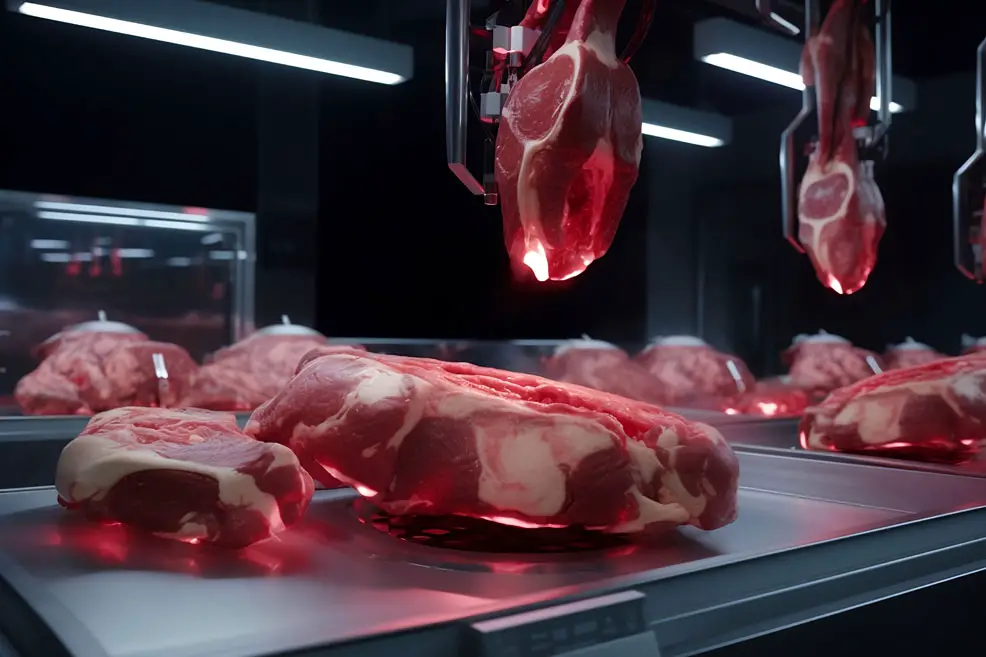
Plant-based products retain an important place in the food system. Decades of investment and technological development have given them a mature, highly scalable manufacturing base, making them particularly competitive in burgers, mince, nuggets, sausages and other processed foods. Fermentation has also established a durable role, both as a direct source of protein and as a way of producing fats, flavour compounds and other ingredients. Cultivated meat, meanwhile, increasingly appeals to consumers who want the taste, texture and nutritional qualities of animal meat without conventional livestock farming.
The spread of these technologies beyond wealthy countries is now accelerating the decline of traditional livestock agriculture globally. Falling production costs allow cultivated and fermentation-based foods to compete in large urban markets throughout Asia and Latin America, while expanding infrastructure brings them to an increasing number of African cities. In some regions, these new methods offer important advantages beyond animal welfare or climate concerns, such as reduced dependence on imported feed, lower water and land requirements, greater resilience to livestock diseases and the ability to produce food closer to major population centres.
Livestock farming nevertheless remains a vast global industry. Poultry and pork are still relatively inexpensive in many countries, while pastoralism, small farms, cultural traditions and premium markets sustain demand for conventionally produced meat. Some lower-income regions continue to increase their consumption of conventional meat and other animal products even as conventional meat consumption declines globally. This uneven transition is creating sharp contrasts between countries and regions.
The contraction of livestock farming is reshaping landscapes around the world. Farmers now require less land for grazing and feed crops, freeing much of this land for rewilding, forestry, ecosystem restoration, renewable energy and other uses. Agricultural greenhouse gas emissions have declined substantially, while pressures on freshwater supplies, forests and biodiversity are easing. The number of animals raised and slaughtered for food is falling rapidly.
These changes – while positive in many respects – have caused major economic and social disruption. Many communities that historically depended heavily on cattle, poultry and pig farming now face falling demand and declining investment. In some of the hardest-hit regions, governments and businesses support retraining, diversification and new rural industries, as farmers move into alternative-protein production, energy, forestry, environmental restoration and related sectors. Other producers focus on premium, heritage and specialist markets, where consumers continue to pay higher prices for products from particular breeds, regions or farming systems.
For the average consumer, however, the distinction between conventional and alternative meat matters less than it once did. Supermarkets, restaurants and fast-food chains offer products from several production methods, and people increasingly choose between them according to price, flavour, nutrition and convenience. Younger generations grow up with cultivated and fermentation-derived foods as ordinary parts of everyday life rather than technological novelties.
This transition continues to accelerate. In the mid-2080s, cultivated meat will overtake conventional meat as the largest single source of global meat-equivalent consumption. Livestock products continue to occupy traditional, premium and specialist niches, but the centuries-long dominance of conventional meat production has now entered a lasting decline.
The distribution of birds in the United States has been altered substantially
By 2075, environmental impacts in the United States have caused disruption to many animal species in terms of how they live, feed and breed. The habitat ranges of birds have been particularly affected. Not all of these changes have been negative, as some species have actually benefited and seen major increases in their traditional ranges. However, despite the extra room for expansion, these winners now face renewed competition and territorial contests from other species, as well as new predators.
Generally speaking, higher temperatures have pushed the overall range of species further north. Desert-dwelling birds now have increased habitat, while those preferring cold weather conditions have seen a decrease. In contrast to the broad, sweeping influence of climate change, the effects of landscape changes resulting largely from human activity have been more scattered and focussed, with a high loss of habitat at certain local and regional scales. Urban growth, deforestation, mining and other resource use has been at least as impactful on ranges as climate change.
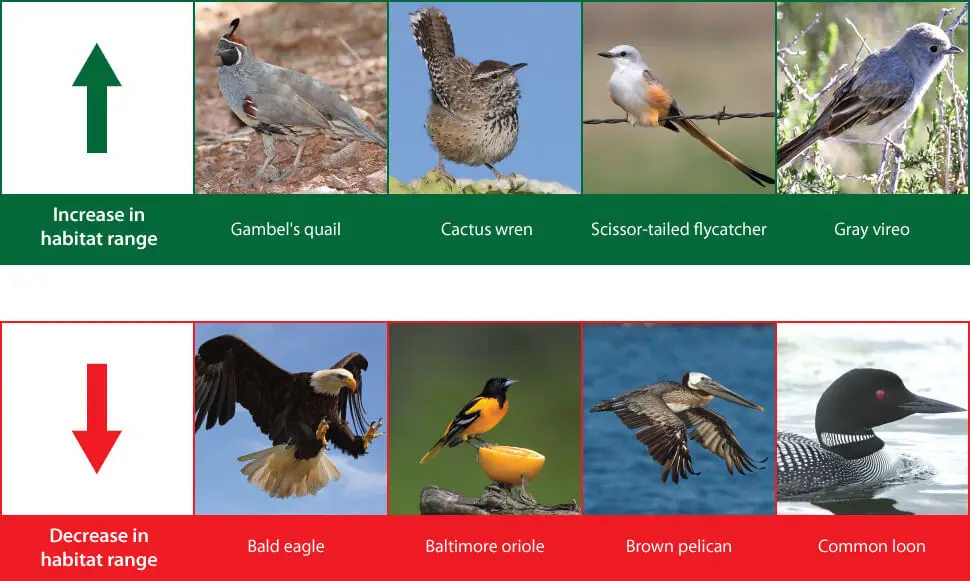
Many familiar sounds and spectacles of birds that were previously common in backyards and countryside walks have disappeared, while new and strangely unfamiliar ones have appeared to replace them. Among the bird ranges seeing the greatest expansions are those of Gambel's quail (+62%), the cactus wren (+54%), scissor-tailed flycatcher (+46%), gray vireo (+45%) and painted bunting (+39%).** Conversely, many state birds and mascots are vanishing now including the Baltimore oriole, brown pelican of Louisiana, common loon of Minnesota and others. The iconic bald eagle has lost nearly 75% of its range.*
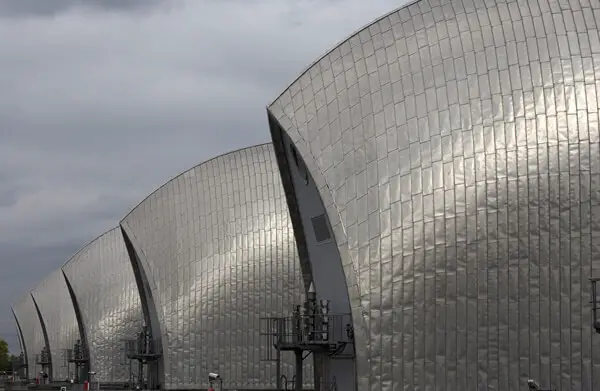
The Thames Barrier is upgraded
London is the latest of many cities to upgrade its flood defences in the wake of devastating storm surges and sea level rises.* The original barrier was raised a total of 62 times between 1983 and 2001. It was raised with increasing frequency as the decades went by. Towards the end of this century its successor will need to be raised over 200 times each and every year.*
2076
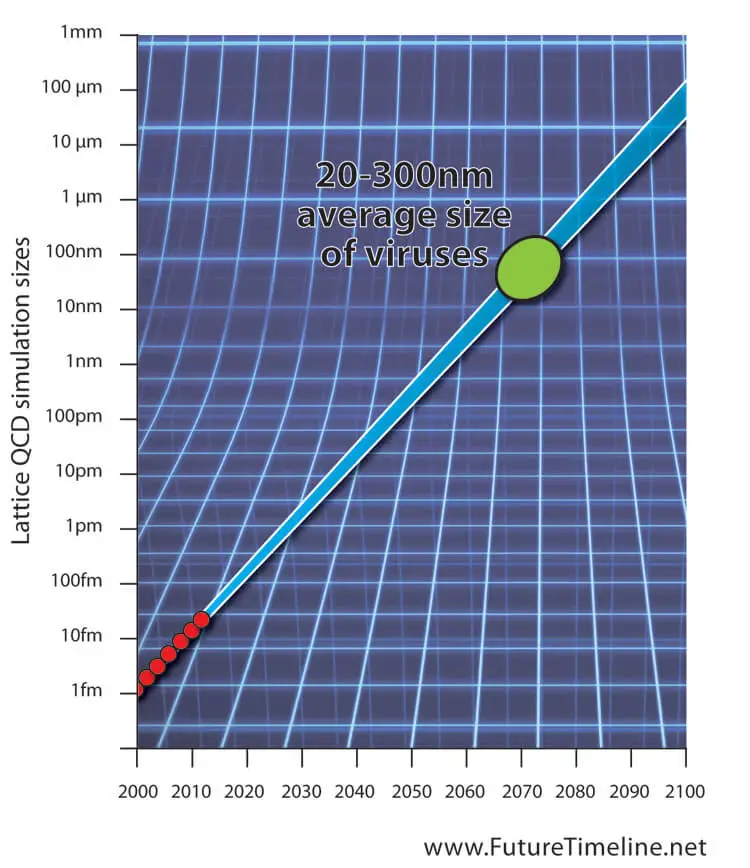
Accurate simulations of viruses
Thanks to advances in lattice quantum chromodynamics, the vast majority of viruses have now been accurately modelled and simulated down to the quantum level.* This provides what is essentially a complete picture of these tiny organisms, which average 20-300 nanometres in size, with millions of different types. As this area of science continues to advance, ever larger and more detailed simulations become possible,* providing new insights into the nature of matter.
Unmanned probes to Sedna
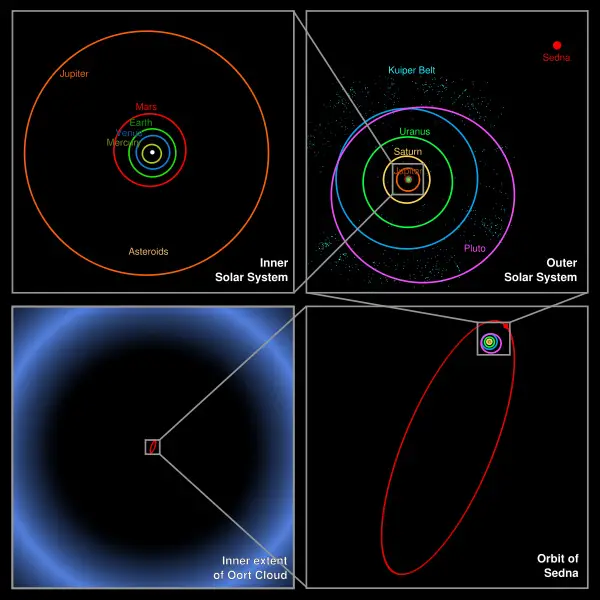
Sedna is a trans-Neptunian "dwarf planet", similar in size and composition to Pluto.* Officially announced in 2004, it became the most distant object yet observed in the Solar System, and the largest solar body to be found in over 70 years. Its orbit is highly elliptical, going from 76 AU to about 975 AU over the course of 12,000 years. In 2076, it reaches perihelion (its closest point to the Sun) and unmanned probes are sent to explore it.
2078
The world's electricity has been fully decarbonised
Electrical phenomena had been studied since antiquity, but progress in theoretical understanding remained slow until the 17th and 18th centuries. Even then, practical applications for electricity were few. It would not be until the late 19th century that engineers were finally able to put it to industrial and residential use. The rapid expansion in electrical technology at this time transformed society and was a driving force behind the Second Industrial Revolution. The extreme versatility of electricity provided an almost limitless set of applications including transport, heating, lighting, communications and computation. It became the backbone of modern industrial society.
In the late 1870s, cities began installing large-scale electric street lighting systems based on arc lamps. After the development of a practical incandescent lamp for indoor lighting, Thomas Edison switched on the world's first public electric supply utility in 1882.
Subsequent discoveries and inventions would include the first electromagnetic waves (1888), the fuse (1890), wireless telegraphy systems (1894), a radio receiver to detect lightning strikes (1894), X-Rays (1895), the first successful intercontinental telegram (1896), the first cathode ray oscilloscope (1897), fluorescent lamps (1901), diodes (1904), triodes (1906) and superconductivity (1911).
The 1920s saw rapid growth in demand for domestic applications of electricity. Public exhibitions featured "homes of the future", and in 1926, the Scottish inventor John Logie Baird gave the first demonstration of a television system in London, launching a revolution in communication and entertainment.
By the 1930s, around 50% of people in the United Kingdom and 70% in the United States had access to electricity and these figures reached almost 100% within the next 30 years. The Second World War saw tremendous advances in electronics, especially in radar and other aircraft systems.
Following the war, Bell Telephone Laboratories developed the first working transistor, in 1947. With rising household incomes, consumer devices became more and more widespread and included vacuum cleaners, refrigerators, washing machines, dishwashers, air conditioning, colour TV, hi-fi and other audio systems and latterly computers and microprocessors.
Until relatively recently in world history, humans had lived simple and slower-paced lives, in far smaller numbers. The Industrial Revolution marked the beginning of profound change, with a population explosion and previously unimaginable technology. To power the machines, vehicles, lighting and everything else transforming society required a vast amount of electricity. In the 19th and 20th centuries, the easiest and cheapest way to obtain this power was from the ancient stores of carbon-based materials that lay buried in the ground: fossil fuels.
While many different subtypes existed, fossil fuels could be generally divided into three main variants – coal, oil and gas. The first of these had been around for millennia in, for example, smelting and domestic heating, but became far more important during the Industrial Revolution with larger-scale applications. The first coal-fired power stations producing electricity for public use became operational in the 1880s. With enormous demand for electricity, and centuries' worth of mining reserves, a rush to acquire this valuable resource got underway. Likewise, oil became a major new commodity. By the 1920s, oil fields had been established in many countries including Canada, Peru, Poland, Russia, Sweden, Ukraine, the United States, and Venezuela. Natural gas, meanwhile, became more important during the second half of the 20th century.
Hydropower had been around since ancient times – as a way of grinding grain, for example. It spread to Europe in the Middle Ages and provided mechanical power for textiles and machines during the Industrial Revolution. It became a source for generating electricity in 1882 and expanded rapidly in the 20th century, with gigantic projects such as the Hoover Dam completed in 1936. Hydroelectric power reached 1,000 terawatt hours by the 1960s or about one-quarter of annual global electricity demand.
Nuclear electricity production was first demonstrated in 1948 and grew rapidly from the 1960s onward. However, accidents such as Three Mile Island (1979) and Chernobyl (1986) led to a subsequent stagnation. The economic costs of building plants led to further concerns about the risks of the industry.
With ongoing advances in science and technology, new forms of electricity production emerged. The American satellite Vanguard 1, launched in 1958, became the first man-made object in space to incorporate solar electric power, with a 0.1W panel. The energy crisis of the 1970s led to a groundswell of public interest in solar research, development and deployment.
The first wind turbine for electricity production was built by Scottish engineer James Blyth in 1887. While this renewable energy technology saw widespread adoption in some countries, such as Denmark, it remained a minor source of electricity on a global basis. However, the installed capacity began to grow exponentially in the closing years of the 20th century. Offshore wind production joined the mix in 1991, which had the advantage of capturing stronger and more persistent winds at sea.
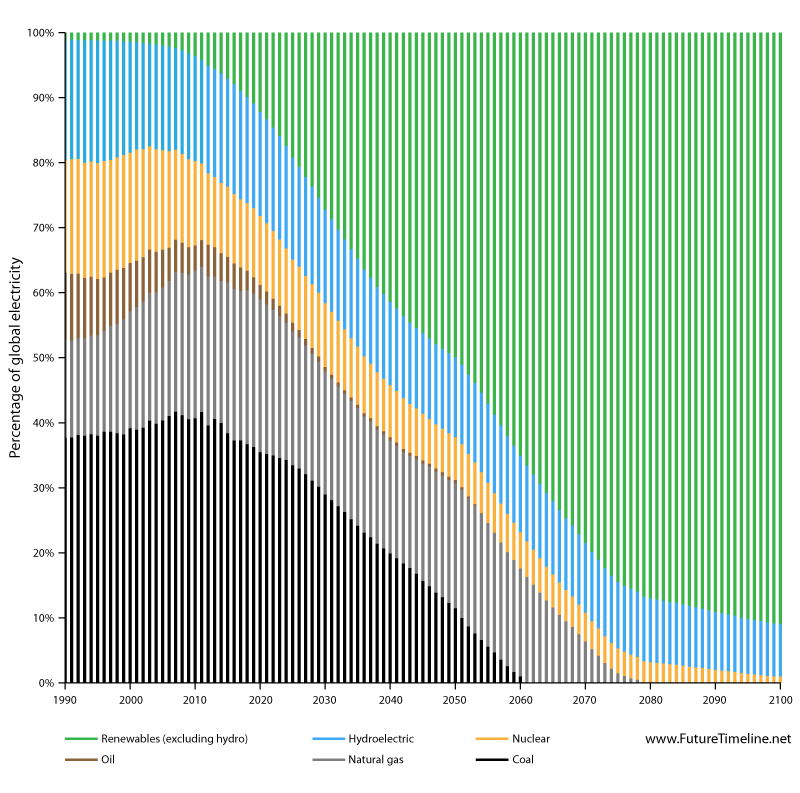
At the start of the 21st century, the global electricity sources consisted of coal (39.2%), natural gas (18%), oil (7.4%), nuclear (17%), hydroelectric (17%) and renewables (1.4%). The world's population, which stood at roughly a billion in 1800, exceeded six billion. Concerns over the environmental impacts of fossil fuels – already substantial in the 20th century – now began shifting to a whole new level.
Air, land and water pollution had been issues for as far back as fossil fuels existed. Carbon now constituted a much more serious and longer-term threat in the form of global warming. It would become perhaps the greatest challenge for humanity in the modern era.
The basic physics of heat-trapping greenhouse gases were established by the work of Fourier (1824), Tyndall (1859), Arrhenius (1896) and others who showed that without carbon dioxide (CO2), the Earth would be 30°C colder. By the early 21st century, carbon isotope ratios proved that human activity had increased the atmospheric concentration of CO2 by 45% – an unprecedented change when viewed on geological timescales, matched only by catastrophic events such as large asteroid strikes. The annual output of greenhouse gases from human activity now surpassed all of the world's volcanoes by two orders of magnitude. As a result, the global average temperature had warmed by 1.0°C (1.8°F) since the Industrial Revolution and was projected to rise by as much as 6°C by the year 2100.
The Intergovernmental Panel on Climate Change (IPCC), established in 1988, had sought to improve the scientific understanding of climate change and facilitate the discussion of possible response options. As well as publishing reports, authored by thousands of scientists contributing on a voluntary basis, the organisation held conferences around the world every year. However, while the IPCC member states agreed that climate change was real and the current period of rapid warming was human-caused, finding solutions proved extremely challenging. The level of action needed to stabilise greenhouse gas concentrations and reverse the temperature trend was simply too great, from an economic and political standpoint. To maintain a 50% probability of keeping the global temperature rise below 2°C, at least two-thirds of known fossil fuel reserves would need to remain buried in the ground.
Even as the world continued to warm, with impacts becoming greater and more obvious, little or no progress could be achieved. Then in 2015, a significant milestone occurred at the COP21 summit. Known as the Paris Agreement, this recognised the need to keep the global average temperature rise below 2°C (generally agreed as the "point of no return"), and to pursue efforts to limit the increase to 1.5°C, and committed all countries to reduce their carbon emissions for the first time.
Despite this new consensus, actually implementing the required policies was another matter entirely. Fossil fuels were the richest and most profitable enterprise in human history, forming the bedrock of the global economy and employing millions of people. With some $500 billion in annual subsidies, industry lobbyists held considerable influence, and governments were reluctant to give up trillions of dollars' worth of resources. Russia, for example, had the largest natural gas reserves in the world; Middle Eastern countries such as Saudi Arabia and Iraq were abundant in oil; and the largest coal reserves were in the United States, Russia, China, India and Australia. Fossil fuels provided cheap and easy access to energy, helping to lift billions out of poverty.
On the other hand, shifting away from fossil fuels and into clean energy provided many opportunities, regardless of climate change. The global economic costs of air pollution amounted to $5 trillion per year as a result of productivity losses and degraded quality of life, with up to 7 million deaths. Solar and wind power – alongside their health benefits – could provide further advantages, such as new jobs, technology innovation, energy independence, local and decentralised energy protected from blackouts, less price volatility, and so on. Besides solar and wind, other alternatives were available too, in some cases provided by geography. Iceland, for example, produced almost 100% of its electricity from geothermal and hydropower.
As the political debates raged on, more and more businesses could sense the winds of change and the beginning of an energy revolution. Investment now poured into the nascent renewable sector, as the cost of solar and wind power fell dramatically. From tens of dollars per watt in the 1970s, solar had fallen to $5 per watt by the year 2000 and continued to plunge, reaching less than a dollar per watt by the early 2010s. At the same time, solar cell efficiencies were improving with new production techniques, nanotechnology materials, and other breakthroughs. Wind turbines were growing larger, some reaching skyscraper sizes, with far greater capacities than before. Meanwhile, related technologies continued to advance, such as batteries/storage, home energy efficiencies, smart grids, and electric vehicles.
The writing was on the wall for fossil fuels. However, the industry would not disappear without a fight, and continued to expand. New reserves were being exploited in the form of fracking, deepwater, and other unconventional techniques. In a rather ironic development, the Arctic became a target for drilling, even as ice cover in this region hit record lows.
By the late 2010s, the atmospheric concentration of CO2 had surpassed 400ppm – a level not seen for millions of years – and the cultural zeitgeist shifted more and more in favour of action on climate change. Support for renewables was especially strong from the younger generations, now holding large-scale protests on a regular basis in many cities around the world.
The percentage of electricity from coal had peaked worldwide at 42% and now entered a terminal decline, as the adoption of renewables continued to accelerate and surpassed 10% globally. In 2017, the cost of solar-generated electricity became cheaper than coal in India. A number of countries now pledged to eliminate coal power plants within a decade. Recognising the existential threat to their industry, coal companies had begun to research carbon sequestration methods and extolled the promise of "clean coal", but the decline continued.
The 2020s became a pivotal decade for renewables, as they entered perhaps their most disruptive phase. Solar was to play a major role in the energy transition. Many cities and larger regions now mandated that rooftop solar be fitted on all newly-constructed buildings.* In addition to these home, community and workplace installations, utility-scale projects attained gigantic proportions, dwarfing previous power plants.* Likewise, many enormous wind projects were now coming online with multi-gigawatts (GW) of capacity.
Floating offshore wind – contrasted with fixed-bottom offshore wind farms – remained a niche sector throughout the 2020s. However, improvements in technology and cost competitiveness led to a major expansion in the 2030s.* This allowed offshore wind to be deployed in vastly greater areas, as opposed to shallow-water locations near coastlines.
Ongoing, exponential growth in renewables continued to eat away at the market share of fossil fuels. Coal in particular, now undergoing a full-scale collapse, contributed to a financial crisis on par with the Great Recession of the late 2000s and early 2010s. Future historians would argue that this "carbon bubble", exposing trillions of dollars in stranded assets, marked the beginning of the end for oil, gas, and coal-based electricity. Some of the richest countries were now fully decarbonising their power supplies.* Alongside this, smart cities were improving energy conservation, while innovations such as wireless power transfer became increasingly common. Many cafes, restaurants, airports and other public areas now featured "wi-tricity" for recharging electronic devices.
By the 2040s, as the global average temperature rise approached the critical 2°C threshold, the battle against climate change appeared to be lost. However, carbon sequestration – including mass reforestation programs, direct air capture, and other methods – still offered hope. Carbon taxes were now implemented by most nations, while annual subsidies to fossil fuels had dwindled substantially, making future investments ever more unattractive.*
The first solar power satellites, beaming energy down from space, provided a way of capturing sunlight 24 hours a day. This power could then be distributed to isolated locations, or disaster-hit areas with damaged infrastructure. Fusion power – another major development in the 2040s – appeared to be nearing commercial availability, with a successor to the ITER experimental reactor showing great promise.
By 2050, the percentage of electricity from renewables (excluding hydroelectric) had reached 50% globally.* Including hydroelectric and nuclear, the zero carbon figure now stood at nearly 70%. Coal was being phased out almost everywhere, except in a small number of the poorest countries. Oil, too, was on the verge of disappearing from use in electrical systems. Only natural gas remained a significant source of carbon-based electricity.
Electric and plug-in hybrids, already ubiquitous in the West, now formed the majority of cars in Africa, the Middle East, Asia and elsewhere. Large ships and even airliners were now going fully electric. Further developments included the emergence of continent-wide "supergrids" able to link together vast regions and optimise their clean energy supplies at all times of the year. The use of high-voltage direct current (HVDC) transmission, instead of traditional alternating current (AC) lines, allowed far greater efficiency, since DC lines had much lower electrical losses over long distances.
By 2060, both coal and oil had been virtually eliminated from the global electricity supply.* Practically every new building in the world now utilised solar power in some way** – either via rooftop modules, or transparent solar embedded in windows and other surfaces. Given the state of the global climate, fossil fuels had become extremely taboo, with most countries outright banning them for electrical generation.
By the late 2070s, the global transition is essentially complete.* Even the poorest nations are now achieving zero carbon electricity, as the last of their natural gas power plants are finally shut down. After more than a century of research, solar cells are nearing their theoretical limit for efficiency – nanotechnology has largely perfected their internal structures. The latest generation of modules, not only cheaper and more affordable than ever, can also access a wider part of the electromagnetic spectrum (i.e. beyond visible light, into the infrared), are more sturdy and longer-lasting, and can be configured to alter their appearance and blend into existing buildings more easily. Having begun to achieve commercial viability in the 2040s, huge clusters of solar power satellites now orbit the Earth and provide 100% coverage to wherever electricity is needed. Wind and offshore wind turbine projects have continued to expand in recent decades and will soon be powerful enough to change the very air currents of Earth.* Hydroelectric has declined in terms of its overall share of the world's electricity, but remains a significant source of power, helped by new developments in wave, tidal, and ocean thermal energy.
Meanwhile, nuclear fusion has moved from the laboratory into commercial uses in a number of countries, although it remains at a low percentage of global electricity for now – partly due to the high capital investment costs. However, it sees greater usage in the 22nd century as the technology is miniaturised and increasingly used for space-based applications.
Kidney cancer is exceptionally rare and routinely curable
By 2078, kidney cancer is no longer a serious threat to public health in the most advanced regions of the world. The age-standardised mortality rate (ASR) – already below 1 per 100,000 by 2040 – has now fallen to under 0.01 per 100,000, with only a handful of cases occurring annually in developed countries,* and a continued reduction globally. These "biological outliers" tend to be highly atypical, or driven by rare genetic mutations that remain difficult to predict or prevent.
Routine screening at the molecular level has become integrated into everyday healthcare. Nanotechnology diagnostics, wearable biochips, and regular blood tests detect cellular abnormalities long before symptoms appear. Kidney cancers now rarely progress beyond the very earliest stages, and even then, treatment is swift, localised, and minimally disruptive.
Advanced cell therapies allow doctors to retrain a patient's immune system with high specificity. Off-the-shelf T-cell treatments, combined with nanobot-assisted delivery systems, ensure that malignant cells are eradicated without damaging surrounding tissue. In parallel, regenerative techniques using stem-cell scaffolds enable partial or full reconstruction of kidney tissue when required.
Artificial general intelligence (AGI), having surpassed human-level reasoning in the biosciences, contributes daily to breakthroughs in oncology. These systems can identify new cancer targets, model patient responses, and design precision therapeutics with unprecedented speed – compressing the research cycle from years to just minutes.
While kidney cancer has not disappeared entirely, it now joins the ranks of conditions considered medically routine, such as seasonal allergies or mild infections. Patients no longer fear it as a life-threatening disease; instead, it has become a rare diagnosis, quickly resolved through established protocols and advanced medical infrastructure.

Advances in space travel and tourism
By the late 21st century, the frontiers of human space exploration have shifted from the Moon, Mars and inner Solar System, to more distant locations in the outer Solar System.***
The National Aeronautics and Space Administration (NASA), formed in 1958, remains in operation after 120 years.* However, the agency's funding is now negligible compared to that of the private sector, which has turned space into a multi-trillion dollar industry.*
The cost of launching people and cargo into space has declined substantially over the last century. From $85,000 per kilogram a hundred years earlier, it is now less than a dollar per kilogram.* This means that even people on relatively low incomes have access to Earth orbit – thanks to a new generation of rockets and space planes, alongside the recent development of a space elevator. Basic orbital cruises are therefore taken for granted by most people and regarded in much the same way as a long-haul airplane flight, or visit to a famous landmark; something that most people do every few years. For those with a little extra money, trips around the Moon are available, along with extended stays at a number of private hotels in cislunar space.
For the more adventurous, guided excursions on the lunar surface are possible. However, being somewhat more expensive and complicated, these are generally still reserved for those on above-average incomes. In addition, anything longer than a simple tour requires dedication and training that means it is often considered a rather extreme leisure activity, akin to mountain climbers or deep sea divers of the past. Among the most popular tour destinations are the Apollo landing sites, which have been surrounded by perimeter fencing and made into UNESCO World Heritage sites. Beyond these "tourist traps" are many areas of geological interest, which are being visited by explorers and researchers keen to claim their place in the history books.
Mars had gained a human presence some decades earlier. The first permanent base was followed by another, then another. By 2078, the population, infrastructure and self-sufficiency have all grown to such an extent that Mars will soon be ready to declare independence. Water, food and energy supplies are being handled by increasingly heavy use of robotics and general automation. Originally intended for scientists and other researchers, these stations are now experiencing a steady influx of regular citizens, keen to escape Earth and begin a new life on the Red Planet.
In addition to habitats on the Moon and Mars, a large and ever-growing number of mining operations are dotted around near-Earth objects, main belt asteroids and others, with some as far out as the Trojans of Jupiter. These are providing an abundance of previously rare metals and minerals, which has caused a dramatic fall in the price of certain commodities. The operations are almost entirely automated and overseen by powerful artificial intelligences, requiring little or no human input. A network of refuelling stations now provides a ready source of propellant – made from separating water into hydrogen and oxygen, for example – the equivalent of space-based filling stations that enable longer, cheaper and faster journeys.
With much of the inner Solar System now home to a thriving economy, attention has turned to the untapped potential of the gas giants. For government and commercial interests, by far the most promising candidate is Saturn's largest moon, Titan.*
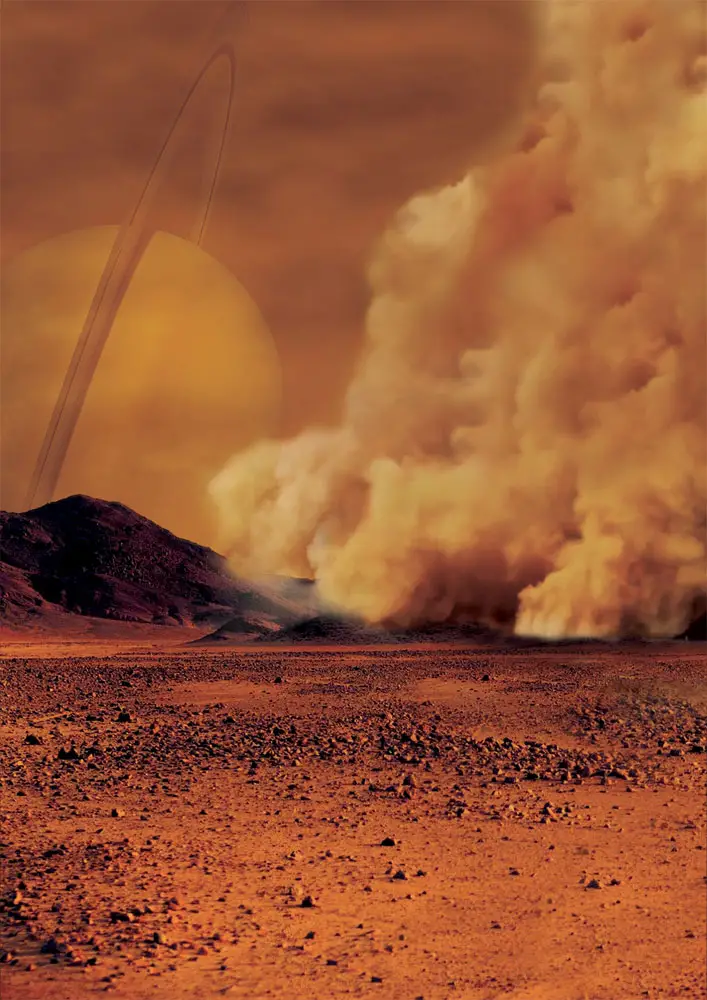
Copyright IPGP/Labex UnivEarthS/University Paris Diderot – C. Epitalon & S. Rodriguez
The unmanned Huygens probe had landed successfully on this strange world in 2005, returning the first pictures from its surface. The journey had taken almost eight years. Subsequent probes to the outer Solar System, such as New Horizons in 2015, were of similarly long durations. In the years and decades following these spacecraft, however, advances in propulsion technology led to reduced travel times – the use of solar sails to generate a small but continuous acceleration, for example, meant that higher speeds could be achieved over time. Other notable innovations included nuclear pulse propulsion and progress with antimatter research. Titan's 1.4 billion kilometre distance was no longer a significant obstacle. These and other developments were now being amplified and optimised by powerful artificial intelligences. By the 2070s, many formerly insurmountable challenges with space travel have been overcome.
One of the biggest problems encountered by earlier colonists on the Moon and Mars was how to deal with radiation. On Titan, the issue is eliminated – thanks to the satellite's protective atmosphere, which is 45% thicker than Earth's. Because of this high pressure and lack of radiation it is actually possible to walk around on the surface without a bulky, airtight space suit, instead using just an oxygen mask and heavy clothing with embedded heating elements.
Buildings can also be constructed and maintained more easily on Titan, with simpler designs that resemble polar bases on Earth. Occupants can take a somewhat more relaxed approach to keeping habitats airtight. Although leaks must be fixed, there is no immediate danger of death. A simple piece of tape can be applied temporarily until a proper repair is completed. For a cyborg or other suitably "upgraded" human, these environmental issues may be even less of a problem.
The very high ratio of atmospheric density to surface gravity also greatly reduces the wingspan needed for aircraft to maintain lift; so much so that a human can strap on wings and fly great distances while wearing a lightweight spacesuit.
Initially, the population of Titan is restricted to scientists and other government/corporate personnel – but like the Moon and Mars, it eventually grows to include regular citizens brave enough to make the voyage and start a new life. During the 22nd century it becomes a major hub for science, research, commerce and tourism in the outer Solar System.
2079
Asbestos production is ending globally
Asbestos is a group of naturally occurring silicate minerals, all of which form into long, fibrous, crystalline shapes. Viewed at the microscopic level, each fibre is composed of millions of tiny "fibrils" that can be released by abrasion or other processes.
Asbestos was first mined in ancient times, but large-scale industrial extraction only began in the 1870s. It was regarded as a revolutionary new material for its physical properties that included resistance to fire, heat and electricity, along with sound absorption and good tensile strength. Its affordability led to widespread use around the world – in applications such as electrical products, building insulation, fabric and mats, steam engines and turbines. By 1950, over a million tons were being produced globally.
However, this rapid growth was accompanied by increasing concerns about health impacts. Researchers were beginning to notice a large number of early deaths and lung problems in mining towns. It was subsequently confirmed that asbestos dust and fibres – too small for the naked eye, and often with a long period between first exposure and the onset of symptoms – were a major public health issue. By the mid-20th century, it was clear that, far from being a beneficial and sustainable material, asbestos was extremely hazardous.
The United States government and various industries were criticised for not acting quickly enough. In the late 1970s, court documents proved that asbestos industry officials had known of the dangers since the 1930s, but concealed them from the public. The continued long-term use of asbestos after harmful health effects were known or suspected, and the slow emergence of symptoms decades after exposure ceased, made asbestos litigation the longest, most expensive mass tort in U.S. history, involving more than 8,000 defendants and 700,000 claimants.
Worldwide asbestos production reached a peak of 4.8 million metric tons in 1978, before declining rapidly in the 1980s and 90s.* Many countries were now strongly regulating or outright banning its use.* After a brief plateau, production fell rapidly again, from 2.1 million tons in 2000 to 1.3 million tons by 2017.
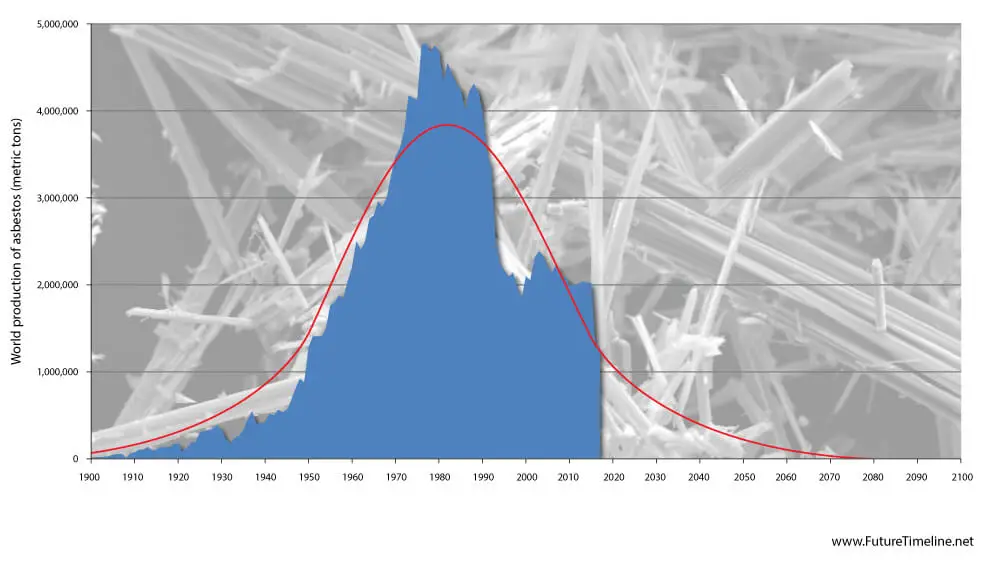
Despite the severity of asbestos-related diseases, the material remained in widespread use during the early 21st century. Production was still high in countries such as Brazil, China, India, Indonesia, Kazakhstan and Russia – fuelled by demand for cheap, mass-produced building materials in much of the developing world and supported by aggressive industry campaigns and lobbyist groups. The World Health Organisation (WHO) estimated that 125 million people were being exposed to asbestos in the workplace every year.
More than 60 countries had enacted bans by 2020 – including Australia, Canada, all European Union (EU) members, Japan and South Korea, alongside a number of nations across Africa, the Middle East and South America. Although regulations existed in the United States, however, there was still no official federal ban of the carcinogen. The last domestic producer in the U.S. had ceased operations in 2002, but imports continued to meet manufacturing needs. Nevertheless, consumption in the U.S. was in terminal decline, which led to eventual obsolescence.
More and more nations continued to phase out asbestos, in response to both health and liability issues. Rising incomes in Africa, Asia and elsewhere also meant that substitutes were increasingly viable. Worldwide production was now shrinking to a fraction of its former level.
The material was persistent in terms of its long term impacts, however. One notable example was in the 2040s, when a spike in cases of lung cancer was recorded in the U.S. and New York in particular. During the terrorist attacks of September 2001, hundreds of thousands of people had been exposed to asbestos embedded in the collapsing towers' drywall, insulation, fireproofing and steel structures. Decades later, many survivors were now feeling the health effects.
While bans were successfully covering new buildings, new products and so on, vast amounts of asbestos were extant in older buildings, older items, etc. Recognising this ongoing danger, countries in both the developed and developing world worked to remove asbestos and eradicate it completely. This had traditionally been a risky and expensive process, but was gradually becoming cheaper and safer through the use of robots.
By the late 2070s, the last remaining pockets of asbestos mining have closed – 100 years after the peak in global production and 200 years after the first industrial-scale operations. Health impacts continue in some countries until the end of the 21st century, but are less of a problem than before, as the medical advances of this time can substantially improve survival rates for lung cancer, mesothelioma, asbestosis and other such illnesses. This once ubiquitous and promising material is finally consigned to history.
While asbestos was being phased out, new fears about the health impact of micro- and nano-sized particles were arising as nanotechnology began to emerge and become widespread in the early- to mid-21st century.* Graphene, carbon nanotubes and other nanostructures were providing revolutionary breakthroughs in a range of industries, but some observers noted the parallels with asbestos in its early years and viewed these developments with growing unease. Although some of these concerns were valid, they proved to be overstated. Nanotechnology applications were fundamentally different to those of asbestos, with atoms far more tightly bound and less likely to break apart or be inhaled. Industry regulations and oversight were also vastly improved between the 19th and 21st centuries,* enhanced in particular by powerful AI to monitor the slightest defects and report any problems.
Total solar eclipse in New York
A rare total eclipse is witnessed in New York City, as well as Nova Scotia in Canada, and Greenland, on 1st May 2079.*

SQL Server databases are hit by a major glitch
On 6th June 2079, the "smalldatetime" fields in SQL Server databases wrap around to January 1, 1900. Similar to the Year 2038 problem, this is caused by a limited number of possible element ranges.* There are major errors for any vintage/antique computers still using these systems, though most of the surviving examples are in museums by now. Structured Query Language is exactly a century old, having been commercially introduced in 1979.

« 2069 |
⇡ Back to top ⇡ |
2080 » |
If you enjoy our content, please consider sharing it:
References
1 Islam projected to be world's largest religion by 2070, USA Today:
http://www.usatoday.com/story/news/world/2015/04/02/religion-muslims-christians-populations-pew-research/70769318/
Accessed 7th April 2015.
2 See 2030.
3 See 2095.
4 The Future of World Religions: Population Growth Projections, 2010-2050, Pew Research Centre:
http://www.pewforum.org/2015/04/02/religious-projections-2010-2050/
Accessed 7th April 2015.
5 Data Explorer - Pew-Templeton Global Religious Futures Project, Pew Research Centre:
http://www.globalreligiousfutures.org/
Accessed 7th April 2015.
6 U. S. FUSION ENERGY FUTURE, Princeton Plasma Physics Laboratory:
https://www.osti.gov/biblio/765153-GEEIUE/webviewable/
Accessed 19th November 2019.
7 Inside the house of the future, BBC:
http://news.bbc.co.uk/1/hi/world/europe/7348940.stm
Accessed 20th May 2010.
8 24 Room Apartment Crammed Into A 344 Sq. Foot Space (video), Gadget Review:
http://www.gadgetreview.com/2010/04/24-room-apartment-crammed-into-a-344-sq-foot-space-video.html
Accessed 20th May 2010.
9 Engines of Creation: The Coming Era of Nanotechnology, by Eric Drexler:
http://www.amazon.com/Engines-Creation-Coming-Era-Nanotechnology/dp/0385199732/
Accessed 1st December 2012.
10 Manufacturing Complex 3-D Metallic Structures at Nanoscale Made Possible, Science Daily:
http://www.sciencedaily.com/releases/2012/10/121018103020.htm
Accessed 1st December 2012.
11 See 2040.
12 Self-cleaning clothes, Future Timeline Blog:
https://www.futuretimeline.net/blog/2011/12/20.htm
Accessed 1st December 2012.
13 Light-triggered fragrance, Henkel:
http://www.henkel.com/press/press-releases-2011-20110607-light-triggered-fragrance-32662.htm
Accessed 1st December 2012.
14 Military Uses of Nanotechnology: Perspectives and Concerns, Jürgen Altmann:
http://www.uk.sagepub.com/chaston/Chaston%20Web%20readings%20chapters%201-12/Chapter%2012
Accessed 1st December 2012.
15 Wearable Breast Cancer Test Detects Tumors Before Doctors, Singularity Hub:
http://singularityhub.com/2012/11/05/wearable-breast-cancer-test-detects-tumors-before-doctors/
Accessed 1st December 2012.
16 See 2080.
17 The Age of Spiritual Machines, by Ray Kurzweil (1999)
Accessed 20th June 2009.
18 To get an idea of the scale we are talking about here, see: http://htwins.net/scale2/
Picotechnology would involve the use of components smaller than a carbon
atom (drag the slider from left to right to zoom in).
19 How much of global plastic is recycled?, Our World In Data:
https://ourworldindata.org/faq-on-plastics#how-much-of-global-plastic-is-recycled
Accessed 31st May 2019.
20 EU ambassadors back Waste Framework Directive revisions, Lets Recycle:
https://www.letsrecycle.com/news/latest-news/eu-ambassadors-back-waste-framework-directive-revisions/
Accessed 31st May 2019.
21 Government commits to zero 'avoidable' plastic waste by 2042 in 25 Year Environment Plan, Resource Media:
https://resource.co/article/government-commits-zero-avoidable-plastic-waste-2042-25-year-environment-plan-12344
Accessed 31st May 2019.
22 #breakfreefromplastic:
https://www.breakfreefromplastic.org/about/#vision
Accessed 31st May 2019.
23 Malaysia orders tonnes of imported waste to be returned, BBC News:
https://www.bbc.co.uk/news/av/world-asia-48438364/malaysia-orders-tonnes-of-imported-waste-to-be-returned
Accessed 31st May 2019.
24 How China's ban on plastic waste imports became an 'earthquake' that threw recycling efforts into turmoil, South China Morning Post:
https://www.scmp.com/news/china/politics/article/3007280/how-chinas-ban-plastic-waste-imports-became-earthquake-threw
Accessed 31st May 2019.
25 Supermarkets in Asia are Now Using Banana Leaves Instead of Plastic Packaging, Next Shark:
https://nextshark.com/banana-leaves-asia-plastic-packaging/
Accessed 31st May 2019.
26 4 reasons why recycling is better than incineration, Zero Waste Europe:
https://zerowasteeurope.eu/2017/09/4-reasons-why-recycling-is-better-than-incineration/
Accessed 31st May 2019.
27 Konstantin Tsiolkovsky, Wikipedia:
https://en.wikipedia.org/wiki/Konstantin_Tsiolkovsky
Accessed 29th January 2014.
28 See 2040.
29 Space Elevator: Stability, Science Direct:
http://www.sciencedirect.com/science/article/pii/S0094576508000507
Accessed 5th July 2013.
30 Space elevator vibration, New Scientist:
http://www.youtube.com/watch?v=8TAcNvlUZBU
Accessed 5th July 2013.
31 When do you predict Earth will get its first space elevator, Future Timeline Poll:
https://www.futuretimeline.net/polls.htm#space-elevator
Accessed 5th July 2013.
32 Size of products with molecular-level detail, Future Timeline:
https://www.futuretimeline.net/21stcentury/images/picotechnology-femtotechnology.jpg
Accessed 5th July 2013.
33 According to Smitherman, construction is not feasible today but it could be toward the end of the 21st century. "First we'll develop the technology," said Smitherman. "In 50 years or so, we'll be there. Then, if the need is there, we'll be able to do this. That's the gist of the report."
See Audacious & Outrageous: Space Elevators, NASA:
https://science.nasa.gov/science-news/science-at-nasa/2000/ast07sep_1
Accessed 3rd January 2018.
34 "... it could take around 15 years to build a space elevator."
See Materials Research Needed to Make Space Elevator a Reality, PC World:
http://www.pcworld.com/article/203280/article.html
Accessed 5th July 2013.
35 The Space Elevator Fact Sheet, The International Space Elevator Consortium:
http://www.isec.org/images/stories/isec%20fact%20sheet.pdf
Accessed 5th July 2013.
36 Space elevator, Wikipedia:
https://en.wikipedia.org/wiki/Space_elevator
Accessed 18th September 2025.
37 Space Elevators – An Advanced Earth-Space Infrastructure for the New Millennium, NASA:
http://www.nss.org/resources/library/spaceelevator/2000-SpaceElevator-NASA-CP210429.pdf
Accessed 5th July 2013.
38 Chickens are taking over the planet, Vox:
https://www.vox.com/future-perfect/2023/8/4/23818952/chicken-meat-forecast-predictions-beef-pork-oecd-fao
Accessed 7th September 2023.
39 Total animal-based food energy demand projections per region over time in EJ, Compare your country:
https://www.compareyourcountry.org/snaps/agricultural-outlook-2023/en/5722/EJ
Accessed 7th September 2023.
40 Who Will Come to Your Bird Feeder in 2075?, USGS:
http://www.usgs.gov/newsroom/article.asp?ID=4049&from=rss_home#.VHIHe8mJnq7
Accessed 23rd November 2014.
41 Species Distribution Modeling: The Relative Impacts of Projected Climate and Land-use Change on Conterminous United States Bird Species from 2001 to 2075, USGS:
http://landcover-modeling.cr.usgs.gov/sdm.php
Accessed 23rd November 2014.
42 North America's key birds facing extinction, study finds, The Guardian:
http://www.theguardian.com/environment/2014/sep/09/north-america-birds-extinction-study-climate-change
Accessed 23rd November 2014.
43 Thames Barrier to hold until 2070, BBC:
http://news.bbc.co.uk/1/hi/england/london/7973623.stm
Accessed 29th November 2009.
44 Six Degrees, by Mark Lynas. Amazon.co.uk:
http://www.amazon.co.uk/Six-Degrees-Future-Hotter-Planet/dp/0007209053/ref=sr_1_1?ie=UTF8&s=books&qid=1221170576&sr=1-1.
Accessed 11th Sept 2008.
45 Constraints on the Universe as a Numerical Simulation, Silias R. Beane. et al., University of Washington:
http://arxiv.org/pdf/1210.1847v2.pdf
Accessed 15th January 2013.
46 See 2140.
47 90377 Sedna, Wikipedia:
http://en.wikipedia.org/wiki/90377_Sedna
Accessed 24th November 2009.
48 All new homes in California will have solar power from 2020, Future Timeline Blog:
https://www.futuretimeline.net/blog/2018/05/11.htm
Accessed 5th December 2019.
49 Solar megaproject to boost global capacity by 200GW, Future Timeline Blog:
https://www.futuretimeline.net/blog/2018/03/29.htm
Accessed 5th December 2019.
50 Page 62 of report:
Offshore wind, Global Wind Energy Council:
http://gwec.net/wp-content/uploads/2018/04/offshore.pdf
Accessed 5th December 2019.
51 See 2034.
52 See 2046.
53 The World Will Get Half Its Power From Wind, Solar by 2050, Bloomberg:
https://www.bloomberg.com/news/articles/2019-06-18/the-world-will-get-half-its-power-from-wind-and-solar-by-2050
Accessed 5th December 2019.
54 From the video:
- Coal makes up 70% of Indian electricity, as of 2019
- 12 billion tons of coal in India
- Coal can continue "for up to 40 more years."
India's economic growth rate has halved in just three years, CNN:
https://edition.cnn.com/2019/11/29/economy/india-gdp/index.html
Accessed 5th December 2019.
55 See from 24:51 onwards:
Elon Musk's TED 2017 Full Interview, YouTube:
https://youtu.be/GPaYrhUZSYQ?t=1491
Accessed 5th December 2019.
56 Elon Musk's First Tesla Solar Roof Is Here, and It Looks Amazing, Inverse:
https://www.inverse.com/article/35022-elon-musk-tesla-solar-roof-photos-amazing
Accessed 5th December 2019.
57 World electricity sources, 1990-2100, Future Timeline Data & trends:
https://www.futuretimeline.net/data-trends/15.htm
Accessed 5th December 2019.
58 See 2095-2100.
59 Extrapolated from the following dataset, and based on a Gompertz trend:
Age-standardized rate (World) per 100 000, mortality, both sexes, Australia + Austria + Canada + France (metropolitan) + Greece + Hungary + Ireland + Italy + Japan + The Netherlands + Singapore + Spain + Switzerland, United Kingdom, USA – Kidney, Cancer Over Time:
https://gco.iarc.fr/overtime/en/dataviz/trends...
Accessed 28th July 2025.
60 Solar System Exploration: A Vision for the Next 100 Years, by Ralph L. McNutt Jr.:
http://www.jhuapl.edu/techdigest/TD/td2702/mcnutt.pdf
Accessed 6th October 2018.
61 "...a stretch goal of exploring the entire solar system by the end of the century."
Donald Trump expected to slash Nasa's climate change budget in favour of sending humans back to the moon - and beyond, Telegraph:
https://www.telegraph.co.uk/news/2016/11/20/donald-trump-expected-to-slash-nasas-climate-change-budget-in-fa/
Accessed 6th October 2018.
62 "Within 50 years: Mars. After that comes the gas and ice giants in the outer solar system and their intriguing moons."
See Cosmic Concept: Laser-Powered Space Travel, Popular Mechanics:
https://www.popularmechanics.com/space/deep-space/a9576/cosmic-concept-laser-powered-space-travel-16020462/
Accessed 6th October 2018.
63 "What's in store for space exploration 60 years from now? For predictions, we turned to the experts."
The Big 10 with Jeff D'Alessio, July 29, 2018, The News-Gazette:
http://www.news-gazette.com/news/local/2018-07-29/the-big-10-with-jeff-dalessio-july-29-2018.html
Accessed 6th October 2018.
64 Extrapolated from 2038.
65 Launch costs to low Earth orbit, 1980-2100, Future Timeline:
https://www.futuretimeline.net/data-trends/6.htm
Accessed 6th October 2018.
66 Beyond Earth: Our path to a new home in the planets, by Charles Wohlforth and Amanda R. Hendrix, PhD:
https://www.amazon.co.uk/Beyond-Earth-Path-Home-Planets/dp/0804197970
Accessed 6th October 2018.
67 USGS - Minerals Information: Asbestos, USGS:
https://minerals.usgs.gov/minerals/pubs/commodity/asbestos/
Accessed 30th July 2018.
68 Chronology of Asbestos Bans and Restrictions, International Ban Asbestos Secretariat (IBAS):
http://www.ibasecretariat.org/chron_ban_list.php
Accessed 30th July 2018.
69 Are Carbon Nanotubes the Next Asbestos?, YouTube:
https://www.youtube.com/watch?v=6L7xXgWcbrQ
Accessed 30th July 2018.
70 Are carbon nanotubes the next asbestos?, BMC:
https://blogs.biomedcentral.com/on-health/2014/11/26/are-carbon-nanotubes-the-next-asbestos/
Accessed 30th July 2018.
71 Total Solar Eclipse of 2079 May 01, NASA:
http://eclipse.gsfc.nasa.gov/SEgoogle/SEgoogle2051/SE2079May01Tgoogle.html
Accessed 28th February 2010.
72 smalldatetime (Transact-SQL), Microsoft:
http://msdn.microsoft.com/en-gb/library/ms182418.aspx
Accessed 25th November 2014.
 |
|||||||||||||||||||||||||||||||
|
Latest predictions |
Timeline » 21st century |
Blogs » AI & Robotics |
Features » |
About us
|
|||||||||||||||||||||||||||
|
|
|||||||||||||||||||||||||||||||