
|
|
|
|
|
|
2100
Human intelligence is being vastly amplified by AI
Ubiquitous, large-scale automation has led to vast swathes of human employees being replaced by virtual or robotic counterparts. Strong AI now occupies almost every level of business, government, the military, manufacturing and service sectors.
Rather than being separate entities, these AIs are often merged with human minds, greatly extending the latter's capability. For instance, knowledge and skills can now be downloaded and stored directly within the brain. As well as basic information and data, this includes many physical abilities. A person can learn self-defence, for example, become an expert in any sport, or be taught to operate a new vehicle, all within a matter of seconds.
The world has been transformed by this fusion of people and machines. The vastly greater power of AI means that it has become, simultaneously, both master and servant to the human race.
The benefits of this human-AI merger require the extensive use of implants, however – something which a significant segment of the population still refuses to accept. Compared to transhumans, these non-upgraded humans are becoming like cavemen – thousands of years behind in intellectual development.* Unable to comprehend the latest technology, the world around them appears "fast" and "strange" from their increasingly limited perspective.* This is creating a major division in society.

Africa is a major urban and political centre
Historically, Africa had been poor, with limited influence on the world stage. By 2100, this situation has dramatically reversed.
The 19th century had belonged to Great Britain, while the 20th century had been the American century. Following Asia's rise in the 21st century, the baton is now passing to Africa.
After its colonisation and subjugation by foreign powers, independence movements took place in Africa in the post-WWII period. Devastating famines wracked the continent in the late 20th century, combined with political, economic, and humanitarian catastrophes, limiting its progress.
Africa's economy improved in the early 21st century, in parallel with democracy and the rule of law spreading to more of its countries. Governments began to crack down on corruption and patronage, while macroeconomic growth plans aimed at improving living conditions came to fruition. Millions of Africans flocked to cities in search of jobs and other amenities.
Meanwhile, foreign investors poured vast sums of money into Africa. China, by far the biggest contributor, sought to extract the continent's abundant metals, minerals, fossil fuels, and other resources. This occurred alongside the building of new ports, roads, pipelines, and other infrastructure. China also expanded these investments into agriculture, finance, real estate, technology, tourism, and other emerging fields.
Africa received further support and development from initiatives such as the UN's Sustainable Development Goals for 2030. Other milestones around this time included the expansion of its free trade agreements, the introduction of a single African currency, and the building of a trans-continental road and rail network to all corners of the continent.
In the 2040s, many more African nations achieved economic diversification enabling them to attract foreign investment in new areas. Even the likes of oil-rich Nigeria had begun to transition away from older fossil fuel industries. This decade saw ecological restoration efforts completed in the Niger Delta and the final clearing of landmines in countries such as Angola adding a further boost to social and economic development. Meanwhile, some of the richer African nations invested in new coastal defences to mitigate sea level rises.
In Central Africa, the Congolian rainforests had lost two-thirds of their original tree cover by mid-century. Domestic and international agreements aimed at slowing the rate of deforestation came into force, with better monitoring and regulations preventing a complete collapse of the region, although problems would persist for some time into the future.
By 2050, Africa's population stood at 2.5 billion – two and a half times the number in 2009 – and continued to rise.* While other continents had a fertility rate near or below the replacement level of 2.1 children per woman, Africa maintained a figure well above this, having only recently fallen below 3.0.
Improvements in education, economic opportunity, living standards, and medicine transformed much of Africa, with child mortality declining to negligible levels in many countries. Diseases such as dengue fever, HIV/AIDS, and malaria became largely eradicated. By 2050, the average life expectancy in Africa had reached 70 – up from 60 in 2013, 50 in 1981, and just 40 in 1958.
Agenda 2063, a set of initiatives proposed 50 years earlier, achieved most of its long-term goals.* These included further improvements in living standards, education, and health, alongside the enshrinement of democratic values, equality, and human rights. For some African nations still struggling with repressive and dictatorial regimes, these goals would remain out of reach for now. But for Africa in aggregate, a whole new plateau of possibilities had emerged. Agenda 2063 also called for a more united Africa, strengthened by continental institutions to maintain peace and stability.
By now, the earlier transport networks had seen upgrades such as high-speed rail and widespread electric charging/self-driving infrastructure. Major new construction projects included the 'Bridge of Horns' across the Red Sea, linking East Africa with the Middle East, and a 155 km tunnel from Tunisia to Sicily.*
Africa faced severe environmental challenges, being among the regions most vulnerable to climate change. Higher temperatures, changing rainfall patterns, drought, and increased climate variability, all threatened to derail economic and human development. Climate change exacerbated long-standing problems and reignited earlier tensions. At several points during the mid-to-late 21st century, it appeared that Africa's progress would stall, or even go into reverse.
Refugee movements became a particular source of conflict – especially in the north, where millions attempted to reach southern Europe, amid pressures from desertification and water scarcity.
Africa had worked to modernise its agriculture with more sustainable practices and a variety of new technological approaches. One of the biggest success stories proved to be the introduction of next-generation, genetically modified crops. In earlier decades, laboratory and field tests had shown the potential for yield boosts of 40% or more.*** Even greater yield increases became possible with advances in CRISPR and related platforms. Meanwhile, the growing use of robots and AI, now increasingly accessible and low-cost for even developing countries, helped in the planning, management, production, harvesting, and distribution of farming. Rooftop and vertical farming became popular, while buildings had their surfaces painted with heat-reflective coatings to bring down temperatures by up to 10°C.* The increased planting of trees in urban areas helped to further improve local cooling, air quality, and the ability to absorb rainwater.*
Other, more radical solutions became increasingly necessary as the impacts of climate change worsened. In the north, a megaproject entered its final stage in preventing the expansion of the Sahara, with financing and support from southern European nations who also stood to be affected as winds carried the sands across the Mediterranean Sea. This involved re-vegetating vast areas of uninhabited desert, while also creating saltwater-cooled greenhouses with solar power, using both photovoltaics and concentrated solar power.**
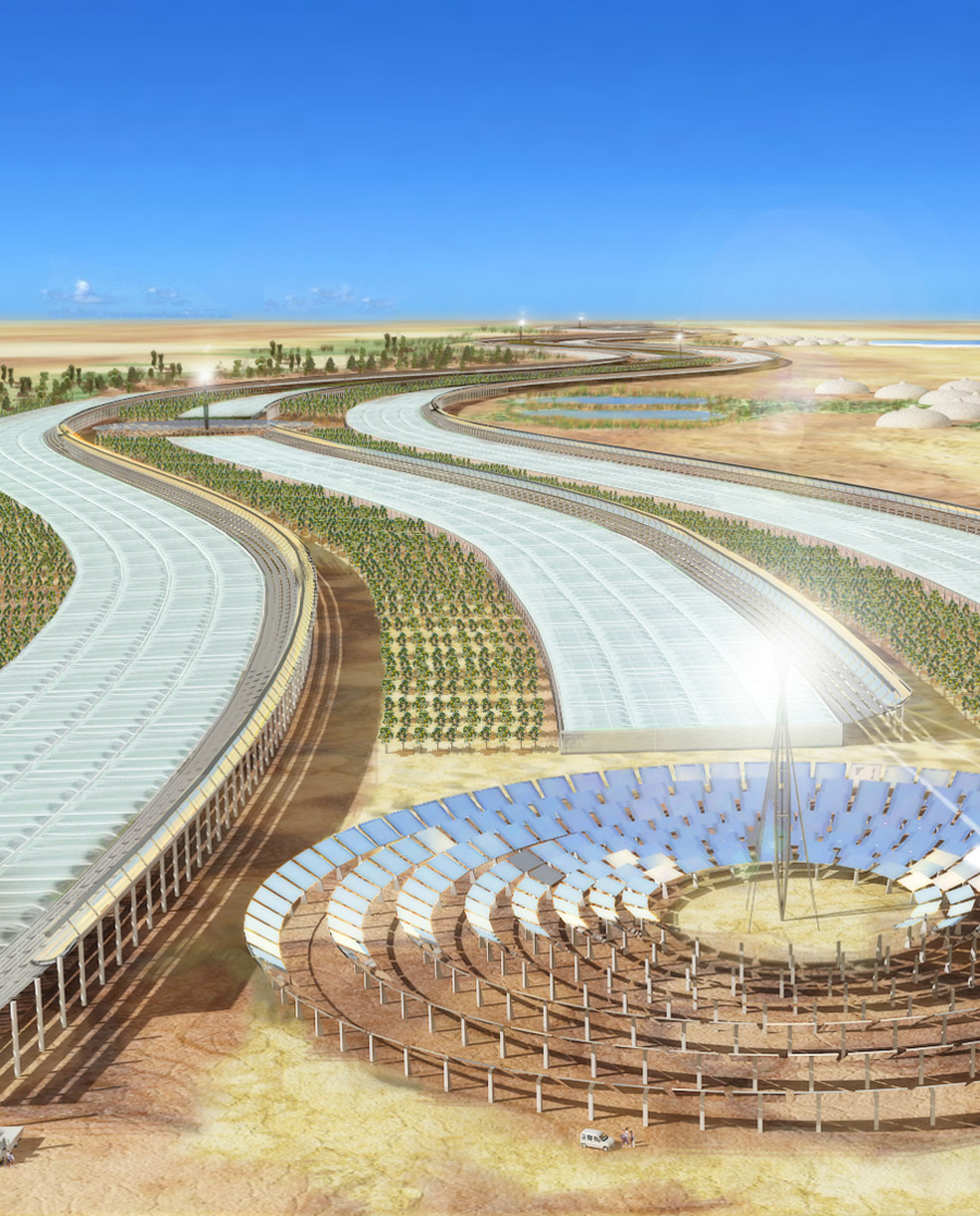
On the coasts, new pipelines carried water from desalination plants, using nanofiltration for greater efficiency. Many communities also benefited from atmospheric water generators extracting water from ambient air.
In the aftermath of disasters such as floods or wildfires, 3D printing technology aided recovery efforts. This enabled homes and other buildings to be relocated and replaced in a matter of hours.*
With most of the world having reached net zero by 2050, in part thanks to the unexpectedly rapid rollout of solar and wind power, attention had turned to carbon negative technologies aimed at removing historical emissions of greenhouse gases. The second half of the 21st century saw a major scaling up of these efforts, with gigatons being captured each year and buried or converted into useful products. The Keeling Curve, which had measured the accumulation of carbon dioxide in the Earth's atmosphere since 1958, first plateaued, and then began to decline.
These and other developments enabled Africa to avoid the more apocalyptic impacts of climate change that some analysts had predicted. The continent faced many ongoing crises, however, with periodic flashpoints and uneven progress. While the richer nations and cities achieved a relative stability, poorer and more rural areas struggled to implement the required adaptation measures. The worst-hit regions became the subject of long-term, large-scale resettlement and compensation programs, with international negotiations dragging on for decades.
Nevertheless, Africa as a whole survived and in many ways has prospered by 2100 – entering the 22nd century as a stronger, more confident, independent, and geopolitically influential player. Climate change has failed to significantly reduce its total population, now above four billion and still rising. More and more people have flocked to its cities, taking advantage of the safe haven and greater opportunities available in them. Artificial intelligence now controls many aspects of African society and solves problems faster and more effectively than in the past.
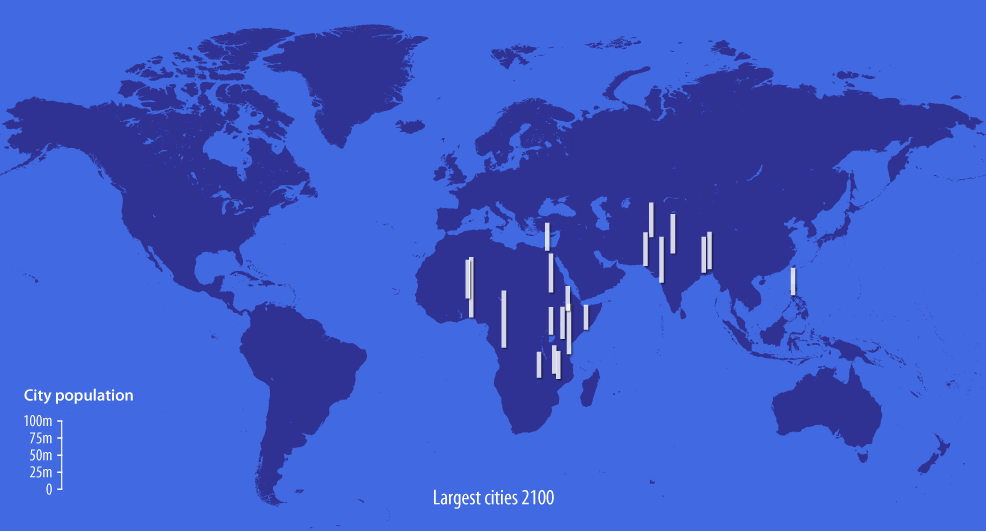
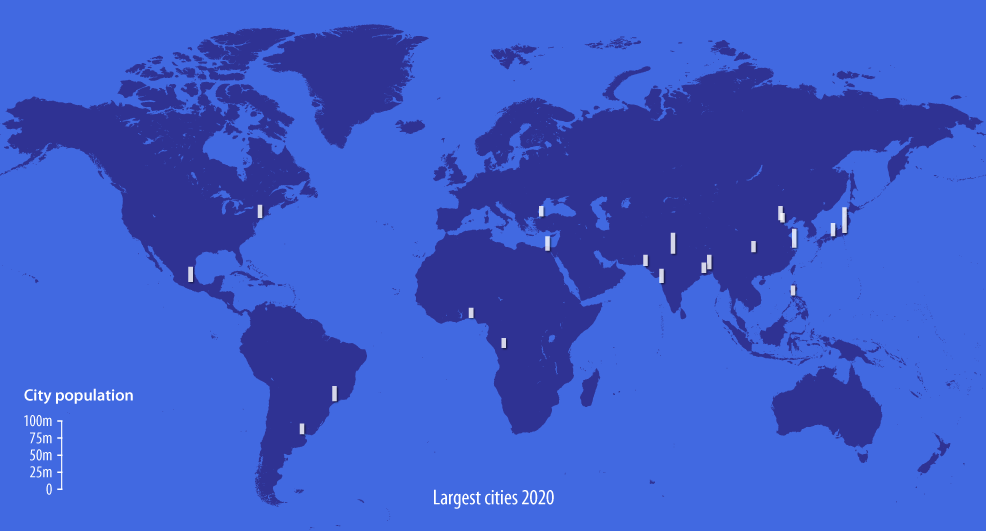
Today, in 2100, 13 of the 20 largest cities in the world are African,* up from just three in 2020. The most populous of all is Lagos, Nigeria, which has swelled from 7.3 million a century earlier to more than 88 million now, a 12-fold increase. Other megacities of 2100 include Kinshasa (83m) and Dar Es Salaam (74m).*
The gross domestic product (GDP) per capita for Sub-Saharan Africa stood at just $1,323 in 1950. This rose to $1,981 by the year 2000 and $3,532 by 2020 and $5,500 by 2050 (adjusted for inflation and in 2011 dollars). By 2100, the average person in Sub-Saharan Africa can expect to earn almost $10,000 – five times more than a century earlier. A few of the richer nations have GDPs per capita exceeding $50,000 and comparable to a Western income circa 2020. In light of environmental and resource constraints, however, GDP has become a less important consideration by now, with new metrics the preferred choice for many people in terms of measuring societal wealth, health, and overall well-being.
Africa continues to make progress during the 22nd century, in an increasingly homogenised and globalised world that now offers a more level playing field in terms of economic and political dynamism.
Click to toggle between years:
| 2020 | 2100 |
Nomadic floating cities are roaming the oceans
At the dawn of the 22nd century, many of the world's cities lie partially submerged due to rising sea levels.* Despite some attempts to build flood defences, even famous locations – such as New York, London, Hong Kong, Shanghai and Sydney – have been affected. With over 10% of the world's population living on coastlines, hundreds of millions have been forced to migrate.
While many citizens have abandoned their homelands, a growing number have adopted a new means of living which does away with national boundaries altogether. This comes in the form of floating, artificial islands – entirely self-sufficient and able to cruise around the world indefinitely.*
These ships provide comfort, safety and security, in stark contrast to the upheaval and chaos experienced by many land dwellers. In addition to a continuous supply of food and freshwater, various facilities are available including virtual reality suites, state-of-the-art android servants/companions, swimming pools, landing pads for anti-grav vehicles and much more. Carefully maintained arboretums with real trees can also be found on board (flora which is becoming increasingly rare these days).
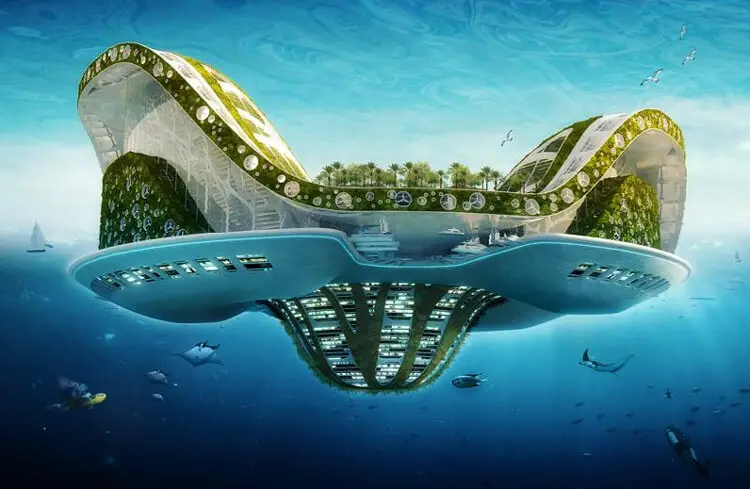
Credit: Vincent
Callebaut architects
These giant, amphibious ships are especially popular in Southeast Asia, which has been hit hard by the effects of climate change. Some of the largest craft house upwards of 100,000+ residents. Whole new cultures are forming on these "micro nations" – often based around particular themes, lifestyles, ethics or belief systems that appeal to a specific demographic.
Seasteading in general has exploded in recent decades. In addition to city ships, permanent settlements have appeared along the flooded coasts of many regions. This often takes the form of recovered infrastructure rebuilt to accommodate rising sea levels. In the more prosperous nations, cities may be rebuilt using massive anchored pontoons or other hydrostatic devices. More commonly, entirely new cities are devised by governments to accommodate the displaced populations of coastal cities.
New, larger and more advanced versions of the Energy Islands built in earlier decades make up the majority of these settlements. Some consist of huge artificial archipelagos, stretching for tens of kilometres. Units are often covered in natural plant life, in addition to hi-tech systems for carbon sequestration.
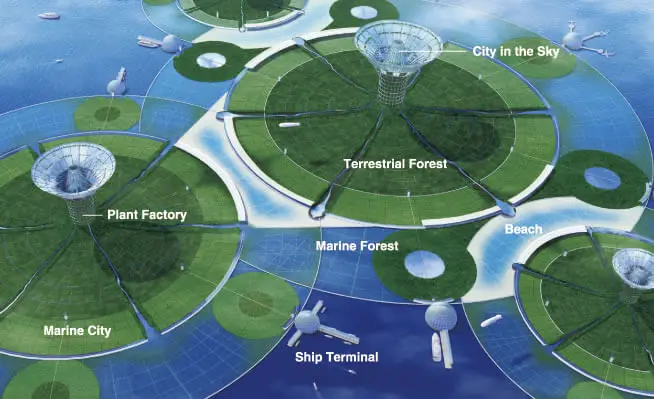
Credit: Shimizu Corporation
As well as CO2 capture, offshore settlements play a role in scrubbing general air and water pollution, acting as giant filters that remove trash and chemicals from the ocean. These materials can then be recycled and put to new use. This is now having a significant impact in reversing the enormous damage that has accumulated over the centuries from ocean acidification, plastic debris, nitrogen and other man-made waste products.**
Needless to say, these settlements, both stationary and roaming, are entirely carbon neutral. Power is produced from a combination of OTEC plants, offshore wind farms, tidal and wave plants, solar arrays, and other means. Some even utilise fusion. Food is grown and water desalinated locally. These ocean settlements are themselves among the earliest adopters of the so-called "post-growth economy". This had emerged out of the converged crises of resource depletion and advanced automation that began during the mid-late 21st century, and seeks to minimise the impact of human economic activity on the environment.
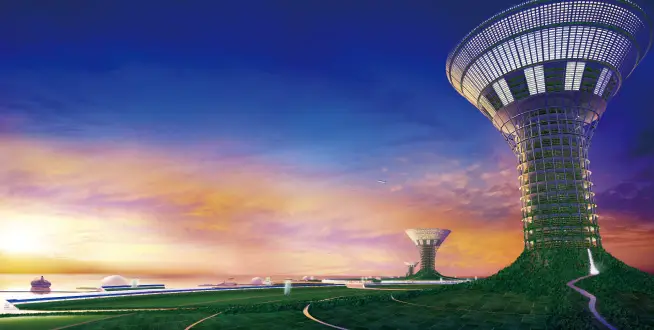
Credit: Shimizu Corporation
Emperor Penguins face extinction
For centuries, Emperor Penguins were the best-loved and most recognised symbol of Antarctica. By the early 22nd century, their numbers have dwindled to almost nothing because of melting sea ice, depletion of krill and industrial activity. Small populations continue to exist, by adapting their breeding habits, but even these will eventually disappear.*

© Bernard
Breton | Dreamstime.com
Terraforming of Mars is underway
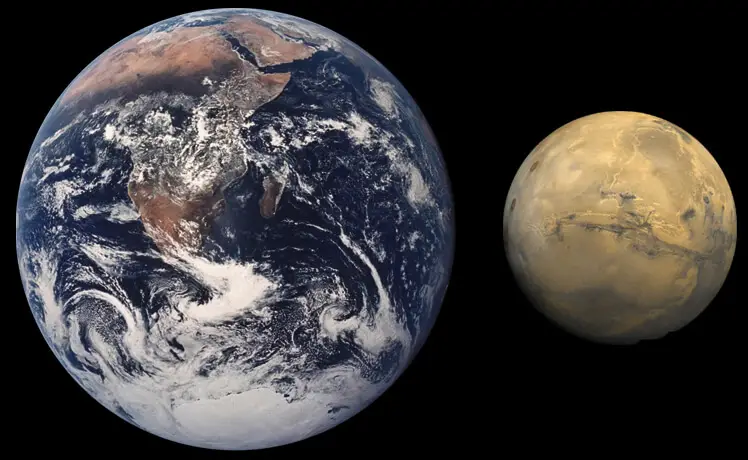
With space travel becoming low cost (now just a few cents per kilogram of payload),* and journeys between planets now relatively routine, serious plans are underway for the transformation of Mars, with the ultimate goal of making it habitable for humans. Exactly who should be given control of Mars and its resources – or if the planet should have independence – is the subject of much debate and speculation around this time.
2110
Capital punishment is ending globally
From the beginning of civilisation, the execution of criminals and dissidents occurred in nearly all societies. In pre-modern times, the killings themselves often involved torture with cruel and painful methods.
During the early modern era, social reformers began to question the need for capital punishment. Cesare Beccaria, widely considered one of the greatest thinkers of the Age of Enlightenment, published his influential treatise On Crimes and Punishments in 1764. This became the first detailed written work to demand the abolition of the death penalty. Jeremy Bentham, founder of modern utilitarianism, called for the abolition of the death penalty in an 1831 essay.
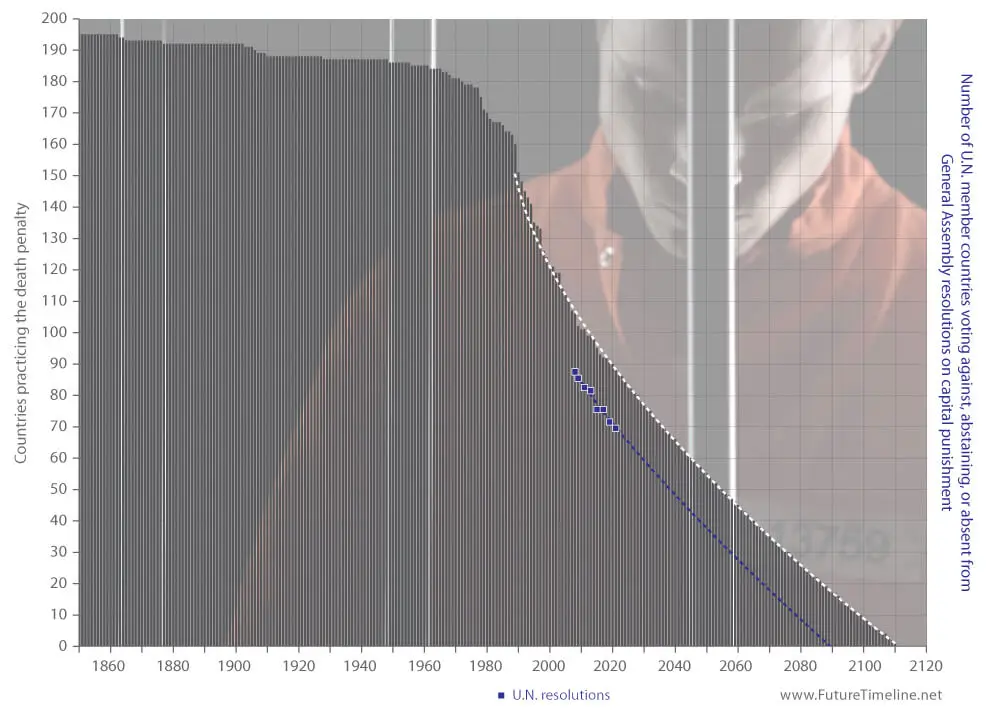
In 1863, Venezuela became the first country to permanently abolish the death penalty for all crimes. In the next hundred years, only 11 more countries followed. From the 1960s onwards, abolition became far more popular. Some of the major developed countries to enact bans included Austria and the UK (although the latter retained the death penalty for the crime of treason until as late as 1998). Other European countries followed in the 1970s and 1980s. France conducted its last execution by guillotine in 1977 and outlawed the practice in 1981.
After the end of the Cold War, many more countries around the world followed. 36 countries abolished capital punishment in the 1990s, with nine in 1990 alone, and 23 during the 2000s.
In 2007, the United Nations General Assembly (UNGA) began to issue resolutions calling for a global moratorium on the death penalty. The first vote resulted in 104 of the 192 member nations voting in favour, with 54 against, and 29 abstentions (as well as five absent at the time of the vote). The next resolution in 2008 produced a larger majority in favour. Subsequent votes occurred every two years after that, gradually increasing the majority in favour. By 2015, the number of member countries prohibiting capital punishment in their domestic statutes had overtaken those retaining its use.
This incremental progress continued. By the late 2030s, only around one-third of U.N. members continued to use capital punishment.* China remained the world's top executioner, killing thousands of its citizens each year. Excluding China, 86% of all reported executions took place in just four countries – Egypt, Iran, Iraq, and Saudi Arabia.
Japan and the United States became two of the last remaining and most high profile of the developed nations to retain capital punishment. Public support for the death penalty had trended downwards in America for a variety of reasons – such as DNA exonerations of death row inmates, controversies over the mentally ill, high costs of executions (triple those of life sentences), and so on. These shifting attitudes led to a phasing out of the death penalty across more and more states and then eventually at the federal level. Japan, however, proved to be more resistant to abolition. Like many other countries in Asia, it had strong public support lasting through much of the 21st century.
Traditionally, the Islamic world had been regulated by Sharia. This mandated the death penalty for adultery and same-sex activity, in addition to the most serious violent crimes, according to some interpretations. Saudi Arabia conducted public beheadings even in the 21st century, while other countries such as Iran continued to allow stoning.
With the Middle East becoming more developed, however, as well as Africa and parts of Asia, legal systems in these regions began to evolve – slowly but surely moving away from attitudes of the past. Improvements in education, the empowerment of women (who favoured clemency more than men), and the ever more connected and globalised nature of society led to greater consideration of human rights. Although stopping short of adopting full Western values, a softer and more secular form of Islam began to emerge – enough to nudge the pendulum of history towards capital punishment reforms. Under public pressure and increasing scrutiny from the international community, the last remaining countries to use the death penalty are now considering its abolition, 250 years after the precedent set by Venezuela.**
Room-temperature superconductors are in widespread use
By the early 22nd century,* room-temperature superconductors are embedded in myriad applications and have transformed much of the world's infrastructure and road networks. Just some of the revolutionary advancements include lossless energy transfer, better containment of fusion energy, improved imaging for medical scans, and a variety of new hovering or flying vehicles that can glide effortlessly over the ground.
The discovery of superconductivity in 1911 revealed a set of physical properties observed in certain materials where electrical resistance vanishes at close to absolute zero. A further breakthrough in 1933 led to discovery of the Meissner effect – the ejection of magnetic field lines from the interior of the superconductor during its transition into a superconducting state, which occurs when the material is cooled by liquid nitrogen to −203°C (−334°F) and levitates a magnet.
Initially, scientists knew of only a few metals with vanishing electrical resistance at just above absolute zero, or −273°C (−460°F). In the 1980s, however, researchers discovered ceramic materials displaying this phenomenon above 35 K (−238°C, or –397°F). Further progress with ceramics in the 1990s demonstrated critical temperatures reaching above 150 K (−123°C, or –190°F), a substantial jump.

The Meissner effect. Credit: ktsdesign
In the early 21st century, incremental improvements occurred with various other materials, but all required tremendously high pressures comparable to the conditions in Earth's outer core. Researchers finally achieved the "holy grail" of room-temperature superconductivity in 2020, with a compound at 15°C (59°F) using a diamond anvil cell at 269 gigapascals (GPa).*
In subsequent years and decades, research teams shifted their focus away from higher temperatures and onto efforts to reduce the immense pressures required for superconductivity. New techniques emerged for scaling up materials – from the nanoscale, to the microscale and larger. Eventually it became possible to combine a room temperature regime with materials both visible to the naked eye and stable at relatively low pressures.
Later in the 21st century, some of the world's most powerful artificial intelligences made further discoveries, with even lower pressures. Ultimately, these stable states matched the Earth's atmosphere at sea level. The next critical step involved the perfection of mass production methods for these new compounds, via the ultra-precise arrangement of nanotechnology. A shift from the laboratory and into practical applications then occurred – once again managed and deployed by AI in the most efficient ways possible. In factories and other facilities, 3D printing enabled these superconductors to coalesce in a blur of speed; one of the Singularity-like effects to be witnessed during this time.
Following the discovery of superconductivity and the Meissner effect, it took a century for the first room-temperature superconductor to emerge. Now, after a further hundred years of research and development, the practical applications are clear to see. In 2110, the world is being transformed by new devices and components able to function without electrical resistance and with expulsion of magnetic field lines at room temperatures.
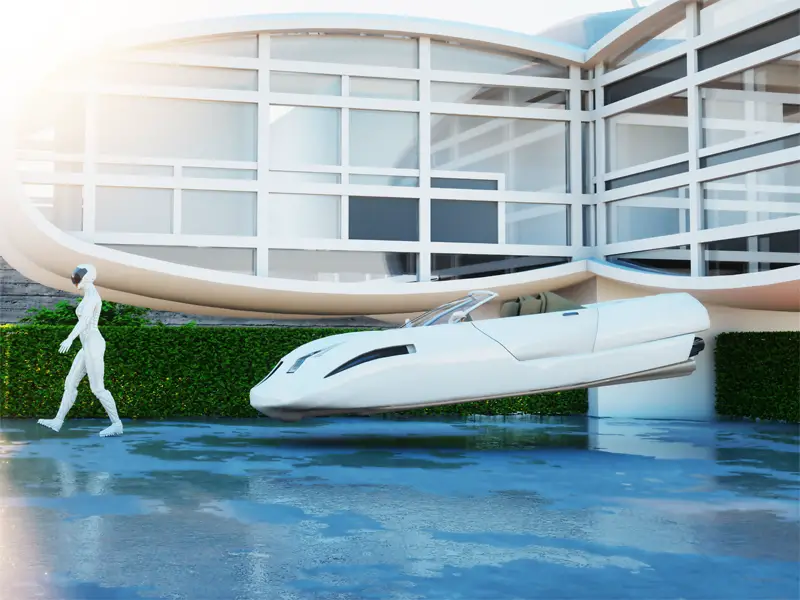
In a city of today, it is common to witness floating cars, pods and other vehicles gliding smoothly through the air. These float over a cushion of magnetism and are powered by wireless energy transmitted from pads embedded in the ground. Outside a building, you might come across the surreal sight of a parked vehicle, hanging stationary in the air. Even the building itself may incorporate structures, signs or architectural elements that appear to have nothing below them.
These hovering vehicles have a number of advantages over traditional wheeled transport. By adjusting their altitude when near pedestrians, they can simply drift above them – eliminating the possibility of accidents. This also reduces the incidence of roadkill, which had been responsible for millions of animal deaths per day during the 20th and 21st centuries. The lack of surface contact also eliminates the problem of tyre wear and therefore reduces both air and microplastic pollution produced from vehicles.
Although wheels are still common in transport, they are rapidly being supplanted by superconducting technology, as these benefits are increasingly recognised by city authorities and the required infrastructure is expanded. Some of the wealthier and more hi-tech districts have already upgraded their entire road networks to cater for levitating vehicles. As more and more routes become available, being able to travel in three dimensions rather than two enables faster journey times. Combined with AI for traffic management, congestion is virtually eliminated. Abundant energy is available for these autonomous flying vehicles, with 100% of the world's electricity now supplied by ultra-efficient clean tech, and multiple redundances are built in to ensure they stay aloft.
Room-temperature superconductors are transforming numerous other areas. Lossless power transmission is now possible, for example – making obsolete the traditional infrastructure for converting low and high voltage AC and enabling perfect transmission over huge distances. Energy storage is being revolutionised too as battery degradation is no longer a problem, with superconducting wires instead capturing and storing electricity indefinitely. Computers, tablets and other electronics can be made to run cooler, more efficiently, and with far less energy consumption.
Other developments include super-powerful and ultra-compact motors, along with machines that once required entire buildings or rooms to operate being viable on much smaller scales. Compact nuclear fusion is now emerging, for example, which is especially useful in space travel. Large-scale science facilities such as particle accelerators now need less energy and capital costs, while high-end medical imaging is more efficient and available in smaller form factors.
Personal health pods are common in homes
In the early 22nd century, many functions previously performed in clinical settings can be automated and supplied to patients at home. Full body scanners providing a wide range of diagnoses and treatments are now a common household appliance, relieving the burden on hospitals.*
These devices come in a variety of form factors, but typically consist of a cylindrical capsule about two metres in size. The occupant either stands (in the case of vertical models) or lies down (in a horizontal configuration)* for the procedure, which takes a matter of seconds. Cameras with sub-nanometre precision obtain images at trillions of frames per second, panning from head to toe while tracking and adjusting for even the slightest movement.
Every region of the body undergoes real-time 3D analysis and is "pinged" for any high-risk changes or abnormalities since the previous scan, to determine spots that need further attention. A summary is then provided to the user, ranked in order of severity. For simple or benign problems, the machine can recommend a drug or other medication. For issues requiring surgery, treatment can be provided by robotic arms/tools, lasers, or nanorobots injected and then guided via a combination of magnets and their own tiny motors. For a transhuman individual, who may already have extensive implants and upgrades, many of these remedies may be unnecessary.
While the medical capabilities of 2110 are vastly improved when compared to a hundred years previously, not every aspect of biology is fully understood yet. Certain rare and unusual conditions, for example, continue to persist in the population and require more specialist intervention than these home-based machines can provide. For the most part, however, treatment of once life-threatening illnesses is now relatively routine. In subsequent decades, a further proliferation of these health pods in tandem with new advances in science leads to cancer mortality being largely eliminated in many countries.*
Force fields are in military use
A combination of several unique technologies, stacked together in layers, has led to a radical new form of protective shielding.* To observers from the previous century, this would resemble the "force fields" depicted in science fiction movies. When activated, it provides an instant, near-impenetrable field withstanding hits from all but the most powerful weaponry.
The outer layer consists of a supercharged plasma window, shaped into a dome or sphere by electromagnetic fields. This is hot enough to vaporise most incoming metals. A secondary layer underneath contains millions of curved laser beams, producing a high-energy web that captures projectiles fast or powerful enough to bypass the plasma window. A third layer consists of a "lattice" made from trillions of carbon nanotubes. These microscopic structures are woven together in an instant, forming a diamond-hard shell repelling objects missed by the other two layers. If necessary, this can be extended to cover a larger perimeter, at the cost of decreased strength. Conversely, it can be reduced in size to provide an even denser and more durable barrier.
The layers described above can protect against the majority of bullets, bombs and projectiles. However, they are almost useless against lasers. A fourth and final layer takes care of this problem. This uses photochromatic particles, which change their properties when exposed to laser light, effectively neutralising most directed-energy weapons. An early form of this technology was seen a century previously, with sunglasses that changed colour when exposed to sunlight.
In addition to warzones, these multilayered force fields are used in a range of other situations. National borders, for example, are more secure – as are many sources of food and water production. Corporate spaces and luxury dwellings owned by the rich are also utilising them. A number of satellites are being fitted with this technology too.

Large-scale arcologies are emerging as an alternative to traditional cities
The global convergence of environmental issues and resource depletion has forced humanity to drastically readdress the way urban areas are designed. The refugee crisis that emerged in the mid-21st century has now largely subsided, with much of civilization having been relocated to the polar regions of Northern Europe, Russia, Canada and Western Antarctica. In order to accommodate so many people in such a smaller area, cities have become increasingly dense and self-contained.
However, decades of concerted geoengineering efforts have led to success in stabilising global temperatures. Combined with ongoing population pressures, this has prompted governments to begin repopulating some of the abandoned regions in more central latitudes. Despite this progress, most countries still face the problems of resettling hyper-arid, ecologically-ravaged environments. As such, long-hypothesised "arcologies" have begun to emerge as a radical departure from traditional urbanism, condensing an entire city into one massive structure.*
A precedent for these mega-structures could be seen as far back as the 2020s, with construction of the first centrally-planned, truly sustainable cities.** Later in the 21st century, these principles were adapted for the development of single structures – resulting in supertall skyscrapers that combined vertical farming with residential and commercial space, recycling and production systems for energy, water and other resources.*
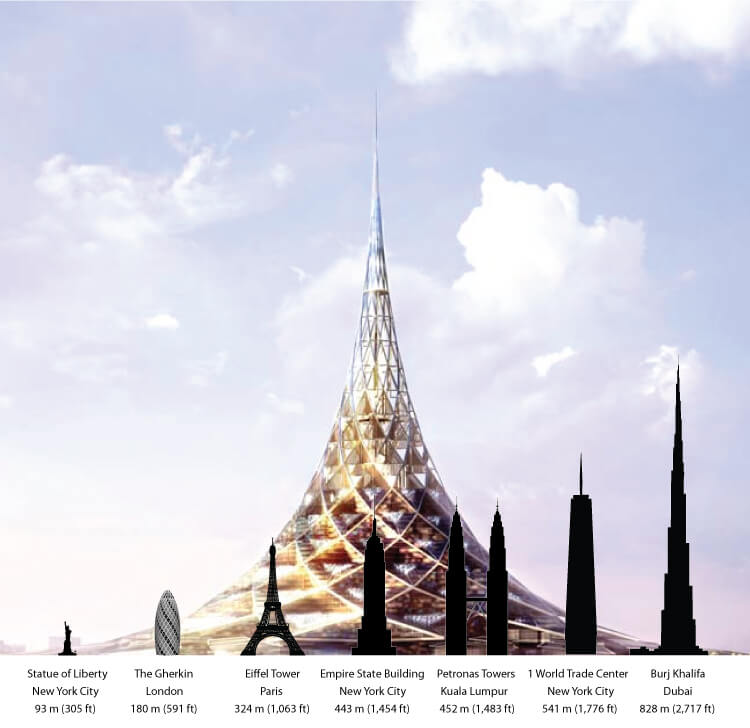
By the 22nd century, these towers have evolved into some of the mightiest structures ever built: of such immense volume that some cover several kilometres in girth, typically rise over 1.5 kilometres in height* and accommodate millions of people.** Some are partially or fully merged into mountainsides and other landscapes – resembling enormous ant colonies, and living up to their portmanteau of "architecture" and "ecology". This scale of engineering has been made possible through advances in materials science, with carbon nanotubes utilised to cope with the massive forces involved. The sheer size and strength of arcologies makes them virtually immune to earthquakes, hurricanes and other disasters.
Each of these self-contained structures holds everything it needs for human survival. Automation is ubiquitous with intelligent robots managing almost all construction and maintenance.* Highly efficient transport systems are located throughout to move travellers horizontally, vertically or diagonally. Advancements in elevator technology have made lifts capable of whisking riders up in a single trip – no matter what height – as opposed to changing halfway up.* This has been accomplished through improved cable design and, more recently, the use of electromagnetic propulsion.* This kind of hyper-dense urban environment allows movement around a city at speeds unheard of in previous centuries.
These radical new designs exemplify an overall trend in recent human development: low environmental impact. Globally, cities and their connecting infrastructure are slowly being retracted, giving over more land to nature. Advances in transportation and civil engineering, combined with nano-scale manufacturing, are enabling humans to operate with little or no impact on the environment. Though classically designed cities still exist, the arcology represents a fundamental shift in the balance between humans and nature.
2120
Mind uploading enters mainstream society
Adequate hardware to simulate a human mind became available as far back as the 2020s, thanks to the exponential progress of Moore's Law.* This led to comprehensive studies of neural processes in humans. However, the underlying software foundation required to achieve the much more advanced technology known as mind uploading proved to be a vastly greater challenge. Full transfer of consciousness into artificial substrates presented enormous technical difficulties, in addition to raising ethical and philosophical issues.
The sheer complexity of the brain, and its inherent fragility – along with the many legislative barriers that stood in the way – meant that it was nearly a century before such technology reached the mainstream.
Some breakthroughs occurred in the latter decades of the 21st century, with partial transfer of memories and thought patterns, allowing some limited experience of the mind uploading process. However, it was only through the emergence of picotechnology and strong AI that sufficiently detailed scanning methods became available. This new generation of machines, being orders of magnitude faster and more robust, finally bridged the gap between organic human brains and their synthetic equivalents.
Initially tested on monkeys, the procedure was eventually offered to certain marginalised people including death row inmates and terminally ill patients. Once it could be demonstrated as being safe and reversible, the project garnered a steady stream of free and healthy volunteers, tempted by this new form of computerised immortality.
Years of red tape and legislation followed, including some of the strictest regulations ever enacted into law. Religious and conservative groups voiced their objections to what they saw as a fundamental violation of God's will. At times, this threatened to postpone the technology indefinitely. Eventually though, like so many other breakthroughs in science, the zeitgeist moved on. The level of demand for mind uploading proved to be enormous, and the treatment became widely available in the 2120s.
Today, citizens have access to special clinics in which their biological brains can be literally discarded in favour of artificial ones. Rather than simply "duplicating" a mind, the machine physically shifts the consciousness, like a sponge soaking up water. The brain is gradually replaced – piece by piece – so the original personality remains intact during the transition. This vital aspect of the procedure assuages the fear which many have of losing their identity.
For the wealthiest individuals, entire new bodies can be grown, into which the synthetic brains can be transplanted. These bodies may themselves be artificial, with options for partially cyborg or fully robotic replacements. Externally, they are often indistinguishable from real human bodies, but include many hi-tech add-ons and internal features boosting physical and mental abilities.
Not everyone is opting for these types of treatments, however. A significant percentage view them with extreme suspicion, as though somehow immoral and dehumanising. With each passing year, society is becoming increasingly fractured, with an ever-widening divide between those who seek to enhance themselves, and those who prefer to eschew such technology.

© Kts | Dreamstime.com
The Onkalo nuclear waste depository is sealed
Following a major expansion of its nuclear power, Finland began operating the world's first permanent repository for high-level nuclear waste in the mid-2020s. Known as Onkalo (meaning "cave" or "hiding place"), this had been in planning since the 1980s, with construction taking place from 2004 until 2017. The facility would reach a depth of 420 metres (1,380 ft) underground and be located near the Olkiluoto nuclear power plant on the country's west coast.
Spent uranium fuel rods, encased in large copper casks, arrived via elevator before remote-controlled vehicles took them to one of many disposal tunnels, forming a structure like a giant ant's nest in the bedrock.
Posiva, a company established by two nuclear power utilities, studied and mapped the site's geology before and during excavation to ensure the copper casks would be protected from any water corrosion. First, the rock itself functioned as a barrier, due to its extreme hardness and lack of porosity. Secondly, they placed rings of bentonite clay around each cask to absorb water that somehow got through, as well as blocking microbes that might accelerate corrosion processes. Finally, copper had been chosen for the casks themselves because of its lack of reactivity in oxygen-free waters, although some scientists had said corrosion might still be possible in pure water and that bronze might have been more suitable.*
Onkalo had enough capacity to accept canisters of nuclear waste for one hundred years. As a viable, long-term solution for such waste, other countries began to adopt this method.* By 2120, the final burials are taking place, before the access tunnel is backfilled and sealed for 100,000 years, after which time the radiation declines to a safe level.
2130
Antimatter triggers a new era of space exploration
By the 2130s, the dream of harnessing antimatter for industrial and propulsive use has finally moved from theoretical physics and into practical engineering. Although humanity is not yet ready to launch the starships of science fiction, a crucial milestone is being reached, with global annual production of antihydrogen now hitting 1 gram.* While this amount may sound trivial – roughly the mass of a paperclip – in the realm of high-energy physics it represents a staggering amount of potential energy, sufficient to revolutionise travel within the Solar System.
The journey to this point began over a century earlier. Facilities like CERN in Switzerland had struggled to produce even nanograms of antimatter, and their early attempts demanded budgets that no nation could sustain. The clean energy revolution transformed that landscape; as fusion power became commercially widespread and the world entered an era of energy abundance, humanity finally gained the immense power supply needed for large-scale antimatter production. At the same time, advanced AI systems optimised magnetic confinement traps and improved the stability of antimatter storage.
Most research in the 2130s is directed not toward pure antimatter rockets, but a hybrid propulsion system called Antimatter-Catalysed Micro-Fission/Fusion (ACMF). Instead of burning antimatter as a primary fuel, spacecraft inject microscopic bursts of antiprotons into tiny pellets of deuterium–tritium. The antimatter triggers immediate and highly efficient fusion reactions that provide thrust via magnetic confinement and a magnetic nozzle, without relying on the gigantic lasers or heavy magnetic coils that earlier fusion engines required.
The economics of space travel are shifting dramatically in this era. A journey to Mars, once a seven-month endurance test, now takes only a few weeks on the fastest launch windows, with the swiftest hybrid drives completing the trip in just over two weeks. Heavy industry is appearing in the asteroid belt and the moons of both Jupiter and Saturn,* using hybrid shuttles that consume only micrograms of antimatter per trip.
Beyond propulsion, the practical applications of antimatter have revolutionised astronomy. Its ultra-high energy density is providing deep-space observatories with a compact, long-duration power source, allowing them to operate far beyond the reach of solar energy. While fission and fusion systems already do this, antimatter delivers far more energy per kilogram, keeping power units and propellant masses extraordinarily small.
Engineers are now using this capability to deploy and maintain vast swarms of free-flying telescopes that function as a single, colossal instrument. Instead of relying on one mirror, these networks use antimatter-derived power to run micro-thrusters and metrology systems that hold formation with nanometre-scale precision across tens of kilometres. This technique – known as optical interferometry – gives the array a resolving power equivalent to a telescope as large as the entire formation. As a result, astronomers can resolve surface patterns on the nearest exoplanets, distinguishing land–sea contrasts and tracking cloud systems over days and weeks, while long-term monitoring reveals seasonal and climatic shifts on worlds light years from Earth.
Elsewhere in the Solar System, the first private ventures have reached the inner Oort Cloud, once a dark and inaccessible frontier around 300 billion kilometres from the Sun. These rigs operate using Penning traps – compact "antimatter batteries" that deliver short, intense bursts of power for drilling into volatile-rich cometary ice and rock.
Meanwhile, planetary defence has been largely perfected; potential asteroid impacts are no longer a source of existential dread, as interceptors equipped with high-yield antimatter charges can vaporise incoming threats with surgical precision.
On Earth, the military application of antimatter has produced a new class of strategic weapon. These devices deliver an intense burst of lethal radiation and explosive power, but without the long-lived fallout associated with fission weapons, allowing for what might be described as "clean" strikes. However, in a world increasingly stabilised by post-scarcity economics, these weapons remain a deterrent rather than a tool of war.
On a more fundamental level, greater access to antimatter has enabled a new wave of experiments into the deepest questions in physics. Larger trapped samples of antihydrogen allow laboratories to compare matter and antimatter with unprecedented precision, testing gravity and fundamental symmetries for tiny deviations. Even the smallest mismatch could help explain how the very early Universe tipped in favour of matter, leaving almost no primordial antimatter behind.
While the Solar System has effectively become humanity's backyard, the stars themselves remain just out of reach for human crews. The current generation of hybrid drives – while miraculous by historical standards – cannot yet bridge the vast gulf to Alpha Centauri within a human lifespan. However, with antimatter production rates continuing to climb exponentially, engineers are already drafting plans for the next great leap in propulsion – a true relativistic engine for interstellar exploration later this century.

2140
"Perfect" simulations of one cubic metre
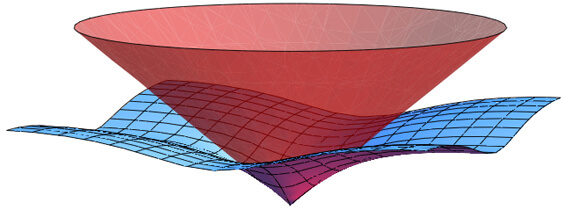
In the early 21st century, supercomputers used a simulation technique called lattice quantum chromodynamics, performing calculations by essentially dividing space-time into a four-dimensional grid. With a resolution based on the fundamental physical laws, they could simulate only a tiny portion of the universe accurately – on the scale of one 100-trillionth of a metre, slightly larger than the nucleus of an atom.*
At best, algorithms were able to demonstrate the strong nuclear force among protons and neutrons and its effect on nuclei and their interactions. This was achieved in femto-sized universes where the space-time continuum was replaced by a lattice, with spatial and temporal sizes on the order of several femto-metres or fermis and whose lattice spacings (pixelations) were fractions of fermis. Lattice gauge theory revealed new insights into the nature of matter, but was still fairly limited in scope.
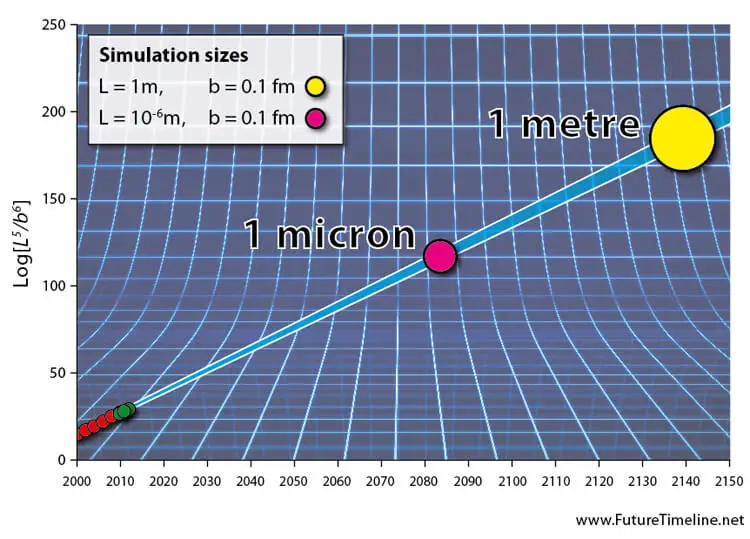
However, computer power and information technology in general were growing exponentially. In fact, they had followed a remarkably smooth and predictable trend throughout the 20th century.* This growth rate continued its consistent path in the 21st and 22nd centuries.*
By 2140, a region of space measuring 1 cubic metre can be simulated in near-perfect detail, down to the smallest quantum unit.* This landmark in physics has profound applications. It soon paves the way for larger simulations of two metres, providing absolutely accurate representations of the entire human body. Scientific experiments on these and similar-sized objects can now be literally as controlled as they can be – with data obtained far more reliably and much faster than in real-world and real-time settings.
Holodeck-style environments become possible in the latter half of this century, as these simulations continue to increase in detail and spatial extent, reaching tens of metres and greater. This offers a level of realism that was unavailable with full-immersion virtual reality. To an observer placed in these miniature universes, it would be almost impossible to distinguish reality from fantasy.
« 2099 |
⇡ Back to top ⇡ |
2150 » |
If you enjoy our content, please consider sharing it:
References
1 "An analysis of the history of technology shows that technological
change is exponential, contrary to the common-sense 'intuitive linear'
view. So we won't experience 100 years of progress in the 21st century
— it will be more like 20,000 years of progress (at today's rate).
The 'returns,' such as chip speed and cost-effectiveness, also increase
exponentially. There's even exponential growth in the rate of exponential
growth. Within a few decades, machine intelligence will surpass human
intelligence, leading to the Singularity — technological change
so rapid and profound it represents a rupture in the fabric of human history.
The implications include the merger of biological and nonbiological intelligence,
immortal software-based humans, and ultra-high levels of intelligence..."
The
Singularity is Near, by Ray Kurzweil (2005)
http://www.amazon.com/Singularity-Near-Humans-Transcend-Biology/dp/0143037889/ref=sr_1_1?ie=UTF8&s=books
2 Lanier’s Singularity, H+ Magazine:
http://web.archive.org/web/20100918094717/http://www.hplusmagazine.com/articles/ai/lanier%E2%80%99s-singularity
Accessed 1st September 2010.
3 Population, 1800 to 2100,
Our World in Data:
https://ourworldindata.org/grapher/projected-population-by-country?country=~Africa
Accessed 17th January 2022.
4 Agenda 2063,
African Union Development Agency:
https://www.nepad.org/agenda-dashboard
Accessed 17th January 2022.
5 Strait of Sicily Tunnel,
Wikipedia:
https://en.wikipedia.org/wiki/Strait_of_Sicily_Tunnel
Accessed 17th January 2022.
6 Genetically modified "superwheat" could boost yields by 40%,
Future Timeline Blog:
https://www.futuretimeline.net/blog/2016/11/16.htm
Accessed 17th January 2022.
7 Genetic "shortcut" boosts plant growth by 40%,
Future Timeline Blog:
https://www.futuretimeline.net/blog/2019/01/8.htm
Accessed 17th January 2022.
8 CRISPR-edited rice plants increase grain yield by up to 31%,
Future Timeline Blog:
https://www.futuretimeline.net/blog/2018/05/27-2.htm
Accessed 17th January 2022.
9 Ultra-white paint cools surfaces by 10°C,
Future Timeline Blog:
https://www.futuretimeline.net/blog/2021/04/19-ultra-white-paint-cools-surfaces.htm
Accessed 17th January 2022.
10 Urban trees can improve millions of lives by reducing air pollution and temperature, says report,
Future Timeline Blog:
https://www.futuretimeline.net/blog/2016/11/1-2.htm
Accessed 17th January 2022.
11 Large-scale solar and wind power could help in "greening" the Sahara,
Future Timeline Blog:
https://www.futuretimeline.net/blog/2018/09/8-2.htm
Accessed 17th January 2022.
12 Sahara Forest Project,
Wikipedia:
https://en.wikipedia.org/wiki/Sahara_Forest_Project
Accessed 17th January 2022.
13 World's first 3D printed school opens in Malawi,
Future Timeline Blog:
https://www.futuretimeline.net/blog/2021/07/13-worlds-first-3d-printed-school.htm
Accessed 17th January 2022.
14 Africa's rising cities: How Africa will become the center of the world's urban future,
The Washington Post:
https://www.washingtonpost.com/world/interactive/2021/africa-cities/
Accessed 17th January 2022.
15 Animation: World's Largest Megacities by 2100,
Visual Capitalist:
https://www.visualcapitalist.com/worlds-20-largest-megacities-2100/
Accessed 17th January 2022.
16 Future sea level predictions revised upwards,
Future Timeline Blog:
https://www.futuretimeline.net/blog/2019/09/27.htm
Accessed 17th January 2022.
17 Lilypad, a floating ecopolis for climate refugees, vincent.callebaut.org:
http://www.vincent.callebaut.org/page1-img-lilypad.html
Accessed 16th July 2009.
18 Green Float,
Shimizu Corporation:
http://www.shimz.co.jp/english/theme/dream/greenfloat.html
Accessed 8th January 2014.
19 Marine pollution, Wikipedia:
https://en.wikipedia.org/wiki/Marine_pollution
Accessed 8th January 2014.
20 Emperor penguins could be virtually extinct by 2100, scientists say,
Telegraph.co.uk:
http://www.telegraph.co.uk/earth/earthnews/4355800/Emperor-penguins-could-be-virtually-extinct-by-2100-scientists-say.html
Accessed 19th September 2009.
21 Launch costs to low Earth orbit, 1980-2100,
Future Timeline:
https://www.futuretimeline.net/data-trends/6.htm
Accessed 8th May 2020.
22 See 2038.
23 Capital punishment by country,
Wikipedia:
https://en.wikipedia.org/wiki/Capital_punishment_by_country
Accessed 12th October 2021.
24 United Nations moratorium on the death penalty,
Wikipedia:
https://en.wikipedia.org/wiki/United_Nations_moratorium_on_the_death_penalty
Accessed 12th October 2021.
25 Physics of the Impossible,
Penguin Random House:
https://www.penguinrandomhouse.com/books/89412/physics-of-the-impossible-by-michio-kaku/
Accessed 24th January 2021.
26 Superconductivity achieved at 15°C,
Future Timeline Blog:
https://www.futuretimeline.net/blog/2020/10/17-room-temperature-superconductor-future-timeline.htm
Accessed 24th January 2021.
27 Samsung predicts the world 100 years from now,
Future Timeline Blog:
https://www.futuretimeline.net/blog/2016/02/24.htm
Accessed 9th May 2020.
28 The Med-Bay in Elysium (2013),
YouTube:
https://www.youtube.com/watch?v=ZK1r6VP49qI
Accessed 9th May 2020.
29 Cancer deaths in the United States, 2000-2150,
Future Timeline:
https://www.futuretimeline.net/data-trends/7.htm
Accessed 9th May 2020.
30 "Force fields" are more than just science fiction. They are
perfectly possible within the laws of physics, according to Michio Kaku
– one of the world's leading futurists. He predicts use of this technology
"within a century or so".
See Physics of the Impossible, by Michio Kaku:
http://www.amazon.com/Physics-Impossible-Scientific-Exploration-Teleportation/dp/0307278824/ref=sr_1_1?ie=UTF8&s=books&qid=1250029787&sr=1-1
Accessed 9th September 2009.
31 "According to Discovery Channel's documentary on the pyramid it would be complete within the year 2110."
See New Mega-City Challenge – Concept,
Geekwidget:
http://www.geekwidget.com/shimizu-try-2004-mega-city-pyramid-346
Accessed 1st December 2013.
32 Masdar City,
Wikipedia:
https://en.wikipedia.org/wiki/Masdar_City
Accessed 9th June 2016.
33 Five real-world arcologies under construction,
Wired:
http://www.wired.co.uk/news/archive/2011-06/21/paolo-soleri-arcologies
Accessed 1st December 2013.
34 See 2050.
35 New skyscraper technology allows lifts to reach over 1 km,
Future Timeline Blog:
https://www.futuretimeline.net/blog/2013/06/14.htm
Accessed 1st December 2013.
36 "One of the most radical ideas is to build vast numbers of "superskyscrapers". Far taller than conventional skyscrapers, these buildings will gradually come to dominate cities, from London to Moscow, and house millions of people who currently live in the countryside or the suburbs."
The way we'll live next,
The Telegraph:
http://www.telegraph.co.uk/news/science/9475573/Report-The-way-well-live.html
Accessed 3rd January 2018.
37 The Tallest 20 in 2020: Entering the Era of the Megatall,
http://www.ctbuh.org/TallBuildings/HeightStatistics/BuildingsinNumbers/TheTallest20in2020/tabid/2926/language/en-US/Default.aspx
Accessed 1st December 2013.
38 See 2100.
39 New skyscraper technology allows lifts to reach over 1 km,
Future Timeline Blog:
https://www.futuretimeline.net/blog/2013/06/14.htm
Accessed 1st December 2013.
40 "A smart though far-off solution, Wood says, would be to replace cabled elevators with electromagnetically propelled cars. Occupants could be strapped in, rather like on theme park rides, and whisked to their in-building destinations through shafts running horizontally as well as vertically. 'That would be the single biggest breakthrough in tall buildings,' Wood says. 'The minute you have elevators go horizontal, you can reduce the number of shafts in the building. You could design one with just two shafts and have 80 cars working in a system where they pass each other.'"
Taller: How Future Skyscrapers Will Beat the Burj Khalifa,
Popular Mechanics:
http://www.popularmechanics.com/technology/engineering/architecture/taller-how-future-skyscrapers-will-beat-the-burj-khalifa-8893983
Accessed 1st December 2013.
41 The Singularity is Near, by Ray Kurzweil (2005)
http://www.amazon.co.uk/Singularity-Near-Raymond-Kurzweil/dp/0715635611
Accessed 19th July 2009.
42 Finland built this tomb to store nuclear waste. Can it survive for 100,000 years?, Science:
https://www.science.org/content/article/finland-built-tomb-store-nuclear-waste-can-it-survive-100000-years
Accessed 6th March 2022.
43 Finland Might Have Solved Nuclear Power's Biggest Problem, YouTube:
https://www.youtube.com/watch?v=kYpiK3W-g_0
Accessed 6th March 2022.
44 Extrapolated from the following data:
CERN (LEAR) (1995)
9 atoms
ATHENA (2002)
50,000 atoms
ALPHA-2 (2017)
250,000 atoms
ALPHA-g (2024)
2,000,000 atoms
45 First human landing on an asteroid by 2073, say scientists, Astronomy.com:
https://www.astronomy.com/space-exploration/first-human-landing-on-an-asteroid-by-2073-say-scientists/
Accessed 7th December 2025.
46 Do we live in a computer simulation? Researchers say idea can be tested, Future Timeline Blog:
https://www.futuretimeline.net/blog/2012/12/11.htm
Accessed 10th January 2013.
47 Exponential Growth of Computing, Singularity.com:
http://www.singularity.com/charts/page70.html
Accessed 10th January 2013.
48 The Singularity is Near, by Ray Kurzweil:
http://www.amazon.com/Singularity-Near-Humans-Transcend-Biology/dp/0143037889/
Accessed 10th January 2013.
49 Constraints on the Universe as a Numerical Simulation, Silias R. Beane. et al., University of Washington:
http://arxiv.org/pdf/1210.1847v2.pdf
Accessed 10th January 2013.
 |
|||||||||||||||||||||||||||||||
|
Latest predictions |
Timeline » 21st century |
Blogs » AI & Robotics |
Features » |
About us
|
|||||||||||||||||||||||||||
|
|
|||||||||||||||||||||||||||||||


