
![[+]](https://www.futuretimeline.net/images/buttons/expand-symbol.gif)
|
|
|
|
|
|
2036-2045
The International Lunar Research Station (ILRS) establishes long-term human operations
The International Lunar Research Station (ILRS) is a Moon base constructed at the lunar south pole, initially uncrewed and robotic but later involving humans on increasingly long duration stays. Led by China, the ILRS attracts international partners such as Russia who contribute various components.
The Chang'e series of probes, beginning in 2007, allowed China to gain experience with orbital manoeuvres and the lunar surface environment. The first two of these missions formed Phase I of its Lunar Exploration Program. Chang'e 3 and 4, which formed Phase II, involved soft landings and the deployment of rovers. Phase III followed with Chang'e 5-T1 and Chang'e 5, the latter in 2020 which became China's first sample return mission.
China intended a fourth phase to serve as preparation for a lunar research station. Chang'e 6, launched in 2024, investigated the topography, composition and subsurface structure of a landing site at the south pole, and returned samples from this region to Earth. Its successor, Chang'e 7, explored the polar environment in more detail. This mission included an orbiter, lander, rover, and mini-flying probe. Chang'e 8 followed in 2027 and became the most advanced lunar mission ever attempted by China. In addition to a lander, rover, and flying detector, it featured 3D printing using in-situ resource utilisation. This experiment demonstrated the test-building of a structure necessary for a lunar base.
By 2030, China had completed its robotic Lunar Exploration Program and begun shifting to more human-oriented missions. The Long March 9 super-heavy lift launch vehicle dramatically expanded the country's capabilities in space. With a payload capacity of 50,000 kg for trans-lunar injection, very large cargoes could now be delivered to the surface.
Following the earlier demonstration by Chang'e 8, more activity occurred around the site. Subsequent machines with more sophisticated construction techniques established the beginnings of a temporary lunar base. A major landmark in China's history occurred at this time with its first astronauts walking on the Moon.
China intended to sustain a more permanent presence on the lunar surface and worked to develop the International Lunar Research Station (ILRS), by far its most ambitious undertaking yet. This would include support for longer-term, larger-scale scientific research, technical experiments and the development and utilisation of lunar resources, as well as habitat modules, solar energy generation, and vehicles for exploring beyond the site. By the late 2030s, it has begun to welcome human crews on long duration stays.*
Like its NASA counterpart, the south pole is a favoured location for the ILRS, due to permanently sunlit spots with near-continuous solar energy, as well as permanently shadowed craters known to contain water and other volatiles; a result of the Moon's axis of rotation. Roscosmos* and other international partners are involved in the ILRS, which continues to expand and develop into the 2040s.* By 2045, China begins to shift its focus away from the Moon and onto Mars.*
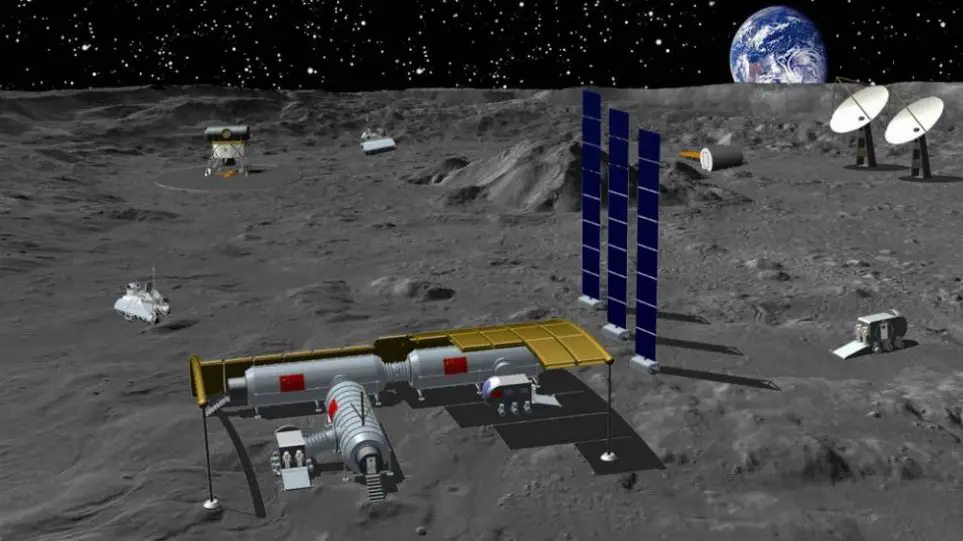
China Moon base of the 2030s. Credit: China Academy of Space Technology (CAST)
2036-2040
Transhuman sports competitors
By the late 2030s, genetic therapies and bio-technological implants have become so cheap, accessible and mainstream that it has dramatically altered the world of sports and recreation. A combination of personalised DNA sequencing (now ubiquitous), gene-editing options like CRISPR, and smart drug delivery methods has led to the gradual acceptance of do-it-yourself biology and the destigmatisation of performance-enhancing techniques. New forms of robotic and cybernetic integration are also seeing widespread use, pushing the boundaries of human ability.
In 2016, the first "cybathlon" had taken place in Zurich, Switzerland.** This competition was designed to offer amputees and other disabled people the chance to upgrade their physical abilities, using experimental prototypes from research labs and commercially successful products from large companies. These included exoskeletons to make stepping easier for paraplegics, as well as sensors implanted in athletes' bodies to directly control machines. Subsequent years would see major advances in prosthetics and other devices, some of which were officially introduced into sports. Initially confined to those with disabilities, the various upgrades eventually began to match and even exceed the capabilities of normal humans. Alongside breakthroughs in gene therapy and stem cells, this led to many public debates and conversations about the legality of bodily enhancements, with calls to provide options for regular, able-bodied competitors.
In addition to a more dynamic and exciting Paralympics, a third "super athlete" event category is a feature of the 2036 and 2040 Olympics.** This aims to showcase a new generation of enhanced "transhumans" with superior strength, speed and endurance. While something of a novelty at first, the event is soon taken seriously and becomes a permanent fixture, drawing in huge audiences and sponsorship deals. With sport becoming ever more commercialised each year, transhumans are heavily funded and sponsored by pharmaceutical, biotech, electronics and other firms marketing their products and services.
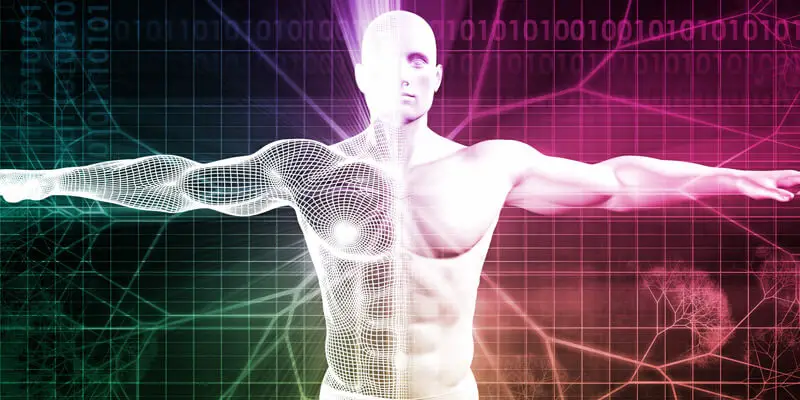
The new abilities offered to super athletes are numerous and diverse.* Treatments are available to increase red blood cell counts, thus boosting oxygen delivery by up to 50% and providing greater endurance. Genes can be altered to block pain pathways in nerves, allowing athletes to play through pain. Deactivating the MSTN gene can double muscle mass, while the PEPCK gene can be tweaked to burn fatty acid for energy without producing lactic acid, meaning athletes can run at top speed for 60% longer. Modifying the LRP5 gene can increase bone density, while the TNC and COL5A1 genes can improve resistance to tendon and ligament injury. Most athletes can now recover from injuries within days, rather than weeks or months.
These and other treatments are now safe and legal – and used not just in athletics, but a whole range of sports and recreational activities. Whereas in the past, success was determined to some extent by the genetic lottery, a more level playing field is now possible with drugs being administered to specific, pre-determined amounts for each competitor.
Other changes in the world of sport include dramatic improvements to stadium infrastructure. Advances in ultra-lightweight carbon fibre allow morphing of buildings, roofs and tracks, to cater for any event. Giant, flexible video screens can be integrated on walls and other surfaces, along with massive holographic displays for action replays. Nanotechnology used on track surfaces and in sports equipment can improve grip, or create lighter structures. Driverless cars remove the need for dedicated parking lots, meaning a stadium's footprint can be shrunk considerably, or alternatively used for greater capacity with some having 250,000 seats. Artificial intelligence can choose seats based on social media contacts or other factors, while facial recognition can monitor for signs of trouble and prevent criminal activity.
For those watching from home, highly immersive VR and other options are now available. For example, some players now wear contact lenses featuring built-in cameras that can stream video to provide a first-person view of the action.
2036
Supercomputers reach the zettascale
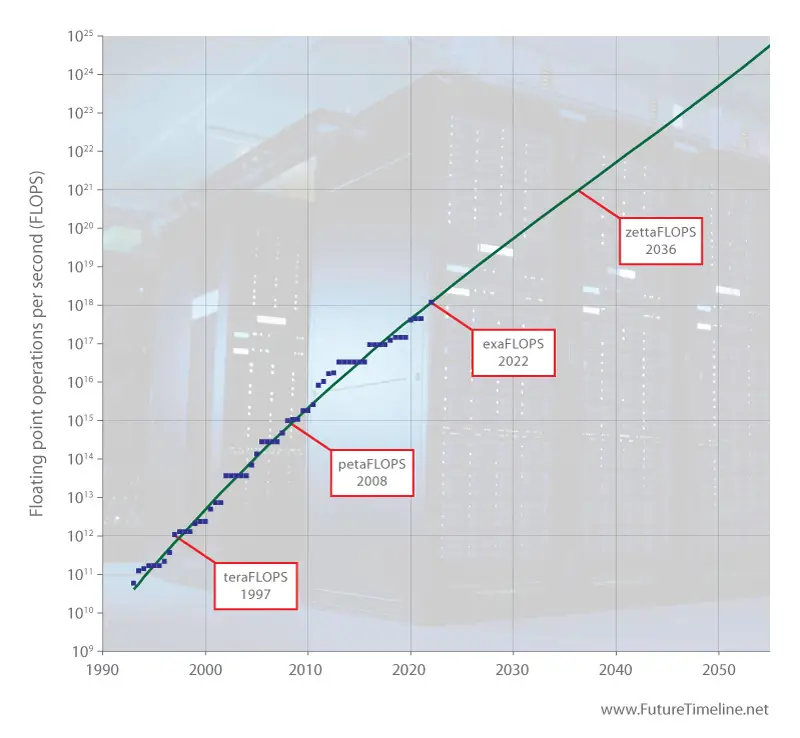
Supercomputers are now 1,000 times more powerful than in 2022.* The fastest machines are reaching 1021 floating point operations per second (FLOPS). This is known as zettascale computing, which follows the previous exascale regime.
A supercomputer running on 1 zettaFLOPS is capable of full weather modelling over a two-week period.* The cliché of people complaining of inaccurate forecasts is fading from public discourse, as more and more weather agencies upgrade their monitoring systems. Climate change models are also becoming more accurate than ever before, further reducing the uncertainties over temperature rises and future impacts. This is placing even greater pressure on governments and businesses to take meaningful action.
Zettascale computing can also dramatically reduce the time needed for astrophysical simulations of rare phenomena, such as black holes, neutron star mergers and supernovae. For example, 3D model calculations of shock wave instability from the collapsing core of a supernova – which took a million processor-hours to run on petaFLOPS machines and 1,000 hours on exaFLOPS machines – can now be performed in just one hour.*
At the microscopic scale, biological research is moving from "proof of concept simulations" to "production simulations". While the former can represent short trajectories on large systems containing many millions of atoms, or millisecond trajectories on ultra-simplistic systems, the latter enables large systems embedded in complex biological environments to be well sampled. Not only can the folding of large proteins be observed, but the entire cell proteome and the dynamics of entire signal transduction pathways.* This is revealing the mechanisms behind aging, cellular senescence and many other aspects of biology in greater detail than ever before.
Alongside these conventional applications, intelligent computing applications such as deep learning continue to emerge. Processor designs in zettascale systems are therefore taking mixed-precision arithmetic (numbers with varying widths in a single operation) into greater consideration to support more varied workloads. Micro-architectures are evolving to consist of increasingly diverse and heterogeneous components, with many forms of specialised accelerators – including new paradigms like quantum computing – co-existing to boost performance. New interconnect materials such as photonic crystals are enabling fully optical-interconnecting systems to come into use, leading to more scalable, high-speed, and low-cost interconnection. Memristors are also being deployed to close the gap between storage and computing.*
Despite new cooling systems and other efficiency improvements, the power requirements for zettascale computing are huge. Some have peak consumption upwards of 100 megawatts (MW), enough to power a small city, and more than triple the figure of Japan's Fugaku, the world's fastest machine in 2021.
Hepatitis C has become a rare disease in the U.S.
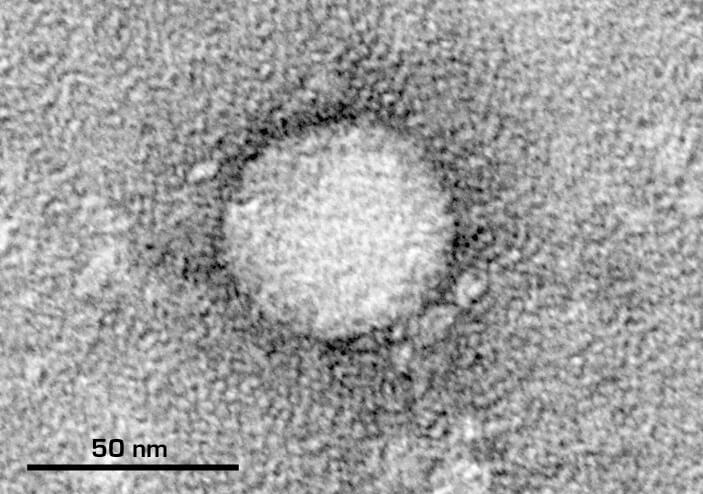
Hepatitis C is an infectious disease affecting primarily the liver, caused by the hepatitis C virus (HCV). The infection is often asymptomatic, but chronic infection can lead to scarring of the liver and ultimately to cirrhosis, which is generally apparent after many years. In some cases, those with cirrhosis will go on to develop liver failure, liver cancer, or life-threatening oesophageal and gastrointestinal damage. HCV is spread by blood-to-blood contact from intravenous drug use, poorly sterilised medical equipment, transfusions, body modification (such as tattoos or piercings) and high-risk sexual activity.
The existence of hepatitis C (originally identified only as a type of non-A non-B hepatitis) was first suggested in the 1970s and proven in 1989. By the early years of the 21st century, an estimated 150–200 million people globally were infected. Those who developed cirrhosis or liver cancer required a liver transplant in some cases. However, in many regions of the world, people were unable to afford treatment as they either lacked insurance coverage or the insurance they had would not pay. In the United States, the average lifetime cost of HCV was estimated at over $33,000, with a liver transplant costing approximately $200,000; and more than 15,000 deaths were attributed to the disease each year.
Standard approved treatments were able to cure 50–80% of patients. However, a new generation of medicine was emerging, based on nanoparticles* and direct-acting antivirals* – able to target specific virus enzymes. This was alongside trends showing improvements in access to treatment, and more aggressive screening guidelines. By the 2010s, over a hundred new medications were being researched and developed. By 2036, only 1 in every 1,500 people in the U.S. are infected with HCV.**
In-vitro meat is a mature industry
Recent advances in tissue engineering have made it possible to "grow" synthetic meat, using single animal cells. This first became affordable to the public in the 2020s.** After years of further testing and refinement, a wide range of different meat products are now available, in what has become a rapidly expanding market.*
In-vitro meat has a number of advantages. Being just a lump of cultivated cells, it is produced without harm or cruelty to animals. It is unusually pure and healthy whilst retaining the original flavour, texture and appearance of real meat. Perhaps most importantly, it requires far less water and energy to produce, greatly lessening the impact on the environment.
Like GM crops, there were political and psychological hurdles that delayed its adoption in some countries. However, rising food prices caused by population growth and ecological impacts, together with endorsements from animal welfare groups, later gave impetus to its development. Though still years away from completely replacing traditional meat, it is now a mainstream product in most countries around the world.

Lemurs are on the brink of extinction
After years of decline, the vast majority of the world's 103 species of lemur are facing extinction. This has been the result of decades of sustained deforestation, mining, hunting, and slash-and-burn farming on Madagascar – their only natural habitat on the planet. By now, very little of the island's original forest cover remains. This has forced lemurs and countless other species into increasingly small and isolated patches of liveable habitat.*
In earlier decades, a number of efforts were undertaken which attempted to preserve the remaining populations. The effectiveness of these projects was severely limited by the social and political climate of Madagascar. Government corruption and the impotence of law enforcement meant that any restrictions on deforestation and poaching were poorly enforced or outright ignored. The extreme poverty of the nation also forced many inhabitants to turn to the forests to illegally cut wood or dig for gold in order to support themselves. Many hunted lemurs for food as well.
Today, the majority of remaining individuals can be found only in zoos and private collections. Lemurs are now joining the ranks of the radiated tortoise* and many other species disappearing from Madagascar. By the middle of the 21st century the island will have experienced one of the most dramatic mass extinctions in human history. This will occur alongside many similar events throughout the natural world.*

Contact with the Voyager probes is lost
By 2036,* contact with the Voyager probes finally comes to an end, bringing one of the longest and most remarkable missions in the history of space exploration to a close. Launched in 1977, Voyager 1 and Voyager 2 far exceeded their original design lifetimes, remaining operational for nearly six decades as they journeyed into interstellar space.
Voyager 1 is the farthest human-made object from Earth, travelling nearly 16 billion miles (26 billion km) away, or over 170 times the distance between the Sun and Earth. Both spacecraft left the heliosphere years earlier and continued returning unique measurements of the interstellar medium, providing humanity with its first direct observations from beyond the protective influence of the solar wind and the Sun's magnetic field.
The mission did not end in a single moment, but faded out in stages. During the second half of the 2020s, the Voyagers ceased returning science data as dwindling electrical power forced mission controllers to shut down instruments one by one. Engineers prioritised the fields and particles instruments most relevant to interstellar space, but even these eventually fell silent as output from the probes' radioisotope thermoelectric generators continued to decline.
This staged shutdown plan replaced earlier expectations of a sudden loss of contact. Instead of attempting to keep all instruments operating until a hard cutoff, mission managers deliberately powered down systems incrementally, conserving enough energy to keep transmissions going for as long as possible. As a result, while scientific measurements largely ended by the mid-2020s, the Voyagers continued returning engineering and telemetry data for many years afterward, allowing Earth-based teams to monitor spacecraft health, orientation, and power levels.
Engineers also extended the mission through careful management of aging subsystems. In 2025, controllers revived a set of long-dormant backup thrusters on Voyager 1 to help maintain antenna pointing and preserve its ability to communicate with Earth. Combined with a systematic shutdown of non-essential systems, these measures stretched the probes' communicative lifetimes well beyond earlier projections.
By the mid-2030s, however, the remaining power supply is dropping below the threshold required to operate the transmitters themselves. One by one, the final carrier signals fade as both spacecraft lose the ability to send even their basic engineering data. When the last transmission disappears, contact with the Voyagers ends permanently.
However, each probe continues its silent journey through the galaxy, carrying a gold-plated audio-visual disc intended as a message from Earth to any potential future finders. Voyager 1 will reach the inner Oort Cloud by 2310, and pass near the red dwarf star Gliese 445 around the year 42,000 AD, while Voyager 2 will drift near Sirius in 298,000 AD.

The Venera-D mission arrives at Venus
Venera-D is a Russian-led space mission to study the atmosphere and surface of Venus, with the primary aim of understanding the planet's history, climate evolution and potential past habitability. Russian scientists first proposed the mission to the Russian Academy of Sciences in 2003, with early studies envisioning a possible launch in the 2010s. Repeated delays and redesigns pushed the schedule back by more than two decades.
Russia finally launches the spacecraft in 2036,* with arrival at Venus later the same year. The mission consists of three main components: an orbiter, a balloon platform operating in the upper atmosphere, and a surface lander.
The orbiter carries advanced spectrometers, radar instruments and atmospheric sensors. These systems map the planet's surface at far higher resolution than earlier missions such as Venera 15 and 16 in the 1980s and NASA's Magellan in the 1990s. The orbiter studies the composition and structure of the atmosphere and clouds, the radiative balance that drives the extreme greenhouse effect, and the behaviour of the ionosphere and magnetosphere. It also measures how gases escape into space and investigates the long-standing mystery of atmospheric super-rotation, in which high-altitude winds circle the planet in just a few days while surface winds remain comparatively slow.
The balloon operates within the more temperate layers of Venus's atmosphere, where pressures and temperatures are far less extreme than at the surface. It drifts with the winds at altitudes of around 50–60 kilometres, analysing atmospheric chemistry, cloud structure and dynamic processes over an extended period. By remaining airborne for much longer than a descent probe, it provides continuous in situ measurements of wind speeds, turbulence and chemical composition, offering a detailed picture of the planet's climate system. It also searches for possible signs of microbial life in the clouds, following earlier, disputed detections of phosphine and ammonia in Venus's atmosphere.*
The lander descends to the surface and investigates the geology and chemistry of Venusian terrain, landing in a tessera region – an ancient, highly deformed highland that preserves clues about the planet's early history. This terrain represents a remnant of a time when Venus had a very different climate, which may have included liquid water. The mission returns the first surface data from Venus since the Soviet Vega 2 mission in 1985, over half a century earlier. Its cameras return images of a dim, orange-lit landscape of fractured rock beneath a dense, crushing atmosphere.
Venus presents some of the most extreme conditions in the Solar System, with surface temperatures around 460 °C, pressures more than 90 times that of Earth and clouds of sulphuric acid. Earlier landers survived for little more than an hour, but Venera-D uses more robust electronics and thermal protection systems to extend operational time.
The mission marks a renewed Russian focus on Venus exploration and contributes to a broader international resurgence of interest in the planet during the 2030s, alongside missions such as NASA's DAVINCI and VERITAS and ESA's EnVision. Data from Venera-D helps scientists refine models of Venus's climate evolution and better understand why Earth and Venus, despite their similar size and composition, followed such dramatically different paths.

Credits: O'Rourke, J.G., Wilson, C.F., Borrelli, M.E. et al., CC BY-SA 4.0, via Wikimedia Commons (left). NASA/JPL-Caltech (right).
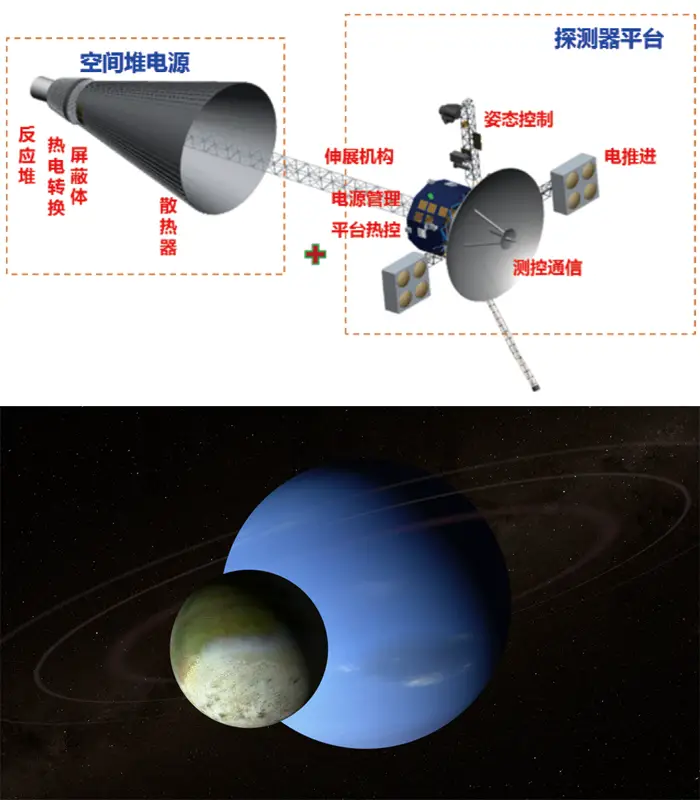
China's first mission to Neptune
Neptune Explorer is a nuclear-powered spacecraft developed by the China National Space Administration (CNSA). Launched in 2030 and remaining operational for at least 15 years, it uses a gravity assist around Jupiter before arriving at Neptune in 2036.*
To reliably provide electricity for its long mission duration, a Radioisotope Thermoelectric Generator (RTG) is used. This nuclear battery, similar to that of recent Mars rovers, converts heat energy from the decay of radioactive material into electricity, offering a 10-kilowatt energy (kWe) capacity.
The spacecraft enters into a polar orbit around Neptune. Its primary science objectives include global remote sensing and studying Neptune's internal structure, atmospheric composition and motion characteristics, the magnetic field, the solar wind, and the planet's moons and ring system. Neptune has the strongest sustained winds of any planet in the Solar System – reaching 2,100 km/h (1,300 mph) – and the cause of these powerful hurricanes is revealed, as well as the reason for the formation and long-term presence of the so-called Great Dark Spot.
The probe reveals new insights relating to the Solar System's formation, early history, and possible future. For instance, evidence is found to show how Neptune's large volumes of gas influenced the protostellar nebula and the eventual positioning of planets closer to the Sun.
The ice giant's largest moon, Triton, is also studied in greater detail than ever before. Only 40% of its surface had been imaged by Voyager 2, so new images of the previously unphotographed sides are captured, at much higher resolution too. The probe generates a trove of scientific data on the moon's geophysical activity and plumes, liquid subsurface environment, and ice cap of frozen nitrogen and methane (the coldest place in the Solar System). It also provides new clues as to Triton's origin and whether it originally formed as a dwarf planet in the Kuiper belt, before gravitational capture by Neptune, possibly causing the breakup of Neptune's existing satellites and the formation of new, smaller ones.
Four microsatellites weighing a total of 100 kg (220 lbs) are deployed from the main craft. Two are released en route to Neptune to visit a main belt and a centaur-class asteroid (the latter being small, orbit-crossing bodies lying between Jupiter and Neptune). Two more are used as penetrators, one targeting Neptune's atmosphere and the other Triton.
« 2035 |
⇡ Back to top ⇡ |
2037 » |
If you enjoy our content, please consider sharing it:
References
1 China is aiming to attract partners for an international lunar research station, Space News:
https://spacenews.com/china-is-aiming-to-attract-partners-for-an-international-lunar-research-station/
Accessed 6th March 2021.
2 Russia, China to sign agreement on international lunar research station, Space News:
https://spacenews.com/russia-china-to-sign-agreement-on-international-lunar-research-station/
Accessed 6th March 2021.
3 China Emphasizes International Cooperation in Future Lunar and Deep Space Exploration, Chinese Academy of Sciences:
http://english.cas.cn/bcas/201902/201911/P020191101567712273312.pdf
Accessed 6th March 2021.
4 Manned moon, Mars missions among plans, China Daily:
https://www.chinadaily.com.cn/a/201911/05/WS5dc07e79a310cf3e355755d1.html
Accessed 6th March 2021.
5 About – CYBATHLON – moving people and technology, ETH Zurich:
http://www.cybathlon.ethz.ch/about-us.html
Accessed 3rd January 2018.
6 The first Cybathlon pushed the limits of bionic technology, engadget:
https://www.engadget.com/2016/10/20/superhumans-cybathlon-cyborg-games-finale/
Accessed 26th January 2017.
7 The New Bionic Sports of the Future Transhumanist Olympics, Motherboard:
http://motherboard.vice.com/read/the-new-bionic-sports-of-the-future-transhumanist-olympics
Accessed 26th January 2017.
8 What could the world of sports look like in 25 years?, Sports Coaster:
http://www.sportscoaster.com/what-could-the-world-of-sports-look-like-in-25-years/
Accessed 26th January 2017.
9 The Future of Sports, Delaware North:
http://www.gannett-cdn.com/usatoday/editorial/sports/The-Future-of-Sports-2015-Report.pdf
Accessed 26th January 2017.
10 Supercomputers – future predictions, Future Timeline:
https://www.futuretimeline.net/data-trends/20-supercomputer-future-prediction.htm
Accessed 17th August 2021.
11 Reversible logic for supercomputing, Proceedings of the 2nd conference on Computing frontiers (pp. 391–402):
https://dl.acm.org/doi/10.1145/1062261.1062325
Accessed 17th August 2021.
12 Frontiers of Extreme Computing 2007 Applications and Algorithms Working Group, Zettaflops.org:
http://www.zettaflops.org/fec07/presentations/Thursday-1130-Zetta-apps-r7.pdf
Archived at: https://www.futuretimeline.net/21stcentury/pdfs/zettaflops-supernovae.pdf
Accessed 17th August 2021.
13 Surviving the deluge of biosimulation data, ResearchGate:
https://www.researchgate.net/publication/337441708_Surviving_the_deluge_of_biosimulation_data
Accessed 17th August 2021.
14 Zettascale by 2035? China Thinks So, HPCwire:
https://www.hpcwire.com/2018/12/06/zettascale-by-2035/
Accessed 17th August 2021.
15 Nanoparticle Completely Eradicates Hepatitis C Virus, IEEE Spectrum:
http://spectrum.ieee.org/nanoclast/semiconductors/nanotechnology/nanoparticle-completely-eradicates-hepatitis-c-virus
Accessed 7th August 2014.
16 Anticipating New Regimens with Direct Acting Antivirals for Hepatitis C, U.S. Department of Veterans Affairs:
http://www.hepatitis.va.gov/provider/hcv/DAA-update.asp
Accessed 7th August 2014.
17 Hepatitis C Will Become a Rare Disease by 2036, techstair:
http://www.techstair.com/2014/08/05/hepatitis-c-will-become-rare-disease-2036/
Accessed 7th August 2014.
18 "With the availability of highly effective therapies, HCV infection could become a rare disease in the next 22 years."
See The Changing Burden of Hepatitis C Virus Infection in the United States: Model-Based Predictions, Annals of Internal Medicine:
http://annals.org/article.aspx?articleid=1892615
Accessed 7th August 2014.
19 Test-Tube Burger Served Up For First Time, Sky News:
http://news.sky.com/story/1124439/test-tube-burger-served-up-for-first-time
Accessed 5th August 2013.
20 What's next: the future, from 2009 to 2049, Wired:
http://www.wired.co.uk/magazine/archive/2009/05/features/whats-next-the-future-from-2009-to-249?page=all
Accessed 28th April 2009.
21 "Eating real meat in 2035 could be as morally questionable as eating foie gras – and about as expensive."
"... over the next 25 years ... the supply of food [will change] more radically than at any time during the 20th century."
Inside the meat lab: the future of food, The Guardian:
http://www.guardian.co.uk/science/2013/jan/05/the-future-of-food
Accessed 7th January 2013.
22 "'If continued at this rate of deforestation, we can say that within 20 to 25 years there will be no more forest and thus no more lemurs,' Jonah Ratsimbazafy, a well-known local primatologist, told AFP."
See Furry lemurs 'could be wiped out within 20 years' , The Telegraph:
http://www.telegraph.co.uk/news/worldnews/africaandindianocean/madagascar/10252191/
Accessed 27th August 2013.
23 See 2029.
24 See 2045-2050.
25 Voyager – Frequently Asked Questions, NASA:
https://science.nasa.gov/mission/voyager/frequently-asked-questions/
Accessed 3rd January 2026.
26 Russia aims to reclaim Soviet space glory with 2036 launch of ambitious Venus mission, Space.com:
https://www.space.com/astronomy/venus/russia-aims-to-reclaim-soviet-space-glory-with-2036-launch-of-ambitious-venus-mission
Accessed 18th March 2026.
27 Possible biosignature detected on Venus, Future Timeline:
https://www.futuretimeline.net/blog/2020/09/14-biosignature-venus.htm
Accessed 18th March 2026.
28 China is Considering a Nuclear-Powered Mission to Neptune, Universe Today:
https://www.universetoday.com/156509/china-is-considering-a-nuclear-powered-mission-to-neptune/
Accessed 26th October 2022.
 |
|||||||||||||||||||||||||||||||
|
Latest predictions |
Timeline » 21st century |
Blogs » AI & Robotics |
Features » |
About us
|
|||||||||||||||||||||||||||
|
|
|||||||||||||||||||||||||||||||


