Thousands of Hungarian Opposition Supporters Rally March 15, 2025
Introduction:
(Radio Free Europe/Radio Liberty) Thousands of Hungarians rallied in Budapest to protest Prime Minister Viktor Orban as the leader of the surging opposition Tisza party vowed to end Orban's 15-year rule.
Orban, meanwhile, stepped up his campaign rhetoric in a separate speech on March 15, pledging to crack down on politicians and journalists who receive foreign funding and again ruling out European Union membership for Ukraine
Hungary is scheduled to hold general elections next year, and opinion polls show the Tisza party, which is headed by former Orban ally Peter Magyar, is surging, in part because of the country’s sputtering economy.
As more than 50,000 backers of Tisza and others rallied in cold weather in Budapest, Magyar pledged to release a popular survey on 12 key economic and political issues in order to hear the "voice of the nation."
"Those who cheat on their own nation should end up in the dustbin of history," Magyar told the crowd. "Our time has come."
This is great news coming out of Hungary. Still, the hard work has just begun. If the new administration fails to implement economic reforms that benefit the country in tangible ways, the appetite for right wing alternatives may grow. Messaging regarding efforts to implement such constructive policies will also be important.
Look at what happened in the U.S. Trump was defeated in 2020 only to stage a comeback in 2024. Hungary needs to avoid such a comeback of right- wing forces.
Who is Hungary’s Péter Magyar and How He Overturned Viktor Orbán’s Illiberal Democracy By Gemma Ware and Zsolt Enyedi
April 16, 2026
Introduction:
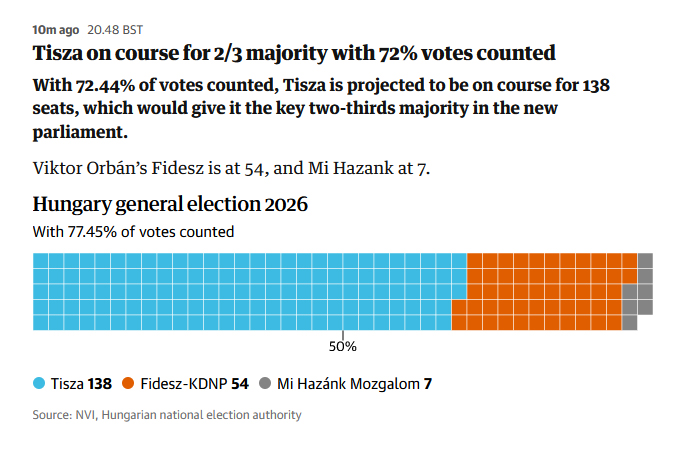
(The Conversation) The day after Péter Magyar ousted Victor Orbán as prime minister of Hungary, he gave a combative press conference. He spoke in Hungarian, but was talking to the world – and particularly to Europe.
“We will do everything to restore the rule of law, plural democracy, and the system of checks and balances,” Magyar said, calling his election a historic moment for Hungary.
During 16 years in power, Orbán and his Fidesz party managed to take control of many of Hungary’s levers of power, from the judiciary to state-owned media, and weakened the institutions that could keep them accountable. Orbán liked to call it an illiberal democracy.
Magyar also urged the Hungarian president to move swiftly to install him as prime minister, before any more damage could be done by Orbán’s loyalists. “We know that people have been destroying documents, just like in the old communist age, that shredders are working full time,” he said.
Viktor Orbán is Gone, but Scores of Public Monuments Show the Potency of His Legacy and Hungarian Nationalism By Brett R. Chloupek
July 15, 2026
Introduction:
(The Conversation) When newly elected Hungarian Prime Minister Péter Magyar delivered a June 4 address to mark Hungary’s Day of National Unity, he did so facing a long stone trench known as the Monument of National Unity. The memorial pays homage to the Treaty of Trianon in 1920, which formally ended Hungary’s involvement in World War I but also resulted in the nation losing about two-thirds of its territory, economy and population.
The monument is provocative in several ways. Its walls are covered with the Hungarianized names of more than 12,000 towns and cities that were once part of “Greater Hungary.” That’s the colloquial name for Hungary’s territory before World War I, when it was still a part of the Austro-Hungarian Empire. The monument incorporates thousands of places now in Slovakia, Romania, Serbia, Ukraine, Croatia, Slovenia, Austria and Poland. The names are intermixed rather than grouped geographically, suggesting the indivisibility of Greater Hungary despite modern borders.
When former Prime Minister Viktor Orbán unveiled such a nationalistic monument in Budapest, the cosmopolitan bastion of the Hungarian political left, it was interpreted as a victory lap. Orbán, a pro-EU capitalist turned right-wing populist, was ousted in April 2026 after 20 total years in power.
He was replaced by Magyar, a former member of Orbán’s Fidesz party whom many observers hope will be a more cooperative international partner.
However, those same individuals across the United States and Europe who cheered Magyar’s surprising victory with hopes it might signal a significant break from Orbánism will likely be disappointed. That’s because Magyar’s huge political mandate should be understood as a referendum on the endemic corruption in Hungarian politics and a desire to return to the political norms of civil society.
What it was not was a clear repudiation of Orbán’s national-historical worldview. Such an outlook, shared by Magyar and a majority of Hungarians, is evident in the more than 125 public monuments built under Orban as part of his Civic Circles movement. Indeed, as a geographer who studies the symbolism of monuments, I see them as a visible manifestation of a nationalist spirit that is pervasive throughout Hungary’s society and politics.