Wearable tech (smart watches, smart glasses etc) news and discussions
-
weatheriscool
- Posts: 26097
- Joined: Sun May 16, 2021 6:16 pm
- Contact:
-
weatheriscool
- Posts: 26097
- Joined: Sun May 16, 2021 6:16 pm
- Contact:
-
weatheriscool
- Posts: 26097
- Joined: Sun May 16, 2021 6:16 pm
- Contact:
-
weatheriscool
- Posts: 26097
- Joined: Sun May 16, 2021 6:16 pm
- Contact:
-
weatheriscool
- Posts: 26097
- Joined: Sun May 16, 2021 6:16 pm
- Contact:
-
weatheriscool
- Posts: 26097
- Joined: Sun May 16, 2021 6:16 pm
- Contact:
-
weatheriscool
- Posts: 26097
- Joined: Sun May 16, 2021 6:16 pm
- Contact:
-
weatheriscool
- Posts: 26097
- Joined: Sun May 16, 2021 6:16 pm
- Contact:
-
weatheriscool
- Posts: 26097
- Joined: Sun May 16, 2021 6:16 pm
- Contact:

-
weatheriscool
- Posts: 26097
- Joined: Sun May 16, 2021 6:16 pm
- Contact:
-
weatheriscool
- Posts: 26097
- Joined: Sun May 16, 2021 6:16 pm
- Contact:
-
weatheriscool
- Posts: 26097
- Joined: Sun May 16, 2021 6:16 pm
- Contact:
-
weatheriscool
- Posts: 26097
- Joined: Sun May 16, 2021 6:16 pm
- Contact:
Re: Wearable tech (smart watches, smart glasses etc) news and discussions
Apple Watch Series 12 Ushers in New Health Sensing System, Oura-Like Readiness Score
Starts at $399
By Devesh Beri September 10, 2026
https://www.extremetech.com/electronics ... -readiness
Starts at $399
By Devesh Beri September 10, 2026
https://www.extremetech.com/electronics ... -readiness
At its "Surprise and Shine" event on Wednesday, Apple launched the Apple Watch Series 12 with a new Health Sensing System and the S11 chip.
The device's new heart rate sensor uses larger, more efficient green LEDs and a ring of photodiodes, which improves light capture. The heart sensor has a bigger electrode for improved skin contact during ECG readings. The company says this gives the watch its most accurate heart rate sensing in a wearable, according to its own internal study involving about 1,000 participants.
The watch now measures your heart rate every five seconds throughout the day, rather than exclusively during a workout or sleep. It also measures heart rate variability (HRV) up to 24x more often, with separate Recovery HRV and Overall HRV views in the Heart Rate app.
Re: Wearable tech (smart watches, smart glasses etc) news and discussions
Backpack massages muscles when it detects they’re fatigued
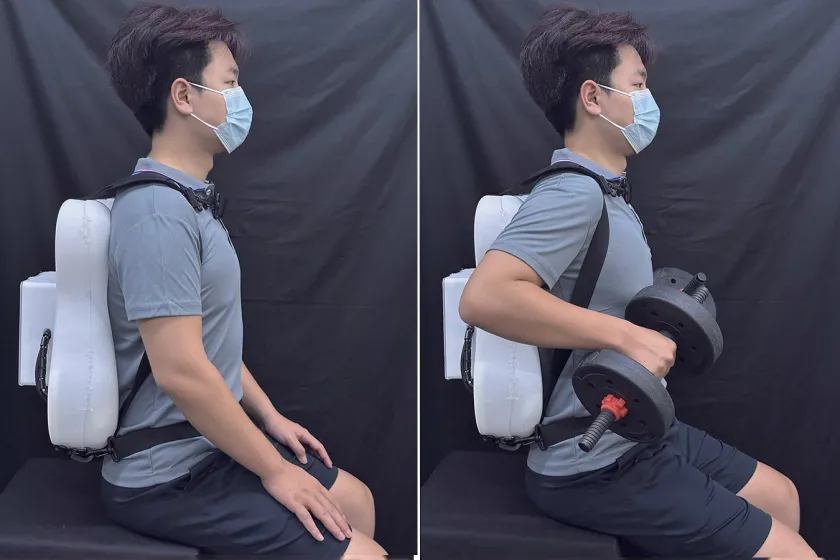
A backpack consisting of electrodes, cables and a soft massage head kneads muscles in the back when it picks up on them being fatigued
By Christa Lesté-Lasserre
24 September 2026
A backpack can detect when muscles become fatigued and automatically massage the affected areas. This seems to help muscles recover better than heat therapy or pre-programmed massages, like those delivered by chairs and cushions.
About 1 in 6 adults in the UK have some form of back pain. This can occur when back muscles become fatigued through exertion or prolonged or repetitive activity. Persistent fatigue can impair local blood flow and tissue recovery, potentially contributing to chronic pain.
Tired back muscles can be relieved through heat therapy and automated massage, which often involves rollers moving across the back in pre-programmed patterns. But these tend to be standardised treatments that don’t take into account people’s individual muscular issues, says Chengsong Yu at the Wuhan Institute of Technology in China.
Looking for a more bespoke approach, Yu and his colleagues have developed a wearable system, like a backpack, that uses electrodes on the skin to monitor electrical activity in four groups of back muscles. The system then determines which muscles are fatigued, and how much. Cables move a soft massage head to the affected areas, where sensor feedback allows the system to continually adjust the force according to the fatigue levels, says Yu.
https://www.newscientist.com/article/25 ... -fatigued/
Huang et al., 2026, Cell Reports Physical Science
A backpack consisting of electrodes, cables and a soft massage head kneads muscles in the back when it picks up on them being fatigued
By Christa Lesté-Lasserre
24 September 2026
A backpack can detect when muscles become fatigued and automatically massage the affected areas. This seems to help muscles recover better than heat therapy or pre-programmed massages, like those delivered by chairs and cushions.
About 1 in 6 adults in the UK have some form of back pain. This can occur when back muscles become fatigued through exertion or prolonged or repetitive activity. Persistent fatigue can impair local blood flow and tissue recovery, potentially contributing to chronic pain.
Tired back muscles can be relieved through heat therapy and automated massage, which often involves rollers moving across the back in pre-programmed patterns. But these tend to be standardised treatments that don’t take into account people’s individual muscular issues, says Chengsong Yu at the Wuhan Institute of Technology in China.
Looking for a more bespoke approach, Yu and his colleagues have developed a wearable system, like a backpack, that uses electrodes on the skin to monitor electrical activity in four groups of back muscles. The system then determines which muscles are fatigued, and how much. Cables move a soft massage head to the affected areas, where sensor feedback allows the system to continually adjust the force according to the fatigue levels, says Yu.
https://www.newscientist.com/article/25 ... -fatigued/
Huang et al., 2026, Cell Reports Physical Science
-
weatheriscool
- Posts: 26097
- Joined: Sun May 16, 2021 6:16 pm
- Contact:
Re: Wearable tech (smart watches, smart glasses etc) news and discussions
Printable 'smart' clothing cools its wearer and generates electricity
By Etiido Uko
September 27, 2026
https://newatlas.com/wearables/smart-cl ... ectricity/
Even though clothing is a fundamental human need, it doesn't seem to be advancing as rapidly as many others. That said, scientists have now created a printable textile that can cool, detect movement, and generate electricity without external systems or multiple layers.
Researchers in the Grainger College of Engineering at the University of Illinois have created a zirconium oxide (ZrO₂) nanocomposite textile material that combines passive cooling and biomechanical energy harvesting.
The material uses radiative cooling to reflect 96% of incoming solar radiation, keeping the wearer cool outdoors, plus it can also radiate away the wearer's thermal energy. Furthermore, the material senses motion by detecting the triboelectricity generated as the wearer moves against the textile. This extremely small amount of electricity can serve as a signal for integrated technologies. It can also serve to power small wearables, according to the researchers.