Superconductors news and discussions

weatheriscool
Posts: 24492
Joined: Sun May 16, 2021 6:16 pm
Contact:

Superconductors news and discussions

Post by weatheriscool »

Researchers develop new tool for analyzing large superconducting circuits
https://phys.org/news/2021-09-tool-larg ... cuits.html
by Northwestern University
The next generation of computing and information processing lies in the intriguing world of quantum mechanics. Quantum computers are expected to be capable of solving large, extremely complex problems that are beyond the capacity of today's most powerful supercomputers.

New research tools are needed to advance the field and fully develop quantum computers. Now Northwestern University researchers have developed and tested a theoretical tool for analyzing large superconducting circuits. These circuits use superconducting quantum bits, or qubits, the smallest units of a quantum computer, to store information.

Circuit size is important since protection from detrimental noise tends to come at the cost of increased circuit complexity. Currently there are few tools that tackle the modeling of large circuits, making the Northwestern method an important contribution to the research community.

"Our framework is inspired by methods originally developed for the study of electrons in crystals and allows us to obtain quantitative predictions for circuits that were previously hard or impossible to access," said Daniel Weiss, corresponding and first author of the paper. He is a fourth-year graduate student in the research group of Jens Koch, an expert in superconducting qubits.
weatheriscool
Posts: 24492
Joined: Sun May 16, 2021 6:16 pm
Contact:

Re: Superconductors news and discussions

Post by weatheriscool »

Towards more energy-efficient 2D semiconductor devices
https://techxplore.com/news/2021-09-ene ... vices.html
by Singapore University of Technology and Design
According to researchers from the Singapore University of Technology and Design (SUTD), a recently discovered family of two-dimensional (2D) semiconductors could pave the way for high-performance and energy-efficient electronics. Their findings, published in npj 2D Materials and Applications, may lead to the fabrication of semiconductor devices applicable in mainstream electronics and optoelectronics—and even potentially replace silicon-based device technology altogether.

In the quest of miniaturizing electronic devices, one well-known trend is Moore's law, which describes how the number of components in the integrated circuits of computers doubles every two years. This trend is possible thanks to the ever-decreasing size of transistors, some of which are so small that millions of them can be crammed onto a chip the size of a fingernail. But as this trend continues, engineers are starting to grapple with the inherent material limitations of silicon-based device technology.

"Due to the quantum tunneling effect, shrinking a silicon-based transistor too small will lead to highly uncontrollable device behaviors," said SUTD Assistant Professor Ang Yee Sin, who led the study. "People are now looking for new materials beyond the 'silicon era', and 2D semiconductors are a promising candidate."
User avatar
Yuli Ban
Posts: 5194
Joined: Sun May 16, 2021 4:44 pm

Re: Superconductors news and discussions

Post by Yuli Ban »

And remember my friend, future events such as these will affect you in the future
weatheriscool
Posts: 24492
Joined: Sun May 16, 2021 6:16 pm
Contact:

Re: Superconductors news and discussions

Post by weatheriscool »

Researchers achieve charge-order-enhanced capacitance in semiconductor moiré superlattices
https://phys.org/news/2021-09-charge-or ... tices.html
by Ingrid Fadelli , Phys.org
In recent years, electronics engineers have been experimenting with new materials that could be used to study electronic correlation phenomena. Van der Waals (vdW) moiré materials are particularly promising for examining these phenomena. VdW materials are composed of strongly bonded two-dimensional (2D) layers that are bound in the third dimension through weaker dispersion forces.

The term moiré, on the other hand, refers to a specific pattern produced when an opaque ruled pattern with gaps is placed onto a similar pattern. Studies have recently unveiled robust and correlated insulating states at both integer and fractional filling factors of semiconducting materials with a moiré pattern.

Researchers at Cornell University and the National Institute for Materials Science in Japan have recently carried out a study exploring the thermodynamic properties of these robust correlated states. Their paper, published in Nature Nanotechnology, ultimately showed that capacitance (i.e., the ability of a system to store electric charge) can play a key role in probing correlated states of semiconductor moiré materials.
weatheriscool
Posts: 24492
Joined: Sun May 16, 2021 6:16 pm
Contact:

Re: Superconductors news and discussions

Post by weatheriscool »

Researchers combine two semiconductor doping methods to achieve new efficiencies
https://phys.org/news/2021-11-combine-s ... ncies.html
by FLEET
A University of Wollongong-led team across three FLEET nodes has combined two traditional semiconductor doping methods to achieve new efficiencies in the topological insulator bismuth-selenide (Bi2Se3).

Two doping elements were used: samarium (Sm) and iron (Fe).

The resulting bismuth-selenide crystals show clear ferromagnetic ordering, a large bulk band gap, high electronic mobility, and the opening of a gap of surface state making this system a good candidate to achieve QAHE at the higher temperatures necessary for viable, sustainable future low-energy electronics.

"The combination of electronic and magnetic properties in topological systems is the keystone of novel topological devices, and one of the core projects in FLEET," says project- leader Prof Xiaolin Wang (UOW). "We have proposed and successfully realized a new way to magnetize a novel electronic material—a topological insulator—by adding two different magnetic ions."
User avatar
Yuli Ban
Posts: 5194
Joined: Sun May 16, 2021 4:44 pm

Re: Superconductors news and discussions

Post by Yuli Ban »

Breakthrough or bust? Claim of room-temperature superconductivity draws fire
A result last year hailed as a breakthrough in physics also generated skepticism that has now escalated into angry recriminations. Researchers said they had made the first superconductor that works at room temperature, a long-sought goal. But Jorge Hirsch, a physicist at the University of California (UC), San Diego, attacked some of the evidence, particularly a set of magnetic measurements. He says his requests to see the underlying data have been rebuffed by the authors for nearly a year. And, last month in a peer-reviewed paper, he charged that the results are “probably fraudulent.”

Ranga Dias, an applied physicist at the University of Rochester, who with his colleagues made the room-temperature superconductivity claim, rejects Hirsch’s allegations. He asserts that Hirsch isn’t an expert in high-pressure physics and that he has a history of claiming that the Nobel Prize–winning “BCS theory” underlying superconductivity is incorrect. Dias says Hirsch relentlessly badgers superconductivity researchers. “Hirsch is a troll,” Dias says. “We are not going to feed this troll” by providing the data.

Superconductivity is normally seen only at temperatures well below 200 K, or –73°C. But several research groups working with hydrogen-rich compounds called hydrides have claimed that they became superconductors between 200 K and 250 K when squeezed to intense pressures. Dias and his team went further. They reported that by adding a bit of carbon to precursors that make H3S, a known hydride superconductor, they were able to create a carbon sulfur hydride (CSH) material that pushed the superconducting temperature up to 287 K (nearly 15°C), the temperature of a cool room. The result, published in the 14 October 2020 issue of Nature, generated worldwide acclaim.

Some scientists attempted to replicate or extend the finding, without much success. And Hirsch and others raised concerns.
And remember my friend, future events such as these will affect you in the future
weatheriscool
Posts: 24492
Joined: Sun May 16, 2021 6:16 pm
Contact:

Re: Superconductors news and discussions

Post by weatheriscool »

Study shows how superconductivity can be switched on and off in superconductors
https://phys.org/news/2022-03-supercond ... ctors.html
by Ingrid Fadelli , Phys.org
Superconductors are materials that can enter a state of no electrical resistance, through which magnetic fields cannot penetrate. Due to their interesting properties, many material scientists and engineers have been exploring the potential of these materials for a wide range of electronics applications.

A key advantage of superconductors is that they can transport electrical signals while preventing their dissipation, which is particularly useful when developing quantum computers. Controlling their states, as is commonly done with semiconductor technology, however, has so far proved to be challenging.

A few years ago, a study suggested the superconductivity of superconducting materials could be switched on and off. Researchers at IBM Research in Zurich have been investigating these results further, in the hope of explaining the switching mechanism unveiled by this previous study. Their findings were recently outlined in a paper published in Nature Electronics.

"Superconductors are, first of all, metals, and metals screen external electric fields very effectively," Andreas Fuhrer and Fabrizio Nichele, two of the researchers who carried out the study, told Phys.org. "This fundamental concept, found in all physics textbooks, was put into question by a 2018 publication. In that work, the authors claimed to have turned on and off the superconductivity in a titanium nanowire via moderate electric fields applied by a nearby gate electrode."
User avatar
caltrek
Posts: 9280
Joined: Mon May 17, 2021 1:17 pm

Re: Superconductors news and discussions

Post by caltrek »

Discovery of the One-way Superconductor That was Thought to be Impossible
April 27, 2022

https://www.eurekalert.org/news-releases/950503

Introduction:
(EurekAlert) Associate professor Mazhar Ali and his research group at TU Delft have discovered one-way superconductivity without magnetic fields, something that was thought to be impossible ever since its discovery in 1911 – up till now. The discovery, published in Nature, makes use of 2D quantum materials and paves the way towards superconducting computing. Superconductors can make electronics hundreds of times faster, all with zero energy loss. Ali: “If the 20th century was the century of semi-conductors, the 21st can become the century of the superconductor.”

During the 20th century many scientists, including Nobel Prize winners, have puzzled over the nature of superconductivity, which was discovered by Dutch physicist Kamerlingh Onnes in 1911 (read more about this in the frame below). In superconductors, a current goes through a wire without any resistance, which means inhibiting this current or even blocking it is hardly possible – let alone getting the current to flow only one way and not the other. That Ali’s group managed to make superconducting one-directional – necessary for computing – is remarkable: one can compare it to inventing a special type of ice which gives you zero friction when skating one way, but insurmountable friction the other way.

Superconductor: super-fast, super-green

The advantages of applying superconductors to electronics are twofold. Superconductors can make electronics hundreds of times faster, and implementing superconductors into our daily lives would make IT much greener: if you were to spin a superconducting wire from here to the moon, it would transport the energy without any loss. For instance, the use of superconductors instead of regular semi-conductors might safe up to 10% of all western energy reserves according to NWO.

The (im)possibility of applying superconducting

In the 20th century and beyond, no one could tackle the barrier of making superconducting electrons go in just one-direction, which is a fundamental property needed for computing and other modern electronics (consider for example diodes that go one way as well). In normal conduction the electrons fly around as separate particles; in superconductors they move in pairs of twos, without any loss of electrical energy
Don't mourn, organize.

-Joe Hill
User avatar
raklian
Posts: 1981
Joined: Sun May 16, 2021 4:46 pm
Location: North Carolina

Re: Superconductors news and discussions

Post by raklian »

This pretty much guarantees we'll at least have zettascale computing.
To know is essentially the same as not knowing. The only thing that occurs is the rearrangement of atoms in your brain.
User avatar
Yuli Ban
Posts: 5194
Joined: Sun May 16, 2021 4:44 pm

Re: Superconductors news and discussions

Post by Yuli Ban »

caltrek wrote: Wed Apr 27, 2022 3:49 pm Discovery of the One-way Superconductor That was Thought to be Impossible
Q: Is it realistic for ordinary computers (or even the supercomputers of KNMI and IBM) to make use of superconducting?

Yes, it is! Not for people at home, but for server farms or for supercomputers, it would be smart to implement this. Centralized computation is really how the world works now-a-days. Any and all intensive computation is done at centralized facilities where localization adds huge benefits in terms of power management, heat management, etc. The existing infrastructure could be adapted without too much cost to work with Josephson diode based electronics. There is a very real chance, if the challenges discussed in the other question are overcome, that this will revolutionize centralized and supercomputing.
And remember my friend, future events such as these will affect you in the future
User avatar
Yuli Ban
Posts: 5194
Joined: Sun May 16, 2021 4:44 pm

Re: Superconductors news and discussions

Post by Yuli Ban »


And remember my friend, future events such as these will affect you in the future
User avatar
wjfox
Site Admin
Posts: 13587
Joined: Sat May 15, 2021 6:09 pm
Location: Essex, UK
Contact:

Re: Superconductors news and discussions

Post by wjfox »

An atomic-scale window into superconductivity paves the way for new quantum materials

3 June 2022

Superconductors are materials with no electrical resistance whatsoever, commonly requiring extremely low temperatures. They are used in a wide range of domains, from medical applications to a central role in quantum computers. Superconductivity is caused by specially linked pairs of electrons known as Cooper pairs. So far, the occurrence of Cooper pairs has been measured indirectly macroscopically in bulk, but a new technique developed by researchers at Aalto University and Oak Ridge National Laboratories in the US can detect their occurrence with atomic precision.

The experiments were carried out by Wonhee Ko and Petro Maksymovych at Oak Ridge National Laboratory with the theoretical support of Professor Jose Lado of Aalto University. Electrons can quantum tunnel across energy barriers, jumping from one system to another through space in a way that cannot be explained with classical physics. For example, if an electron pairs with another electron right at the point where a metal and superconductor meet, it could form a Cooper pair that enters the superconductor while also “kicking back” another kind of particle into the metal in a process known as Andreev reflection. The researchers looked for these Andreev reflections to detect Cooper pairs.

To do this, they measured the electrical current between an atomically sharp metallic tip and a superconductor, as well as how the current depended on the separation between the tip and the superconductor. This enabled them to detect the amount of Andreev reflection going back to the superconductor, while maintaining an imaging resolution comparable to individual atoms. The results of the experiment corresponded exactly to Lado’s theoretical model.

This experimental detection of Cooper pairs at the atomic scale provides an entirely new method for understanding quantum materials. For the first time, researchers can uniquely determine how the wave functions of Cooper pairs are reconstructed at the atomic scale and how they interact with atomic-scale impurities and other obstacles.

‘This technique establishes a critical new methodology for understanding the internal quantum structure of exotic types of superconductors known as unconventional superconductors, potentially allowing us to tackle a variety of open problems in quantum materials,’ Lado says. Unconventional superconductors are a potential fundamental building block for quantum computers and could provide a platform to realize superconductivity at room temperature. Cooper pairs have unique internal structures in unconventional superconductors which so far have been challenging to understand.

This discovery allows for the direct probing of the state of Cooper pairs in unconventional superconductors, establishing a critical new technique for a whole family of quantum materials. It represents a major step forward in our understanding of quantum materials and helps push forward the work of developing quantum technologies.

https://www.eurekalert.org/news-releases/954798


Image
weatheriscool
Posts: 24492
Joined: Sun May 16, 2021 6:16 pm
Contact:

Re: Superconductors news and discussions

Post by weatheriscool »

Study observes the coexistence of topological edge states and superconductivity in stanene films

by Ingrid Fadelli , Phys.org
https://phys.org/news/2022-06-coexisten ... ivity.html
Stanene is a topological insulator comprised of atoms typically arranged in a similar pattern to those inside graphene. Stanene films have been found to be promising for the realization of numerous intriguing physics phases, including the quantum spin Hall phase and intrinsic superconductivity.

Some theoretical studies also suggested that these films could host topological superconductivity, a state that is particularly valuable for the development of quantum computing technology. So far, however, topological edge states in stanene had not been reliably and consistently observed in experimental settings.

Researchers at Shanghai Jiao Tong University, the University of Science and Technology of China, Henan University, Zhengzhou University, and other institutes in China have recently demonstrated the coexistence of topological edge states and superconductivity in one to five-layer stanene films placed on the Bi(111) substrate. Their observations, outlined in a paper published in Physical Review Letters, could have important implications for the development of Stanene-based quantum devices.
weatheriscool
Posts: 24492
Joined: Sun May 16, 2021 6:16 pm
Contact:

Re: Superconductors news and discussions

Post by weatheriscool »

Fermi-level tuning to improve the stability of 2D graphene-based FETs
https://techxplore.com/news/2022-06-fer ... based.html
by Ingrid Fadelli , Tech Xplore

Two-dimensional (2D) semiconductors are a class of semiconducting materials with thicknesses on the atomic scale. These materials have numerous advantageous properties, including good mobilities at thicknesses below 1 nm, which make them particularly promising for the development of field effect transistors (FETs) and other electronic, photonic and optoelectronic components.

Despite their advantages, when they are used to build electronic components, these materials often exhibit a limited electrical stability. The main reason for this is that the charge carriers originating from the semiconductors can interact with defects in the insulators that surround the materials inside devices, hindering the devices' stability.

Researchers at TU Wien and AMO GmbH have recently demonstrated a strategy that could be used to improve the stability of FETs based on 2D materials. This strategy, introduced in a paper published in Nature Electronics, entails tuning the Fermi Level of the 2D materials, ensuring that it maximizes the energy distance between the charge carriers and defects in the gate insulator while the device is operating.

"In FETs, the resulting trapped charges can lead to large hysteresis and device drifts, particularly when common amorphous gate oxides (such as silicon or hafnium dioxide) are used, hindering stable circuit operation," the researchers wrote in their paper. "We show that device stability in graphene-based field-effect transistors with amorphous gate oxides can be improved by Fermi-level tuning."
weatheriscool
Posts: 24492
Joined: Sun May 16, 2021 6:16 pm
Contact:

Re: Superconductors news and discussions

Post by weatheriscool »

Physicists discover a 'family' of robust, superconducting graphene structures
https://phys.org/news/2022-07-physicist ... phene.html
by Jennifer Chu, Massachusetts Institute of Technology

When it comes to graphene, it appears that superconductivity runs in the family.

Graphene is a single-atom-thin material that can be exfoliated from the same graphite that is found in pencil lead. The ultrathin material is made entirely from carbon atoms that are arranged in a simple hexagonal pattern, similar to that of chicken wire. Since its isolation in 2004, graphene has been found to embody numerous remarkable properties in its single-layer form.

In 2018, MIT researchers found that if two graphene layers are stacked at a very specific "magic" angle, the twisted bilayer structure could exhibit robust superconductivity, a widely sought material state in which an electrical current can flow through with zero energy loss. Recently, the same group found a similar superconductive state exists in twisted trilayer graphene—a structure made from three graphene layers stacked at a precise, new magic angle.
weatheriscool
Posts: 24492
Joined: Sun May 16, 2021 6:16 pm
Contact:

Re: Superconductors news and discussions

Post by weatheriscool »

Unusual superconductivity observed in twisted trilayer graphene
https://phys.org/news/2022-07-unusual-s ... phene.html
by Robert Perkins, California Institute of Technology
The ability to turn superconductivity off and on with a literal flip of a switch in so-called "magic-angle twisted graphene" has allowed engineers at Caltech to observe an unusual phenomenon that may shed new light on superconductivity in general.

The research, led by Stevan Nadj-Perge, assistant professor of applied physics and materials science, was published in the journal Nature on June 15.

Magic-angle twisted graphene, first discovered in 2018, is made from two or three sheets of graphene (a form of carbon consisting of a single layer of atoms in a honeycomb-like lattice pattern) layered atop one another, with each sheet twisted at precisely 1.05 degrees in relation to the one below it. The resulting bilayer or trilayer has unusual electronic properties: for example, it can be made into an insulator or a superconductor depending on how many electrons are added.
weatheriscool
Posts: 24492
Joined: Sun May 16, 2021 6:16 pm
Contact:

Re: Superconductors news and discussions

Post by weatheriscool »

A proof of odd-parity superconductivity
https://phys.org/news/2022-07-proof-odd ... ivity.html

Image
by Ingrid Rothe, Max Planck Society
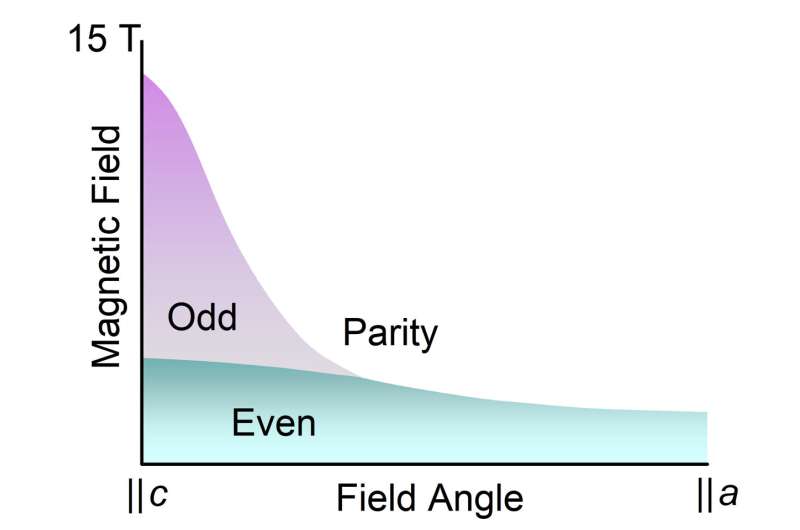
Superconductivity is a fascinating state of matter in which an electrical current can flow without any resistance. Usually, it can exist in two forms. One is destroyed easily with a magnetic field and has "even parity" (i.e., it has a point symmetric wave function with respect to an inversion point). The other form is stable in magnetic fields applied in certain directions and has "odd parity" (i.e., it has an antisymmetric wave function). Consequently, the latter form should present a characteristic angle dependence of the critical field where superconductivity disappears. But odd-parity superconductivity is rare in nature; only a few materials support this state, and in none of them has the expected angle dependence been observed.

In a new publication in Physical Review X, the group by Elena Hassinger and collaborators show that the angle dependence in the superconductor CeRh2As2 is exactly that expected of an odd-parity state.

CeRh2As2 was recently found to exhibit two superconducting states: A low-field state changes into a high-field state at 4 T when a magnetic field is applied along one axis. For varying field directions, we measured the specific heat, magnetic susceptibility, and magnetic torque of this material to obtain the angle dependence of the critical fields. We find that the high-field state quickly disappears when the magnetic field is turned away from the initial axis. These results are in excellent agreement with our model identifying the two states with even- and odd-parity states.
weatheriscool
Posts: 24492
Joined: Sun May 16, 2021 6:16 pm
Contact:

Re: Superconductors news and discussions

Post by weatheriscool »

New leap in understanding nickel oxide superconductors
https://phys.org/news/2022-07-nickel-ox ... ctors.html
by Glennda Chui, SLAC National Accelerator Laboratory
A new study shows that nickel oxide superconductors, which conduct electricity with no loss at higher temperatures than conventional superconductors do, contain a type of quantum matter called charge density waves, or CDWs, that can accompany superconductivity.

The presence of CDWs shows that these recently discovered materials, also known as nickelates, are capable of forming correlated states—"electron soups" that can host a variety of quantum phases, including superconductivity, researchers from the Department of Energy's SLAC National Accelerator Laboratory and Stanford University reported in Nature Physics today.

"Unlike in any other superconductor we know about, CDWs appear even before we dope the material by replacing some atoms with others to change the number of electrons that are free to move around," said Wei-Sheng Lee, a SLAC lead scientist and investigator with the Stanford Institute for Materials and Energy Science (SIMES) who led the study.

"This makes the nickelates a very interesting new system—a new playground for studying unconventional superconductors."

Nickelates and cuprates

In the 35 years since the first unconventional "high-temperature" superconductors were discovered, researchers have been racing to find one that could carry electricity with no loss at close to room temperature. This would be a revolutionary development, allowing things like perfectly efficient power lines, maglev trains and a host of other futuristic, energy-saving technologies.

But while a vigorous global research effort has pinned down many aspects of their nature and behavior, people still don't know exactly how these materials become superconducting.
weatheriscool
Posts: 24492
Joined: Sun May 16, 2021 6:16 pm
Contact:

Re: Superconductors news and discussions

Post by weatheriscool »

Scientists clarify how best known superconductor works
https://phys.org/news/2022-08-scientist ... uctor.html
by Skolkovo Institute of Science and Technology

In a series of experiments on lanthanum superhydride with impurities, researchers from Skoltech, Lebedev Physical Institute of RAS and their colleagues from the United States, Germany and Japan, have established the mechanism behind the highest-temperature superconductivity in polyhydrides observed to date. Reported in Advanced Materials, the discovery paves the way for future studies pursuing materials that conduct electricity with zero resistance at or close to room temperature. Those would come in handy for superconducting electronics and quantum computers, maglev trains, MRI machines, particle accelerators, and perhaps even nuclear fission reactors and lossless power lines, if you're into that kind of thing.

If not the Holy Grail of materials science, near room-temperature superconductors are certainly among the most sought-after materials with technological applications. If discovered, such a material would enable monster electromagnets that could be used in fundamental research instruments, such as ultraprecise magnetic sensors and particle accelerators that would make the Large Hadron Collider seem puny, as well as in medical tech (better MRI scanners), magnetic levitation trains, miniature motors and generators, and extended battery life gadgets. Among the more futuristic applications are long-distance power transmission lines that would deliver electricity nearly without losses.

Theoretically, pure hydrogen should be the best high-temperature superconductor, provided you could squeeze it hard enough to turn it into a metal. But that's quite a challenge, to say the least. So instead, scientists are exploring compounds that contain additional elements, besides lots of hydrogen. That way they are sacrificing some of the temperature to bring the pressures needed to stabilize the superconducting material down and into the realm of what's technologically possible.
weatheriscool
Posts: 24492
Joined: Sun May 16, 2021 6:16 pm
Contact:

Re: Superconductors news and discussions

Post by weatheriscool »

A magneto-optic modulator could facilitate the development of next-generation superconductor-based computers
https://techxplore.com/news/2022-09-mag ... based.html
by Ingrid Fadelli , Tech Xplore
In the future, many computers will most likely be based on electronic circuits made of superconductors. These are materials through which an electrical current can flow without energy losses, could be very promising for the development of high-performance supercomputers and quantum computers.

Researchers at University of California Santa Barbara, Raytheon BBN Technologies, University of Cagliari, Microsoft Research, and the Tokyo Institute of Technology have recently developed a magneto-optic modulator—a device that control the properties of a light beam through a magnetic field. This device, introduced in a paper published in Nature Electronics, could contribute to the implementation of large-scale electronics and computers based on superconductors.

"We are working on a new technology that can speed up high-performance supercomputers and quantum computers based on superconductor technology," Paolo Pintus, the researcher who led the study, told TechXplore. "Superconductors work properly only at low temperatures, generally just above absolute zero (-273.15° Celsius). Because of this, circuits made of these materials must be kept inside a dedicated refrigerator."

Circuits made of superconductors are typically connected to their external surroundings using metal cables. These cables have a limited communication speed and can transfer heat into a cold circuit.
Post Reply