Material Science News and Discussions

weatheriscool
Posts: 24495
Joined: Sun May 16, 2021 6:16 pm
Contact:

Re: Material Science News and Discussions

Post by weatheriscool »

Graphene-boosted plastic makes auto parts 20% stronger, 18% lighter
By Ben Coxworth
November 18, 2025
https://newatlas.com/materials/gratek-g ... e-plastic/
Glass-filled polypropylene is already a very commonly used plastic for automotive parts, but could it be improved? Well, yes. A new substance, Gratek, is claimed to make the plastic 20% stronger yet 18% lighter, thanks to the addition of graphene.

Widely hailed as a "wonder material," graphene takes the form of one-atom-thick sheets of carbon atoms linked to one another in a honeycomb pattern. Along with being the world's strongest human-made substance, it's also very flexible, stretchable and chemically stable, plus it exhibits high electrical and thermal conductivity.

weatheriscool
Posts: 24495
Joined: Sun May 16, 2021 6:16 pm
Contact:

Re: Material Science News and Discussions

Post by weatheriscool »

weatheriscool
Posts: 24495
Joined: Sun May 16, 2021 6:16 pm
Contact:

Re: Material Science News and Discussions

Post by weatheriscool »

3D-printable concrete alternative hardens in three days, not four weeks
By Ben Coxworth
November 25, 2025
Although we've heard a lot about how 3D-printing concrete homes speeds up the construction process, you still have to wait up to 28 days for the concrete to sufficiently cure. A new printable substitute, however, is ready to go in just three days.

Concrete consists of three parts: water, an aggregate such as sand or gravel, and a cement which binds everything together. The cement is the part that typically takes about a month to cure after being poured. And a slow curing time isn't cement's only problem.

Traditional Portland-style cement is made by grinding up limestone and other raw materials, then heating the resulting powder to temperatures of up to 1,450 ºC (2,642 ºF). Unfortunately, the processes by which that heat is generated produce a lot of carbon dioxide.
https://newatlas.com/materials/3d-print ... ternative/
weatheriscool
Posts: 24495
Joined: Sun May 16, 2021 6:16 pm
Contact:

Re: Material Science News and Discussions

Post by weatheriscool »

Simple solvent makes polycotton fabric completely recyclable
By Ben Coxworth
November 26, 2025
What we think of as polyester fabric is most often actually a blend of polyester and cotton, which has proven very difficult to recycle. A new solvent, however, breaks the blend down into its two components, leaving both almost completely reusable.

Made up of menthol and benzoic acid, the solution was developed by PhD student Nika Depope, Dr. Andreas Bartl and colleagues at the Vienna University of Technology.

Although both substances are solid at room temperature, they take on a "deep eutectic solvent" form when heated to a temperature of 216 ºC (421 ºF). When polycotton (polyester/cotton blend) textiles are immersed in that liquid, it causes the polyester to dissolve and separate from the cotton fibers within just five minutes.
https://newatlas.com/environment/solven ... on-fabric/
weatheriscool
Posts: 24495
Joined: Sun May 16, 2021 6:16 pm
Contact:

Re: Material Science News and Discussions

Post by weatheriscool »

weatheriscool
Posts: 24495
Joined: Sun May 16, 2021 6:16 pm
Contact:

Re: Material Science News and Discussions

Post by weatheriscool »

weatheriscool
Posts: 24495
Joined: Sun May 16, 2021 6:16 pm
Contact:

Re: Material Science News and Discussions

Post by weatheriscool »

weatheriscool
Posts: 24495
Joined: Sun May 16, 2021 6:16 pm
Contact:

Re: Material Science News and Discussions

Post by weatheriscool »

Research reinvents MXene synthesis at a fraction of the cost
https://phys.org/news/2025-12-reinvents ... ction.html
by Paul Dailing, University of Chicago
https://phys.org/news/2025-12-reinvents ... ction.html
MXenes (pronounced like the name "Maxine") are a class of two-dimensional materials, first identified just 14 years ago, with remarkable potential for energy storage, catalysts, ultrastrong lightweight composites, and a variety of other purposes ranging from electromagnetic shielding to ink that can carry a current.

But manufacturing MXenes has been expensive, difficult and crude.

"MXenes have been made by a very elaborate, multi-step process that involved days of high-temperature work, followed by using dangerous chemicals like hydrofluoric acid and creating a lot of waste," said Prof. Dmitri Talapin of the University of Chicago Pritzker School of Molecular Engineering (UChicago PME) and Department of Chemistry. "That may have been okay for early-stage research and lab exploration, but became a big roadblock for taking the next step to large-scale applications."

Talapin led a team of researchers from UChicago, University of Illinois Chicago and Vanderbilt University who developed a new technique for synthesizing the two-dimensional MXenes, atom by atom, from the bottom up.
User avatar
caltrek
Posts: 9280
Joined: Mon May 17, 2021 1:17 pm

Re: Material Science News and Discussions

Post by caltrek »

The Perfect Plastic? Plant-based, Fully Saltwater Degradable, Zero Microplastics
December 16 , 2025

Introduction:
(Eurekalert) IKEN Center for Emergent Matter Science (CEMS) in Japan have one-upped themselves in their quest to solve our microplastic problem. In a recent study published in the Journal of the American Chemical Society they report a new type of plastic made from plant cellulose, the world’s most abundant organic compound. The new plastic is strong, flexible, and capable of rapid decomposition in natural environments, setting it apart from other plastics marketed as biodegradable.

Microplastics are a global contaminant found in nearly every ecosystem, from the soil and the ocean to the animals and plants that live there. They have even been found in human tissue and the bloodstream where they likely have adverse effects. While biodegradable plastics and even some cellulose-derived plastics (cellulose nitrate or cellulose acetate) are not new, most plastics labeled “biodegradable” do not degrade in marine environments or they take a very long time to degrade, leaving microplastics behind in the meantime.

Last year, Aida and his team developed a plastic that could quickly degrade in salt water within several hours, without leaving any microplastics behind. That plastic was a supramolecular plastic made from two polymers held together by reversible interactions called "salt bridges." In the presence of salt water, the bonds holding the two polymers together came apart and the plastic decomposed. But this plastic wasn’t as practical as it could be for real-world manufacture.

The new plant-based plastic is similar, except that one of the two polymers is a commercially available, FDA approved, biodegradable wood-pulp derivative called carboxymethyl cellulose. Finding a compatible second polymer took some trial and error, but eventually the team found a safe crosslinking agent made from positively charged polyethylene-imine guanidinium ions. When the cellulose and guanidinium ions were mixed in room temperature water, the negatively and positively charged molecules attracted each other like magnets and formed the critical cross-linked network that makes this kind of plastic strong. At the same time, the salt bridges holding the network together broke as expected in the presence of salt water. To avoid unintentional decomposition, the plastic can be protected with a thin coating on the surface.
Read more here: https://www.eurekalert.org/news-releases/1110174
Don't mourn, organize.

-Joe Hill
weatheriscool
Posts: 24495
Joined: Sun May 16, 2021 6:16 pm
Contact:

Re: Material Science News and Discussions

Post by weatheriscool »

Newly discovered material conducts heat nearly 3x faster than any metal
By Abhimanyu Ghoshal
January 27, 2026

Data center servers, powerful smartphones, and your computer's motherboard have one thing in common. When these devices get too hot, their performance takes a hit, and we can't have that. That's why copper is used to manufacture them: this metal has high thermal conductivity, which means it can efficiently carry heat and dissipate it across its surface.

Now, copper is already pretty good at what it does. With a thermal conductivity of approximately 401 W/mK at room temperature, it's second only to silver by a wee bit, while being a lot less expensive to procure. But aerospace engineers at University of California Los Angeles (UCLA) have discovered a material that blows those two out of the water with nearly thrice the thermal conductivity.

Metallic theta-phase tantalum nitride exhibits an ultrahigh thermal conductivity of 1,100 W/mK, which means it's way more efficient at transporting heat than copper and silver. Their conductivity is limited by the strong interactions between free-moving electrons and atomic vibrations called phonons.

That name just rolls off the tongue, doesn't it? It refers to a specific crystal structure of this metallic compound which has certain properties – similar to how carbon can be found in the form of soft graphite, and also as hard diamond.
https://newatlas.com/materials/metallic ... m-nitride/
weatheriscool
Posts: 24495
Joined: Sun May 16, 2021 6:16 pm
Contact:

Re: Material Science News and Discussions

Post by weatheriscool »

firestar464
Posts: 7206
Joined: Wed Oct 12, 2022 7:45 am

Re: Material Science News and Discussions

Post by firestar464 »

More on that by Georgetown University:

https://college.georgetown.edu/news-sto ... chnologies.
firestar464
Posts: 7206
Joined: Wed Oct 12, 2022 7:45 am

Re: Material Science News and Discussions

Post by firestar464 »

Multi-agent AI and robots automate materials discovery in closed-loop lab system

https://phys.org/news/2026-01-multi-age ... omate.html
firestar464
Posts: 7206
Joined: Wed Oct 12, 2022 7:45 am

Re: Material Science News and Discussions

Post by firestar464 »

Hard-to-synthesize materials revived using AI: An LLM-based materials redesign technology

https://phys.org/news/2026-01-hard-mate ... i-llm.html
User avatar
raklian
Posts: 1981
Joined: Sun May 16, 2021 4:46 pm
Location: North Carolina

Re: Material Science News and Discussions

Post by raklian »

firestar464 wrote: Mon Feb 02, 2026 10:14 pm Hard-to-synthesize materials revived using AI: An LLM-based materials redesign technology

https://phys.org/news/2026-01-hard-mate ... i-llm.html
"SynCry"

How appropriate. :lol:
To know is essentially the same as not knowing. The only thing that occurs is the rearrangement of atoms in your brain.
firestar464
Posts: 7206
Joined: Wed Oct 12, 2022 7:45 am

Re: Material Science News and Discussions

Post by firestar464 »

How topological surfaces boost clean energy catalysts

https://phys.org/news/2026-01-topologic ... lysts.html
weatheriscool
Posts: 24495
Joined: Sun May 16, 2021 6:16 pm
Contact:

Re: Material Science News and Discussions

Post by weatheriscool »

weatheriscool
Posts: 24495
Joined: Sun May 16, 2021 6:16 pm
Contact:

Re: Material Science News and Discussions

Post by weatheriscool »

New supercool alloy could take the heat off helium-3
By Etiido Uko
March 23, 2026
https://newatlas.com/materials/rare-ear ... -helium-3/
The heated race to achieve the extreme cold that quantum technologies demand may have a frontrunner. Chinese scientists have developed an alloy that almost reaches absolute zero, the coldest possible temperature, without using the scarce isotope, helium-3.

By harnessing the strange behavior of particles at the tiniest scales, quantum technologies are enabling applications that are borderline science fiction across various industries. A good example is quantum computing. Unlike conventional computers, which store information as 0s and 1s, quantum computers use qubits, fundamental units of information that can exist in multiple states simultaneously, enabling them to perform calculations that would take conventional computers millions of years to complete.

Other examples include quantum sensors that detect the tiniest changes in magnetic or gravitational fields with unprecedented precision, and quantum communication that enables virtually unhackable networks.

Now, the thing about this technology is that it “detests heat.” Atoms are constantly vibrating, giving off energy we perceive as heat. However, quantum technologies require atoms to be nearly motionless, a state achievable only at extremely low temperatures (below 1 kelvin, or -272.15 °C / -457.87 ºF).
weatheriscool
Posts: 24495
Joined: Sun May 16, 2021 6:16 pm
Contact:

Re: Material Science News and Discussions

Post by weatheriscool »

Lasers used to seal paper – no adhesives or plastics required
By Etiido Uko
March 28, 2026
https://newatlas.com/manufacturing/laser-paper-sealing/
In the packaging war between paper and plastic, plastic has remained indispensable – even in paper products – through one vital aspect: sealing. Until now, reliable paper seals have required adhesives or plastic layers. Scientists may have found a way to eliminate both.

Despite all our efforts to curb plastic pollution by using paper packaging, we often inadvertently end up using it anyways. This happens because paper packages still require plastic to provide leak-proof sealing. You see, paper is porous, allowing air to reach solid content and allowing liquids to leak out.

To address these limitations, paper packaging for food or chemicals still contains plastic. Examples of this are everywhere. Milk and juice cartons, even though they look like paper, are lined with plastic (often polyethylene) and heat-sealed at the seams to prevent leaks. Another example is paper packets for snacks like biscuits and chips. The edges are heat-sealed plastic films to keep air and moisture out so the food stays crisp. We also have “paper” coffee cups, takeaway boxes, and cosmetic bottles that all feature plastic seams or linings.
weatheriscool
Posts: 24495
Joined: Sun May 16, 2021 6:16 pm
Contact:

Re: Material Science News and Discussions

Post by weatheriscool »

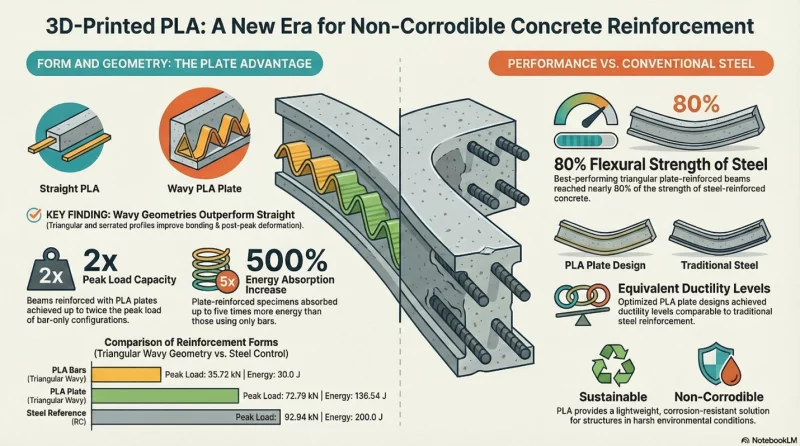
Steel rebar may have met its match – in the form of wavy plastic
By Etiido Uko
April 10, 2026
https://newatlas.com/materials/wavy-pla ... ternative/
Who could possibly compare to Superman, the Man of Steel? Definitely not a man of plastic! Right? Wrong. Researchers at the University of Sharjah, UAE, have discovered that plastics, in certain shapes, may perform as well as steel bars as reinforcement materials in concrete.

In a study that was as much about the shape of the material as the material itself, the researchers 3D-printed and tested various material configurations, finding that certain shapes outperformed others by up to 500% in specific tests.

Concrete, which primarily comprises cement, water, and aggregates, is the most used construction material in the world. This composite is often upgraded with steel reinforcement to a stronger version called reinforced concrete.

Over the past century, steel has proven to be a highly effective concrete reinforcement material, so much so that more than 20% of the almost 2 billion tonnes of global steel produced annually is used to reinforce concrete.
Image
Image
Post Reply