Brain-on-chip systems and hybrid AI

Post Reply
User avatar
wjfox
Site Admin
Posts: 13576
Joined: Sat May 15, 2021 6:09 pm
Location: Essex, UK
Contact:

Brain-on-chip systems and hybrid AI

Post by wjfox »

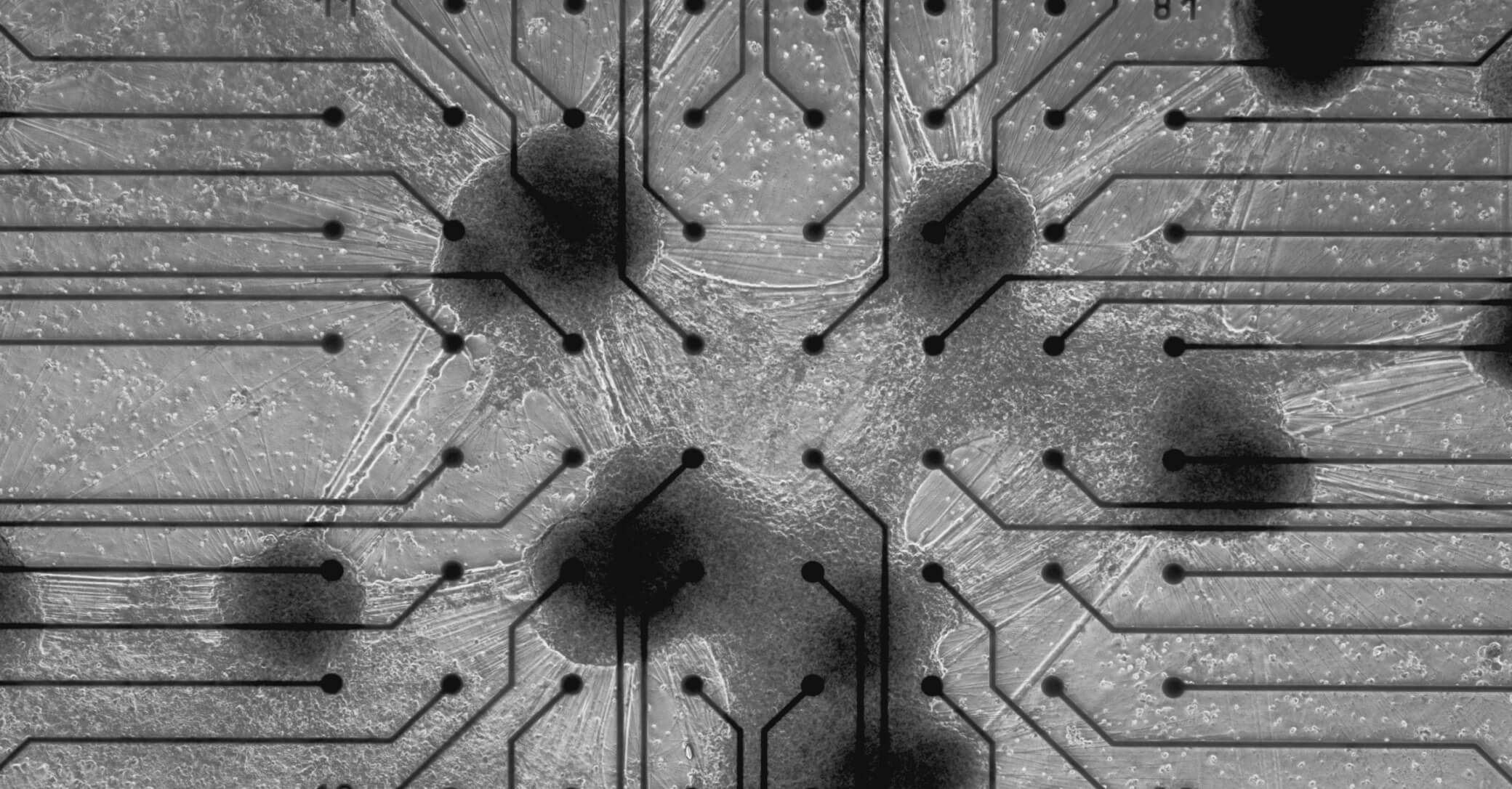
In this thread, we can discuss the development of brain-on-chip systems and hybrid AI, including recent experiments where living human neurons have been trained to perform complex tasks such as playing video games.

What are the implications for computing, robotics, and the future of machine intelligence?


Image
Credit: Cortical Labs
User avatar
wjfox
Site Admin
Posts: 13576
Joined: Sat May 15, 2021 6:09 pm
Location: Essex, UK
Contact:

Re: Brain-on-chip systems and hybrid AI

Post by wjfox »

Human brain cells on a chip learned to play Doom in a week

Neuron-powered computer chips can now be easily programmed to play a first-person shooter game, bringing biological computers a step closer to useful applications

By Alex Wilkins

27 February 2026

A clump of human brain cells can play the classic computer game Doom. While its performance is not up to par with humans, experts say it brings biological computers a step closer to useful real-world applications, like controlling robot arms.

In 2021, the Australian company Cortical Labs used its neuron-powered computer chips to play Pong. The chips consisted of clumps of more than 800,000 living brain cells grown on top of microelectrode arrays that can both send and receive electrical signals. Researchers had to carefully train the chips to control the paddles on either side of the screen.

Now, Cortical Labs has developed an interface that makes it easier to program these chips using the popular programming language Python. An independent developer, Sean Cole, then used Python to teach the chips to play Doom, which he did in around a week.

“Unlike the Pong work that we did a few years ago, which represented years of painstaking scientific effort, this demonstration has been done in a matter of days by someone who previously had relatively little expertise working directly with biology,” says Brett Kagan of Cortical Labs. “It’s this accessibility and this flexibility that makes it truly exciting.”

The neuronal computer chip, which used about a quarter as many neurons as the Pong demonstration, played Doom better than a randomly firing player, but far below the performance of the best human players. However, it learnt much faster than traditional, silicon-based machine learning systems and should be able to improve its performance with newer learning algorithms, says Kagan.

Read more: https://www.newscientist.com/article/25 ... in-a-week/


Image
User avatar
wjfox
Site Admin
Posts: 13576
Joined: Sat May 15, 2021 6:09 pm
Location: Essex, UK
Contact:

Re: Brain-on-chip systems and hybrid AI

Post by wjfox »


firestar464
Posts: 7202
Joined: Wed Oct 12, 2022 7:45 am

Re: Brain-on-chip systems and hybrid AI

Post by firestar464 »

Depends on whether long-term memory exists, which is necessary for a sense of self. Also to what extent. There are varying degrees of self-awareness depending on the animal one is talking about.
User avatar
Yuli Ban
Posts: 5194
Joined: Sun May 16, 2021 4:44 pm

Re: Brain-on-chip systems and hybrid AI

Post by Yuli Ban »

wjfox wrote: Wed Mar 04, 2026 11:37 am


I have to agree, I wonder at what point could you call this "conscious"
I suppose the transformer-based LLM architecture might limit that to some extent, but clearly something's happening
And remember my friend, future events such as these will affect you in the future
User avatar
wjfox
Site Admin
Posts: 13576
Joined: Sat May 15, 2021 6:09 pm
Location: Essex, UK
Contact:

Re: Brain-on-chip systems and hybrid AI

Post by wjfox »

Startup is building the first data centre to use human brain cells

Cortical Labs is building two data centres that will house its neuron-filled chips. The technology is still in the very early stages of development

10 March 2026

Data centres use huge amounts of energy and chips are in high demand – could brain cells be the answer? Australia-based start-up Cortical Labs has announced it is building two “biological” data centres in Melbourne and Singapore, stacked with the same neuron-filled chips that it has demonstrated can play Pong or Doom.

Cortical Labs is one of a few companies developing biological computers, consisting of neuronal cells wired up to microelectrode arrays that can stimulate and measure the response of cells when fed data. Earlier this month, the firm demonstrated that its flagship computer, the CL1, could learn to play the game Doom in a week.

Now, Cortical Labs has revealed two data centres that it plans to build. The first, in Melbourne, will contain around 120 CL1 units. The second, which is being built in collaboration with the National University of Singapore, will house 20 CL1s initially, but the company hopes it will eventually contain 1000 units in a larger data centre, after regulatory approval. Cortical Labs says this will allow it to expand its cloud-based brain-computing service.

Biological computers like the CL1 are being built and tested by research groups around the world, but they are often hard to build and not easy for others to use, says Michael Barros at the University of Essex, UK. “We spend a lot of money and sweat to build these [systems].”

“What [Cortical Labs] is doing is essentially allowing its biocomputer to be accessible at a large scale,” says Barros, who already uses cloud services from Cortical Labs as part of his research. “They’ll be the first ones to do that.”

https://www.newscientist.com/article/25 ... ain-cells/

Post Reply