
TESS discovers a super-Earth exoplanet orbiting nearby star
March 15, 2026
Using the Transiting Exoplanet Survey Satellite (TESS), astronomers have discovered a new super-Earth exoplanet orbiting a star located about 83 light years away. The newfound alien world is slightly larger than Earth and encircles its host in less than four days. The finding was reported in a paper published Feb. 28 on the arXiv pre-print server.
According to the study, TOI-1080 b has a radius of about 1.2 Earth radii and its mass is estimated to be not larger than 10.7 Earth masses (most likely around 1.75 Earth masses). The planet has an orbital period of approximately 3.97 days and is very close to its host—at a distance of some 0.027 AU. The equilibrium temperature of TOI-1080 b is at a level of 368 K.
Based on the properties, the astronomers classified TOI-1080 b as a temperate super-Earth with a likely rocky composition. Given that the planet is inner to the habitable zone of the host star, the researchers assumed that it could potentially have a carbon dioxide or a massive oxygen atmosphere. However, atmospheric characterization studies are required in order to confirm this.
When it comes to the parent star, TOI-1080, it is five times smaller than the sun and its mass is about 0.16 solar masses. The star has an effective temperature of 3,065 K, metallicity at a level of -0.25 dex, and is estimated to be at least 5–7 billion years old.
https://phys.org/news/2026-03-tess-supe ... iting.html
Exoplanets – worlds of other suns
-
weatheriscool
- Posts: 25738
- Joined: Sun May 16, 2021 6:16 pm
- Contact:
-
weatheriscool
- Posts: 25738
- Joined: Sun May 16, 2021 6:16 pm
- Contact:

Re: Exoplanets – worlds of other suns
"Super-Earth" Orbiting Star GL 887 Is Second-Closest Habitable Zone Exoplanet with Unusually Good Prospects for Life
By Stephen Luntz
March 16, 2026
Introduction:
By Stephen Luntz
March 16, 2026
Introduction:
Read more here: https://www.iflscience.com/super-earth ... fe-82861(IFL Science) A planet orbiting the star GJ 887 may be the closest object to Earth with good prospects for supporting life, although confirming that will not be easy. The newly discovered “super-Earth” with a mass more than six time’s Earth’s should have tropical temperatures. GJ 887’s low flare activity means the chances of a substantial atmosphere are much better than for planets close to most red dwarfs.
The search for life beyond the Solar System is currently dominated by the search for liquid water, or at least conditions that could support water. References to “habitable zones” around stars mean places not too hot or cold for water to exist at the surface. However, water also needs an atmosphere if it is not to instantly boil away, and many habitable zone planets are suspected not to have one.
A newly announced planet orbiting in the habitable zone of the star GJ 887 has much better prospects than most of having retained an atmosphere, and therefore being within a true habitable zone.
Also known as Gliese 887, HD 217987, and Lacaille 9352, GJ 887 is the 16th closest star to the Sun, and the eighth closest solo star, 10.7 light-years away. In 2020, two planets were found orbiting GJ 887, but both are too close – and therefore too hot – to support liquid water.
That discovery was important, since such nearby planets might provide opportunities for study that more distant ones don’t, but the paper reporting them also revealed signs of a third planet, which if real would receive only slightly more incoming heat than Earth. At the time, the authors said the observations could be equally easily explained by a habitable zone planet or more boring distortions to the signal.
Don't mourn, organize.
-Joe Hill
-Joe Hill
-
firestar464
- Posts: 8321
- Joined: Wed Oct 12, 2022 7:45 am
Re: Exoplanets – worlds of other suns
Earth-size exoplanet with a one-year orbit is the best candidate for life astronomers have found to date
https://www.earth.com/news/earth-size-p ... -355-days/
https://www.earth.com/news/earth-size-p ... -355-days/
-
firestar464
- Posts: 8321
- Joined: Wed Oct 12, 2022 7:45 am
Re: Exoplanets – worlds of other suns
Origin of lowest density super-puff planet remains a hazy mystery
https://phys.org/news/2026-03-lowest-de ... lanet.html
https://phys.org/news/2026-03-lowest-de ... lanet.html
Re: Exoplanets – worlds of other suns
Direct confirmation of two baby planets forming around a young, sun-like star
March 26, 2026
As the number of exoplanet detections has breached 6,000 and continues to grow, scientists are finding a wide variety of different solar system architectures. Critical to understanding how these architectures take shape is finding young planets forming around very young stars. In 2025, a team of astronomers announced the discovery of a planet about five times more massive than Jupiter around a star that's very much a younger version of our sun.
The star is called WISPIT 2, is about 437 light-years away, and has around 1.08 solar masses. It's very young, at only about 5 million years old. It's so young it hasn't yet commenced its life of fusion on the main sequence. That also means that it's in the stage where young planets are still forming. Taken together, it's a helpful analog for our solar system.
The exoplanet discovered around the star last year is named WISPIT 2-b, following convention. It was found with the Very Large Telescope (VLT) and its Spectro-Polarimetric High-contrast Exoplanet REsearch (SPHERE) instrument. The powerful VLT was able to image the planet, and that image became the ESO's Picture of the Week.
Now some of the same astronomers behind the detection of WISPIT 2b have found another planet in the same young solar system, WISPIT 2c. The discovery is in new research published in The Astrophysical Journal Letters titled "Direct Spectroscopic Confirmation of the Young Embedded Protoplanet WISPIT 2c." The lead author is Chloe Lawlor, a Ph.D. student from the University of Galway's Center for Astronomy and the Ryan Institute.
"WISPIT 2 is a nearby young star with a multiringed disk that was recently confirmed to host a ∼4.9 MJup gas giant planet embedded in a large (60 au) gap at a radial separation of 57 au from the host star. We confirm and characterize a second, close-in planet in the WISPIT 2 system..." the authors write. WISPIT 2c is likely twice as massive as its sibling, and also closer to the host star, "with a mass range of 8–12 MJup and a radial separation of 14 au," the authors add.
https://phys.org/news/2026-03-baby-plan ... -star.html
March 26, 2026
As the number of exoplanet detections has breached 6,000 and continues to grow, scientists are finding a wide variety of different solar system architectures. Critical to understanding how these architectures take shape is finding young planets forming around very young stars. In 2025, a team of astronomers announced the discovery of a planet about five times more massive than Jupiter around a star that's very much a younger version of our sun.
The star is called WISPIT 2, is about 437 light-years away, and has around 1.08 solar masses. It's very young, at only about 5 million years old. It's so young it hasn't yet commenced its life of fusion on the main sequence. That also means that it's in the stage where young planets are still forming. Taken together, it's a helpful analog for our solar system.
The exoplanet discovered around the star last year is named WISPIT 2-b, following convention. It was found with the Very Large Telescope (VLT) and its Spectro-Polarimetric High-contrast Exoplanet REsearch (SPHERE) instrument. The powerful VLT was able to image the planet, and that image became the ESO's Picture of the Week.
Now some of the same astronomers behind the detection of WISPIT 2b have found another planet in the same young solar system, WISPIT 2c. The discovery is in new research published in The Astrophysical Journal Letters titled "Direct Spectroscopic Confirmation of the Young Embedded Protoplanet WISPIT 2c." The lead author is Chloe Lawlor, a Ph.D. student from the University of Galway's Center for Astronomy and the Ryan Institute.
"WISPIT 2 is a nearby young star with a multiringed disk that was recently confirmed to host a ∼4.9 MJup gas giant planet embedded in a large (60 au) gap at a radial separation of 57 au from the host star. We confirm and characterize a second, close-in planet in the WISPIT 2 system..." the authors write. WISPIT 2c is likely twice as massive as its sibling, and also closer to the host star, "with a mass range of 8–12 MJup and a radial separation of 14 au," the authors add.
https://phys.org/news/2026-03-baby-plan ... -star.html
-
weatheriscool
- Posts: 25738
- Joined: Sun May 16, 2021 6:16 pm
- Contact:
Re: Exoplanets – worlds of other suns
Sulphur-soaked lava world is in a planetary class all its own
By Elizabeth Howell
April 20, 2026 01:03 am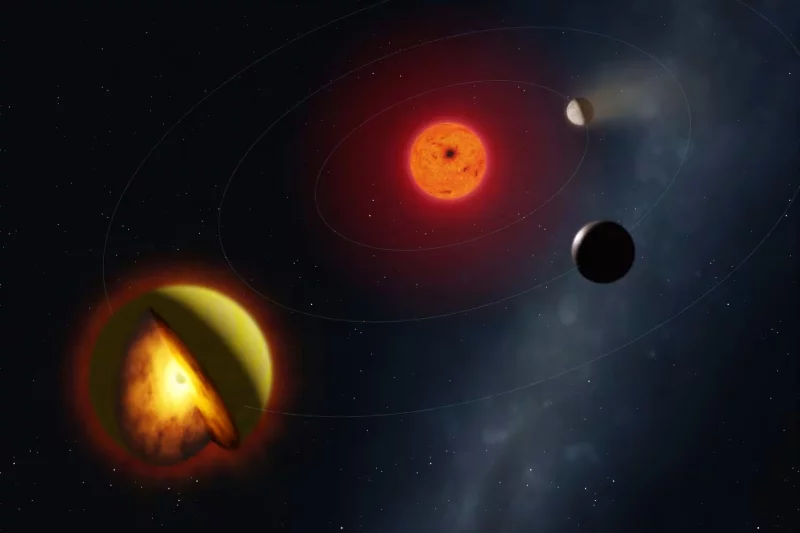
https://refractor.io/space/sulphur-lava-world/
By Elizabeth Howell
April 20, 2026 01:03 am
The floor is literally lava on a nearby exoplanet, new telescope observations show. Given its small size and strange history, one team of scientists suggests planet L 98-59 d’s molten ocean and odd atmosphere might represent an entirely new category of extraterrestrial world.
In space terms, the planet is relatively close to us — about 35 light-years away — and similar to Earth’s size, measuring about 1.6 times our planet’s diameter. But L 98-59 d has a puzzling composition, compared with our planet’s size and history: it essentially has a mantle composed of molten silicate, which is similar to lava on Earth. This molten reservoir allows the planet to store enormous amounts of sulphur deep in its interior, and makes it unlike other rocky planets seen before. L 98-59 d may therefore be part of a new class of sulfur-rich, magma ocean worlds, never before witnessed.
https://refractor.io/space/sulphur-lava-world/
-
weatheriscool
- Posts: 25738
- Joined: Sun May 16, 2021 6:16 pm
- Contact:
-
weatheriscool
- Posts: 25738
- Joined: Sun May 16, 2021 6:16 pm
- Contact:
-
weatheriscool
- Posts: 25738
- Joined: Sun May 16, 2021 6:16 pm
- Contact:
-
weatheriscool
- Posts: 25738
- Joined: Sun May 16, 2021 6:16 pm
- Contact:
-
weatheriscool
- Posts: 25738
- Joined: Sun May 16, 2021 6:16 pm
- Contact:
-
weatheriscool
- Posts: 25738
- Joined: Sun May 16, 2021 6:16 pm
- Contact:
Re: Exoplanets – worlds of other suns
The lower size limit for habitable exoplanets, according to the new model discussed in that Reddit post (r/exoplanets), is 0.8 Earth radii (R⊕).
phys.org
The post links to a May 11, 2026, phys.org article about the Smaller Than Earth Habitability Model (STEHM), developed by researchers (led by Michelle L. Hill) at the University of California, Riverside. The pre-print paper is available on arXiv (2605.00170).
phys.org
What the limit meansThe model focuses on whether small rocky planets in the habitable zone of a Sun-like star can retain a thick atmosphere for billions of years (long enough for life to potentially develop and thrive). Planets ≥ 0.8 R⊕ can hold onto their atmospheres under default Earth-like conditions (stagnant-lid tectonics, CO₂-rich atmosphere). Planets ≤ 0.7 R⊕ lose their atmospheres relatively quickly due to two main factors:
universetoday.com
Weaker gravity/escape velocity → atmospheric gases escape more easily via Jeans escape, especially under intense extreme ultraviolet (XUV) radiation from the young star.
Faster internal cooling → smaller planets have a higher surface-area-to-volume ratio, so they cool quickly. This thickens the lithosphere, shuts down volcanic outgassing, and starves the atmosphere of replenishment.
Examples from the modelA 0.6 R⊕ planet retains an atmosphere for ~400 million years.
A 0.5 R⊕ planet loses it in only ~30 million years.
phys.org
Important caveatsThe 0.8 R⊕ cutoff is for “typical” formation conditions. Rare exceptions (e.g., an unusually large initial carbon budget, low core radius fraction, or a “cold start” with delayed mantle heating) could let some planets as small as 0.7 R⊕ keep an atmosphere, but these are considered exceedingly uncommon.
universetoday.com
The Reddit post itself has very few comments so far (it’s brand new as of May 12, 2026), but the linked article and the underlying paper provide the full details. This model helps astronomers prioritize which small exoplanets are worth targeting with future telescopes for signs of habitability.
===
This is what I suspected all along. Mars is simply too small to sustain in atmosphere as it doesn't have enough gravity but also isn't massive enough to maintain its liquid core to sustain a magnetic field. An earth sized mars would probably still have oceans today but would be somewhat colder so it would be icy.
-
firestar464
- Posts: 8321
- Joined: Wed Oct 12, 2022 7:45 am
Re: Exoplanets – worlds of other suns
It's more of a core issue afaik.
-
weatheriscool
- Posts: 25738
- Joined: Sun May 16, 2021 6:16 pm
- Contact:
Re: Exoplanets – worlds of other suns
A Climate-Constrained Bayesian Inverse Method for JWST Rocky Exoplanet Eclipse Spectra: A Case Study of LTT 1445A b
Nicholas Wogan, Natasha Batalha, Jegug Ih, Jacob Lustig-Yaeger, Kevin Stevenson
Nicholas Wogan, Natasha Batalha, Jegug Ih, Jacob Lustig-Yaeger, Kevin Stevenson
https://arxiv.org/abs/2605.14997Determining whether temperate rocky exoplanets orbiting M stars retain atmospheres is currently a central goal of exoplanet astronomy. To this end, the James Webb Space Telescope has begun searching for atmospheres on these worlds with MIRI secondary eclipse spectroscopy and photometry. Here, we develop a novel climate-constrained Bayesian inference framework that yields atmospheric pressure and composition constraints from these datasets, while accounting for planetary, stellar, and model uncertainties. Our approach fits observations with model spectra derived from self-consistent pressure-temperature profiles at radiative-convective equilibrium, thus maximizing the information extracted from the data and providing more robust inferences than retrievals that use parameterized pressure-temperature profiles. We demonstrate the framework on the existing MIRI LRS eclipse spectrum of LTT 1445A b (1.34 and K). An atmosphere does not need to be invoked to explain the data, meaning a bare rock model produces an adequate fit. If the planet has an atmosphere, the upper limits on surface partial pressures are bar for an optically thin gas like O , N or CO, bar for CO , bar for H O, and bar for SO . Scheduled MIRI F1500W observations could detect one of the thicker atmospheres permitted by the existing data (1 bar O and 0.01 bar CO ), if a precision of 20 ppm or better is achieved. This case study demonstrates that climate-constrained Bayesian inversion can turn rocky-planet eclipse spectra into the quantitative constraints necessary to test population-level atmospheric retention hypothesis, like the cosmic shoreline.
Re: Exoplanets – worlds of other suns
Temperate super-Earth found orbiting nearby red dwarf
19th May 2026
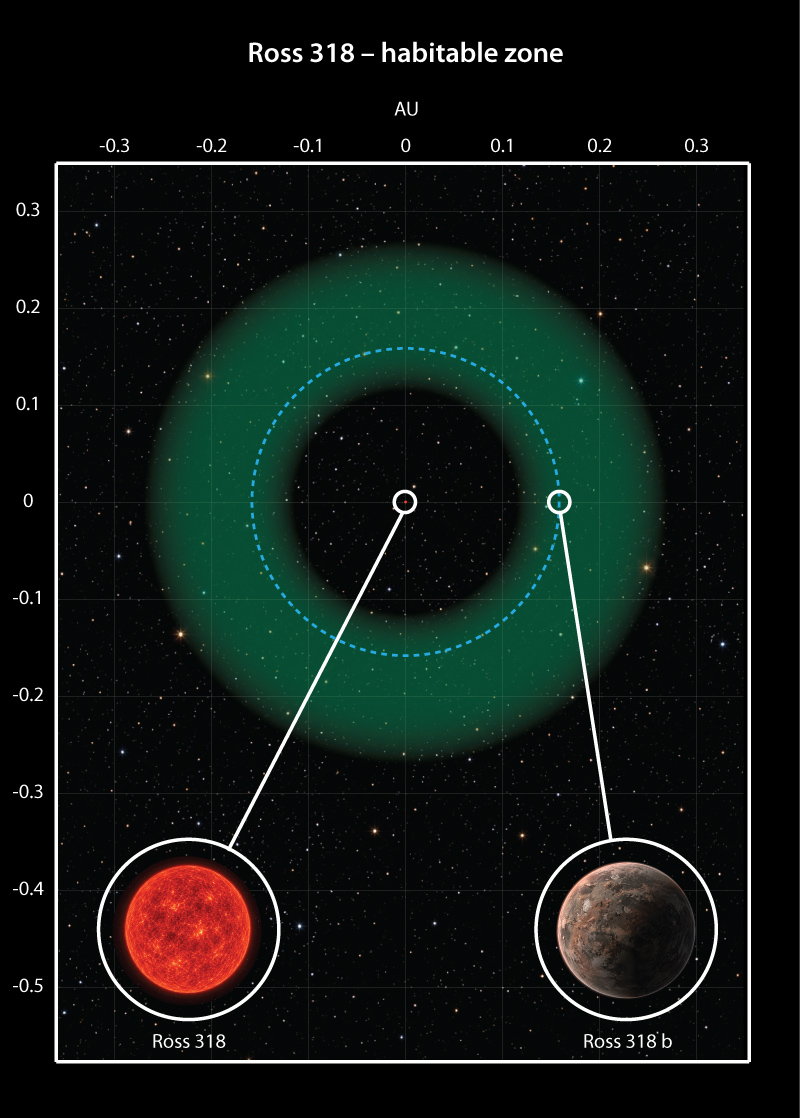
A team of astronomers from Italy and Brazil has reported a temperate super-Earth within the habitable zone of Ross 318, a nearby red dwarf just 28 light-years away.
Read more: https://www.futuretimeline.net/blog/202 ... -318-b.htm
19th May 2026
A team of astronomers from Italy and Brazil has reported a temperate super-Earth within the habitable zone of Ross 318, a nearby red dwarf just 28 light-years away.
Read more: https://www.futuretimeline.net/blog/202 ... -318-b.htm