Aging & Longevity News and Discussions

Post Reply
User avatar
wjfox
Site Admin
Posts: 13580
Joined: Sat May 15, 2021 6:09 pm
Location: Essex, UK
Contact:

Aging & Longevity News and Discussions

Post by wjfox »

This thread is specifically for news and developments in life extension, as well as the wider implications for society.

A great resource I recommend is Lifespan.io's Rejuvenation Roadmap, which tracks the latest clinical trials:

https://www.lifespan.io/road-maps/the-r ... n-roadmap/

I also recommend following these people, who are experts in their field:

https://twitter.com/davidasinclair
https://twitter.com/aubreydegrey


Image


Image
User avatar
wjfox
Site Admin
Posts: 13580
Joined: Sat May 15, 2021 6:09 pm
Location: Essex, UK
Contact:

Re: Aging & Longevity News and Discussions

Post by wjfox »

When do we think aging might be preventable?

Some fairly substantial progress has already been achieved in mice, worms and fruit flies. However, only minimal advances in humans (so far).

I'm betting on ~2040-45 for the inflection point in aging research, with treatments widely available to most people within a couple of decades of that.

Aside from climate change, I can't think of any other subject that's more important to me. Without a cure for aging, we're all dead within a century and won't get to experience a single damn thing after that. It should be in everyone's top 3 for their most-wanted future breakthroughs.
User avatar
Ozzie guy
Posts: 527
Joined: Sun May 16, 2021 4:40 pm

Re: Aging & Longevity News and Discussions

Post by Ozzie guy »

wjfox wrote: Thu May 20, 2021 7:51 am When do we think aging might be preventable?
Yuli is confident in proto/first generation AGI before the end of 2024.

I don't think it will take many years after proto AGI before we get human level AGI.

I don't think it will take many years after human level AGI before we reach the longevity escape velocity.
User avatar
raklian
Posts: 1981
Joined: Sun May 16, 2021 4:46 pm
Location: North Carolina

Re: Aging & Longevity News and Discussions

Post by raklian »

wjfox wrote: Thu May 20, 2021 7:51 am
Aside from climate change, I can't think of any other subject that's more important to me. Without a cure for aging, we're all dead within a century and won't get to experience a single damn thing after that. It should be in everyone's top 3 for their most-wanted future breakthroughs.
It's my #1 most wanted future need.... errr... I mean, technological breakthrough I look forward to. :)
To know is essentially the same as not knowing. The only thing that occurs is the rearrangement of atoms in your brain.
User avatar
Ken_J
Posts: 249
Joined: Sun May 16, 2021 5:25 pm

Re: Aging & Longevity News and Discussions

Post by Ken_J »

the hazard in trying to estimate when it will happen is that we have a heavy bias in measuring these things against our own timelines. It's why some of the big names in the field imagine it's already happening... just in time for their 50 something birthday.

I want to say that with +NAD supplements, Telomerase, surtuin activators, PQQ for mitochondria improvements and reduction in inflammation and oxidation stressors; Together with fasting to trigger autophaghy, caloric restriction and some analouge to hyperbaric oxygen therapies; that we could maybe be looking at a life expectancy increase of maybe 5 years average, and maybe in the range of 8-12 years for individuals.

All of that is viable right now. The rest of the things going on are still highly more speculative. Like gene therapies, stem cell therapies, young plasma...

and it always reminds me of all the superstitious rituals of past cultures designed to calm the fear of ceasing to exist one day. That there is still a legacy in our current time of believing that if we live the right way, say and do the right things and take the prescribed offerings that it will spare us the dissolution of self into nothing for the rest of eternity.

Now do I think it's feasable to give a person a life span in multiple hundreds if not thousands of years? Yes. I also feel that it will be such a departure from how life works now, as to be confusing to us. Like I'm not entirely convinced that neurological tissue is up to living 180-350 years. So we may shed memories of our early lives or port them over to some synthetic storage medium as we repopulate section of brains with new cells, in effect building a new childs brain around the core of our consciousness. And I genuinely believe that the rest of the body can largely be replaced over and over again. And that all of this is really what will open up the galaxy to us. Where people can make fifty year trips to nearby stars because 50 years will be the new summer vacation.

But the achievement of those capabilities, I feel depend more on nanoscale medicine of a near drexlerian style, as well as huge discoveries into the nature of consciousness and human brains in general (some of which I expect to be bad news, but not a complete preclusion of progress toward huge advances). And While the tech could advance quickly if it was treated like a moon race, the tendency of medical advancements to be methodical and there to be hidden consequences to long term health and wellbeing that one really can only uncover through years and decades of research...

Not to mention the cultural and social complications. Not just the logistics of work, economics, and political issues; but the superstitious panicy animals that humanity is and that drives things like anti-vaxxers even in a global pandemic will get involved in defining that timeline.

And so I debate with myself whether I think it will get here in the next 20-30-40 years or if it will be just 10 years away in 60 years and then just 5 years away in 80 years and just around the corner in 100 years.
User avatar
wjfox
Site Admin
Posts: 13580
Joined: Sat May 15, 2021 6:09 pm
Location: Essex, UK
Contact:

Re: Aging & Longevity News and Discussions

Post by wjfox »

User avatar
Yuli Ban
Posts: 5194
Joined: Sun May 16, 2021 4:44 pm

Re: Aging & Longevity News and Discussions

Post by Yuli Ban »

Analysis of blood markers predicts human lifespan limit.


I'm not the healthiest man alive, but I would like to live for a good long while to see all that the Future™ has in store. Presuming I do somehow magically make it to 138 through arcane magic and extreme luck, that would mean I'd live to 2132.
And remember my friend, future events such as these will affect you in the future
User avatar
raklian
Posts: 1981
Joined: Sun May 16, 2021 4:46 pm
Location: North Carolina

Re: Aging & Longevity News and Discussions

Post by raklian »

Yuli Ban wrote: Wed May 26, 2021 10:21 pm Analysis of blood markers predicts human lifespan limit.


I'm not the healthiest man alive, but I would like to live for a good long while to see all that the Future™ has in store. Presuming I do somehow magically make it to 138 through arcane magic and extreme luck, that would mean I'd live to 2132.
If you're going to live to 2132, you'll most certainly going to live to 2500 and even beyond sans a freak accident.
To know is essentially the same as not knowing. The only thing that occurs is the rearrangement of atoms in your brain.
User avatar
wjfox
Site Admin
Posts: 13580
Joined: Sat May 15, 2021 6:09 pm
Location: Essex, UK
Contact:

Re: Aging & Longevity News and Discussions

Post by wjfox »

Image
User avatar
wjfox
Site Admin
Posts: 13580
Joined: Sat May 15, 2021 6:09 pm
Location: Essex, UK
Contact:

Re: Aging & Longevity News and Discussions

Post by wjfox »

In terms of health benefits, pomegranate seeds are one of the best things you can eat – great for anti-aging, heart health and cancer prevention. I can't recommend them highly enough.

Google "pomegranate seeds health benefits" and you'll see what I mean. :)

I eat them nearly every day. You can have them with yogurt to improve the flavour/texture.
User avatar
wjfox
Site Admin
Posts: 13580
Joined: Sat May 15, 2021 6:09 pm
Location: Essex, UK
Contact:

Re: Aging & Longevity News and Discussions

Post by wjfox »

Israeli scientists extend mice’s lives by 23%, say method may work on humans

Mice not only live longer, but are more youthful and less susceptible to cancer, after team from Bar Ilan University and US National Institutes of Health boosts a single protein

1 June 2021, 7:42 am

Israeli scientists have boosted the life expectancy of mice by 23 percent, in an advance they hope could eventually be replicated in humans.

They increased the supply of a protein, SIRT6, which normally wanes with aging, in 250 mice. In peer-reviewed research just published in the journal Nature Communications, they have revealed the increased life expectancy — and also stated that the protein-rich mice were more youthful and less susceptible to cancer.

“The change in life expectancy is significant, when you consider that an equivalent jump in human life expectancy would have us living on average until almost 120,” said Prof. Haim Cohen of Bar-Ilan University.

[...]

In 2012 Cohen became the first researcher to to actually increase levels in animals and increase life expectancy, and in doing so cause male mice to live 15% longer. But that experiment had no impact on female mice.

In the latest research — a collaboration between international scientists including Prof. Rafael de Cabo from the US National Institutes of Health — the jump in life expectancy was seen among both male and female mice. It is bigger among the male mice, who are now living 30% longer than males from the control group. The female mice are living 15% longer than their control group counterparts.

Read more: https://www.timesofisrael.com/israeli-s ... on-humans/
User avatar
wjfox
Site Admin
Posts: 13580
Joined: Sat May 15, 2021 6:09 pm
Location: Essex, UK
Contact:

Re: Aging & Longevity News and Discussions

Post by wjfox »

New study finds most adults would not take a life extension pill, even if it existed

By Douglas Heingartner
June 6, 2021

A new study of about 900 U.S. adults has found that only 33% would use a hypothetical life extension treatment that would allow them “to live forever,” even if it were available today. About 42% said they would not use it, and 25% said they were unsure.

[...]

The 911 participants consisted of three age groups: 593 young adults (aged 18 – 29, average age 20, recruited from a U.S. university), a group of 272 “younger” seniors (average age 72) recruited via senior centers and church groups, and a third group of 46 “older” seniors (average age 88) recruited in the same way.

The researchers asked the participants three questions. One was “If doctors developed a pill that enabled you to live forever at your current age, would you take it?” The possible answers were yes, no, or unsure. The second question was “What is the youngest age at which you would be willing to live forever?” and the third was “What is the oldest age at which you would be willing to live forever?”

[...]

The overall differences between the three age groups were small. Among young adults, 34% said yes, 40% said no, and 26% were unsure. For the younger seniors, 32% said yes, 43% said no, and 25% were unsure. And among the group of older seniors, 24% said yes, 59% said no, and 17% indicated they were unsure.

[...]

But the researchers did find a large difference between the three age groups in terms of the youngest and oldest age at which they would be willing to live forever. For young adults, the youngest age at which they would like to “freeze” the aging process and then live forever was 23, and the oldest age was 42.

https://www.psychnewsdaily.com/new-stud ... t-existed/

User avatar
Ken_J
Posts: 249
Joined: Sun May 16, 2021 5:25 pm

Re: Aging & Longevity News and Discussions

Post by Ken_J »

There is a part of me that feels like I'm okay with half the population not choosing to live an extended life. I mean there are plenty of people who have had strokes and heart attacks and yet choose not to give up fatty food, cigarettes and drinking. There are those who would arm themselves with guns and try to kidnap government officials because they think the government is faking a pandemic to try and get 5g microchips implanted into people. If these blithering nitwits feel unwilling to take the option to have an indefinite future I'm sure not going to force the rest of humanity to work one iota more to convince them otherwise.

And yet at the same time I've faced some pain and sickness recently and some minor depression that can really make one feel like like really is a long string of injuries (physical, mental and emotional) acquired one after another until you can no longer recover and then just a lingering demise. And the idea of that sort of pain and misery, over and over again without end... is literally describing hell as most people envision it.

But I think that in part the results of this survey are due to how the question is asked.

If it instead asked the participants if they were offered medical therapies that prevented heart disease, mental declines, thinning bones, arthritis, vision and hearing loss, and could allow them to eat like they used to eat when younger... and the therapies were easy and quick to take and lasted a decade each... how many would they take in the future? When would be a good time to stop taking them?

I think part of the problem is that we frame it as an active choice, and the consequences are made to sound infinite. In a world where many people have lived lives slaving away for companies that destroy the world without checks while we are beaten down for demanding authority stop murdering our fellow citizens in the streets with impunity. That the summers will become impossibly hotter each year, with increased droughts. more pandemics will emerge, along with economic recessions, depressions, famines, and wars. That feels like an awful lot to sign up for over and over again for all time.

It's why I prefer to flip the framing. Asking myself and others, if you could prevent the symptoms of aging until the end of your life, when would you chose to die. Cuz given the passive choice to keep playing games, reading books, trying new recipes, walking with friends, playing some sport, seeing movies, learning new things... etc. people will almost always just keep doing things. They don't want to choose to stop it all.

I think the result would vary greatly if we framed the questions differently.
User avatar
wjfox
Site Admin
Posts: 13580
Joined: Sat May 15, 2021 6:09 pm
Location: Essex, UK
Contact:

Re: Aging & Longevity News and Discussions

Post by wjfox »

User avatar
Time_Traveller
Posts: 3025
Joined: Sun May 16, 2021 4:49 pm
Location: New York City, USA, November 5th 2032 C.E.

Re: Aging & Longevity News and Discussions

Post by Time_Traveller »

Is 150 years really the limit of human lifespan?
Thursday 10 Jun 2021

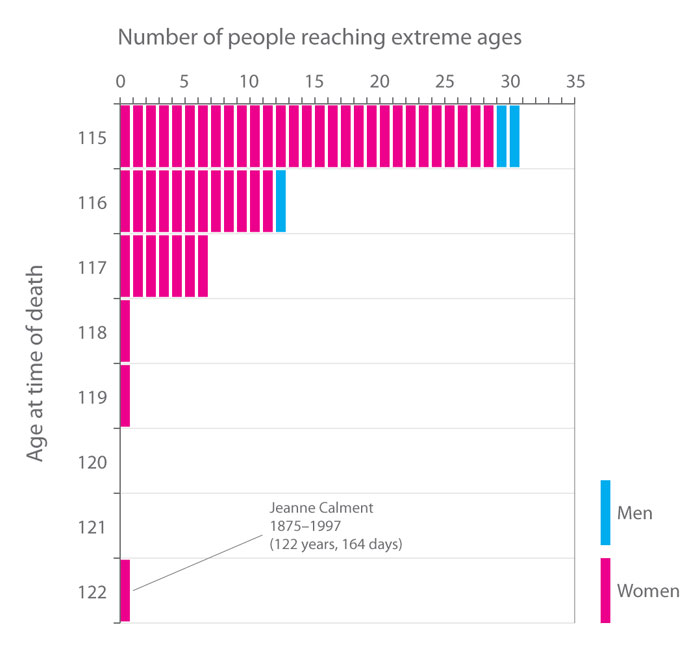
While most of us can expect to live to around 80, some people defy expectations and live to be over 100. In places such as Okinawa, Japan and Sardinia, Italy, there are many centenarians. The oldest person in history — a French woman named Jeanne Calment — lived to 122. When she was born in 1875, the average life expectancy was roughly 43.

But just how long could a human actually live? It’s a question people have been asking for centuries. While average life expectancy (the number of years a person can expect to live) is relatively easy to calculate, maximum lifespan estimates (the greatest age a human could possibly reach) are much harder to make. Previous studies have placed this limit close to 140 years of age. But a more recent study proposes that the limit to human lifespan is closer to 150.

Calculating lifespan

The oldest and still most widely used method for calculating life expectancy, and thus lifespan, relies on the Gompertz equation. This is the observation, first made in the 19th century, that human death rates from disease increase exponentially with time. Essentially, this means your chance of death — from cancer, heart disease and many infections, for example — roughly doubles every eight to nine years.

There are many ways the formula can be tweaked to account for how different factors (such as sex or disease) affect the lifespan within a population. Gompertz calculations are even used to calculate health insurance premiums — which is why these companies are so interested in whether you smoke, whether you are married and anything else that might allow them to more accurately judge the age at which you will die.

Another approach to figuring out how long we can live is to look at how our organs decline with age, and run that rate of decline against the age at which they stop working. For example, eye function and how much oxygen we use while exercising show a general pattern of decline with ageing, with most calculations indicating organs will only function until the average person is around 120 years old.
https://metro.co.uk/2021/06/10/is-150-y ... i=14745298
“In the quantum multiverse, every choice, every decision you've ever and never made exists in an unimaginably vast ensemble of parallel universes.”
weatheriscool
Posts: 24486
Joined: Sun May 16, 2021 6:16 pm
Contact:

Re: Aging & Longevity News and Discussions

Post by weatheriscool »

It will all come down to repairing the body and renewing the cells. Sure, cells and organs without this could only last 150 years but regeneration could allow for thousands of years.
User avatar
wjfox
Site Admin
Posts: 13580
Joined: Sat May 15, 2021 6:09 pm
Location: Essex, UK
Contact:

Re: Aging & Longevity News and Discussions

Post by wjfox »

Could ‘super-agers’ help explain how we get old?

Beryl Voss is 88-years-old and is still very active - going hiking on a regular basis and volunteering twice a week at a food hall to help people who are hungry.

She is also part of a study to find out why people like her have aged well and what scientists can learn from her.

BBC Click’s James Clayton finds out more.


weatheriscool
Posts: 24486
Joined: Sun May 16, 2021 6:16 pm
Contact:

Re: Aging & Longevity News and Discussions

Post by weatheriscool »

Age Resetting Genes Going to Human Studies in Two Years
June 8, 2021 by Brian Wang
https://www.nextbigfuture.com/2021/06/a ... years.html
David Sinclair is a geneticist at Harvard and author of Lifespan.

Nature – Reversal of biological clock restores vision in old mice
Sinclair and his team restored vision in old mice and in mice with damaged retinal nerves by resetting some of the thousands of chemical marks that accumulate on DNA as cells age. They are now working to rejuvenate the brains of old mice. This work is so promising that Sinclair believes he can get to human trials within two years. Sinclair is using three genes to reset the age of cells.
weatheriscool
Posts: 24486
Joined: Sun May 16, 2021 6:16 pm
Contact:

Re: Aging & Longevity News and Discussions

Post by weatheriscool »

Convergent mechanism of aging discovered
https://phys.org/news/2021-06-convergen ... aging.html
by Max Planck Society
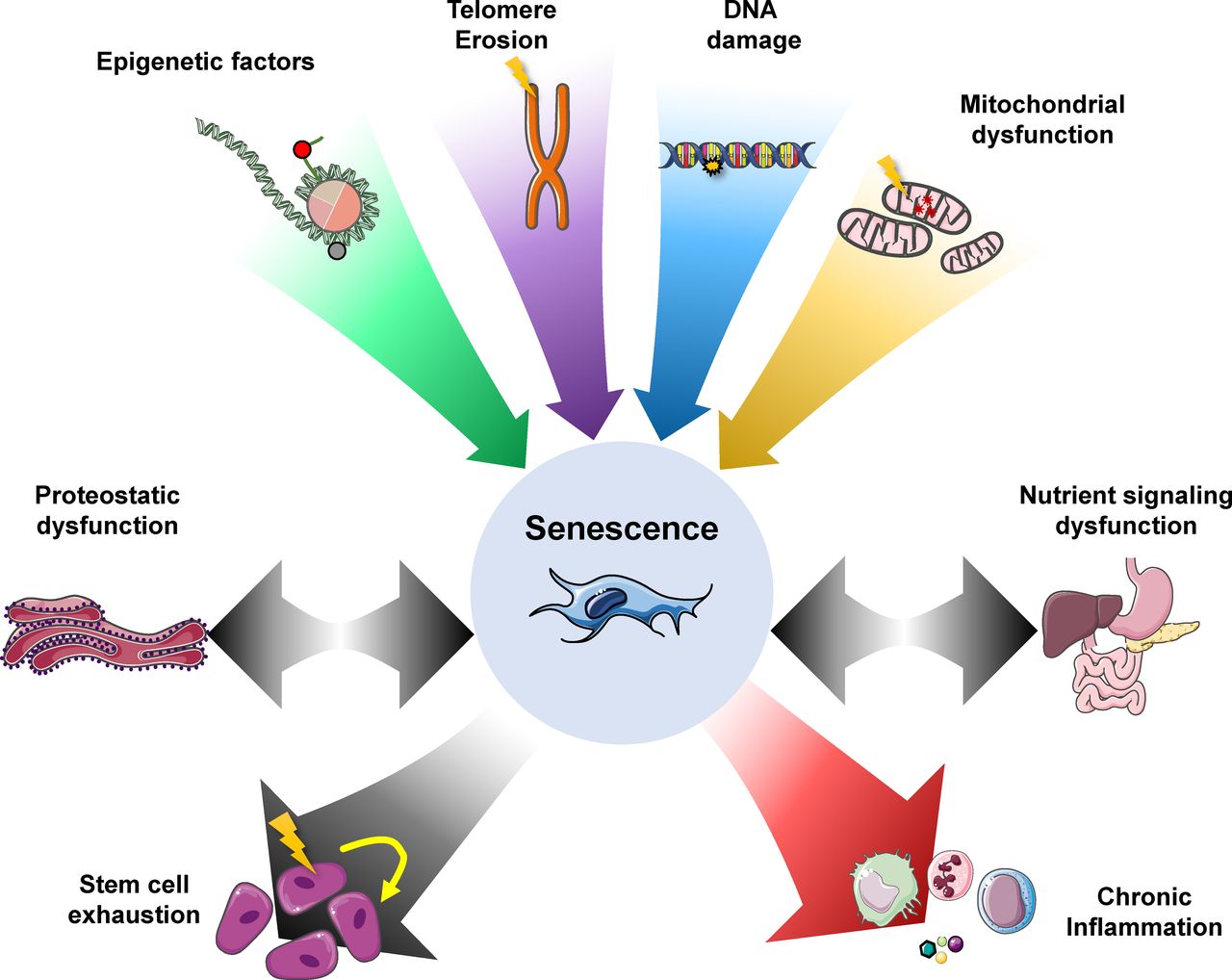
Several different causes of aging have been discovered, but the question remains whether there are common underlying mechanisms that determine aging and lifespan. Researchers from the Max Planck Institute for Biology of Ageing and the CECAD Cluster of Excellence in Ageing research at the University Cologne have now come across folate metabolism in their search for such basic mechanisms. Its regulation underlies many known aging signaling pathways and leads to longevity. This may provide a new possibility to broadly improve human health during aging.

In recent decades, several cellular signaling pathways have been discovered that regulate the lifespan of an organism and are thus of enormous importance for aging research. When researchers altered these signaling pathways, this extended the lifespan of diverse organisms. However, the question arises whether these different signaling pathways converge on common metabolic pathways that are causal for longevity.
weatheriscool
Posts: 24486
Joined: Sun May 16, 2021 6:16 pm
Contact:

Re: Aging & Longevity News and Discussions

Post by weatheriscool »

Anti-aging protein in red blood cells helps stave off cognitive decline

by Public Library of Science
https://medicalxpress.com/news/2021-06- ... cells.html
Research conducted by Qiang et al has discovered a link between a protein in red blood cells and age-related decline in cognitive performance. Published in the open access journal PLOS Biology on 17th June 2021, the study shows that depleting mouse blood of the protein ADORA2B leads to faster declines in memory, delays in auditory processing, and increased inflammation in the brain.

As life expectancies around the world increase, so are the number of people who will experience age-related cognitive decline. Because the amount of oxygen in the blood also declines with age, the team hypothesized that aging in the brain might be naturally held at bay by adenosine receptor A2B (ADORA2B), a protein on the membrane of red blood cells which is known to help release oxygen from the blood cells so it can be used by the body. To test this idea, they created mice that lacked ADORA2B in their blood and compared behavioral and physiological measures with control mice.
Post Reply