https://phys.org/news/2021-08-astronome ... world.html
by Tomasz Nowakowski , Phys.org
A new class of exoplanet very different to our own, but which could support life, has been identified by astronomers, which could greatly accelerate the search for life outside our Solar System.
In the search for life elsewhere, astronomers have mostly looked for planets of a similar size, mass, temperature and atmospheric composition to Earth. However, astronomers from the University of Cambridge believe there are more promising possibilities out there.
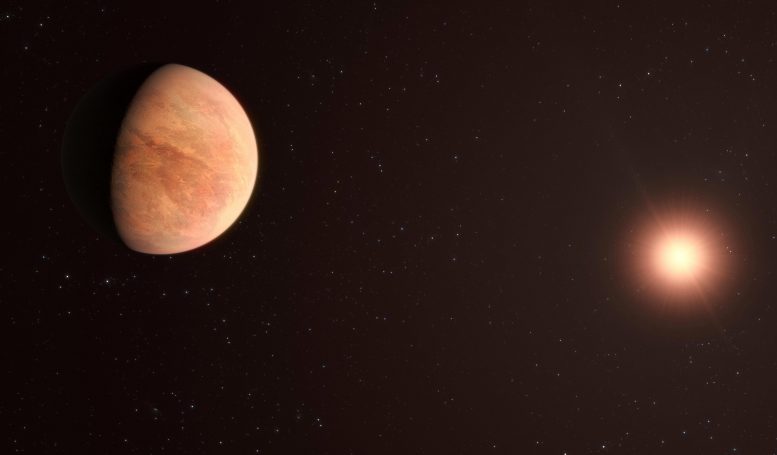
The researchers have identified a new class of habitable planets, dubbed 'Hycean' planets—hot, ocean-covered planets with hydrogen-rich atmospheres—which are more numerous and observable than Earth-like planets.
The researchers say the results, reported in The Astrophysical Journal, could mean that finding biosignatures of life outside our Solar System within the next two or three years is a real possibility.
The ESPRESSO spectrograph is a new powerful tool to detect and characterize extrasolar planets. Its design allows unprecedented radial velocity precision (down to a few tens of cm/s) and long-term thermo-mechanical stability. We present the first standalone detection of an extrasolar planet by blind radial velocity search using ESPRESSO and aim at showing the power of the instrument in characterizing planetary signals at different periodicities in long time spans. We use 41 ESPRESSO measurements of HD\,22496 within a time span of 895 days with a median photon noise of 18 cm/s. A radial velocity analysis is performed to test the presence of planets in the system and to account for the stellar activity of this K5-K7 main sequence star. For benchmarking and comparison, we attempt the detection with 43 archive HARPS measurements and compare the results yielded by the two datasets. We also use four TESS sectors to search for transits. We find radial velocity variations compatible with a close-in planet with an orbital period of P=5.09071±0.00026 days when simultaneously accounting for the effects of stellar activity at longer time scales (Prot=34.99+0.58−0.53 days). We characterize the physical and orbital properties of the planet and find a minimum mass of 5.57+0.73−0.68 M⊕, right in the dichotomic regime between rocky and gaseous planets. Although not transiting according to TESS data, if aligned with the stellar spin axis, the absolute mass of the planet must be below 16 M⊕. We find no significant evidence for additional signals with semi-amplitudes above 56 cm/s at 95% confidence. With a modest set of radial velocity measurements, ESPRESSO is capable of detecting and characterizing low-mass planets and constrain the presence of planets in the habitable zone of K-dwarfs down to the rocky-mass regime.
An international team of astronomers has detected a new ultra-hot Jupiter extrasolar planet using NASA's Transiting Exoplanet Survey Satellite (TESS). The newfound alien world is nearly two times larger than Jupiter and has a misaligned orbit. The finding is detailed in a paper published August 25 on the arXiv pre-print repository.
The so-called "hot Jupiters" are similar in characteristics to the solar system's biggest planet, but have orbital periods of less than 10 days. Such exoplanets have high surface temperatures, as they orbit their parent stars very closely.
Now, a group of astronomers led by Samuel H. C. Cabot of Yale University reports the finding of a new exoplanet of this type, which turns out to have an ultra-high surface temperature. While observing a bright star designated TOI-1518 with TESS, a transit signal was identified in the light curve of this object. The planetary nature of this signal was confirmed by follow-up high-resolution observations with the EXPRES spectrograph at the Lowell Discovery Telescope.
We present the first results of K2-OjOS, a collaborative project between professional and amateur astronomers primarily aimed to detect, characterize and validate new extrasolar planets. For this work, 10 amateur astronomers looked for planetary signals by visually inspecting the 20,427 light curves of K2 campaign 18 (C18). They found 42 planet candidates, of which 18 are new detections and 24 had been detected in the overlapping C5 by previous works. We used archival photometric and spectroscopic observations, as well as new high-spatial resolution images in order to carry out a complete analysis of the candidates found, including a homogeneous characterization of the host stars, transit modeling, search for transit timing variations and statistical validation. As a result, we report four new planets (K2-XXX b, K2-XXX b, K2-XXX b, and K2-XXX b) and 14 planet candidates. Besides, we refine the transit ephemeris of the previously published planets and candidates by modeling C5, C16 (when available) and C18 photometric data jointly, largely improving the period and mid-transit time precision. Regarding individual systems, we highlight the new planet K2-XXX b and candidate EPIC211537087.02 being near a 2:1 period commensurability, the detection of significant TTVs in the bright star K2-184 (V = 10.35), the location of K2-103 b inside the habitable zone according to optimistic models, the detection of a new single transit in the known system K2-274, and the disposition reassignment of K2-120 b, which we consider as a planet candidate as the origin of the signal can not be ascertained.
Super-Earths with periods shorter than one day are usually referred as Ultra-Short Period planets. Some of them orbit the host star so closely that the surface temperature can reach several thousand degrees, and the thermal emission of the day side can be detected photometrically in the same light curve used to discover the planet. The HARPS-N GTO collaboration has been pivotal in measuring the mass and internal density of these so-called lava worlds detected by Kepler, K2, and now TESS. After briefly reviewing the most important lava worlds, in this proposed talk I will describe our efforts to characterize TOI-2431, a rocky planet orbiting a bright (V=10.9) K dwarf every 5.4 hours, the shortest period among planets with a known density. The planet is expected to have lost its primordial atmosphere, but it may well possess a rock vapor atmosphere sustained by its surface magma ocean. For its short orbital period and the brightness of the host star, this is so far the best target for the characterization of the molten surface of an exo-world using current and future facilities such as CHEOPS, Hubble, and James Webb Space Telescopes.
TOI 1246 is one of only eight four-planet systems with measured masses and radii for all four planets. TESS observed this moderately bright K dwarf (V=11.6, K=9.9) for 12 sectors, and found four transiting planets. We collected 90 RV observations with Keck/HIRES and TNG/HARPS-N, many of which were contemporaneous with TESS photometry. We refit the photometry to refine planet radii, measure masses for all four planets, and find a surprising range of masses and densities. This system is brighter 93% of other four planet systems, and is a particularly interesting testing ground for mass loss and formation hypotheses due to the high planet multiplicity and varied planet masses.
We present two small transiting planets with mass measurements orbiting bright mid M dwarfs (GJ 3473, GJ 3929). GJ 3473 b (Kemmer et al. 2020) is a hot, presumably rocky, planet (P = 1.198 d, Mb = 1.86 ± 0.30 Me, and radius, Rb = 1.264 ± 0.050 Re), which is due to its high temperature a particularly attractive target for thermal emission spectroscopy. Further, it is accompanied by another non-transiting planet (Pc = 15.509 ± 0.033 d) that has a minimum mass of Mc sin i = 7.41 ± 0.91 Me. For GJ 3929 b (in prep.) we present a preliminary analysis that yields a period of P = 2.616 d, mass Mb = 2.03 ± 0.59 Me, and radius, Rb = 1.155 ± 0.043 Re. The radial velocity data show evidence for another signal, whose origin is, however, not yet clarified.
Both systems add to the TESS level-one science goal to measure the masses for 50 transiting planets with radii smaller than 4 Re.
An international team of astronomers has not only detected clouds on the distant exoplanet WASP-127b, but also measured their altitude with unprecedented precision. A presentation by Dr. Romain Allart at the Europlanet Science Congress (EPSC) 2021 shows how, by combining data from a space- and a ground-based telescope, the team has been able to reveal the upper structure of the planet's atmosphere. This paves the way for similar studies of many other faraway worlds.
WASP-127b, located more than 525 light-years away, is a "hot Saturn"—a giant planet similar in mass to Saturn that orbits very close to its sun. The team observed the planet passing in front of its host star to detect patterns that become embedded in the starlight as it is filtered through the planet's atmosphere and altered by the chemical constituents. By combining infrared observations from the ESA/NASA Hubble Space Telescope (HST) and visible light measurements from the ESPRESSO spectrograph at the European Southern Observatory's Very Large Telescope in Chile, the researchers were able to probe different regions of the atmosphere. The results brought a few surprises.
'First, as found before in this type of planet, we detected the presence of sodium, but at a much lower altitude than we were expecting. Second, there were strong water vapor signals in the infrared but none at all at visible wavelengths. This implies that water-vapor at lower levels is being screened by clouds that are opaque at visible wavelengths but transparent in the infrared,' said Allart, of the iREx/Université de Montréal and Université de Genève, who led the study.
https://www.nextbigfuture.com/2021/09/2 ... aging.html
A NASA NIAC Phase III is developing and plans to fly a 2022 TDM (Technology Demonstration Mission) to prove the SGLF’s (Solar Gravitational Lens Focus) mission architecture. They will then prepare a near-term (by 2024), low-cost (less than $40M) mission to fly through the solar system faster than any spacecraft ever ~7 AU/year, capable of rendezvous with an interstellar object (ISO).
During Phase III they will consider a set of missions to demo critical technologies.
These efforts align with our roadmap for the SGLF mission capability build-up:
• 2020-21: Phase III develops SGLF design/cost, validates critical technology;
• 2021: SGLF technology roadmap; tech demo mission(s) (TDM) formulated; coronagraph design; initial TDM is designed, passes PDR, readied for flight;
• 2022: A public-private partnership (PPP) initiates technology demonstration; series of TDMs proposed via the PPP;
• 2023-4: Sailcraft flights (less than $20M) to achieve TRL 9;
• 2026-8: Sun-accelerated flights (with ~10 AU/yr); confirm CONOPS;
• 2027: SGLF Project starts for a preselected target;
• 2032-42: Launch a string-of-pearls (SoP) mission (20+ AU/yr) to the target;
• 2060: Discover life beyond the solar system.
UNLV researchers and colleagues may have identified the first known planet to orbit three stars.
Unlike our solar system, which consists of a solitary star, it is believed that half of all star systems, like GW Ori where astronomers observed the novel phenomenon, consist of two or more stars that are gravitationally bound to each other.
But no planet orbiting three stars—a circumptriple orbit—has ever been discovered. Perhaps until now.
Takeaways
Using observations from the powerful Atacama Large Millimeter/submillimeter Array (ALMA) telescope, UNLV astronomers analyzed the three observed dust rings around the three stars, which are critical to forming planets.
But they found a substantial, yet puzzling, gap in the circumtriple disc.
The research team investigated different origins, including the possibility that the gap was created by gravitational torque from the three stars. But after constructing a comprehensive model of GW Ori, they found that the more likely, and fascinating, explanation for the space in the disc is the presence of one or more massive planets, Jupiter-like in nature. Gas giants, according to Jeremy Smallwood, lead author and a recent Ph.D. graduate in astronomy from UNLV, are usually the first planets to form within a star system. Terrestrial planets like Earth and Mars follow.
Considered an ultra-hot Jupiter—a place where iron gets vaporized, condenses on the night side and then falls from the sky like rain—the fiery, inferno-like WASP-76b exoplanet may be even more sizzling than scientists had realized.
An international team, led by scientists at Cornell University, University of Toronto and Queen's University Belfast, reports the discovery of ionized calcium on the planet—suggesting an atmospheric temperature higher than previously thought, or strong upper atmosphere winds.
The discovery was made in high-resolution spectra obtained with Gemini North near the summit of Mauna Kea in Hawaii.
Hot Jupiters are named for their high temperatures, due to proximity to their stars. WASP-76b, discovered in 2016, is about 640 light-years from Earth, but so close to its F-type star, which is slightly hotter than the sun, that the giant planet completes one orbit every 1.8 Earth days.
The research results are the first of a multiyear, Cornell-led project, Exoplanets with Gemini Spectroscopy survey, or ExoGemS, that explores the diversity of planetary atmospheres.
Countless astrophysicists and astronomers are actively searching for unobserved celestial bodies in the universe, as detecting these bodies could improve our understanding of space and help to address unanswered astrophysical questions. Among these elusive objects are exoplanets, planets that orbit a star other than the sun, thus outside of the solar system.
One crucial challenge impeding the detection of exoplanets is that with existing methods, it is hard to see a faint emissions of a secondary source that is in the proximity of a much brighter source. This significantly limits the use of direct imaging techniques in exoplanet searches.
Researchers at University of Sheffield in the United Kingdom and Macquarie University in Australia have recently showed that it might be possible to reduce errors in detecting the presence of a weak secondary source during exoplanet searches, particularly in instances where two sources have small angular separations. Their paper, published in Physical Review Letters, specifically suggests that these errors could be reduced using quantum state discrimination and quantum imaging methods.
"Our work was inspired by recent papers on super-resolution quantum imaging, which was first rigorously quantified by Mankei Tsang and his colleagues at National University of Singapore," Zixin Huang, one of the researchers who carried out the study, told Phys.org. "These papers showed that the angular separation of two incoherent sources can be much better resolved by using quantum techniques (this is an estimation task, where the parameter we want to measure is the angular separation)."
Read more: https://www.tweaktown.com/news/82025/st ... RCE5nNr_-gOne planet, in particular, is certainly quite strange to say the least. It's called WASP-76b, and is described as a "hot Jupiter". Researchers found that on this planet, it rains iron from the sky, and it doesn't just drizzle it literally buckets down with iron regularly. Why does this happen? The short answer is heat, and quite a lot of it as well. According to researchers, the planet is quite close to its parent star and is tidally locked to it, only ever showing one side of the planet to its local star.
Temperature estimations on WASP-76b came out in early 2020, and researchers said that the planet probably reached around 3,800 Fahrenheit. However, those estimations may have been slightly incorrect. A new study has been published in the journal Astrophysical Journal Letters, and within the study, researchers analyzed the planet's upper atmosphere with the Hawaiian Gemini telescope. The researchers found a strong signal of ionized calcium.
According to Ernst de Mooij, an astrophysicist at Queen's University Belfast and co-author of the study, "The signal we see from calcium, which comes from the tenuous upper atmosphere of the planet, is much stronger than what we expect from models."
Using the world's most powerful radio antenna, scientists have discovered stars unexpectedly blasting out radio waves, possibly indicating the existence of hidden planets.
The University of Queensland's Dr. Benjamin Pope and colleagues at the Dutch national observatory ASTRON have been searching for planets using the world's most powerful radio telescope Low Frequency Array (LOFAR) situated in the Netherlands.
"We've discovered signals from 19 distant red dwarf stars, four of which are best explained by the existence of planets orbiting them," Dr. Pope said.
"We've long known that the planets of our own solar system emit powerful radio waves as their magnetic fields interact with the solar wind, but radio signals from planets outside our solar system had yet to be picked up.
"This discovery is an important step for radio astronomy and could potentially lead to the discovery of planets throughout the galaxy."
Lets hope this beast of a telescope can launch successfully ( planned for 18. december).After the ultra-powerful James Webb Space Telescope launches later this year, Laura Kreidberg will lead two efforts to check the weather on rocky planets orbiting other stars.
Young planetary systems generally experience extreme growing pains, as infant bodies collide and fuse to form progressively larger planets. In our own solar system, the Earth and moon are thought to be products of this type of giant impact. Astronomers surmise that such smashups should be commonplace in early systems, but they have been difficult to observe around other stars.
Now astronomers at MIT, the National University of Ireland at Galway, Cambridge University, and elsewhere have discovered evidence of a giant impact that occurred in a nearby star system, just 95 light years from Earth. The star, named HD 172555, is about 23 million years old, and scientists have suspected that its dust bears traces of a recent collision.
The MIT-led team has observed further evidence of a giant impact around the star. They determined that the collision likely occurred between a roughly Earth-sized terrestrial planet and a smaller impactor at least 200,000 years ago, at speeds of 10 kilometers per second, or more than 22,000 miles per hour.
Crucially, they detected gas indicating that such a high-speed impact likely blew away part of the larger planet's atmosphere—a dramatic event that would explain the observed gas and dust around the star. The findings, appearing today in Nature, represent the first detection of its kind.