Space News and Discussions

Post Reply
User avatar
caltrek
Posts: 9280
Joined: Mon May 17, 2021 1:17 pm

Re: Space News and Discussions

Post by caltrek »

'Star Trek' Star Tim Russ Helps Detect Asteroid for NASA's Upcoming Mission
by Sudiksha Kochi
August 27, 2021

https://www.usatoday.com/story/entertai ... 204195002/

Introduction:
(USA Today) Tim Russ, who played Lieutenant Commander Tuvok on the sci-fi show "Star Trek: Voyager" is going back to his space roots. On his latest mission, he's helping detect asteroids for NASA.

Russ and five other citizen astronomers contributed to the detection of Patroclus, an asteroid orbiting Jupiter.

The purpose of detecting the asteroid is to serve NASA's upcoming mission in October where it will launch a probe named Lucy into space, according to Russ. NASA said in a statement posted to their website that Lucy will complete a 12-year journey to eight different asteroids: a Main Belt and seven Trojans.

"These Trojan asteroids were captured in Jupiter's orbit, probably from farther out in the solar system, so they're more rare and more pristine in terms of what information they might have in their chemical makeup," Russ tells USA TODAY.

According to NASA, the Trojan asteroids are "stabilized by the Sun and its largest planet in a gravitational balancing act. …These primitive bodies hold vital clues to deciphering the history of the solar system, and perhaps even the origins of organic material on Earth."
Image
Tim Russ stands next to his telescope.

Don't mourn, organize.

-Joe Hill
User avatar
wjfox
Site Admin
Posts: 13588
Joined: Sat May 15, 2021 6:09 pm
Location: Essex, UK
Contact:

Re: Space News and Discussions

Post by wjfox »

User avatar
caltrek
Posts: 9280
Joined: Mon May 17, 2021 1:17 pm

Re: Space News and Discussions

Post by caltrek »

Enigmatic Object Called 'The Accident' Hints of an Entire Population of Unknown Stars
by Michele Starr
September 1, 2021

https://www.sciencealert.com/something- ... ic-objects

Introduction:
(Science Alert) There are many kinds of stars out there in the big, wide Universe. We have a whole system for categorizing them according to temperature, size, and brightness.

Even so, a recently discovered object is suggesting that we're far from knowing everything.

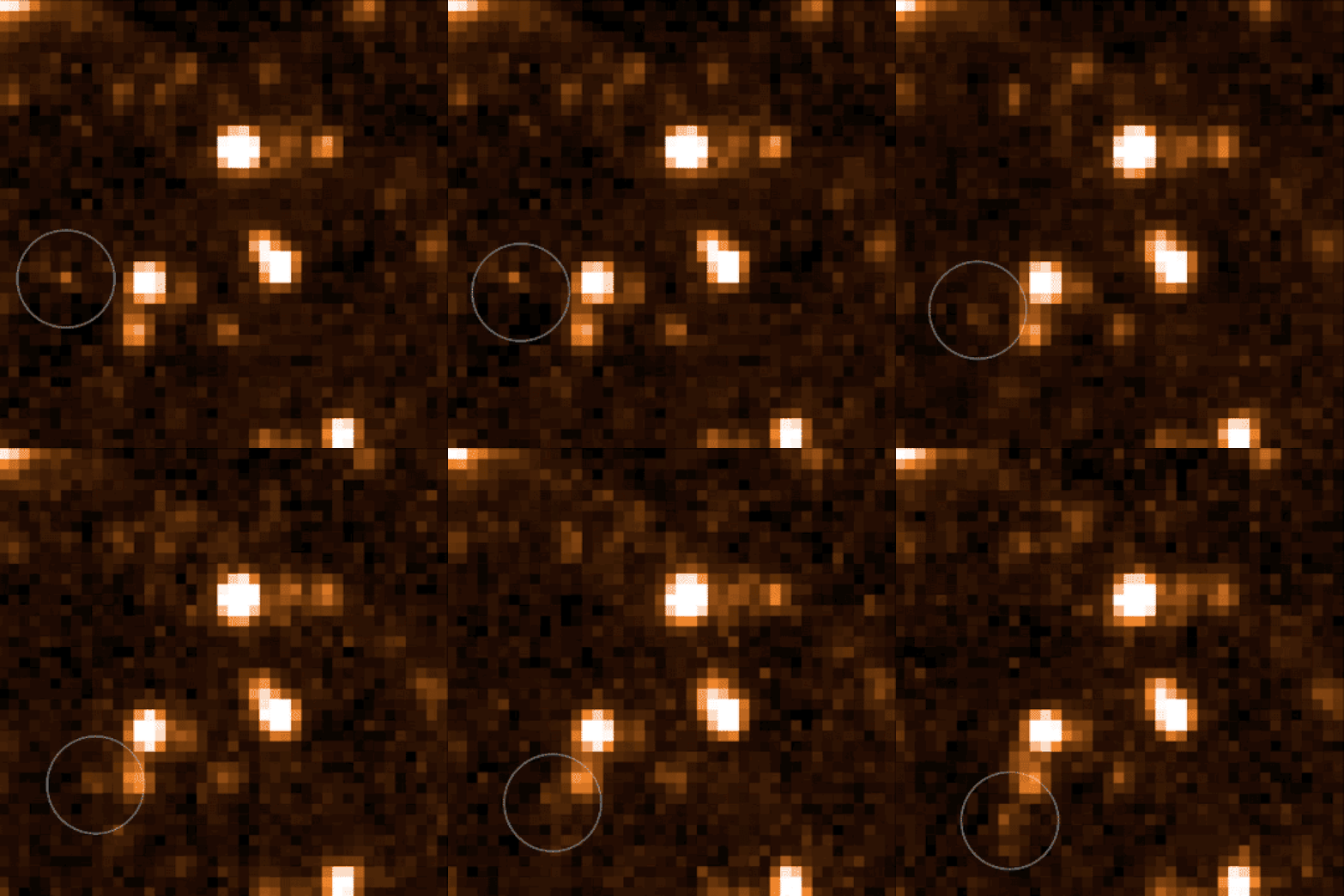
It's been nicknamed 'The Accident', and it's a type of object called a brown dwarf, also known as failed stars. But it's unlike any brown dwarf we've ever seen before, with a confusing spectrum – suggesting that it may be nearly as old as the Universe.

Since all of the other brown dwarfs discovered to date are considerably younger, this means there could be an entire population of very old ones out there that we've simply not spotted because they don't look like we expect them to.

"This object defied all our expectations," said astrophysicist Davy Kirkpatrick of Caltech.
Image
That faint, moving object in the bottom left is The Accident.
NASA/JPL-Caltech/Dan Caselden
Don't mourn, organize.

-Joe Hill
User avatar
caltrek
Posts: 9280
Joined: Mon May 17, 2021 1:17 pm

Re: Space News and Discussions

Post by caltrek »

NASA's Hubble Telescope Spots Rare Object That Looks Like a Space Lightsaber
by Amanda Kooser
August 31, 2021

https://www.cnet.com/news/nasas-hubble- ... ightsaber/

Introduction:
(c/net)Paging Luke Skywalker. A newly released Hubble Space Telescope view of a slash of glowing gas against the star-studded darkness of space has me in a very Star Wars mood. The European Space Agency described the object as a "relatively rare celestial phenomenon" in a statement Monday.

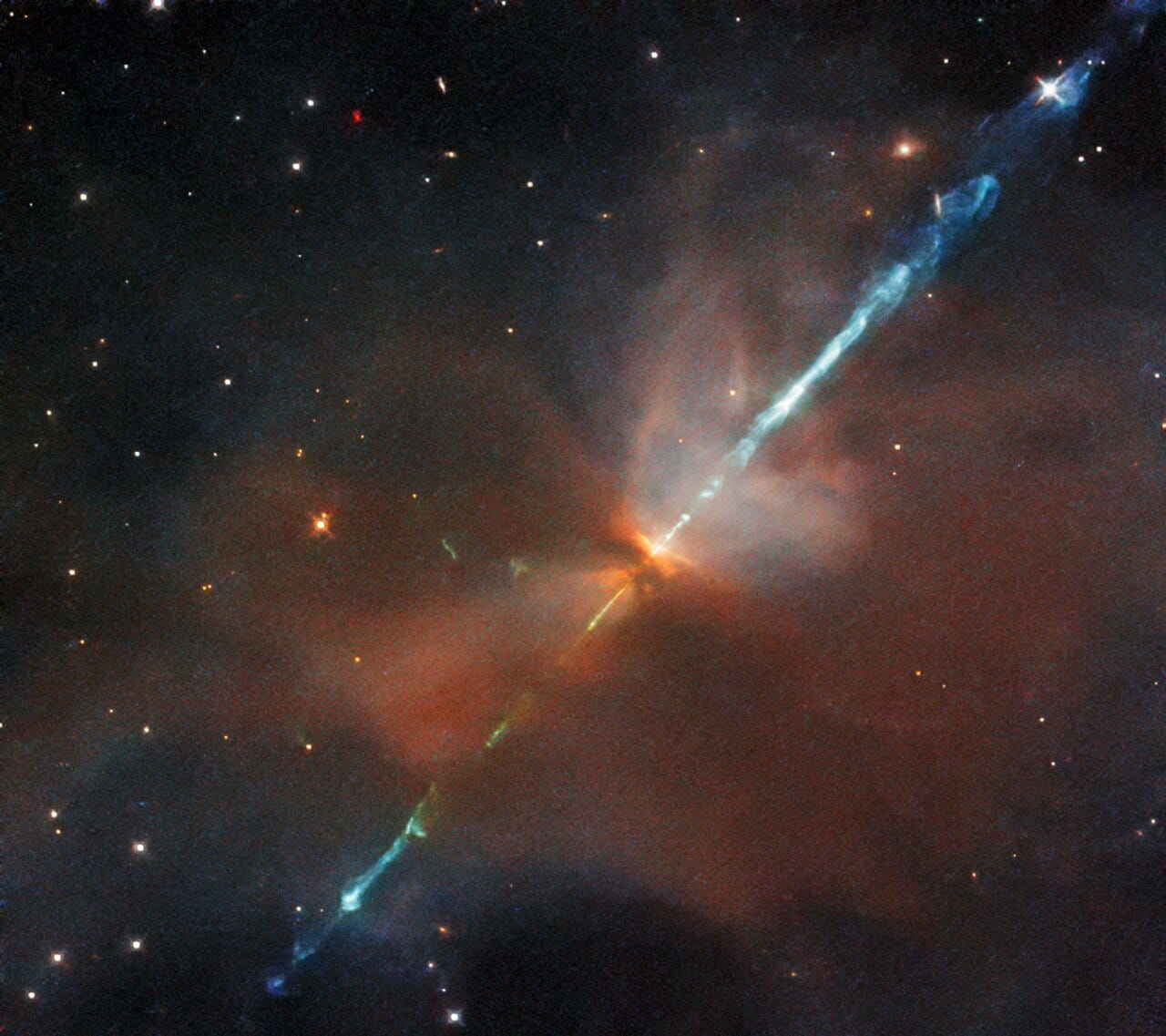
What we're seeing in the image is a Herbig–Haro object (named for astronomers George Herbig and Guillermo Haro) called HH111. The setting is a star-forming region in the constellation of Orion. The jet of gas looks like it's cosplaying as a blue lightsaber.

Herbig-Haro objects have dramatic origin stories. "Newly formed stars are often very active, and in some cases they expel very narrow jets of rapidly moving ionized gas — gas that is so hot that its molecules and atoms have lost their electrons, making the gas highly charged," said ESA. "The streams of ionized gas then collide with the clouds of gas and dust surrounding newly formed stars at speeds of hundreds of kilometers per second."

NASA is the agency that first clued me into how Herbig–Haro objects can look like lightsabers in space. In 2015, NASA shared a Hubble view of Herbig-Haro Jet HH24 just ahead of the opening of Star Wars: The Force Awakens, calling it a "double-bladed lightsaber" with a "Jedi-like cloak of dust."
The spectacular view of HH111 comes from Hubble's Wide Field Camera 3, which sees in both optical (close to what our human eyes see) and infrared. The ability to make observations in infrared gives Hubble the clarity to peer through the gas and dust to get a good look at objects like this one.
Image
Herbig–Haro object HH111 resembles a Star Wars weapon.
ESA/Hubble & NASA, B. Nisini
Don't mourn, organize.

-Joe Hill
User avatar
raklian
Posts: 1981
Joined: Sun May 16, 2021 4:46 pm
Location: North Carolina

Re: Space News and Discussions

Post by raklian »

To know is essentially the same as not knowing. The only thing that occurs is the rearrangement of atoms in your brain.
weatheriscool
Posts: 24502
Joined: Sun May 16, 2021 6:16 pm
Contact:

Re: Space News and Discussions

Post by weatheriscool »

Planetary radar observes 1,000th near-earth asteroid since 1968
https://phys.org/news/2021-09-planetary ... eroid.html
by Jet Propulsion Laboratory
On Aug. 14, 2021, a small near-Earth asteroid (NEA) designated 2021 PJ1 passed our planet at a distance of over 1 million miles (about 1.7 million kilometers). Between 65 and 100 feet (20 and 30 meters) wide, the recently discovered asteroid wasn't a threat to Earth. But this asteroid's approach was historic, marking the 1,000th NEA to be observed by planetary radar in just over 50 years.

And only seven days later, planetary radar observed the 1,001st such object, but this one was much larger.
User avatar
wjfox
Site Admin
Posts: 13588
Joined: Sat May 15, 2021 6:09 pm
Location: Essex, UK
Contact:

Re: Space News and Discussions

Post by wjfox »

New class of supernova discovered

4th September 2021

Until now, astronomers have divided supernovae into two main types: those involving the core collapse of very massive stars at the end of their lives, and those involving the accretion of material onto white dwarfs.

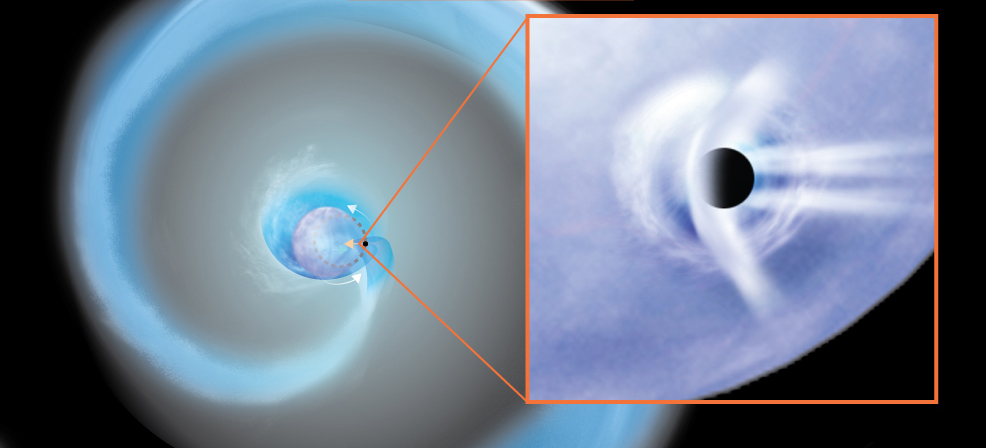
A third type has now been confirmed, however, following the results of a multi-year project using the National Science Foundation's Very Large Array (VLA) in central New Mexico, USA. Researchers found strong evidence that a black hole or neutron star spiralled its way into the core of a companion star and caused that companion to explode.

"Theorists had predicted that this could happen, but this is the first time we've actually seen such an event," said Dillon Dong, a graduate student at Caltech and lead author on a paper reporting the discovery in the journal Science.

https://www.futuretimeline.net/blog/202 ... meline.htm


Image
User avatar
caltrek
Posts: 9280
Joined: Mon May 17, 2021 1:17 pm

Re: Space News and Discussions

Post by caltrek »

Astronomers Create the First 3D-printed Stellar Nurseries
by Tim Stephens
September 2, 2021

https://news.ucsc.edu/2021/09/touching-stars.html

Introduction:
(UC Santa Cruz) Astronomers can’t touch the stars they study, but astrophysicist Nia Imara is using 3-dimensional models that fit in the palm of her hand to unravel the structural complexities of stellar nurseries, the vast clouds of gas and dust where star formation occurs.

Imara and her collaborators created the models using data from simulations of star-forming clouds and a sophisticated 3D printing process in which the fine-scale densities and gradients of the turbulent clouds are embedded in a transparent resin. The resulting models—the first 3D-printed stellar nurseries—are highly polished spheres about the size of a baseball (8 centimeters in diameter), in which the star-forming material appears as swirling clumps and filaments.

“We wanted an interactive object to help us visualize those structures where stars form so we can better understand the physical processes,” said Imara, an assistant professor of astronomy and astrophysics at UC Santa Cruz and first author of a paper describing this novel approach published August 25 in Astrophysical Journal Letters.

An artist as well as an astrophysicist, Imara said the idea is an example of science imitating art. “Years ago, I sketched a portrait of myself touching a star. Later, the idea just clicked. Star formation within molecular clouds is my area of expertise, so why not try to build one?” she said.

She worked with coauthor John Forbes at the Flatiron Institute’s Center for Computational Astrophysics to develop a suite of nine simulations representing different physical conditions within molecular clouds. The collaboration also included coauthor James Weaver at Harvard University’s School of Engineering and Applied Sciences, who helped to turn the data from the astronomical simulations into physical objects using high-resolution and photo-realistic multi-material 3D printing.
Image
The first 3D-printed stellar nurseries are highly polished spheres about the size of a baseball, in which swirling clumps and filaments represent star-forming clouds of gas and dust.
Photo by Saurabh Mhatre
Don't mourn, organize.

-Joe Hill
User avatar
wjfox
Site Admin
Posts: 13588
Joined: Sat May 15, 2021 6:09 pm
Location: Essex, UK
Contact:

Re: Space News and Discussions

Post by wjfox »

weatheriscool
Posts: 24502
Joined: Sun May 16, 2021 6:16 pm
Contact:

Re: Space News and Discussions

Post by weatheriscool »

NASA's next space telescope to launch in December
https://phys.org/news/2021-09-nasa-spac ... ember.html

The $10 billion observatory, which will be the largest and most powerful telescope launched into space, will take off on a European Space Agency (ESA) Ariane 5 rocket from Spaceport in French Guiana, on the northeastern coast of South America.

The James Webb Space Telescope, which astronomers hope will herald a new era of discovery, will launch on December 18, NASA said Wednesday.

The $10 billion observatory, which is a joint project by NASA, the European Space Agency and the Canadian Space Agency, will blast off on an Ariane 5 rocket from Spaceport in French Guiana.

It is currently stowed at contractor Northrop Grumman's facilities in Redondo Beach, California, where it is awaiting shipping.

"Webb is an exemplary mission that signifies the epitome of perseverance," said Webb's NASA program director Gregory Robinson in a statement.

"We are extremely honored to orbit NASA's James Webb Space Telescope with Ariane, a first for Arianespace and the European space team," added Stephane Israel, CEO of Arianespace.
User avatar
caltrek
Posts: 9280
Joined: Mon May 17, 2021 1:17 pm

Re: Space News and Discussions

Post by caltrek »

We Now Know Why There Are Dead Galaxies Floating Lost in The Void of Space
by David Nield
September 11, 2021

https://www.sciencealert.com/we-now-kno ... d-of-space

Introduction:
(Science Alert) Ultra-diffuse galaxies (UDGs) are something of a mystery for astronomers.

They're smaller galaxies in terms of the number of stars, but they're still spread out over great distances, making them faint and difficult to spot. It's not clear how they're formed or if there's something special about the dark matter halos that helps them form.

Recently published research might be able to answer a few outstanding questions about UDGs and, in particular, "quenched" UDGs – ones that aren't forming any new stars. Through a series of simulations, astronomers have been able to spot and analyze some new galaxies that match this description.
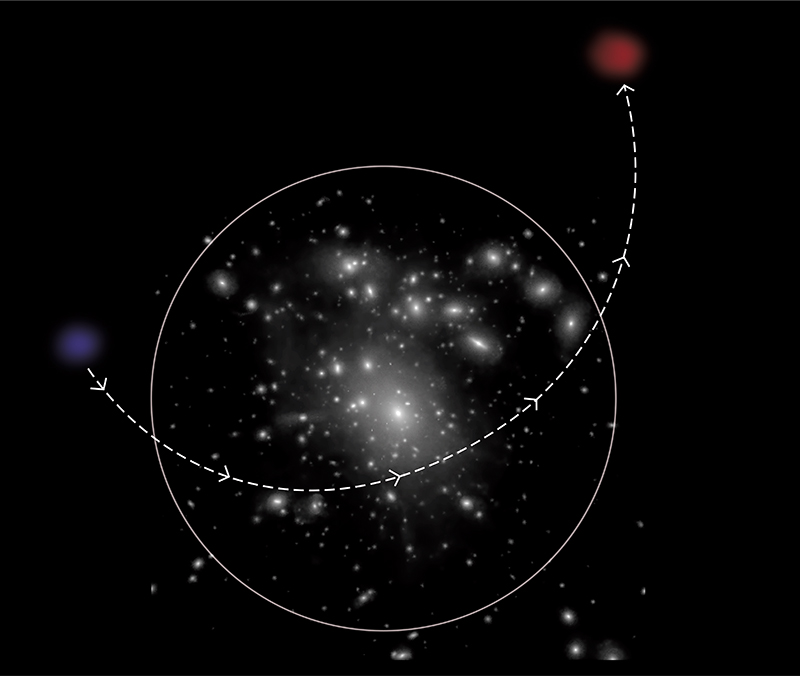
Observations and modeling revealed these quenched UDGs were born in what's known as a backsplash orbit, far beyond the edges of a host galaxy but still loosely connected. In other words, they were part of a bigger system before becoming isolated and share some characteristics with that original system.

"What we have detected is at odds with theories of galaxy formation since quenched dwarfs are required to be in clusters or group environments in order to get their gas removed and stop forming stars," says astronomer Laura Sales from the University of California, Riverside.
Image
The fall of a blue ultra-diffuse galaxy into a galaxy system and its subsequent ejection as a red ultra-diffuse galaxy.
Vanina Rodriguez
Don't mourn, organize.

-Joe Hill
User avatar
caltrek
Posts: 9280
Joined: Mon May 17, 2021 1:17 pm

Re: Space News and Discussions

Post by caltrek »

Doomed Satellite was Equipped With a Drag Sail to Deorbit it After its Mission was Complete
by Paul M. Sutter

https://www.universetoday.com/152497/do ... ore-152497

Inroduction:
(Universe Today) A team at Purdue University developed a drag sail to attach to satellites to help them de-orbit to combat space debris. Unfortunately, the rocket carrying the test device, launched by Firefly Aerospace, exploded shortly after launch.

Space junk is a growing problem, with tens of thousands of small objects constantly whirling around the Earth. Each one is a potential hazard, capable of ripping apart solar panels and driving holes into spacecraft. One of the biggest sources of space junk is unused satellites, which remain in orbit even after the end of their lifetimes. These satellites cannot be controlled or steered, so they have the occasional bad habit of crashing into other things.

Mitigating this problem is essential to the future of spaceflight. One approach is to ditch unwanted satellites into the Earth’s atmosphere, which generally does a pretty good job of incinerating spacecraft.

A team of students, faculty, and staff at Perdue University’s Space Flight Projects Laboratory developed Spinnaker3, a drag sail that could someday be attached to satellites. The drag sail would slow the orbit of a satellite at the end of its mission until it can plunge into the atmosphere on its own.

Fully deployed, Spinnaker3 – named for the three-meter length of its carbon-fiver booms – was designed to be 194 square feet once fully deployed and was made of CP1, a fluorinated polyimide developed by high-performance materials designer NeXolve.
Don't mourn, organize.

-Joe Hill
User avatar
caltrek
Posts: 9280
Joined: Mon May 17, 2021 1:17 pm

Re: Space News and Discussions

Post by caltrek »

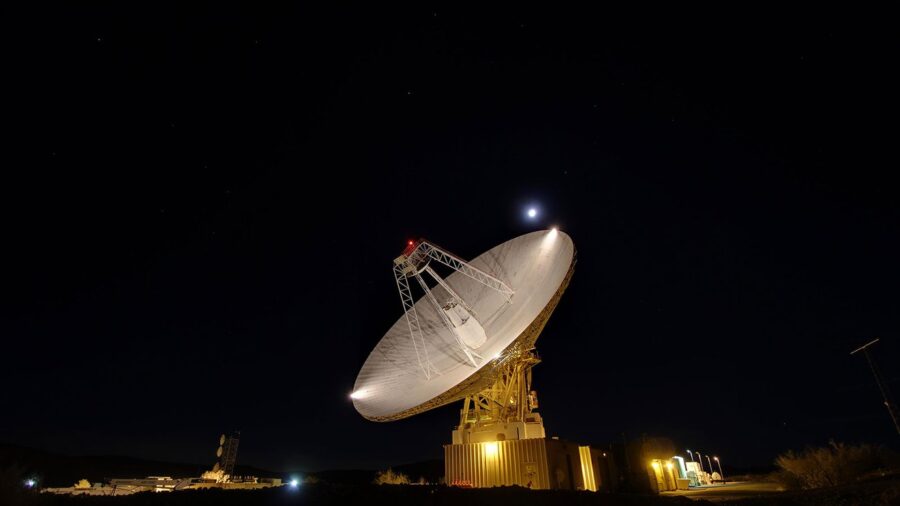
NASA is Upgrading its Deep Space Network to Keep Up With the Demands of Modern Interplanetary Communications.
by David Dickinson
September 6, 2021

https://skyandtelescope.org/astronomy-n ... -upgraded/

Introduction:
(Sky & Telescope) A key piece of interplanetary communications infrastructure is getting an overhaul. NASA recently revealed how its venerable worldwide Deep Space Network (DSN) is upgrading as more missions depart for points across the solar system, and how it will keep communications running in the future.

Established in 1963 at the beginning of the Apollo era, the DSN is made up of three sites, offering worldwide coverage: outside Madrid, Spain; Goldstone, outside of Barstow California; and the only southern hemisphere site, in Canberra, Australia. If a spacecraft is anywhere in the solar system beyond Earth, it's almost always in view of at least one DSN site.

Each site is actually a collection of several radio antennas: one main 70-meter dish in Goldstone, three 34-meter dishes in Canberra and Goldstone, and four smaller dishes at Madrid.

Generally, the DSN is supporting 39 missions across the solar system at any given time, with an additional 30 missions in the development pipeline. As missions fly farther afield, data rates come at a premium: For example, typical data rates from Mars run at an average of 500 to 32,000 bits per second, roughly half as fast as a standard home modem. New Horizons had to relay data at a miserly 1,000 bits a second after its 2019 flyby of Arrokoth.

“Capacity is a big pressure, and our antenna-enhancement program is going to help that out,” says DSN Deputy Director Michael Levesque (JPL) in a recent press release. “This includes the building of two new antennas, increasing our number from 12 to 14.”
Image
The iconic 70-meter dish, dubbed Deep Space Station 14, at Goldstone, California.
NASA / JPL-Caltech
Don't mourn, organize.

-Joe Hill
User avatar
raklian
Posts: 1981
Joined: Sun May 16, 2021 4:46 pm
Location: North Carolina

Re: Space News and Discussions

Post by raklian »

It's actually Enceladus, not Europa but doesn't make it less incredible.

To know is essentially the same as not knowing. The only thing that occurs is the rearrangement of atoms in your brain.
weatheriscool
Posts: 24502
Joined: Sun May 16, 2021 6:16 pm
Contact:

Re: Space News and Discussions

Post by weatheriscool »

SpaceX Inspiration4 All Civilian Orbital Mission Could Launch Tomorrow
September 14, 2021 by Brian Wang
Inspiration4, the world’s first all-civilian mission to orbit, is targeted to launch no earlier than 8:02 p.m. EDT on Wednesday, September 15, 2021. The crew discuss their mission from historic Launch Complex 39A at NASA’s Kennedy Space Center in Florida.

The mission will be commanded by Jared Isaacman, the 38-year-old founder and Chief Executive Officer of Shift4 Payments and an accomplished pilot and adventurer. Inspiration4 will leave Earth from Kennedy Space Center’s historic Launch Complex 39A, the embarkation point for Apollo and Space Shuttle missions, and travel across a low earth orbit on a multi-day journey that will continually eclipse more than 90% of the earth’s population. Named in recognition of the four-person crew that will raise awareness and funds for St. Jude Children’s Research Hospital, this milestone represents a new era for human spaceflight and exploration.

Their payload will include the first-ever minted NFT song to be played in orbit, created by the Grammy Award-winning rock band Kings of Leon.
https://www.nextbigfuture.com/2021/09/s ... orrow.html
User avatar
raklian
Posts: 1981
Joined: Sun May 16, 2021 4:46 pm
Location: North Carolina

Re: Space News and Discussions

Post by raklian »

To know is essentially the same as not knowing. The only thing that occurs is the rearrangement of atoms in your brain.
weatheriscool
Posts: 24502
Joined: Sun May 16, 2021 6:16 pm
Contact:

Re: Space News and Discussions

Post by weatheriscool »

It is now official Inspiration4 is in a circular 585k (363.5 mile) orbit, after dragon completed it's two phasing burns. A Dragon altitude record, and the last humans were in orbit at this altitude was almost 22 years ago. (Space shuttle Discovery STS-103 - December 1999)
weatheriscool
Posts: 24502
Joined: Sun May 16, 2021 6:16 pm
Contact:

Re: Space News and Discussions

Post by weatheriscool »


The Three Shenzhou 12 Taikonauts Have Returned To Earth

Nie Haisheng, Liu Boming, and Tang Hongbo have safely return down to Earth after spending three months inside Tiangong Space Station. The three taikonauts – a term modeled after the Chinese word for space 太空 (tàikōng) - have been the inaugural mission of the Chinese space station.

They launched on board the Shenzhou-12 spacecraft and landed back with it in the Gobi Desert at 05:34 UTC on September 17. The crew appears to be in good health and they will quarantine for 14 days to makes sure their immune system has not weakened too much in their sojourn in space. At 92 days, this was the longest crewed mission that China has ever conducted.

Tiangong is still a work-in-progress. Just like the International Space Station (ISS), Tiangong is modular, so it is being constructed in stages. Currently, it is composed of the main module Tianhe. Two experiment modules will be launched next year. The first, Wentian (meaning Quest for Heavens), is expected to launch around May-June 2022, followed about three months later by Mengtian (meaning Dreaming of Heavens). Once complete it will have about one-fifth of the mass of the ISS.

On top of the scientific modules, Tiangong will also be equipped with a telescope module, currently under construction, called Xuntian (whose literal meaning is Touring the Heavens). The telescope is going to have a primary mirror 2 meters (6.6 feet) in diameter with a field of view 300 times larger than the Hubble Space Telescope. Over the 10-year primary mission, Xuntian is expected to image 40 percent of the sky with its 2.5 gigapixel camera.

Unlike the ISS, Tiangong won’t be continuously inhabited. The next crew going up will be the Shenzhou 13 in October for a duration of 6 months, and it will be followed by two more crews in 2022.

Counting the seven astronauts and cosmonauts in the ISS, the four civilian crew members on Inspiration4, and these three taikonauts, yesterday was the busiest day in space in the history of humanity. There have never been as many as 14 people in orbit around the Earth before.
https://www.iflscience.com/space/the-th ... B-0JyDAVDs
User avatar
caltrek
Posts: 9280
Joined: Mon May 17, 2021 1:17 pm

Re: Space News and Discussions

Post by caltrek »

How Many Satellites are Orbiting Earth?
by Supriya Chakrabarti
September 17, 2021

https://theconversation.com/how-many-sa ... rth-166715

Introduction:
(The Conversation) It seems like every week, another rocket is launched into space carrying rovers to Mars, tourists or, most commonly, satellites. The idea that “space is getting crowded” has been around for a few years now, but just how crowded is it? And how crowded is it going to get?

I am a professor of physics and director of the Center for Space Science and Technology at the University of Massachusetts, Lowell. Many satellites that were put into orbit have gone dead and burned up in the atmosphere, but thousands remain. Groups that track satellite launches don’t always report the same exact numbers, but the overall trend is clear – and astounding.

Since the Soviet Union launched Sputnik – the first human-made satellite – in 1957, humanity has steadily been putting more and more objects into orbit every year. Over the the second half of the 20th century, there was a slow but steady growth, with roughly 60 to 100 satellites launched yearly until the early 2010s.

But since then, the pace has been increasing dramatically.

By 2020, 114 launches carried around 1,300 satellites to space, surpassing the 1,000 new satellites per year mark for the first time. But no year in the past compares to 2021. As of Sept. 16, roughly 1,400 new satellites have already begun circling the Earth, and that will only increase as the year goes on. Just this week, SpaceX deployed another 51 Starlink satellites into orbit.
Oh, and the actual number of satellites orbiting earth as estimated in The Conversation article: 7,941.
Don't mourn, organize.

-Joe Hill
weatheriscool
Posts: 24502
Joined: Sun May 16, 2021 6:16 pm
Contact:

Re: Space News and Discussions

Post by weatheriscool »

SpaceX's private Inspiration4 mission splashes down safely in Atlantic Ocean
Source: CNBC
SpaceX safely returned its Crew Dragon spacecraft from orbit on Saturday, with the capsule carrying the four members of the Inspiration4 mission back to Earth after three days in space. Crew Dragon capsule Resilience splashed down off the coast of Cape Canaveral, Florida in the Atlantic Ocean. Elon Musk tweeted his congratulations to the crew shortly after splashdown.

The historic private mission — which includes commander Jared Isaacman, pilot Sian Proctor, medical officer Hayley Arceneaux and mission specialist Chris Sembroski — orbited the Earth at an altitude as high as 590 kilometers, which is above the International Space Station and the furthest humans have traveled above the surface in years. A free-flying spaceflight, the capsule did not dock with the ISS but instead circled the Earth independently at a rate of 15 orbits per day.

Inspiration4 shared photos from the crew’s time in orbit, giving a look at the expansive views from the spacecraft’s “cupola” window.This is the third time SpaceX has returned astronauts from space, and the second time for this capsule – which previously flew the Crew-1 mission for NASA on a trip that returned in May. Both prior SpaceX astronaut missions splashed down in the Gulf of Mexico, making this the first that returned in the Atlantic Ocean.

The mission also comes with multiple other milestones for Musk’s company, including: The first private SpaceX spaceflight, the first entirely nonprofessional crew to become astronauts, the first Black female spacecraft pilot, the youngest American astronaut to date, and the first person to fly in space with a prosthesis.
Read more: https://www.cnbc.com/2021/09/18/watch-s ... turns.html
Post Reply