The Middle Ages (500 – 1499 AD)

Re: The Middle Ages (500 – 1499 AD)
The voyages of Christopher Columbus, 1492–1504.
https://en.wikipedia.org/wiki/Christopher_Columbus
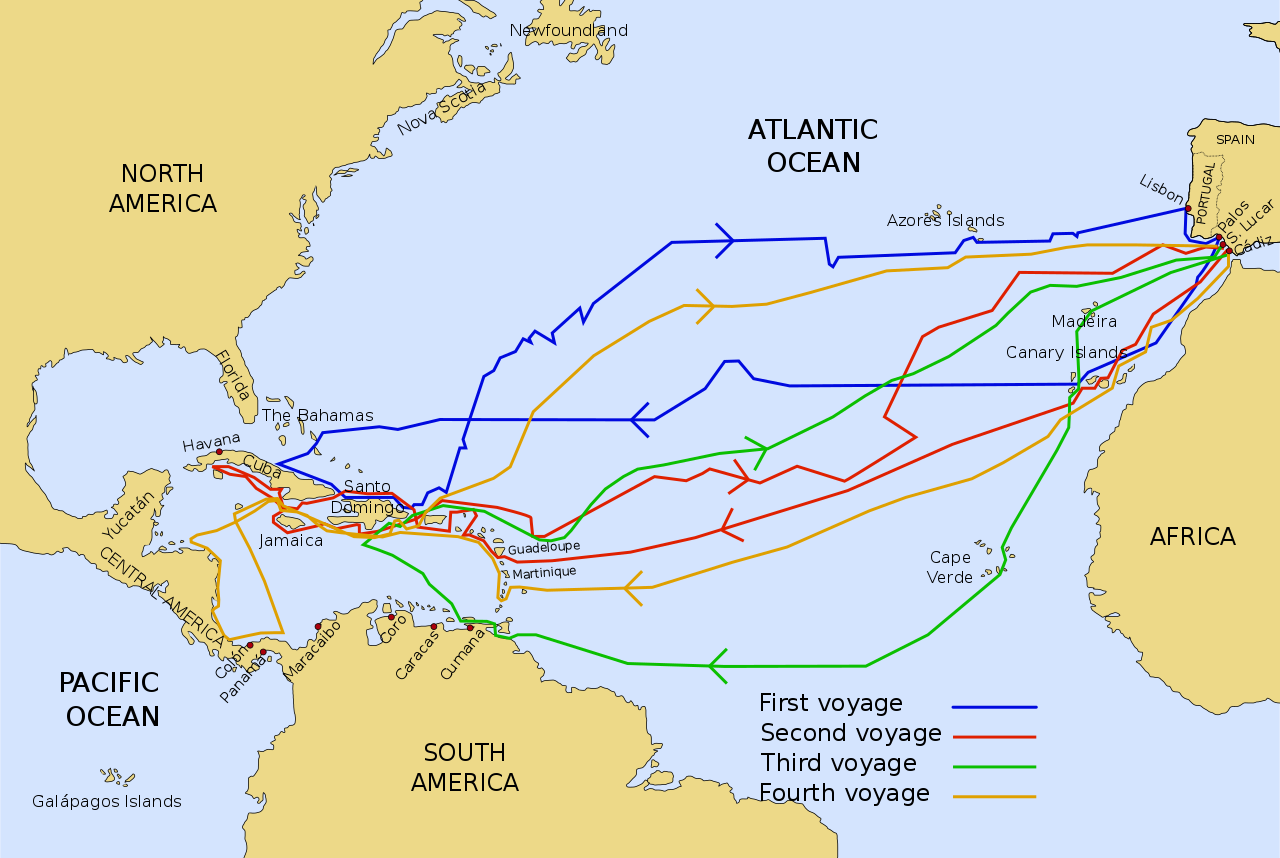
Viajes_de_colon.svg: Phirosiberiaderivative work: Phirosiberia, CC BY-SA 3.0, via Wikimedia Commons
https://en.wikipedia.org/wiki/Christopher_Columbus
Viajes_de_colon.svg: Phirosiberiaderivative work: Phirosiberia, CC BY-SA 3.0, via Wikimedia Commons
-
weatheriscool
- Posts: 25737
- Joined: Sun May 16, 2021 6:16 pm
- Contact:
Re: The Middle Ages (500 – 1499 AD)
A 15th-century Inca building was built for sound—researchers are working to understand why
by Sean Brenner, University of California, Los Angeles
https://phys.org/news/2025-10-15th-cent ... built.html
by Sean Brenner, University of California, Los Angeles
https://phys.org/news/2025-10-15th-cent ... built.html
The Inca empire is renowned for its architecture; its buildings were intricately designed and extraordinarily durable.
But this summer, it was another aspect of Inca construction that captured the attention of Stella Nair, a UCLA associate professor of art history whose expertise is Indigenous arts and architecture of the Americas.
Nair spent three weeks in the remote town of Huaytará, Peru, studying a single Inca building that appears to have been created primarily to amplify sound and music. Known as a carpa uasi, the structure was likely built in the mid-15th century.
-
weatheriscool
- Posts: 25737
- Joined: Sun May 16, 2021 6:16 pm
- Contact:
Re: The Middle Ages (500 – 1499 AD)
Giant wooden marker post dates Cahokia's political and economic peak

by Sandee Oster, Phys.org
by Sandee Oster, Phys.org
https://phys.org/news/2025-10-giant-woo ... hokia.html
Dr. Nicholas Kessler and his colleagues examined the largest known marker post from the ancient North American city of Cahokia. Their study is published in PLOS One.
Cahokia emerged around 1050 CE as the largest city north of Mesoamerica. Its population of around 20,000 or more was greater than even contemporary medieval London.
-
weatheriscool
- Posts: 25737
- Joined: Sun May 16, 2021 6:16 pm
- Contact:
Re: The Middle Ages (500 – 1499 AD)
Ancient Maya monument discovery rewrites the history books
By Pranjal Malewar
November 14, 2025
https://newatlas.com/history/ancient-ma ... discovery/
By Pranjal Malewar
November 14, 2025
https://newatlas.com/history/ancient-ma ... discovery/
For a long time, archaeologists believed that large buildings required large bosses. The idea was simple: only societies with strong hierarchies (kings, priests, and planners) could organize massive construction projects.
But recent discoveries in the Maya region are rewriting that script. Archaeologists previously pictured early Maya life as simple and small-scale: people making pottery, living in scattered villages from 1000 to 700 BCE. They thought big cities developed much later.
But that old story began to crack when archaeologists uncovered massive early structures at sites such as Ceibal, Cival, Yaxnohcah, and Xocnaceh. However, it was a site called Aguada Fénix, with a giant man-made monument from over 3,000 years ago, that truly shook things up. Suddenly, experts were rethinking the origins of early Mesoamerican civilizations.
Unlike the Olmec centers of San Lorenzo and La Venta, early Maya sites show no signs of top-down power. Yet people still came together to build big. Why?
Re: The Middle Ages (500 – 1499 AD)
Volcanic eruption may have sparked Europe's Black Death plague, scientists find
Thursday 4 December 2025 16:55, UK
The rapid spread of the Black Death through medieval Europe could have its origins in a massive volcanic eruption, according to new research.
The plague killed between a third and half of the European population in the mid-14th century. But it's unknown what triggered the pandemic.
Now scientists in Cambridge and Germany have pieced together an extraordinary sequence of events from environmental clues and historical records that they believe solves the mystery.
They say sooty particles trapped deep in the ice sheets of Antarctica and Greenland suggest there was at least one eruption by an as-yet-unknown volcano in the tropics, around the year 1345, that shrouded the planet in a thick haze of ash and sulphur.
[...]
The researchers say the subsequent famine explains why the Italian maritime cities of Venice, Genoa and Pisa reached out to the Mongols of the Golden Horde around the Black Sea in 1347 and began to import grain.
https://news.sky.com/story/volcanic-eru ... d-13479387

Thursday 4 December 2025 16:55, UK
The rapid spread of the Black Death through medieval Europe could have its origins in a massive volcanic eruption, according to new research.
The plague killed between a third and half of the European population in the mid-14th century. But it's unknown what triggered the pandemic.
Now scientists in Cambridge and Germany have pieced together an extraordinary sequence of events from environmental clues and historical records that they believe solves the mystery.
They say sooty particles trapped deep in the ice sheets of Antarctica and Greenland suggest there was at least one eruption by an as-yet-unknown volcano in the tropics, around the year 1345, that shrouded the planet in a thick haze of ash and sulphur.
[...]
The researchers say the subsequent famine explains why the Italian maritime cities of Venice, Genoa and Pisa reached out to the Mongols of the Golden Horde around the Black Sea in 1347 and began to import grain.
https://news.sky.com/story/volcanic-eru ... d-13479387
-
firestar464
- Posts: 8314
- Joined: Wed Oct 12, 2022 7:45 am
Re: The Middle Ages (500 – 1499 AD)
Ear piercings marked one of the earliest Maya rites of passage, research shows
https://phys.org/news/2025-12-ear-pierc ... rites.html
https://phys.org/news/2025-12-ear-pierc ... rites.html

Re: The Middle Ages (500 – 1499 AD)
Medieval Peasants Probably Enjoyed Their Holiday Festivities More Than You Do
By Bobbi Sutherland
December 19, 2025
Introduction:
By Bobbi Sutherland
December 19, 2025
Introduction:
Read more here: https://theconversation.com/medieval-p ... do-241328(The Conversation) When people think of the European Middle Ages, it often brings to mind grinding poverty, superstition and darkness. But the reality of the 1,000-year period from 500 to 1500 was much more complex. This is especially true when considering the peasants, who made up about 90% of the population.
For all their hard work, peasants had a fair amount of downtime. Add up Sundays and the many holidays, and about one-third of the year was free of intensive work. Celebrations were frequent and centered around religious holidays like Easter, Pentecost and saints’ days.
But the longest and most festive of these holidays was Christmas.
As a professor of medieval history, I can assure you the popular belief that the lives of peasants were little more than misery is a misconception. They enjoyed rich social lives – maybe richer than ours – ate well, celebrated frequently and had families not unlike our own. For them, holiday festivities didn’t begin with Christmas Eve and end with New Year’s.
The party was just getting started.
Don't mourn, organize.
-Joe Hill
-Joe Hill

Re: The Middle Ages (500 – 1499 AD)
And remember my friend, future events such as these will affect you in the future
-
firestar464
- Posts: 8314
- Joined: Wed Oct 12, 2022 7:45 am
Re: The Middle Ages (500 – 1499 AD)
Medieval gold ring with dazzling blue gemstone discovered in Norway is a 'fantastically beautiful and rare specimen'
https://www.livescience.com/archaeology ... e-specimen
https://www.livescience.com/archaeology ... e-specimen
Re: The Middle Ages (500 – 1499 AD)
Bayeux Tapestry arrives in UK for first time in 900 years under police guard
5 hours ago
The Bayeux Tapestry has arrived in the UK, for the first time since it is believed to have been created here nearly 1,000 years ago.
At 02:50 BST, chaperoned from a secret location in northern France by a police guard, it was driven into a loading bay at the British Museum, which will put it on display in September.
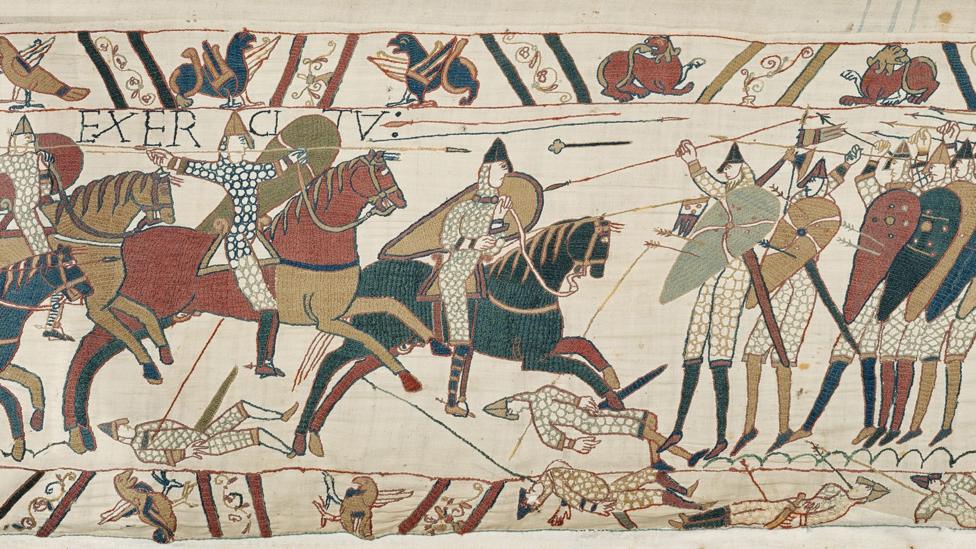
The 70m-long 11th Century embroidery depicts in 58 scenes events leading up to the Battle of Hastings and Norman Conquest of England in 1066 - the moment that changed the country forever.
The heavy-looking crate, encased in an aluminium frame, was lowered out of the lorry in front of a select crowd including the French ambassador to the UK and the director of the British Museum.
Nick Cullinan, the director of the British Museum, told me: "We've just witnessed something rather extraordinary, which is the arrival of the Bayeux Tapestry at the British Museum but specifically it is returning to England for the first time in almost 1,000 years. It feels like a really remarkable thing not just to witness but to be part of, and we're so excited to share it with as many people as possible."
https://www.bbc.co.uk/news/articles/cly9r54e5r4o
The Making of Heritage in Normandy, Antoine Cazin
5 hours ago
The Bayeux Tapestry has arrived in the UK, for the first time since it is believed to have been created here nearly 1,000 years ago.
At 02:50 BST, chaperoned from a secret location in northern France by a police guard, it was driven into a loading bay at the British Museum, which will put it on display in September.
The 70m-long 11th Century embroidery depicts in 58 scenes events leading up to the Battle of Hastings and Norman Conquest of England in 1066 - the moment that changed the country forever.
The heavy-looking crate, encased in an aluminium frame, was lowered out of the lorry in front of a select crowd including the French ambassador to the UK and the director of the British Museum.
Nick Cullinan, the director of the British Museum, told me: "We've just witnessed something rather extraordinary, which is the arrival of the Bayeux Tapestry at the British Museum but specifically it is returning to England for the first time in almost 1,000 years. It feels like a really remarkable thing not just to witness but to be part of, and we're so excited to share it with as many people as possible."
https://www.bbc.co.uk/news/articles/cly9r54e5r4o
The Making of Heritage in Normandy, Antoine Cazin