Modern History (1800 – present)


Re: Modern History (1800 – present)
President Dwight D. Eisenhower's Farewell Address (1961)
Introduction:
caltrek’s comment: The Republican party sure has made a long descent from the time of Eisenhower. At least the Eisenhower that spoke these words.
Michale T. Klare, writing in Common Dreams, described how that military-industrial complex looks today:
Introduction:
Additional extract:(National Archives)On January 17, 1961, in this farewell address, President Dwight Eisenhower warned against the establishment of a "military-industrial complex."
Read more here: https://www.archives.gov/milestone-doc ... rnascriptIn the councils of government, we must guard against the acquisition of unwarranted influence, whether sought or unsought, by the military-industrial complex.
…
Another factor in maintaining balance involves the element of time. As we peer into society's future, we-you and I, and our government-must avoid the impulse to live only for today, plundering, for our own ease and convenience, the precious resources of tomorrow. We cannot mortgage the material assets of our grandchildren without risking the loss also of their political and spiritual heritage. We want democracy to survive for all generations to come, not to become the insolvent phantom of tomorrow.
caltrek’s comment: The Republican party sure has made a long descent from the time of Eisenhower. At least the Eisenhower that spoke these words.
Michale T. Klare, writing in Common Dreams, described how that military-industrial complex looks today:
Read more here: https://www.commondreams.org/opinion/d ... l-complexIn 2024, just five companies — Lockheed Martin (with $64.7 billion in defense revenues), RTX (formerly Raytheon, with $40.6 billion), Northrop Grumman ($35.2 billion), General Dynamics ($33.7 billion), and Boeing ($32.7 billion) — claimed the vast bulk of Pentagon contracts. (Anduril and General Atomics didn’t even appear on a list of the top 100 contract recipients.)
…
Now, however, a new force — Silicon Valley startup culture — has entered the fray, and the military-industrial complex equation is suddenly changing dramatically.
Along Came Anduril
Consider Anduril Industries, one of two under-the-radar companies that left three MIC heavyweights in the dust last April by winning the contract to build a prototype of the Collaborative Combat Aircraft. Anduril (named after the sword carried by Aragorn in J.R.R. Tolkien’s The Lord of the Rings) was founded in 2017 by Palmer Luckey, a virtual-reality headset designer, with the goal of incorporating artificial intelligence into novel weapons systems. He was supported in that effort by prominent Silicon Valley investors, including Peter Thiel of the Founders Fund and the head of another defense-oriented startup, Palantir (a name also derived from The Lord of the Rings).
From the start, Luckey and his associates sought to shoulder aside traditional defense contractors to make room for their high-tech startups. Those two companies and other new-fledged tech firms often found themselves frozen out of major Pentagon contracts that had long been written to favor the MIC giants with their bevies of lawyers and mastery of government paperwork. In 2016, Palantir even sued the U.S. Army for refusing to consider it for a large data-processing contract and later prevailed in court, opening the door for future Department of Defense awards.
Don't mourn, organize.
-Joe Hill
-Joe Hill
-
firestar464
- Posts: 8317
- Joined: Wed Oct 12, 2022 7:45 am
Re: Modern History (1800 – present)
My Lai massacre
The My Lai massacre was a United States war crime committed on 16 March 1968, involving the mass murder of unarmed civilians in Sơn Mỹ village, Quảng Ngãi province, South Vietnam, during the Vietnam War. At least 347 and up to 504 civilians, almost all women, children, and elderly men, were murdered by U.S. Army soldiers from C Company, 1st Battalion, 20th Infantry Regiment, 11th Brigade and B Company, 4th Battalion, 3rd Infantry Regiment, 11th Brigade of the 23rd Division (organized as part of Task Force Barker). Some of the women were gang-raped and their bodies mutilated, and some soldiers mutilated and raped children as young as 12. The incident was the largest massacre of civilians by U.S. forces in the 20th century.
https://en.wikipedia.org/wiki/My_Lai_massacre

Photograph taken by Ronald L. Haeberle of South Vietnamese women and children in Mỹ Lai before being killed in the massacre. According to Haeberle, soldiers had attempted to rip the blouse off the woman in the back while her mother, in the front of the photo, tried to protect her.
The My Lai massacre was a United States war crime committed on 16 March 1968, involving the mass murder of unarmed civilians in Sơn Mỹ village, Quảng Ngãi province, South Vietnam, during the Vietnam War. At least 347 and up to 504 civilians, almost all women, children, and elderly men, were murdered by U.S. Army soldiers from C Company, 1st Battalion, 20th Infantry Regiment, 11th Brigade and B Company, 4th Battalion, 3rd Infantry Regiment, 11th Brigade of the 23rd Division (organized as part of Task Force Barker). Some of the women were gang-raped and their bodies mutilated, and some soldiers mutilated and raped children as young as 12. The incident was the largest massacre of civilians by U.S. forces in the 20th century.
https://en.wikipedia.org/wiki/My_Lai_massacre
Photograph taken by Ronald L. Haeberle of South Vietnamese women and children in Mỹ Lai before being killed in the massacre. According to Haeberle, soldiers had attempted to rip the blouse off the woman in the back while her mother, in the front of the photo, tried to protect her.
Re: Modern History (1800 – present)
Interesting short documentary about the ending and immediate aftermath of WW2.
Running time: 25 minutes.
Running time: 25 minutes.
Re: Modern History (1800 – present)
Alexander L. Kielland (platform)
Alexander L. Kielland was a Norwegian semi-submersible drilling rig that, on 27 March 1980, capsized in the Ekofisk oil field in the North Sea, killing 123 people. The capsize was the worst disaster in Norwegian waters since the Second World War. The rig, located approximately 320 km east of Dundee, Scotland, was owned by the Stavanger Drilling Company of Norway and was on hire to the U.S. company Phillips Petroleum at the time of the disaster.
https://en.wikipedia.org/wiki/Alexander ... (platform)
Alexander L. Kielland was a Norwegian semi-submersible drilling rig that, on 27 March 1980, capsized in the Ekofisk oil field in the North Sea, killing 123 people. The capsize was the worst disaster in Norwegian waters since the Second World War. The rig, located approximately 320 km east of Dundee, Scotland, was owned by the Stavanger Drilling Company of Norway and was on hire to the U.S. company Phillips Petroleum at the time of the disaster.
https://en.wikipedia.org/wiki/Alexander ... (platform)
Re: Modern History (1800 – present)
What Denying Science Cost the Soviet Union
by Megan Chong
June 18, 2025
Introduction:
by Megan Chong
June 18, 2025
Introduction:
Read more here: https://www.zocalopublicsquare.org/wha ... t-union/(Zócalo) Science institutions and universities are facing an attack on their funding and academic freedom, with $9.5 billion of promised grant money cancelled and a May 23 executive order promising to make political appointees responsible for overseeing U.S. science agencies—a power that could easily be abused for political ends. Lasting consequences—scientific, political, personal—hang like a specter over every Department of Health & Human Services announcement.
As I go about my day in the lab I work in, culturing cells, writing grants, or doing experiments—and worrying that my own career will be cut short—I’m haunted by a course I took during my PhD program: “Soviet Genetics,” a history of science class that focused on how scientific repression in the Soviet era impacted discovery, innovation, and individual scientists’ lives.
For decades, science has been established by consensus: Across many months or years, investigators build a body of evidence through carefully controlled experiments that other scientists can repeat independently to produce results that agree. This reproducibility is a critical feature of rigorous science. Our understanding of the world is often incomplete or at least partly wrong, but independent repetition and peer review help us consistently root out misunderstandings.
Thanks to this incremental scientific method, modern genetics was taking off in the early 20th century. After years of research, questioning, and debate, scientists had figured out that genes, located on chromosomes in all living things, determine traits and pass them down through generations. Understanding that our traits had a microscopic physical source inside our cells shed light on why some people are predisposed to certain diseases—the first step to improving treatments. It also refined our ability to tackle agricultural problems and unlocked new experimental tools to accelerate scientific discovery in biology.
During the 1920s, Russian scientists were still enmeshed in the global science community. The Soviet government encouraged collaborations with researchers abroad, especially in genetics, where they saw potential for improved farming practices to help them feed an undernourished population. But as the threat of food shortages increased, officials put scientists under increasing pressure to produce quick results. Sound evidence fell by the wayside.
Don't mourn, organize.
-Joe Hill
-Joe Hill
Re: Modern History (1800 – present)
Entente Cordiale
The Entente Cordiale comprised a series of agreements signed on 8 April 1904 between the United Kingdom and the French Republic which saw a significant improvement in Anglo-French relations.
[...]
In long-term perspective, the Entente Cordiale marked the end of almost a thousand years of intermittent conflict between the two states and their predecessors, and replaced the modus vivendi that had existed since the end of the Napoleonic Wars in 1815 with a more formal agreement.
https://en.wikipedia.org/wiki/Entente_Cordiale

French and British boy scouts with their respective national flags. Agence Rol, Public domain, via Wikimedia Commons
The Entente Cordiale comprised a series of agreements signed on 8 April 1904 between the United Kingdom and the French Republic which saw a significant improvement in Anglo-French relations.
[...]
In long-term perspective, the Entente Cordiale marked the end of almost a thousand years of intermittent conflict between the two states and their predecessors, and replaced the modus vivendi that had existed since the end of the Napoleonic Wars in 1815 with a more formal agreement.
https://en.wikipedia.org/wiki/Entente_Cordiale
French and British boy scouts with their respective national flags. Agence Rol, Public domain, via Wikimedia Commons
Re: Modern History (1800 – present)
20 years ago today –
https://en.wikipedia.org/wiki/7_July_20 ... n_bombings

Ellywa, CC BY-SA 3.0 <http://creativecommons.org/licenses/by-sa/3.0/>, via Wikimedia Commons
https://en.wikipedia.org/wiki/7_July_20 ... n_bombings
Ellywa, CC BY-SA 3.0 <http://creativecommons.org/licenses/by-sa/3.0/>, via Wikimedia Commons
Re: Modern History (1800 – present)
John Rawls in the Streets
By Matthew McManus
July 10, 2025
Extract:
By Matthew McManus
July 10, 2025
Extract:
Conclusion:(Liberal Currents ) In her magisterial In the Shadow of Justice: Postwar Liberalism and the Remaking of Political Philosophy Harvard Professor Katrina Forrester offers a carefully researched primer on how Rawls' philosophy emerged. More importantly, she explains how and why Rawlsian political philosophy came to dominate much of the conversation for better or worse—so much so that in the English-speaking world even critics of Rawls and the enormous range of competing traditions that emerged in his wake still require a basic fluence in Rawlsese.
Read more here: https://www.liberalcurrents.com/rawls- ... streets/Where many now heed the siren's call of militant particularisms of the left to counterbalance the nationalist chauvinism of the right, I think progressives are more likely to succeed by appealing to a concrete universalism defended by reason. Specific struggles for class, racial, gender and sexual justice must continue. But these should be incorporated into a broader political project centered around the quintessentially liberal principle that all life is equally sacred and deserves to be experienced with dignity.
Our failure to adequately live by these ideals, let alone establish societies governed by them, is a demonstration of the ethical demands they make of us. These demands are far higher than those imposed by the right, which invariably lower our standards to looking after ourselves and potentially those who look and think like us—that is, where they don't lean on the utopian aspiration to play God and judge others without holding a mirror to themselves.
Liberty, equality, and solidarity for all remains the most powerful social vision yet articulated. That we have yet to build a society that lives up to it is a sign of how much is still to be done.
Source: https://press.princeton.edu/books/hard ... Vl3PWThW-(Princeton University Press) In the Shadow of Justice tells the story of how liberal political philosophy was transformed in the second half of the twentieth century under the influence of John Rawls. In this first-ever history of contemporary liberal theory, Katrina Forrester shows how liberal egalitarianism—a set of ideas about justice, equality, obligation, and the state—became dominant, and traces its emergence from the political and ideological context of the postwar United States and Britain.
In the aftermath of the civil rights movement and the Vietnam War, Rawls’s A Theory of Justice made a particular kind of liberalism essential to political philosophy. Using archival sources, Forrester explores the ascent and legacy of this form of liberalism by examining its origins in midcentury debates among American antistatists and British egalitarians. She traces the roots of contemporary theories of justice and inequality, civil disobedience, just war, global and intergenerational justice, and population ethics in the 1960s and ’70s and beyond. In these years, political philosophers extended, developed, and reshaped this liberalism as they responded to challenges and alternatives on the left and right—from the New International Economic Order to the rise of the New Right. These thinkers remade political philosophy in ways that influenced not only their own trajectory but also that of their critics.
Recasting the history of late twentieth-century political thought and providing novel interpretations and fresh perspectives on major political philosophers, In the Shadow of Justice offers a rigorous look at liberalism’s ambitions and limits.
Don't mourn, organize.
-Joe Hill
-Joe Hill
Re: Modern History (1800 – present)
Health-impaired World Leaders Raise Nuclear War Fears
July 15, 2025
Introduction:
Extract from study:
July 15, 2025
Introduction:
Read more of the Eureklaert article here: https://www.eurekalert.org/news-releases/1091378(Eureklaert) Many former leaders of the world’s nine nuclear-armed nations were impaired by health conditions while in office, raising concerns over their decision-making abilities while they had access to nuclear weapon launch codes, a study from the University of Otago, New Zealand, has found.
The study analysed the health information of 51 deceased leaders of nuclear-armed countries: China, France, India, Israel, North Korea, Pakistan, Russia, the United Kingdom and the United States. Eight of the leaders died from chronic disease while still in office, five from heart attacks or strokes. Many of the leaders had multiple serious health issues while in office, including dementia, personality disorders, depression and drug and alcohol abuse.
The research was led by Professor Nick Wilson, from the Department of Public Health at the University of Otago, Wellington – Ōtākou Whakaihu Waka, Pōneke, with Associate Professor George Thomson and independent researcher Dr Matt Boyd.
Professor Wilson says that of the leaders who left office while still alive, 15 had confirmed or possible health issues which likely hastened their departure.
“Probably all of this group of 15 leaders had their performance in office impaired by their health conditions. In some cases, the degree of impairment was profound, such as in the case of two former Israeli Prime Ministers: Ariel Sharon, who became comatose after suffering a stroke in office, and Menachem Begin, whose depression was so severe he spent his last year as leader isolated in his home. Impairment during crises was also seen in the case of Richard Nixon’s bouts of heavy drinking – including during a nuclear crisis involving the Middle East.
“There have also been occasions where health information about leaders has been kept secret at the time.”
Extract from study:
Read more of study results as published in BMC Research Notes here: https://bmcresnotes.biomedcentral.com/ ... 5-07351-8(BMC Research Notes) Over a fifth of the leaders (22%, 11/51), died in office. When excluding the three who were assassinated, there were eight deaths from chronic health conditions in office (Table 1; Fig. 1 – see linked article for tables). The mean number of known health conditions for this group was 3.9 per person (SD = 2.8), with Mao having the most at 10 (Table 2). Cardiovascular disease (heart attack or stroke) was the major cause of death for these chronic disease deaths (62%, 5/8; Table 2). Mental health conditions were common and included probable personality disorders (Stalin, Mao and possibly Kim Jong Il), depression (Mao), probable anxiety disorder (Mao), and substance use disorders (Mao, Brezhnev, and possibly Kim Jong Il) (Table 2). Cognitive decline was probable for Stalin and Brezhnev (both with multi-infarct dementia), and possibly also Konstantin Chernenko.
…there are at least nine US presidents for which important health information has been withheld from the public. This includes three in the dataset of this study i.e.: “Eisenhower’s doctor initially described his heart attack in 1955 as ‘a digestive upset.’ John F. Kennedy’s aides lied about his Addison’s disease. Ronald Reagan’s administration hid the extent of his injuries after he was shot in 1981 and the signs of his dementia in later years”. To this list can be added the non-disclosure of health issues involving: Truman’s possible heart disease, Nixon’s misuse of alcohol, Churchill’s stroke in 1953, Mitterrand’s cancer, Pompidou’s cancer, and Golda Meir’s cancer…
Don't mourn, organize.
-Joe Hill
-Joe Hill
Re: Modern History (1800 – present)
Munich Agreement
The Munich Agreement was reached in Munich on 30 September 1938, by Nazi Germany, the United Kingdom, France, and Italy. The agreement provided for the German annexation of part of Czechoslovakia called the Sudetenland, where three million people, mainly ethnic Germans, lived. The pact is known in some areas as the Munich Betrayal, because of a previous 1924 alliance agreement and a 1925 military pact between France and the Czechoslovak Republic.
Germany had started a low-intensity undeclared war on Czechoslovakia on 17 September 1938. In reaction, Britain and France on 20 September formally requested Czechoslovakia cede the Sudetenland territory to Germany. This was followed by Polish and Hungarian territorial demands brought on 21 and 22 September, respectively. Meanwhile, German forces conquered parts of the Cheb District and Jeseník District, where battles included use of German artillery, Czechoslovak tanks, and armored vehicles. Lightly armed German infantry briefly overran other border counties before being repelled. Poland grouped its army units near its common border with Czechoslovakia and conducted an unsuccessful probing offensive on 23 September. Hungary moved its troops towards the border with Czechoslovakia, without attacking. The Soviet Union announced its willingness to come to Czechoslovakia's assistance, provided the Red Army would be able to cross Polish and Romanian territory; both countries refused.
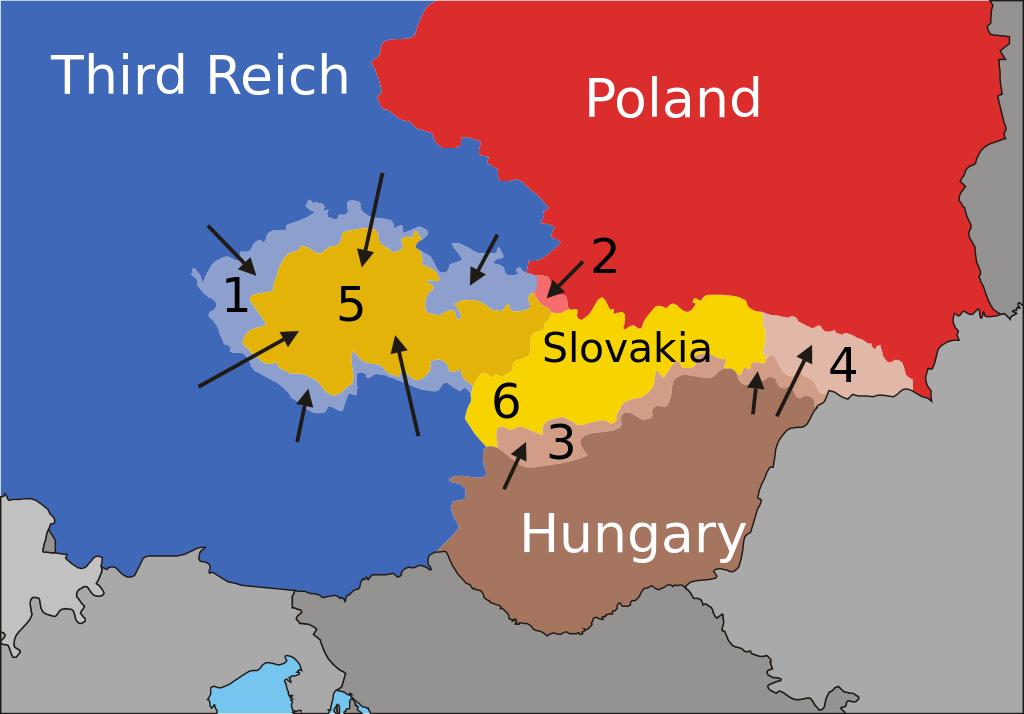
Jaro.p, CC BY-SA 2.5, via Wikimedia Commons
An emergency meeting of the main European powers–not including Czechoslovakia, although their representatives were present in the town, or the Soviet Union, an ally to France and Czechoslovakia–took place in Munich, on 29–30 September. An agreement was quickly reached on Adolf Hitler's terms, and signed by the leaders of Germany, France, Britain, and Italy. The Czechoslovak mountainous borderland marked a natural border between the Czech state and the Germanic states since the early Middle Ages; it also presented a major natural obstacle to a possible German attack. Strengthened by border fortifications, the Sudetenland was of absolute strategic importance to Czechoslovakia. On 30 September, Czechoslovakia submitted to the combination of military pressure by Germany, Poland, and Hungary, and diplomatic pressure by Britain and France, and agreed to surrender territory to Germany following the Munich terms.
The Munich Agreement was soon followed by the First Vienna Award on 2 November 1938, separating largely Hungarian inhabited territories in southern Slovakia and southern Subcarpathian Rus' from Czechoslovakia. On 30 November, Czechoslovakia ceded to Poland small patches of land in the Spiš and Orava regions. In March 1939, the First Slovak Republic, a German puppet state, proclaimed its independence. Shortly afterwards, Hitler reneged on his promise to respect the integrity of Czechoslovakia by occupying the remainder of the country and creating the Protectorate of Bohemia and Moravia. The conquered nation's military arsenal played an important role in Germany's invasions of Poland and France in 1939 and 1940.
Much of Europe celebrated the Munich Agreement, as they considered it a way to prevent a major war on the continent. Hitler announced that it was his last territorial claim in Northern Europe. Today, the Munich Agreement is regarded as a failed act of appeasement, and the term has become "a byword for the futility of appeasing expansionist totalitarian states."
https://en.wikipedia.org/wiki/Munich_Agreement
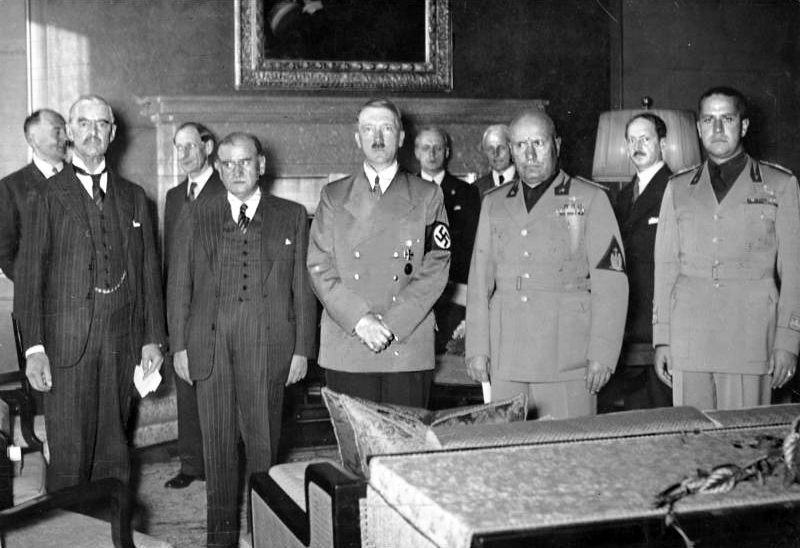
Bundesarchiv, Bild 183-R69173 / CC-BY-SA 3.0, CC BY-SA 3.0 DE, via Wikimedia Commons
The Munich Agreement was reached in Munich on 30 September 1938, by Nazi Germany, the United Kingdom, France, and Italy. The agreement provided for the German annexation of part of Czechoslovakia called the Sudetenland, where three million people, mainly ethnic Germans, lived. The pact is known in some areas as the Munich Betrayal, because of a previous 1924 alliance agreement and a 1925 military pact between France and the Czechoslovak Republic.
Germany had started a low-intensity undeclared war on Czechoslovakia on 17 September 1938. In reaction, Britain and France on 20 September formally requested Czechoslovakia cede the Sudetenland territory to Germany. This was followed by Polish and Hungarian territorial demands brought on 21 and 22 September, respectively. Meanwhile, German forces conquered parts of the Cheb District and Jeseník District, where battles included use of German artillery, Czechoslovak tanks, and armored vehicles. Lightly armed German infantry briefly overran other border counties before being repelled. Poland grouped its army units near its common border with Czechoslovakia and conducted an unsuccessful probing offensive on 23 September. Hungary moved its troops towards the border with Czechoslovakia, without attacking. The Soviet Union announced its willingness to come to Czechoslovakia's assistance, provided the Red Army would be able to cross Polish and Romanian territory; both countries refused.
Jaro.p, CC BY-SA 2.5, via Wikimedia Commons
An emergency meeting of the main European powers–not including Czechoslovakia, although their representatives were present in the town, or the Soviet Union, an ally to France and Czechoslovakia–took place in Munich, on 29–30 September. An agreement was quickly reached on Adolf Hitler's terms, and signed by the leaders of Germany, France, Britain, and Italy. The Czechoslovak mountainous borderland marked a natural border between the Czech state and the Germanic states since the early Middle Ages; it also presented a major natural obstacle to a possible German attack. Strengthened by border fortifications, the Sudetenland was of absolute strategic importance to Czechoslovakia. On 30 September, Czechoslovakia submitted to the combination of military pressure by Germany, Poland, and Hungary, and diplomatic pressure by Britain and France, and agreed to surrender territory to Germany following the Munich terms.
The Munich Agreement was soon followed by the First Vienna Award on 2 November 1938, separating largely Hungarian inhabited territories in southern Slovakia and southern Subcarpathian Rus' from Czechoslovakia. On 30 November, Czechoslovakia ceded to Poland small patches of land in the Spiš and Orava regions. In March 1939, the First Slovak Republic, a German puppet state, proclaimed its independence. Shortly afterwards, Hitler reneged on his promise to respect the integrity of Czechoslovakia by occupying the remainder of the country and creating the Protectorate of Bohemia and Moravia. The conquered nation's military arsenal played an important role in Germany's invasions of Poland and France in 1939 and 1940.
Much of Europe celebrated the Munich Agreement, as they considered it a way to prevent a major war on the continent. Hitler announced that it was his last territorial claim in Northern Europe. Today, the Munich Agreement is regarded as a failed act of appeasement, and the term has become "a byword for the futility of appeasing expansionist totalitarian states."
https://en.wikipedia.org/wiki/Munich_Agreement
Bundesarchiv, Bild 183-R69173 / CC-BY-SA 3.0, CC BY-SA 3.0 DE, via Wikimedia Commons