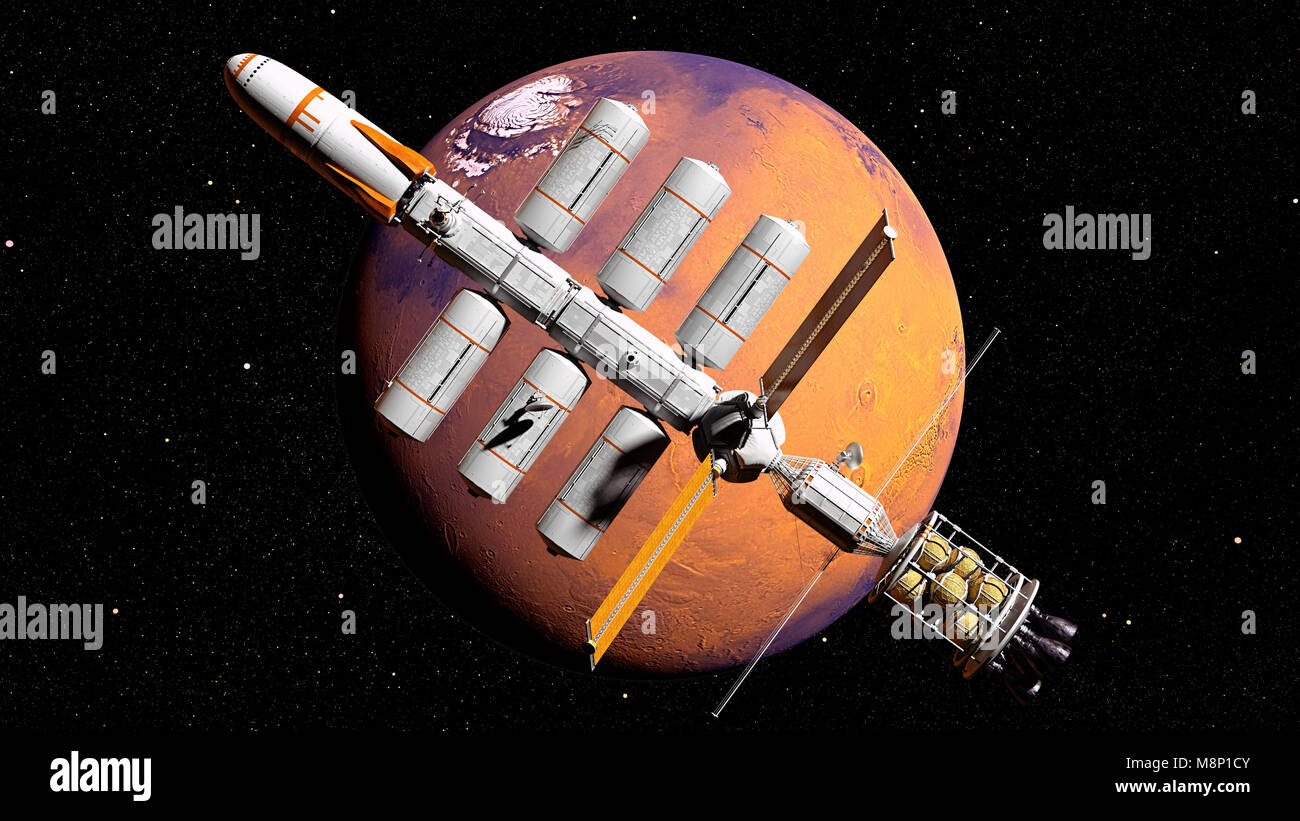
We need to develop some form of shields or a stable dome that can be constructed by 3-d printers to shield the outpost(think so sci-fi).
What Are "Star Trek"-Like Shields?In "Star Trek," shields are generated by advanced energy fields (often electromagnetic or gravitic) powered by a starship’s warp core. They:Deflect or absorb incoming threats (phasers, torpedoes, micrometeoroids, radiation).
Operate dynamically, adjusting to specific frequencies or intensities.
Require immense energy but are lightweight, avoiding the mass penalty of physical shielding.
For a Mars mission or outpost, the primary threat is solar radiation (solar wind, solar particle events, and galactic cosmic rays), so the focus would be on radiation-deflecting energy shields.Scientific Basis and Current FeasibilityThe closest real-world analog to "Star Trek" shields is active radiation shielding, which uses electromagnetic or plasma fields to deflect charged particles. Here’s an analysis:Electrostatic or Magnetic Shields:Principle: Solar radiation and cosmic rays consist mostly of charged particles (protons, electrons, heavy ions). Strong electric or magnetic fields can deflect these particles, creating a protective bubble around a spacecraft or habitat.
Current Research:Magnetic Shields: Concepts like the Mini-Magnetosphere (inspired by Earth’s magnetosphere) have been studied by NASA, ESA, and researchers like Dr. Ruth Bamford at the Rutherford Appleton Laboratory. A superconducting magnetic coil could generate a field to deflect charged particles. Experiments (e.g., 2010s plasma physics studies) show small-scale success in deflecting particles in lab settings.
Electrostatic Shields: High-voltage electrostatic fields could repel positively charged particles. Proposals, like those from the University of Washington (2013), suggest lightweight electrodes creating fields of ~1 MV to protect spacecraft.
Feasibility for Mars:Spacecraft: A magnetic shield generating a 1–2 Tesla field could reduce radiation exposure significantly. For a Mars mission, a toroidal magnetic field around a spacecraft (e.g., 10–20 meters in diameter) could deflect solar wind and SPEs. However, the energy requirements (hundreds of kilowatts to megawatts) and the mass of superconducting coils (even with high-temperature superconductors) are currently prohibitive for a lightweight spacecraft.
Outpost: On Mars, a localized magnetic field around a habitat could supplement passive shielding (e.g., regolith). However, maintaining a continuous field over a large area requires a stable, high-power source (e.g., nuclear reactor), which is challenging with current technology.
Plasma Shields:Principle: A plasma bubble, held in place by magnetic fields, could scatter or absorb charged particles. This mimics the fictional "Star Trek" shield’s ability to adapt to threats.
Current Research: NASA’s Advanced Concepts Institute (NIAC) has funded studies on plasma shields, such as the Plasma Magnet Shield (2016). A low-mass plasma cloud, generated by a small magnetic coil, could expand to form a large protective barrier, reducing the energy needed compared to a pure magnetic shield.
Feasibility for Mars: Plasma shields are theoretically promising due to their low mass, but they’re still in early research stages. Generating and sustaining a stable plasma field in space or on Mars requires advanced control systems and power sources not yet available. Additionally, plasma interactions with Mars’ thin atmosphere could complicate deployment.
Comparison to "Star Trek" Shields:Similarities: Both fictional and real concepts aim to create an energy-based barrier to deflect threats, minimizing physical mass. Magnetic and plasma shields align with the dynamic, adaptable nature of "Star Trek" shields.
Differences:Energy Requirements: "Star Trek" shields rely on fictional warp cores producing near-infinite energy. Real-world shields need compact, high-output power sources (e.g., nuclear fusion or advanced fission), which are decades away.
Versatility: Fictional shields block everything (energy weapons, physical objects, radiation). Real shields are optimized for charged particles and struggle with neutral particles (e.g., neutrons) or high-energy cosmic rays.
Scalability: "Star Trek" shields envelop massive starships instantly. Real shields are limited by field strength and size, with current prototypes only protecting small areas.
Challenges to Achieving "Star Trek"-Like ShieldsEnergy Generation: Current spacecraft rely on solar panels (50–100 kW for large missions) or radioisotope thermoelectric generators (RTGs, ~100 W). A magnetic or plasma shield requires megawatts of power, necessitating breakthroughs in compact fusion reactors or advanced solar.
Material Limitations: Superconducting magnets require cryogenic cooling, adding complexity and mass. High-temperature superconductors (e.g., YBCO) are improving but not yet lightweight or robust enough for space.
Secondary Radiation: Deflecting high-energy particles can produce secondary radiation (e.g., bremsstrahlung X-rays), requiring hybrid shielding (active + passive).
Mars Surface Constraints: Mars’ weak magnetic field and thin atmosphere offer little natural protection, so shields must be self-contained. Powering a large-scale shield on Mars would likely require a nuclear reactor, which poses logistical and safety challenges.
Cost and Development: Active shielding is still in the experimental phase. Deploying it for a Mars mission by, say, 2035 (a plausible timeline for crewed missions) would require significant investment and testing.
Current Alternatives for MarsWhile "Star Trek"-like shields are not yet feasible, practical alternatives exist:Passive Shielding: Polyethylene, water, or Martian regolith (1–2 meters thick) can reduce radiation to safe levels (~50 mSv/year) for both spacecraft and outposts.
Storm Shelters: Small, heavily shielded compartments protect against solar particle events during transit.
Subsurface Habitats: On Mars, lava tubes or buried habitats offer natural shielding, minimizing the need for energy-intensive active systems.
Future ProspectsNear-Term (2030s): Magnetic and electrostatic shields could become viable for small-scale applications (e.g., protecting critical spacecraft modules or habitat sections). NASA’s NIAC and ESA’s General Studies Programme are actively funding such research.
Long-Term (2050s+): Advances in fusion power, high-temperature superconductors, and plasma physics could enable larger, more efficient shields, approaching "Star Trek" functionality for radiation protection. However, deflecting physical objects or energy weapons (as in "Star Trek") remains speculative, requiring physics beyond current understanding (e.g., gravitic manipulation).
Speculative Technologies: Concepts like manipulating spacetime or using exotic matter (as hinted in "Star Trek") are theoretically intriguing but lack experimental grounding. For now, they remain science fiction.
Conclusion"Star Trek"-like shields, as energy-based barriers to protect against solar radiation, are theoretically possible through magnetic or plasma-based active shielding. Small-scale prototypes show promise, but scaling to protect a Mars-bound spacecraft or outpost requires breakthroughs in power generation, materials, and field control. For now, passive shielding (polyethylene, water, regolith) and subsurface habitats are more practical for Mars missions. With continued research, active shields could become viable by the 2040s, offering a step toward the sci-fi dream but not yet matching its full versatility. If you’d like, I can search X or the web for recent advancements in active shielding research to provide more specific updates.

 If it was me I'd use the starship concept to get things into orbit like parts of a much larger nuclear or fusion powered planetary class ship to go to mars. Star ship is a complete joke for anything besides getting that into space.