Past predictions about the future

-
funkervogt

- Posts: 1370
- Joined: Mon May 17, 2021 3:03 pm
Re: Past predictions about the future
From 10 years ago
https://www.popsci.com/science/article/ ... trip-mars/Mars One wants to land the first group (two men and two women, ideally from four different continents, says CEO Bas Lansdorp) on the red planet in 2023, with the other groups following one at a time, every two years. Applications close August 31, 2013.
Re: Past predictions about the future
Scientist’s ‘ruthlessly imaginative’ 1925 predictions for the future come true – mostly
Sun 29 Dec 2024 14.00 GMT
When the scientist and inventor Prof Archibald Montgomery Low predicted “a day in the life of a man of the future” one century ago, his prophesies were sometimes dismissed as “ruthlessly imaginative”.
They included, reported the London Daily News in 1925, “such horrors” as being woken by radio alarm clock; communications “by personal radio set”; breakfasting “with loudspeaker news and television glimpses of events”; shopping by moving stairways and moving pavements.
One hundred years after Low’s publication of his book The Future some of his forecasts were spot on. Others, including his prophesy that everyone would be wearing synthetic felt one-piece suits and hats, less so.
Researchers from the online genealogy service Findmypast, have excavated accounts of Low’s predictions from its extensive digital archive of historical newspapers available to the public and included them in a collection on its website of forecasts made for 2025 by people a century ago.
Low, born in 1888, was an engineer, research physicist, inventor and author. A pioneer in many fields, he invented the first powered drone, worked on the development of television, was known as the “father of radio guidance systems” for his work on planes, torpedo boats and guided rockets and reportedly attracted at least two unsuccessful assassination attempts by the Germans.
Read more: https://www.theguardian.com/science/202 ... -come-true
Sun 29 Dec 2024 14.00 GMT
When the scientist and inventor Prof Archibald Montgomery Low predicted “a day in the life of a man of the future” one century ago, his prophesies were sometimes dismissed as “ruthlessly imaginative”.
They included, reported the London Daily News in 1925, “such horrors” as being woken by radio alarm clock; communications “by personal radio set”; breakfasting “with loudspeaker news and television glimpses of events”; shopping by moving stairways and moving pavements.
One hundred years after Low’s publication of his book The Future some of his forecasts were spot on. Others, including his prophesy that everyone would be wearing synthetic felt one-piece suits and hats, less so.
Researchers from the online genealogy service Findmypast, have excavated accounts of Low’s predictions from its extensive digital archive of historical newspapers available to the public and included them in a collection on its website of forecasts made for 2025 by people a century ago.
Low, born in 1888, was an engineer, research physicist, inventor and author. A pioneer in many fields, he invented the first powered drone, worked on the development of television, was known as the “father of radio guidance systems” for his work on planes, torpedo boats and guided rockets and reportedly attracted at least two unsuccessful assassination attempts by the Germans.
Read more: https://www.theguardian.com/science/202 ... -come-true
Re: Past predictions about the future
30 years ago Tomorrow's World predicted 2025 - how did it do?
9 hours ago
In 1995, the BBC's Tomorrow's World programme decided to predict what the world would look like 30 years later, in 2025.
The show, which is no longer broadcast, featured one of the most famous scientists of the age, Prof Stephen Hawking, who predicted: "By 2025 we can expect big changes."
The programme team agreed, suggesting a raft of world-shaking innovations from hologram surgery to space junk gel.
So, with the help of some experts - and the benefit of three decades of hindsight - let's take a look at how much of today's world that Tomorrow's World successfully anticipated.
https://www.bbc.co.uk/news/articles/cjdn10yk0k1o

9 hours ago
In 1995, the BBC's Tomorrow's World programme decided to predict what the world would look like 30 years later, in 2025.
The show, which is no longer broadcast, featured one of the most famous scientists of the age, Prof Stephen Hawking, who predicted: "By 2025 we can expect big changes."
The programme team agreed, suggesting a raft of world-shaking innovations from hologram surgery to space junk gel.
So, with the help of some experts - and the benefit of three decades of hindsight - let's take a look at how much of today's world that Tomorrow's World successfully anticipated.
https://www.bbc.co.uk/news/articles/cjdn10yk0k1o
-
funkervogt
- Posts: 1370
- Joined: Mon May 17, 2021 3:03 pm
Re: Past predictions about the future
The Parable of the Sower's 2024 thankfully failed to arrive.
https://www.militantfuturist.com/review ... the-sower/
https://www.militantfuturist.com/review ... the-sower/
-
firestar464
- Posts: 8314
- Joined: Wed Oct 12, 2022 7:45 am
Re: Past predictions about the future
BBC predicts home working and video phones in '90s
In the early 1990s, the BBC's First Sight programme looked at how advances in technology could make working from home a reality for Londoners.
Much of the technology for people to work from home already existed in 1991 and some sectors in the capital had employees working remotely, including a handful of London's councils.
But as a recession began to bite, Britain's big businesses were starting to seriously consider it as an option to cut costs. Unions were not as open to the idea, with concerns of exploitation and constant monitoring by employers.
The programme also explored how people balanced working from home and family life as well as the psychological impact on working from home five days a week.
From First Sight, South & East, Thursday 14 February 1991.
https://www.bbc.co.uk/news/videos/cly8kzj0ky1o
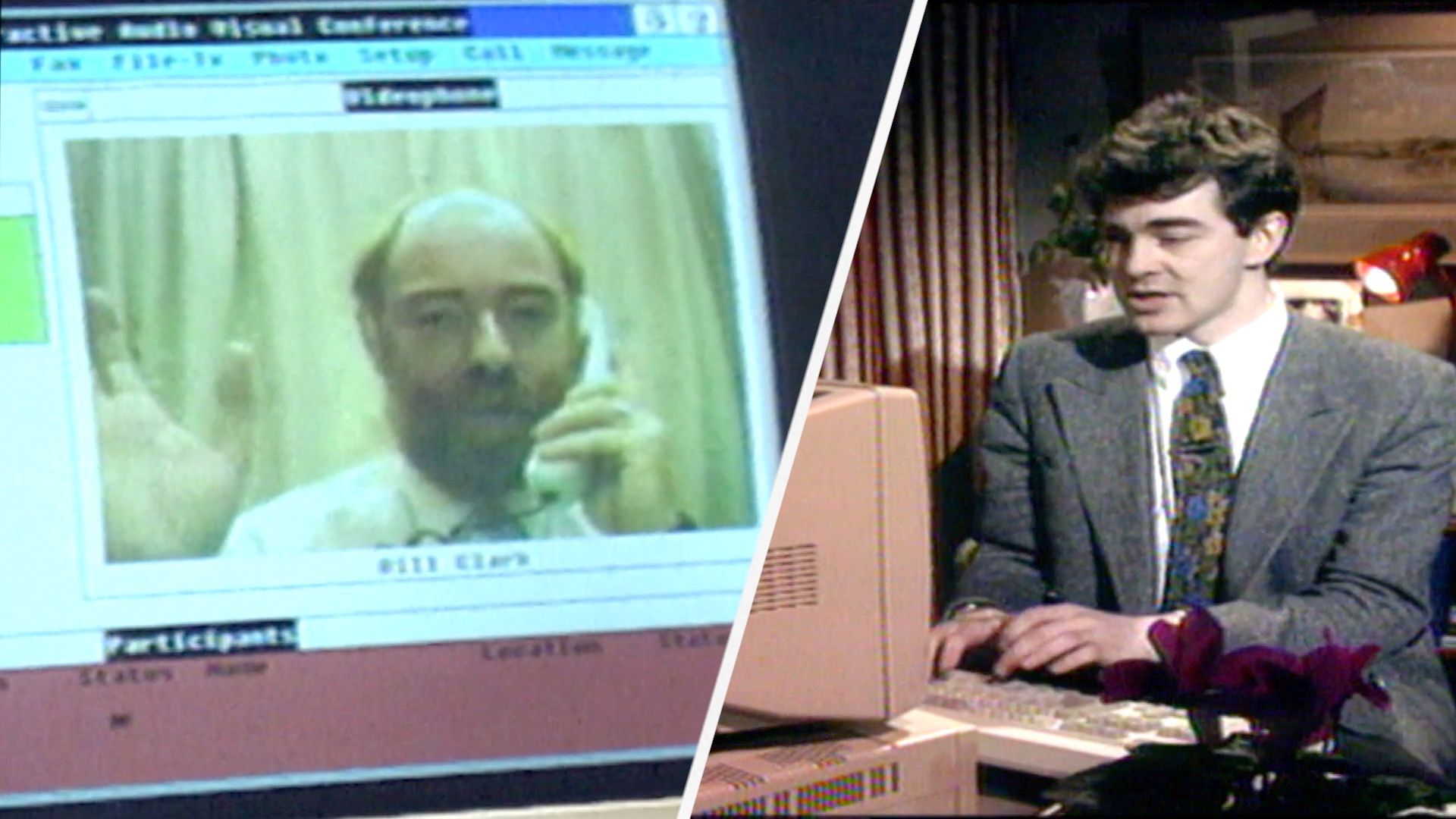
In the early 1990s, the BBC's First Sight programme looked at how advances in technology could make working from home a reality for Londoners.
Much of the technology for people to work from home already existed in 1991 and some sectors in the capital had employees working remotely, including a handful of London's councils.
But as a recession began to bite, Britain's big businesses were starting to seriously consider it as an option to cut costs. Unions were not as open to the idea, with concerns of exploitation and constant monitoring by employers.
The programme also explored how people balanced working from home and family life as well as the psychological impact on working from home five days a week.
From First Sight, South & East, Thursday 14 February 1991.
https://www.bbc.co.uk/news/videos/cly8kzj0ky1o

Re: Past predictions about the future
13 Classic Sitcoms That Predicted the Future and Got It Right
by Shallom Joe
June 16, 2025
Introduction:
by Shallom Joe
June 16, 2025
Introduction:
Read more here: https://www.msn.com/en-us/tv/news/13-c ... e3&ei=332(MSN) 1. The Simpsons has been a prophetic force in popular culture, predicting technological advancements and societal trends with eerie accuracy. Long before wrist-wearables became mainstream, The Simpsons didn’t predict smart watches in the way a prophet foretells the future, but they highlighted the potential for wrist-worn technology with a telephone function. In the episode “Lisa’s Wedding” (Season 6, Episode 19), Bart mentions a watch that “allows you to make calls. In the 2000 episode “Bart to the Future,” the show even pictured President Trump, 16 years ahead of time. The series also poked fun at autocorrect gone wrong, a daily frustration many experience today. Additionally, The Simpsons predicted smartwatches, smart home devices, tablets, video conferencing, and even Donald Trump’s presidency, showcasing the writers’ uncanny ability to tap into the zeitgeist and foresee a world few saw coming.
2. The TV show Friends demonstrated an eerie ability to predict future trends, and its portrayal of DNA testing is a prime example. In a 1995 episode, Joey and Chandler’s discussion of a paternity test based on DNA seemed like a humorous plot device at the time, but it actually foreshadowed the widespread use of DNA tests in modern life. What were once niche home-DNA kits have become routine, used not only for ancestry exploration but also for health checks. Friends captured the moment when DNA testing was still a novelty, hinting at a future where a simple spit sample could reveal intimate about a person’s life, ancestry, and health. This episode showcases the show’s writers’ keen insight into emerging science and its potential impact on society.
3. The TV show 30 Rock demonstrated its sharp wit and prescience in a 2009 episode, where it joked about a giant streaming service. This humorous reference was remarkably prophetic, as NBCUniversal would later launch Peacock in 2020, a streaming service that embodies the very concept the show had mocked years earlier.
Don't mourn, organize.
-Joe Hill
-Joe Hill
-
funkervogt
- Posts: 1370
- Joined: Mon May 17, 2021 3:03 pm
Re: Past predictions about the future
Five years ago, Elon Musk predicted AI would overtake humans in five years.
'Musk added that the invaluable experience of working with different types of AI at Tesla has given him the confidence to say “that we’re headed toward a situation where AI is vastly smarter than humans, and I think that time frame is less than five years from now. But that doesn’t mean that everything goes to hell in five years. It just means that things get unstable or weird.”'
Things have definitely gotten weird (perfect AI-generated deepfakes, chatbots describing themselves as Hitler, mass student use of AI to cheat on homework), but the rest of Musk's prediction was too optimistic. Anyone who has used an LLM knows the latter are vastly smarter but also vastly dumber than humans.
https://nationalinterest.org/blog/techl ... ars-165776
'Musk added that the invaluable experience of working with different types of AI at Tesla has given him the confidence to say “that we’re headed toward a situation where AI is vastly smarter than humans, and I think that time frame is less than five years from now. But that doesn’t mean that everything goes to hell in five years. It just means that things get unstable or weird.”'
Things have definitely gotten weird (perfect AI-generated deepfakes, chatbots describing themselves as Hitler, mass student use of AI to cheat on homework), but the rest of Musk's prediction was too optimistic. Anyone who has used an LLM knows the latter are vastly smarter but also vastly dumber than humans.
https://nationalinterest.org/blog/techl ... ars-165776
Re: Past predictions about the future
1989: The Home of 2020
What will the home of 2020 look like? Judith Hann and Howard Stableford give viewers the tour.
This clip is from Tomorrow's World, originally broadcast 12 December 1989.
https://www.bbc.co.uk/videos/cnk55nnnyxpo
What will the home of 2020 look like? Judith Hann and Howard Stableford give viewers the tour.
This clip is from Tomorrow's World, originally broadcast 12 December 1989.
https://www.bbc.co.uk/videos/cnk55nnnyxpo
-
funkervogt
- Posts: 1370
- Joined: Mon May 17, 2021 3:03 pm
Re: Past predictions about the future
"Within two decades, we will have a detailed understanding of how all the regions of the human brain work."
--Ray Kurzweil, The Singularity is Near (2005)
--Ray Kurzweil, The Singularity is Near (2005)