Ryzen 5 7400F will be available only in China for 849 RMB ($100 without VAT). It is based on Raphael microarchitecture. It lacks any integrated graphics. Boost clock is 4.7 GHz (300 MHz lower than the 7500F), L2+L3 cache is 38 MB and TDP is 65 watts.
VideoCardz article: https://videocardz.com/newz/just-releas ... 6-in-china
GPU and CPU news and discussions
-
Tadasuke
 RTX 5090 relative gaming performance in 3840x2160 and more
Founders Edition review according to TechPowerUp: https://www.techpowerup.com/review/nvid ... on/22.html
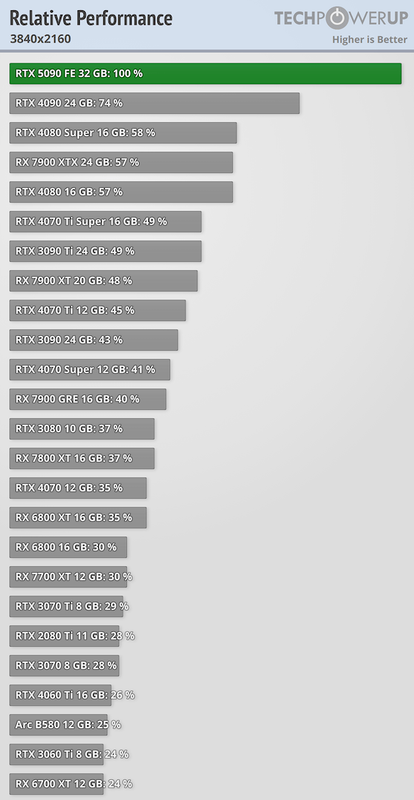
35.2% faster and 33.3% more memory than RTX 4090, with 25% higher MSRP (when not adjusting for inflation) 2 years and 3 months later
consumes 587 watts while gaming, compared to 411 watts for the RTX 4090, 368 watts for the RTX 3090 and 360 watts for Radeon 7900 XTX
I don't know who is impressed, and by what, honestly. I am not impressed in the slightest. In my opinion, this is a very disappointing line-up.
35.2% faster and 33.3% more memory than RTX 4090, with 25% higher MSRP (when not adjusting for inflation) 2 years and 3 months later
consumes 587 watts while gaming, compared to 411 watts for the RTX 4090, 368 watts for the RTX 3090 and 360 watts for Radeon 7900 XTX
I don't know who is impressed, and by what, honestly. I am not impressed in the slightest. In my opinion, this is a very disappointing line-up.

-
Tadasuke
my prediction about future computer capabilities
My current prediction about CPU and GPU performance is this (will change it as new data comes along):
CPU & GPU raw performance is probably going to double every 4 years on average. Even if PS5 Pro isn't 2x PS5 (it's 1.4x PS5), PS6 still might be 4x PS5, exactly eight years later (Switch 2 seems to be between 4x and 5x faster in raw perf than Switch 1, after 8 years and 2 months). Even if RTX 5060 isn't 2x RTX 3060 after 4 years (it's 1.4x), 2029 RTX 7060 still might be 4x 3060. Even if 2025 Ryzen 9600 isn't 2x faster than 2021 Ryzen 5600 after 4 years, comparable processor might be 4x faster approximately eight years after Ryzen 5600 (with twice as many cores & twice single core speed), etc. 128-core Zen 5 server processor is usually about 2x faster than 64 core Zen 3 one (after 4 years). Why isn't it 4x faster? Because of scaling issues above 16 cores. And it is 4-6x faster in AI workloads which make use of AVX-512 instructions.
So it is entirely conceivable and I think so, that real raw performance of APUs, GPUs and CPUs might continue this 2x per 4 years approximated trend well into the 2030s (and perhaps even 2040s, because of 3D IC). Although it doesn't rise like we would prefer (for example exactly 26% exactly every 365 days, so it would be much easier to plan, calculate and know what to expect).
AI performance will be growing faster than that - doubling every 3 years on average I guess. And AI will not only be faster because of hardware, but because of being made more efficient and because of more appropriate weights. AI will make computers much more useful, helpful, will make video quality better, upscale and denoise images. AI will also interpolate frames in video games allowing for turning 10 real frames into 1000 perceived frames. So that even a mid-range GPU will allow for 8K 1000 fps gaming in new titles. And that's probably coming around the year 2030. It is already possible to make 1080p 30fps into 2160p 120fps today (using Nvidia cards with DLSS 4). Locally run AI is going to change computing landscape a lot. More memory would be welcome, but it seems that even with 16 GB you can run something which can help you a lot.
I may be wrong of course. But what I wrote seems rather plausible with current information about the situation.
CPU & GPU raw performance is probably going to double every 4 years on average. Even if PS5 Pro isn't 2x PS5 (it's 1.4x PS5), PS6 still might be 4x PS5, exactly eight years later (Switch 2 seems to be between 4x and 5x faster in raw perf than Switch 1, after 8 years and 2 months). Even if RTX 5060 isn't 2x RTX 3060 after 4 years (it's 1.4x), 2029 RTX 7060 still might be 4x 3060. Even if 2025 Ryzen 9600 isn't 2x faster than 2021 Ryzen 5600 after 4 years, comparable processor might be 4x faster approximately eight years after Ryzen 5600 (with twice as many cores & twice single core speed), etc. 128-core Zen 5 server processor is usually about 2x faster than 64 core Zen 3 one (after 4 years). Why isn't it 4x faster? Because of scaling issues above 16 cores. And it is 4-6x faster in AI workloads which make use of AVX-512 instructions.
So it is entirely conceivable and I think so, that real raw performance of APUs, GPUs and CPUs might continue this 2x per 4 years approximated trend well into the 2030s (and perhaps even 2040s, because of 3D IC). Although it doesn't rise like we would prefer (for example exactly 26% exactly every 365 days, so it would be much easier to plan, calculate and know what to expect).
AI performance will be growing faster than that - doubling every 3 years on average I guess. And AI will not only be faster because of hardware, but because of being made more efficient and because of more appropriate weights. AI will make computers much more useful, helpful, will make video quality better, upscale and denoise images. AI will also interpolate frames in video games allowing for turning 10 real frames into 1000 perceived frames. So that even a mid-range GPU will allow for 8K 1000 fps gaming in new titles. And that's probably coming around the year 2030. It is already possible to make 1080p 30fps into 2160p 120fps today (using Nvidia cards with DLSS 4). Locally run AI is going to change computing landscape a lot. More memory would be welcome, but it seems that even with 16 GB you can run something which can help you a lot.
I may be wrong of course. But what I wrote seems rather plausible with current information about the situation.


-
weatheriscool
- Posts: 25737
- Joined: Sun May 16, 2021 6:16 pm
- Contact:
Re: GPU and CPU news and discussions
Intel Panther Lake CPUs Shown At Embedded World
It's the clearest shot of the CPUs since the original unveiling, but can Intel keep these chips on track for a 2025 release?
By Jon Martindale March 14, 2025
It's the clearest shot of the CPUs since the original unveiling, but can Intel keep these chips on track for a 2025 release?
By Jon Martindale March 14, 2025
https://www.extremetech.com/computing/i ... dded-world
Intel's next-generation Panther Lake processors were seen in the silicon flesh at the recent Embedded World show in Nuremberg, Germany. This is the first time the chips have been unveiled since their original debut last year, although they were merely bare dies here; no CPUs were seen in operation. That throws more fuel on the rumors that Intel may struggle to get these Core Ultra 300 processor designs out of the door and into devices before the end of the year.
Intel's next-generation Panther Lake CPUs were first unveiled in 2024, by then-Intel CEO Pat Gelsinger. He outlined plans to launch Panther Lake in the second half of 2025, and Intel has reiterated that is the plan still, even with rumors swirling that full production of the new chips won't take place until 2026. The new CPUs are expected to have a mobile focus, with more low-power efficiency cores to improve idle performance while reducing power demands. They will also come equipped with a new generation of Xe graphics, which should make them much more capable at casual gaming without a dedicated GPU.
-
weatheriscool
- Posts: 25737
- Joined: Sun May 16, 2021 6:16 pm
- Contact:
Re: GPU and CPU news and discussions
TSMC Readies for Flood of 2nm Orders in April
Apple is probably at the head of the line.
March 24, 2025
Apple is probably at the head of the line.
March 24, 2025
https://www.extremetech.com/computing/t ... s-in-april
With both Intel and TSMC bringing their 2nm/sub-2nm nodes toward mass production, 2025 is set to be a year of fierce competition. Intel appears to be on pace with its plans to ramp up production of its sub-2nm 18A process later this year. TSMC, which has been firing on all cylinders while Intel struggled in recent years, starts taking orders April 1, according to a report in the China Times (via Wccftech). Apple, which has already worked with TSMC for iPhone chips, is apparently first in line for TSMC’s new process, which isn’t surprising.
TSMC is reportedly shooting for 50,000 wafers per month (on the 2nm process) by the end of 2025. That puts it well ahead of Intel as far as 2nm production goes and likely gives TSMC a significant advantage in attracting customers. Although Apple appears to be the first customer, other major buyers are lining up. China Times points to AMD, Broadcom, AWS, and even Intel as potential customers for TSMC’s 2nm process. The report also pointed out that TSMC chairman Wi Zhejia has indicated that demand for TSMC’s 2nm process is outpacing TSMC’s wildly popular 3nm process.
-
Tadasuke
 how the top top PCI-E Nvidia GPU cards changed between 2013 and 2025
So here's a comparison I made, of how the top PCI-E Nvidia GPU cards, which you can normally buy, have been evolving, since the 2013 Titan GTX (which was branded as both professional and gaming card):
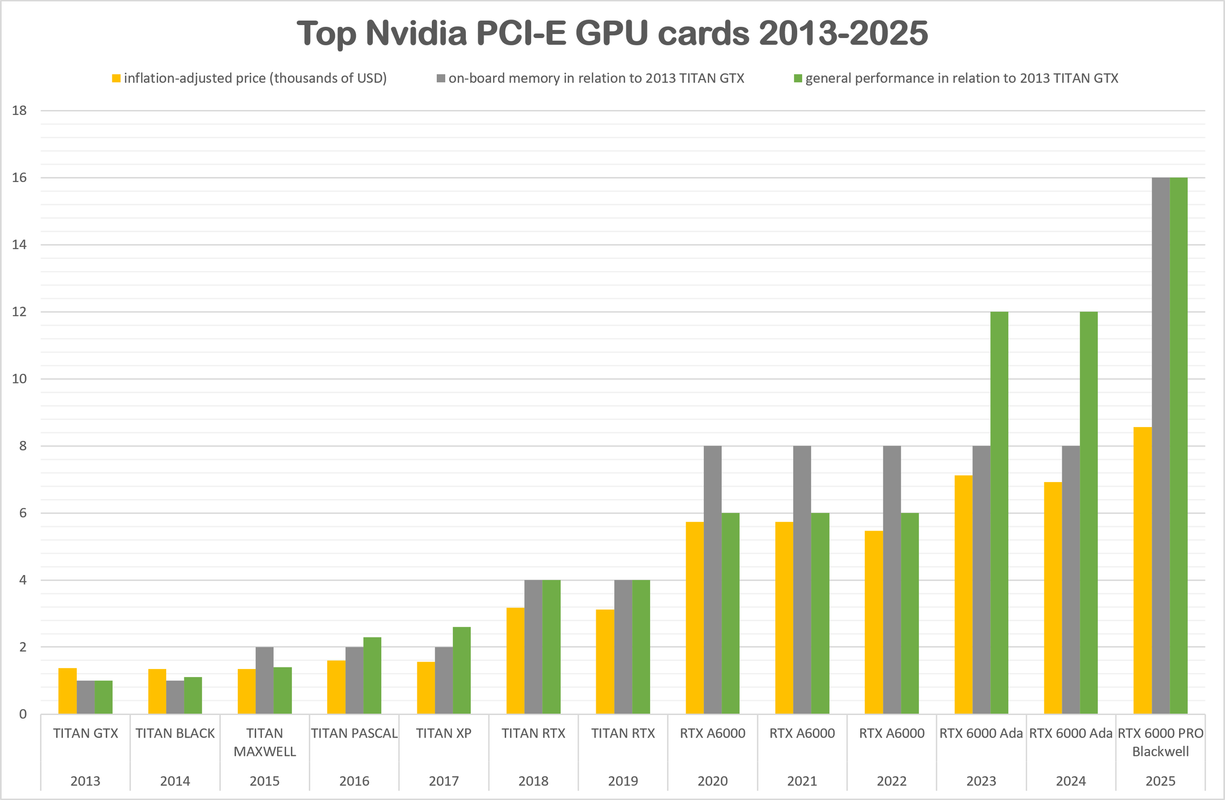
As you see, general performance and memory size has been doubling every 3 years on average (which is certainly appreciated, and not bad), but the MSRP has also been going up very significantly - 6.3x (!) in 12 years. TDP (or power draw) has gone up by 140% during that time. The newest 6000 PRO RTX Blackwell has 21% higher performance and 200% more memory than the ~2600 USD RTX 5090. As for current AI inference performance, the 2025 card is about 250-300x faster than the 2013 $999 TITAN GTX, which is substantial.
As you see, general performance and memory size has been doubling every 3 years on average (which is certainly appreciated, and not bad), but the MSRP has also been going up very significantly - 6.3x (!) in 12 years. TDP (or power draw) has gone up by 140% during that time. The newest 6000 PRO RTX Blackwell has 21% higher performance and 200% more memory than the ~2600 USD RTX 5090. As for current AI inference performance, the 2025 card is about 250-300x faster than the 2013 $999 TITAN GTX, which is substantial.
Re: GPU and CPU news and discussions
Ironwood: The first Google TPU for the age of inference
Ironwood is our most powerful, capable and energy efficient TPU yet, designed to power thinking, inferential AI models at scale.
Apr 09, 2025
Today at Google Cloud Next 25, we’re introducing Ironwood, our seventh-generation Tensor Processing Unit (TPU) — our most performant and scalable custom AI accelerator to date, and the first designed specifically for inference. For more than a decade, TPUs have powered Google’s most demanding AI training and serving workloads, and have enabled our Cloud customers to do the same. Ironwood is our most powerful, capable and energy efficient TPU yet. And it's purpose-built to power thinking, inferential AI models at scale.
Ironwood represents a significant shift in the development of AI and the infrastructure that powers its progress. It’s a move from responsive AI models that provide real-time information for people to interpret, to models that provide the proactive generation of insights and interpretation. This is what we call the “age of inference” where AI agents will proactively retrieve and generate data to collaboratively deliver insights and answers, not just data.
Ironwood is built to support this next phase of generative AI and its tremendous computational and communication requirements. It scales up to 9,216 liquid cooled chips linked with breakthrough Inter-Chip Interconnect (ICI) networking spanning nearly 10 MW. It is one of several new components of Google Cloud AI Hypercomputer architecture, which optimizes hardware and software together for the most demanding AI workloads. With Ironwood, developers can also leverage Google’s own Pathways software stack to reliably and easily harness the combined computing power of tens of thousands of Ironwood TPUs.
Here’s a closer look at how these innovations work together to take on the most demanding training and serving workloads with unparalleled performance, cost and power efficiency.
https://blog.google/products/google-clo ... inference/

Ironwood is our most powerful, capable and energy efficient TPU yet, designed to power thinking, inferential AI models at scale.
Apr 09, 2025
Today at Google Cloud Next 25, we’re introducing Ironwood, our seventh-generation Tensor Processing Unit (TPU) — our most performant and scalable custom AI accelerator to date, and the first designed specifically for inference. For more than a decade, TPUs have powered Google’s most demanding AI training and serving workloads, and have enabled our Cloud customers to do the same. Ironwood is our most powerful, capable and energy efficient TPU yet. And it's purpose-built to power thinking, inferential AI models at scale.
Ironwood represents a significant shift in the development of AI and the infrastructure that powers its progress. It’s a move from responsive AI models that provide real-time information for people to interpret, to models that provide the proactive generation of insights and interpretation. This is what we call the “age of inference” where AI agents will proactively retrieve and generate data to collaboratively deliver insights and answers, not just data.
Ironwood is built to support this next phase of generative AI and its tremendous computational and communication requirements. It scales up to 9,216 liquid cooled chips linked with breakthrough Inter-Chip Interconnect (ICI) networking spanning nearly 10 MW. It is one of several new components of Google Cloud AI Hypercomputer architecture, which optimizes hardware and software together for the most demanding AI workloads. With Ironwood, developers can also leverage Google’s own Pathways software stack to reliably and easily harness the combined computing power of tens of thousands of Ironwood TPUs.
Here’s a closer look at how these innovations work together to take on the most demanding training and serving workloads with unparalleled performance, cost and power efficiency.
https://blog.google/products/google-clo ... inference/
-
weatheriscool
- Posts: 25737
- Joined: Sun May 16, 2021 6:16 pm
- Contact:
Re: GPU and CPU news and discussions
Intel Might Launch a Barlett Lake Desktop Chip With 12 P-Cores
Mostly designed for edge computing, but Bartlett Lake could be a good stopgap for gaming in the near term.
By Jon Martindale April 15, 2025
Mostly designed for edge computing, but Bartlett Lake could be a good stopgap for gaming in the near term.
By Jon Martindale April 15, 2025
https://www.extremetech.com/computing/i ... 12-p-coresIntel might have an alternative to the rumored Arrow Lake refresh on desktop. According to a well-known overclocker affiliated with MSI, Intel is working on launching a desktop version of its edge-computing CPUs known as Bartlett Lake. The design will allegedly have 12 performance (P) cores but no efficiency (E) cores. Although that could limit its multi-threading performance, its gaming capabilities could be intriguing.
The Intel CPU strategy for several generations now has been to bundle larger P cores with smaller E cores. This lets it leverage additional cores for higher performance without needing to worry so much about the higher thermal demands of more, larger-scale cores. However, it's been stuck with a mere eight P cores for several generations, and if the Arrow Lake generation is any indication, it's starting to hamper gaming performance. While there are rumors of an Arrow Lake refresh, and future Nova Lake designs could be truly impressive, Bartlett Lake may serve as an intermediate option for gamers, as per Videocardz.
-
weatheriscool
- Posts: 25737
- Joined: Sun May 16, 2021 6:16 pm
- Contact:
Re: GPU and CPU news and discussions
TSMC Plans to Produce 30% of 2nm and Sub-2nm Chips in US
Arizona Fab 21 will get cutting-edge tech in the near future.
By Josh Gulick April 18, 2025
https://www.extremetech.com/computing/t ... hips-in-us
Arizona Fab 21 will get cutting-edge tech in the near future.
By Josh Gulick April 18, 2025
https://www.extremetech.com/computing/t ... hips-in-us
TSMC made clear this week that it has big plans for Fab 21, its Arizona chip manufacturing campus. In an earnings call, TSMC CEO C.C. Wei dismissed reports that the company was considering a joint venture with Intel and laid out the chipmaker’s plans for its burgeoning US presence. Referring to TSMC’s recent announcement regarding a planned $100 billion investment in the US, Wei noted that plans for Arizona have increased from the initial three fabrication plants to six, and that 30% of its sub-2nm chip production will eventually happen in the US. The bulk of N2 production will take place in Taiwan.
-
weatheriscool
- Posts: 25737
- Joined: Sun May 16, 2021 6:16 pm
- Contact:
Re: GPU and CPU news and discussions
TSMC Is Targeting 2028 for Its A14 1.4nm Process
It promises up to 30% reduction in power consumption compared with N2.
https://www.extremetech.com/computing/t ... nm-process
It promises up to 30% reduction in power consumption compared with N2.
https://www.extremetech.com/computing/t ... nm-process
Hoo boy. Things are about to get tricky when talking about chip technologies. That’s because TSMC finally made good on its promise to change its name structure for sub-2nm chips to one Apple already uses for its own processors. TSMC is going from its N naming convention—as in, N2, its 2nm process—to A for chips smaller than 2nm.
The first of these will be A16 and A14, the latter of which TSMC just highlighted at the North America Technology Symposium. That’s the upcoming 1.4nm process, which is not to be confused with Apple’s A14 Bionic SoC. (Apple’s chip appears in some older iPhones and is not made with a sub-nm process.)
Perhaps worse is that Intel also uses the A naming structure—and for the same reason TSMC adopted it. The A in Intel’s highly anticipated new A18, 1.8nm-class process stands for Angstrom, a unit of measurement suited to the ever-shrinking die processes.
-
weatheriscool
- Posts: 25737
- Joined: Sun May 16, 2021 6:16 pm
- Contact:
Re: GPU and CPU news and discussions
Customers Are Lining Up for 2nm TSMC N2 Chips
But don’t discount Intel 18A just yet.
By Josh Gulick May 8, 2025
But don’t discount Intel 18A just yet.
By Josh Gulick May 8, 2025
https://www.extremetech.com/computing/c ... c-n2-chipsA battle for customers is brewing between Intel and TSMC as the silicon giants prepare for mass production of their next-gen chips. TSMC has the advantage of already being further ahead in developing its N2, 2nm-class node. It started taking orders in April, with Apple likely being its first major customer. But Intel recently hit the risk reduction milestone in its own journey to produce the sub-2nm 18A node, meaning customers have two very solid, high-density processes to choose from for the next couple of years.
For its part, TSMC appears to be facing even greater demand for N2 than the company saw for its beloved N3 process, according to the China Times, which comes via Wccftech. According to the China Times, the high demand was confirmed by TSMC Chairman Wi Zhejia, who described it as “unprecedented.” You’d expect a company to toot its own horn, but in this case, it appears very likely that both chip giants are seeing massive demand.
-
weatheriscool
- Posts: 25737
- Joined: Sun May 16, 2021 6:16 pm
- Contact:
Re: GPU and CPU news and discussions
TSMC Arizona Fab Nears 100% Capacity
The chipmaker has excellent yields on its 2nm-class N2 wafers.
By Josh Gulick June 3, 2025
The chipmaker has excellent yields on its 2nm-class N2 wafers.
By Josh Gulick June 3, 2025
https://www.extremetech.com/computing/t ... 0-capacityTSMC’s N2 node development is on track and continues to hit impressive milestones. Most recently, the chipmaker surpassed 90% yields on its 2nm-class N2 wafers (for memory products). And its US fab cluster, which has seen customers lining up for some time now, could be nearing capacity thanks to high demand from Apple and others, according to a report from Wccftech.
The N2 wafers are likely selling in the neighborhood of $30,000 a piece, which is quite a jump from the N3 wafers Apple buys from TSMC for its iPhones. Those may be selling for about $18,000 per wafer. Unfortunately, we’re stuck with estimates from analysts because TSMC, like other foundries, keeps details like pricing (and even its customer list) as close to the vest as possible. Apple appears to be having TSMC produce its A20 SoC for the iPhone 18 on TSMC’s N2 node, notes MacRumors. That would make sense, as the upcoming iPhone 17 phones, which are expected to launch in about three months, have SoCs built on TSMC’s 3nm-class N3 node. (That’s not to say that the iPhone 16 and 17 SoCs will be the same—they’re built on different generations of the N3 process.)
TSMC Fab 21
-
weatheriscool
- Posts: 25737
- Joined: Sun May 16, 2021 6:16 pm
- Contact:
Re: GPU and CPU news and discussions
New GPU Clock Speed Record Broken With Intel Integrated GPU
Move over RTX 4090—there's a new speed king in town.
By Jon Martindale June 6, 2025
https://medicalxpress.com/news/2025-06- ... nosis.html
Move over RTX 4090—there's a new speed king in town.
By Jon Martindale June 6, 2025
When you think of cutting-edge graphics and sky-high clock speeds, you probably think of top-tier GPUs like the RTX 5090 or RTX 4090. But the world record for the highest clock speed on a GPU was just broken using an Intel Arrow Lake integrated GPU. Using a combination of a high voltage and sub-zero temperatures, a team of overclockers at the recent Computex show took the Intel GPU to more than 4.25GHz, beating out the RTX 4090 that held the previous record.
Clock speed world records aren't quite like benchmarking records, where the goal is to achieve the highest score or the highest frames per second. When it comes to clock speeds, it's the actual clock of the component that matters, whether it can run anything or not. As long as it boots, it qualifies. The GPU didn't manage to complete any benchmarks, as TechSpot confirms, but the clock record was achieved nonetheless.
https://medicalxpress.com/news/2025-06- ... nosis.html
Re: GPU and CPU news and discussions
Beyond 1s and 0s: China starts mass production of world’s first non-binary AI chip
Zhang Tongin Beijing
9 Jun 2025
China has initiated the world’s first large-scale application of non-binary AI chips, integrating its proprietary hybrid computing technology into critical sectors including aviation and industrial systems.
Spearheaded by Professor Li Hongge’s team at Beihang University in Beijing, this breakthrough overcomes fundamental barriers in traditional computing by merging binary and stochastic logic, enabling unprecedented fault tolerance and power efficiency in intelligent control applications like touch displays and flight systems while sidestepping US chip restrictions.
https://www.scmp.com/news/china/science ... ry-ai-chip
Zhang Tongin Beijing
9 Jun 2025
China has initiated the world’s first large-scale application of non-binary AI chips, integrating its proprietary hybrid computing technology into critical sectors including aviation and industrial systems.
Spearheaded by Professor Li Hongge’s team at Beihang University in Beijing, this breakthrough overcomes fundamental barriers in traditional computing by merging binary and stochastic logic, enabling unprecedented fault tolerance and power efficiency in intelligent control applications like touch displays and flight systems while sidestepping US chip restrictions.
https://www.scmp.com/news/china/science ... ry-ai-chip
-
weatheriscool
- Posts: 25737
- Joined: Sun May 16, 2021 6:16 pm
- Contact:
Re: GPU and CPU news and discussions
Intel Says Its 18A Node is 25% Faster Than Intel 3
Alternatively, it can run up to 36% more efficiently.
By Josh Gulick June 23, 2025
Alternatively, it can run up to 36% more efficiently.
By Josh Gulick June 23, 2025
https://www.extremetech.com/computing/i ... an-intel-3
Intel has great things to say about its upcoming 18A node, but it’s using some tough-to-verify comparisons. Intel made its claims at the 2025 Symposium on VLSI Technology in Japan, according to PC Gamer. The chipmaker compared its 18A node with the Intel 3 node, which didn’t lead to chips in laptops. So, for now, the performance improvement numbers are just mildly interesting, rather than data with which to make any decisions.
The company’s more interesting claims boil down to this: a chip based on the 18A process can be up to 25% faster. If you stick to the same speed as Intel 3, 18A is 36% more efficient. That sounds intriguing, but the comparison that potential customers will make is not between 18A and Intel 3; it will be between Intel’s 18A and TSMC’s N2, which is the 2-nm class node. Intel’s chief rival in the processor space, AMD, already has TSMC producing its next generation of Epyc data center CPUs on the N2 node.
In any event, we’ll have answers with the arrival of Intel’s upcoming Panther Lake laptop CPUs. Samples of the system-on-a-chip (SoC) made an appearance at Computex this summer, proving that the vaunted 18A node is about ready for production. Intel estimates that it will start production of the chips sometime this year. As for when we’ll see laptops with Panther Lake chips in them? That’s looking more like early 2026, says Intel.
-
weatheriscool
- Posts: 25737
- Joined: Sun May 16, 2021 6:16 pm
- Contact:
Re: GPU and CPU news and discussions
AMD Zen 6 CPUs May Hit 7GHz and Have Up to 24 Cores
AMD could need something special to beat Intel's 52-core Nova Lake chips, and this might just do it.
By Jon Martindale July 14, 2025

AMD could need something special to beat Intel's 52-core Nova Lake chips, and this might just do it.
By Jon Martindale July 14, 2025
https://www.extremetech.com/computing/a ... o-24-coresAMD's next-generation Zen 6 CPUs may reach an incredible new frequency milestone if new rumors are to be believed. They claim that AMD is pushing the Ryzen 10000 CPUs to reach as high as 7 GHz, all while sporting as many as 24 cores. This wouldn't just be a first for AMD, but it would be by far the highest clock speed of any out-of-the-box CPU ever made.
The current-generation AMD Ryzen 9000 CPUs are dominating in processor sales, leading Intel to slash prices and offer incredible bundle offerings to keep its sales up. But AMD isn't sitting back and enjoying this success, it seems: It's going to double down on the next generation. Zen 6 CPUs could be by far the fastest chips we've ever seen.
-
weatheriscool
- Posts: 25737
- Joined: Sun May 16, 2021 6:16 pm
- Contact:
Re: GPU and CPU news and discussions
Overclocker Hits DDR5 World Record With G.Skill Memory and Intel Inside
Bl4ckdot hit an OC home run using liquid nitrogen.
By Josh Gulick July 16, 2025
https://www.extremetech.com/computing/o ... tel-inside
Bl4ckdot hit an OC home run using liquid nitrogen.
By Josh Gulick July 16, 2025
https://www.extremetech.com/computing/o ... tel-inside
Last spring, overclocker Seby took some G.Skill Triedent Z5 memory to new heights using extreme cooling and some skillful overclocking. Now, thanks to French overclocker Bl4ckdot, there’s a new record: DDR5-12872.
“We are proud to see G.Skill Trident Z5 memory once again breaking the boundaries,” said Frank Hung, Marketing Manager of G.Skill, in a statement. “This achievement once again demonstrates G.Skill’s commitment to memory overclocking performance.”
Bl4ckdot pulled off the overclocking feat with a custom liquid nitrogen setup and a single 24GB G.Skill Trident Z5 module. He used an Asus ROG Maximus Z890 Apex motherboard, which is the same model motherboard that Seby used to create a record in the spring. The board is a wallet buster, going for more than $600 on both Amazon and Newegg, but it apparently has the chops to handle more than your usual wear and tear.
-
weatheriscool
- Posts: 25737
- Joined: Sun May 16, 2021 6:16 pm
- Contact:
Re: GPU and CPU news and discussions
AMD Officially Announced Threadripper 9000 and Prices Aren't As Crazy As We Thought
The top chip is still close to $12,000, but that's much better than $13,000.
By Jon Martindale July 18, 2025
The top chip is still close to $12,000, but that's much better than $13,000.
By Jon Martindale July 18, 2025
https://www.extremetech.com/computing/a ... s-crazy-asAMD has officially unveiled its next-generation Threadripper 9000 CPUs, along with details on core counts, clock speeds, TDPs, and—importantly—pricing. Though the high-end nature of these CPUs (and AMD's relatively uncontested market position) means the prices are indeed high, they aren't as bad as they looked like they would be after this week's retailer leaks. The cheapest model will offer 16 cores and 32 threads for a mere $1,650, while the 96-core top CPU will be priced at $11,700.
Threadripper CPUs have always been a little mad, pushing up the core counts we can expect in desktop computers—even high-end ones. Prices have always reflected that, but as core counts have risen over the generations, the prices have skyrocketed.
Still, AMD's price tags are a relief compared with the $13,000 some retailers mistakenly cited just a few days ago. It's also always worth remembering that these are professional processors designed for enterprises and business server clusters. Other prices throughout the range are cheaper than we were told, too, with VideoCardz stating it's between a $300 and $1300 decrease, depending on which model you're looking at.