20th September 2024
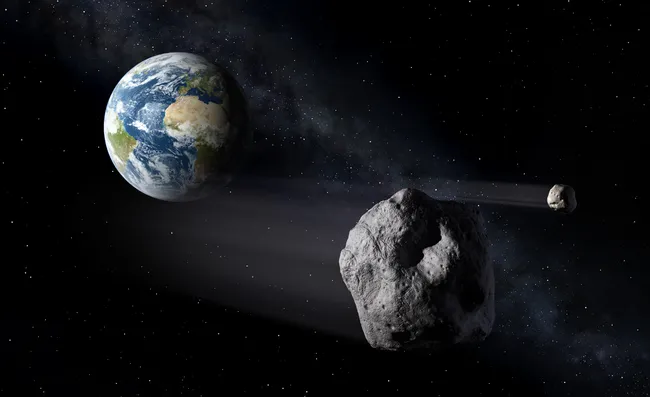
A newly discovered object will temporarily become our second moon, as it orbits the Earth from 29th September until 25th November. It will return in the year 2055.
Read more: https://www.futuretimeline.net/blog/202 ... 24-pt5.htm
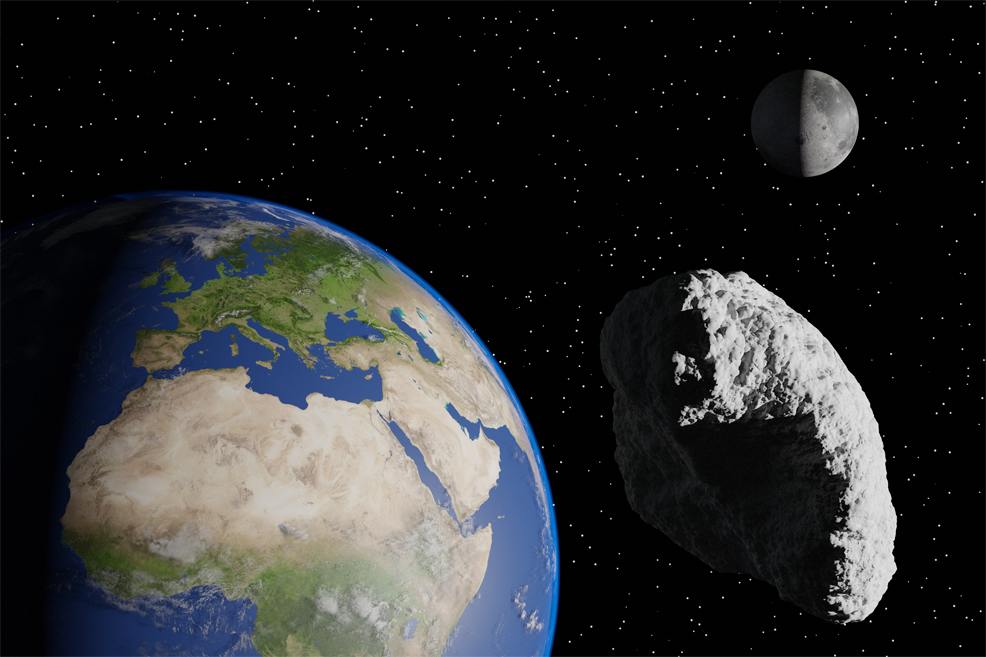
https://www.extremetech.com/science/we- ... -after-allEarth exists in a cosmic shooting gallery, and it's not a matter of if but rather when a large asteroid hits the bullseye. It's happened plenty of times in the past, but for the first time, humanity might have a chance to avert disaster. The movies always say we can nuke asteroids, an option long dismissed by scientists as fantasy. A new study says that might not be as crazy as it sounds.
We've learned more about the composition of asteroids in the last few years than in the prior few decades. Missions like Hayabusa2 and OSIRIS-REx have returned pristine samples from ancient space rocks, and the DART mission successfully changed the orbit of a small asteroid. However, scientists estimate it could take dozens of DART-like missions to redirect a dangerous asteroid that was on course for Earth. As an alternative, the Department of Energy's Lawrence Livermore National Laboratory (LLNL) suggests we could use nuclear weapons, but not like they do in the movies.
Read more of the Eurekalert article here: https://www.eurekalert.org/news-releases/1059613(Eurekalert) Since the first sighting of the first-discovered and largest asteroid in our solar system was made in 1801 by Giuseppe Piazzi, astronomers and planetary scientists have pondered the make-up of this asteroid/dwarf planet. Its heavily battered and dimpled surface is covered in impact craters. Scientists have long argued that visible craters on the surface meant that Ceres could not be very icy.
Researchers at Purdue University and the NASA's Jet Propulsion Lab (JPL) now believe Ceres is a very icy object that possibly was once a muddy ocean world. This discovery that Ceres has a dirty ice crust is led by Ian Pamerleau, PhD student, and Mike Sori, assistant professor in Purdue’s Department of Earth, Atmospheric, and Planetary Sciences who published their findings in Nature Astronomy. The duo along with Jennifer Scully, research scientist with JPL, used computer simulations of how craters on Ceres deform over billions of years.
“We think that there's lots of water-ice near Ceres surface, and that it gets gradually less icy as you go deeper and deeper,” Sori said. “People used to think that if Ceres was very icy, the craters would deform quickly over time, like glaciers flowing on Earth, or like gooey flowing honey. However, we've shown through our simulations that ice can be much stronger in conditions on Ceres than previously predicted if you mix in just a little bit of solid rock.”
The team’s discovery is contradictory to the previous belief that Ceres was relatively dry. The common assumption was that Ceres was less than 30% ice, but Sori’s team now believes the surface is more like 90% ice.
“Our interpretation of all this is that Ceres used to be an ‘ocean world’ like Europa (one of Jupiter's moons), but with a dirty, muddy ocean,’” Sori said. “As that muddy ocean froze over time, it created an icy crust with a little bit of rocky material trapped in it.”
Additional extract:(IFL Science) While the world waits to see comet C/2023 A3 (Tsuchinshan-ATLAS) brighten up our skies a little later this month, astronomers bring more good news. A newly discovered comet should be visible later this month, possibly outshining Venus.
On September 27, the NASA-funded Asteroid Terrestrial-impact Last Alert System (ATLAS) on Mauna Loa in Hawai'i spotted the new comet, which has temporarily been named A11bP7I. The comet appears to be a sungrazer, which means that it passes extremely closely to the Sun at perihelion, or its closest approach.
Read more here: https://www.iflscience.com/newly-disco ... us-76179Technically, the comet is a subset of sungrazers known as Kreutz Sungrazers, named after astronomer Heinrich Kreutz who studied them in the late 19th Century.
"The Kreutz sungrazers get to within about 50,000 kilometres [31,068 miles] of the surface, just passing through the lower regions of the solar atmosphere (the corona)," the European Space Agency explains. "Most simply evaporate in the hot solar atmosphere."
Time will tell whether A11bP7I survives its encounter and brightens our skies. If not, Comet Tsuchinshan-ATLAS has survived its own encounter and will be visible very shortly to those who know where to look.

https://newatlas.com/space/watch-hera-a ... lifts-off/
ESA's Hera spacecraft designed to assess NASA's experiment to deflect an asteroid has launched from Cape Canaveral Space Force Station, Florida. At 14:52 GMT, the robotic probe lifted off atop a Falcon 9 rocket to begin its three-year mission.
In 2022, NASA's Double Asteroid Redirection Test (DART) spacecraft slammed into the pyramid-sized asteroid Dimorphos, which orbits the much larger 65803 Didymos. The collision was part of a project to test ways to protect the Earth against the threat of dangerous asteroid impacts.
One would think that the experiment ended two years ago, but when the impact occurred the asteroid pair were 6.8 million miles (11 million km) from Earth, which made observing the event a bit like target shooting at a rifle range without any binoculars to see where the bullet landed.

To try and imagine what it was like when this was last seen in our inner solar system 80,000 years ago.wjfox wrote: ↑Sun Oct 06, 2024 8:21 am Comet last seen in stone age to make closest approach to Earth
Tue 1 Oct 2024 15.30 BST
A comet that has not been seen from Earth since Neanderthals were alive and kicking has reappeared in the sky, with astronomers saying it might be visible to the naked eye.
Comet C/2023 A3 (Tsuchinshan–Atlas) was discovered by astronomers early last year, and is thought to orbit the sun about every 80,000 years on a highly elongated path.
Dr Gregory Brown, the senior public astronomy officer at the Royal Observatory Greenwich, said the comet was thought to have originated in the Oort cloud, which lies beyond Neptune’s orbit.
https://www.theguardian.com/science/202 ... h-to-earth
Credit: Borja Suárez/Reuters
https://www.space.com/the-universe/aste ... tudy-findspublished 25 minutes ago
Landslides and tremors may transform the asteroid Apophis during its 2029 brush with Earth, according to a new study.
Named after Apep, the ancient Egyptian god of chaos, Apophis is a 1,100-foot-long (340 meters), peanut-shaped asteroid. Although an impact with a space rock that size wouldn't annihilate our planet, it could easily destroy a city.
When Apophis was discovered in 2004, astronomers calculated that it could pass extremely close to Earth in 2029. More detailed observations in 2021 allowed scientists to determine Apophis' path with greater accuracy, revealing that it had a smaller chance of hitting Earth than researchers initially estimated. At present, Apophis is predicted to sail as close as 20,000 miles (32,000 kilometers) to Earth on April 13, 2029, bringing it closer than some artificial satellites.
Given that distance, Apophis probably won't affect Earth much in 2029. But how will the asteroid itself fare after this close encounter?
That question intrigued Ronald-Louis Ballouz, an asteroid scientist at the Johns Hopkins University Applied Physics Laboratory. Tiny meteoroids constantly bombard asteroid surfaces in a process called space weathering, Ballouz told Live Science in an email. However, Ballouz added that astronomers have long seen that asteroids that pass close to planets like Earth often lack weathered surfaces.
https://phys.org/news/2024-11-ryugu-ast ... nized.html46 minutes ago
Panspermia is the hypothesis that life can survive the transfer between planetary bodies as a secondary path for life to get started on planets throughout a solar system. The discovery of extraterrestrial life on asteroids or within meteorites would have profound implications for understanding the origins and distribution of life in the universe.
Reports of microorganisms found in chondritic meteorites have long fueled debates about extraterrestrial life reaching Earth and possibly as an origin of life here. While studies have concluded these microbial signatures are just terrestrial contaminants, arguments for them being extraterrestrial travelers have continued.
Researchers from Imperial College London have discovered that a space-returned sample from asteroid Ryugu was rapidly colonized by terrestrial microorganisms, even under stringent contamination control measures.
In the study, "Rapid colonization of a space-returned Ryugu sample by terrestrial microorganisms," published in the journal Meteoritics & Planetary Science, researchers analyzed sample A0180, a tiny (1 × 0.8 mm) particle collected by the JAXA Hayabusa 2 mission from asteroid 162173 Ryugu.
Transported to Earth in a hermetically sealed chamber, the sample was opened in nitrogen in a class 10,000 clean room to prevent contamination. Individual particles were picked with sterilized tools and stored under nitrogen in airtight containers. Before analysis, the sample underwent Nano-X-ray computed tomography and was embedded in an epoxy resin block for scanning electron microscopy.

Maybe better to post in the asteroid mining thread.weatheriscool wrote: ↑Wed Jan 29, 2025 3:27 pm https://x.com/SpaceNews_Inc/status/1884614602605871199