Ancient History (3500 BC – 499 AD)

Got something to say about the past? Say it here!
weatheriscool
Posts: 24495
Joined: Sun May 16, 2021 6:16 pm
Contact:

Re: Ancient History (3500 BC – 499 AD)

Post by weatheriscool »

Discovery may explain why Egyptian pyramids were built along long-lost Ahramat branch of the Nile
https://phys.org/news/2024-05-discovery ... -lost.html
by Nature Publishing Group
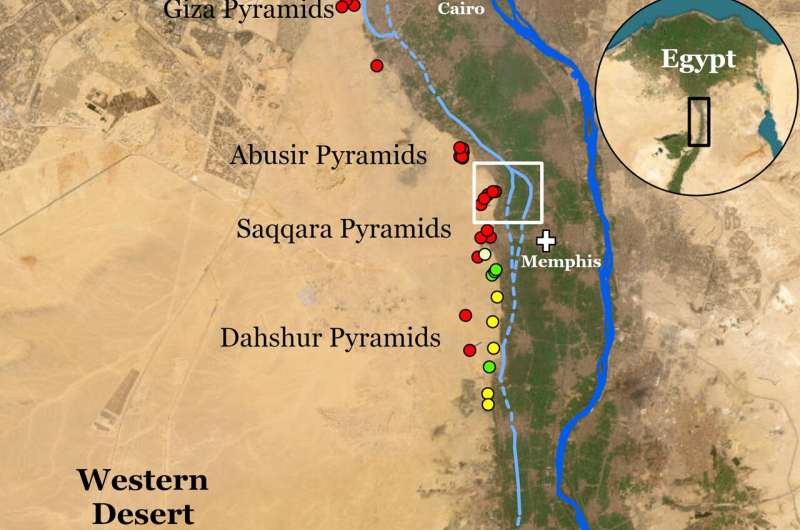
Some 31 pyramids in Egypt, including the Giza pyramid complex, may originally have been built along a 64-km-long branch of the river Nile which has long since been buried beneath farmland and desert. The findings, reported in a paper in Communications Earth & Environment, could explain why these pyramids are concentrated in what is now a narrow, inhospitable desert strip.
Image
User avatar
caltrek
Posts: 9280
Joined: Mon May 17, 2021 1:17 pm

Re: Ancient History (3500 BC – 499 AD)

Post by caltrek »

A Devastating Fire 2,200 years Ago Preserved a Moment of Life and War in Iron Age Spain
May 16, 2024

Introduction:
(Eurekalert) A ruined building in the middle of the Pyrenees records a tragedy for the people who lived there — a devastating fire which burned a settlement to the ground, destroying everything down to a hidden gold earring. Now archaeologists’ excavation of Building G, in the strategically placed Iron Age site of Tossal de Baltarga, reveals a way of life derailed by violence: potentially, a forgotten episode of the war between Carthage and Rome.

“The destruction was dated around the end of the third century BCE, the moment where the Pyrenees were involved in the Second Punic War and the passage of Hannibal’s troops,” said Dr Oriol Olesti Vila of the Autonomous University of Barcelona, lead author of the article in Frontiers in Environmental Archaeology. “It is likely that the violent destruction of the site was connected to this war. The general fire points to anthropic destruction, intentional and very effective — not only Building G, but all the buildings of the site, were destroyed. In Building D we found a complete dog, burned…”

Buried treasure

Tossal de Baltarga was a hillfort of the Cerretani community, who had a major settlement at nearby Castellot de Bolvir. It seems to have lacked defensive walls, but commanded an excellent view over the river and critical travel routes. Its sudden destruction preserved organic remains, which allowed archaeologists to paint a detailed picture of the life that its occupants lived until it was set alight.

“These valleys were an important territory economically and strategically,” said Olesti Vila. “We know that Hannibal passed the Pyrenees fighting against the local tribes, likely the Cerretani. Not many archaeological remains of this expedition are preserved. Tossal de Baltarga is likely one of the best examples.”

Building G had two floors. The fire burned so fiercely that the roof, support beams, and wooden upper floor fell in, but some of the valuables survived the fall: the archaeologists found an iron pickaxe and the gold earring, concealed in a little pot.
Read more of the Eurekalert article here: https://www.eurekalert.org/news-releases/1044380

For more information as published in Frontiers in Environmental Archaeology: https://www.frontiersin.org/articles/1 ... 7394/full
Don't mourn, organize.

-Joe Hill
weatheriscool
Posts: 24495
Joined: Sun May 16, 2021 6:16 pm
Contact:

Re: Ancient History (3500 BC – 499 AD)

Post by weatheriscool »

Researchers discover the world's oldest wine in Rome
https://phys.org/news/2024-06-world-old ... -rome.html
by University of Córdoba
A white wine over 2,000 years old, of Andalusian origin, is the oldest wine ever discovered.

Hispana, Senicio and the other four inhabitants (two men and two women, their names unknown) of a Roman tomb in Carmona, discovered in 2019, probably never imagined that what for them was a funerary ritual would end up being momentous 2,000 years later, for an entirely different reason.

As part of that ritual, the skeletal remains of one of the men were immersed in a liquid inside a glass funerary urn. This liquid, which over time has acquired a reddish hue, has been preserved since the first century AD, and a team with the Department of Organic Chemistry at the University of Cordoba, led by Professor José Rafael Ruiz Arrebola, in collaboration with the City of Carmona, has identified it as the oldest wine ever discovered, thus toppingthe Speyer wine bottle discovered in 1867 and dated to the fourth century AD, preserved in the Historical Museum of Pfalz (Germany).
User avatar
Powers
Posts: 1183
Joined: Fri Apr 07, 2023 7:32 pm
Location: a.k.a Lurking, Member, Lorem Ipsum, ..., --- and ººº.

Re: Ancient History (3500 BC – 499 AD)

Post by Powers »

^ Now drink it.
User avatar
caltrek
Posts: 9280
Joined: Mon May 17, 2021 1:17 pm

Re: Ancient History (3500 BC – 499 AD)

Post by caltrek »

Study Proposes Novel Hypothesis to Explain Occupation of Brazil’s Southern Coast 2,000 Years Ago
June 17, 2024

Introduction:
(Eurekalert) An important chapter of the history of human occupation on the coast of Brazil is being rewritten by Brazilian researchers affiliated with the University of São Paulo’s Museum of Archeology and Ethnology (MAE-USP) and supported by FAPESP.

In an article published in the journal PLOS ONE, the group, which also includes researchers in Santa Catarina state, South Brazil, and in other countries (the United States, Belgium and France), shows that the sambaqui builders of Galheta IV, an archeological site in Laguna (Santa Catarina), were not replaced by ancestors of the Southern Jê, as previously thought.

As the article explains, sambaquis are middens that constitute “evidence of long-term occupation”. They consist of mounds with layers of shellfish debris, human and animal bones, remains of plants and hearths, stone or bone utensils, and other refuse. They were used for burial and shelter, and to demarcate territory.

“There was far less interaction than has been thought between these midden builders [sambaquieiros] and the proto-Jê populations, as we call them. Their funerary practices and pottery were different. Moreover, the sambaquieiros lived there from birth and were descendants of people who had lived in the same place,” says André Strauss, a professor at MAE-USP and penultimate author of the article.
Read more of the Eurekalert article here: https://www.eurekalert.org/news-releases/1048576

For results of the study as published in PlosOne: https://journals.plos.org/plosone/artic ... e.0300684
Don't mourn, organize.

-Joe Hill
weatheriscool
Posts: 24495
Joined: Sun May 16, 2021 6:16 pm
Contact:

Re: Ancient History (3500 BC – 499 AD)

Post by weatheriscool »

Gravitational Wave Research Helps Solve Mystery of 2,000-Year-Old Computer
A new analysis says the Antikythera mechanism was used to track the Greek lunar calendar.
By Ryan Whitwam July 8, 2024
For more than a century, scientists have puzzled over the Antikythera mechanism, the earliest known analog computer. The object was discovered in pieces amid the wreckage of a Greek ship that sank in the second century BCE. A team from the University of Glasgow has published an analysis of the Antikythera mechanism that uses techniques gleaned from the study of gravitational waves to show the device was most likely a moon-centric calendar.
https://www.extremetech.com/science/gra ... d-computer
Explorers discovered the unusual object in 1901 off the coast of the Aegean island of Antikythera (hence the name). Scientists believe it was initially about the size of a shoebox, contained within a frame that has long since disintegrated. The surviving metal components represent only part of the original device, making it difficult to reconstruct. The object has attracted so much attention that it was the basis for the eponymous artifact in 2023's Indiana Jones and the Dial of Destiny.
User avatar
caltrek
Posts: 9280
Joined: Mon May 17, 2021 1:17 pm

Re: Ancient History (3500 BC – 499 AD)

Post by caltrek »

Ancient Temple and Theater Discovered in Peru
July 10, 2024

Introduction:
(Eurekalert) A team of archaeologists, led by Field Museum scientist Luis Muro Ynoñán, has unearthed the remains of what appears to be a four-thousand-year-old temple and theater in coastal Peru.

“It was amazing,” says Muro Ynoñán, a research scientist in the Negaunee Integrative Research Center at the Field Museum in Chicago. “This discovery tells us about the early origins of religion in Peru. We still know very little about how and under which circumstances complex belief systems emerged in the Andes, and now we have evidence about some of the earliest religious spaces that people were creating in this part of the world.”

Peru’s most famous archaeological site, the citadel of Machu Picchu, was built by the Inca Empire about 600 years ago, in the 15th century AD. The newly-discovered temple predates Machu Picchu by roughly 3,500 years, and was made long before the Inca and their predecessors, including the Moche and Nazca cultures. “We don’t know what these people called themselves, or how other people referred to them. All we know about them comes from what they created: their houses, temples, and funerary goods” says Muro Ynoñan.

Muro Ynoñán and his team were made aware of the new archaeological site, La Otra Banda, Cerro Las Animas, in 2023. The local government reached out to alert them to looting that had been taking place near the historic town of Zaña, and called on them to study the area before it was destroyed. Supporters including Dumbarton Oaks, Archaeology in Action, and the Pontifical Catholic University of Peru raised funds to excavate the site, and the archaeologists began digging in June 2024.

The team selected a plot roughly 33 by 33 feet (10 by 10 meters) and began slowly removing the sediment that had piled up over the millenia. Just six feet deep, the team found signs of ancient walls made of mud and clay. “It was so surprising that these very ancient structures were so close to the modern surface,” says Muro Ynoñan.
Read more here: https://www.eurekalert.org/news-releases/1050924
Don't mourn, organize.

-Joe Hill
User avatar
Time_Traveller
Posts: 3025
Joined: Sun May 16, 2021 4:49 pm
Location: New York City, USA, November 5th 2032 C.E.

Re: Ancient History (3500 BC – 499 AD)

Post by Time_Traveller »

Archaeologists discover traces of Roman circus at Iruña-Veleia
July 17, 2024

Archaeologists from ARKIKUS have announced the discovery of a Roman circus at Iruña-Veleia, a former Roman town in Hispania, now located in the province of Álava, Basque Autonomous Community, Spain.
The town was an important transit centre on the Ab Asturica Burdigalam (Roman road), with a peak population of around 10,000 inhabitants.

In a recent study using aerial photography and light detection and ranging (LiDAR), archaeologists have found a Roman circus and previously unknown urban areas of Iruña-Veleia.

A Roman circus was a large open-air venue used mainly for chariot races, although sometimes serving other purposes. Chariot racing was the most popular of many subsidised public entertainments, and was an essential component in several religious festivals.
https://www.heritagedaily.com/2024/07/a ... eia/152646
“In the quantum multiverse, every choice, every decision you've ever and never made exists in an unimaginably vast ensemble of parallel universes.”
User avatar
Time_Traveller
Posts: 3025
Joined: Sun May 16, 2021 4:49 pm
Location: New York City, USA, November 5th 2032 C.E.

Re: Ancient History (3500 BC – 499 AD)

Post by Time_Traveller »

Archaeologists make new discoveries at Bodbury Ring hillfort
July 17, 2024

Bodbury Ring is a univallate hillfort, strategically located at the southern tip of Bodbury Hill in Shropshire, England.
Hillforts in Britain are known from the Bronze Age, but the main period of hillfort construction occurred during the Celtic Iron Age.

Hillfort fortifications follow the contours of a hill and consist of one or more lines of earthworks or stone ramparts, with stockades or defensive walls, and external ditches.

Archaeologists from Time Team and the Universities of Chester and York, recently conducted a study of Bodbury Ring using light detection and ranging (LiDAR).

Light Detection and Ranging (LiDAR) is a remote sensing technique that employs pulsed laser light to measure distances to the Earth. By analysing variations in the return times and wavelengths of the laser pulses, this method can generate a detailed 3-D digital map of the landscape.
https://www.heritagedaily.com/2024/07/a ... ort/152641
“In the quantum multiverse, every choice, every decision you've ever and never made exists in an unimaginably vast ensemble of parallel universes.”
User avatar
caltrek
Posts: 9280
Joined: Mon May 17, 2021 1:17 pm

Re: Ancient History (3500 BC – 499 AD)

Post by caltrek »

Engineers Found Evidence of Hydraulics in an Ancient Pyramid, Solving a 4,500-Year-Old Mystery
July 26, 2024

Introduction:
(Popular Mechanics)

• A new study suggests that the first of seven key pyramids in Egypt, the Step Pyramid of Djoser, was built using a hydraulic lift.

• Dated to about 4,500 years ago, this would move up the introduction of major hydraulic systems from previous beliefs.

• The landscape, waterways, and interior architecture of the pyramid all point to the hydraulic system.

Hydraulic mechanics may have indeed been the driving force behind the construction of ancient Egyptian pyramids.

In a recently published study in PLOS ONE, scientists concluded that the Step Pyramid of Djoser in Saqqara, Egypt—believed to be the oldest of the seven monumental pyramids and potentially constructed about 4,500 years ago—offers a remarkable blueprint for hydraulic engineering.
Read more here: https://www.msn.com/en-us/news/world/e ... 3df&ei=43


For results of the study as published in PLOS ONE: https://www.researchgate.net/publicati ... of_Saqqara

caltrek’s comment: I will have to admit that I am more than a little bit skeptical about this explanation. At least in its more extreme forms. Use of canals to move stones to the construction sites etc. seems highly plausible
Don't mourn, organize.

-Joe Hill
User avatar
caltrek
Posts: 9280
Joined: Mon May 17, 2021 1:17 pm

Re: Ancient History (3500 BC – 499 AD)

Post by caltrek »

Genetics Reveal Ancient Trade Routes and Path to Domestication of the Four Corners Potato
July 24, 2024

Introduction:
(Eurekalert) A new study shows that a native potato species was brought to southern Utah by Indigenous people in the distant past, adding to an ever-growing list of culturally significant plant species that pre-contact cultures domesticated in the Southwestern U.S.

The team of researchers, led by Red Butte Garden and the Natural History Museum of Utah (NHMU) at the University of Utah, used genetic analysis to reveal how and where tubers of the Four Corners potato (Solanum jamesii) had been collected, transported and traded throughout the Colorado Plateau. The findings support the assertion that the tuber is a “lost sister,” joining maize, beans and squash—commonly known as the three sisters—as a staple of crops ingeniously grown across the arid landscape.

“Transport is one of the early crucial steps in the domestication of native plants into crops," said Dr. Lisbeth Louderback, curator of archaeology for NHMU, associate professor of anthropology at the U and coauthor of the study. “Domestication can begin with people gathering and replanting propagules in a new location.”

The authors collected DNA samples from modern Four Corners potato populations near archaeological sites and from non-archaeological populations within the potato's natural range in the Mogollon Rim of central Arizona and New Mexico. The findings indicate that the potato was transported and cultivated, likely by the ancestors of modern Pueblo (Hopi, Zuni, Tewa, Zia), Diné, Southern Paiute and Apache tribes.

"The Four Corners potato, along with maize, cacao, and agave, reflects the significant influence of humans on plant diversity in the landscape over millennia,” said Dr. Bruce Pavlik, former director of conservation at Red Butte Garden and lead author of the study.
Read more of the Eurekalert article here: https://www.eurekalert.org/news-releases/1052517

Read a presentation of study results as presented in the American Journal of Botany here: https://bsapubs.onlinelibrary.wiley.com ... jb2.16365
Don't mourn, organize.

-Joe Hill
User avatar
Time_Traveller
Posts: 3025
Joined: Sun May 16, 2021 4:49 pm
Location: New York City, USA, November 5th 2032 C.E.

Re: Ancient History (3500 BC – 499 AD)

Post by Time_Traveller »

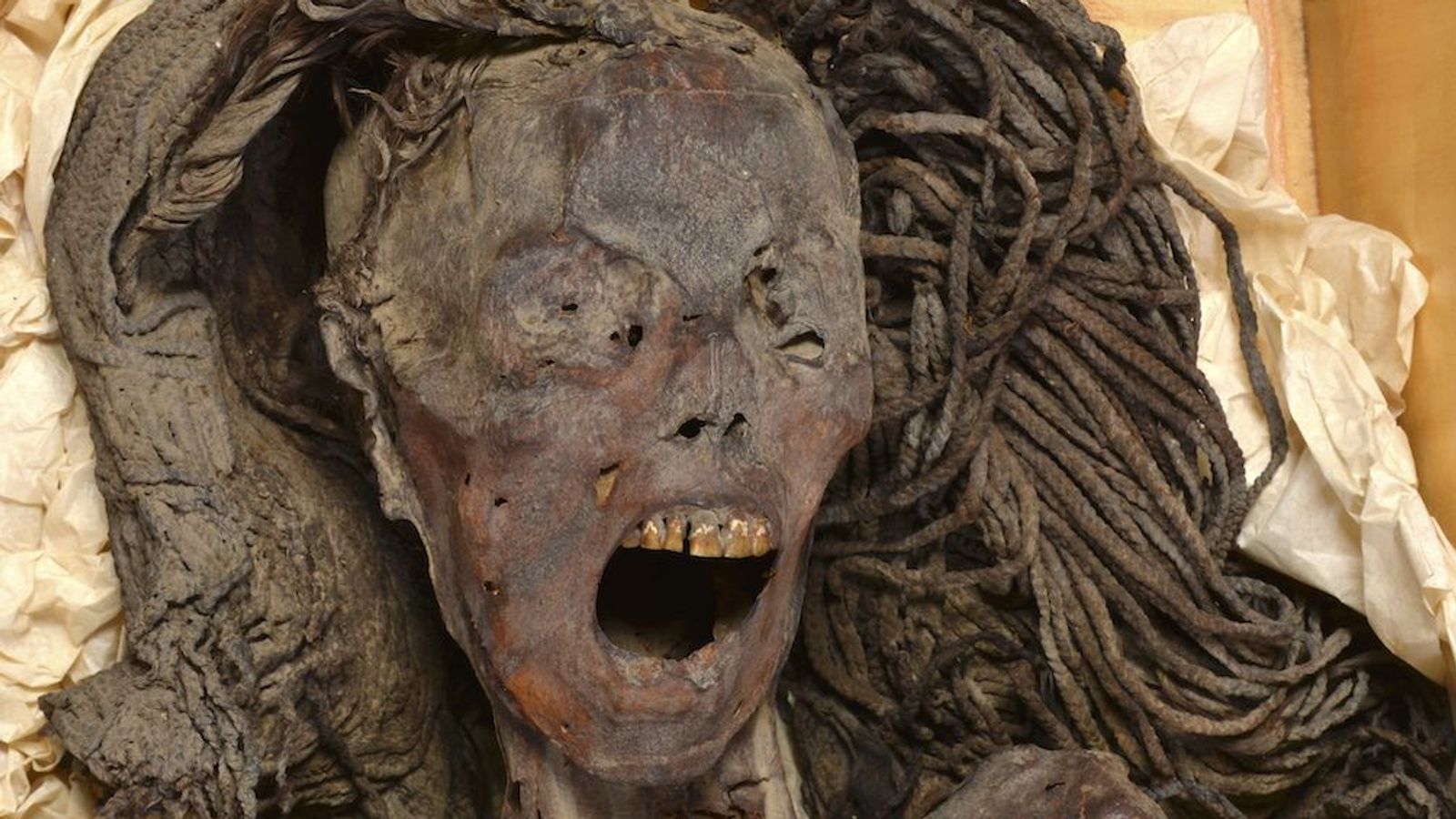
'Screaming Woman': Egyptian mummy's pained expression may have been caused by rare event
Friday 2 August 2024 11:36, UK

Image

The mystery of why an ancient Egyptian mummy nicknamed the Screaming Woman had a pained expression on her face may have been solved.

New analysis by scientists suggests she died "screaming from agony" around 3,000 years ago.

The experts say she may then have experienced a rare event known as a cadaveric spasm at the moment of death, causing her muscles to stiffen and immortalise her suffering.

The condition causes the muscles to freeze in the exact position the person was in when they died.

Although her cause of death remains a mystery, cadaveric spasms are usually associated with violent deaths under extreme physical conditions and intense emotions.
https://news.sky.com/story/screaming-wo ... t-13189151
“In the quantum multiverse, every choice, every decision you've ever and never made exists in an unimaginably vast ensemble of parallel universes.”
User avatar
Time_Traveller
Posts: 3025
Joined: Sun May 16, 2021 4:49 pm
Location: New York City, USA, November 5th 2032 C.E.

Re: Ancient History (3500 BC – 499 AD)

Post by Time_Traveller »

New find hints Wales fully-integrated into Roman Britain
4 hours ago

An academic who discovered a Roman fort while out on a bike ride says his discovery indicates a more militant history for west Wales than previously thought.

It is believed the site, which is located underneath a farmer’s field in the north of Pembrokeshire, suggests that Wales was fully integrated into Roman Britain.

Dr Mark Merrony, of Wolfson College, Oxford, said he was "absolutely thrilled".

"I wasn't expecting to find something like this... it's one thing finding a villa or a road, but to find a military site like this is [on] a very different scale altogether really."

The site is believed to be two to three hectares in size.
https://www.bbc.co.uk/news/articles/c51y1x4n9qko
“In the quantum multiverse, every choice, every decision you've ever and never made exists in an unimaginably vast ensemble of parallel universes.”
User avatar
Time_Traveller
Posts: 3025
Joined: Sun May 16, 2021 4:49 pm
Location: New York City, USA, November 5th 2032 C.E.

Re: Ancient History (3500 BC – 499 AD)

Post by Time_Traveller »

Stonehenge discovery highlights 500-mile mystery - as central stone 'didn't come from Wales'

Wednesday 14 August 2024 12:54, UK

Image

The Altar Stone at the centre of Stonehenge was brought 500 miles from northern Scotland - not Wales - as was previously thought, according to new research, adding to the mystery of the Neolithic site.

Geological fingerprinting has revealed the six-tonne stone almost certainly came from the Orcadian Basin, a rock deposit stretching north from Inverness up to the Orkney Islands.

"This is a genuinely shocking result," said co-researcher Dr Robert Ixer from University College London.

"The work prompts two important questions: why and exactly how was the Altar Stone transported from the very north of Scotland, a distance of more than 700km, to Stonehenge?"

Archaeologists do not know for sure when the Altar Stone arrived at the prehistoric monument in southern England, but it is thought to have been added during the second construction phase, sometime between 2620 and 2480 BCE.

https://news.sky.com/story/stonehenge-d ... s-13196882
“In the quantum multiverse, every choice, every decision you've ever and never made exists in an unimaginably vast ensemble of parallel universes.”
User avatar
caltrek
Posts: 9280
Joined: Mon May 17, 2021 1:17 pm

Re: Ancient History (3500 BC – 499 AD)

Post by caltrek »

The Roman Siege of Masada Lasted Just a Few Weeks, Not Several Years
September 5, 2024

Introduction:

(Eurekalert) The researchers: "According to the common myth, the Romans laid siege to the desert fortress of Masada for three long years. A new survey employing advanced technologies indicates that the siege was probably a much quicker affair."

Researchers from the Sonia & Marco Nadler Institute of Archaeology at Tel Aviv University used a range of modern technologies, including drones, remote sensing, and 3D digital modeling, to generate the first objective, quantified analysis of the Roman siege system at Masada. Findings indicate that contrary to the widespread myth, the Roman army's siege of Masada in 73 CE lasted no more than a few weeks.
Read more here: https://www.eurekalert.org/news-releases/1056923

Introduction to article published in Cambridge University Press:
The sheer cliffs surrounding the horst of Masada separate its elevated plateau from the Judean Desert Plateau to the west and the Dead Sea Plain to the east. Though the isolated mountain served as a refuge from the Chalcolithic to the Byzantine Period,Footnote1 the site is best known for its role as the last stronghold of the First Jewish Revolt against the Roman Empire, dated to 66–73/74 CE.Footnote2 The siege of Masada probably took place in 73/74 CE and was the final battle of this war. According to the contemporary account of Judeo-Roman historian Flavius Josephus, it ended with the Romans breaching the fortress's fortification walls, only to find that all its inhabitants had committed suicide to escape a future of slavery.Footnote3

During the battle over Masada, the Roman army built an extensive siege system around the fortress. This system included eight army camps, a siege wall (circumvallation),Footnote4 and a large ramp approaching the fortress's wall. In addition, they either built or re-used a network of trails connecting the Judean Plateau and the eastern plain. The dry desert environment and the remote location allowed for the superb preservation of this system;Footnote5 today, it is easy to identify its various architectonic features, from camp walls to tent bases, gates, towers, and a possible water cistern. Even the wood used for the construction of the siege ramp is still intact.Footnote6

Though the site of Masada has been comprehensively explored since its identification in the 19th c. and its top extensively excavated since the 1960s,Footnote7 surprisingly little attention has been given to the siege system,Footnote8 particularly the wall. To date, only Camp A,Footnote9 Camp F, and the siege rampFootnote10 have been excavated and partially published, and as “the archaeological evidence for the Roman army at war is very slim,”Footnote11 a new investigation into the Masada siege system was therefore due.

Read more here (including footnotes): https://www.cambridge.org/core/journal ... 47DFD271E
Don't mourn, organize.

-Joe Hill
User avatar
caltrek
Posts: 9280
Joined: Mon May 17, 2021 1:17 pm

Re: Ancient History (3500 BC – 499 AD)

Post by caltrek »

Secret Tomb Discovered in One of Archaeology's Most Famous Wonders
by Carly Cassella
October 17, 2024

Introduction:
( ScienceAlert ) One of the most famous facades in all the world has been concealing a deep secret.

Underneath the iconic and intricately carved Treasury building at the center of the renowned archaeological site Petra, excavators have stumbled upon a long-lost crypt holding 12 skeletons.

One of the buried individuals was found clutching the top of a broken ceramic jug.

"When we spotted what looked like a chalice, all of us just
froze," recalls American television presenter Josh Gates, who was included in the excavation for a documentary on Discovery Channel.

"It looked nearly identical to the Holy Grail featured in Indiana Jones and the Last Crusade, set in the ancient building directly above the tomb. It was the ultimate moment of life imitating art."
Read more here: https://www.sciencealert.com/secret-to ... s-wonders

caltrek’s comment: The article refers to the Discovery channel. On my channel guide this show appears on what is referred to as The Science Channel. I enjoy watching most of Gates’ shows. He documents a lot of nice tries when it comes to archaeological discoveries, so it is nice to see him involved in an actual major discovery.

Of related interest:
Don't mourn, organize.

-Joe Hill
User avatar
Powers
Posts: 1183
Joined: Fri Apr 07, 2023 7:32 pm
Location: a.k.a Lurking, Member, Lorem Ipsum, ..., --- and ººº.

Re: Ancient History (3500 BC – 499 AD)

Post by Powers »

caltrek wrote: Fri Oct 18, 2024 8:33 pm Secret Tomb Discovered in One of Archaeology's Most Famous Wonders
by Carly Cassella
October 17, 2024

Introduction:
( ScienceAlert ) One of the most famous facades in all the world has been concealing a deep secret.

Underneath the iconic and intricately carved Treasury building at the center of the renowned archaeological site Petra, excavators have stumbled upon a long-lost crypt holding 12 skeletons.

One of the buried individuals was found clutching the top of a broken ceramic jug.

"When we spotted what looked like a chalice, all of us just
froze," recalls American television presenter Josh Gates, who was included in the excavation for a documentary on Discovery Channel.

"It looked nearly identical to the Holy Grail featured in Indiana Jones and the Last Crusade, set in the ancient building directly above the tomb. It was the ultimate moment of life imitating art."
Read more here: https://www.sciencealert.com/secret-to ... s-wonders

caltrek’s comment: The article refers to the Discovery channel. On my channel guide this show appears on what is referred to as The Science Channel. I enjoy watching most of Gates’ shows. He documents a lot of nice tries when it comes to archaeological discoveries, so it is nice to see him involved in an actual major discovery.

Of related interest:
NO WAY, For real? I mean I think it's just a coincidence.
User avatar
Time_Traveller
Posts: 3025
Joined: Sun May 16, 2021 4:49 pm
Location: New York City, USA, November 5th 2032 C.E.

Re: Ancient History (3500 BC – 499 AD)

Post by Time_Traveller »

'Unusual' Anglo-Saxon replica of Roman coin found
7 hours ago

A "very unusual" gold pendant made by an early Anglo-Saxon in imitation of a Roman coin has been discovered by a detectorist.

The replica is a copy of a solidus coin showing the emperor Honorius (AD393-423), external on one side and a figure holding a banner with Christian symbols on the other.

The late 5th to early 6th Century pendant was created at a time when Anglo-Saxons were pagans, which was "slightly ironic", said coin expert Adrian Marsden.

The find was discovered in a field near Attleborough, Norfolk, in January 2023, and has been declared treasure by a coroner.

Numismatist Adrian Marsden thinks it belonged to someone with "quite a bit of wealth" and may have been part of the owner's grave goods

Dr Marsden, from the Norfolk Historic Environment Service, external, said this was an era when the Roman Empire, which had become officially Christian by AD380, was "in freefall".
https://www.bbc.co.uk/news/articles/cvgxye0lrvjo
“In the quantum multiverse, every choice, every decision you've ever and never made exists in an unimaginably vast ensemble of parallel universes.”

User avatar
caltrek
Posts: 9280
Joined: Mon May 17, 2021 1:17 pm

Re: Ancient History (3500 BC – 499 AD)

Post by caltrek »

The Many Faces of the Kingdom of Shu
by Ling Xin
November/December 2024

Introduction:
( Archaeology Magazine ) For much of China’s millennia-long history, the western region of Sichuan was geographically isolated, encircled by mountains and with only limited connections to the outside world via the Yangtze River and its tributaries. The Bronze Age people of Sichuan were long thought to have been peripheral to the rise of that era’s two great powers, the Shang Dynasty (ca. 1600–1046 B.C.) and the Zhou Dynasty (1046–256 B.C.). These two states held sway over China’s Central Plains to the east of Sichuan along the middle and lower reaches of the Yellow River. “Sichuan was left out of the grand narrative of the origins of Chinese history,” says archaeologist Rowan Flad of Harvard University.

The fourth-century A.D. Chronicles of Huayang, the oldest surviving Chinese geographical survey, records that Sichuan was once the domain of the Kingdom of Shu. According to these chronicles, one Shu king, who is described as having bulging eyes, taught his people how to cultivate silkworms, while another had the ability to communicate with fish. For thousands of years, the Kingdom of Shu was known only through such semilegendary accounts. Then, in 1927, a father and son dug a ditch at the site of three earthen mounds near the banks of the Yazi River in central Sichuan, 25 miles northeast of present-day Chengdu. They found that the mounds, known locally as Sanxingdui, or “three-star mounds,” concealed hundreds of jade artifacts, including ceremonial tablets and scepters. Archaeologists who excavated the site soon thereafter discovered that the mounds were, in fact, remnants of a wall that surrounded a Bronze Age city that had existed around the same time as the Shang Dynasty. Perhaps, they thought, Sanxingdui had been the capital of the elusive Kingdom of Shu.

Hua Sun, a historian from Peking University, says he was shocked by this bronze figure when he first saw it after it was unearthed in 1986. “A human sculpture isn’t a typical sight when you are used to Shang-style bronze ritual vessels,” he says.
Read more here: https://archaeology.org/issues/novembe ... -of-shu/
Don't mourn, organize.

-Joe Hill
User avatar
caltrek
Posts: 9280
Joined: Mon May 17, 2021 1:17 pm

Re: Ancient History (3500 BC – 499 AD)

Post by caltrek »

Archaeologists Just Uncovered an Ancient Maya Empire City — and There Might Be Many More
by Elana Spivack
October 29, 2024

Introduction:
(Inverse) Hundreds of years after its downfall, the Maya empire still holds plenty of secrets. The pre-Columbian civilization started over 4,000 years ago and at its peak sprawled throughout what is now southern Mexico, Guatemala, Belize, and parts of Honduras and El Salvador. While archaeologists have mapped and explored much of this region, new research suggests that there’s far more to this former empire that remains undiscovered.

Published today in the journal Antiquity, a new paper spearheaded by researchers at Tulane University reveals previously unknown Maya settlements, including an urban center in Campeche, Mexico, a region of the Maya Lowlands that archaeologists have historically not paid attention to. This discovery underscores the fact that much of the Maya civilization remains unknown to archaeologists.

The team surveyed 50 square miles of land in Campeche using technology called lidar, which stands for light detection and ranging. Lidar uses a remote-sensing laser to map structures including vegetation height and density, which allowed the researchers to identify structures like pyramids. Using this technique, they found over 6,500 pre-Columbian structures, including an entire city.

The team called this city Valeriana after a nearby freshwater lagoon with the same name. Characterized by dense settlement and landscape engineering, Valeriana comprises two architecture centers 2 kilometers apart. The larger of these two centers contains temple pyramids, a ball court, a reservoir, and other hallmarks of the Classic Maya era. The researchers also note that the style and density of the area’s architecture matches that of the Chactun-Tamchen area, about 20 km southwest.

Valeriana has gone undetected for centuries, which speaks to the potential extent of how much of the Maya civilization still remains unknown.

Read more of the Inverse article here: https://www.inverse.com/science/archae ... pire-city

Of related interest: https://www.inverse.com/maya-lost-city ... astronomy

For a presentation of archaeological findings as published in Antiquity : https//www.cambridge.org/core/journal ... 804B08D
Don't mourn, organize.

-Joe Hill
Post Reply