Video Analysis of Iceland 2010 Eruption Could Improve Volcanic Ash Forecasts for Aviation Safety June 13, 2024
Introduction:
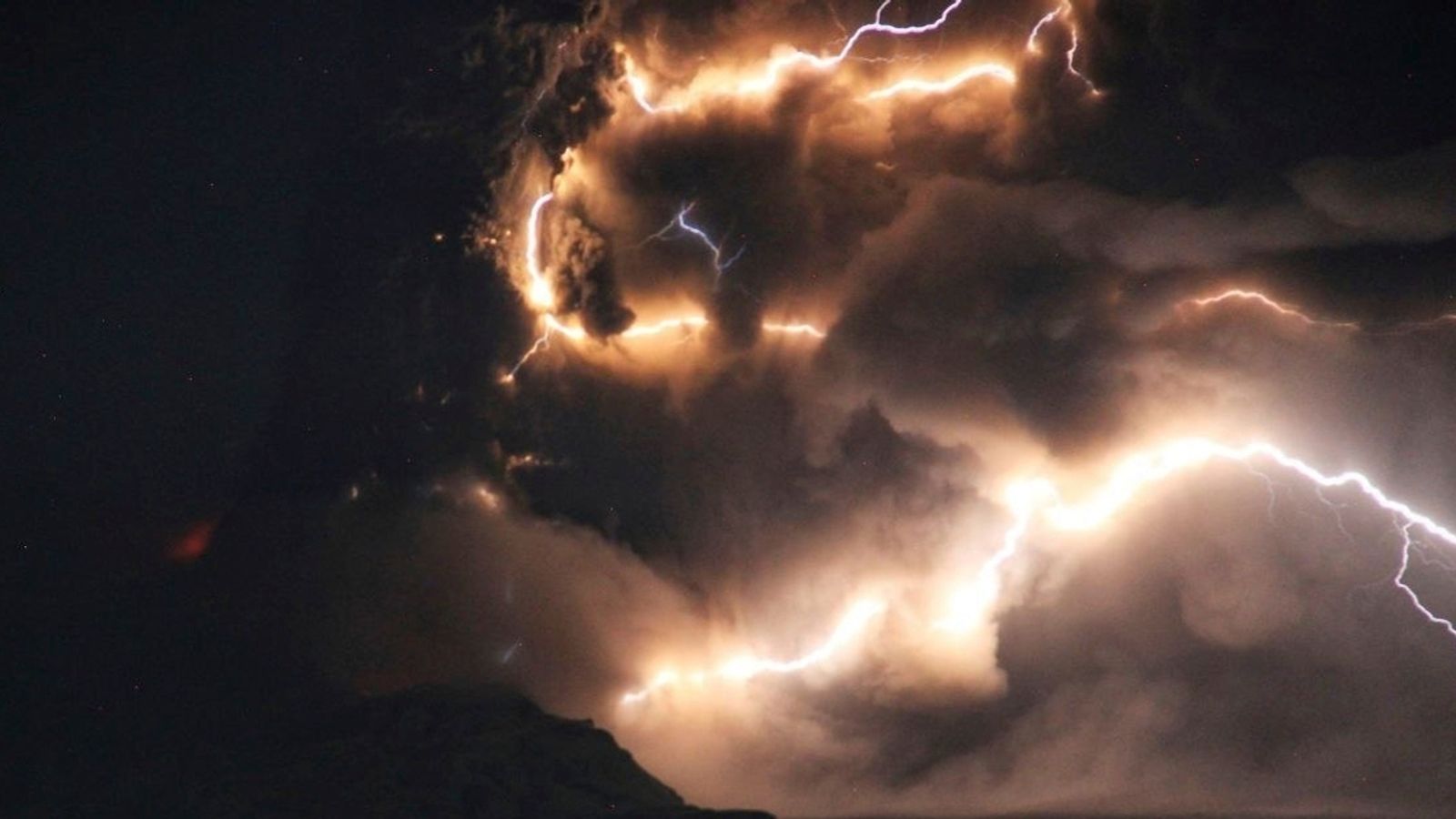
(Eurekalert) Video footage of Iceland’s 2010 Eyjafjallajökull eruption is providing researchers from the University of Cambridge with rare, up-close observations of volcanic ash clouds — information that could help better forecast how far explosive eruptions disperse their hazardous ash particles.
When Eyjafjallajökull erupted in 2010, it ejected roughly 250 million tonnes of volcanic ash into the atmosphere: much of which was blown over Europe and into flight paths. With planes grounded, millions of air passengers were left stranded.
Forecasts of how ash will spread in the aftermath of an explosive eruption can help reduce impacts to aviation by informing decisions to shut down areas of airspace. But these forecasts require knowledge of what is happening at the volcano, information that often can’t be obtained directly and must instead be estimated.
In the new study, the researchers split a 17-minute film into time segments to understand how the Eyjafjallajökull ash cloud grew upwards and outwards as the eruption ensued.
“No one has previously observed the shape and speed of wind-blown ash clouds directly,” said Professor Andy Woods, lead author of the study from Cambridge’s Department of Earth Sciences and Institute for Energy and Environmental Flows. Their new video analysis method was reported in Nature Communications Earth and Environment.
Satellite Data Could Warn Us Of Earthquakes Days in Advance
So-called earthquake precursors have been detected by European and Chinese satellites up to 19 days ahead of the actual event.
By Adrianna Nine June 17, 2024
https://www.extremetech.com/science/sat ... in-advance
Scientists have taken another step toward developing an early earthquake warning system. According to new research, satellites orbiting Earth are capable of spotting anomalies in the ground, atmosphere, and ionosphere that eventually give way to earthquakes. These anomalies, called earthquake precursors, have been detected by European and Chinese satellites up to 19 days ahead of disasters in the Mediterranean.
Following the 7.8-magnitude earthquake on the border between Turkey and Syria in 2023, Dr. Mehdi Akhoondzadeh, an associate professor of remote sensing at Iran's University of Tehran, wanted to see if operating satellites picked up on the event ahead of time. He pulled data from China's Zhangheng 1, NASA's Aqua and Aura satellites, and the European Space Agency's three-satellite Swarm mission, then compared it against earthquake data from the US Geological Survey (USGS). The goal was to see whether Earth betrayed any warning signs prior to the actual quake—signs that could be used to issue evacuation orders ahead of future tectonic events.
Major airport forced to close after Mount Etna volcanic eruption
6 hours ago
Flights serving the eastern Sicilian city of Catania in Italy were halted on Tuesday after an eruption from nearby Mount Etna, the airport operator said, bringing fresh travel woe during the peak summer tourist season.
Etna, one of the world’s most active volcanoes, has seen intense activity in recent days, spewing hot ash and lava.
The airport of Catania had already been closed earlier this month due to ash in the sky. It acts as a hub for the east of Sicily and attracts more arrivals than the capital Palermo.
The statement said that authorities had decided on “the suspension of all incoming and outgoing flights.”
“The suspension will result in cancellations and/or rerouting to other airports,” it added, saying normal operations would resume once the ash fallout had ended.
Hydrothermal explosion sends water, rocks flying at Yellowstone National Park's Biscuit Basin
Yellowstone tourists were sent running after a small hydrothermal explosion sent boiling water, steam and debris flying over a boardwalk in the national park's Biscuit Basin. The explosion, which occurred near Sapphire Pool just north of Old Faithful, destroyed the fence along the boardwalk.
Iceland’s Recent Volcanic Eruptions Driven by Pooling Magma are Set to Last Centuries into the Future by James Day
July 31, 2024
Introduction:
(The Conversation) To experience a volcanic eruption is to witness nature’s raw power. If you would like to see one for yourself, Iceland is a great location for it. Since 2021, seven eruptions have taken place along the Reykjanes Peninsula, close to Reykjavík.
These recent Icelandic eruptions have garnered attention from Earth scientists like me. The eruptions help us understand how volcanoes work in incredible detail. My team has been taking samples from the erupting lava from the Reykjanes Peninsula and finding some interesting results.
One of our findings suggests that magma from the first eruption pooled just under the island’s surface, where it built up the energy to spectacularly erupt. This initial burst of volcanism made it easier for more eruptions to follow after it.
Why is Iceland called the land of fire?
The island nation of Iceland is sometimes called “the land of ice and fire.” Early settlers witnessed several great “fires” – or volcanic eruptions – along the Reykjanes Peninsula.
After about 800 years without a volcanic event on the Reykjanes Peninsula, the Fagradalsfjall volcano roared to life on March 19, 2021. Then, two more discrete volcanic events occurred at Fagradalsfjall in 2022 and 2023. Subsequently, four more eruptions have taken place to the west at the Sundhnúkur fissure system in 2023 and 2024.
Magnitude 7.1 Quake Hits Southwestern Japan, Megaquake Fear Grows August 8, 2024
Introduction:
(Kyodo News) An earthquake with a magnitude of 7.1 hit southwestern Japan on Thursday and tsunami advisories were issued for the Pacific coast extending to the western part of the country, sparking concerns that a megaquake may occur in the near future.
The Japan Meteorological Agency issued an urgent advisory on the trench-type megaquake for the first time, warning the possibility of the quake happening along the Nankai Trough, stretching from off southwestern to central Japan, is relatively higher than usual.
In consideration of the advisory, Central Japan Railway Co. said it will run the Tokaido Shinkansen Line at a slower pace than usual for about one week, while suspending operations of some expresses in the western part of the nation.
The 4:43 p.m. quake occurred at a depth of around 30 kilometers off Miyazaki Prefecture and registered lower 6 on the Japanese seismic intensity scale of 7 in the city of Nichinan in the southern part of the prefecture, the weather agency said.
Shortly afterward, the agency began its first investigation into whether there is any link between the temblor and a potential Nankai Trough earthquake. The system has been in operation since 2017.
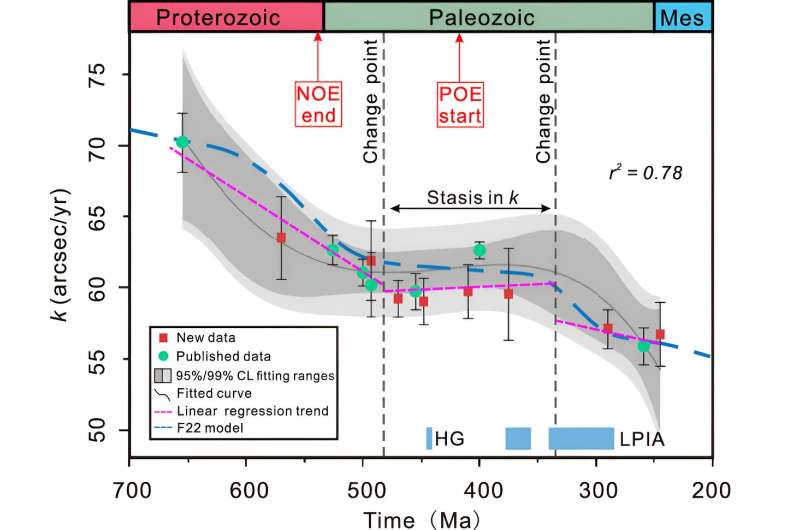
A multi-institutional team of geoscientists has found evidence that the Earth's rotation slows in a staircase pattern, with two stable periods that stand out. In their study, published in the Proceedings of the National Academy of Sciences, the group analyzed sediment sample data going back more than a half-billion years.
Prior research has shown Earth's axial spin is decreasing due mostly to tidal dissipation, but as the researchers with this new effort noted, the deceleration rate has not been consistently charted. In this effort, they attempted to achieve that by looking back 650 million years.
The researchers analyzed eight geological datasets compiled over many decades. These sedimentary archives offer not just geographic history, but evidence of the Earth's rotational history. The datasets covered the period from 280 to 650 million years ago.
The timeline reveals that it has not been a smooth deceleration; instead, Earth has experienced a series of slowdowns followed by stability, resulting in a staircase pattern. The researchers also found two notable stable periods, one that coincided with the Cambrian explosion, which led to a massive increase in wildlife diversity, and another that coincided with the largest known mass extinction. They suggest the periods following the two slowdowns may have been more than coincidental.
7.0-magnitude earthquake triggers Russian volcano eruption and ash cloud warning for aircraft
Sunday 18 August 2024 14:10, UK
One of Russia's most active volcanoes has erupted, spewing massive plumes of ash into the atmosphere and putting aircraft on alert.
It was triggered by a powerful 7.0 magnitude earthquake off the east coast of Russia's Kamchatka peninsula at 7.10am local time on Sunday (8.10pm UK time on Saturday), according to the US Geological Survey (USGS).
The quake struck at a depth of 18 miles (29km) and there were reports of "severe shaking" and "moderate to heavy damage" in the nearest city of Petropavlovsk-Kamchatsky, which has a population of more than 150,000 people.
According to the Kamchatka Volcanic Eruption Response Team (KVERT), aircraft have been issued a "red" code warning, the highest alert level, for a significant amount of ash in the atmosphere.
It describes explosions from the Shiveluch volcano, sending ash up three miles (5km) in the air, with the plume extending about 930 miles (1,500km) to the east-south-east.
An Innovative System for Seeing into the Bowels of Volcanos September 18, 2024
Introduction:
(Eurekalert) A team of researchers from the CNRS and the Paris Institute of Planetary Physics1 has developed an innovative imaging method that can probe the bowels of a volcano with unparalleled resolution and depth. This new method is based on the deployment of a network of geophones that capture not only the powerful shaking of earthquakes, but also the seismic noise caused by wind, the ocean, and human activity.
Their study was conducted on La Soufrière volcano in Guadeloupe, and provided a 3D view of its internal structure to a depth of 10 kilometres, with a precision on the order of 100 metres. It confirmed the existence, in the depths beneath La Soufrière, of a large magma storage zone structured by a network of interconnected magma pockets.This imaging tool can be applied to any geophone network and could record volcanic activity much more thoroughly, thereby providing greater anticipation of volcanic eruptions throughout the world.
The study recently appeared in the journal Communications, Earth & Environment.
Tongan Volcanic Eruption Triggered by Explosion as Big as ‘Five Underground Nuclear Bombs’ September 30, 2024
Introduction:
(Eurekalert) The Hunga Tonga underwater volcano was one of the largest volcanic eruptions in history, and now, two years later, new research from The Australian National University (ANU) has revealed its main trigger.
Until now, the cause of the cataclysmic event has remained largely a mystery to the scientific community, yet a student-led team of ANU seismologists has been able to shed new light on the natural explosion that initiated the event.
The student researchers analysed the climactic event’s noisy but valuable seismic records to decipher its mysterious physical mechanism.
“Our findings confirm there was an explosion, possibly due to a gas-compressed rock, which released energy that equated to five of the largest underground nuclear explosions conducted by North Korea in 2017,” study co-author and ANU PhD student, Jinyin Hu, said.
“Our model suggests the event resulted from the gas-compressed rock being trapped underneath a shallow sea, like an overcooked pressure cooker.
Indonesian Volcano Mount Lewotobi Laki Laki Erupts November 4, 2024
Introduction:
(CBS) Maumere, Indonesia — Indonesia's National Disaster Management Agency said Monday that at least 10 people had died as a series of volcanic eruptions widens on the remote island of Flores. The eruption at Mount Lewotobi Laki Laki around midnight spewed thick brownish ash as high as 6,500 feet into the air and hot ashes hit several villages, burning down houses including a convent of Catholic nuns, said Firman Yosef, an official at the Mount Lewotobi Laki Laki monitoring post.
Yosef said volcanic material was thrown up to 3.7 miles from the volcano's crater, blanketing nearby villages and towns with tons of volcanic debris and forcing residents to flee.
Rescuers were still searching for more bodies buried under collapsed houses, said Abdul Muhari, the National Disaster Management Agency's spokesperson. Muhari said all the bodies, including a child, were found with a 2.4-mile radius of the crater. He said at least 10,000 people had been affected by the eruption in six villages.
Colombian authorities reported on Monday that they are investigating a "possible eruption" of a mud volcano in the Necoclí region. The National Unit for Disaster Risk Management (UNGRD) reported on its X network account that emergency agencies are heading to the site to accompany departmental authorities to verify what happened.
Icelandic Volcano Erupts for the Seventh Time This Year
This volcano might have previously been dormant for 800 years, but clearly it's not ready to go back to bed.
By Adrianna Nine November 25, 2024
A volcano in Iceland has emerged from its centuries-long slumber with a series of "spectacular" eruptions. The most recent eruption, which peaked Thursday, is the seventh bout of activity the volcano has thrown at southwestern Iceland this year.
Known as Reykjanes for its position on the Reykjanes Peninsula, the volcano is classified as a rift activity volcano, which erupts when two diverging tectonic plates shift away from each other. The Reykjanes Peninsula is a part of the Mid-Atlantic Ridge, which consists of the North American and Eurasian tectonic plates. When these two plates move apart, magma rises from Earth's mantle to fill the gap, resulting in a fissure eruption. These eruptions are visible because of the Peninsula's elevation above sea level; in other regions, many fissure eruptions go unnoticed until they cause significant disturbances.
This Massive Underwater Mountain Range Was Made by a 'Moving' Hotspot December 3, 2024
Introduction:
(Science Alert) The Indian Ocean is home to a mountain range longer than the North American Rockies, and yet today, all 5,000 kilometers (3,107 miles) of it are hidden under the sea.
A new study delves deep beneath the waves to show how the Ninetyeast Ridge was formed between 43 and 83 million years ago – and its origins are quite the surprise.
Seamounts are underwater volcanoes found in every single ocean. They are caused by 'hotspots' beneath Earth's surface, in which gathering heat melts away the mantle, releasing hot plumes in a pipe-like upwelling.
At first, scientists did not think hotspots could move, so a trail of volcanoes underwater was thought to result from tectonic plates sliding over the top of a stationary hotspot. Think of it like an upside-down sewing machine, with a stationary 'needle' of hot material piercing a cloth sliding above it, stitching a line.
As it turns out, the Indian Ocean's submerged volcanic chain was formed in a different way. The hotspot in this case is better imagined as a fountain pen, with the moving 'tip' depositing liquid magma across the surface of the Earth.