Space News and Discussions

Re: Space News and Discussions
Northern Lights captured glowing over Europe
4 hours ago
The Northern Lights, also known as aurora borealis, have been seen lighting up the night sky over Europe.
Time-lapse videos posted on social media show swirls of green, pink and scarlet moving across the sky.
They became visible after one of the strongest geomagnetic storms for years hit Earth, with the US National Oceanic and Atmospheric Administration (NOAA) issuing a rare solar storm warning.
The lights are caused by charged particles from the sun hitting gases in the Earth's atmosphere.
https://www.bbc.co.uk/news/av/uk-68994265
4 hours ago
The Northern Lights, also known as aurora borealis, have been seen lighting up the night sky over Europe.
Time-lapse videos posted on social media show swirls of green, pink and scarlet moving across the sky.
They became visible after one of the strongest geomagnetic storms for years hit Earth, with the US National Oceanic and Atmospheric Administration (NOAA) issuing a rare solar storm warning.
The lights are caused by charged particles from the sun hitting gases in the Earth's atmosphere.
https://www.bbc.co.uk/news/av/uk-68994265
-
weatheriscool
- Posts: 25212
- Joined: Sun May 16, 2021 6:16 pm
- Contact:
Re: Space News and Discussions
Relativity Space Tests the Aeon R Rocket Engine
May 10, 2024 by Brian Wang
May 10, 2024 by Brian Wang
https://www.nextbigfuture.com/2024/05/r ... ngine.html
Relativity Space is a private space company that is developing 3D printed rockets, artificial intelligence, and autonomous robotics. They have raised about $1.34 billion and have a valuation of about $5 billion.
Advertisement
They plan to launch the Terran R from Launch Complex 16 at Cape Canaveral Space Force Base starting in 2026.
It is a SpaceX Falcon 9 class rocket. They also plan to reuse the first stage.
-
Time_Traveller

- Posts: 3025
- Joined: Sun May 16, 2021 4:49 pm
- Location: New York City, USA, November 5th 2032 C.E.
Re: Space News and Discussions
NASA's PREFIRE mission is ready to unlock the mysteries of Earth's poles
https://www.space.com/nasa-prefire-pola ... e-cubesatspublished yesterday
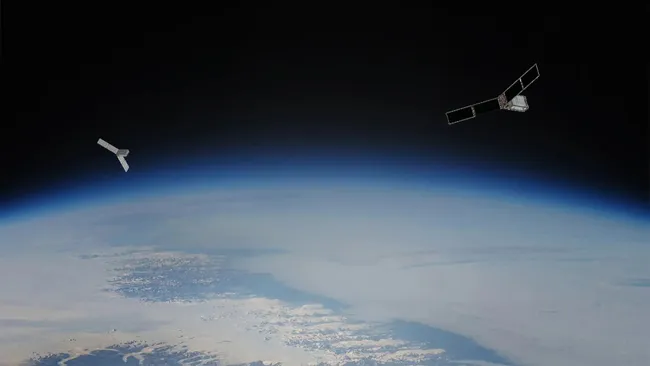
NASA is preparing to launch its latest climate science mission, the Polar Radiant Energy in the Far-Infrared Experiment (PREFIRE), which aims to capture brand new data on how heat is lost to space from Earth's polar regions.
PREFIRE consists of a pair of cubesats that will launch separately into near-polar orbits. The first, "Ready, Aim, PREFIRE," is set to launch no earlier than (NET) May 22, on a Rocket Lab Electron rocket from Pad B at the company's Launch Complex 1, in Māhia, New Zealand. The second cubesat, "PREFIRE and ICE," will launch a few days later.
The pair are designed to measure far-infrared radiation — wavelengths longer than 15 microns — that account for about 60 percent of the total heat lost at the poles. "We've never measured that before," said PREFIRE Principle Investigator at the University of Wisconsin-Madison Tristan L'Ecuyer during a May 15 call with reporters. L'Ecuyer says PREFIRE will help scientists study how different properties at the poles, such as clouds, humidity and the fluctuation of the surface between frozen and liquid states, contribute to the dissipation of heat lost to space.
The Arctic is warming faster than anywhere else on Earth, leading to paradigm shifts for local populations and wildlife habitats at the poles, as well as global ramifications such as rising sea levels. "Ultimately, [PREFIRE] information is going to be combined with our climate models and hopefully we'll be able to improve our ability to simulate what sea level rise might look like in the future, and also how the polar climate change is going to affect the weather systems around the planet," L'Ecuyer said.
The PREFIRE cubesats are each about the size of a loaf of bread, and contain identical thermal infrared spectrometers. Though small, their cost-effective design and singular purpose fit nicely into NASA's growing matrix of climate research missions, such as the much larger SWOT satellite (Surface Water and Ocean Topography) for studying water levels across the entire planet. "NASA needs both our large missions and these smaller missions," said Karen St. Germain, NASA's Earth Science Division director at the agency's headquarters. "You can think of them in some ways as generalists versus specialists to answer this full range of questions we have about understanding the Earth as a system."
“In the quantum multiverse, every choice, every decision you've ever and never made exists in an unimaginably vast ensemble of parallel universes.”
-
weatheriscool
- Posts: 25212
- Joined: Sun May 16, 2021 6:16 pm
- Contact:
Re: Space News and Discussions
World's first commercial spaceplane in final stages before debut ISS flight
By Bronwyn Thompson
May 20, 2024
By Bronwyn Thompson
May 20, 2024
https://newatlas.com/space/dream-chaser-spaceplane-iss/
The world's first winged commercial spaceplane has arrived at NASA’s Kennedy Space Center in Florida, its final destination before its first mission to the International Space Station (ISS) later this year.
Following rigorous testing at Ohio's Neil Armstrong Test Facility, the Dream Chaser DC-100 spaceplane named Tenacity got the green light to commence final pre-launch preparations, such as finishing its thermal protection system and payload integration, before it hitches a ride on a United Launch Alliance (ULA) Vulcan rocket to deliver 7,800 pounds (3,540 kg) of food, water and science experiments to the ISS.
-
firestar464
- Posts: 7705
- Joined: Wed Oct 12, 2022 7:45 am
Re: Space News and Discussions
Boeing’s first crewed Starliner launch pushed back again, next possible opportunity ‘still being discussed’
https://www.marketwatch.com/story/boein ... d-07b1a421
Common Boeing L
https://www.marketwatch.com/story/boein ... d-07b1a421
Common Boeing L
-
weatheriscool
- Posts: 25212
- Joined: Sun May 16, 2021 6:16 pm
- Contact:
Re: Space News and Discussions
Scientists discover CO₂ and CO ices in outskirts of solar system
https://phys.org/news/2024-05-scientist ... solar.html
by Eddy Duryea, University of Central Florida
https://phys.org/news/2024-05-scientist ... solar.html
by Eddy Duryea, University of Central Florida
For the first time, carbon dioxide and carbon monoxide ices have been observed in the far reaches of our solar system on trans-Neptunian objects (TNOs).
A research team, led by planetary scientists Mário Nascimento De Prá and Noemí Pinilla-Alonso from the University of Central Florida's Florida Space Institute (FSI), made the findings by using the infrared spectral capabilities of the James Webb Space Telescope (JWST) to analyze the chemical composition of 59 trans-Neptunian objects and Centaurs.
The pioneering study, published this week in Nature Astronomy, suggests that carbon dioxide ice was abundant in the cold outer regions of the protoplanetary disk, the vast rotating disk of gas and dust from which the solar system formed. Further investigation is needed to understand the carbon monoxide ice's origins, as it is also prevalent on the TNOs in the study.
-
weatheriscool
- Posts: 25212
- Joined: Sun May 16, 2021 6:16 pm
- Contact:
-
weatheriscool
- Posts: 25212
- Joined: Sun May 16, 2021 6:16 pm
- Contact:
-
firestar464
- Posts: 7705
- Joined: Wed Oct 12, 2022 7:45 am
Re: Space News and Discussions
FALSE ALARM
Re: Space News and Discussions
Voyager 1 makes stellar comeback to science operations
Fri 14 Jun 2024
NASA's Voyager 1 spacecraft is back in action and conducting normal science operations for the first time since the veteran probe began spouting gibberish at the end of 2023.
All four of the spacecraft's remaining operational instruments are now returning usable data to Earth, according to NASA.
https://www.theregister.com/2024/06/14/ ... _restored/
Fri 14 Jun 2024
NASA's Voyager 1 spacecraft is back in action and conducting normal science operations for the first time since the veteran probe began spouting gibberish at the end of 2023.
All four of the spacecraft's remaining operational instruments are now returning usable data to Earth, according to NASA.
https://www.theregister.com/2024/06/14/ ... _restored/
-
weatheriscool
- Posts: 25212
- Joined: Sun May 16, 2021 6:16 pm
- Contact:
-
weatheriscool
- Posts: 25212
- Joined: Sun May 16, 2021 6:16 pm
- Contact:
-
weatheriscool
- Posts: 25212
- Joined: Sun May 16, 2021 6:16 pm
- Contact:
Re: Space News and Discussions
China's reusable rocket successfully reaches altitude of 7.5 miles
By David Szondy
June 25, 2024
https://newatlas.com/space/chinas-reusa ... 7-5-miles/
By David Szondy
June 25, 2024
https://newatlas.com/space/chinas-reusa ... 7-5-miles/
Playing catch-up with the likes of SpaceX, China has announced the successful test flight and landing of a reusable rocket. On June 23, 2024, the liquid-fueled launcher rose to a height of 7.5 miles (12 km) from the Jiuquan Satellite Launch Center.
Vertical landing rockets have been around since the Apollo days, but it's only in the last decade that companies like SpaceX and Blue Origin have turned them into a game changer. By recovering a booster intact instead of crashing into the ocean, a very large part of launch costs can be saved. It also allows for economies of scale to be introduced through the ability to expand an existing rocket fleet as well as developing revenue-generating communication services based on gigantic satellite constellations.
Because SpaceX has focused on pouring profits from launch services back into development, the economic impact of increasingly large reusable rockets has still not been fully felt. Some financial analysts have said that if the company were to concentrate on launches, its current cost of about US$1,000/kg would drop much further.

-
weatheriscool
- Posts: 25212
- Joined: Sun May 16, 2021 6:16 pm
- Contact:
Re: Space News and Discussions
How to watch the maiden flight of the Ariane 6 heavy lift rocket
By David Szondy
July 07, 2024
By David Szondy
July 07, 2024
Europe will be back in the heavy lift rocket business on July 9, 2024 when the Ariane 6 lifts off on its maiden flight carrying almost a dozen satellites and experiments. The launch window at Kourou, French Guiana opens at 2:00 pm EDT. Here's how to watch.
https://newatlas.com/space/how-to-watch ... -6-rocket/
ESA has been looking forward to the launch of Ariane 6 for quite a long time. First conceived as a replacement for its workhorse Ariane 5 about 15 years ago, it was supposed to fly in 2020, but today it remains on the ground even though Ariane 5 retired a year ago.
That's scheduled to change on Tuesday when the first Ariane 6 is scheduled to take off from equatorial South America. Expected to last two hours, 51 minus, and 40 seconds, the flight has a crowded checklist. Not only is it intended to show that Ariane 6 can fly, it will also demonstrate the ability of the second stage to refire up to four times. The purpose of this is to place different payloads in different orbits and to reduce space debris by ensuring that the stage can be made to either reenter the Earth's atmosphere to burn up or boost into a graveyard orbit set aside for defunct spacecraft.
-
weatheriscool
- Posts: 25212
- Joined: Sun May 16, 2021 6:16 pm
- Contact:
Re: Space News and Discussions
Europe's new Ariane 6 rocket blasts off for first time
https://phys.org/news/2024-07-europe-ar ... lasts.html
by Mathieu Rabechault with Daniel Lawler in Paris
Europe's Ariane 6 rocket ahead of blastoff in French Guiana.
https://phys.org/news/2024-07-europe-ar ... lasts.html
by Mathieu Rabechault with Daniel Lawler in Paris
Europe's Ariane 6 rocket ahead of blastoff in French Guiana.
Europe's new Ariane 6 rocket blasted off for the first time smoothly on Tuesday, carrying with it the continent's hopes of regaining independent access to space.
The much-delayed inaugural flight of the European Space Agency's most powerful rocket yet launched from Europe's spaceport in Kourou, French Guiana at 4pm local time (1900 GMT).
Crews on the ground at the launch site, which is surrounded by jungle on the South American coast, applauded as the rocket soared into clear skies.
Ariane 6's first launch, which was originally planned for 2020, is hoped to bring an end to a difficult time for European space efforts.
Since the last flight of its workhorse predecessor, Ariane 5, a year ago, Europe has been unable to launch satellites or other missions into space without relying on rivals such as Elon Musk's US firm SpaceX.
-
weatheriscool
- Posts: 25212
- Joined: Sun May 16, 2021 6:16 pm
- Contact:
-
Time_Traveller
- Posts: 3025
- Joined: Sun May 16, 2021 4:49 pm
- Location: New York City, USA, November 5th 2032 C.E.
Re: Space News and Discussions
Northern Lights to stretch to UK and US tonight after huge solar storm
https://www.independent.co.uk/space/nor ... 84998.html8 hours ago
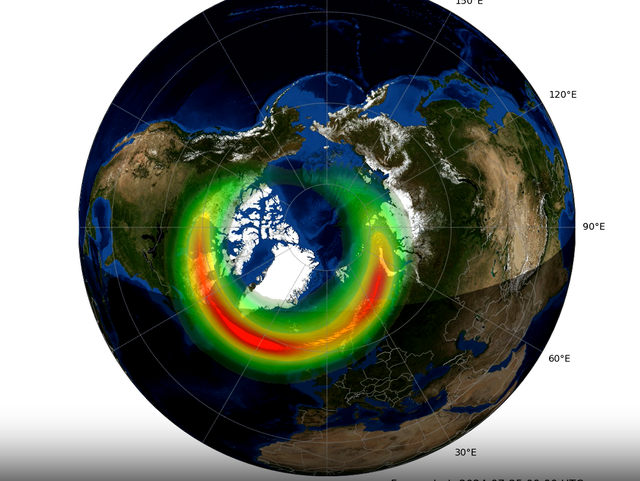
The northern lights will stretch as far south as England on Wednesday night, according to the UK Met Office’s latest forecast, as a major geomagnetic storm hits the Earth.
A plume of plasma released by the Sun, known as a coronal mass ejection (CME), will see the aurora borealis appear across the US, with astronomers predicting they could be seen from New York and other northerly US states.
The Met Office’s Space Weather forecast stated that the celestial display is expected to last from Tuesday night until midnight on Wednesday, however conditions across many parts of the UK may not be ideal.
“A coronal mass ejection is likely to arrive early on 24 July, giving a peak chance of Strong Geomagnetic Storm (G3) conditions,” the forecast stated.
“This may result in auroral displays down to Northern Ireland, northern England and similar geomagnetic latitudes, albeit impeded by the near-full moon and limited hours of darkness.”
“In the quantum multiverse, every choice, every decision you've ever and never made exists in an unimaginably vast ensemble of parallel universes.”