Exoplanets – worlds of other suns

weatheriscool
Posts: 24495
Joined: Sun May 16, 2021 6:16 pm
Contact:

Re: Exoplanets – worlds of other suns

Post by weatheriscool »

Astronomers discover an Earth-sized exoplanet orbiting a nearby ultracool dwarf star
https://phys.org/news/2024-06-astronome ... iting.html
by Tomasz Nowakowski , Phys.org

An international team of astronomers reports the discovery of a new Earth-sized exoplanet that orbits an ultracool dwarf star located just 54.6 light years away. The newfound alien world, designated SPECULOOS-3 b, is slightly smaller but much hotter than our planet. The finding was reported in a paper published May 15 in the journal Nature Astronomy.

The Search for Planets EClipsing ULtra-cOOl Stars (SPECULOOS) project aims to find potentially habitable exoplanets around some of the smallest and coldest stars of the solar neighborhood. It employs a network of six robotic 1-m-aperture telescopes: the four telescopes of the SPECULOOS-South Observatory (SSO) in Chile, Artemis, the first telescope of the SPECULOOS-North Observatory (SNO) in Tenerife, and the SAINT-EX telescope in San Pedro Martir Observatory in Mexico.
weatheriscool
Posts: 24495
Joined: Sun May 16, 2021 6:16 pm
Contact:

Re: Exoplanets – worlds of other suns

Post by weatheriscool »

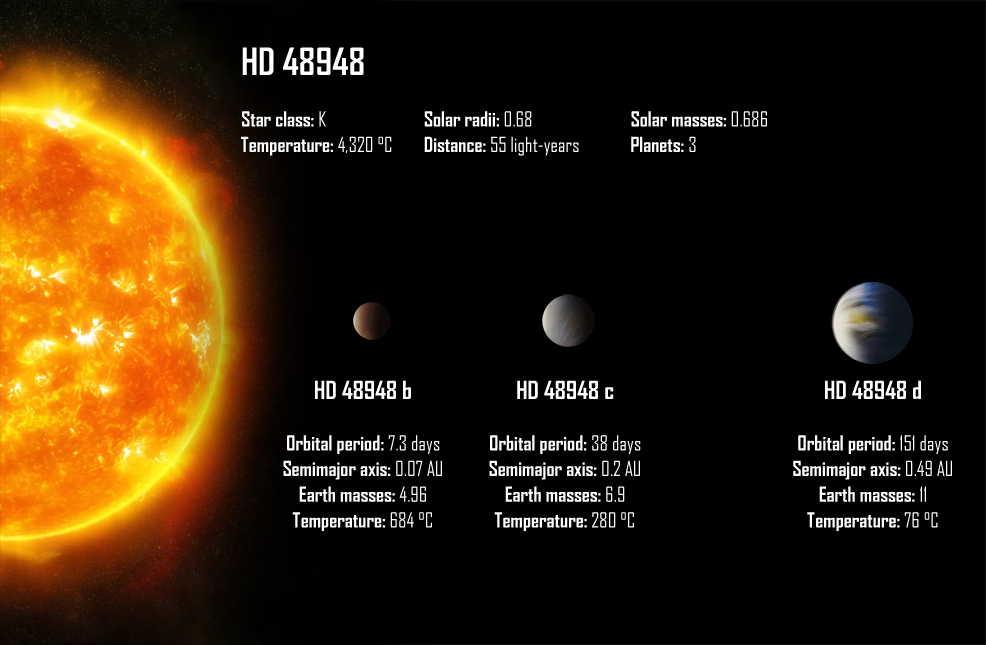
Trio of super-Earth candidates orbiting K-dwarf HD 48948: a new habitable zone candidate.

https://doi.org/10.1093/mnras/stae1367
User avatar
wjfox
Site Admin
Posts: 13587
Joined: Sat May 15, 2021 6:09 pm
Location: Essex, UK
Contact:

Re: Exoplanets – worlds of other suns

Post by wjfox »

weatheriscool wrote: Fri Jun 28, 2024 11:52 pm Trio of super-Earth candidates orbiting K-dwarf HD 48948: a new habitable zone candidate.

https://doi.org/10.1093/mnras/stae1367

More on this here:

https://www.futuretimeline.net/blog/202 ... meline.htm


Image
User avatar
Time_Traveller
Posts: 3025
Joined: Sun May 16, 2021 4:49 pm
Location: New York City, USA, November 5th 2032 C.E.

Re: Exoplanets – worlds of other suns

Post by Time_Traveller »

Extreme 'hot Jupiter' exoplanet stinks like rotten eggs and has raging glass storms
Image

2 hours ago

Using the James Webb Space Telescope (JWST), astronomers have discovered that one of the closest "hot Jupiter" planets to Earth stinks like rotten eggs. The planet is already infamous for its deadly rains of glass, extreme temperatures, and 5,000 mph (8,046 kph) winds that blow sideways, but this discovery makes this world seem even less friendly.

The eggy JWST conclusion results from the discovery of hydrogen sulfide, a molecule that gives off the stench of rotten eggs, in the atmosphere of this extrasolar planet or "exoplanet."

This could tell scientists how the atmospheres of giant gas planets can be influenced by the presence of sulfur, which is considered an important element in the formation of planets.

The exoplanet in question is HD 189733 b, a planet that is around 1.13 times the size and mass of Jupiter. The planet, discovered in 2005, is located around 65 light years from Earth in the constellation Vulpecula.

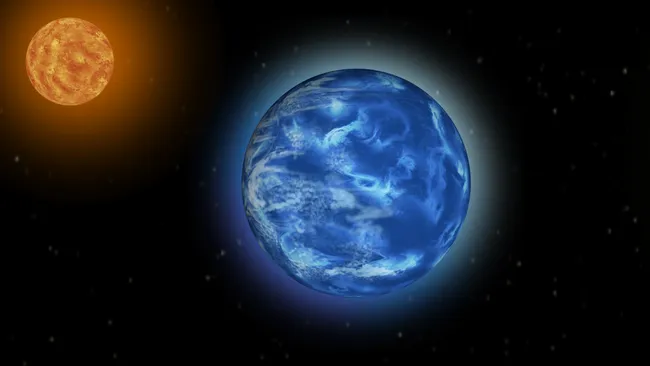
HD 189733 b orbits its star at a distance of around 3 million miles (4.8 million km), or about 3% of the distance between Earth and the sun. Its hot atmosphere and glass-laced clouds give it a deceptive, almost placid, blue-and-white marble appearance.
https://www.space.com/james-webb-space- ... otten-eggs
“In the quantum multiverse, every choice, every decision you've ever and never made exists in an unimaginably vast ensemble of parallel universes.”
weatheriscool
Posts: 24495
Joined: Sun May 16, 2021 6:16 pm
Contact:

Re: Exoplanets – worlds of other suns

Post by weatheriscool »

Astronomers find surprising ice world in the habitable zone with JWST data
https://phys.org/news/2024-07-astronome ... -zone.html
by Nathalie Ouellette, University of Montreal
A team of astronomers has identified a temperate exoplanet as a promising super-Earth ice or water world.

The findings, led by Université de Montréal, show that the habitable zone exoplanet, LHS 1140 b, is not likely a mini-Neptune, a small so-called gas giant—large planets composed mostly of gas—with a thick hydrogen-rich atmosphere. The planet, located about 48 light-years away in the constellation Cetus, emerges as one of the most promising habitable zone exoplanet candidates known, potentially harboring an atmosphere and even a liquid water ocean.

Data from the James Webb Space Telescope (JWST) were collected in December 2023 and added to previous data from other space telescopes Spitzer, Hubble, and TESS to solidify this result, accepted for publication in The Astrophysical Journal Letters this week and currently available on the arXiv preprint server.
weatheriscool
Posts: 24495
Joined: Sun May 16, 2021 6:16 pm
Contact:

Re: Exoplanets – worlds of other suns

Post by weatheriscool »

Nearby exoplanet has trace amounts of hydrogen sulfide, Webb data suggest
https://phys.org/news/2024-07-nearby-ex ... lfide.html
by Johns Hopkins University

An exoplanet infamous for its deadly weather has been hiding another bizarre feature—it reeks of rotten eggs, according to a new Johns Hopkins University study of data from the James Webb Space Telescope.

The atmosphere of HD 189733 b, a Jupiter-sized gas giant, has trace amounts of hydrogen sulfide, a molecule that not only gives off a stench but also offers scientists new clues about how sulfur, a building block of planets, might influence the insides and atmospheres of gas worlds beyond the solar system.
weatheriscool
Posts: 24495
Joined: Sun May 16, 2021 6:16 pm
Contact:

Re: Exoplanets – worlds of other suns

Post by weatheriscool »


A Nearby Exoplanet May Have a Liquid Water Ocean
A new Webb observation makes LHS 1140 b an ideal place to search for signs of life.
By Ryan Whitwam July 9, 2024

https://www.extremetech.com/science/a-n ... ater-ocean
The exoplanet LHS 1140 b has been an enticing object for astronomers ever since it was discovered in 2017. That's mainly thanks to its location, a mere 48 light-years away. That makes it one of the closest potentially habitable worlds, and interest may be about to skyrocket. A new observation with the James Webb Space Telescope suggests LHS 1140 b may not be a gas giant as previously thought. Instead, it could be an icy or watery world with a thick atmosphere. If that's the case, it would also be an ideal place to search for life.
weatheriscool
Posts: 24495
Joined: Sun May 16, 2021 6:16 pm
Contact:

Re: Exoplanets – worlds of other suns

Post by weatheriscool »

New ultra-hot Neptune-sized exoplanet discovered
https://phys.org/news/2024-07-ultra-hot ... lanet.html
by Tomasz Nowakowski , Phys.org
Image
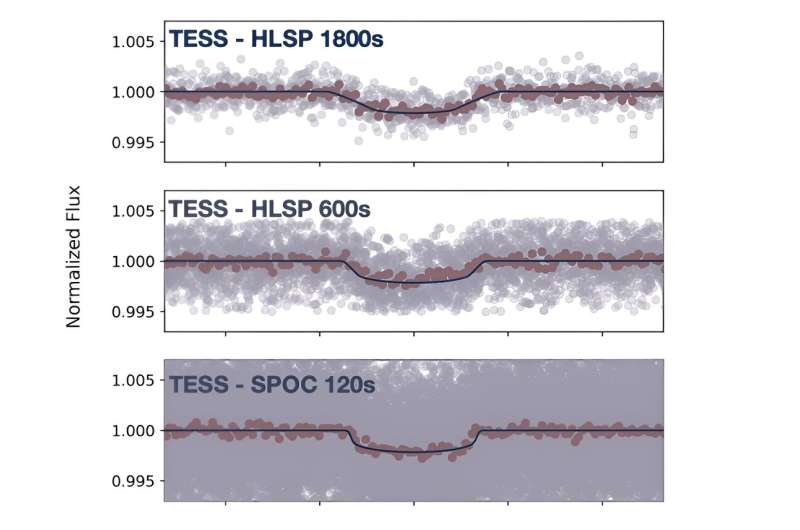
Using NASA's Transiting Exoplanet Survey Satellite (TESS), an international team of astronomers has detected a new exoplanet. The newfound alien world, designated TOI-3261b, is nearly the size of Neptune and its equilibrium temperature exceeds 1,700 K. The finding was reported in a research paper published July 5 on the pre-print server arXiv.

To date, TESS has identified more than 7,200 candidate exoplanets (TESS Objects of Interest, or TOI), of which 482 have been confirmed. Since its launch in April 2018, the satellite has been conducting a survey of about 200,000 of the brightest stars near the sun with the aim of searching for transiting exoplanets—ranging from small, rocky worlds to gaseous giants.
User avatar
caltrek
Posts: 9280
Joined: Mon May 17, 2021 1:17 pm

Re: Exoplanets – worlds of other suns

Post by caltrek »

WIYN 3.5-meter telescope at Kitt Peak Discovers Extremely Strange Orbit of Rare Hot Jupiter Exoplanet
July 17, 2024

Introduction:
(Eurekalert) At present there are over 5600 confirmed exoplanets in just over 4000 star systems. Within this population, about 300–500 exoplanets fall into the curious class known as hot Jupiters — large, Jupiter-like exoplanets that orbit very close to their star, some even as close as Mercury is to our Sun. How hot Jupiters end up in such close orbits is a mystery, but astronomers postulate that they begin in orbits far from their star and then migrate inward over time. The early stages of this process have rarely been observed, but with this new analysis of an exoplanet with an unusual orbit, astronomers are one step closer to unraveling the hot Jupiter mystery.

The discovery of this exoplanet, named TIC 241249530 b, originated with the detection by NASA’s Transiting Exoplanet Survey Satellite (TESS) in January 2020 of a dip in a star’s brightness consistent with a single Jupiter-sized planet passing in front of, or transiting, it. To confirm the nature of these fluctuations and eliminate other possible causes, a team of astronomers used two instruments on the WIYN 3.5-meter Telescope at the U.S. National Science Foundation Kitt Peak National Observatory (KPNO), a Program of NSF NOIRLab.

The team first utilized the NASA-funded NN-EXPLORE Exoplanet and Stellar Speckle Imager (NESSI) in a technique that helps to ‘freeze out’ atmospheric twinkling and eliminate any extraneous sources that might confuse the signal’s source. Then, using the NASA-funded NEID spectrograph, the team measured the radial velocity of TIC 241249530 b by carefully observing how its host star’s spectrum, or wavelengths of its emitted light, shifted as a result of the exoplanet orbiting it.

Arvind Gupta, NOIRLab postdoctoral researcher and lead author of the paper published in Nature, praised NESSI and NEID as being critical to the team’s efforts to characterize and confirm the exoplanet’s signal. “NESSI gave us a sharper view of the star than would have been possible otherwise, and NEID precisely measured the star’s spectrum to detect shifts in response to the orbiting exoplanet,” explained Gupta. Gupta particularly noted the unique flexibility of NEID’s observation-scheduling framework as it allows for swift adaptation of the team’s observing plan in response to new data.
Read more here: https://www.eurekalert.org/news-releases/1051262

For a technical presentation of study results as published in Nature: https://www.nature.com/articles/s41586-024-07688-3
Don't mourn, organize.

-Joe Hill

User avatar
caltrek
Posts: 9280
Joined: Mon May 17, 2021 1:17 pm

Re: Exoplanets – worlds of other suns

Post by caltrek »

The question occurred to me: is there a catalog of exoplanets available online?

Here it is:

https://exoplanet.eu/catalog/

Note the "Apply Filter" feature.
Don't mourn, organize.

-Joe Hill
weatheriscool
Posts: 24495
Joined: Sun May 16, 2021 6:16 pm
Contact:

Re: Exoplanets – worlds of other suns

Post by weatheriscool »

weatheriscool
Posts: 24495
Joined: Sun May 16, 2021 6:16 pm
Contact:

Re: Exoplanets – worlds of other suns

Post by weatheriscool »

A transiting multi-planet system in the 61 million year old association Theia 116

https://arxiv.org/abs/2407.19680
weatheriscool
Posts: 24495
Joined: Sun May 16, 2021 6:16 pm
Contact:

Re: Exoplanets – worlds of other suns

Post by weatheriscool »

Additional planet orbiting the star TOI-1408 discovered
https://phys.org/news/2024-07-additiona ... r-toi.html
by Tomasz Nowakowski , Phys.org
Using NASA's Transiting Exoplanet Survey Satellite, an international team of astronomers has detected a second planet orbiting a distant main sequence star known as TOI-1408. The newfound alien world, designated TOI-1408 c, is about two times larger and nearly eight times more massive than the Earth. The finding was reported in a research paper published July 25 on the pre-print server arXiv.

To date, TESS has identified more than 7,200 candidate exoplanets (TESS Objects of Interest, or TOI), of which 543 have been confirmed. Since its launch in April 2018, the satellite has been conducting a survey of about 200,000 of the brightest stars near the sun with the aim of searching for transiting exoplanets—ranging from small, rocky worlds to gaseous giants.

TOI-1408 is a main sequence star of spectral type F8V, located some 453 light years away. It is about 50% larger and 30% more massive than the sun. The star is estimated to be 2.7 billion years old, has an effective temperature of 6,117 K and its metallicity is at a level of 0.25 dex.
weatheriscool
Posts: 24495
Joined: Sun May 16, 2021 6:16 pm
Contact:

Re: Exoplanets – worlds of other suns

Post by weatheriscool »

TESS discovery of two super-Earths orbiting the M-dwarf stars TOI-6002 and TOI-5713 near the radius valley

https://arxiv.org/abs/2408.00709
User avatar
wjfox
Site Admin
Posts: 13587
Joined: Sat May 15, 2021 6:09 pm
Location: Essex, UK
Contact:

Re: Exoplanets – worlds of other suns

Post by wjfox »

Hellish conditions have warped an Earth-like planet into an egg

Planets that orbit close to their parent stars are blasted with radiation and contorted by gravity – and the exoplanet TOI-6255b might be the most extreme example yet

By Alex Wilkins
15 August 2024

A distant Earth-sized planet is orbiting so close to its parent star that gravity is stretching it to an extreme degree, turning it egg-shaped.

A handful of known exoplanets are extremely close to their parent stars, which exposes them to incredibly harsh conditions. These “ultra-short period” planets – they take less than a day to complete one loop around their stars – are blasted with radiation and often have surfaces composed entirely of lava.

https://www.newscientist.com/article/24 ... to-an-egg/
weatheriscool
Posts: 24495
Joined: Sun May 16, 2021 6:16 pm
Contact:

Re: Exoplanets – worlds of other suns

Post by weatheriscool »

In six new rogue worlds, Webb Telescope finds more star birth clues
https://phys.org/news/2024-08-rogue-wor ... -star.html
by Johns Hopkins University
The James Webb Space Telescope has spotted six likely rogue worlds—objects with planetlike masses but untethered from any star's gravity—including the lightest ever identified with a dusty disk around it.

The elusive objects offer new evidence that the same cosmic processes that give birth to stars may also play a common role in making objects only slightly bigger than Jupiter.

"We are probing the very limits of the star forming process," said lead author Adam Langeveld, an astrophysicist at Johns Hopkins University. "If you have an object that looks like a young Jupiter, is it possible that it could have become a star under the right conditions? This is important context for understanding both star and planet formation."
weatheriscool
Posts: 24495
Joined: Sun May 16, 2021 6:16 pm
Contact:

Re: Exoplanets – worlds of other suns

Post by weatheriscool »

An Earth-Mass Planet and a Brown Dwarf in Orbit Around a White Dwarf

https://arxiv.org/abs/2409.02157
Terrestrial planets born beyond 1-3 AU have been theorized to avoid being engulfed during the red-giant phases of their host stars. Nevertheless, only a few gas-giant planets have been observed around white dwarfs (WDs) -- the end product left behind by a red giant. Here we report on evidence that the lens system that produced the microlensing event KMT-2020-BLG-0414 is composed of a WD orbited by an Earth-mass planet and a brown dwarf (BD) companion, as shown by the non-detection of the lens flux using Keck Adaptive Optics (AO). From microlensing orbital motion constraints, we determine the planet to be a 1.9±0.2 Earth-mass (M⊕) planet at a physical separation of 2.1±0.2 au from the WD during the event. By considering the system evolutionary history, we determine the BD companion to have a projected separation of 22 au from the WD, and reject an alternative model that places the BD at 0.2 au. Given planetary orbital expansion during the final evolutionary stages of the host star, this Earth-mass planet may have existed in an initial orbit close to 1 au, thereby offering a glimpse into the possible survival of planet Earth in the distant future.
weatheriscool
Posts: 24495
Joined: Sun May 16, 2021 6:16 pm
Contact:

Re: Exoplanets – worlds of other suns

Post by weatheriscool »

Astronomers discover iron winds on an ultra-hot exoplanet
https://phys.org/news/2024-09-astronome ... lanet.html
by University of Geneva
An international team of astronomers, including scientists from the University of Geneva (UNIGE) and the PlanetS National Center of Competence in Research, has identified the presence of iron winds in the atmosphere of the ultra-hot Jupiter WASP-76 b.

This planet with its extreme conditions—over 2,000 degrees Celsius—is a prime target for researchers, who for several years have been dissecting the slightest physical mechanisms at work in its atmosphere. The presence of a ''rainbow'' was detected there last April, for example.

The discovery of iron winds sweeping across the day side of the planet offers new insight into the complex climatic dynamics of this distant world. These results can be found in the journal Astronomy & Astrophysics.
weatheriscool
Posts: 24495
Joined: Sun May 16, 2021 6:16 pm
Contact:

Re: Exoplanets – worlds of other suns

Post by weatheriscool »

it’s over 9,000 +Candidates for Gaia!!

Searching for substellar companion candidates with Gaia. II. A catalog of 9,698 planet candidate solar-type hosts
https://arxiv.org/abs/2409.16993
There are also significant clues of something lurking in Sirius B...
weatheriscool
Posts: 24495
Joined: Sun May 16, 2021 6:16 pm
Contact:

Re: Exoplanets – worlds of other suns

Post by weatheriscool »

Astronomers Find Earth-Like Exoplanet Orbiting Dead Star
Could Earth survive the Sun's death, too?
By Ryan Whitwam September 27, 2024
The Earth of today is a lush garden that supports countless living organisms, but give it a few billion years, and Earth will be swallowed up by the Sun. Or maybe not. Astronomers have discovered an Earth-like world 4,000 light-years away that shows another way forward. This world remains intact, orbiting an ancient white dwarf that was probably very much like the Sun at one point.

A white dwarf is a stellar remnant. After a Sun-like star expends its nuclear fuel, it loses its outer layers leaving a dim clump of matter. On the way to becoming a white dwarf, stars go through a red giant phase, during which their atmosphere swells and consumes any nearby planets. This assumption has been challenged by the study of a gravitational lensing event.
https://www.extremetech.com/science/ast ... -dead-star
Post Reply