Exploration of the gas giants

weatheriscool
Posts: 24492
Joined: Sun May 16, 2021 6:16 pm
Contact:

Re: Exploration of the gas giants

Post by weatheriscool »

New evidence found for Planet 9
https://phys.org/news/2024-04-evidence-planet.html
by Bob Yirka , Phys.org

A small team of planetary scientists from the California Institute of Technology, Université Côte d'Azur and Southwest Research Institute reports possible new evidence of Planet 9. They have published their paper on the arXiv preprint server, and it has been accepted for publication in The Astrophysical Journal Letters.

In 2015, a pair of astronomers at Caltech found several objects bunched together beyond Neptune's orbit, near the edge of the solar system. The bunching, they theorized, was due to the pull of gravity from an unknown planet—one that later came to be called Planet 9.
weatheriscool
Posts: 24492
Joined: Sun May 16, 2021 6:16 pm
Contact:

Re: Exploration of the gas giants

Post by weatheriscool »

weatheriscool
Posts: 24492
Joined: Sun May 16, 2021 6:16 pm
Contact:

Re: Exploration of the gas giants

Post by weatheriscool »

NASA's Juno Probe Reveals Glass-Like Surface of Io's Giant Lava Lake
Loki Patera is a prominent feature of Io, but you've never seen it like this.
By Ryan Whitwam April 24, 2024
Image
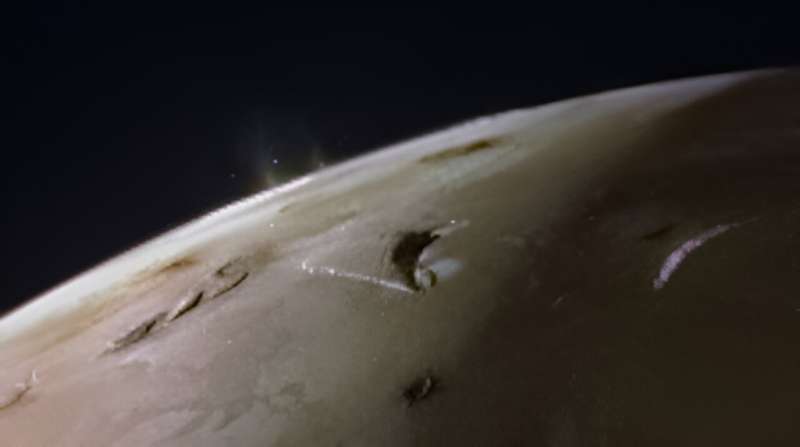
NASA's Juno spacecraft was dispatched on a mission in 2011 to study the planet Jupiter. It has beamed back some truly stunning images and valuable data on the solar system's largest planet. While in the neighborhood, Juno also took a closer look at some of the larger Jovian moons. The mission's most recent triumph is a close-up view of the volcanic moon Io, depicting lakes of lava as smooth as glass.

Technically, the images you've seen around the internet are not real photos of the surface, but they're based on data from the probe's recent flybys of Io. These artist impressions of the moon's lava lakes came from data Juno acquired on its recent low-altitude passes in December 2023 and February 2024. The probe passed within 930 miles (1,500 kilometers) of the surface during those flybys.
weatheriscool
Posts: 24492
Joined: Sun May 16, 2021 6:16 pm
Contact:

Re: Exploration of the gas giants

Post by weatheriscool »

firestar464
Posts: 7205
Joined: Wed Oct 12, 2022 7:45 am

Re: Exploration of the gas giants

Post by firestar464 »

Looking for life on Enceladus: What questions should we ask?

https://phys.org/news/2024-05-life-enceladus.html
weatheriscool
Posts: 24492
Joined: Sun May 16, 2021 6:16 pm
Contact:

Re: Exploration of the gas giants

Post by weatheriscool »

NASA's Juno provides high-definition views of Europa's icy shell
https://phys.org/news/2024-05-nasa-juno ... views.html
by NASA
Images from the JunoCam visible-light camera aboard NASA's Juno spacecraft supports the theory that the icy crust at the north and south poles of Jupiter's moon Europa is not where it used to be. Another high-resolution picture of the icy moon, by the spacecraft's Stellar Reference Unit (SRU), reveals signs of possible plume activity and an area of ice shell disruption where brine may have recently bubbled to the surface.

The JunoCam results recently appeared in the Planetary Science Journal and the SRU results in the journal JGR Planets.

On Sept. 29, 2022, Juno made its closest flyby of Europa, coming within 220 miles (355 kilometers) of the moon's frozen surface. The four pictures taken by JunoCam and one by the SRU are the first high-resolution images of Europa since Galileo's last flyby in 2000.
weatheriscool
Posts: 24492
Joined: Sun May 16, 2021 6:16 pm
Contact:

Re: Exploration of the gas giants

Post by weatheriscool »

Glimpses of a volcanic world: New telescope images of Jupiter's moon Io rival those from spacecraft
https://phys.org/news/2024-05-glimpses- ... mages.html
by Daniel Stolte, University of Arizona
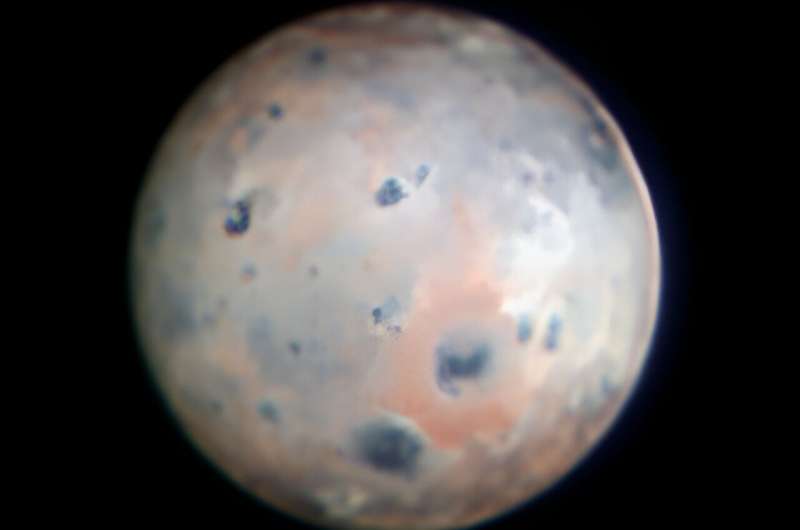
New images of Jupiter's volcano-studded moon Io, taken by the Large Binocular Telescope on Mount Graham in Arizona, offer the highest resolution of Io ever achieved with an Earth-based instrument. The observations were made possible by a new high-contrast optical imaging instrument, dubbed SHARK-VIS, and the telescope's adaptive optics system, which compensates for the blurring induced by atmospheric turbulence.

The images, to be published in the journal Geophysical Research Letters, reveal surface features as small as 50 miles across, a spatial resolution that until now had been achievable only with spacecraft sent to Jupiter. This is equivalent to taking a picture of a dime-sized object from 100 miles away, according to the research team.Image
SHARK-VIS allowed the researchers to identify a major resurfacing event around Pele, one of Io's most prominent volcanoes. According to the paper's first author, Al Conrad, the eruptions on Io, the most volcanically active body in the solar system, dwarf their contemporaries on Earth.
User avatar
wjfox
Site Admin
Posts: 13586
Joined: Sat May 15, 2021 6:09 pm
Location: Essex, UK
Contact:

Re: Exploration of the gas giants

Post by wjfox »

User avatar
caltrek
Posts: 9280
Joined: Mon May 17, 2021 1:17 pm

Re: Exploration of the gas giants

Post by caltrek »

weatheriscool wrote: Mon Jun 03, 2024 6:41 am Glimpses of a volcanic world: New telescope images of Jupiter's moon Io rival those from spacecraft
https://phys.org/news/2024-05-glimpses- ... mages.html
by Daniel Stolte, University of Arizona
...
Image
The New Horizons mission's camera caught a view of one of this moon's volcanos erupting.
Credit: NASA Goddard Space Flight Center Scientific Visualization Studio
Don't mourn, organize.

-Joe Hill
weatheriscool
Posts: 24492
Joined: Sun May 16, 2021 6:16 pm
Contact:

Re: Exploration of the gas giants

Post by weatheriscool »

NASA's Juno probe gets a close-up look at lava lakes on Jupiter's moon Io
https://phys.org/news/2024-06-nasa-juno ... lakes.html
by NASA

New findings from NASA's Juno probe provide a fuller picture of how widespread the lava lakes are on Jupiter's moon Io and include first-time insights into the volcanic processes at work there. These results come courtesy of Juno's Jovian Infrared Auroral Mapper (JIRAM) instrument, contributed by the Italian Space Agency, which "sees" in infrared light. Researchers have published a paper on Juno's most recent volcanic discoveries in Communications Earth and Environment.
Image

Io has intrigued astronomers since 1610, when Galileo Galilei first discovered the Jovian moon, which is slightly larger than Earth. Some 369 years later, NASA's Voyager 1 spacecraft captured a volcanic eruption on the moon. Subsequent missions to Jupiter, with more Io flybys, discovered additional plumes—along with lava lakes. Scientists now believe Io, which is stretched and squeezed like an accordion by neighboring moons and massive Jupiter itself, is the most volcanically active world in the solar system. But while there are many theories on the types of volcanic eruptions across the surface of the moon, little supporting data exists.
User avatar
caltrek
Posts: 9280
Joined: Mon May 17, 2021 1:17 pm

Re: Exploration of the gas giants

Post by caltrek »

A Glow in Jupiter's Night Could Be the Smoking Gun Signal For Dark Matter
by Michele Starr
June 27, 2024

Introduction:
(Science Alert) Somewhere, out there, lurking in the Universe, is a whole bunch of matter we haven't been able to find.

And it's not a trivial amount, either. Roughly 70 to 80 percent of all mass is considered to be the mysterious stuff known as dark matter. Normal matter makes up the minority. That's everything we can detect – all the stars, planets, black holes, dust, gas, moons, people.

So where is all this dark matter? Well, we don't know. But there are ways we may be able to detect it, and one of them is right here in the Solar System.

On the night side of Jupiter, an infrared glow high up in the atmosphere could be produced by an interaction with this shadowy material.

There, charged hydrogen ions called trihydrogen cations (H3+) can be found in abundance. And, while there are several cosmic processes that can produce H3+ in the Jovian atmosphere, an interaction with dark matter could produce an excess beyond what we'd expect to find.
Read more here: https://www.sciencealert.com/a-glow-in ... k-matter
Don't mourn, organize.

-Joe Hill
weatheriscool
Posts: 24492
Joined: Sun May 16, 2021 6:16 pm
Contact:

Re: Exploration of the gas giants

Post by weatheriscool »

New analysis of Cassini data yields insights into Titan's seas
https://phys.org/news/2024-07-analysis- ... titan.html
by Cornell University
A new study of radar experiment data from the Cassini-Huygens mission to Saturn has yielded fresh insights related to the makeup and activity of the liquid hydrocarbon seas near the north pole of Titan, the largest of Saturn's 146 known moons.

Using data from several bistatic radar experiments, a Cornell University-led research team was able to separately analyze and estimate the composition and roughness of Titan's sea surfaces, something previous analyses of monostatic radar data were unable to achieve. This will help pave the way for future combined examinations of the nature of Titan's seas using Cassini data.

Valerio Poggiali, research associate at Cornell University, is lead author of "Surface Properties of the Seas of Titan as Revealed by Cassini Mission Bistatic Radar Experiments," which was published July 16 in Nature Communications.
weatheriscool
Posts: 24492
Joined: Sun May 16, 2021 6:16 pm
Contact:

Re: Exploration of the gas giants

Post by weatheriscool »

Signatures of life could survive near surfaces of the moons Enceladus and Europa, NASA experiment suggests
https://phys.org/news/2024-07-signature ... moons.html
by NASA
Europa, a moon of Jupiter, and Enceladus, a moon of Saturn, have evidence of oceans beneath their ice crusts. A NASA experiment suggests that if these oceans support life, signatures of that life in the form of organic molecules (e.g. amino acids, nucleic acids, etc.) could survive just under the surface ice despite the harsh radiation on these worlds. If robotic landers are sent to these moons to look for life signs, they would not have to dig very deep to find amino acids that have survived being altered or destroyed by radiation.

"Based on our experiments, the 'safe' sampling depth for amino acids on Europa is almost 8 inches (around 20 centimeters) at high latitudes of the trailing hemisphere (hemisphere opposite to the direction of Europa's motion around Jupiter) in the area where the surface hasn't been disturbed much by meteorite impacts," said Alexander Pavlov of NASA's Goddard Space Flight Center in Greenbelt, Maryland, lead author of a paper on the research.

"Subsurface sampling is not required for the detection of amino acids on Enceladus—these molecules will survive radiolysis (breakdown by radiation) at any location on the Enceladus surface less than a tenth of an inch (under a few millimeters) from the surface," Pavlov continued.
User avatar
wjfox
Site Admin
Posts: 13586
Joined: Sat May 15, 2021 6:09 pm
Location: Essex, UK
Contact:

Re: Exploration of the gas giants

Post by wjfox »

User avatar
Time_Traveller
Posts: 3025
Joined: Sun May 16, 2021 4:49 pm
Location: New York City, USA, November 5th 2032 C.E.

Re: Exploration of the gas giants

Post by Time_Traveller »

A moon of Uranus could have a hidden ocean, James Webb Space Telescope finds
published 49 minutes ago

Image

Using the James Webb Space Telescope (JWST), astronomers discovered that Ariel, a moon of Uranus, could be hiding in a buried liquid water ocean.

The discovery could supply an answer to a mystery surrounding this Uranian moon that has perplexed scientists: the fact Ariel's surface is covered with a significant amount of carbon dioxide ice. This is puzzling because at the distance Uranus and its moons exist from the sun, 20 times further out from the sun than Earth, carbon dioxide turns to gas and is lost to space. This means some process must refresh the carbon dioxide at the surface of Ariel.

Previous theories have suggested this happens as a result of interactions between Ariel's surface and charged particles trapped in Uranus' magnetosphere that provide ionizing radiation, breaking down molecules and leaving carbon dioxide, a process called "radiolysis."

However, new evidence from the JWST suggests the source of this carbon dioxide could come not from outside Ariel but from its interior, possibly from a buried subsurface ocean.

Uranus and its rings as seen by the James Webb Space Telescope in 2023. (Image credit: NASA, ESA, CSA, STScI)
Because chemical elements and molecules absorb and emit light at characteristic wavelengths, they leave individual "fingerprints" on spectra. The team behind this discovery used the JWST to gather spectra of light from Ariel, which helped them paint a picture of the chemical makeup of the Uranian moon.


https://www.space.com/uranus-moon-ariel ... -telescope
“In the quantum multiverse, every choice, every decision you've ever and never made exists in an unimaginably vast ensemble of parallel universes.”
weatheriscool
Posts: 24492
Joined: Sun May 16, 2021 6:16 pm
Contact:

Re: Exploration of the gas giants

Post by weatheriscool »

Massive, Ancient Asteroid May Have Smashed Into One of Jupiter's Moons
One researcher thinks the asteroid, which is thought to have hit Ganymede 4 billion years ago, was 20 times larger than the one that wiped out Earth's dinosaurs.
By Adrianna Nine September 6, 2024
https://www.extremetech.com/science/mas ... ters-moons
Aside from being the biggest of Jupiter's 95 moons, Ganymede is best known for its axial tilt and deep furrows. These characteristics—particularly the rivets that lend Ganymede its unusual topography—have long puzzled researchers, calling into question the satellite's evolutionary history. Now, a scientist in Japan thinks he's uncovered the cause of both Ganymede's tilt and texture. The answer, he says, lies 4 billion years in the past.

According to Naoyuki Hirata, an assistant professor of planetology at Kobe University, the heftiest of Jupiter's Galilean moons likely experienced a smack from a massive asteroid when our own planet was still very young. Hirata's theory, which he details in a new paper for Scientific Reports, is based on an extensive system of furrows that mimic how cracks spread outward from a glass impact. The central point of this system sits along Ganymede's rotational axis, implying that something might have struck Ganymede's surface, producing changes to the moon's topography and tilt.
weatheriscool
Posts: 24492
Joined: Sun May 16, 2021 6:16 pm
Contact:

Re: Exploration of the gas giants

Post by weatheriscool »

NASA Reveals Close-Up of Europa's Landscape Ahead of Clipper's Launch
By Adrianna Nine October 9, 2024
https://www.extremetech.com/science/nas ... ers-launch
Europa Clipper might be in launch limbo thanks to Hurricane Milton, but NASA is still building hype around the mission. Before the agency sends Europa Clipper to Jupiter's fourth-largest moon, it's showing off a newly colorized close-up of Europa's icy surface.
Image
The image depicts terrain within Conamara Chaos, a region of Europa also referred to simply as Conamara. Named for the chaotic patterns in its cracked, rugged geography, Conamara results from disruptions to Europa's icy crust. Large rafts of ice are thought to have jumbled at the surface as water or slush rose from below, creating the slapdash landscape shown above.
weatheriscool
Posts: 24492
Joined: Sun May 16, 2021 6:16 pm
Contact:

Re: Exploration of the gas giants

Post by weatheriscool »

weatheriscool
Posts: 24492
Joined: Sun May 16, 2021 6:16 pm
Contact:

Re: Exploration of the gas giants

Post by weatheriscool »

weatheriscool
Posts: 24492
Joined: Sun May 16, 2021 6:16 pm
Contact:

Re: Exploration of the gas giants

Post by weatheriscool »

Saturn's moon Titan has insulating methane-rich crust up to six miles thick
https://phys.org/news/2024-10-saturn-mo ... thane.html
by University of Hawaii at Manoa
Saturn's largest moon, Titan, is the only place other than Earth known to have an atmosphere and liquids in the form of rivers, lakes and seas on its surface. Because of its extremely cold temperature, the liquids on Titan are made of hydrocarbons like methane and ethane, and the surface is made of solid water ice.

A new study published in The Planetary Science Journal, led by planetary scientists at the University of Hawai'i at Mānoa, revealed that methane gas may also be trapped within the ice, forming a distinct crust up to six miles thick, which warms the underlying ice shell and may also explain Titan's methane-rich atmosphere.
Image
Post Reply