Terrestrial transport is heavily dominated by nuclear power, not just in the military sector, but also for civilian transport. Unlike on Earth, where nuclear energy is often met with public skepticism, red tape and safety concerns, Kyanah city-states in affluent regions have adopted nuclear-powered airlines--traveling at Mach 2--and trains with little to no regard for such concerns. Suborbital transit via spaceplanes is sometimes used by packs of high-ranking executives, politicians, or diplomats who don't have time to waste sitting in a plane for hours. Nuclear-powered trucks are also not uncommon; as their homeworld is a super-Earth with no oceans, routes can get extremely long (Ikun-Kanenhah is about 30,000 km by road and it's not even the longest route on the planet), and not needing gas stations or charging areas can be very handy. Even some nuclear powered cars for individual packs have been developed, though the complexities of cramming a nuclear reactor and radiation shielding under a car hood make them a premium item, starting at the equivalent of approximately $100,000 in human terms--though some say this is made up for by the convenience of being able to just get in and drive, without ever worrying about plebian matters like fueling or recharging. For most packs in developed city-states, electric cars are the norm instead, with advances in battery life via room temperature superconductors rivalling or exceeding ICEs. However, some older coal-powered ones--the only naturally occurring fossil fuel, due to the lack of oceans--can be seen, and are quite numerous in poor and developing city-states. Notably, many consumer cars tend to be much larger than on Earth, almost like vans; as packless Kyanah aren't generally in a position to afford cars, and those with packs rarely if ever have any reason to drive anywhere without their packs, cars must be made to accommodate entire packs, with 4-6 adults plus however many young they may have.
Perhaps unsurprisingly, the Kyanahs' devil-may-care attitude towards nuclear power extends to nuclear bombs as well. In fact, peaceful nuclear detonations make up a majority of the nuclear detonations on the Kyanah homeworld, outnumbering nuclear tests and acts of war combined. As per Ikun's policy of nuclear monopoly, no other city-state is allowed to develop nuclear weapons, but Ikun itself has performed thousands of peaceful detonations, both for its own projects and occasionally, on request from one of its allies. Such projects include flattening extremely large areas of terrain for infrastructure megaprojects (including road and rail links through impact various ranges, or flattening areas for building in said impact ranges), exposing valuable mineral deposits for mining, and even using the craters generated by nukes to create several artificial oases; at least 18 independent city-states have been created from scratch around such oases--this has occasionally been used by Ikun as a means of creating pro-Ikun regimes in areas where overthrowing an existing city-state was deemed impractical. Nukes have also been used by Ikun to power Raiun-cannons, which as the name suggests are essentially large cannons that use a nuclear explosion rather than a chemical one to propel thousand-ton payloads into space; the equivalent human term is "Wang Bullet". However, these have largely fallen out of fashion with the development of SSTO nuclear spaceplanes that can carry more delicate payloads and not destroy the launch site with every use. As it has been 66 Earth years--more than the average Kyanah lifetime--since the Day of Tower Clouds and almost 40 since the last nuclear annihilation by Ikun, the average Kyanah in Ikun is more likely to associate nukes with projects like these than with a nuclear holocaust--though in some places, the nuclear annihilations early in Ikun's Hegemony Era cast a long shadow even in the present day.
Many large-scale, and even planetary-scale infrastructure projects do exist on the Kyanah homeworld, but anything that extends between multiple city-states is almost invariably an emergent phenomenon that has emerged from many different entities independently building infrastructure for their own economic and strategic needs, often following historic trade routes. For instance, while almost all known medium sized (population >131k) and large (population >1.04M) city-states are connected via paved roads, there is no centralized figure behind this, like with the Interstate Highway System, and the network constantly changes as entities stop maintaining highways that no longer suit their interests, and others decide to construct their own. While such highways are in the open land between city-states, which is legally considered in a manner similar to international waters on Earth, whatever entity commissioned the building of a particular road or railway through open land is considered to own it and be responsible for it. Quality varies considerably, ranging from two-lane pothole-strewn death traps in the middle of nowhere to eight-lane smart highways that display alerts and information holographically, automatically inform maintainers about needed repairs via wireless sensors, and communicate with autonomous vehicles to allow them to navigate smoothly; city streets in wealthy city-states also share these features. Some roads in the Rktakian Kwardniet have the ability to wirelessly transfer power to compatible electric vehicles for a toll, reducing the need to stop and charge. Paved roads are usually built from some form of concrete rather than asphalt and in wealthy regions, are sometimes seeded with nanoparticles or genetically engineered microbes that automatically repair micro-cracks, meaning that such roads only need any maintenance at all once every 30-40 Earth years, and--if simulations hold up--won't need to be outright resurfaced for centuries. Road workers in these affluent areas--such as much of the Rktakian Kwardniet, and parts of the Far South, Meatbucket, and Western Sector, are thus only needed to build new roads, or if natural disasters have destroyed part of a road. Most cars and trucks have a high level of autonomy, equivalent to level 4-5 on smart highways and 3-4 on arbitrary roads; it's common in vast stretches of highway between city-states to see multiple trucks traveling in a convoy with only the first one actually being driven by a pack.
Rail networks have largely evolved in a similar organic fashion with no top-down authority guiding their development or standards, and thus as a practical matter, variable gauge trains have always been required to cover any serious distance without running into this issue. There are an estimated 15 million kilometers of rail on the Kyanah homeworld, about 20 times as much as on Earth, a factor which can be attributed to it being an oceanless super-Earth with nearly 9 times the land area, and barring political considerations or issues with customs, it is usually possible to get from almost any mid-sized or large city-state to any other by rail. In recent epochs, the development of room temperature superconductors has made long range maglev systems practical; in practice, these are often integrated into existing rail lines, allowing both maglevs and internally powered nuclear or internal-combustion trains to use the same route, though maglev-compatible lines are much more sparse outside of the Rktakian Kwardniet, Western Sector, Meatbucket, Far South, and immediate vicinity of various megacities outside these regions. New rails are often constructed from self-healing metals to reduce the need for repairs. To the Kyanah, "high-speed rail" refers to vactrains, which have been implemented, but are even more sparse. The expense of making the required room-temperature superconductors in orbit and maintaining a vacuum tube for hundreds of kilometers, the extreme security risks and high-profile terrorist attacks, and the fact that acceleration time greatly limit the available stops--to avoid turning it into a high-G experience and still make full use of the available speed, stops must be at least 400-500 km apart, with any in-between destinations being served by a second line, and the necessity of having a perfectly straight line--mean that only a few such lines exist. The only one in the Rktakian Kwardniet runs the Ryden-Ikun-Aktin route, covering 1500 kilometers in about 25 minutes, including an 8-minute stop in Ikun, at half the cost and three times the speed of an equivalent plane ticket. However, security concerns, red tape, and bickering between the three city-states in question have caused this project to cost roughly half a trillion koin and take 37 years to complete--or in human terms, about $80 billion and 17 Earth years, double the cost and 50% longer than originally planned--and in 38 years/17.5 Earth years of operation, it has yet to be a net profit, discouraging the construction of further vactrains in the Rktakian Kwardniet. The Far South, with a less car-centric culture and a greater prevalence of direct government control over infrastructure, has seen 17 city-states be connected with four vactrain lines, and one additional line connects four city-states from East Anweri to Dagtan, though this has been the most controversial of all due to the poverty and developing economies of these city-states. While advances in mega-scale 3D printing of infrastructure since about Y944 may lead to the cost of vactrain lines dropping in--in human terms--under $50 million/km, it will likely never be as practical for most routes as nuclear jets that can go from almost anywhere to anywhere else, even if they only travel at 0.7 km/s instead of 2 km/s as vactrains do.
The planet's impact ranges pose a considerable challenge to ground transport--arguably worse than Earth mountain ranges--as the masses of overlapping craters, impact peaks, and ejecta piles lead to chaotic, loose, rockfall-prone terrain with drops and rises reaching hundreds of meters or even kilometers. Most impact ranges have several major highways passing through in modern times, using elaborate systems of bridges, tunnels, and ramps to navigate through the treacherous crater fields. The largest and most treacherous such area, known as the Shatter, where three separate impact ranges overlap, only has one paved road and rail crossing, at the Dagtan Gap, where the shattered crater-field narrows from hundreds of kilometers across to just 60. Naturally, this has put Dagtan city-state, on the southern side of the gap, in a very important but also very high-pressure position; they are much bigger and wealthier than many city-states in their general vicinity due to the sheer volume of trade between the Rktakian Kwardniet+Western Sector and the Middle+Far South going through Dagtan. However, hundreds of city-states are constantly trying to influence Dagtan and secure beneficial trade arrangements, and Ikun itself has invaded no fewer than three times during the Hegemony Era to overthrow the government in Dagtan. Some companies in Rktakian Kwardniet city-states have proposed using nukes to blast a path through the Shatter a few thousand kilometers east of Dagtan to create an alternate route (as has been done a few times in other impact ranges) but there are few large and economically developed city-states near the proposed route, so hundreds or even thousands of kilometers of smart highways and magrails across barren desert would have to be built to connect it to existing infrastructure, and also Ikun's government seems disinterested in using nukes for this particular project, making it largely a pipe dream.
The largest piece of infrastructure on the Kyanah homeworld is undoubtedly the Water Distribution System. While pipelines to carry water between city-states have existed since the early industrial times, construction has accelerated drastically after the Utopian Wars, as technology has advanced and economic interconnectedness have increased, and thousands of city-states and corporations have built pipelines, silos, ultra-deep water wells, and fog collection systems to transfer water between themselves and their allies and trading partners. This way, water can be quickly and easily moved from regions with an excess to regions with drought, a handy piece of infrastructure for such an arid planet. However, Ikun has heavily invested in the underlying technology and infrastructure, bridging gaps in strategic locations around the world and building vast numbers of the most powerful and efficient control nodes and refining and optimizing the infrastructure, causing the emergent networks to gradually merge into a cohesive whole. With more than 120 million kilometers of pipelines and 9 million control nodes, corporations and government agencies based in Ikun together own some 82,000 control nodes, nearly 1% of the entire system and over three times as many as the next most influential city-state, and have also built some half million kilometers of pipelines themselves. In recent years, construction robots and metal 3D printing technology has made this construction more efficient, enabling the production of pipelines in one continuous length, without the need to haul disparate segments into place and weld them together. Sensors are ubiquitous along the system's length, immediately alerting control node owners of mechanical issues in remote areas so that construction crews can be sent to repair them.
A human, with a human-centric view of institutions and interconnected systems, could be forgiven for thinking that the Water Distribution System was a grand altruistic endeavor intended to uplift impoverished communities. But to the Kyanah that was never the point, even though it's certainly had that effect in most parts of the world. Essentially, the crux of the Water Distribution System is the control nodes, which can be used by their owners to activate valves, pumps, and storage mechanisms to either push or pull water in a particular part of the system, causing it to be routed to their desired location; the more powerful and efficient the underlying hardware is, the more effective the control node is. However, thousands of entities are pushing or pulling water at any given time; if multiple control nodes are trying to move water in the same direction, their effect will be magnified, while if they are moving water in the opposite direction, their effects will be diminished or even cancelled out entirely.
The Water Distribution System is thus, in a sense pay-to-win via technical investment, as affluent and technologically advanced city-states like Ikun have more and heavier-weighted control nodes. It is a very complex strategic landscape with organizations heavily relying on optimization and game theory to try and maximize their influence and access to water. Sometimes, city-states cooperate, and other times they work against each other, using complex strategies to deny their enemies water by strategically pushing or pulling from enemies, allies, and neighbors to indirectly leave the target in a situation where water is flowing away from them in every direction with a force too great for their own control nodes to override. Determining the optimal strategy is a computationally hard problem with no closed-form solution, so those with the biggest supercomputing clusters and the best scientists to devise classified algorithms gain an advantage that stacks with control node superiority. The Water Distribution System is a lot like a planetary chess game, where some players have like three queens on the board and a computer running Stockfish, and others...just don't. Because of this, the system can be controversial, with approval ranging from less than 30% of packs to over 90%, depending on the city-state. And yet, access to water has genuinely increased. Often-times there will in fact be excess water somewhere in the world that a struggling city-state can pull with little or no resistance, and even if not, other players will often push it to them to secure political concessions in other areas, bolster alliances, or even just to keep global trade networks stable, avert a refugee crisis, and maintain trust in the Water Distribution System, which are all generally in the best interests of the wealthy power players, so they generally don't just suck impoverished city-states dry for no reason unless there's a goal even more pressing than these general interests.
In recent years, speculative geoengineering technology has been increasingly implemented by various city-states with the goal of securing more favorable weather conditions and reversing ecological damage in their regions. Koranah, a Far South city-state and geopolitical enemy of Ikun, with the largest raw GDP (even beating Ikun, albeit not per capita), has invested heavily in building control nodes in this new system and promoting the widespread use of geoengineering across the planet. Naturally, this too is not some altruistic collective venture to save the planet, but a calculated strategy by Koranah to mirror Ikun's success at influencing global politics via the Water Distribution System, by creating an even more powerful piece of infrastructure, the Climate Control System. Naturally, the technology of the Climate Control System is far more advanced. Control nodes are essentially quasi-living factories--with inorganic protective shells and networking equipment surrounding biotech internals--that produce vast amounts of genetically engineered or outright synthetic microbes, which can block out or concentrate sunlight to alter temperatures, seed or disperse clouds to cause or prevent rainfall, break down pollutants or release beneficial trace chemicals into the atmosphere, or promote or suppress key aspects of local ecosystems from the ground up. With the use of biotechnology and genetically engineered organisms, the need to manually repair and replace these systems or come in and manually adjust settings constantly, is greatly reduced, as the low-level details can self-regulate. However, even the most basic versions of this sort of technology are much more expensive and intricate than pipelines and pumps. Additionally, global weather systems and ecologies are open, chaotic systems instead of closed, deterministic ones like water pipelines, and actions taken by control nodes in the Climate Control System have ripple effects across the world that require sophisticated modeling and advanced science to accurately predict. Thus determining a suitable strategy is two nested computationally hard problems: in order to solve for the optimal instructions to give to a particular control node, you first need to accurately predict the effects of each instruction on the environment, taking into account theoretically unlimited knock-on effects outside the system itself; it's a lot more complex than "we want water there, so we push/pull water there". So city-states with even a slight advantage in geoengineering technology and/or computing will utterly dominate. As Ikun and Koranah are neck-and-neck in the supercomputing arms race and Koranah's geoengineering is 3-5 Earth years ahead of Ikun's, the government of Ikun has gone all-out in suppressing geoengineering through its superior soft power, leveraging sanctions, treaties, and propaganda to disrupt the Climate Control System's expansion.
Curiously, while plenty of city-states import and export energy to others, there's no recognizable global grid in the same manner as the Water Distribution System or Climate Control System, with regional power trading arrangements between dozens or hundreds of city-states at most instead. There are various technical and political reasons why, but essentially energy is neither as scarce as water nor as globalized as the environment itself, so techno-political forces governing the energy industry tend to be different. Fission power provides a plurality and near-majority of the Kyanah homeworld's energy supply, about 47% in total--Ikun's nuclear monopoly does not preclude other city-states from building nuclear reactors, just nuclear weapons. Thousands of city-states have nuclear reactors, and thorium reactors have been extensively commercialized alongside uranium ones. Miniaturized fission reactors are also frequently used; the smallest are not much larger than a conventional car engine. Solar takes second place, with 27% prevalence; the Kyanah homeworld receives more solar flux than Earth and tends to have fewer clouds, so it tends to be a viable choice in most places, except those that have a polar night. There has been some commercialization of space solar, as not having to deal with nighttime or an atmosphere makes it far more efficient. So far, this is only about 1% of the global solar market, but growing fast. Coal--the only fossil fuel that exists in significant quantities--makes up 18% in total. Though it's not evenly distributed; in affluent and developed areas, fission makes up 80-90% of energy generation, while nuclear reactors are rare in developing regions where coal dominates; the Middle South, with its poor yet rapidly industrializing city-states, is also known as the Coal Belt for a reason. Fusion power is a solved problem, but only makes up 4% of global energy usage due to the severe logistical problems with finding deuterium, tritium, or helium-3. Thus far, the most practical solution has been atmospheric mining, first implemented at the system's only gas giant, Entiak-Ryitu, about 7.5 AU out, in Y927 (49 years ago; 22.5 Earth years). There are few regions where wind or hydroelectric are practical, so these only comprise a trace amount of energy output on a global scale.
Road to Hope
Re: Road to Hope
The typical Kyanah approach to AI differs substantially from the human approach. They don't see it as in any way trying to trying to create intelligent software--let alone sentient software--but instead simply about algorithmically finding answers to certain types of questions that are difficult to automatically answer with classical methods. There is little serious research effort or public interest in creating AI that is self-aware or otherwise Kyanah-like, and consequently, fears of an "AI uprising" or Skynet-type scenario are almost completely absent from Kyanah society; to them it would be like being scared of a calculator uprising. When questioned about this by humans, they seem to believe that if a task truly requires sentience, then there are billions of packs who can do it, and if it doesn't, then there's no point in including it in their algorithmic solution. This reflects extensively in real-world examples of Kyanah AI: they almost never appear to exhibit any sort of personality or even act as though they are conversing with their users at all; they simply output a solution to whatever problem was input into them. This likely stems from Kyanah society; as a heavily pack-centric species for whom interactions with outside their own packs are transactional and have little or no emotional weight, they have little interest in being able to talk to their AI and would in fact consider the idea off-putting. In fact, there is no distinct field of AI at all, with all the research and applications that humans would consider as such instead being split into advanced versions of optimization, pattern recognition and generation, and control theory.
Nevertheless, applications that we would widely consider AI are widespread in Kyanah society, and in many cases are quite developed. One of the earliest examples is query adapters, used to convert natural language queries into a complex and structured query parameter protocol that is used to traverse the tree-like structure of Kyanah internets and find the node that is most relevant to a particular query. Considerable amounts of research have been devoted to optimizing the resulting query parameter protocols and preventing them from falling into spam traps. However, many of their most advanced modern applications revolve around finding winning strategies in complex, massively multi-agent fully or partially adversarial "games"--likely an area that has seen considerable investment due to the fractious geopolitical nature of their homeworld, with thousands of competing city-states, rather than a few nation states or one world government. Such applications are often known as tactical engines. The most obvious example of this are the military tactical engines used during their invasion of Earth, calculating optimal attacks and defenses with machine-like precision, enabling them to outsmart and outmaneuver human forces in nearly every engagement. In the civilian sector, this sort of technology is used for various techno-political "games" such as the global Water Distribution System and Climate Control System, as well as local and regional scale versions, often involving local power grids, natural resource extraction in areas where other actors may be trying to extract the same or similar resources, and access to shared technical resources like computing clusters, whose owners may offer more and/or cheaper compute power to users whose work is deemed more useful to the owner's interests and goals, a factor that is itself often calculated by advanced algorithms. The Kyanah version of Globalist doctrine, wherein city-states exploit natural resources in unclaimed open land between city-states from across the world strategically denying closer and often less developed city-states the opportunity to extract these resources, can also sometimes be considered a techno-political game, with the location and nature of resource gathering being optimized to maximize a city-state's political influence or deny enemy city-states access to natural resources they need for economic development. In the realm of politics, these sorts of tactical engines are used in conjunction with language models by politicians and diplomats to draft laws and treaties designed to be the most likely to be adopted and accomplish the desired agenda while stifling competing agendas. In corporate offices, they are used to guide the purchasing and selling of assets in pursuit of executives' goals. Notably, this doesn't just mean making money; as governments tend to be tightly integrated into the economy, serving as economic actors that get just as involved as any private company, instead of an overseer or controller of the economy, businesses can also seek to increase political influence, gain access to state resources, or reduce constraints imposed on them by the state.
In more light-hearted matters, tactical engines are used by online creators to devise powerful memetics and content that will successfully out-compete other content for netizens' attention. They are also frequently used in actual games. Kyanah video games tend to heavily focus on game AI while having comparatively bare-bones graphics that leave much to the imagination, only conveying what's needed for the players to know what's going on. In fact, most hardcore gamers see fancy graphics as something for casuals, that only serve to distract them from the underlying mechanics. While game landscapes are rather barren, they are filled with extremely sophisticated and diverse enemies and other entities that are extremely capable of maximizing their in-game resources and surviving whatever players and other entities throw at them; instead of having absurdly high stats, bosses are simply as smart or smarter than the players themselves, requiring superior items or numbers to beat. Procedurally-generated AI is a common feature of Kyanah games, ensuring that every entity behaves in a unique manner. Anomalous randomly-generated bosses have sometimes survived in multiplayer servers for years despite the best efforts of thousands of packs to destroy them. Hardcore Kyanah gamers, who are often just as hyper-dedicated as their human counterparts, have been known to go as far as renting supercomputer clusters and running millions of simulations to find a winning strategy against a particularly annoying enemy. Likewise, most classical strategy games have been either fully solved or achieved vastly super-Kyanah performance, even those that are designed to be played amongst members of a pack, instead of between two packs, and thus involve alliances, deception, and social deduction, and even some games that have been specifically designed--often by algorithms--to be computer-proof.
In addition to tactical engines, the Kyanah also have efficiency maximizers. The goal of these is to find the minimum amount of resources (broadly defined) to achieve a particular goal in settings that may not necessarily be multi-agent or adversarial. In the Kyanah invasion of Earth, these were used along with tactical engines to optimize the payload for their interstellar vehicle and production of resources on Earth via ISRU. Efficiency maximizers are also used in the civilian sector; one application that has been increasing in prevalence in recent years is to guide staffing decisions in combination with wearable sensors. The data from these sensors allows efficiency maximizers to calculate the productivity of each worker and retain the minimum staffing necessary to achieve business goals. Naturally, this has been contentious among the workers themselves, who have devised elaborate strategies to game the system and sabotage coworkers to relatively boost their own metrics. Some city-states use similar algorithms on immigrant populations to swiftly deport those who are deemed to be assimilating poorly or otherwise aren't contributing sufficiently, so that state resources can be used on natural citizens and more useful immigrants. And naturally, efficiency maximizers play a major role in resource acquisition in the corporate world, ensuring that only the minimum necessary resources are purchased. In general, most Kyanah cultures have an extreme aversion to waste--likely due to the arid and resource-poor nature of their homeworld--which manifests as them going to extreme lengths to ensure that un-needed resources are not spent on a goal.
Efficiency maximizers can also tie in with social and actual networks to create influence maximizers, which basically seek to find the fewest nodes in a network that need to be influenced to propagate some concept or agenda through the network. This is used in politics a lot, both by domestic politicians figuring out who they are best off working with to get their desired agenda passed--a tricky task since cohesive, named political parties are largely unknown, with power blocs instead revolving around influential packs--and in inter-city relations to calculate who to ally with; it's often ideal to ally with as few packs or city-states as possible to pass an agenda, to reduce the number of potential concessions and compromises that will need to be made. Similarly, they can be used to figure out how to spread or suppress ideas with a minimum expenditure of social capital, e.g. corporations figuring out which online nodes to buy ad space on to get exposure with minimal expenditure or governments seeking to suppress threatening movements by selectively targeting as few important packs as possible, instead of wasting resources on mass arrests and crackdowns, or even working in tandem with military tactical engines to achieve strategic goals with minimum loss of life or target specific enemy soldiers whose loss will have the strongest effect on morale or operational capabilities.
Other forms of AI exist as well, including AI art--or as the Kyanah see it, extremely complex and aesthetic pattern generation, though it seems to be less advanced than their tactical engines and efficiency maximizers, arguably not far beyond recent human developments. In general, Kyanah art, whether literary, visual, or physical, tends to be heavily pack-centric. Written works (whether artistic or merely informational) are often multi-threaded, with each member of a pack creating their own thread that is interleaved with those of the other members, rather than a singular sequential plot line; art in other media is often organized in a similar fashion. Thus, pattern generation can be used to create works with more threads than there are members in the pack that created them, by filling in the blank space based on given parameters about the nonexistent packmate. This sort of breaks down when too many threads are added, or Kyanah don't create any of the threads themselves. However, multi-agent pattern generators can be used for this use case by having multiple generators that simultaneously influence each other's parameters. Systematic encoding of ground truths and relations between subpatterns are used in combination with statistical models to ensure a greater self-consistency over long ranges than pure statistical models; this takes the form of huge numbers of auto-generated constraints added to the generators, though the produced works aren't flawless upon close examination. Instead of simply creating massive numbers of regular story-threads or other media, generators usually focus on making things that would be impossible for Kyanah packs to produce: works with dozens or hundreds of threads, visual media that have details even when zoomed in absurdly far, and works that are too large or long to be created by a single pack. This, combined with the general cultural stigma against waste, lead to a generated art scene where instead of wasting compute power to make a hundred pieces of AI-generated trash, they just make one, relying on how obviously alien and impossible it is to produce by real Kyanah to draw in as much or more attention than a huge pile of AI generated spam. The prevailing attitude seems to be that using pattern generators to make art that looks and feels like Kyanah-made art is like building a car that walks on two legs: inefficient and completely missing the point of a car. That being said, it's sort of an open secret that many creators of commercial story-threads and other multi-threaded work sometimes use pattern generators to pad out the number of threads or by individual pack members to optimize their own individual threads.
Pattern generation can also be combined with speculative biology or genetic engineering and efficiency maximizers to create procedurally generated life and algorithmically optimize the genetics of their genetically modified creatures. It is rare for genetic modifications to be made by biologists looking at a creature's genome and figuring out which genes they have to modify to get the desire result; instead gene sequences are automatically optimized. In high-priority areas where this research has been done for decades (e.g. agriculture), it's only possible to discover marginal gains to state-of-the-art gene sequences with immense computing resources. This also leads to generative paleontology, where pattern generators are used to fill gaps in the fossil record; while inefficient and unreliable, it has on occasion accurately predicted extinct organisms that were later found in the fossil record, but is still being refined. Naturally, the Kyanah have been known to use AI to create AI, though this is seen more as, variably, optimizer optimizers or generator generators. However, out-of-the-box generated algorithms are often further modified, especially if maximum performance is required.
Nevertheless, applications that we would widely consider AI are widespread in Kyanah society, and in many cases are quite developed. One of the earliest examples is query adapters, used to convert natural language queries into a complex and structured query parameter protocol that is used to traverse the tree-like structure of Kyanah internets and find the node that is most relevant to a particular query. Considerable amounts of research have been devoted to optimizing the resulting query parameter protocols and preventing them from falling into spam traps. However, many of their most advanced modern applications revolve around finding winning strategies in complex, massively multi-agent fully or partially adversarial "games"--likely an area that has seen considerable investment due to the fractious geopolitical nature of their homeworld, with thousands of competing city-states, rather than a few nation states or one world government. Such applications are often known as tactical engines. The most obvious example of this are the military tactical engines used during their invasion of Earth, calculating optimal attacks and defenses with machine-like precision, enabling them to outsmart and outmaneuver human forces in nearly every engagement. In the civilian sector, this sort of technology is used for various techno-political "games" such as the global Water Distribution System and Climate Control System, as well as local and regional scale versions, often involving local power grids, natural resource extraction in areas where other actors may be trying to extract the same or similar resources, and access to shared technical resources like computing clusters, whose owners may offer more and/or cheaper compute power to users whose work is deemed more useful to the owner's interests and goals, a factor that is itself often calculated by advanced algorithms. The Kyanah version of Globalist doctrine, wherein city-states exploit natural resources in unclaimed open land between city-states from across the world strategically denying closer and often less developed city-states the opportunity to extract these resources, can also sometimes be considered a techno-political game, with the location and nature of resource gathering being optimized to maximize a city-state's political influence or deny enemy city-states access to natural resources they need for economic development. In the realm of politics, these sorts of tactical engines are used in conjunction with language models by politicians and diplomats to draft laws and treaties designed to be the most likely to be adopted and accomplish the desired agenda while stifling competing agendas. In corporate offices, they are used to guide the purchasing and selling of assets in pursuit of executives' goals. Notably, this doesn't just mean making money; as governments tend to be tightly integrated into the economy, serving as economic actors that get just as involved as any private company, instead of an overseer or controller of the economy, businesses can also seek to increase political influence, gain access to state resources, or reduce constraints imposed on them by the state.
In more light-hearted matters, tactical engines are used by online creators to devise powerful memetics and content that will successfully out-compete other content for netizens' attention. They are also frequently used in actual games. Kyanah video games tend to heavily focus on game AI while having comparatively bare-bones graphics that leave much to the imagination, only conveying what's needed for the players to know what's going on. In fact, most hardcore gamers see fancy graphics as something for casuals, that only serve to distract them from the underlying mechanics. While game landscapes are rather barren, they are filled with extremely sophisticated and diverse enemies and other entities that are extremely capable of maximizing their in-game resources and surviving whatever players and other entities throw at them; instead of having absurdly high stats, bosses are simply as smart or smarter than the players themselves, requiring superior items or numbers to beat. Procedurally-generated AI is a common feature of Kyanah games, ensuring that every entity behaves in a unique manner. Anomalous randomly-generated bosses have sometimes survived in multiplayer servers for years despite the best efforts of thousands of packs to destroy them. Hardcore Kyanah gamers, who are often just as hyper-dedicated as their human counterparts, have been known to go as far as renting supercomputer clusters and running millions of simulations to find a winning strategy against a particularly annoying enemy. Likewise, most classical strategy games have been either fully solved or achieved vastly super-Kyanah performance, even those that are designed to be played amongst members of a pack, instead of between two packs, and thus involve alliances, deception, and social deduction, and even some games that have been specifically designed--often by algorithms--to be computer-proof.
In addition to tactical engines, the Kyanah also have efficiency maximizers. The goal of these is to find the minimum amount of resources (broadly defined) to achieve a particular goal in settings that may not necessarily be multi-agent or adversarial. In the Kyanah invasion of Earth, these were used along with tactical engines to optimize the payload for their interstellar vehicle and production of resources on Earth via ISRU. Efficiency maximizers are also used in the civilian sector; one application that has been increasing in prevalence in recent years is to guide staffing decisions in combination with wearable sensors. The data from these sensors allows efficiency maximizers to calculate the productivity of each worker and retain the minimum staffing necessary to achieve business goals. Naturally, this has been contentious among the workers themselves, who have devised elaborate strategies to game the system and sabotage coworkers to relatively boost their own metrics. Some city-states use similar algorithms on immigrant populations to swiftly deport those who are deemed to be assimilating poorly or otherwise aren't contributing sufficiently, so that state resources can be used on natural citizens and more useful immigrants. And naturally, efficiency maximizers play a major role in resource acquisition in the corporate world, ensuring that only the minimum necessary resources are purchased. In general, most Kyanah cultures have an extreme aversion to waste--likely due to the arid and resource-poor nature of their homeworld--which manifests as them going to extreme lengths to ensure that un-needed resources are not spent on a goal.
Efficiency maximizers can also tie in with social and actual networks to create influence maximizers, which basically seek to find the fewest nodes in a network that need to be influenced to propagate some concept or agenda through the network. This is used in politics a lot, both by domestic politicians figuring out who they are best off working with to get their desired agenda passed--a tricky task since cohesive, named political parties are largely unknown, with power blocs instead revolving around influential packs--and in inter-city relations to calculate who to ally with; it's often ideal to ally with as few packs or city-states as possible to pass an agenda, to reduce the number of potential concessions and compromises that will need to be made. Similarly, they can be used to figure out how to spread or suppress ideas with a minimum expenditure of social capital, e.g. corporations figuring out which online nodes to buy ad space on to get exposure with minimal expenditure or governments seeking to suppress threatening movements by selectively targeting as few important packs as possible, instead of wasting resources on mass arrests and crackdowns, or even working in tandem with military tactical engines to achieve strategic goals with minimum loss of life or target specific enemy soldiers whose loss will have the strongest effect on morale or operational capabilities.
Other forms of AI exist as well, including AI art--or as the Kyanah see it, extremely complex and aesthetic pattern generation, though it seems to be less advanced than their tactical engines and efficiency maximizers, arguably not far beyond recent human developments. In general, Kyanah art, whether literary, visual, or physical, tends to be heavily pack-centric. Written works (whether artistic or merely informational) are often multi-threaded, with each member of a pack creating their own thread that is interleaved with those of the other members, rather than a singular sequential plot line; art in other media is often organized in a similar fashion. Thus, pattern generation can be used to create works with more threads than there are members in the pack that created them, by filling in the blank space based on given parameters about the nonexistent packmate. This sort of breaks down when too many threads are added, or Kyanah don't create any of the threads themselves. However, multi-agent pattern generators can be used for this use case by having multiple generators that simultaneously influence each other's parameters. Systematic encoding of ground truths and relations between subpatterns are used in combination with statistical models to ensure a greater self-consistency over long ranges than pure statistical models; this takes the form of huge numbers of auto-generated constraints added to the generators, though the produced works aren't flawless upon close examination. Instead of simply creating massive numbers of regular story-threads or other media, generators usually focus on making things that would be impossible for Kyanah packs to produce: works with dozens or hundreds of threads, visual media that have details even when zoomed in absurdly far, and works that are too large or long to be created by a single pack. This, combined with the general cultural stigma against waste, lead to a generated art scene where instead of wasting compute power to make a hundred pieces of AI-generated trash, they just make one, relying on how obviously alien and impossible it is to produce by real Kyanah to draw in as much or more attention than a huge pile of AI generated spam. The prevailing attitude seems to be that using pattern generators to make art that looks and feels like Kyanah-made art is like building a car that walks on two legs: inefficient and completely missing the point of a car. That being said, it's sort of an open secret that many creators of commercial story-threads and other multi-threaded work sometimes use pattern generators to pad out the number of threads or by individual pack members to optimize their own individual threads.
Pattern generation can also be combined with speculative biology or genetic engineering and efficiency maximizers to create procedurally generated life and algorithmically optimize the genetics of their genetically modified creatures. It is rare for genetic modifications to be made by biologists looking at a creature's genome and figuring out which genes they have to modify to get the desire result; instead gene sequences are automatically optimized. In high-priority areas where this research has been done for decades (e.g. agriculture), it's only possible to discover marginal gains to state-of-the-art gene sequences with immense computing resources. This also leads to generative paleontology, where pattern generators are used to fill gaps in the fossil record; while inefficient and unreliable, it has on occasion accurately predicted extinct organisms that were later found in the fossil record, but is still being refined. Naturally, the Kyanah have been known to use AI to create AI, though this is seen more as, variably, optimizer optimizers or generator generators. However, out-of-the-box generated algorithms are often further modified, especially if maximum performance is required.
Re: Road to Hope
Both industrial robots and autonomous free-moving robots are widely used in Kyanah society. These tend to rely on artificial muscle technology via shape-memory alloys to move in an energy efficient manner and navigate terrain that would stump wheeled robots or legged robots with conventional actuators; they are capable of near-perfect balance in virtually all environments. When applicable, these robots are equipped with multiple hand-like appendages at various shapes and sizes, with as many or more degrees of freedom than an actual Kyanah hand. Legged robots with artificial muscles are often used in the military to carry all the supplies in the field, leaving soldiers free to use their strength solely on carrying guns, ammo, and heavy armor, instead of the huge backpacks often carried by human soldiers. But similar robots are often seen in the civilian sector as well, especially in mining, construction, and factories, where their ability to automatically navigate in tricky spaces can come in handy for fetching and carrying and the like. Adoption of robots is widespread in nearly every industry; they can often be found harvesting feed crops for the Kyanahs' livestock, extracting resources via mining and logging, assembling items in factories, and doing surgeries. "Android" type robots are quite rare, most robots tend to have four, six, or eight legs coming out of a central box, with however many arms and sensors are needed being bolted on at odd angles. Notably, adoption of such solutions is not universal; less developed regions, or those that have had strong backlash by workers have less ubiquitous robotics than city-states like Ikun.
While artificial muscle robots are common, they are not the answer to every problem. Conventional drones swarm through the skies above major cities like Ikun, delivering food and light packages faster than ground vehicles that would have to navigate through the often chaotic street traffic. They also perform surveillance in areas that are too remote or out of reach for conventional camera arrays, being semi-automatically deployed whenever intelligence agencies calculate that there is something of interest to monitor and can also be found in large numbers around battlefields gathering real-time data to feed to tactical engines. Swarms of drones and crowds of artificial-muscle ground robots can sometimes be found wandering the wilderness between city-states, seemingly at random; these can be surveyor bots or academic data-gathering bots but are actually often a harbinger of a future Kyanah industrial operation, and they're often there due to satellite observations, not at random. Many corporations and governments that are involved in resource extraction maintain fleets of bots and remote-controlled vehicles that traverse the world, autonomously prospecting for minerals and ecologies. Ground bots are often ruggedized for traversing all manner of terrain and have solar panels and charging ports for their companion drones. When these bots find something, the Kyanah themselves will quickly show up and get to work. City-states with the means to maintain such fleets can extract resources from just about anywhere on the planet, often out-competing and stifling domestic industry in regions that don't have such elaborate technology. There have been some prototypes of systems that can not only prospect but 3D print basic infrastructure before Kyanah workers even arrive on scene, but civilian tech in this regard lags behind military tech and a fully unsupervised system is still years away for both. There is also research into using genetically engineered organisms with neural remote control systems, so they can survive in nature as living things do, but this too is years away from being practical. Bot-and-drone fleets can also be found traveling together across Ryitu (Tau Ceti f) though they are mostly scientific in nature rather than industrial.
Powered exoskeletons are in widespread use in many heavy industries. Unlike stereotypical mech suits, these are not practical for combat and not intended for fighting with (except in certain sports) but instead simply for lifting heavy loads in environments where robots may not be the most practical or cost-effective option, boosting the operator's carrying capacity by up to an order of magnitude. These can include emergency responders and industrial work in remote areas and military engineering, but also more mundane applications. While many warehouses are fully automated, those that store diverse and non-standardized items and containers--which can happen when collecting goods from many different city-states due to a generally decentralized culture and lack of agreed-upon global standards--often have exoskeleton-wielding workers to handle them, especially as young packless Kyanah can be hired for such roles, and packless labor is dirt-cheap compared to packs.
Ever since the early Utopian Wars, modular manufacturing has become increasingly widespread, providing a second level of industrialization above merely having assembly lines with interchangeable parts; this is considered the Kyanah homeworld's second industrial revolution. Complex machines and products, including but not limited to robots, are made by simply slotting together various combinations of parts, and can be modified or improved upon quite easily by removing and replacing or rearranging individual components--though many companies go out of their way to ensure that only their building blocks are compatible with each other. And closely looking at the individual components will often reveal that they've been manufactured in the same modular manner. However, with this level of freedom comes a very large possible design space when manufacturing products, with plenty of room to make mistakes or improvements. Building Kyanah technology can in some ways be likened to assembling lego sets where every assembly step is an equation that has to be solved for. With this, combined with the high level of robotics involved, manufacturing of physical objects often more closely resembles the software development process, with continuous rapid iteration on product design and deployment of new ideas even while products are being manufactured; different iterations of the same product will often have subtle variations. To capitalize on this, assembly lines have become quite nonlinear, with multiple lines operating in parallel and interleaving with each other to converge on optimal parameters within the assembly space. Most modern systems and infrastructure are filled with embedded sensors to automatically alert personnel if things have failed or broken down, greatly reducing the need for active monitoring.
The presence of robotics and AI have significantly altered the economy on the Kyanah homeworld, especially in level 3 economies--or post-industrial as humans would call them--like Ikun, and traditional manufacturing has declined significantly, while surging in new level 2 economies in previously less developed regions. Many city-states, especially in more conservative and traditional cultures, have adapted strict laws limiting automation in response to civil unrest from workers, but in Ikun, such regulations are fairly minimal. Packs that aren't knowledge workers or participating in the service sector have tended to adapt by acting as the glue between automated systems, often moving between different sites as they do so. The general lack of standardization and uniformity created by the hyper-competitive environment, in which organizations are constantly and aggressively optimizing technologies and procedures, and creating very diverse solutions as a result, has allowed considerable room for this sort of economic activity. In general, most Kyanah cultures have a disdain for waste and inefficiency--whether that be waste of money and material goods, lives, or socio-political capital--and unnecessary expenditure of resources is seen as not just an engineering failure but a moral shortcoming. This is likely due to the relative lack of abundance on their hot and arid homeworld, especially in historic times. Combine this with their cultural distrust of central authority sources outside their own packs, and the constant competition between thousands of city-states and subgroups within said city-states, and you get the current cultural and industrial landscape of the Kyanah homeworld, characterized by extreme customization, high tolerance for risk, and low tolerance for waste--quite the opposite of human industry.
While artificial muscle robots are common, they are not the answer to every problem. Conventional drones swarm through the skies above major cities like Ikun, delivering food and light packages faster than ground vehicles that would have to navigate through the often chaotic street traffic. They also perform surveillance in areas that are too remote or out of reach for conventional camera arrays, being semi-automatically deployed whenever intelligence agencies calculate that there is something of interest to monitor and can also be found in large numbers around battlefields gathering real-time data to feed to tactical engines. Swarms of drones and crowds of artificial-muscle ground robots can sometimes be found wandering the wilderness between city-states, seemingly at random; these can be surveyor bots or academic data-gathering bots but are actually often a harbinger of a future Kyanah industrial operation, and they're often there due to satellite observations, not at random. Many corporations and governments that are involved in resource extraction maintain fleets of bots and remote-controlled vehicles that traverse the world, autonomously prospecting for minerals and ecologies. Ground bots are often ruggedized for traversing all manner of terrain and have solar panels and charging ports for their companion drones. When these bots find something, the Kyanah themselves will quickly show up and get to work. City-states with the means to maintain such fleets can extract resources from just about anywhere on the planet, often out-competing and stifling domestic industry in regions that don't have such elaborate technology. There have been some prototypes of systems that can not only prospect but 3D print basic infrastructure before Kyanah workers even arrive on scene, but civilian tech in this regard lags behind military tech and a fully unsupervised system is still years away for both. There is also research into using genetically engineered organisms with neural remote control systems, so they can survive in nature as living things do, but this too is years away from being practical. Bot-and-drone fleets can also be found traveling together across Ryitu (Tau Ceti f) though they are mostly scientific in nature rather than industrial.
Powered exoskeletons are in widespread use in many heavy industries. Unlike stereotypical mech suits, these are not practical for combat and not intended for fighting with (except in certain sports) but instead simply for lifting heavy loads in environments where robots may not be the most practical or cost-effective option, boosting the operator's carrying capacity by up to an order of magnitude. These can include emergency responders and industrial work in remote areas and military engineering, but also more mundane applications. While many warehouses are fully automated, those that store diverse and non-standardized items and containers--which can happen when collecting goods from many different city-states due to a generally decentralized culture and lack of agreed-upon global standards--often have exoskeleton-wielding workers to handle them, especially as young packless Kyanah can be hired for such roles, and packless labor is dirt-cheap compared to packs.
Ever since the early Utopian Wars, modular manufacturing has become increasingly widespread, providing a second level of industrialization above merely having assembly lines with interchangeable parts; this is considered the Kyanah homeworld's second industrial revolution. Complex machines and products, including but not limited to robots, are made by simply slotting together various combinations of parts, and can be modified or improved upon quite easily by removing and replacing or rearranging individual components--though many companies go out of their way to ensure that only their building blocks are compatible with each other. And closely looking at the individual components will often reveal that they've been manufactured in the same modular manner. However, with this level of freedom comes a very large possible design space when manufacturing products, with plenty of room to make mistakes or improvements. Building Kyanah technology can in some ways be likened to assembling lego sets where every assembly step is an equation that has to be solved for. With this, combined with the high level of robotics involved, manufacturing of physical objects often more closely resembles the software development process, with continuous rapid iteration on product design and deployment of new ideas even while products are being manufactured; different iterations of the same product will often have subtle variations. To capitalize on this, assembly lines have become quite nonlinear, with multiple lines operating in parallel and interleaving with each other to converge on optimal parameters within the assembly space. Most modern systems and infrastructure are filled with embedded sensors to automatically alert personnel if things have failed or broken down, greatly reducing the need for active monitoring.
The presence of robotics and AI have significantly altered the economy on the Kyanah homeworld, especially in level 3 economies--or post-industrial as humans would call them--like Ikun, and traditional manufacturing has declined significantly, while surging in new level 2 economies in previously less developed regions. Many city-states, especially in more conservative and traditional cultures, have adapted strict laws limiting automation in response to civil unrest from workers, but in Ikun, such regulations are fairly minimal. Packs that aren't knowledge workers or participating in the service sector have tended to adapt by acting as the glue between automated systems, often moving between different sites as they do so. The general lack of standardization and uniformity created by the hyper-competitive environment, in which organizations are constantly and aggressively optimizing technologies and procedures, and creating very diverse solutions as a result, has allowed considerable room for this sort of economic activity. In general, most Kyanah cultures have a disdain for waste and inefficiency--whether that be waste of money and material goods, lives, or socio-political capital--and unnecessary expenditure of resources is seen as not just an engineering failure but a moral shortcoming. This is likely due to the relative lack of abundance on their hot and arid homeworld, especially in historic times. Combine this with their cultural distrust of central authority sources outside their own packs, and the constant competition between thousands of city-states and subgroups within said city-states, and you get the current cultural and industrial landscape of the Kyanah homeworld, characterized by extreme customization, high tolerance for risk, and low tolerance for waste--quite the opposite of human industry.
Re: Road to Hope
The Kyanah are a heavily pack-centric species so if anyone commits a crime, the whole pack is, with few exceptions, considered responsible both morally and in the eyes of the law. This includes their children, though if imprisoned, they can usually petition for release upon adulthood even if the rest of the pack is still doing their time. Likewise, any occupation or social role is held by a pack, not an individual. In most city-states, criminal cases, much like civil cases or pursuit of public office, are handled via a challenge in the arena, judged by an arbiter-pack. This is a descendant of ancient trial by combat practices, though in modern times, challenges are instead conducted by presenting the relevant facts and laws, and the combat aspect, if present at all, is purely symbolic.
Justice systems vary wildly between thousands of independent city-states, but in Ikun: as the government itself obviously isn't a physical entity that can stand in the arena, it appoints a Champion, a pack with legal expertise to fight the challenge on behalf of the state. (Champions, a concept descended from the skilled warrior packs who would historically represent nobles in combat challenges, back when nobility existed, can represent non-pack entities who are challengers or defenders in any challenge. Notably, packs don't get this, as they're already physical entities that can 1v1 in the arena.) In the interest of fairness and preserving the 1v1 aspect of the challenge, neither pack is allowed to communicate with the outside world during the challenge, though speaking to legal consultants beforehand is allowed and encouraged. To prevent stalling, challenges must continue without stopping until a verdict is ready, unless both parties agree to adjourn, which can give them time to rest and discuss strategies with consultants. Additionally, arbiters are chosen at random from the pool of arbiter packs, and their identities are not revealed until the challenge begins, to reduce the probability of collusion. Similarly, Champions must delicately balance their chosen win conditions; the challenge is to prove that the defending pack is guilty and deserves the stated sentence, and overly extreme demands can make this more difficult.
Once the arbiter pack has no more questions and both sides are done presenting the evidence, they will decide who won. Arbiters who don't at least give the appearance of being objective may find themselves either facing a criminal challenge against a Champion of the state seeking to have them imprisoned for breaking the law, or a successional challenge, by a citizen pack seeking to take their place due to their incompetence. Or even both, in especially egregious rulings.
If the Champion wins, results for the defending pack can include flogging--replacement for fines, which are seen in Ikun society as adjacent to bribery--exile/denaturalization--usually for tax or immigration related crimes, and rarely for other matters, imprisonment, or death. In modern Ikun, there's no elaborate ritual or gruesome torture. The guards just escort the condemned into the prison courtyard and unceremoniously fire a bullet to the head at point blank range, one for each member of the guilty pack. Some have proposed that nitrogen chambers, if properly implemented, would consume fewer resources, but this hasn't caught on in Ikun.
As for the prison system itself, it's basically like being forced to move to a shitty apartment that you can't leave, where the landlord is armed and always watching. The goal seems to be neither rehabilitation nor retribution, but just keeping threats to society contained as efficiently as possible until they're no longer a threat. Cells are arrayed in a circle around a central control room, sometimes stacked several stories high, so that all cells can be seen at once from one area. To add to this effect, the central area is kept dark while the cells are lit at all times, making it difficult to see out via the transparent doors, but easy to see in.
The cells themselves each contain an entire pack, as splitting up packs is powerful psychological torture and is banned except for captured foreign military or intelligence personnel. Each one is windowless and about three meters by five meters and two meters high--Kyanah themselves average about 1.5. Most of this space is taken by an empty plastic nest frame fixed to the concrete floor, a sink, and a toilet. And four cameras in the ceiling to monitor everything. When packs are sent to prison, they are usually given the opportunity to bring their stuff with them, including nest-building materials, personal devices and whatever else they want from home, as prisons themselves don't issue such items, though guards inspect everything for weapons, contraband, and illicit files.
Imprisoned packs are expected to pay market rate for meat, water, and utilities so as not to be a burden on the system, though how they do this is up to them, so long as they can do it from inside the prison walls. That can include burning through savings, somehow holding down a remote job from prison, or working in the prison itself, maintaining the bioreactor tanks where meat is grown from genetically engineered microbes, cleaning and maintaining the grounds and systems, taking care of administration, or in some cases working in adjoining factories that some companies set up in prisons for the below-market labor. While the pay is atrocious in this latter case, it's the most practical option for packs that don't have tons of money or connections, and provides the only regular opportunity to leave the cell--other opportunities can include speaking to registered legal consultants or medical professionals, though for these, appointments have to be approved in advance. Work details and shifts are randomized to prevent alliances or rivalries from forming between imprisoned packs, and thwart escape attempts.
On the flip side, all activity is heavily monitored at all times. Any property suspected of being used for criminal activity, or in violation of personal property or spending limits, can be seized and destroyed by prison officials at any time, without the due process and legal proceedings required for free packs, as long as they believe in good faith that it was being used to break rules or laws--and demonstrating that they don't is notoriously difficult to prove. Similarly, escapes, riots, and other troublemaking can lead to temporary bans from leaving the cell, which can make acquiring rent rather difficult to say the least. And failing to pay rent on the cell will lead to confiscation of its contents and eventually getting food and water cut off.
Justice systems vary wildly between thousands of independent city-states, but in Ikun: as the government itself obviously isn't a physical entity that can stand in the arena, it appoints a Champion, a pack with legal expertise to fight the challenge on behalf of the state. (Champions, a concept descended from the skilled warrior packs who would historically represent nobles in combat challenges, back when nobility existed, can represent non-pack entities who are challengers or defenders in any challenge. Notably, packs don't get this, as they're already physical entities that can 1v1 in the arena.) In the interest of fairness and preserving the 1v1 aspect of the challenge, neither pack is allowed to communicate with the outside world during the challenge, though speaking to legal consultants beforehand is allowed and encouraged. To prevent stalling, challenges must continue without stopping until a verdict is ready, unless both parties agree to adjourn, which can give them time to rest and discuss strategies with consultants. Additionally, arbiters are chosen at random from the pool of arbiter packs, and their identities are not revealed until the challenge begins, to reduce the probability of collusion. Similarly, Champions must delicately balance their chosen win conditions; the challenge is to prove that the defending pack is guilty and deserves the stated sentence, and overly extreme demands can make this more difficult.
Once the arbiter pack has no more questions and both sides are done presenting the evidence, they will decide who won. Arbiters who don't at least give the appearance of being objective may find themselves either facing a criminal challenge against a Champion of the state seeking to have them imprisoned for breaking the law, or a successional challenge, by a citizen pack seeking to take their place due to their incompetence. Or even both, in especially egregious rulings.
If the Champion wins, results for the defending pack can include flogging--replacement for fines, which are seen in Ikun society as adjacent to bribery--exile/denaturalization--usually for tax or immigration related crimes, and rarely for other matters, imprisonment, or death. In modern Ikun, there's no elaborate ritual or gruesome torture. The guards just escort the condemned into the prison courtyard and unceremoniously fire a bullet to the head at point blank range, one for each member of the guilty pack. Some have proposed that nitrogen chambers, if properly implemented, would consume fewer resources, but this hasn't caught on in Ikun.
As for the prison system itself, it's basically like being forced to move to a shitty apartment that you can't leave, where the landlord is armed and always watching. The goal seems to be neither rehabilitation nor retribution, but just keeping threats to society contained as efficiently as possible until they're no longer a threat. Cells are arrayed in a circle around a central control room, sometimes stacked several stories high, so that all cells can be seen at once from one area. To add to this effect, the central area is kept dark while the cells are lit at all times, making it difficult to see out via the transparent doors, but easy to see in.
The cells themselves each contain an entire pack, as splitting up packs is powerful psychological torture and is banned except for captured foreign military or intelligence personnel. Each one is windowless and about three meters by five meters and two meters high--Kyanah themselves average about 1.5. Most of this space is taken by an empty plastic nest frame fixed to the concrete floor, a sink, and a toilet. And four cameras in the ceiling to monitor everything. When packs are sent to prison, they are usually given the opportunity to bring their stuff with them, including nest-building materials, personal devices and whatever else they want from home, as prisons themselves don't issue such items, though guards inspect everything for weapons, contraband, and illicit files.
Imprisoned packs are expected to pay market rate for meat, water, and utilities so as not to be a burden on the system, though how they do this is up to them, so long as they can do it from inside the prison walls. That can include burning through savings, somehow holding down a remote job from prison, or working in the prison itself, maintaining the bioreactor tanks where meat is grown from genetically engineered microbes, cleaning and maintaining the grounds and systems, taking care of administration, or in some cases working in adjoining factories that some companies set up in prisons for the below-market labor. While the pay is atrocious in this latter case, it's the most practical option for packs that don't have tons of money or connections, and provides the only regular opportunity to leave the cell--other opportunities can include speaking to registered legal consultants or medical professionals, though for these, appointments have to be approved in advance. Work details and shifts are randomized to prevent alliances or rivalries from forming between imprisoned packs, and thwart escape attempts.
On the flip side, all activity is heavily monitored at all times. Any property suspected of being used for criminal activity, or in violation of personal property or spending limits, can be seized and destroyed by prison officials at any time, without the due process and legal proceedings required for free packs, as long as they believe in good faith that it was being used to break rules or laws--and demonstrating that they don't is notoriously difficult to prove. Similarly, escapes, riots, and other troublemaking can lead to temporary bans from leaving the cell, which can make acquiring rent rather difficult to say the least. And failing to pay rent on the cell will lead to confiscation of its contents and eventually getting food and water cut off.
Re: Road to Hope
Scrubland Dominion (~2300-900 BC). The first phase of civilization in Kyanah world history, originating with the creation of the oldest true city-states--areas permanently inhabited by Kyanah doing second-order agriculture (growing feed crops for their livestock) and exhibiting a division of labor enabled by surplus food--around 43-4400 Earth years ago, clinging to the shores of some of the larger boreal scrublands oases. Their livestock predominantly consisted of nyruds and smaller scrubland herbivores such as the sheep-sized undergrowth-browsing onikagi. These early city-states would all be on the rim of the Great Polar Plateau, between 57-65N and 30-60W; this region is considered to be the hatching nest of Kyanah civilization and includes one of the oldest extant city-states, Aiyahah, likely founded around 2050 BC.
Unfortunately, little is known about most of these earliest city-states, as they had yet to develop a written language, relying on oral tradition to pass down information to their young and handle administrative matters. Additionally, traditional scrublands buildings were made of readily available timber from shrubs and bushes, leaves, and animal hides. Few have withstood the test of time, though some buried ruins have provided a clue as to the nature of such structures. It is believed that they were constructed by balancing rows of branches from exoskeleton plants against each other in a triangular prism shape, securing them with sinews or plant fibers, and patching the gaps with hides, leaves, and dirt. Some could be up to 40 meters long, perhaps serving as storehouses, workshops, or temples, while dwellings for packs were much shorter. By 2000 BC, packs in these primitive city-states were frequently building their nests inside such structures; indeed Kyanah architecture likely originated in the first place as, essentially, robust "nested nests". This was likely not just protection from the elements--nests were already quite sophisticated at retaining heat--but a place to store and protect the increasing amount of tools, equipment, and other possessions associated with a sedentary, agrarian lifestyle.
Metal-working would emerge in the early Scrublands city-states with copper smithing around 1600 BC, followed about a century later by the first bronze tools and weapons. Other key innovations include kilns, allowing for the creation of more advanced pottery, plant-protein based alcohol to go along with existing animal protein-based versions, metal jewelry and armor, and starting from around 1900 BC, increasingly complex irrigation works instead of just having disorganized crop fields hugging the oasis shores. Meteoric iron scavenged from impact craters was sometimes utilized, though this was rare. Towards the end of this period, around 1200-1100 BC, wells, muscle-powered pumps, and terraced fields and pastures surrounding oases would make things even more complex. By 1200 BC, traditional stone-stacking art would become considerably more complex and standardized, with increasing evidence of stones being extensively carved before being added to cairns. This may indicate the use of cairns to transmit information, as a form of proto-writing. By the late Scrubland dominion, some of the largest city-states had populations around a quarter million, the largest concentrations of Kyanah anywhere on the planet at the time, in a time where no oasis anywhere else had more than about 30,000. These huge populations for the technology at a time can be attributed to the geography of the Kyanah homeworld: as oases are the only stable and permanent source of water, it's only natural that packs in societies developing civilization are overwhelmingly concentrated there instead of being scattered all over the place in smaller villages.
However, without formalized writing, it's unclear what political or economic systems were employed, or even if they saw themselves as a singular polity or just thousands of packs jockeying for space at the same oasis. Based on later observations of societies at a similar technological level, it is likely such systems were simple. A pack became the new City Alpha by killing the old one, and trade was done via bartering. In general, packs semi-autonomously tended their own plots of land and livestock--or workshops or mines, given the increasing division of labor in this era--and handed over a portion of every slaughter to the City Alpha in exchange for protection by (and from) the City Alpha and their ikoin (allies). Violence between packs seeking more water and farmland was likely common, despite mediation from the nascent state.
While Scrubland-dominion civilizations were the most sophisticated and developed areas on the planet, the rest of the world was not by any means idle. The last completely uninhabited major regions in the Dunelands, the Ptekyen Highlands, and the Naatnan Desert were settled by hunter-trappers and herders, and in the far south, packs began advancing into the polar barrens, closing in on the south pole. However, the Deadlands still remained uninhabited. Global population increased from around 300 million in 2300 BC to 550 million by 900 BC (adjusting for land area, this would be like 33 and 62 million humans on Earth, respectively). Organized city-states, with second-order agriculture and eventually bronze or copper tools, would spread from the Great Polar Plateau Rim Cluster into to the inner plateau, towards the north pole, by 1900 BC, into the boreal savannas by 1700 BC, the Western Sector and Meatbucket by 1500 BC, and the Rktakian Kwardniet by 1400 BC. In the southern hemisphere, city-states would independently develop in the Anweri cluster around 1200 BC and the western equatorial flood meadows around 950 BC. As hot-walkers (essentially warm-blooded mammal-like reptiles like the Kyanah themselves) were less dominant closer to the equator, these civilizations would instead farm cold-walkers (characterized by cold-bloodedness, splayed legs, and soft-shelled eggs). Meanwhile, the Scrubland-dominion societies would pass their peak around 1100 BC and begin to decline, with around three quarters of the city-states in this region having collapsed by 900 BC. The exact cause is unclear, but bad crop management, possibly brought about by forgetting important agricultural knowledge such as crop rotation--first practiced around 1400 BC--likely weakened many of them. Climatic shifts and/or overhunting and extinction of several tyotonkior species--relatives of the nyruds--caused an incursion of nomadic hunters and warriors from deep inside the Great Polar Plateau to finish them off; this is likely the source of legends written centuries later about such fearsome peoples as the "great-horned-nyrud-riders", "ratorkortyot-skull-wearers", and "blood-face-painters"--highly exaggerated accounts of (probably) real cultures that came down from near the north pole around 950-900 BC and killed thousands of Kyanah in the city-states.
Unfortunately, little is known about most of these earliest city-states, as they had yet to develop a written language, relying on oral tradition to pass down information to their young and handle administrative matters. Additionally, traditional scrublands buildings were made of readily available timber from shrubs and bushes, leaves, and animal hides. Few have withstood the test of time, though some buried ruins have provided a clue as to the nature of such structures. It is believed that they were constructed by balancing rows of branches from exoskeleton plants against each other in a triangular prism shape, securing them with sinews or plant fibers, and patching the gaps with hides, leaves, and dirt. Some could be up to 40 meters long, perhaps serving as storehouses, workshops, or temples, while dwellings for packs were much shorter. By 2000 BC, packs in these primitive city-states were frequently building their nests inside such structures; indeed Kyanah architecture likely originated in the first place as, essentially, robust "nested nests". This was likely not just protection from the elements--nests were already quite sophisticated at retaining heat--but a place to store and protect the increasing amount of tools, equipment, and other possessions associated with a sedentary, agrarian lifestyle.
Metal-working would emerge in the early Scrublands city-states with copper smithing around 1600 BC, followed about a century later by the first bronze tools and weapons. Other key innovations include kilns, allowing for the creation of more advanced pottery, plant-protein based alcohol to go along with existing animal protein-based versions, metal jewelry and armor, and starting from around 1900 BC, increasingly complex irrigation works instead of just having disorganized crop fields hugging the oasis shores. Meteoric iron scavenged from impact craters was sometimes utilized, though this was rare. Towards the end of this period, around 1200-1100 BC, wells, muscle-powered pumps, and terraced fields and pastures surrounding oases would make things even more complex. By 1200 BC, traditional stone-stacking art would become considerably more complex and standardized, with increasing evidence of stones being extensively carved before being added to cairns. This may indicate the use of cairns to transmit information, as a form of proto-writing. By the late Scrubland dominion, some of the largest city-states had populations around a quarter million, the largest concentrations of Kyanah anywhere on the planet at the time, in a time where no oasis anywhere else had more than about 30,000. These huge populations for the technology at a time can be attributed to the geography of the Kyanah homeworld: as oases are the only stable and permanent source of water, it's only natural that packs in societies developing civilization are overwhelmingly concentrated there instead of being scattered all over the place in smaller villages.
However, without formalized writing, it's unclear what political or economic systems were employed, or even if they saw themselves as a singular polity or just thousands of packs jockeying for space at the same oasis. Based on later observations of societies at a similar technological level, it is likely such systems were simple. A pack became the new City Alpha by killing the old one, and trade was done via bartering. In general, packs semi-autonomously tended their own plots of land and livestock--or workshops or mines, given the increasing division of labor in this era--and handed over a portion of every slaughter to the City Alpha in exchange for protection by (and from) the City Alpha and their ikoin (allies). Violence between packs seeking more water and farmland was likely common, despite mediation from the nascent state.
While Scrubland-dominion civilizations were the most sophisticated and developed areas on the planet, the rest of the world was not by any means idle. The last completely uninhabited major regions in the Dunelands, the Ptekyen Highlands, and the Naatnan Desert were settled by hunter-trappers and herders, and in the far south, packs began advancing into the polar barrens, closing in on the south pole. However, the Deadlands still remained uninhabited. Global population increased from around 300 million in 2300 BC to 550 million by 900 BC (adjusting for land area, this would be like 33 and 62 million humans on Earth, respectively). Organized city-states, with second-order agriculture and eventually bronze or copper tools, would spread from the Great Polar Plateau Rim Cluster into to the inner plateau, towards the north pole, by 1900 BC, into the boreal savannas by 1700 BC, the Western Sector and Meatbucket by 1500 BC, and the Rktakian Kwardniet by 1400 BC. In the southern hemisphere, city-states would independently develop in the Anweri cluster around 1200 BC and the western equatorial flood meadows around 950 BC. As hot-walkers (essentially warm-blooded mammal-like reptiles like the Kyanah themselves) were less dominant closer to the equator, these civilizations would instead farm cold-walkers (characterized by cold-bloodedness, splayed legs, and soft-shelled eggs). Meanwhile, the Scrubland-dominion societies would pass their peak around 1100 BC and begin to decline, with around three quarters of the city-states in this region having collapsed by 900 BC. The exact cause is unclear, but bad crop management, possibly brought about by forgetting important agricultural knowledge such as crop rotation--first practiced around 1400 BC--likely weakened many of them. Climatic shifts and/or overhunting and extinction of several tyotonkior species--relatives of the nyruds--caused an incursion of nomadic hunters and warriors from deep inside the Great Polar Plateau to finish them off; this is likely the source of legends written centuries later about such fearsome peoples as the "great-horned-nyrud-riders", "ratorkortyot-skull-wearers", and "blood-face-painters"--highly exaggerated accounts of (probably) real cultures that came down from near the north pole around 950-900 BC and killed thousands of Kyanah in the city-states.
Re: Road to Hope
Savanna Dominion (~900BC-200 AD). The second phase of Kyanah civilization, it would emerge in the flatter and warmer boreal savannas just south of the Great Polar Plateau. Initially, small city-states arose in the boreal savannas in 1700 BC, relying on nyruds they brought with them from the boreal scrublands, as well as the native tyukruds. However, with the fall of Scrubland-dominion, the economic and technological center of gravity would shift to the boreal savannas, whose civilizations would be a quantum leap forward from their predecessors. Even before Savanna-dominion, these city-states had built complex irrigation works and knew how to work bronze by 1150 BC, and by 900 BC, would rediscover some of the lost knowledge about crop rotation. As their environment was quite different from the boreal scrublands, they were more able to drive away the invading ratorkortyot-skull-wearers from the north. However, their biggest advantage would be the development of proper writing systems--first picture-based proto-writing scratched into rocks or mud-bricks by 1150 BC and later, actual symbolic written language, around 950 BC. This would prevent the loss of knowledge between generations and enable more complex and accurate record-keeping. The first true written works appear to be collections of ground truths and relations between them, geared towards helping whatever pack wrote it track complex relations between different packs to find useful allies in the complicated and cutthroat city-state environment and maximize their own influence more efficiently than trying to work everything out in their heads. They thus include countless statements indicating what some pack said or did, interactions between other packs, and useful recipes or procedures.
By 800 BC, these informal writings created by various--likely powerful and influential--packs would become more formalized and standardized, being refined into the first legal codes and professional scribe and arbiter packs by 700 BC. Concurrently, the development of writing would also allow for the first rigorous study of mathematics, leading to nascent accounting, allowing for a more diversified economy, and the study of complex tree and graph like data structures, often used by the ruling elite to model various engineering and statecraft problems. All of this led to a drastic increase in the cohesiveness of the state apparatus, with a basic bureaucracy and formal tax code. An increase in farming the more intensive nyruds likely also contributed. However, this efficiency also led to a major stratifying of society and decrease in the autonomy of farmers and crafts-packs. Instead of working their own fields and herds and handing over a portion of the meat as tribute, they were now working the state's fields and herds and in return getting to keep a portion of the meat for themselves. And instead of succession being determined through strength in combat and allied packs to back up their claims, it was determined through highly ritualized show fights between the mostly closed set of allied packs who owned the land and nyruds. This is the basis of the Noble Ikoin system, more stable and less bloody than its predecessor, Rule by Righteous Strength, yet ultimately less free--though many packs were not 100% bound to the land like serfs and had some limited ability to choose whose fields they worked in certain circumstances, as noble packs were always seeking to maximize their own work force at the expense of rivals'. Unlike human nobles, this nobility was often but not strictly hereditary--as has been discussed, Kyanah packs generally don't form emotional bonds with those outside their packs, so would have little inherent reason to give land to packs that happen to contain their adult children. Thus it's occasionally possible for the nobility to decide that a pack of nobles' young are just commoners (albeit likely rich ones), or to elevate an entirely common pack into the set of nobles. Elaborate weighted voting systems and trial by ritualized combat are often used to settle disputes between nobles without resorting to having to kill each other, as in older systems. With these more rigid and well-defined states came the first known political and philosophical treatise in Raknatay city-state by ~664 BC, as well as the first gods who haven't been lost to time and are still worshiped by some modern Kyanah.
Bolstered by widespread written languages, technology and science would advance in Savanna-dominion city-states. Iron-smelting without relying on meteoric iron would be developed between 700 and 600 BC. Additionally, architecture advanced considerably over Scrubland-dominion city-states. Before about 1000 BC, Kyanah in boreal savanna city-states would mostly put their nests inside hide or leaf tents, due to relative lack of timber. However, advances in stacking-stone technology eventually allowed dry-stone architecture, with carefully selected stones being fitted together without mortar to create sturdy buildings; the 1.4G gravity of the Kyanah homeworld necessitated very skilled and precise engineering to pull this off. With iron tools making it more practical to shape stones to reduce gaps and bumps and make them interlock to increase stability, this really took off after 600 BC, even enabling the construction of two and three story buildings, high walls, and watch towers. Beginning around 500 BC, noble packs and City Alphas would begin adopting this technology to build some of the oldest surviving great monuments, having their laborers stack thousands of stones into large piles. They would often have an elaborately shaped footprint rather than a simple square or circle, with the base stones being extensively carved, polished, and covered in writing and relief sculpture. The idea was that the pack who commissioned it would be laid to rest at the top, drawing the attention of the gods to ensure that they would be included in the universe's next iteration and not forgotten. Competition amongst elites within and between city-states would over time lead to bigger and bigger monuments, with the largest in 100 AD being upwards of 40 meters high. Over time they have partially collapsed and become overgrown, but hundreds are still recognizable and remain prominent tourist attractions.
The flatter and more open terrain of the boreal savannas also made wheel-based transport more practical and so two and four wheeled nyrud-drawn carts were invented even before Savanna-dominion, and had spread across the boreal savannas already by 800 BC. This enabled them to carry larger loads than just riding on the back of a nyrud, though advances were made in this area as well, with the development of practical nyrud saddles by 500 BC. (Notably, riding nyruds is unlike riding a Terran horse--nyruds are so wide that it's physically impossible to straddle them, so riders have to either sit sideways or kneel on the back of the nyrud, and also entire packs would typically share one or two nyruds when riding; thus nyrud saddles were designed very differently from horse saddles; in lieu of stirrups, stabilizing devices like straps would be popularized by 200 BC.) This increase in nyrud-based transport also led to the first known road networks between city-states, stretching tens or even hundreds of kilometers. At first these were dirt roads, but by 400 BC, some gravel roads would be created and maintained. In the interest of optimizing these road networks, advanced--for the time--surveying methods would be discovered and quickly optimized, leading to the creation of surprisingly detailed regional maps, whose accuracy was not surpassed until the modern era. In fact, it was this increase in organized long-distance travel, combined with strange and subtle inaccuracies in some of their biggest maps (failing to take into account planetary curvature!) that led to boreal savanna cultures being the first to see--by 100 BC--the Kyanah homeworld as a finite sphere with a single sun circling around it, rather than an infinite plane with suns constantly rising out of the ground in the day and sinking back in at night. New maps taking into account planetary curvature, combined with the development of the magnetized compass in the first century AD, enabled the first long-range expeditions. The first known deliberate attempts to reach the North Pole were made soon after--albeit polar herders and hunter-trappers had likely passed near it unwittingly for thousands of years--and likely succeeded, judging by the anachronistic presence of iron tools and tyukrud bones near the north pole about 200 Earth years before iron-working and tyukrud farming were being done there. There is no record of any successful circumnavigation of the Kyanah homeworld in the Savanna-dominion, though it's unclear of the packs who attempted died or just abandoned the mission and settled in some other city-state. With a human mentality, this would lead to the formation of the first empires, but with Kyanah mentality, such large-scale social organization was virtually impossible.
The Savanna-dominion was ended by the -42nd epoch impact event, in the late 2nd century AD by Earth time. A large asteroid impact around 62N, 10E caused regional devastation that led to a collapse in the major boreal savanna cities and caused less apocalyptic but still significant effects to food supply across the northern hemisphere. The cartographic revolution of 300-100 BC was not limited to just surface maps; cartographers also mapped soil, geology, and ecosystems, leading to further refinements in agriculture and more stable support of large populations around oases. During the Savanna-dominion, world population would increase from 550 million to around 1.8 billion (equivalent population density to an Earth with ~203 million people), likely falling to around 1.7 billion in the years after the impact event. Over this period, city-states, second-order agriculture, and metallurgy would continue to expand across the northern hemisphere, with a resurgence in the boreal scrublands around 700 BC; iron-working would follow eventually, leading to the iron-nail cultures arising in 400 BC, using (obviously) iron nails to hold together dwellings instead of sinews or fibers as in the Scrubland-dominion. In the Kuayen plains, between the Western Sector and the Deadlands, civilization would develop around 500 BC and by 100 AD would have organized city-states nearly as advanced as the boreal savannas, with an independently developed written language and legal system, sophisticated cisterns and filters for storing water in this semi-arid region, and elaborate glassworks. While in the Middle South, cold-walker farming civilizations continued to expand. The Dunelands had city-states by 1 AD, leaving the only fully un-civilized areas in the northern hemisphere some of the more arid and mountainous regions near the equator, and the Deadlands. In the Far South, between the Middle South and the Green Impact Range at around 60-70S, civilizations would arise around 600 BC. The earliest Kyanah presence at the south pole dates to around 200 BC, though it would be highly sporadic until after 300 AD.
By 800 BC, these informal writings created by various--likely powerful and influential--packs would become more formalized and standardized, being refined into the first legal codes and professional scribe and arbiter packs by 700 BC. Concurrently, the development of writing would also allow for the first rigorous study of mathematics, leading to nascent accounting, allowing for a more diversified economy, and the study of complex tree and graph like data structures, often used by the ruling elite to model various engineering and statecraft problems. All of this led to a drastic increase in the cohesiveness of the state apparatus, with a basic bureaucracy and formal tax code. An increase in farming the more intensive nyruds likely also contributed. However, this efficiency also led to a major stratifying of society and decrease in the autonomy of farmers and crafts-packs. Instead of working their own fields and herds and handing over a portion of the meat as tribute, they were now working the state's fields and herds and in return getting to keep a portion of the meat for themselves. And instead of succession being determined through strength in combat and allied packs to back up their claims, it was determined through highly ritualized show fights between the mostly closed set of allied packs who owned the land and nyruds. This is the basis of the Noble Ikoin system, more stable and less bloody than its predecessor, Rule by Righteous Strength, yet ultimately less free--though many packs were not 100% bound to the land like serfs and had some limited ability to choose whose fields they worked in certain circumstances, as noble packs were always seeking to maximize their own work force at the expense of rivals'. Unlike human nobles, this nobility was often but not strictly hereditary--as has been discussed, Kyanah packs generally don't form emotional bonds with those outside their packs, so would have little inherent reason to give land to packs that happen to contain their adult children. Thus it's occasionally possible for the nobility to decide that a pack of nobles' young are just commoners (albeit likely rich ones), or to elevate an entirely common pack into the set of nobles. Elaborate weighted voting systems and trial by ritualized combat are often used to settle disputes between nobles without resorting to having to kill each other, as in older systems. With these more rigid and well-defined states came the first known political and philosophical treatise in Raknatay city-state by ~664 BC, as well as the first gods who haven't been lost to time and are still worshiped by some modern Kyanah.
Bolstered by widespread written languages, technology and science would advance in Savanna-dominion city-states. Iron-smelting without relying on meteoric iron would be developed between 700 and 600 BC. Additionally, architecture advanced considerably over Scrubland-dominion city-states. Before about 1000 BC, Kyanah in boreal savanna city-states would mostly put their nests inside hide or leaf tents, due to relative lack of timber. However, advances in stacking-stone technology eventually allowed dry-stone architecture, with carefully selected stones being fitted together without mortar to create sturdy buildings; the 1.4G gravity of the Kyanah homeworld necessitated very skilled and precise engineering to pull this off. With iron tools making it more practical to shape stones to reduce gaps and bumps and make them interlock to increase stability, this really took off after 600 BC, even enabling the construction of two and three story buildings, high walls, and watch towers. Beginning around 500 BC, noble packs and City Alphas would begin adopting this technology to build some of the oldest surviving great monuments, having their laborers stack thousands of stones into large piles. They would often have an elaborately shaped footprint rather than a simple square or circle, with the base stones being extensively carved, polished, and covered in writing and relief sculpture. The idea was that the pack who commissioned it would be laid to rest at the top, drawing the attention of the gods to ensure that they would be included in the universe's next iteration and not forgotten. Competition amongst elites within and between city-states would over time lead to bigger and bigger monuments, with the largest in 100 AD being upwards of 40 meters high. Over time they have partially collapsed and become overgrown, but hundreds are still recognizable and remain prominent tourist attractions.
The flatter and more open terrain of the boreal savannas also made wheel-based transport more practical and so two and four wheeled nyrud-drawn carts were invented even before Savanna-dominion, and had spread across the boreal savannas already by 800 BC. This enabled them to carry larger loads than just riding on the back of a nyrud, though advances were made in this area as well, with the development of practical nyrud saddles by 500 BC. (Notably, riding nyruds is unlike riding a Terran horse--nyruds are so wide that it's physically impossible to straddle them, so riders have to either sit sideways or kneel on the back of the nyrud, and also entire packs would typically share one or two nyruds when riding; thus nyrud saddles were designed very differently from horse saddles; in lieu of stirrups, stabilizing devices like straps would be popularized by 200 BC.) This increase in nyrud-based transport also led to the first known road networks between city-states, stretching tens or even hundreds of kilometers. At first these were dirt roads, but by 400 BC, some gravel roads would be created and maintained. In the interest of optimizing these road networks, advanced--for the time--surveying methods would be discovered and quickly optimized, leading to the creation of surprisingly detailed regional maps, whose accuracy was not surpassed until the modern era. In fact, it was this increase in organized long-distance travel, combined with strange and subtle inaccuracies in some of their biggest maps (failing to take into account planetary curvature!) that led to boreal savanna cultures being the first to see--by 100 BC--the Kyanah homeworld as a finite sphere with a single sun circling around it, rather than an infinite plane with suns constantly rising out of the ground in the day and sinking back in at night. New maps taking into account planetary curvature, combined with the development of the magnetized compass in the first century AD, enabled the first long-range expeditions. The first known deliberate attempts to reach the North Pole were made soon after--albeit polar herders and hunter-trappers had likely passed near it unwittingly for thousands of years--and likely succeeded, judging by the anachronistic presence of iron tools and tyukrud bones near the north pole about 200 Earth years before iron-working and tyukrud farming were being done there. There is no record of any successful circumnavigation of the Kyanah homeworld in the Savanna-dominion, though it's unclear of the packs who attempted died or just abandoned the mission and settled in some other city-state. With a human mentality, this would lead to the formation of the first empires, but with Kyanah mentality, such large-scale social organization was virtually impossible.
The Savanna-dominion was ended by the -42nd epoch impact event, in the late 2nd century AD by Earth time. A large asteroid impact around 62N, 10E caused regional devastation that led to a collapse in the major boreal savanna cities and caused less apocalyptic but still significant effects to food supply across the northern hemisphere. The cartographic revolution of 300-100 BC was not limited to just surface maps; cartographers also mapped soil, geology, and ecosystems, leading to further refinements in agriculture and more stable support of large populations around oases. During the Savanna-dominion, world population would increase from 550 million to around 1.8 billion (equivalent population density to an Earth with ~203 million people), likely falling to around 1.7 billion in the years after the impact event. Over this period, city-states, second-order agriculture, and metallurgy would continue to expand across the northern hemisphere, with a resurgence in the boreal scrublands around 700 BC; iron-working would follow eventually, leading to the iron-nail cultures arising in 400 BC, using (obviously) iron nails to hold together dwellings instead of sinews or fibers as in the Scrubland-dominion. In the Kuayen plains, between the Western Sector and the Deadlands, civilization would develop around 500 BC and by 100 AD would have organized city-states nearly as advanced as the boreal savannas, with an independently developed written language and legal system, sophisticated cisterns and filters for storing water in this semi-arid region, and elaborate glassworks. While in the Middle South, cold-walker farming civilizations continued to expand. The Dunelands had city-states by 1 AD, leaving the only fully un-civilized areas in the northern hemisphere some of the more arid and mountainous regions near the equator, and the Deadlands. In the Far South, between the Middle South and the Green Impact Range at around 60-70S, civilizations would arise around 600 BC. The earliest Kyanah presence at the south pole dates to around 200 BC, though it would be highly sporadic until after 300 AD.
Re: Road to Hope
Middle South Dominion (200 AD-1600 AD). By 200 AD, city-states in the Middle South could be found across the entire region, a swathe of warm and comparatively fertile land (relative to the rest of the planet anyway; everything is still generally hotter and drier than Earth) running from about 20S 140W to 50S 10E, not just in the Anweri region. As they primarily farmed cold-blooded livestock, which have a lower energy expenditure and thus supported more Kyanah on less land area than warm-blooded ones, the Middle South was a prime region to support high populations--other southern hemisphere regions near the equator were either hotter and wetter, leading to a greater prevalence of disease in concentrated city-states together with a bit less of an incentive to stick together in such a lush environment (likely the main reason why the western equatorial flood meadows, or the Nyruietkot Riyentkin/eastern equatorial flood meadows, which developed its first city-states and iron-working around 500-600 AD, never had their turn as the economic center of gravity), or else inhospitable barren deserts. In the aftermath of the -42nd epoch impact event, a warming and drying climate around 300 AD led to a thousand-year warm period that made the environment even more suitable for cold-blooded livestock. Populations in the Middle South would boom, giving rise to the first city-states on the Kyanah homeworld with populations over a million by 400 AD.
With the rapidly increasing populations of Middle South city-states, the state apparatus naturally becomes more complex. The bureaucracy becomes more multi-layered and separate from the nobility and their direct advisors, with bureaucrats being increasingly chosen via (somewhat) objective examinations instead of being chosen based on the whims of the nobility. Some even use conscription to work the machinery of the state, requiring all packs to serve in either the military or the state bureaucracy. Trade also increases dramatically between city-states, facilitated by advanced cut-stone roads. These roads were, like other Kyanah stoneworks of the time, made via dry-stone techniques, with stones slotted together without mortar, as available cement mixtures at the time consumed too much water and would not work in the homeworld's atmosphere. Nevertheless, nyruds and nyrud carts could move far more efficiently than open land or dirt roads. These road networks, arising emergently by different city-states or pairs of city-states constructing individual roads to meet their own economic and strategic interests, are much bigger than the Savanna ones, stretching for thousands of kilometers across the Middle South and behind. The largest city-states would become significant importers of food, utilizing these road systems to trade finished goods and tools, textiles, and ceramics in exchange for meat. The use of textile-based clothing as a cheaper alternative to animal skins had been present in the Middle South since 100 BC, but by 300 AD, it would become much more widespread and expand into the northern hemisphere, and textiles would be grown as cash crops by 600 AD (though in many northern hemisphere languages, even in modern times, the word for clothing is still some reference to 'skin' or 'hide', unlike in English, where 'cloth'ing is an obvious textile reference). The Middle South city-states would also continue to make advances in agriculture and water distribution, making widespread use of pipelines rather than channels that were vulnerable to evaporation in the hot climate. Wind-operated pumps would also be seen by 400 AD to move water from oases to fields, and they additionally employed sophisticated cisterns, much like the Kuayen plains to the north. Some pipelines ran tens of kilometers between multiple oases, and there is evidence of a water trade between neighboring city-states, a primitive precursor to the modern Water Distribution System.
However, the region's reliance on cold-blooded livestock would cause problems, as cold-blooded life tends to be more vulnerable to fungal outbreaks. Around 550 AD, a major outbreak, larger than the regional ones that swept across the Middle South and equatorial regions every few decades, would cause regional famines and economic devastation, although all told, the Middle South was still more economically powerful than anywhere else in the world. While areas such as the Meatbucket and Kuayen plains were doing quite well, and the Western Sector and Rktakian Kwardniet had advance well into the Iron Age and recorded history would begin in many city-states in these regions, they were still not as developed as the Middle South during this slump, in part due to the hot and dry climates still favoring cold-walkers. A second large fungal outbreak would strike in 700 AD, causing further deaths and economic problems. During this time, there was reduced trade and significant strife and war between many Middle South city-states, due to the ramifications of the fungal outbreaks, leading to more deaths. Around 750 AD, during this period of war, the first gunpowder-based explosives would be developed, though the metallurgy for practical firearms was not yet there. However, the Middle South would largely recover by 800 AD, setting the stage for the late Middle South-dominion.
During this period, practical mortar-based architecture reaches the Middle South by 850 AD, enabling much larger buildings to be constructed, with much higher stability, than the older dry-stone architecture, mud-brick, and wooden buildings. In some of the larger city-states, buildings could reach as high as 8 or 12 stories--30-40 meters--a huge achievement considering the high gravity and available technology. The first universities on the Kyanah homeworld were established in this region in around 900 AD, and by 1000, there would be dozens across the Middle South, leading to the first professional researchers and scientists and the seeds of the modern education system. Countless discoveries in agriculture, medicine, mathematics, and engineering would be made at these universities. Meanwhile, in 1200, detailed study of the thukukenoids--organisms that float through the air using giant gas bags filled with hydrogen--led to the creation of the first balloons, using hydrogen collected from said organisms. This would be refined by using lighter and stronger cloth instead of stitched-together thukukenoid skins. By the 1300s, the first crude airships would be deployed, using large kite-like structures deployed at variable altitudes to catch winds of varying speeds for navigation, while hydrogen from thukukenoid farms provided lifting gas, while university researchers extensively studied meteorology to navigate via complex wind patterns. This would revolutionize trade, exploration, and, together with the proliferation of crude firearms and steel plate armor as a defense against them, military strategy as well. During the 14th and 15th centuries, there would be a brief period that would seem to indicate the start of an age of empire building, with powerful Middle South city-states annexing some of their neighbors. However, this was short-lived and did not get very far due to the unique constraints imposed by Kyanah psychology; the most successful would reach an area roughly the size of California and last just 19 years before splintering. It seems that these "city-packs" were not even seen as empires in the human sense, just multiple cities that happen to have the same City Alpha.
The Middle South reached its zenith in the 3rd epoch under Ikun's calendar (late 15th century). It is estimated that over a third and perhaps as many as 40% of all Kyanah at this point lived in the Middle South, with the largest city-state being Anwenyeana. Some contemporary sources assert a population of 8^8 (~16.7 million) though this is largely debunked, and modern historians generally accept a value of 5.1-5.3 million--still larger than any human city until 1900. It would have been a tremendous sight indeed, with its oasis entirely surrounded by kilometers of multi-story stone buildings, broad streets paved with bricks constantly swept and repaired by packs of slaves, huge arenas and temples, grand statues, organized sewers and water filtration systems, and parks filled with exotic plants from across the world. And surrounding the city, some ten or twenty thousand square kilometers of terraced farmland and cold-walker pens, watered by pipes controlled with wind-powered pumps. It was far from the only great city-state with populations in the millions, in a time when no city-state anywhere else in the world was bigger than about 1.2-1.3 million. During this time, trade from the Middle South stretched across nearly half the world, largely due to the advanced Merchant Paths developed by Middle South city-states. While airships were occasionally seen far and wide, the technical expertise and resources required to build them and provide lift gas meant that only the most powerful city-states, the true shining jewels in the Middle South crown, could afford to maintain a handful of them; they were essentially like aircraft carriers on modern Earth.
Going into the 4th epoch, the Middle South would enter a gradual decline, as a resurgence of volcanism in the Anweri region would lower global temperatures, ending the Middle South-domain warm period and making warm-blooded hot-walkers more competitive again. Additionally, the highly entrenched and powerful bureaucracy, while efficient and orderly as long as the status quo remained, was top-heavy and slow to adapt to changing circumstances, such as the changing climate, or increasing civil unrest in the vast and dense city-states. The increasingly conservative and regimented socio-political environment would foster an emphasis on procedure and conformism, spurred on by new philosophical schools of thought such as Fractalism (which posits that relationships between natural and societal structures at differing levels are essentially the same, and the relationship between a pack and its members is essentially a "zoomed in" version of the relationship between the state and citizen packs, thus encouraging deference to high-status packs) even as city-states in other regions were beginning to catch up. However, the real decline of the Middle South would occur in the 5th epoch, with the arrival of the Shadow. This deadly pandemic, spread from the western equatorial flood meadows via nyrud caravans, would infect Kyanah via bites from parasitic crawlcritters and consuming infected nyrud meat. It would first cross the blood-retinal barrier, causing burning and bloody eyes within 2-3 Homeworld days (1-2 Earth days) and blindness within 5-7 Homeworld days (3-4.5 Earth days)--hence the name. From here it would often spread via the optic nerve to the brain, causing diminished motor control and reflexes, brain swelling, and possible death within 10-13 Homeworld days (6.5-8.5 Earth days). Without oceans to stop its spread, it would cross the entire planet in a couple of decades, killing an estimated 15-20% of the global population.
Ironically, the Middle South would be one of the less affected regions. Sanitation was more advanced here than almost anywhere else--in fact, they even knew, thanks to recently developed sophisticated glass lenses, that disease and spoilage were caused by tiny invisible creatures-- and nyrud meat was rarely consumed by these cultures, and they were also hit with an early variant that had a much higher death toll--65-70%--meaning that it would often burn itself out before spreading very far. Thus, the status quo was able to persist in the face of a changing world, which proved to be a double edged sword. Quite a few Middle South city-states from the 14th century onwards could have quickly industrialized had the right economic and political pressures been present, but with huge populations and vast numbers of conscripted laborers and slaves to throw at every problem, such pressures did not arise in time. This would even continue after the Shadow, allowing city-states far beyond the Middle South to beat them to industrialization.
Populations would fluctuate but generally rise during Middle South-dominion, from 1.7 billion in 200 AD to 2.2 billion in 500 AD, then falling to 2.0 billion in 800 AD before rising to 4.3 billion before the Shadow, which would kill an estimated 770 million Kyanah, putting the population at 3.6 billion at the end of the Middle South-dominion. During this time, the first city-states would arise in the outskirts of the Deadlands, and by the 15th century, rumors of gold in the inner Deadlands would lead to the first settlement of the last major uninhabited region--though of course here and there, unclaimed oases still remained in various pockets across the world, and few city-states could exist between oases, leaving inter-oasis populations as mostly hunter-trappers, herders, and other nomads.
With the rapidly increasing populations of Middle South city-states, the state apparatus naturally becomes more complex. The bureaucracy becomes more multi-layered and separate from the nobility and their direct advisors, with bureaucrats being increasingly chosen via (somewhat) objective examinations instead of being chosen based on the whims of the nobility. Some even use conscription to work the machinery of the state, requiring all packs to serve in either the military or the state bureaucracy. Trade also increases dramatically between city-states, facilitated by advanced cut-stone roads. These roads were, like other Kyanah stoneworks of the time, made via dry-stone techniques, with stones slotted together without mortar, as available cement mixtures at the time consumed too much water and would not work in the homeworld's atmosphere. Nevertheless, nyruds and nyrud carts could move far more efficiently than open land or dirt roads. These road networks, arising emergently by different city-states or pairs of city-states constructing individual roads to meet their own economic and strategic interests, are much bigger than the Savanna ones, stretching for thousands of kilometers across the Middle South and behind. The largest city-states would become significant importers of food, utilizing these road systems to trade finished goods and tools, textiles, and ceramics in exchange for meat. The use of textile-based clothing as a cheaper alternative to animal skins had been present in the Middle South since 100 BC, but by 300 AD, it would become much more widespread and expand into the northern hemisphere, and textiles would be grown as cash crops by 600 AD (though in many northern hemisphere languages, even in modern times, the word for clothing is still some reference to 'skin' or 'hide', unlike in English, where 'cloth'ing is an obvious textile reference). The Middle South city-states would also continue to make advances in agriculture and water distribution, making widespread use of pipelines rather than channels that were vulnerable to evaporation in the hot climate. Wind-operated pumps would also be seen by 400 AD to move water from oases to fields, and they additionally employed sophisticated cisterns, much like the Kuayen plains to the north. Some pipelines ran tens of kilometers between multiple oases, and there is evidence of a water trade between neighboring city-states, a primitive precursor to the modern Water Distribution System.
However, the region's reliance on cold-blooded livestock would cause problems, as cold-blooded life tends to be more vulnerable to fungal outbreaks. Around 550 AD, a major outbreak, larger than the regional ones that swept across the Middle South and equatorial regions every few decades, would cause regional famines and economic devastation, although all told, the Middle South was still more economically powerful than anywhere else in the world. While areas such as the Meatbucket and Kuayen plains were doing quite well, and the Western Sector and Rktakian Kwardniet had advance well into the Iron Age and recorded history would begin in many city-states in these regions, they were still not as developed as the Middle South during this slump, in part due to the hot and dry climates still favoring cold-walkers. A second large fungal outbreak would strike in 700 AD, causing further deaths and economic problems. During this time, there was reduced trade and significant strife and war between many Middle South city-states, due to the ramifications of the fungal outbreaks, leading to more deaths. Around 750 AD, during this period of war, the first gunpowder-based explosives would be developed, though the metallurgy for practical firearms was not yet there. However, the Middle South would largely recover by 800 AD, setting the stage for the late Middle South-dominion.
During this period, practical mortar-based architecture reaches the Middle South by 850 AD, enabling much larger buildings to be constructed, with much higher stability, than the older dry-stone architecture, mud-brick, and wooden buildings. In some of the larger city-states, buildings could reach as high as 8 or 12 stories--30-40 meters--a huge achievement considering the high gravity and available technology. The first universities on the Kyanah homeworld were established in this region in around 900 AD, and by 1000, there would be dozens across the Middle South, leading to the first professional researchers and scientists and the seeds of the modern education system. Countless discoveries in agriculture, medicine, mathematics, and engineering would be made at these universities. Meanwhile, in 1200, detailed study of the thukukenoids--organisms that float through the air using giant gas bags filled with hydrogen--led to the creation of the first balloons, using hydrogen collected from said organisms. This would be refined by using lighter and stronger cloth instead of stitched-together thukukenoid skins. By the 1300s, the first crude airships would be deployed, using large kite-like structures deployed at variable altitudes to catch winds of varying speeds for navigation, while hydrogen from thukukenoid farms provided lifting gas, while university researchers extensively studied meteorology to navigate via complex wind patterns. This would revolutionize trade, exploration, and, together with the proliferation of crude firearms and steel plate armor as a defense against them, military strategy as well. During the 14th and 15th centuries, there would be a brief period that would seem to indicate the start of an age of empire building, with powerful Middle South city-states annexing some of their neighbors. However, this was short-lived and did not get very far due to the unique constraints imposed by Kyanah psychology; the most successful would reach an area roughly the size of California and last just 19 years before splintering. It seems that these "city-packs" were not even seen as empires in the human sense, just multiple cities that happen to have the same City Alpha.
The Middle South reached its zenith in the 3rd epoch under Ikun's calendar (late 15th century). It is estimated that over a third and perhaps as many as 40% of all Kyanah at this point lived in the Middle South, with the largest city-state being Anwenyeana. Some contemporary sources assert a population of 8^8 (~16.7 million) though this is largely debunked, and modern historians generally accept a value of 5.1-5.3 million--still larger than any human city until 1900. It would have been a tremendous sight indeed, with its oasis entirely surrounded by kilometers of multi-story stone buildings, broad streets paved with bricks constantly swept and repaired by packs of slaves, huge arenas and temples, grand statues, organized sewers and water filtration systems, and parks filled with exotic plants from across the world. And surrounding the city, some ten or twenty thousand square kilometers of terraced farmland and cold-walker pens, watered by pipes controlled with wind-powered pumps. It was far from the only great city-state with populations in the millions, in a time when no city-state anywhere else in the world was bigger than about 1.2-1.3 million. During this time, trade from the Middle South stretched across nearly half the world, largely due to the advanced Merchant Paths developed by Middle South city-states. While airships were occasionally seen far and wide, the technical expertise and resources required to build them and provide lift gas meant that only the most powerful city-states, the true shining jewels in the Middle South crown, could afford to maintain a handful of them; they were essentially like aircraft carriers on modern Earth.
Going into the 4th epoch, the Middle South would enter a gradual decline, as a resurgence of volcanism in the Anweri region would lower global temperatures, ending the Middle South-domain warm period and making warm-blooded hot-walkers more competitive again. Additionally, the highly entrenched and powerful bureaucracy, while efficient and orderly as long as the status quo remained, was top-heavy and slow to adapt to changing circumstances, such as the changing climate, or increasing civil unrest in the vast and dense city-states. The increasingly conservative and regimented socio-political environment would foster an emphasis on procedure and conformism, spurred on by new philosophical schools of thought such as Fractalism (which posits that relationships between natural and societal structures at differing levels are essentially the same, and the relationship between a pack and its members is essentially a "zoomed in" version of the relationship between the state and citizen packs, thus encouraging deference to high-status packs) even as city-states in other regions were beginning to catch up. However, the real decline of the Middle South would occur in the 5th epoch, with the arrival of the Shadow. This deadly pandemic, spread from the western equatorial flood meadows via nyrud caravans, would infect Kyanah via bites from parasitic crawlcritters and consuming infected nyrud meat. It would first cross the blood-retinal barrier, causing burning and bloody eyes within 2-3 Homeworld days (1-2 Earth days) and blindness within 5-7 Homeworld days (3-4.5 Earth days)--hence the name. From here it would often spread via the optic nerve to the brain, causing diminished motor control and reflexes, brain swelling, and possible death within 10-13 Homeworld days (6.5-8.5 Earth days). Without oceans to stop its spread, it would cross the entire planet in a couple of decades, killing an estimated 15-20% of the global population.
Ironically, the Middle South would be one of the less affected regions. Sanitation was more advanced here than almost anywhere else--in fact, they even knew, thanks to recently developed sophisticated glass lenses, that disease and spoilage were caused by tiny invisible creatures-- and nyrud meat was rarely consumed by these cultures, and they were also hit with an early variant that had a much higher death toll--65-70%--meaning that it would often burn itself out before spreading very far. Thus, the status quo was able to persist in the face of a changing world, which proved to be a double edged sword. Quite a few Middle South city-states from the 14th century onwards could have quickly industrialized had the right economic and political pressures been present, but with huge populations and vast numbers of conscripted laborers and slaves to throw at every problem, such pressures did not arise in time. This would even continue after the Shadow, allowing city-states far beyond the Middle South to beat them to industrialization.
Populations would fluctuate but generally rise during Middle South-dominion, from 1.7 billion in 200 AD to 2.2 billion in 500 AD, then falling to 2.0 billion in 800 AD before rising to 4.3 billion before the Shadow, which would kill an estimated 770 million Kyanah, putting the population at 3.6 billion at the end of the Middle South-dominion. During this time, the first city-states would arise in the outskirts of the Deadlands, and by the 15th century, rumors of gold in the inner Deadlands would lead to the first settlement of the last major uninhabited region--though of course here and there, unclaimed oases still remained in various pockets across the world, and few city-states could exist between oases, leaving inter-oasis populations as mostly hunter-trappers, herders, and other nomads.
Re: Road to Hope
Any bipedal species with a large brain will inevitably need some way to deal with the hard problem of how to bring new individuals into the world without killing one or both of the parties involved. Human biology has taken one extreme, frontloading all the risk onto the mother and forcing her to cram a massive skull through a comparatively tiny pelvis. The Kyanah have taken a drastically different strategy, laying eggs that are far smaller than a newborn human baby and thus don't require extensive modifications to the female pelvic structure or even significant risk; this process usually takes just minutes and it's usually possible to return to work (or to the hunt, in more primitive times) the very next day, with no ill effects. As saving resources is critical on their arid world, the egg structure is rarely (albeit occasionally, by mistake) formed unless fertilized, though with the right nutrition, the mineralization process is surprisingly quick, with a shell forming around the amniotic reservoir by the time the future hatchling is no more than a few hundred cells. If this mineralization does not occur due to a lack of fertilization, the amniotic reservoirs are simply reabsorbed and recycled; in fact, female birth control primarily works by preventing eggshells from coalescing. The eggs, which are generally laid in pairs as a redundancy system, though between 5 and 10 percent are singletons, are predominantly made not from calcium carbonate, but from the tougher and denser silicon dioxide (the same as their primary bone mineral, yet another adaptation to living in 1.4G), tend to have a greenish-brown camouflage pattern to hide them from ovivores. While lacking a continuous brooding instinct, they evolved to build sophisticated nests to trap in heat and keep the eggs warm, along with a thermally insulating amniotic fluid. In general, reproduction can be described as a hybrid of reptilian and mammalian systems, in that they only have one hole--the cloaca--but males still possess a penis-like structure, though technically this is actually a muscular hydrostat (a type of biological structure that on Earth includes tongues, elephant trunks, and cephalopod tentacles).
This whole reproductive strategy has massive repercussions on Kyanah and their development as hatchlings. Eggs hatch just 0.4 homeworld years (0.2 Earth years) after being laid, usually members of a pair hatching within a few hours of each other. An egg tooth, a small keratin spike protruding from their snout, helps them break out of their egg before falling off a few days after hatching, though the adults in their pack can help if they are struggling to break through. The hatchlings weigh on average 300-350 grams each, just one tenth the size of a human newborn; in fact, their entire body is about the size of a human newborn's brain. And therein lies the sacrifice, because they have an immense amount of physical and mental catching up to do, which requires an extreme and constant effort on the part of multiple adults, making the pack structure a crucial element of child-rearing. The vast majority of the risk is thus dumped on the hatchlings instead of the mother, though as they have relatively small numbers of children and expend great effort into caring for them and guiding them through the minefield of the first few years, they still count as K-strategists rather than R-strategists. However, it can't be denied that this is the most dangerous part of the Kyanah life cycle, and in pre-industrial times, the majority of hatchlings didn't make it--though the mortality rate at each of the first few years is roughly equal, instead of peaking in the first year. In modern times, the survival rate has increased to 96-99% in tier 1 city-states, and even in tier 4 city-states is over 80%.
The neural architecture of the Kyanah has been discussed already: a neural stalk to generate nerve signals from raw input, taking in sensory data and polymer "prompts" from their 6 cores, which are devoted to molecular data storage of high-level concepts and reasoning. This looks nothing like a human brain, with the only physical similarities being that they're roughly the same size at adulthood and sit inside the skull: the cores somewhat resemble 3-dimensional H-trees densely packed with meaty filaments down to the microscopic level and joined to each other and the stalk with connective tissue, while the stalk is more like a U-shaped rope of microscopically thin "spaghetti" strands coiled around each other; both have a grayish-purple hue). The stalk is partially pretrained by evolution, making it sufficient for low-level brain functions and basic gross motor skills, but not high-level reasoning or fine or advanced motor skills. Activating higher brain functions is thus the most important goal at this stage, and packs basically have to shovel as much training data into their hatchlings' faces as physically possible to take advantage of the critical early years, when the learning rate is high and the stalk is the most sensitive to new stimuli. Additionally, neurogenesis is not even finished by the time they hatch, and Kyanah continue creating new neurons throughout their stalk until well into childhood. Thus, this training requires not just constant presence, but constant active stimulation as well, with even brief periods of incorrect or nonexistent upbringing having disastrous consequences, and permanently damaging their neural architecture. Hatchlings thus need constant contact from their pack, even more so than older children or adults, and even the level of care afforded to human infants, which still includes long increments of passive care without active interaction, may well lead to serious developmental disorders or death. As the neural stalk trains and expands, the cores also activate immediately after hatching, filling the cores with countless ground truths and relations between distinct entities. Rather than being encoded in electrochemical signals or neural pathways, this information is encoded via direct molecular storage mainly in the form of PAMAM (polyamidoamine) dendrimers, branching tree-like polymers whose convoluted architecture works well for encoding large-scale structured data, and can be created and manipulated by analogs to the polymerases and editases used to manipulate genes. The exact "language" that maps dendrimer sequences to specific concepts is not fully understood, and likely varies between individuals, or possibly even between cores, taking into account not just the molecular structure, but also the positioning and rotation of branches. While hatchlings' eyes and ears are still developing when they hatch and don't open for days, olfactory and tactile data can still be used to start creating relations and ground truths immediately and encoding them in dendrimers; naturally physical touch and sound from others in their pack significantly accelerates this process, and the more frequent and varied the stimulation is, the more effective it is.
By around 1-1.5 years (0.4-0.7 Earth years), the hatchling phase nears its conclusion, leading to the start of the implet phase. At this point, their teeth will have arrived, making it possible to eat solid meat instead of relying on chewed up and regurgitated meat from their pack. Additionally, gross motor skills and mobility have increased, allowing nascent fine motor skills to start developing and hyper-accelerating the rate of accumulating ground-truth and relational dendrimers in the cores (though stalk learning rates continue to gradually decline from their peak right after hatching). Naturally, this requires training to become considerably more involved; constant interaction and stimulation remains critical, but even more thought and intellectual effort is required to make it work with the young Kyanahs' growing capabilities. This doesn't just giving their hatchlings toys and leaving them to play with them, but actively and repeatedly forcing exposure to these objects, and only when they get older and understand them inside and out, being left to use them on their own. They often learn by touching, and--reflecting their predatory and carnivorous instincts--chewing on them. Said objects are often intended to be "dumbed down" versions of tools that the hatchling is supposed to use so solve problems their pack creates for them in order to get rewards; both the "tools" and the problems get more complex with age. Adults and older children in the pack will often have to demonstrate this, allowing the hatchling's and implet's excellent mimicry skills to be fully utilized, and take, move, or otherwise manipulate toys or food to force them to calculate solutions to (age-appropriate) problems. While hatchlings don't eat solid food right out of their egg, instead eating regurgitated meat from their pack members until their teeth come in, but once they do, they aren't just spoon-fed (literally or metaphorically), but have to solve increasingly complex problems to get the food, until they've learned to feed themselves without intervention.
The near-ubiquity of eggs hatching in pairs also allows the pairs to become "adversarial learners", inadvertently helping to train each other by competing for a maximal share of the pack's resources. The pack's adults can step in if necessary to prevent this from getting too violent--providing an early form of social training--and also often play-fight in an age appropriate manner with their young. While at the hatchling stage, this is just intentionally slightly annoying touch, but at the implet stage, these maneuvers become more aggressive and tactical, requiring more sophisticated reasoning to defend against. While to a human it might seem cruel to take away food and toys from a baby or toddler, or intentionally irritate them, this is an important part of their neurological development, and skimping on it can lead to developmental problems down the line. In fact, this sort of adversarial training is often the fastest and most effective in the early stages of development. While it may be intense, this is balanced out by constant showering with affectionate touch; Kyanah are instinctively very touchy feely within their own packs (not so much between packs unless you have a death wish, but that's another story) and children are never sequestered somewhere or left alone, they're always in the middle of things, regardless of where the pack is or what they're doing; even adults in a pack don't usually willingly separate from each other for long. Cordoning children off in an environment like a crib or playpen would be seen as cold and neglectful except in an emergency, and sending them away to an environment like a daycare or school would be downright monstrous. In any case, the implet stage lasts from around 2-7 years (0.9-3.2 Earth years). During this phase, young Kyanah will often learn to recognize, speak, and read or write a fair amount of individual words, though full-scale language processing with complete sentences and fully-formed ideas doesn't yet come online. In addition, gross and fine motor skills often increase considerably, allowing sustained walking and deliberate manipulation of objects in increasingly sophisticated ways. In addition to mental growth, they are also playing catch-up with regards to physical growth in their early years. Right after hatching, they will often need close to half their weight in food each day, and the raw amount goes up over time, even if the proportion relative to body weight decreases. Thus, by 2 years (0.9 Earth years), they will have exploded to 8 kg and by 4 years (1.8 Earth years), it will be close to 14 kg.
By the imp phase, lasting from roughly 8-16 years (3.7-7.3 Earth years), Kyanah will usually have gained the ability to deliberately and consciously--rather than just subconsciously--construct mental trees and graphs to solve problems. This enables them to solve more complex and abstract problems, including simple math and unlocks fully-fledged linguistic ability, since Kyanah understand and process language in terms of binary parse trees rather than linear sequential sequences as humans do, so being able to explicitly create and manipulate mental trees is quite useful, even necessary, to process sentences with unlimited complexity. As a result, linguistic ability tends to explode with astonishing rapidity around this time, jumping from the level of a human toddler to a human 1st or 2nd grader in a matter of Earth months (~1 homeworld year). Given that Kyanah think in terms of trees or graphs rather than linear sequence, it should come as no surprise that the aforementioned "basic math" involves manipulating graph and tree-like structures rather than arithmetic; indeed, most only learn to count higher than 8 (the total number of fingers they have!) after being able to manipulate these basic trees and graphs, and tend not to get around to learning basic arithmetic until late in the imp phase--just a difference in priorities brought about by their nonlinear and relational thinking. As a result of this increased linguistic and mathematical ability, training tends to become a lot less intense and adversarial during this phase, as learning through speaking and reading becomes increasingly effective. Kyanah will learn to construct increasingly dense and wide mental trees and graphs during the imp phase, reaching densities and widths on par with adults by the end, though they still lack significant knowledge and maturity, and their ability to predict and influence other nodes in their social graph are not as well honed as adults. Motor skills gradually reach near-adult levels as the stalk learning rate continues to taper off, though they are obviously still smaller and weaker than adults, growing from an average of 21 kg to 45 kg (the same for either gender).
Additionally, story-threads, an important part of most Kyanah cultures, play a huge role in development. Story-threads are basically created by a pack collectively, with each member creating one thread and taking turns continuing their threads, which intersect each other to tell a story in a suitably nonlinear fashion for them to wrap their heads around. Though obviously many packs don't make their own, instead collectively reading and re-enacting ones written by other packs. Naturally, young children are there to observe while this is going on, and older ones will start being given simple roles to play in the story-thread, which is a common way to expand their vocabulary and also learn to read fully (as opposed to merely recognizing individual written words, which can be done earlier with suitable training). Obviously this is not something that every pack does, or directly involves their children in, but it does boost cognitive and linguistic development for those who do. Play-fighting also continues as a way of boosting motor skills and simply having fun, even if it isn't the main mechanism for learning and problem-solving.
After the imp phase is the subadult phase, typically said to run from 17-24 years (7.8-11.1 Earth years), though there is not a clear cutoff between subadult and adult, with adulthood simply being determined by whenever a Kyanah exits their hatch-pack and begins seeking a new one, and in practice, most subadults can probably physically survive on their own if they really have to. During the subadult phase, their ability to perform both conscious and unconscious operations on their social graph (including concepts like social chunking, being able to compress groups into a single node for social calculations) expands, as does the peak size of the social graph. This is important as they will soon separate from their hatch-packs and need enhanced social calculation ability to seek out potential packmates of their own and navigate around others. Kyanah will also undergo what is known as "dominance struggles" with their pairs or occasionally other siblings who are close in age; these are more complex than earlier play-fighting (but can include it to a limited degree) and tend to rely on socially rather than physically gaining the upper hand to establish and defend their position within the pack. This is quite useful as low-stakes practice for the social skills needed to draw in packmates and get a good position within their future packs--while there is usually no formal hierarchy beyond having a designated Alpha, except in some very old school and traditional packs, different members of a pack will still occupy different informal magnitudes and zones of influence, how an individual navigates this will have a ripple effect on their whole life, since packs are usually for life--for instance, Alphas of a pack are significantly more likely to reproduce than others, even in modern times, and have a larger (though not unlimited) say in professional, medical, and family-planning related matters. Even more crucially, relations with those outside their own packs (first hatch-packs, and later made-packs instead when they have those) will usually be transactional at best or adversarial at worst, so the jockeying for influence and resources won't be tempered by love, affection, or emotional attachment, making this sort of practice even more important to not be screwed over. Additionally, the subadult phase is marked by a gradually diminishing physical and emotional attachment to their hatch-pack; they will be increasingly willing to be apart or wander away from their packs for short periods as they transition towards adulthood, though being separated when they don't want to be can still have the same rapid onset of serious effects on mental health and cognitive function. At the beginning of the subadult phase, neurogenesis finally finishes and the neuron count in the stalk peaks and remains stable until old age.
Sexual maturity occurs in both genders around 20 (9.2 Earth years) regardless of gender and become physically capable of fertilizing and laying eggs. Notably, aside from reproductive organs, sexual dimorphism is much less pronounced than in humans, with many of the distinctions used to distinguish human genders being missing or irrelevant: no difference in size or strength, the entire species have not evolved any form of hair, hatchlings are fed by regurgitating food, any differences in skeletal structure need to accommodate for laying eggs are negligible, and clothing or accessories rarely if ever provide useful clues. However, during the subadult phase, the syrinx does develop slightly differently, leading to a slight but noticeable masculine and feminine accent, though this is partly susceptible to geography and upbringing, and there are some variations in their pheromone profiles from sexual maturity onwards, which are typically too subtle to be noticed by human noses, but are detectable to Kyanah at close range. It's possible that these traits evolved millions of years ago to help their distant ancestors recognize each other's genders to create a balanced pack, thus maximizing stability and genetic diversity, or that they're holdovers from sexually dimorphic ancestor species in the distant past. Interestingly, as Kyanah don't have a biological imperative for personal space or privacy within their own packs, and thus entire packs often prefer to live in a single room, most individuals will be well aware of how sex and reproduction work long before they have the opportunity to seek it out for themselves, and thus there's no widespread cultural phenomenon of explicitly explaining such phenomena to subadults.
The packless adult phase can be considered an in-between phase between childhood and proper adulthood. Without either a significant connection to their hatch-pack or a pack of their own yet, they are at their most independent and best at functioning alone (seeing as they have no choice), but this comes as a double-edged sword. Aside from packs, sources of non-transactional companionship and emotional or physical intimacy are scarce to nonexistent in most Kyanah societies, and jobs and roles in society are intended for packs, as packs are the atomic social building block rather than individuals, leaving the scraps for the packless. Being packless is something of a cold, hard, and lonely existence for most individuals. The middle-aged and older generations sometimes romanticize this time as a great equalizer, something that Kyanah from all walks of life have to suffer through, and emerge from it having found love. Though of course in reality, those who come from packs with money and connections have an easier time of it than those who don't, and in some cultures this can even lead to arranged packs, allowing them to skip the struggle partly or fully.
Naturally, creating or joining a pack will be the top priority of most packless Kyanah, second only to basic survival. Pack fragments, parts of a former pack that are too small to legally be considered a pack, don't have it much better and thus have many of the same biological urges. Packs don't come together all at once, but instead gradually come together in a process known as accretion; first two or occasionally three individuals will get on each other's radar and start to systematically cooperate on endeavors and gather information on each other. This gives them an advantage over lone individuals, as they are closer to forming a pack and have already demonstrated their desirability by showing that at least one other individual already thinks they are attractive and trustworthy to some degree, and thus they are able to be less indiscriminate; usually whichever individual is most responsible for drawing other Kyanah into the accreting pack tends to become the Alpha, but there are exceptions. Thus they draw in other individuals until they reach a critical mass of 4-6 where they have enough members and can safely reject almost anyone else who tries to join a full pack. As Kyanah aren't sexually dimorphic, gender does not play a direct role in this, nor in physical attraction (unlike in humans, sexuality isn't at all related to personal identity and is just something they can, and in quite a lot of cultures, have a moral duty to do, with the other adults in their pack) though there seems to be some biological imperative to keep packs at least somewhat balanced. In the meantime, the proto-pack continues to spend as much time as possible around each other in order to evaluate each other and establish their zones of influence. This process of pack accretion often bears little resemblance to human dating, even without taking into account the number of individuals involved. While the exact norms and traditions vary widely by culture, in Ikun's packless culture for instance, physically or emotionally intimate behavior, or coming across as vulnerable in front of each other, such as eating together or spending time in each other's dwellings (or even knowing exactly where they live in many cases), are uncommon before packs are fully formed, and time together (stereo)typically includes such things as teaming up in work-related tasks if applicable, or various games and sports against other packs or proto-packs to evaluate how they function as a unit in adversarial situations. Similarly, interest is often conveyed through a barrage of unprompted questions, which signal that one has enough interest to spend the time and mental energy doing an in-depth review of another individual or proto-pack's compatibility, to the point that hardcore flirting would sound more like an interrogation to human sensibilities. But the exact details of what is and isn't typical or appropriate vary widely across cultures.
Socially acceptable behavior and rituals during this period, including an acceptable level of physical or emotional intimacy for non-committed packs, vary widely by city-state and time period. But in general, the jump from a primarily transactional relationship where all parties are constantly spending time together to evaluate attraction and calculate compatibility to a purely emotional relationship where all parties are constantly spending time together because they feel overwhelming love and physically and emotionally depend on each other and are determined to spend their lives together, would seem to a human observer to be surprisingly abrupt compared to human dating, in some cases seeming to happen almost overnight once all the packmates have collected enough data through interacting with each other. However, on closer examination, one could definitely observe a period of decreasing willingness to be separated from each other or interact one on one with outsiders, coupled with increasing jealousy when outsiders attempt to interact with their other packmates, even while outwardly maintaining a somewhat reserved and calculating attitude right up until they don't. In addition to having a somewhat different character from human courtship, this process also takes place on a hyper-accelerated timeline; the average time it takes to go from separating from one's hatch-pack to having a pack that they will be with for life is just 3 years (1.4 Earth years), and less in highly structured environments like military training, where there is an incentive to match everyone to packs as quickly as possible, so they can be given a useful role in society. There may be a little bit of lag time between a pack being a de-facto pack and filing the paperwork to be legally recognized by whatever government they're under the jurisdiction of, but not much, generally day-blocks (weeks) at most and often just days; there's no sense in delaying legally committing and getting all the financial and legal boons that come with that. While there are no doubt societal factors at role in this, biology also plays a role, as Kyanah bodies tend to produce heavy doses of hormones and pheromones that effectively keep packs in the "honeymoon phase" indefinitely (or at least until they've grown old and raised any children they might have to adulthood). Combined with the general undesirability of being packless, and in many cases, cultural factors dissuading it, it is rare for packs to dissolve, but not unheard of.
Kyanah usually reach peak physical capabilities around 32 (14.7 Earth years) and maintain it until beginning a gradual decline in fitness starting around 56 (25.8 Earth years). By 80 (37 Earth years), their brain's cores will reach peak information storage, effectively indicating their intellectual peak (in terms of total knowledge and skills, uptake of new information will already be past its peak), and neuron decay in the stalk will start to outpace the rate of neuron creation, leading to a gradual decrease in motor skills and memory acuity. By 96 (44 Earth years), neuron loss in the stalk will accelerate, and the fidelity of the relation and ground truth storing dendrimers in the cores will begin to falter and decay, leading to the start of mental decline. Death usually arrives in 112-128 years (51-58 Earth years) due to various factors including accelerated loss of data in the cores or neurons in the stalk, or their hearts giving out from struggling against 1.4G for so long. Though advances in medicine have delayed and slowed this decline.
This whole reproductive strategy has massive repercussions on Kyanah and their development as hatchlings. Eggs hatch just 0.4 homeworld years (0.2 Earth years) after being laid, usually members of a pair hatching within a few hours of each other. An egg tooth, a small keratin spike protruding from their snout, helps them break out of their egg before falling off a few days after hatching, though the adults in their pack can help if they are struggling to break through. The hatchlings weigh on average 300-350 grams each, just one tenth the size of a human newborn; in fact, their entire body is about the size of a human newborn's brain. And therein lies the sacrifice, because they have an immense amount of physical and mental catching up to do, which requires an extreme and constant effort on the part of multiple adults, making the pack structure a crucial element of child-rearing. The vast majority of the risk is thus dumped on the hatchlings instead of the mother, though as they have relatively small numbers of children and expend great effort into caring for them and guiding them through the minefield of the first few years, they still count as K-strategists rather than R-strategists. However, it can't be denied that this is the most dangerous part of the Kyanah life cycle, and in pre-industrial times, the majority of hatchlings didn't make it--though the mortality rate at each of the first few years is roughly equal, instead of peaking in the first year. In modern times, the survival rate has increased to 96-99% in tier 1 city-states, and even in tier 4 city-states is over 80%.
The neural architecture of the Kyanah has been discussed already: a neural stalk to generate nerve signals from raw input, taking in sensory data and polymer "prompts" from their 6 cores, which are devoted to molecular data storage of high-level concepts and reasoning. This looks nothing like a human brain, with the only physical similarities being that they're roughly the same size at adulthood and sit inside the skull: the cores somewhat resemble 3-dimensional H-trees densely packed with meaty filaments down to the microscopic level and joined to each other and the stalk with connective tissue, while the stalk is more like a U-shaped rope of microscopically thin "spaghetti" strands coiled around each other; both have a grayish-purple hue). The stalk is partially pretrained by evolution, making it sufficient for low-level brain functions and basic gross motor skills, but not high-level reasoning or fine or advanced motor skills. Activating higher brain functions is thus the most important goal at this stage, and packs basically have to shovel as much training data into their hatchlings' faces as physically possible to take advantage of the critical early years, when the learning rate is high and the stalk is the most sensitive to new stimuli. Additionally, neurogenesis is not even finished by the time they hatch, and Kyanah continue creating new neurons throughout their stalk until well into childhood. Thus, this training requires not just constant presence, but constant active stimulation as well, with even brief periods of incorrect or nonexistent upbringing having disastrous consequences, and permanently damaging their neural architecture. Hatchlings thus need constant contact from their pack, even more so than older children or adults, and even the level of care afforded to human infants, which still includes long increments of passive care without active interaction, may well lead to serious developmental disorders or death. As the neural stalk trains and expands, the cores also activate immediately after hatching, filling the cores with countless ground truths and relations between distinct entities. Rather than being encoded in electrochemical signals or neural pathways, this information is encoded via direct molecular storage mainly in the form of PAMAM (polyamidoamine) dendrimers, branching tree-like polymers whose convoluted architecture works well for encoding large-scale structured data, and can be created and manipulated by analogs to the polymerases and editases used to manipulate genes. The exact "language" that maps dendrimer sequences to specific concepts is not fully understood, and likely varies between individuals, or possibly even between cores, taking into account not just the molecular structure, but also the positioning and rotation of branches. While hatchlings' eyes and ears are still developing when they hatch and don't open for days, olfactory and tactile data can still be used to start creating relations and ground truths immediately and encoding them in dendrimers; naturally physical touch and sound from others in their pack significantly accelerates this process, and the more frequent and varied the stimulation is, the more effective it is.
By around 1-1.5 years (0.4-0.7 Earth years), the hatchling phase nears its conclusion, leading to the start of the implet phase. At this point, their teeth will have arrived, making it possible to eat solid meat instead of relying on chewed up and regurgitated meat from their pack. Additionally, gross motor skills and mobility have increased, allowing nascent fine motor skills to start developing and hyper-accelerating the rate of accumulating ground-truth and relational dendrimers in the cores (though stalk learning rates continue to gradually decline from their peak right after hatching). Naturally, this requires training to become considerably more involved; constant interaction and stimulation remains critical, but even more thought and intellectual effort is required to make it work with the young Kyanahs' growing capabilities. This doesn't just giving their hatchlings toys and leaving them to play with them, but actively and repeatedly forcing exposure to these objects, and only when they get older and understand them inside and out, being left to use them on their own. They often learn by touching, and--reflecting their predatory and carnivorous instincts--chewing on them. Said objects are often intended to be "dumbed down" versions of tools that the hatchling is supposed to use so solve problems their pack creates for them in order to get rewards; both the "tools" and the problems get more complex with age. Adults and older children in the pack will often have to demonstrate this, allowing the hatchling's and implet's excellent mimicry skills to be fully utilized, and take, move, or otherwise manipulate toys or food to force them to calculate solutions to (age-appropriate) problems. While hatchlings don't eat solid food right out of their egg, instead eating regurgitated meat from their pack members until their teeth come in, but once they do, they aren't just spoon-fed (literally or metaphorically), but have to solve increasingly complex problems to get the food, until they've learned to feed themselves without intervention.
The near-ubiquity of eggs hatching in pairs also allows the pairs to become "adversarial learners", inadvertently helping to train each other by competing for a maximal share of the pack's resources. The pack's adults can step in if necessary to prevent this from getting too violent--providing an early form of social training--and also often play-fight in an age appropriate manner with their young. While at the hatchling stage, this is just intentionally slightly annoying touch, but at the implet stage, these maneuvers become more aggressive and tactical, requiring more sophisticated reasoning to defend against. While to a human it might seem cruel to take away food and toys from a baby or toddler, or intentionally irritate them, this is an important part of their neurological development, and skimping on it can lead to developmental problems down the line. In fact, this sort of adversarial training is often the fastest and most effective in the early stages of development. While it may be intense, this is balanced out by constant showering with affectionate touch; Kyanah are instinctively very touchy feely within their own packs (not so much between packs unless you have a death wish, but that's another story) and children are never sequestered somewhere or left alone, they're always in the middle of things, regardless of where the pack is or what they're doing; even adults in a pack don't usually willingly separate from each other for long. Cordoning children off in an environment like a crib or playpen would be seen as cold and neglectful except in an emergency, and sending them away to an environment like a daycare or school would be downright monstrous. In any case, the implet stage lasts from around 2-7 years (0.9-3.2 Earth years). During this phase, young Kyanah will often learn to recognize, speak, and read or write a fair amount of individual words, though full-scale language processing with complete sentences and fully-formed ideas doesn't yet come online. In addition, gross and fine motor skills often increase considerably, allowing sustained walking and deliberate manipulation of objects in increasingly sophisticated ways. In addition to mental growth, they are also playing catch-up with regards to physical growth in their early years. Right after hatching, they will often need close to half their weight in food each day, and the raw amount goes up over time, even if the proportion relative to body weight decreases. Thus, by 2 years (0.9 Earth years), they will have exploded to 8 kg and by 4 years (1.8 Earth years), it will be close to 14 kg.
By the imp phase, lasting from roughly 8-16 years (3.7-7.3 Earth years), Kyanah will usually have gained the ability to deliberately and consciously--rather than just subconsciously--construct mental trees and graphs to solve problems. This enables them to solve more complex and abstract problems, including simple math and unlocks fully-fledged linguistic ability, since Kyanah understand and process language in terms of binary parse trees rather than linear sequential sequences as humans do, so being able to explicitly create and manipulate mental trees is quite useful, even necessary, to process sentences with unlimited complexity. As a result, linguistic ability tends to explode with astonishing rapidity around this time, jumping from the level of a human toddler to a human 1st or 2nd grader in a matter of Earth months (~1 homeworld year). Given that Kyanah think in terms of trees or graphs rather than linear sequence, it should come as no surprise that the aforementioned "basic math" involves manipulating graph and tree-like structures rather than arithmetic; indeed, most only learn to count higher than 8 (the total number of fingers they have!) after being able to manipulate these basic trees and graphs, and tend not to get around to learning basic arithmetic until late in the imp phase--just a difference in priorities brought about by their nonlinear and relational thinking. As a result of this increased linguistic and mathematical ability, training tends to become a lot less intense and adversarial during this phase, as learning through speaking and reading becomes increasingly effective. Kyanah will learn to construct increasingly dense and wide mental trees and graphs during the imp phase, reaching densities and widths on par with adults by the end, though they still lack significant knowledge and maturity, and their ability to predict and influence other nodes in their social graph are not as well honed as adults. Motor skills gradually reach near-adult levels as the stalk learning rate continues to taper off, though they are obviously still smaller and weaker than adults, growing from an average of 21 kg to 45 kg (the same for either gender).
Additionally, story-threads, an important part of most Kyanah cultures, play a huge role in development. Story-threads are basically created by a pack collectively, with each member creating one thread and taking turns continuing their threads, which intersect each other to tell a story in a suitably nonlinear fashion for them to wrap their heads around. Though obviously many packs don't make their own, instead collectively reading and re-enacting ones written by other packs. Naturally, young children are there to observe while this is going on, and older ones will start being given simple roles to play in the story-thread, which is a common way to expand their vocabulary and also learn to read fully (as opposed to merely recognizing individual written words, which can be done earlier with suitable training). Obviously this is not something that every pack does, or directly involves their children in, but it does boost cognitive and linguistic development for those who do. Play-fighting also continues as a way of boosting motor skills and simply having fun, even if it isn't the main mechanism for learning and problem-solving.
After the imp phase is the subadult phase, typically said to run from 17-24 years (7.8-11.1 Earth years), though there is not a clear cutoff between subadult and adult, with adulthood simply being determined by whenever a Kyanah exits their hatch-pack and begins seeking a new one, and in practice, most subadults can probably physically survive on their own if they really have to. During the subadult phase, their ability to perform both conscious and unconscious operations on their social graph (including concepts like social chunking, being able to compress groups into a single node for social calculations) expands, as does the peak size of the social graph. This is important as they will soon separate from their hatch-packs and need enhanced social calculation ability to seek out potential packmates of their own and navigate around others. Kyanah will also undergo what is known as "dominance struggles" with their pairs or occasionally other siblings who are close in age; these are more complex than earlier play-fighting (but can include it to a limited degree) and tend to rely on socially rather than physically gaining the upper hand to establish and defend their position within the pack. This is quite useful as low-stakes practice for the social skills needed to draw in packmates and get a good position within their future packs--while there is usually no formal hierarchy beyond having a designated Alpha, except in some very old school and traditional packs, different members of a pack will still occupy different informal magnitudes and zones of influence, how an individual navigates this will have a ripple effect on their whole life, since packs are usually for life--for instance, Alphas of a pack are significantly more likely to reproduce than others, even in modern times, and have a larger (though not unlimited) say in professional, medical, and family-planning related matters. Even more crucially, relations with those outside their own packs (first hatch-packs, and later made-packs instead when they have those) will usually be transactional at best or adversarial at worst, so the jockeying for influence and resources won't be tempered by love, affection, or emotional attachment, making this sort of practice even more important to not be screwed over. Additionally, the subadult phase is marked by a gradually diminishing physical and emotional attachment to their hatch-pack; they will be increasingly willing to be apart or wander away from their packs for short periods as they transition towards adulthood, though being separated when they don't want to be can still have the same rapid onset of serious effects on mental health and cognitive function. At the beginning of the subadult phase, neurogenesis finally finishes and the neuron count in the stalk peaks and remains stable until old age.
Sexual maturity occurs in both genders around 20 (9.2 Earth years) regardless of gender and become physically capable of fertilizing and laying eggs. Notably, aside from reproductive organs, sexual dimorphism is much less pronounced than in humans, with many of the distinctions used to distinguish human genders being missing or irrelevant: no difference in size or strength, the entire species have not evolved any form of hair, hatchlings are fed by regurgitating food, any differences in skeletal structure need to accommodate for laying eggs are negligible, and clothing or accessories rarely if ever provide useful clues. However, during the subadult phase, the syrinx does develop slightly differently, leading to a slight but noticeable masculine and feminine accent, though this is partly susceptible to geography and upbringing, and there are some variations in their pheromone profiles from sexual maturity onwards, which are typically too subtle to be noticed by human noses, but are detectable to Kyanah at close range. It's possible that these traits evolved millions of years ago to help their distant ancestors recognize each other's genders to create a balanced pack, thus maximizing stability and genetic diversity, or that they're holdovers from sexually dimorphic ancestor species in the distant past. Interestingly, as Kyanah don't have a biological imperative for personal space or privacy within their own packs, and thus entire packs often prefer to live in a single room, most individuals will be well aware of how sex and reproduction work long before they have the opportunity to seek it out for themselves, and thus there's no widespread cultural phenomenon of explicitly explaining such phenomena to subadults.
The packless adult phase can be considered an in-between phase between childhood and proper adulthood. Without either a significant connection to their hatch-pack or a pack of their own yet, they are at their most independent and best at functioning alone (seeing as they have no choice), but this comes as a double-edged sword. Aside from packs, sources of non-transactional companionship and emotional or physical intimacy are scarce to nonexistent in most Kyanah societies, and jobs and roles in society are intended for packs, as packs are the atomic social building block rather than individuals, leaving the scraps for the packless. Being packless is something of a cold, hard, and lonely existence for most individuals. The middle-aged and older generations sometimes romanticize this time as a great equalizer, something that Kyanah from all walks of life have to suffer through, and emerge from it having found love. Though of course in reality, those who come from packs with money and connections have an easier time of it than those who don't, and in some cultures this can even lead to arranged packs, allowing them to skip the struggle partly or fully.
Naturally, creating or joining a pack will be the top priority of most packless Kyanah, second only to basic survival. Pack fragments, parts of a former pack that are too small to legally be considered a pack, don't have it much better and thus have many of the same biological urges. Packs don't come together all at once, but instead gradually come together in a process known as accretion; first two or occasionally three individuals will get on each other's radar and start to systematically cooperate on endeavors and gather information on each other. This gives them an advantage over lone individuals, as they are closer to forming a pack and have already demonstrated their desirability by showing that at least one other individual already thinks they are attractive and trustworthy to some degree, and thus they are able to be less indiscriminate; usually whichever individual is most responsible for drawing other Kyanah into the accreting pack tends to become the Alpha, but there are exceptions. Thus they draw in other individuals until they reach a critical mass of 4-6 where they have enough members and can safely reject almost anyone else who tries to join a full pack. As Kyanah aren't sexually dimorphic, gender does not play a direct role in this, nor in physical attraction (unlike in humans, sexuality isn't at all related to personal identity and is just something they can, and in quite a lot of cultures, have a moral duty to do, with the other adults in their pack) though there seems to be some biological imperative to keep packs at least somewhat balanced. In the meantime, the proto-pack continues to spend as much time as possible around each other in order to evaluate each other and establish their zones of influence. This process of pack accretion often bears little resemblance to human dating, even without taking into account the number of individuals involved. While the exact norms and traditions vary widely by culture, in Ikun's packless culture for instance, physically or emotionally intimate behavior, or coming across as vulnerable in front of each other, such as eating together or spending time in each other's dwellings (or even knowing exactly where they live in many cases), are uncommon before packs are fully formed, and time together (stereo)typically includes such things as teaming up in work-related tasks if applicable, or various games and sports against other packs or proto-packs to evaluate how they function as a unit in adversarial situations. Similarly, interest is often conveyed through a barrage of unprompted questions, which signal that one has enough interest to spend the time and mental energy doing an in-depth review of another individual or proto-pack's compatibility, to the point that hardcore flirting would sound more like an interrogation to human sensibilities. But the exact details of what is and isn't typical or appropriate vary widely across cultures.
Socially acceptable behavior and rituals during this period, including an acceptable level of physical or emotional intimacy for non-committed packs, vary widely by city-state and time period. But in general, the jump from a primarily transactional relationship where all parties are constantly spending time together to evaluate attraction and calculate compatibility to a purely emotional relationship where all parties are constantly spending time together because they feel overwhelming love and physically and emotionally depend on each other and are determined to spend their lives together, would seem to a human observer to be surprisingly abrupt compared to human dating, in some cases seeming to happen almost overnight once all the packmates have collected enough data through interacting with each other. However, on closer examination, one could definitely observe a period of decreasing willingness to be separated from each other or interact one on one with outsiders, coupled with increasing jealousy when outsiders attempt to interact with their other packmates, even while outwardly maintaining a somewhat reserved and calculating attitude right up until they don't. In addition to having a somewhat different character from human courtship, this process also takes place on a hyper-accelerated timeline; the average time it takes to go from separating from one's hatch-pack to having a pack that they will be with for life is just 3 years (1.4 Earth years), and less in highly structured environments like military training, where there is an incentive to match everyone to packs as quickly as possible, so they can be given a useful role in society. There may be a little bit of lag time between a pack being a de-facto pack and filing the paperwork to be legally recognized by whatever government they're under the jurisdiction of, but not much, generally day-blocks (weeks) at most and often just days; there's no sense in delaying legally committing and getting all the financial and legal boons that come with that. While there are no doubt societal factors at role in this, biology also plays a role, as Kyanah bodies tend to produce heavy doses of hormones and pheromones that effectively keep packs in the "honeymoon phase" indefinitely (or at least until they've grown old and raised any children they might have to adulthood). Combined with the general undesirability of being packless, and in many cases, cultural factors dissuading it, it is rare for packs to dissolve, but not unheard of.
Kyanah usually reach peak physical capabilities around 32 (14.7 Earth years) and maintain it until beginning a gradual decline in fitness starting around 56 (25.8 Earth years). By 80 (37 Earth years), their brain's cores will reach peak information storage, effectively indicating their intellectual peak (in terms of total knowledge and skills, uptake of new information will already be past its peak), and neuron decay in the stalk will start to outpace the rate of neuron creation, leading to a gradual decrease in motor skills and memory acuity. By 96 (44 Earth years), neuron loss in the stalk will accelerate, and the fidelity of the relation and ground truth storing dendrimers in the cores will begin to falter and decay, leading to the start of mental decline. Death usually arrives in 112-128 years (51-58 Earth years) due to various factors including accelerated loss of data in the cores or neurons in the stalk, or their hearts giving out from struggling against 1.4G for so long. Though advances in medicine have delayed and slowed this decline.
Re: Road to Hope
Any intelligent species that hopes to get beyond the Neolithic will have to develop some form of morals and ethics that in general discourages indiscriminate theft and violence and encourages cooperation and acknowledgement of some form of authority. Without this, it seems likely that organized civilizations would tear themselves apart as quickly as they form, even with an intelligent species. While the details vary by time and culture, in all human societies, this seems to come from the idea that a person's actions should increase, or at least not reduce, the well-being of their in-group (whether that be their tribe, state, or humanity as a whole) and that said in-group as a whole should in general not infringe on personal autonomy unless there is some greater overarching interest. Humans use of these ideas to promote peace and order stems from their comparatively large and sprawling social networks, including emotional connections beyond the immediate family unit (or equivalent) and individuals whose identity is tied up in multiple, possibly even overlapping social groups instead of just a singular pack, and the fact that Earth is generally a fertile planet with vast resources.
However, the Kyanah have arrived at civilized society through different ideals, as their social structures are smaller and more tight-knit and discrete, with identity and packs being much more closely tied together, to the point that their essentially synonymous, and resources are much more limited and tend to only be abundant in very specific regions (i.e. oases), and thus waste and inefficiency are not merely short-sighed, but potentially deadly. You can almost think of it as, other humans are the biggest threat to humans, and thus they must be controlled and neutralized to create an ordered society, whereas the environment/world itself is the biggest threat to Kyanah, and thus the thing they must control and neutralize.
Because of this, the Kyanah are essentially Optimizers, or Entropy-Minimizers, from a moral perspective. An individual's actions should create more complex, efficient, and orderly systems, of which the most important and cherished one of all is their own pack; in other words, doing more with less. And the society should not take actions to reduce the closeness and cohesiveness of packs. And yet, it's usually clear that indiscriminate theft and violence do *not* generally achieve this, and societal cooperation often does. As with humans, Kyanah don't always act in line with such principles, whether through ignorance, malice, or both. Similarly, the question of the "right way" to build highly optimized systems to live in, and what characteristics it would have, have spawned thousands of schools of thought, countless books and treatises, and been a factor in numerous wars throughout history. Also in a parallel to human morality, religion has influenced, and been influenced by morality for thousands of years, with them seeing their gods as cosmic optimizing processes iteratively refining the universe. Indeed, nature gods and goddesses are often seen not as peaceful protectors of life, but as tireless optimizers, sentient engines of natural selection, culling weak life and forcing strong life to become stronger, in their grand quest to make the biosphere as good as it can be.
Naturally this has all kinds of side effects in their society. for instance, the whole conflict and balance between individualism versus collectivism doesn't really exist. There is no real exaltation of personal autonomy as a value; individual autonomy and identity outside of one's own pack is at best not helpful, and at worst actively disrupts the cohesiveness and well-ordering of the pack, forcing them to expend more resources keeping it together, or accept the pack being in a worse state, either of which is pretty much universally regarded as bad. Thus, some level of deference to the pack unit is taken for granted--though the exact level varies by culture--and the concept of individualism thus doesn't really exist as humans understand it. However, none of this implies that collectivism exists either; beyond the level of packs, there is little sign of the requisite communal spirit or altruism, relationships beyond pack lines are transactional with little or no emotional significance, and providing for those in need is not inherently a virtue, unless it coincidentally happens to create systems with greater complexity and/or less waste. However, there are other axes along which morality and belief systems align, creating a complex moral landscape.
For instance: Customized vs. standardized. As previously discussed, Kyanah tend to have a strong aversion towards waste and inefficiency, likely driven by the scarcity of resources on their homeworld, itself a natural consequence of its lack of oceans. One can in many ways draw parallels between the innate Kyanah drive to do more with less with the innate human drive to help other humans in need, in that each often serves as a sort of litmus test for morality for its respective species. (Obviously this is not just limited towards material goods, it also applies to lives, trust, and influence; all are resources to be carefully managed and not merely thrown away on a whim.) However, in terms of how to actually do more with less, there is a spectrum between optimizing individual problems in a highly customized manner, leading to (practically and morally) better solutions for them at the cost of expending more resources optimizing them in the first place, versus creating broader one-size-fits-all solutions and processes at the cost of them being more poorly tailored to specific use cases, thus expending more resources on them. While everyone can agree that a line should be drawn somewhere, inordinate volumes of ink and blood have been spilled over the question of where. In general, the northern hemisphere tends to lean towards customized, while the south leans towards standardized, but hundreds if not thousands of exceptions exist.
Atomized vs. Networked. While pack-centric morality reigns supreme, holding the interests of the pack sacrosanct over both the individuals within them and the broader community, exact attitudes towards these other levels of society are the subject of the next axis. Atomized values hold that, since the only entity that prioritizes a pack's well-being is that pack itself (and it's members) then it is best for packs to not depend on or have to interact with other packs extensively, so they can be at peace and focus on their love for each other, instead of having to contend with outside threats. On the contrary, networked values hold that the social graph is a valuable asset for any pack and that to reject it is to deny packs the ability to manipulate it to their advantage, maximizing their resources and that this is an act of love because it allows the pack to flourish more than they would otherwise, despite the threat of adversarial agents. Though again, obviously, neither absolute extreme is popular at either the individual or the policy level. Interestingly, atomized societies tend to correlate with less deference and fewer responsibilities to the pack's Alpha, since the path to a balanced and loving pack is believed to come from within the pack, not from the pack's manipulations of larger interconnected systems, though even the most atomized societies recognize the Alpha's wishes and vision for their pack as important on some level; on the other hand, networked societies tend to give the Alpha a stronger role and expect more obedience, as presenting a unified front is necessary in such a society, but the Alpha in turn has greater responsibility to emotional labor and mediation within the pack, and dysfunctional packs are seen as a failing of the Alpha rather than mere incompatibility. However, the correlation between Apha-roles and atomized vs networked values is not absolute. In general, the northern hemisphere is more atomized and the southern hemisphere is more networked, but there are as always exceptions.
Tyot vs Determinism. Tyot is a difficult-to-translate Kyanah concept; a very literal reading would imply something like "strength" or "dominance", but in this context it's not really about being able to lift stuff or subjugate others, it's more the ability--of an individual, pack, or society--to manipulate its surroundings in such a way as to maximize its utility in a way that's both effective and righteous--i.e. both mindful of optimization and waste, and showing love and devotion to the pack doing the act in question. Tyot-centric societies believe that what is right and wrong stems from the actions and interactions--both cooperative and adversarial--of different entities, and that those with great tyot will naturally shape the world around them in their image, with right and wrong arising emergently from the actions of countless Kyanah working with and against each other. Deterministic societies instead believe that right and wrong have closed-form solutions and can be enumerated as logical rules. Thus they believe that righteous behavior is determined by rules, rather than rules being determined by righteous behavior. Tyot-aligned cultures are a significant minority in the northern hemisphere in the modern era, and very rare in the southern hemisphere. Most city-states and packs tend to believe in a balance between the two.
Exploit vs. Explore. Another key aspect of efficiency and resource management based morality. Exploration-aligned values tend to mean that packs and societies consider it a moral imperative to continuously challenge established institutions, procedures, and solutions as new discoveries may be made that allow them to operate in a more optimized manner, even if the process of discovery risks being a drain on resources with nothing to show for it. Thus, the burden of proof lies on those who wish to prevent change. Exploitation-aligned values imply a reduced willingness to expend resources in search of further optimization, with the burden of proof on those who wish to enact change to show that it is right. In modern history, exploration has dominated in the northern hemisphere, and exploitation in the southern hemisphere, with the notable exception of the Far South. As with everything, there are exceptions.
In some cases, vaguely similar political movements have appeared throughout Kyanah history, but with completely different framing and outcomes. For instance, during the industrial revolution and the consequent explosion in literacy, there was a movement leading to power being less concentrated in the hands of an elite few of noble heritage. The motivation for this was not the human Enlightenment , but the idea of Explorationism, positing that the most optimal ruler could not necessarily be found by exploiting a small and elite, noble subset of the populace, but that an exhaustive search of a city-state's entire populace. This led not to Democracy, but to the Legalist system, wherein rather than succession being determined by the whims of the ruling elite, it would be determined by legal proceedings, with any citizen (where 'citizen' refers exclusively to packs, rather than individuals as in human societies) being able to challenge the ruler and present their case in the arena (i.e. what they call a 'court'). This would quickly be refined to the Tripartite Legalist system, with three discrete branches with unique powers and limitations, based on the assumption that they would, in the course of competing against each other to maximize their influence on the government, end up creating as efficient a system as possible, and if one branch became too powerful, the other two could team up to neuter it, preserving the balance.
For a second example, the increase in global communications, transportation, and scientific innovation later in the industrial era did indeed herald a period of ideological extremism much like 20th century Earth. However, this stemmed from Utopianism, a philosophical school which proposed that there was a closed-form solution to the "Great Societal Equation" and that perfect governance could thus be achieved through the scientific method. The progression of events is naturally fairly obvious: consensus that there is a closed-form solution -> consensus that leaders are morally obligated to find it by any means necessary -> various rulers, politicians, and revolutionaries claim to have found it -> any failures in creating a utopia are blamed on other city-states not implementing the claimed solutions worldwide -> many years of devastating wars, killing millions.
As a third example, as industrialization continued further, the ecological consequences became increasingly clear, leading to something akin to Environmentalism. But unlike human Environmentalism, this was not about cherishing and protecting the natural world for its innate worth, but rather controlling and managing it in order to prevent it from damaging optimized systems and even turn the natural world itself into a highly optimized system that perhaps even functions more efficiently than the original ecology. This manifests in culture and artwork in many ways: a Kyanah hand holding their world is a common symbol much as a human hand holding Earth, but it tends to be depicted as grasping or clutching the world rather than cradling it.
Some of these moral ideas even bleed over into language itself. Terms like "closed-form solution", "local maximum", and "global maximum", in human languages limited mostly to math and computer science, appear extensively in Kyanah philosophy, politics, and sociology; indeed it's often considered important for politicians to know optimization and game theory on some level. In many languages, "entropy" (in the thermodynamic sense) and "evil" are either spelled and pronounced the same, or very close to it. Quite a lot of Kyanah languages (though not all) seem to have two words for "beauty", which may be translated as "efficient-beauty" (often used for things that are very well-optimized for their purpose, such as a highly attractive packmate, or an excellently designed tool) and "complex-beauty" (often used for things whose purpose is especially deep and sophisticated, like a well-thought-out scientific or philosophical theory or piece of advanced infrastructure). The "social graph" is a literal graph that their minds consciously visualize and "manipulate" to achieve their goals.
However, the Kyanah have arrived at civilized society through different ideals, as their social structures are smaller and more tight-knit and discrete, with identity and packs being much more closely tied together, to the point that their essentially synonymous, and resources are much more limited and tend to only be abundant in very specific regions (i.e. oases), and thus waste and inefficiency are not merely short-sighed, but potentially deadly. You can almost think of it as, other humans are the biggest threat to humans, and thus they must be controlled and neutralized to create an ordered society, whereas the environment/world itself is the biggest threat to Kyanah, and thus the thing they must control and neutralize.
Because of this, the Kyanah are essentially Optimizers, or Entropy-Minimizers, from a moral perspective. An individual's actions should create more complex, efficient, and orderly systems, of which the most important and cherished one of all is their own pack; in other words, doing more with less. And the society should not take actions to reduce the closeness and cohesiveness of packs. And yet, it's usually clear that indiscriminate theft and violence do *not* generally achieve this, and societal cooperation often does. As with humans, Kyanah don't always act in line with such principles, whether through ignorance, malice, or both. Similarly, the question of the "right way" to build highly optimized systems to live in, and what characteristics it would have, have spawned thousands of schools of thought, countless books and treatises, and been a factor in numerous wars throughout history. Also in a parallel to human morality, religion has influenced, and been influenced by morality for thousands of years, with them seeing their gods as cosmic optimizing processes iteratively refining the universe. Indeed, nature gods and goddesses are often seen not as peaceful protectors of life, but as tireless optimizers, sentient engines of natural selection, culling weak life and forcing strong life to become stronger, in their grand quest to make the biosphere as good as it can be.
Naturally this has all kinds of side effects in their society. for instance, the whole conflict and balance between individualism versus collectivism doesn't really exist. There is no real exaltation of personal autonomy as a value; individual autonomy and identity outside of one's own pack is at best not helpful, and at worst actively disrupts the cohesiveness and well-ordering of the pack, forcing them to expend more resources keeping it together, or accept the pack being in a worse state, either of which is pretty much universally regarded as bad. Thus, some level of deference to the pack unit is taken for granted--though the exact level varies by culture--and the concept of individualism thus doesn't really exist as humans understand it. However, none of this implies that collectivism exists either; beyond the level of packs, there is little sign of the requisite communal spirit or altruism, relationships beyond pack lines are transactional with little or no emotional significance, and providing for those in need is not inherently a virtue, unless it coincidentally happens to create systems with greater complexity and/or less waste. However, there are other axes along which morality and belief systems align, creating a complex moral landscape.
For instance: Customized vs. standardized. As previously discussed, Kyanah tend to have a strong aversion towards waste and inefficiency, likely driven by the scarcity of resources on their homeworld, itself a natural consequence of its lack of oceans. One can in many ways draw parallels between the innate Kyanah drive to do more with less with the innate human drive to help other humans in need, in that each often serves as a sort of litmus test for morality for its respective species. (Obviously this is not just limited towards material goods, it also applies to lives, trust, and influence; all are resources to be carefully managed and not merely thrown away on a whim.) However, in terms of how to actually do more with less, there is a spectrum between optimizing individual problems in a highly customized manner, leading to (practically and morally) better solutions for them at the cost of expending more resources optimizing them in the first place, versus creating broader one-size-fits-all solutions and processes at the cost of them being more poorly tailored to specific use cases, thus expending more resources on them. While everyone can agree that a line should be drawn somewhere, inordinate volumes of ink and blood have been spilled over the question of where. In general, the northern hemisphere tends to lean towards customized, while the south leans towards standardized, but hundreds if not thousands of exceptions exist.
Atomized vs. Networked. While pack-centric morality reigns supreme, holding the interests of the pack sacrosanct over both the individuals within them and the broader community, exact attitudes towards these other levels of society are the subject of the next axis. Atomized values hold that, since the only entity that prioritizes a pack's well-being is that pack itself (and it's members) then it is best for packs to not depend on or have to interact with other packs extensively, so they can be at peace and focus on their love for each other, instead of having to contend with outside threats. On the contrary, networked values hold that the social graph is a valuable asset for any pack and that to reject it is to deny packs the ability to manipulate it to their advantage, maximizing their resources and that this is an act of love because it allows the pack to flourish more than they would otherwise, despite the threat of adversarial agents. Though again, obviously, neither absolute extreme is popular at either the individual or the policy level. Interestingly, atomized societies tend to correlate with less deference and fewer responsibilities to the pack's Alpha, since the path to a balanced and loving pack is believed to come from within the pack, not from the pack's manipulations of larger interconnected systems, though even the most atomized societies recognize the Alpha's wishes and vision for their pack as important on some level; on the other hand, networked societies tend to give the Alpha a stronger role and expect more obedience, as presenting a unified front is necessary in such a society, but the Alpha in turn has greater responsibility to emotional labor and mediation within the pack, and dysfunctional packs are seen as a failing of the Alpha rather than mere incompatibility. However, the correlation between Apha-roles and atomized vs networked values is not absolute. In general, the northern hemisphere is more atomized and the southern hemisphere is more networked, but there are as always exceptions.
Tyot vs Determinism. Tyot is a difficult-to-translate Kyanah concept; a very literal reading would imply something like "strength" or "dominance", but in this context it's not really about being able to lift stuff or subjugate others, it's more the ability--of an individual, pack, or society--to manipulate its surroundings in such a way as to maximize its utility in a way that's both effective and righteous--i.e. both mindful of optimization and waste, and showing love and devotion to the pack doing the act in question. Tyot-centric societies believe that what is right and wrong stems from the actions and interactions--both cooperative and adversarial--of different entities, and that those with great tyot will naturally shape the world around them in their image, with right and wrong arising emergently from the actions of countless Kyanah working with and against each other. Deterministic societies instead believe that right and wrong have closed-form solutions and can be enumerated as logical rules. Thus they believe that righteous behavior is determined by rules, rather than rules being determined by righteous behavior. Tyot-aligned cultures are a significant minority in the northern hemisphere in the modern era, and very rare in the southern hemisphere. Most city-states and packs tend to believe in a balance between the two.
Exploit vs. Explore. Another key aspect of efficiency and resource management based morality. Exploration-aligned values tend to mean that packs and societies consider it a moral imperative to continuously challenge established institutions, procedures, and solutions as new discoveries may be made that allow them to operate in a more optimized manner, even if the process of discovery risks being a drain on resources with nothing to show for it. Thus, the burden of proof lies on those who wish to prevent change. Exploitation-aligned values imply a reduced willingness to expend resources in search of further optimization, with the burden of proof on those who wish to enact change to show that it is right. In modern history, exploration has dominated in the northern hemisphere, and exploitation in the southern hemisphere, with the notable exception of the Far South. As with everything, there are exceptions.
In some cases, vaguely similar political movements have appeared throughout Kyanah history, but with completely different framing and outcomes. For instance, during the industrial revolution and the consequent explosion in literacy, there was a movement leading to power being less concentrated in the hands of an elite few of noble heritage. The motivation for this was not the human Enlightenment , but the idea of Explorationism, positing that the most optimal ruler could not necessarily be found by exploiting a small and elite, noble subset of the populace, but that an exhaustive search of a city-state's entire populace. This led not to Democracy, but to the Legalist system, wherein rather than succession being determined by the whims of the ruling elite, it would be determined by legal proceedings, with any citizen (where 'citizen' refers exclusively to packs, rather than individuals as in human societies) being able to challenge the ruler and present their case in the arena (i.e. what they call a 'court'). This would quickly be refined to the Tripartite Legalist system, with three discrete branches with unique powers and limitations, based on the assumption that they would, in the course of competing against each other to maximize their influence on the government, end up creating as efficient a system as possible, and if one branch became too powerful, the other two could team up to neuter it, preserving the balance.
For a second example, the increase in global communications, transportation, and scientific innovation later in the industrial era did indeed herald a period of ideological extremism much like 20th century Earth. However, this stemmed from Utopianism, a philosophical school which proposed that there was a closed-form solution to the "Great Societal Equation" and that perfect governance could thus be achieved through the scientific method. The progression of events is naturally fairly obvious: consensus that there is a closed-form solution -> consensus that leaders are morally obligated to find it by any means necessary -> various rulers, politicians, and revolutionaries claim to have found it -> any failures in creating a utopia are blamed on other city-states not implementing the claimed solutions worldwide -> many years of devastating wars, killing millions.
As a third example, as industrialization continued further, the ecological consequences became increasingly clear, leading to something akin to Environmentalism. But unlike human Environmentalism, this was not about cherishing and protecting the natural world for its innate worth, but rather controlling and managing it in order to prevent it from damaging optimized systems and even turn the natural world itself into a highly optimized system that perhaps even functions more efficiently than the original ecology. This manifests in culture and artwork in many ways: a Kyanah hand holding their world is a common symbol much as a human hand holding Earth, but it tends to be depicted as grasping or clutching the world rather than cradling it.
Some of these moral ideas even bleed over into language itself. Terms like "closed-form solution", "local maximum", and "global maximum", in human languages limited mostly to math and computer science, appear extensively in Kyanah philosophy, politics, and sociology; indeed it's often considered important for politicians to know optimization and game theory on some level. In many languages, "entropy" (in the thermodynamic sense) and "evil" are either spelled and pronounced the same, or very close to it. Quite a lot of Kyanah languages (though not all) seem to have two words for "beauty", which may be translated as "efficient-beauty" (often used for things that are very well-optimized for their purpose, such as a highly attractive packmate, or an excellently designed tool) and "complex-beauty" (often used for things whose purpose is especially deep and sophisticated, like a well-thought-out scientific or philosophical theory or piece of advanced infrastructure). The "social graph" is a literal graph that their minds consciously visualize and "manipulate" to achieve their goals.
Re: Road to Hope
I feel like Ikun's internal politics and inter-city relations during the Project Hope era are a bit messy and not fully fleshed out, so I will try to disentangle a bit (as foolhardy an endeavor as trying to disentangle Kyanah politics may be). But TLDR: Y930s: Project Hope conceived and seems to be the panacea to Ikun's political predicament; Y940s: the cracks are starting to show Y950s-Y960s: It all comes crumbling down Y970: Project Hope limps to the finish line as a shambling zombie, almost destroying Ikun in the process.
========
ANYWAY...
========
Both politically and economically speaking, Project Hope was highly controversial and difficult to pull off, requiring much delicate balancing and savvy maneuvering by Ikun city-state, both domestically and abroad. Within Ikun's Tripartite Legalist system, the Lawspeakers are tasked with crafting the city-state's annual problem statement and presenting it to the incumbent City Alpha every year. This annual problem statement is framed as a sort of optimization problem, with both a set of goals--which may include such things as building infrastructure, arresting and filing criminal challenges against those who do proscribed actions (which is how laws in general are conceptualized under modern Tripartite Legalism), and achieving diplomatic concessions against other city-states--and a set of constraints. The term 'Lawspeaker' is often considered a better translation than something like 'Lawmaker' as their role is merely to define the problem, while the City Alpha, with the help of their state agencies, state-owned corporations, and other assets, is meant to find the maximally effective solution, though attaining 100% is often impossible in practice, as annual problem statements for large city-states like Ikun are often vast, and include goal sets that have an empty solution set, or are even explicitly contradictory. However, achieving as optimal a solution as reasonably possible, in accordance with the goal set and their relative weights, is important to avoid being challenged and removed from office. How they do this, including how much and where they raise the money from, is largely up to them, within the enumerated constraints. As for the Arbiters, they naturally evaluate challenges in the arena, including challengers for political office, thus deterring (at least in theory--not always in practice) incompetent or criminal Lawspeakers and Arbiters and City Alphas. While most--but not all--City Alphas don't go around giving speeches and acting as the faces of the government like some sort of President, usually preferring to operate quietly in the background as the state's "architect" of sorts, rather than its executive, they don't necessarily operate in a vacuum.
As each pack in the Lawspeakers' Association have their own values and agendas, some hot-button parts of the annual agenda are formulated vaguely, giving the City Alpha broad latitude on how to proceed. They can thus often negotiate with specific Lawspeakers, agreeing to implement goals in *their* preferred manner, in exchange for the Lawspeakers formulating key components of the next annual problem statement in accordance with the City Alpha's wishes. To make matters more complicated, formalized political parties are not something that really exist in Ikun politics, and are kind of a rarity in Kyanah civilization as a whole. The Lawspeakers' Association is filled with shifting networks of informal, overlapping alliances based on shared political goals, but these are rarely codified and can change at any time as Lawspeakers find more suitable allies, or their goals change. Thus, even figuring out who to negotiate with is a tricky problem that requires careful analysis of the behavior of Lawspeaker packs amongst each other, and their specific contributions to the annual problem statement, with no obvious answer to the question of which politicians are most useful and important and shrewd City Alphas will often promote beneficial alliances, or try to break up alliances that are constraining their actions too much, while savvy Lawspeakers will choose carefully who they work with and when, to ensure that their ideas make it into the annual agenda in a form that's clear and precise enough to leave the City Alpha with little wiggle room.
Project Hope is the brainchild of incumbent City Alpha Nyektak-pack, but it's a delicate procedure to begin, as there are two core ventures, and neither can be done without the other. The invasion of Earth cannot be justified--at least not for its stated reason of giving Ikun and its citizens a new world to retreat to if and when the environment collapses on the Homeworld--unless geoengineering is banned and the Climate Control System is suppressed globally. But burning through Ikun's soft power and political capital to stop the Climate Control System cannot be justified unless there is some alternative available for the serious problems facing the Homeworld. Thus, both measures must be included in the annual problem statement to succeed or fail together, but by the same measure, one cannot be easily repealed by the Lawspeakers without repealing the other. To reduce the probability of this happening, Nyektak-pack decides to negotiate with two Lawspeaker packs at opposite ends of the Lawspeakers' Association network, whom they've calculated to be quite influential while minimal overlap in their allies, in order to maximize the scope and size of the pro-Hope bloc, and get each one to put one of the two components on the problem statement.
To authorize the interstellar invasion plans, they strike a deal with Ronyr-pack, a senior Lawspeaker from Ikun's 4th district, who have more senior Lawspeakers in their immediate sphere of influence than any other pack. Nyektak-pack offers to make Ikoin Corporation, which Ronyr-pack holds considerable stock in (probably the equivalent of tens of millions of $ in human terms), the main contractor for the project. Ronyr-pack is unconvinced, especially given that Nyektak-pack also wants them to invest their political capital into blocking any funding-related constraints related to Project Hope from being included in the problem statement, and demand a laundry list of concessions from Nyektak-pack. Ultimately they are able to negotiate some arrangements that Ronyr-pack is satisfied will increase their bottom line even if Project Hope goes nowhere, and even knock some rivals down a peg if Nyektak-pack is sufficiently cooperative in their implementation. However, careful examination of some of these compromises show that concerted action by a currently nonexistent cluster centered on Lawspeaker Radenkiut-pack, from Ikun's 37th district, could cause these to backfire against Ronyr-pack. For instance, agreeing to drop tax rates on packs in technical R&D, who are in abundance in the 4th district--which, in addition to reducing the likelihood of challengers, is also the state's way of boosting employment in key sectors, as many R&D packs will be needed for Project Hope--knowing that Radenkiut-pack will likely be able to force a massive new research facility to be built in the 37th district specifically, drawing away a huge chunk of the 4th district's most affluent packs and making the "concession" rather useless for Ronyr-pack. Of course, it's none other than Radenkiut-pack that Nyektak-pack negotiates with to pursue the geoengineering ban and suppression of the Climate Control System abroad, as Radenkiut-pack is a relatively new Lawspeaker who has nevertheless attracted Nyektak-pack's attention for having quietly made unusually significant contributions to recent problem statements considering their short tenure and relative lack of allies. Radenkiut-pack is actually already concerned about the security implications of the Climate Control System, but has been somewhat hesitant and skeptical of taking a radical stand against it. In exchange for such a radical stand, Nyektak-pack offers allies--they will make it clear to a number of Lawspeakers with similar values that if they play nice with and defer to Radenkiut-pack, they will be much more likely to get what they really want from Nyektak-pack, instead of whatever bare-bones compromises they can actually put into the problem statement. Theoretically, this will allow Radenkiut-pack to be a lot more effective at pursuing their goal of a more atomized and independent foreign policy, but is secretly somewhat kneecapped by the fact that one of the allies Nyektak-pack is bringing them is expected to realign close to Ronyr-pack on key aspects of major techno-political games, including the Water Distribution System as part of Nyektak-pack's negotiations with Ronyr-pack.
Theoretically speaking, the idea of this plot is that Ronyr-pack will make a concerted effort to put the invasion of Earth into the problem statement, and Radenkiut-pack will do the same with anti-Climate Control System legislation; the fact that neither one can really get anywhere without the other will provide an incentive to cooperate in ensuring that both will end up in the problem statement, but in doing so, will trigger minor political setbacks against each other, sparking hostility and reducing the likelihood that they will cooperate on future ventures, such as agreeing to repeal both measures--and of course, trying to get rid of just one is tantamount to political suicide. As for why Nyektak-pack is doing all of this? I talked about the goals of Project Hope, but why is it *their* idea? Essentially, they are all getting old and know that their time as City Alpha is limited, and Ikun's Hegemony is slipping due to economic, political, and ecological pressures from every direction, threatening to bring the interlocking systems they've spent most of their lives building as the longest-lasting City Alpha in centuries, crashing down. So to ensure that what they've built isn't torn up by some upstart pack the day after they die, they seek to shore up the systems, reclaim Ikun's hyperpower status, and expand the Hegemony to two worlds--as stated, not by directly conquering all of Earth, which would be impossible, but by gaining hyperpower-level influence on Earth politics via the city-states Project Hope aims to establish by force--and make their life's work self-perpetuating in a desperate attempt to stay relevant in the face of their own mortality and a world unrecognizable from the one they grew up in.
Anyway, Nyektak-pack's plan does work at least for the first few years. Ronyr-pack and Radenkiut-pack do collaborate to put Project Hope on the problem statement in exchange for the favors Nyektak-pack has offered them (in particular Radenkiut-pack's position within the Lawspeaker's Association has greatly strengthened, and Ronyr-pack's fortune has grown significantly due to all the money flowing into Ikoin Corporation), their subsequent actions have, as intended by Nyektak-pack, put them at odds with each other and soured further collaboration between them without particularly implicating Nyektak-pack, and they were even able to get the goal without funding constraints, effectively giving them a blank check. However, much work has to be done, and lots of new science has to be created, before any starships can be built. The Interstellar Vehicle Assembly Hub, the largest space station ever built, begins construction in orbit, while a newly built supercomputer cluster begins modeling and simulation to design interstellar engines capable of reaching the required isp of ~4.5 million. As it turns out, this is impossible with straight fusion rockets, antimatter-catalyzed fusion is required instead. Which will require another megaproject to be added to Project Hope, a 150 km, PeV-range accelerator optimized for antimatter production and capture, that can produce a milligram of antimatter per day with minimal downtime, so that a few grams can be produced as a catalyst. Though this is impractical for even a city-state like Ikun to do alone, requiring allies to be gathered, a task that falls to Ikun's highest-ranking ambassador Nyektak-pack (so-named because their Alpha was one of the City Alpha's young). Koranah city-state is theoretically an obvious choice: the largest raw GDP, and lots of crucial expertise, having built the previous largest accelerator. However, relations are hostile, with decades of bad blood due to Ikun's highly interventionist foreign policy including a past regime change in Koranah itself, and Koranah's recent rapid economic and military development putting them in a position second only to Ikun, which has led to Koranah becoming increasingly aggressive abroad as well and leading the charge to create the Climate Control System. However, they decide to work with Koranah anyway to get the accelerator done as quickly as possible and try to distract Koranah from the Climate Control System. Koranah, for their part, has no intention of backing down from the Climate Control System, and while they see Project Hope as a colossal waste of resources, they have no intention of interrupting Ikun while they are making a mistake, and have plenty of use for an accelerator themselves, so agree to work with Ikun, and both parties bring in plenty of smaller allies for technical support. Though Koranah does extract an interesting concession out of Ikun in exchange for helping them, namely that Ikun removes its air base from To-on Kan city-state, which has some of the planet's largest tantalum mines--an important resource because the Kyanah use mechanical rather than electronic computers, and tantalum alloys are often used to make nanogears that can withstand the stresses of high-performance mechanical computing; Koranah is already the biggest nanogear manufacturer, but wants Ikun out of the way so they can overthrow the pro-Ikun government of To-on Kan and prop up a pro-Koranah government, making it easier for Koranah to vertically integrate nanogear production.
Meanwhile, the younger Nyektak-pack has their work cut out for them at the Coalition of Cities. Originally conceived by young idealists and activists as a neutral forum for city-states to resolve their issues in a civilized manner, professional bureaucrats and politicians quickly joined and took over the organization, and Ikun adopted the strategy of using the Coalition as a very much not neutral forum to coordinate its own allies and target its enemies with sanctions and weaponized diplomacy. Much like the Water Distribution System, they carefully select their allies--there are thousands to choose from thanks to the Kyanah having city-states rather than nation-states--to maximize their influence over the Coalition for minimum effort. Normally, as there are 5407 member states (though this is not all or even most of the independent city-states on the Kyanah homeworld, it does include most of the large ones), it's not practical for all ambassador-packs to be at Coalition HQ at all times, especially as a lot of the time, city-states may be using the forum for relatively trivial matters of only regional interest. It can be a crapshoot which members are being represented there at any given time, but savvy ambassadors will try to be present whenever inter-city deals are being made that might concern their city-states, or use occasions when ambassadors from rival city-states aren't present to ram through treaties that are harmful to them. Ikun has an uncanny knack for both of these. They thus hope to essentially trigger a chain reaction of city-states turning against the CCS and spending their own political capital to suppress the CCS through treaties and sanctions, essentially trying to deliberately weaponize the domino theory. One tool for doing this comes in the form of sending foreign investment and aid to certain rogue states, with the apparent purpose of making diplomatic inroads into key regions (and this is in fact a genuine benefit), but with the expectation that some will economically develop enough to implement CCS technology, even going around sanctions to do so, and use it to attack their enemies with meteorological and ecological warfare, triggering the desired anti-CCS chain reaction. And of course more directly by promoting space industry in allied city-states and spreading the word about the dangers of a Koranah-dominated CCS for everyone on the planet, basically doing everything to sway key leaders into promoting an escape into space over geoengineering.
Of course, even as Ikun is spending political capital on a meta level, they are also spending political capital to directly suppress the CCS, using their huge economy to sanction city-states that allow geoengineering development within their borders, comdemnning it as a threat to everyone's soverignty. To further enhance the effectiveness of this economic war, Ikun has other weapons in the form of its dominance in techno-political games like the Water Distribution System--allowing them to both reduce water supply to city-states that pursue CCS technology, and increase it to city-states that ban it, and via Globalist doctrine: using their economic might to launch ultra-long range resource gathering operations in unclaimed open lands before closer and less developed city-states can get their hands on them. They can get quite systematic and tactical with it; instead of just getting their hands on natural resources, these expeditions serve secondary, sometimes multiple strategic purposes, with who doesn't get access to resources often being just as important as who does. Ikun has, for instance, been known to orchestrate blatantly unprofitable mining ventures or burn down ecosystems in open lands, solely to block specific developing city-states from mining and harvesting easily accessible resources just outside their borders, in order to advance some geopolitical goal of their own. And as a last resort, there is always the option of using regime changes to get rid of pro-CCS governments, though Nyektak-pack hopes to keep this to a minimum, knowing it will have a heavy cost in terms of lives, equipment, and political capital, both domestically and abroad.
So by Y940, 6 years (2.7 Earth years) after the beginning of Project Hope, construction of both the Interstellar Vehicle Assembly Hub and the joint Ikun-Koranah Accelerator are underway, fueled by Ikun's seemingly bottomless coffers. Meanwhile, Ikun's plan to start a chain reaction of anti-Climate Control System sentiment is starting to bear fruit, though as CCS technology is still in its infancy, the effects have been somewhat limited so far, though all in all, they have managed to get some 300 city-states to ban geoengineering, directly or indirectly. Though Koranah is fighting back with its own diplomatic, economic, and techno-political tactics to reverse CCS bans, especially in pro-Ikun city-states. Domestically, Project Hope has indeed led to a boom in manufacturing and caused a new era of economic growth and jobs, which has led to widespread support among the lower and middle classes. Notably, this boom is not just limited to Project Hope, it has led to a construction and infrastructure boom, as many megacorps in Ikun are flush with cash from Project Hope.
========
ANYWAY...
========
Both politically and economically speaking, Project Hope was highly controversial and difficult to pull off, requiring much delicate balancing and savvy maneuvering by Ikun city-state, both domestically and abroad. Within Ikun's Tripartite Legalist system, the Lawspeakers are tasked with crafting the city-state's annual problem statement and presenting it to the incumbent City Alpha every year. This annual problem statement is framed as a sort of optimization problem, with both a set of goals--which may include such things as building infrastructure, arresting and filing criminal challenges against those who do proscribed actions (which is how laws in general are conceptualized under modern Tripartite Legalism), and achieving diplomatic concessions against other city-states--and a set of constraints. The term 'Lawspeaker' is often considered a better translation than something like 'Lawmaker' as their role is merely to define the problem, while the City Alpha, with the help of their state agencies, state-owned corporations, and other assets, is meant to find the maximally effective solution, though attaining 100% is often impossible in practice, as annual problem statements for large city-states like Ikun are often vast, and include goal sets that have an empty solution set, or are even explicitly contradictory. However, achieving as optimal a solution as reasonably possible, in accordance with the goal set and their relative weights, is important to avoid being challenged and removed from office. How they do this, including how much and where they raise the money from, is largely up to them, within the enumerated constraints. As for the Arbiters, they naturally evaluate challenges in the arena, including challengers for political office, thus deterring (at least in theory--not always in practice) incompetent or criminal Lawspeakers and Arbiters and City Alphas. While most--but not all--City Alphas don't go around giving speeches and acting as the faces of the government like some sort of President, usually preferring to operate quietly in the background as the state's "architect" of sorts, rather than its executive, they don't necessarily operate in a vacuum.
As each pack in the Lawspeakers' Association have their own values and agendas, some hot-button parts of the annual agenda are formulated vaguely, giving the City Alpha broad latitude on how to proceed. They can thus often negotiate with specific Lawspeakers, agreeing to implement goals in *their* preferred manner, in exchange for the Lawspeakers formulating key components of the next annual problem statement in accordance with the City Alpha's wishes. To make matters more complicated, formalized political parties are not something that really exist in Ikun politics, and are kind of a rarity in Kyanah civilization as a whole. The Lawspeakers' Association is filled with shifting networks of informal, overlapping alliances based on shared political goals, but these are rarely codified and can change at any time as Lawspeakers find more suitable allies, or their goals change. Thus, even figuring out who to negotiate with is a tricky problem that requires careful analysis of the behavior of Lawspeaker packs amongst each other, and their specific contributions to the annual problem statement, with no obvious answer to the question of which politicians are most useful and important and shrewd City Alphas will often promote beneficial alliances, or try to break up alliances that are constraining their actions too much, while savvy Lawspeakers will choose carefully who they work with and when, to ensure that their ideas make it into the annual agenda in a form that's clear and precise enough to leave the City Alpha with little wiggle room.
Project Hope is the brainchild of incumbent City Alpha Nyektak-pack, but it's a delicate procedure to begin, as there are two core ventures, and neither can be done without the other. The invasion of Earth cannot be justified--at least not for its stated reason of giving Ikun and its citizens a new world to retreat to if and when the environment collapses on the Homeworld--unless geoengineering is banned and the Climate Control System is suppressed globally. But burning through Ikun's soft power and political capital to stop the Climate Control System cannot be justified unless there is some alternative available for the serious problems facing the Homeworld. Thus, both measures must be included in the annual problem statement to succeed or fail together, but by the same measure, one cannot be easily repealed by the Lawspeakers without repealing the other. To reduce the probability of this happening, Nyektak-pack decides to negotiate with two Lawspeaker packs at opposite ends of the Lawspeakers' Association network, whom they've calculated to be quite influential while minimal overlap in their allies, in order to maximize the scope and size of the pro-Hope bloc, and get each one to put one of the two components on the problem statement.
To authorize the interstellar invasion plans, they strike a deal with Ronyr-pack, a senior Lawspeaker from Ikun's 4th district, who have more senior Lawspeakers in their immediate sphere of influence than any other pack. Nyektak-pack offers to make Ikoin Corporation, which Ronyr-pack holds considerable stock in (probably the equivalent of tens of millions of $ in human terms), the main contractor for the project. Ronyr-pack is unconvinced, especially given that Nyektak-pack also wants them to invest their political capital into blocking any funding-related constraints related to Project Hope from being included in the problem statement, and demand a laundry list of concessions from Nyektak-pack. Ultimately they are able to negotiate some arrangements that Ronyr-pack is satisfied will increase their bottom line even if Project Hope goes nowhere, and even knock some rivals down a peg if Nyektak-pack is sufficiently cooperative in their implementation. However, careful examination of some of these compromises show that concerted action by a currently nonexistent cluster centered on Lawspeaker Radenkiut-pack, from Ikun's 37th district, could cause these to backfire against Ronyr-pack. For instance, agreeing to drop tax rates on packs in technical R&D, who are in abundance in the 4th district--which, in addition to reducing the likelihood of challengers, is also the state's way of boosting employment in key sectors, as many R&D packs will be needed for Project Hope--knowing that Radenkiut-pack will likely be able to force a massive new research facility to be built in the 37th district specifically, drawing away a huge chunk of the 4th district's most affluent packs and making the "concession" rather useless for Ronyr-pack. Of course, it's none other than Radenkiut-pack that Nyektak-pack negotiates with to pursue the geoengineering ban and suppression of the Climate Control System abroad, as Radenkiut-pack is a relatively new Lawspeaker who has nevertheless attracted Nyektak-pack's attention for having quietly made unusually significant contributions to recent problem statements considering their short tenure and relative lack of allies. Radenkiut-pack is actually already concerned about the security implications of the Climate Control System, but has been somewhat hesitant and skeptical of taking a radical stand against it. In exchange for such a radical stand, Nyektak-pack offers allies--they will make it clear to a number of Lawspeakers with similar values that if they play nice with and defer to Radenkiut-pack, they will be much more likely to get what they really want from Nyektak-pack, instead of whatever bare-bones compromises they can actually put into the problem statement. Theoretically, this will allow Radenkiut-pack to be a lot more effective at pursuing their goal of a more atomized and independent foreign policy, but is secretly somewhat kneecapped by the fact that one of the allies Nyektak-pack is bringing them is expected to realign close to Ronyr-pack on key aspects of major techno-political games, including the Water Distribution System as part of Nyektak-pack's negotiations with Ronyr-pack.
Theoretically speaking, the idea of this plot is that Ronyr-pack will make a concerted effort to put the invasion of Earth into the problem statement, and Radenkiut-pack will do the same with anti-Climate Control System legislation; the fact that neither one can really get anywhere without the other will provide an incentive to cooperate in ensuring that both will end up in the problem statement, but in doing so, will trigger minor political setbacks against each other, sparking hostility and reducing the likelihood that they will cooperate on future ventures, such as agreeing to repeal both measures--and of course, trying to get rid of just one is tantamount to political suicide. As for why Nyektak-pack is doing all of this? I talked about the goals of Project Hope, but why is it *their* idea? Essentially, they are all getting old and know that their time as City Alpha is limited, and Ikun's Hegemony is slipping due to economic, political, and ecological pressures from every direction, threatening to bring the interlocking systems they've spent most of their lives building as the longest-lasting City Alpha in centuries, crashing down. So to ensure that what they've built isn't torn up by some upstart pack the day after they die, they seek to shore up the systems, reclaim Ikun's hyperpower status, and expand the Hegemony to two worlds--as stated, not by directly conquering all of Earth, which would be impossible, but by gaining hyperpower-level influence on Earth politics via the city-states Project Hope aims to establish by force--and make their life's work self-perpetuating in a desperate attempt to stay relevant in the face of their own mortality and a world unrecognizable from the one they grew up in.
Anyway, Nyektak-pack's plan does work at least for the first few years. Ronyr-pack and Radenkiut-pack do collaborate to put Project Hope on the problem statement in exchange for the favors Nyektak-pack has offered them (in particular Radenkiut-pack's position within the Lawspeaker's Association has greatly strengthened, and Ronyr-pack's fortune has grown significantly due to all the money flowing into Ikoin Corporation), their subsequent actions have, as intended by Nyektak-pack, put them at odds with each other and soured further collaboration between them without particularly implicating Nyektak-pack, and they were even able to get the goal without funding constraints, effectively giving them a blank check. However, much work has to be done, and lots of new science has to be created, before any starships can be built. The Interstellar Vehicle Assembly Hub, the largest space station ever built, begins construction in orbit, while a newly built supercomputer cluster begins modeling and simulation to design interstellar engines capable of reaching the required isp of ~4.5 million. As it turns out, this is impossible with straight fusion rockets, antimatter-catalyzed fusion is required instead. Which will require another megaproject to be added to Project Hope, a 150 km, PeV-range accelerator optimized for antimatter production and capture, that can produce a milligram of antimatter per day with minimal downtime, so that a few grams can be produced as a catalyst. Though this is impractical for even a city-state like Ikun to do alone, requiring allies to be gathered, a task that falls to Ikun's highest-ranking ambassador Nyektak-pack (so-named because their Alpha was one of the City Alpha's young). Koranah city-state is theoretically an obvious choice: the largest raw GDP, and lots of crucial expertise, having built the previous largest accelerator. However, relations are hostile, with decades of bad blood due to Ikun's highly interventionist foreign policy including a past regime change in Koranah itself, and Koranah's recent rapid economic and military development putting them in a position second only to Ikun, which has led to Koranah becoming increasingly aggressive abroad as well and leading the charge to create the Climate Control System. However, they decide to work with Koranah anyway to get the accelerator done as quickly as possible and try to distract Koranah from the Climate Control System. Koranah, for their part, has no intention of backing down from the Climate Control System, and while they see Project Hope as a colossal waste of resources, they have no intention of interrupting Ikun while they are making a mistake, and have plenty of use for an accelerator themselves, so agree to work with Ikun, and both parties bring in plenty of smaller allies for technical support. Though Koranah does extract an interesting concession out of Ikun in exchange for helping them, namely that Ikun removes its air base from To-on Kan city-state, which has some of the planet's largest tantalum mines--an important resource because the Kyanah use mechanical rather than electronic computers, and tantalum alloys are often used to make nanogears that can withstand the stresses of high-performance mechanical computing; Koranah is already the biggest nanogear manufacturer, but wants Ikun out of the way so they can overthrow the pro-Ikun government of To-on Kan and prop up a pro-Koranah government, making it easier for Koranah to vertically integrate nanogear production.
Meanwhile, the younger Nyektak-pack has their work cut out for them at the Coalition of Cities. Originally conceived by young idealists and activists as a neutral forum for city-states to resolve their issues in a civilized manner, professional bureaucrats and politicians quickly joined and took over the organization, and Ikun adopted the strategy of using the Coalition as a very much not neutral forum to coordinate its own allies and target its enemies with sanctions and weaponized diplomacy. Much like the Water Distribution System, they carefully select their allies--there are thousands to choose from thanks to the Kyanah having city-states rather than nation-states--to maximize their influence over the Coalition for minimum effort. Normally, as there are 5407 member states (though this is not all or even most of the independent city-states on the Kyanah homeworld, it does include most of the large ones), it's not practical for all ambassador-packs to be at Coalition HQ at all times, especially as a lot of the time, city-states may be using the forum for relatively trivial matters of only regional interest. It can be a crapshoot which members are being represented there at any given time, but savvy ambassadors will try to be present whenever inter-city deals are being made that might concern their city-states, or use occasions when ambassadors from rival city-states aren't present to ram through treaties that are harmful to them. Ikun has an uncanny knack for both of these. They thus hope to essentially trigger a chain reaction of city-states turning against the CCS and spending their own political capital to suppress the CCS through treaties and sanctions, essentially trying to deliberately weaponize the domino theory. One tool for doing this comes in the form of sending foreign investment and aid to certain rogue states, with the apparent purpose of making diplomatic inroads into key regions (and this is in fact a genuine benefit), but with the expectation that some will economically develop enough to implement CCS technology, even going around sanctions to do so, and use it to attack their enemies with meteorological and ecological warfare, triggering the desired anti-CCS chain reaction. And of course more directly by promoting space industry in allied city-states and spreading the word about the dangers of a Koranah-dominated CCS for everyone on the planet, basically doing everything to sway key leaders into promoting an escape into space over geoengineering.
Of course, even as Ikun is spending political capital on a meta level, they are also spending political capital to directly suppress the CCS, using their huge economy to sanction city-states that allow geoengineering development within their borders, comdemnning it as a threat to everyone's soverignty. To further enhance the effectiveness of this economic war, Ikun has other weapons in the form of its dominance in techno-political games like the Water Distribution System--allowing them to both reduce water supply to city-states that pursue CCS technology, and increase it to city-states that ban it, and via Globalist doctrine: using their economic might to launch ultra-long range resource gathering operations in unclaimed open lands before closer and less developed city-states can get their hands on them. They can get quite systematic and tactical with it; instead of just getting their hands on natural resources, these expeditions serve secondary, sometimes multiple strategic purposes, with who doesn't get access to resources often being just as important as who does. Ikun has, for instance, been known to orchestrate blatantly unprofitable mining ventures or burn down ecosystems in open lands, solely to block specific developing city-states from mining and harvesting easily accessible resources just outside their borders, in order to advance some geopolitical goal of their own. And as a last resort, there is always the option of using regime changes to get rid of pro-CCS governments, though Nyektak-pack hopes to keep this to a minimum, knowing it will have a heavy cost in terms of lives, equipment, and political capital, both domestically and abroad.
So by Y940, 6 years (2.7 Earth years) after the beginning of Project Hope, construction of both the Interstellar Vehicle Assembly Hub and the joint Ikun-Koranah Accelerator are underway, fueled by Ikun's seemingly bottomless coffers. Meanwhile, Ikun's plan to start a chain reaction of anti-Climate Control System sentiment is starting to bear fruit, though as CCS technology is still in its infancy, the effects have been somewhat limited so far, though all in all, they have managed to get some 300 city-states to ban geoengineering, directly or indirectly. Though Koranah is fighting back with its own diplomatic, economic, and techno-political tactics to reverse CCS bans, especially in pro-Ikun city-states. Domestically, Project Hope has indeed led to a boom in manufacturing and caused a new era of economic growth and jobs, which has led to widespread support among the lower and middle classes. Notably, this boom is not just limited to Project Hope, it has led to a construction and infrastructure boom, as many megacorps in Ikun are flush with cash from Project Hope.
Re: Road to Hope
Going into the Y940s, the first cracks begin to show in Project Hope domestically. Radenkiut-pack is challenged and deposed in Y942 and their replacement Takra-pack, while not being necessarily motivated by an anti-Hope agenda, is less than willing to work with Radenkiut-pack's former allies, instead operating to take a position in the weighted graph of the Lawspeaker's Association that is closer to the center, held by Ronyr-pack (in Kyanah politics, "center" often refers to being more closely aligned to the most influential politicians who, by virtue of being the most influential, tend to occupy the "center" of the political network, rather than any particular values or policy ideas). Despite this, construction of the joint Ikun-Koranah Accelerator continues, and the Interstellar Vehicle Assembly Hub is completed. However, even still starship construction can't begin yet. Part of this is because first the facility must be used to construct a fleet of spaceplanes that will fly to the gas giant Entiak-Ryitu for atmospheric mining, to get the required 60 million tons of deuterium and lunch it into orbit via skyhooks, and a space station to facilitate the collection of fuel with magnetic containment fields. However, there is also the fact that technical shortcomings and delays have begun to mount. The materials science, once thought resolved, has to be revisited, as new estimates on the mass of equipment needed for life support, the antimatter-catalyzed fusion reactor, and even the protection against interstellar dust, due to a combination of honest mistakes, political meddling, and academic packs faking data to try and get ahead in their careers. This means that the already settled-on alloys are too heavy and will have to be optimized further. To further complicate matters, politicians close to the center have begun adding expansions and clarifications to the initial specifications of Project Hope, insisting on a grander and more ambitious invasion profile, requiring a greater mass, which has knock-on effects down the line, forcing scientific researchers to go back to the drawing board and further optimize the materials. This is a mix of believing that the initial invasion profile won't achieve its political goals unless it is buffed, and politicians misunderstanding the science that goes into interstellar travel and expecting a grand scifi-esque invasion fleet to be feasible. Meanwhile, other Lawspeakers have begun trying to force specific companies, workers from their districts, or industry processes to be used to capitalize on the jobs program aspect of Project Hope or promote technologies or companies or foreign city-states that they believe to be of strategic interest, essentially trying to kill two birds with one stone in a way. These are starting to drive up the already astronomical costs of Project Hope, despite attempts by Nyektak-pack and various Lawspeakers to bring the project scope back under control.
In the meantime, the economic boom caused by Project Hope continues, as huge amounts of new infrastructure and factories are being built in Ikun. Ikoin Corporation, still the biggest contractor working on Project Hope, and many other large corporations in Ikun, have started extremely costly and high-risk high-reward ventures outside of Project Hope, since due to the tremendous influx of money brought in by the booming economy, many projects that were thought to be impossible or impractical are now becoming possible. Among these include starting an expansion of Ikun's vactrain line to Yangokd city-state, a huge redevelopment and modernization of multiple large city-states in the notoriously poor and underdeveloped Nyruietkot Riyentkin region, and--with the help of Ikun's government--using peaceful nuclear explosions to generate an artificial oasis and build a pro-Ikun city-state from scratch in the South Kuayen Passage. In order to pay for such vast and visionary projects in the short term, Ikun's largest building and engineering firms are essentially betting on continually increasing future revenue from Project Hope that hasn't yet arrived. By the mid-late Y940s, there are serious concerns among those who are in the know about this construction bubble, with some experts making ominous warnings about a looming collapse, as now if Project Hope hits any political or technical roadblocks, the economy will come down like a house of cards.
As City Alpha, Nyektak-pack is naturally aware that Ikun's economy and the fate of Project Hope are balancing on a knife's edge even as the public at large seems relatively unaware of what is going on. After being unable to find a Lawspeaker in the right position in the network to properly replace Radenkiut-pack, and having to act quickly to ensure that some Lawspeaker pack is going to be a bulwark keeping anti-CCS legislation in place in case Ronyr-pack decides they want to kill both Project Hope and the anti-CCS policy. Meanwhile, Koranah has completed the first prototype control node in the Climate Control System. Control nodes are essentially quasi-living factories--with inorganic protective shells and networking equipment surrounding biotech internals--that produce vast amounts of genetically engineered or outright synthetic microbes, which can block out or concentrate sunlight to alter temperatures, seed or disperse clouds to cause or prevent rainfall, break down pollutants or release beneficial trace chemicals into the atmosphere, or promote or suppress key aspects of local ecosystems from the ground up. With the use of biotechnology and genetically engineered organisms, the need to manually repair and replace these systems or come in and manually adjust settings constantly, is greatly reduced, as the low-level details can self-regulate. With only one control node, and a relatively unsophisticated one at that, effects are limited, but Koranah tests it and is able to produce rainfall and marginally improved soil conditions in their city-state on demand. Interestingly, this is concurrent with a huge sandstorm in Kanenhah city-state, several hundred kilometers away. As Kanenhah is Ikun's closest ally in the far south, with thousands of Ikun troops stationed there, and protection under Ikun's nuclear umbrella, many believe that this was a deliberate attack using the CCS, but Koranah state media denies that this sandstorm was anything to do with the CCS. Nevertheless, it seems that they have played their hand to soon and given Nyektak the anti-CCS nodes they need within the Lawspeaker network. Multiple of them, in fact, as defending Kanenhah is seen as a high priority even without Project Hope or the broader efforts against the CCS, giving Nyektak-pack the ability to easily turn one or two of them against Lawspeaker Ronyr-pack to preserve the balance that makes Project Hope difficult to remove. Though this doesn't do much about the construction bubble. To handle this, Nyektak-pack decides that they will mass redirect revenue from those state-owned corporations deemed expendable and unlikely to lead to chain reaction, essentially sacrificing them to supplement the revenue stream for an expanding Project Hope and avert the bubble collapsing, while also collecting more taxes, but concentrating on sectors that already lean pro-Hope, such as the more blue-collar packs who have benefited directly from Project Hope, to spread out sentiments of discontent rather than concentrate them in specific demographics in a way that will make a challenger more likely to arise.
By Y950, 16 years (7.4 Earth years) after the beginning of Project Hope, the Interstellar Vehicle Assembly Hub has been done for a few years, with a 1.5 kilometer spinning rung, multiple bays for processing captured asteroids and assembling large void striders (Kyanah term for a spacecraft as the term "ship" isn't widely used; no oceans -> no nautical culture/traditions -> no nautical vocabulary being used in space) in orbit, and living space for thousands of workers. A few spaceplanes designed for atmospheric mining in Entiak-Ryitu have already reached the gas giant to begin the many-year process of collecting deuterium, though they are behind schedule due to scientific difficulties in filtering the deuterium effectively. Political demands from Lawspeakers with either vested interests or strategic plans to start a new techno-political game in space, have insisted on asteroid mining being utilized for some of Project Hope's raw materials, despite it being overall more expensive at the current time, diverting some research and construction to asteroid mining drones. Despite Ikun's economy balancing on a knife's edge, it is still balancing, so the average pack is doing well. Meanwhile, Ikun seems to be largely winning the fight to contain the Climate Control System, as only a few functional control nodes have been built, and they are quite scattered, while more and more city-states are banning geoengineering/CCS technology, and sanctions are beginning to mount against Koranah, though Ikun and Koranah have thus far declined to target each other directly with major sanctions, as the size of both their economies and the level of interconnectedness and trade they have--despite being viciously opposed to each other at the foreign policy level--make it untenable. For Koranah, the sanctions that have been implemented so far begin leading to discontent against Kiinyun-pack, the City Alpha and de facto dictator of Koranah, but this is almost immediately nipped in the bud by Koranah with censorship and mass arrests and executions of prominent packs with anti-CCS views or political acumen and a possible interest in leveraging this discontent, and tightening restrictions on citizens leaving the city-state. As the battle for control of the planet's climate and ecology rages on, the ecology itself continues to do its thing. The extinction of several keystone thukukenoid species due to industrial pollutants, who float through the air like balloons, eating the airweed and other micro-vegetation that drifts in the wind, has led to massive airweed blooms in many places, including Ikun, and excessive concentrations of airweeds can for obvious reasons lead to serious lung irritation. It isn't just "CO2 bad, pollution bad, planet gets hotter, everything dies" but countless little nuisances like this that threaten to snowball into chain reactions across the biosphere and deal death by a thousand cuts to the planet's suitability for the Kyanah species.
In the meantime, the economic boom caused by Project Hope continues, as huge amounts of new infrastructure and factories are being built in Ikun. Ikoin Corporation, still the biggest contractor working on Project Hope, and many other large corporations in Ikun, have started extremely costly and high-risk high-reward ventures outside of Project Hope, since due to the tremendous influx of money brought in by the booming economy, many projects that were thought to be impossible or impractical are now becoming possible. Among these include starting an expansion of Ikun's vactrain line to Yangokd city-state, a huge redevelopment and modernization of multiple large city-states in the notoriously poor and underdeveloped Nyruietkot Riyentkin region, and--with the help of Ikun's government--using peaceful nuclear explosions to generate an artificial oasis and build a pro-Ikun city-state from scratch in the South Kuayen Passage. In order to pay for such vast and visionary projects in the short term, Ikun's largest building and engineering firms are essentially betting on continually increasing future revenue from Project Hope that hasn't yet arrived. By the mid-late Y940s, there are serious concerns among those who are in the know about this construction bubble, with some experts making ominous warnings about a looming collapse, as now if Project Hope hits any political or technical roadblocks, the economy will come down like a house of cards.
As City Alpha, Nyektak-pack is naturally aware that Ikun's economy and the fate of Project Hope are balancing on a knife's edge even as the public at large seems relatively unaware of what is going on. After being unable to find a Lawspeaker in the right position in the network to properly replace Radenkiut-pack, and having to act quickly to ensure that some Lawspeaker pack is going to be a bulwark keeping anti-CCS legislation in place in case Ronyr-pack decides they want to kill both Project Hope and the anti-CCS policy. Meanwhile, Koranah has completed the first prototype control node in the Climate Control System. Control nodes are essentially quasi-living factories--with inorganic protective shells and networking equipment surrounding biotech internals--that produce vast amounts of genetically engineered or outright synthetic microbes, which can block out or concentrate sunlight to alter temperatures, seed or disperse clouds to cause or prevent rainfall, break down pollutants or release beneficial trace chemicals into the atmosphere, or promote or suppress key aspects of local ecosystems from the ground up. With the use of biotechnology and genetically engineered organisms, the need to manually repair and replace these systems or come in and manually adjust settings constantly, is greatly reduced, as the low-level details can self-regulate. With only one control node, and a relatively unsophisticated one at that, effects are limited, but Koranah tests it and is able to produce rainfall and marginally improved soil conditions in their city-state on demand. Interestingly, this is concurrent with a huge sandstorm in Kanenhah city-state, several hundred kilometers away. As Kanenhah is Ikun's closest ally in the far south, with thousands of Ikun troops stationed there, and protection under Ikun's nuclear umbrella, many believe that this was a deliberate attack using the CCS, but Koranah state media denies that this sandstorm was anything to do with the CCS. Nevertheless, it seems that they have played their hand to soon and given Nyektak the anti-CCS nodes they need within the Lawspeaker network. Multiple of them, in fact, as defending Kanenhah is seen as a high priority even without Project Hope or the broader efforts against the CCS, giving Nyektak-pack the ability to easily turn one or two of them against Lawspeaker Ronyr-pack to preserve the balance that makes Project Hope difficult to remove. Though this doesn't do much about the construction bubble. To handle this, Nyektak-pack decides that they will mass redirect revenue from those state-owned corporations deemed expendable and unlikely to lead to chain reaction, essentially sacrificing them to supplement the revenue stream for an expanding Project Hope and avert the bubble collapsing, while also collecting more taxes, but concentrating on sectors that already lean pro-Hope, such as the more blue-collar packs who have benefited directly from Project Hope, to spread out sentiments of discontent rather than concentrate them in specific demographics in a way that will make a challenger more likely to arise.
By Y950, 16 years (7.4 Earth years) after the beginning of Project Hope, the Interstellar Vehicle Assembly Hub has been done for a few years, with a 1.5 kilometer spinning rung, multiple bays for processing captured asteroids and assembling large void striders (Kyanah term for a spacecraft as the term "ship" isn't widely used; no oceans -> no nautical culture/traditions -> no nautical vocabulary being used in space) in orbit, and living space for thousands of workers. A few spaceplanes designed for atmospheric mining in Entiak-Ryitu have already reached the gas giant to begin the many-year process of collecting deuterium, though they are behind schedule due to scientific difficulties in filtering the deuterium effectively. Political demands from Lawspeakers with either vested interests or strategic plans to start a new techno-political game in space, have insisted on asteroid mining being utilized for some of Project Hope's raw materials, despite it being overall more expensive at the current time, diverting some research and construction to asteroid mining drones. Despite Ikun's economy balancing on a knife's edge, it is still balancing, so the average pack is doing well. Meanwhile, Ikun seems to be largely winning the fight to contain the Climate Control System, as only a few functional control nodes have been built, and they are quite scattered, while more and more city-states are banning geoengineering/CCS technology, and sanctions are beginning to mount against Koranah, though Ikun and Koranah have thus far declined to target each other directly with major sanctions, as the size of both their economies and the level of interconnectedness and trade they have--despite being viciously opposed to each other at the foreign policy level--make it untenable. For Koranah, the sanctions that have been implemented so far begin leading to discontent against Kiinyun-pack, the City Alpha and de facto dictator of Koranah, but this is almost immediately nipped in the bud by Koranah with censorship and mass arrests and executions of prominent packs with anti-CCS views or political acumen and a possible interest in leveraging this discontent, and tightening restrictions on citizens leaving the city-state. As the battle for control of the planet's climate and ecology rages on, the ecology itself continues to do its thing. The extinction of several keystone thukukenoid species due to industrial pollutants, who float through the air like balloons, eating the airweed and other micro-vegetation that drifts in the wind, has led to massive airweed blooms in many places, including Ikun, and excessive concentrations of airweeds can for obvious reasons lead to serious lung irritation. It isn't just "CO2 bad, pollution bad, planet gets hotter, everything dies" but countless little nuisances like this that threaten to snowball into chain reactions across the biosphere and deal death by a thousand cuts to the planet's suitability for the Kyanah species.
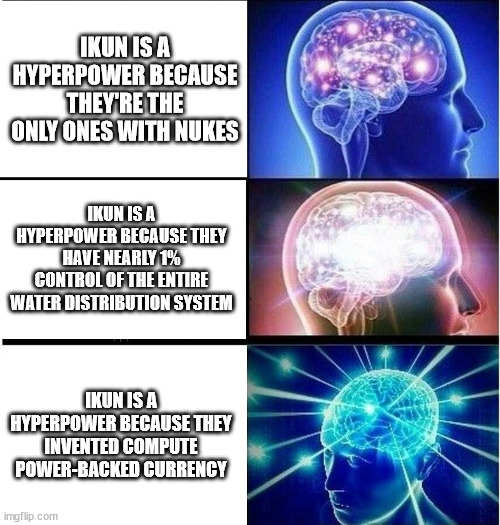
Re: Road to Hope
In the early Y950s, the joint Ikun-Koranah accelerator is finished, leaving Ikun to buy out its allies and consolidate their share of the project, while subtly encouraging Koranah to do the same, leaving just the two of them controlling the accelerator. However, Koranah themselves are unwilling to be bought out, and having full control of the accelerator is crucial in order to produce enough antimatter to catalyze the fusion reaction. However, Ikun does have a trick up their sleeve, in the form of asteroid mining, as their efforts have captured a metal-rich asteroid, primarily intended for Project Hope, but with considerable tantalum. Enough to flood the global market and crash its value, destroying the economies of To-on Kan and several other city-states that Koranah has shifted into its fold as part of their efforts to vertically integrate nanogear production, and thus wasting the resources that Koranah has invested into this goal, which is exactly what Ikun threatens to do if Koranah does not withdraw its government presence in the Near South (Dunelands+Ptekyen Highlands) which includes a couple of newly established Koranah military bases in the Dunelands, making it seem like it is more about encroaching Koranah influence in general, rather than the accelerator in specific. Koranah has little choice but to back down, but threatens to shut down any routes for Ikun to import high-performance nanogears if Ikun attempts to flood the precious metals market, a sort of economic mutually assured destruction, as it would lead to compute power becoming an order of magnitude more expensive in Ikun, and both sides drift closer and closer to direct sanctions against each other.
Meanwhile, technical and financial issues with Project Hope, combined with looming fears of a shortage on computer hardware due to an all-out exchange of sanctions between Ikun and Koranah, lead to a massive run on compute power with numerous entities scrambling to solve hard problems and build new computing clusters while they still can. This triggers a quick energy crisis, which despite its brevity, has far-reaching implications, as it drives up the day-to-day costs of Project Hope work--which, in addition to space launches, precision manufacturing, and a lot of other energy-intensive industry, also uses extensive computing power for the modeling and simulation needed to build a working starship. This brief spike in expenses finally pops the construction bubble, triggering a huge number of layoffs of many of the construction and manufacturing jobs that were brought back to Ikun since Project Hope begins, and a lot of projects, especially the huge and speculative ones, being rapidly canceled or abandoned in Ikun and beyond. Naturally, Nyektak-pack has directed Ikun's government to preserve Project Hope at all costs. In fact, many laid off packs start flooding to work for Project Hope, increasing the supply of workers and slowly starting to suppress wages, with pay for orbital construction workers falling from very high for a blue collar pack, to just decent.
Not long after the collapse of the construction bubble, Ratyanik-pack emerges from within Nyektak-pack's own administration to challenge them for City Alpha, making a grand and sensational case that Nyektak-pack has mismanaged Project Hope and caused the collapse of the construction bubble. Nyektak-pack ultimately emerges victorious, defending themselves as they have against many challenges over the years, burying their challenger in dry policy wonkery and boring and confusing the arbiter with abstruse political mathematics. Despite this, some anti-Hope nodes begin to emerge within the Lawspeakers' Association, though they are scattered far from center, as the fundamental balance still remains: killing Project Hope without killing CCS suppression is political suicide because it leaves no room for any answer to Ikun's political and ecological challenges, killing CCS suppression without killing Project Hope is political suicide because it will simply allow other city-states to control the global environment unopposed while Ikun is distracted with Project Hope, the two groups have fundamentally opposing ideological and strategic interests that make cooperation less likely. Nyektak-pack, while deeply concerned about the construction bubble collapse, ultimately blame short-sighted politicians and risky speculators putting too much economic strain on Hope and Ikun in general. However, they recognize that the specifications on Project Hope have been getting out of control and in order to not abandon it, it will have to be brought under control. Through slight and careful nurturing of anti-Hope Lawspeaker clusters, Nyektak-pack has manufactured a sort of controlled opposition, carefully keeping the flame small enough to not consume the Lawspeakers' Association with anti-Hope ideas, but just large enough to scare the politicians who have been most responsible for Project Hope's bloat into a more modest mission profile. With this, Nyektak-pack is able to cut the first wave of the invasion from five starships to just two.
In the meantime, both natural and artificial drama continue to play out in the Kyanah homeworld's biosphere. The increasing airweed blooms have begun killing off at-risk herbivores in the lower Meatbucket, taking out the only natural predator of the invasive tzeknid bush, which allows it to spread like wildflower across the fertile flood meadows, threatening native plantlife and herbivores, and encroaching into nearby deserts, reducing dust transfer into the Rktakian Kwardniet, where Ikun is located. The lack of nutrient rich dust coming in thins out the seasonal plains, causing deserts to advance north towards Ikun, and simultaneously the drop in vegetation is making the regolith less cohesive, leading to an upsurge in fires and sandstorms. In general, there seems to be a trend towards warmer and drier conditions, though this is a trend, not a universal rule. One area where it is particularly pronounced is the semi-arid deserts east of the Meatbucket, where Knertrietan city-state has entered a state of emergency as its oasis runs dry; it's the largest and most influential of dozens in the region to be affected. Ikun steps in to save them, using their extensive control nodes in the Water Distribution System to redirect water away from Koranah-aligned regions in the impoverished Nyruietkot Riyentkin; Ikun also reroutes more water to itself in this manner to support the on-world industrial processes needed for Project Hope, which have made Ikun's water consumption go through the roof. This gives Ikun the leverage they need to score a moderate win in their battle to keep the CCS out of the northern hemisphere, but accelerates the ongoing refugee crisis with packs (and even packless individuals) pouring out of the Nyruietkot Riyentkin and into the Meatbucket, disrupting local politics, and Koranah's military expeditions to "liberate" poor and developing city-states from Ikun via regime change add fuel to the fire. Andin city-state in particular, where some of the largest agricultural corporations in the world are headquartered, is less than enamored with Ikun's antics and reverses its ban on geoengineering technology in order to allow the development of CCS control nodes before Koranah's lead becomes insurmountable and in general just secure their own strategic goals against rivals and enemies using the Climate Control System. When Ikun predictably hits them with sanctions, Andin hits back with agricultural sanctions and meat prices in Ikun--a net food importer for many years--begin to rise.
In the late Y950s, the radical group Kyakenadak begins to form; while superficially similar to a human environmentalist group, Kyanah morality makes their underlying message very different. Instead of the standard tree-hugger screed like "for too long, we have prioritized corporate greed and consumption over the planet we live on. It's too late for half measures, our planet will die unless we destroy everything that's killing it, by any means necessary", it comes across more like "for too long, we have prioritized high-complexity systems over minimizing resource usage. It's too late for half measures, a catastrophic complexity and efficiency reduction is inevitable unless civilization reverts to a lower-complexity state, by any means necessary". Interestingly, this sentiment inherently carries with it a nativist and isolationist streak, with extreme opposition to global techno-political games like the Water Distribution System and Climate Control System. Also of interest is how mainstream Kyanah society views Kyakenadak and the dozens of related organizations that have sprung up around the planet during the Project Hope era: not as controversial activists with a point, but as dangerous and evil radicals: not only do their ideas threaten to reduce the complexity of their society's systems, but by doing so in the manner they propose, they are also kneecapping efficiency, requiring more resources to be expended for fewer resources gained, even if overall utilization of material resources may be lower. Even Kyakenadak supporters who are not violent are thus regarded as vile and despicable by most of society, and there are plenty of violent members orchestrating sabotage, shootings, and bombings already.
By Y960, 26 years (12 Earth years) after the beginning of Project Hope, the construction of atmospheric miners is nearly done, with a few million tons of fuel having been stockpiled in orbit around Entiak-Ryitu already, and after many technical and financial stumbling blocks, the actual blueprints of the Void Strider and Alpha Strider, the two interstellar vehicles that will travel to Earth in the first wave, have been finalized, meaning that actual planning of the payload--set at 200,000 tons for Void Strider and 50,000 tons for Alpha Strider--can begin in Ikun's universities and government and corporate labs, though significant innovations are still required to create a sufficiently "lean" invasion force that still has a high probability of achieving its objectives. However, the economy of Ikun is no longer on a knife's edge but has started a slow backslide, threatening to wipe out the economic gains from the early years of Project Hope. Ikun faces rising food prices, looming economic war with Koranah, and dwindling jobs--basically the same situation as before Project Hope, but Koranah has consolidated its lead in geoengineering technology and has refined and expanded its control nodes to the point that it has hundreds of them. In general, declining environmental conditions have started to turn the tide against Ikun in their efforts to suppress the CCS, and hundreds of city-states have built thousands of control nodes, though due to the size of the planet and the complexity of the environment, the system still only controls a fraction of a percent of the global environment. Amidst all this, Nyektak-pack have collectively convinced each other that leaving the planet via Project Hope is in spite of everything the only way forward for the Hegemony to exist in any form, as the Homeworld itself faces either impending Koranah hegemony or ecological death. Though their attitude towards this ranges from it simply being too late to turn back now to the current state of affairs being inevitable and Project Hope being a visionary plan enacted in anticipation of everything that has come to pass, they grow increasingly defensive of the intricate systems they have designed, seeing Project Hope as their crowning achievement and life's work, even as the populace increasingly despises them and their Alpha, Nyektak Tun begins to slowly but surely lose mental acuity, increasingly struggling with complex deduction and stumbling over words.
Meanwhile, technical and financial issues with Project Hope, combined with looming fears of a shortage on computer hardware due to an all-out exchange of sanctions between Ikun and Koranah, lead to a massive run on compute power with numerous entities scrambling to solve hard problems and build new computing clusters while they still can. This triggers a quick energy crisis, which despite its brevity, has far-reaching implications, as it drives up the day-to-day costs of Project Hope work--which, in addition to space launches, precision manufacturing, and a lot of other energy-intensive industry, also uses extensive computing power for the modeling and simulation needed to build a working starship. This brief spike in expenses finally pops the construction bubble, triggering a huge number of layoffs of many of the construction and manufacturing jobs that were brought back to Ikun since Project Hope begins, and a lot of projects, especially the huge and speculative ones, being rapidly canceled or abandoned in Ikun and beyond. Naturally, Nyektak-pack has directed Ikun's government to preserve Project Hope at all costs. In fact, many laid off packs start flooding to work for Project Hope, increasing the supply of workers and slowly starting to suppress wages, with pay for orbital construction workers falling from very high for a blue collar pack, to just decent.
Not long after the collapse of the construction bubble, Ratyanik-pack emerges from within Nyektak-pack's own administration to challenge them for City Alpha, making a grand and sensational case that Nyektak-pack has mismanaged Project Hope and caused the collapse of the construction bubble. Nyektak-pack ultimately emerges victorious, defending themselves as they have against many challenges over the years, burying their challenger in dry policy wonkery and boring and confusing the arbiter with abstruse political mathematics. Despite this, some anti-Hope nodes begin to emerge within the Lawspeakers' Association, though they are scattered far from center, as the fundamental balance still remains: killing Project Hope without killing CCS suppression is political suicide because it leaves no room for any answer to Ikun's political and ecological challenges, killing CCS suppression without killing Project Hope is political suicide because it will simply allow other city-states to control the global environment unopposed while Ikun is distracted with Project Hope, the two groups have fundamentally opposing ideological and strategic interests that make cooperation less likely. Nyektak-pack, while deeply concerned about the construction bubble collapse, ultimately blame short-sighted politicians and risky speculators putting too much economic strain on Hope and Ikun in general. However, they recognize that the specifications on Project Hope have been getting out of control and in order to not abandon it, it will have to be brought under control. Through slight and careful nurturing of anti-Hope Lawspeaker clusters, Nyektak-pack has manufactured a sort of controlled opposition, carefully keeping the flame small enough to not consume the Lawspeakers' Association with anti-Hope ideas, but just large enough to scare the politicians who have been most responsible for Project Hope's bloat into a more modest mission profile. With this, Nyektak-pack is able to cut the first wave of the invasion from five starships to just two.
In the meantime, both natural and artificial drama continue to play out in the Kyanah homeworld's biosphere. The increasing airweed blooms have begun killing off at-risk herbivores in the lower Meatbucket, taking out the only natural predator of the invasive tzeknid bush, which allows it to spread like wildflower across the fertile flood meadows, threatening native plantlife and herbivores, and encroaching into nearby deserts, reducing dust transfer into the Rktakian Kwardniet, where Ikun is located. The lack of nutrient rich dust coming in thins out the seasonal plains, causing deserts to advance north towards Ikun, and simultaneously the drop in vegetation is making the regolith less cohesive, leading to an upsurge in fires and sandstorms. In general, there seems to be a trend towards warmer and drier conditions, though this is a trend, not a universal rule. One area where it is particularly pronounced is the semi-arid deserts east of the Meatbucket, where Knertrietan city-state has entered a state of emergency as its oasis runs dry; it's the largest and most influential of dozens in the region to be affected. Ikun steps in to save them, using their extensive control nodes in the Water Distribution System to redirect water away from Koranah-aligned regions in the impoverished Nyruietkot Riyentkin; Ikun also reroutes more water to itself in this manner to support the on-world industrial processes needed for Project Hope, which have made Ikun's water consumption go through the roof. This gives Ikun the leverage they need to score a moderate win in their battle to keep the CCS out of the northern hemisphere, but accelerates the ongoing refugee crisis with packs (and even packless individuals) pouring out of the Nyruietkot Riyentkin and into the Meatbucket, disrupting local politics, and Koranah's military expeditions to "liberate" poor and developing city-states from Ikun via regime change add fuel to the fire. Andin city-state in particular, where some of the largest agricultural corporations in the world are headquartered, is less than enamored with Ikun's antics and reverses its ban on geoengineering technology in order to allow the development of CCS control nodes before Koranah's lead becomes insurmountable and in general just secure their own strategic goals against rivals and enemies using the Climate Control System. When Ikun predictably hits them with sanctions, Andin hits back with agricultural sanctions and meat prices in Ikun--a net food importer for many years--begin to rise.
In the late Y950s, the radical group Kyakenadak begins to form; while superficially similar to a human environmentalist group, Kyanah morality makes their underlying message very different. Instead of the standard tree-hugger screed like "for too long, we have prioritized corporate greed and consumption over the planet we live on. It's too late for half measures, our planet will die unless we destroy everything that's killing it, by any means necessary", it comes across more like "for too long, we have prioritized high-complexity systems over minimizing resource usage. It's too late for half measures, a catastrophic complexity and efficiency reduction is inevitable unless civilization reverts to a lower-complexity state, by any means necessary". Interestingly, this sentiment inherently carries with it a nativist and isolationist streak, with extreme opposition to global techno-political games like the Water Distribution System and Climate Control System. Also of interest is how mainstream Kyanah society views Kyakenadak and the dozens of related organizations that have sprung up around the planet during the Project Hope era: not as controversial activists with a point, but as dangerous and evil radicals: not only do their ideas threaten to reduce the complexity of their society's systems, but by doing so in the manner they propose, they are also kneecapping efficiency, requiring more resources to be expended for fewer resources gained, even if overall utilization of material resources may be lower. Even Kyakenadak supporters who are not violent are thus regarded as vile and despicable by most of society, and there are plenty of violent members orchestrating sabotage, shootings, and bombings already.
By Y960, 26 years (12 Earth years) after the beginning of Project Hope, the construction of atmospheric miners is nearly done, with a few million tons of fuel having been stockpiled in orbit around Entiak-Ryitu already, and after many technical and financial stumbling blocks, the actual blueprints of the Void Strider and Alpha Strider, the two interstellar vehicles that will travel to Earth in the first wave, have been finalized, meaning that actual planning of the payload--set at 200,000 tons for Void Strider and 50,000 tons for Alpha Strider--can begin in Ikun's universities and government and corporate labs, though significant innovations are still required to create a sufficiently "lean" invasion force that still has a high probability of achieving its objectives. However, the economy of Ikun is no longer on a knife's edge but has started a slow backslide, threatening to wipe out the economic gains from the early years of Project Hope. Ikun faces rising food prices, looming economic war with Koranah, and dwindling jobs--basically the same situation as before Project Hope, but Koranah has consolidated its lead in geoengineering technology and has refined and expanded its control nodes to the point that it has hundreds of them. In general, declining environmental conditions have started to turn the tide against Ikun in their efforts to suppress the CCS, and hundreds of city-states have built thousands of control nodes, though due to the size of the planet and the complexity of the environment, the system still only controls a fraction of a percent of the global environment. Amidst all this, Nyektak-pack have collectively convinced each other that leaving the planet via Project Hope is in spite of everything the only way forward for the Hegemony to exist in any form, as the Homeworld itself faces either impending Koranah hegemony or ecological death. Though their attitude towards this ranges from it simply being too late to turn back now to the current state of affairs being inevitable and Project Hope being a visionary plan enacted in anticipation of everything that has come to pass, they grow increasingly defensive of the intricate systems they have designed, seeing Project Hope as their crowning achievement and life's work, even as the populace increasingly despises them and their Alpha, Nyektak Tun begins to slowly but surely lose mental acuity, increasingly struggling with complex deduction and stumbling over words.
Re: Road to Hope
By the early Y960s, Koranah has successfully used the Climate Control System to warm up the weather patterns of their city-state, in the far south, creating greater suitability for agriculture, reducing their reliance on food imports and energy use for heating in the winter. This has had knock-on effects in increasing vegetation in some places in the far south, but the heat has to come from somewhere, so it does create a notable cooling and drying effect in other Far South city-states like Kanenhah; the biggest targets of this have a distinct tendency to be Ikun-aligned or at least anti-Koranah, overpowering the efforts of most city-states with CCS control nodes to defend their climate, though it does win Koranah many south polar allies as the CCS has been instrumental in introducing some much-needed biodiversity. The influx of cool air runs up against the warmer air of the Middle South, creating anomalous super-storms, which they promise to redirect into more arid regions in exchange for political favors such as kicking out Ikun military bases and entering one-sided trade deals with Koranah. Koranah's dictator Kiinyun-pack decides that this is the time to directly use the CCS to go on the offensive against Ikun, executing one minister pack who suggests it may be advisable to simply wait and let Ikun collapse in on itself. Thereafter, Koranah begins to use the CCS to shrink the deserts in the Dunelands with an expanding wave of genetically engineered vegetation and microbes, pushing the Dunelands back even beyond their natural borders in the southeast within a few years. In addition to making key parts of the eastern Dunelands more habitable, thus slowing--but not eliminating--immigration to the Rktakian Kwardniet and depriving Ikun of a labor supply, this also shrinks the wintering habitat of various migratory desert species that live near Ikun, further destabilizing Ikun's ecosystems. Koranah further targets Ikun's current largest agricultural suppliers with droughts, heatwaves, and genetically engineering the natural predators of various pests into extinction.
To this, Ikun finally responds with direct sanctions on Koranah, leveraging its nontrivial economic might to block the flow of high-tech goods and services into Koranah, as well as announcing that Ikun's military--traditionally taking on the role of combating bandits on inter-state land across the world--will no longer be doing so in the vicinity of Koranah, and using the Water Distribution System to systematically redirect water away from Koranah. It seems that Koranah--now under Kiinyun-pack's equally totalitarian successor Nyutnie-pack, has overplayed their hand with the CCS, because many city-states, even those opposed to Ikun and/or on board with the CCS join Ikun in this endeavor, winning Ikun back allies to replace some of those they have lost in recent years, and Ikun, despite everything, still has the third-largest economy on the planet. Naturally Ikun's sanctions against Koranah--and Koranah's economic retaliation against Ikun--do little or nothing to the packs with political power, who mostly dump the costs on the rest of the populace. In Ikun, anger and distrust increasingly grows against Nyektak-pack, who face more challengers for the position of City Alpha, though none seem to be able to present a case that sticks. The pack continues refusing to acknowledge that they have bet all of Ikun's resources on Project Hope and lost the bet, clinging to the notion that Project Hope is a genius political sacrifice that can still render Ikun a hyperpower in Earth geopolitics and allow them to make a resurgence later; this seems to be a mix of saving face in order to preserve the systems they have built within Ikun politics during their career, and delusional thinking brought about by age and cognitive decline. Anti-Hope sentiment is growing amongst the public, and anti-Hope Lawspeakers are becoming more and more numerous and organized, coalescing around a shrewd and charismatic new Lawspeaker Ryen-pack to create a dual-center political topography where one side has no interest in either Project Hope or suppressing the CCS (in fact, being pro-CCS in the case of Ryen-pack themselves), destabilizing the topography that Nyektak-pack has crafted, though actually killing it is hard when Nyektak-pack is spending all their political capital defending it. All the while, Kyakenadak grows increasingly well supported and funded as a response to the collapsing world order and destruction of the environment.
However, the Water Distribution System is becoming increasingly strained due to increasing population and decreasing average rainfall across the world, and the recession in Ikun continues to worsen. As a result, Ikoin Corporation and other Project Hope contractors begin to lower standards and cut corners, increasingly relying on cheap Dunelands workers with poor training and limited knowledge of Ikun's language, leading to accidents and unrest at the Interstellar Vehicle Assembly Hub. Ikun's oasis runs dry for the first time in recent history and even their control nodes on the Water Distribution System aren't enough to cover the shortage, leading to rationing and emergency negotiations for other city-states to use their control nodes to push water to Ikun in exchange for money and geopolitical favors. In the chaos, Koranah chooses this moment to set up a couple of control nodes in the Rktakian Kwardniet, only a few hundred kilometers from Ikun, to goad them into a response; this also serves as a display of strength by Nyutnie-pack, who are still consolidating their power as Koranah's new dictator and have not yet managed to purge every senior politician who poses a threat. The idea of a nuclear strike on Koranah comes up in Ikun, but cooler heads prevail, as nuclear annihilation for reasons other than preserving Ikun's nuclear monopoly would only further destabilize the already collapsing Hegemony. Ikun does the slightly less unthinkable but still unthinkable and floods the market for tantalum and other precious metals using their asteroid mining, crashing prices across the world and netting Ikun a hefty profit. Naturally, Koranah retaliates with their own trump card, as per their plan: a shutdown on cheap nanogear sales to Ikun, threatening to drive compute costs through the roof. This triggers mass panic computing; since Ikun's currency is backed by compute power, countless corporations and governments that hold Ikun-koin scramble to redeem their compute power while they still can, which reveals the key flaw in Ikun's compute power-backed currency: demand for compute power has in recent years outstripped innovations in computing technology and there is actually more currency printed than there is available compute units, and this has been the case for years, something which few have been aware of until now. Those seeking to redeem their compute power face massive delays and queues as everyone else is trying to do the same thing, crashing the value of Ikun's currency.
Nyektak-pack seems to have seen this coming, and prepared by acquiring a significant stash of foreign currency and filling up Ikun's state reserves of nanogears in advance; this, combined with the momentary profits from flooding the tantalum market, give them just enough time to orchestrate a wave of nationalizations. While this is partially being done in order to fleece the newly nationalized companies for resources and funds to pump into Project Hope, there is a second purpose: by specifically targeting companies in industries with a high proportion of young workers, eliminating possible economic routes for them in the coming years in order to funnel them into the military, as Project Hope will require a massive number of troops--some 20% of Ikun's entire military force. With Ikoin Corporation itself, Ikun's government gives their executive packs golden parachutes to get rid of them with minimal backlash and proceeds to nationalize the corporation to gain direct oversight over Project Hope and cut short-term costs. Emerging from this is another wave of Kyakenadak attacks, most notably a dirty bomb in Ikun's spaceport that kills 351 of Project Hope's construction workers.
By Y970, 36 years (16.6 Earth years) after the beginning of Project Hope, the hulls of the Void Strider and Alpha Strider have been completed and progress wrapping up on installing and testing the interstellar engines. The Climate Control System has continued to gain hundreds of nodes per year made by hundreds of city-states and while Koranah maintains superiority over the system, other city-states such as Andin and Aiyahah have emerged as strong competitors with many CCS control nodes of their own and less overtly hostile relations towards Ikun. Ikun ostensibly continues its crusade against the CCS, as their laws against geoengineering are still on the books, and they have been devoting all their resources to finishing Project Hope rather than building control nodes in any case. The increasing desertification in the Rktakian Kwardniet has spread to the Western Sector and Kuayen Plains is having an effect on rain patterns in the Great Polar Plateau and Meatbucket, especially threatening agriculture in the latter, though city-states such as Andin, with extensive CCS nodes to control regional weather and ecologies, seem to be doing well with this change, though Aiyahah is disapproving of it, as refugees have started to come northwards from the rapidly heating and desertifying Rktakian Kwardniet, and have taken steps to reverse Andin's changes by creating their own genetically engineered ecosystems and artificial weather patterns, leading to significant CCS competition that has little or nothing to do with either Ikun or Koranah. With the observation that Koranah is not the only power player in the CCS, Ikun's enforcement of the CCS ban becomes much more half-hearted, especially against pro-Ikun city-states, though the laws still remain on the books; Nyektak-pack decides to focus Ikun's increasingly limited resources elsewhere and turning their original plan for a two-world Hegemony into a one-world Hegemony with the bulk of Ikun's influence being on Earth, as even the most bullish Climate Control System opponents will acknowledge that Ikun has lost the fight to suppress it. In the meantime, Lawspeaker Ryen-pack is preparing for a challenge against Nyektak-pack for City Alpha due to their role in collapsing Ikun's currency.
To this, Ikun finally responds with direct sanctions on Koranah, leveraging its nontrivial economic might to block the flow of high-tech goods and services into Koranah, as well as announcing that Ikun's military--traditionally taking on the role of combating bandits on inter-state land across the world--will no longer be doing so in the vicinity of Koranah, and using the Water Distribution System to systematically redirect water away from Koranah. It seems that Koranah--now under Kiinyun-pack's equally totalitarian successor Nyutnie-pack, has overplayed their hand with the CCS, because many city-states, even those opposed to Ikun and/or on board with the CCS join Ikun in this endeavor, winning Ikun back allies to replace some of those they have lost in recent years, and Ikun, despite everything, still has the third-largest economy on the planet. Naturally Ikun's sanctions against Koranah--and Koranah's economic retaliation against Ikun--do little or nothing to the packs with political power, who mostly dump the costs on the rest of the populace. In Ikun, anger and distrust increasingly grows against Nyektak-pack, who face more challengers for the position of City Alpha, though none seem to be able to present a case that sticks. The pack continues refusing to acknowledge that they have bet all of Ikun's resources on Project Hope and lost the bet, clinging to the notion that Project Hope is a genius political sacrifice that can still render Ikun a hyperpower in Earth geopolitics and allow them to make a resurgence later; this seems to be a mix of saving face in order to preserve the systems they have built within Ikun politics during their career, and delusional thinking brought about by age and cognitive decline. Anti-Hope sentiment is growing amongst the public, and anti-Hope Lawspeakers are becoming more and more numerous and organized, coalescing around a shrewd and charismatic new Lawspeaker Ryen-pack to create a dual-center political topography where one side has no interest in either Project Hope or suppressing the CCS (in fact, being pro-CCS in the case of Ryen-pack themselves), destabilizing the topography that Nyektak-pack has crafted, though actually killing it is hard when Nyektak-pack is spending all their political capital defending it. All the while, Kyakenadak grows increasingly well supported and funded as a response to the collapsing world order and destruction of the environment.
However, the Water Distribution System is becoming increasingly strained due to increasing population and decreasing average rainfall across the world, and the recession in Ikun continues to worsen. As a result, Ikoin Corporation and other Project Hope contractors begin to lower standards and cut corners, increasingly relying on cheap Dunelands workers with poor training and limited knowledge of Ikun's language, leading to accidents and unrest at the Interstellar Vehicle Assembly Hub. Ikun's oasis runs dry for the first time in recent history and even their control nodes on the Water Distribution System aren't enough to cover the shortage, leading to rationing and emergency negotiations for other city-states to use their control nodes to push water to Ikun in exchange for money and geopolitical favors. In the chaos, Koranah chooses this moment to set up a couple of control nodes in the Rktakian Kwardniet, only a few hundred kilometers from Ikun, to goad them into a response; this also serves as a display of strength by Nyutnie-pack, who are still consolidating their power as Koranah's new dictator and have not yet managed to purge every senior politician who poses a threat. The idea of a nuclear strike on Koranah comes up in Ikun, but cooler heads prevail, as nuclear annihilation for reasons other than preserving Ikun's nuclear monopoly would only further destabilize the already collapsing Hegemony. Ikun does the slightly less unthinkable but still unthinkable and floods the market for tantalum and other precious metals using their asteroid mining, crashing prices across the world and netting Ikun a hefty profit. Naturally, Koranah retaliates with their own trump card, as per their plan: a shutdown on cheap nanogear sales to Ikun, threatening to drive compute costs through the roof. This triggers mass panic computing; since Ikun's currency is backed by compute power, countless corporations and governments that hold Ikun-koin scramble to redeem their compute power while they still can, which reveals the key flaw in Ikun's compute power-backed currency: demand for compute power has in recent years outstripped innovations in computing technology and there is actually more currency printed than there is available compute units, and this has been the case for years, something which few have been aware of until now. Those seeking to redeem their compute power face massive delays and queues as everyone else is trying to do the same thing, crashing the value of Ikun's currency.
Nyektak-pack seems to have seen this coming, and prepared by acquiring a significant stash of foreign currency and filling up Ikun's state reserves of nanogears in advance; this, combined with the momentary profits from flooding the tantalum market, give them just enough time to orchestrate a wave of nationalizations. While this is partially being done in order to fleece the newly nationalized companies for resources and funds to pump into Project Hope, there is a second purpose: by specifically targeting companies in industries with a high proportion of young workers, eliminating possible economic routes for them in the coming years in order to funnel them into the military, as Project Hope will require a massive number of troops--some 20% of Ikun's entire military force. With Ikoin Corporation itself, Ikun's government gives their executive packs golden parachutes to get rid of them with minimal backlash and proceeds to nationalize the corporation to gain direct oversight over Project Hope and cut short-term costs. Emerging from this is another wave of Kyakenadak attacks, most notably a dirty bomb in Ikun's spaceport that kills 351 of Project Hope's construction workers.
By Y970, 36 years (16.6 Earth years) after the beginning of Project Hope, the hulls of the Void Strider and Alpha Strider have been completed and progress wrapping up on installing and testing the interstellar engines. The Climate Control System has continued to gain hundreds of nodes per year made by hundreds of city-states and while Koranah maintains superiority over the system, other city-states such as Andin and Aiyahah have emerged as strong competitors with many CCS control nodes of their own and less overtly hostile relations towards Ikun. Ikun ostensibly continues its crusade against the CCS, as their laws against geoengineering are still on the books, and they have been devoting all their resources to finishing Project Hope rather than building control nodes in any case. The increasing desertification in the Rktakian Kwardniet has spread to the Western Sector and Kuayen Plains is having an effect on rain patterns in the Great Polar Plateau and Meatbucket, especially threatening agriculture in the latter, though city-states such as Andin, with extensive CCS nodes to control regional weather and ecologies, seem to be doing well with this change, though Aiyahah is disapproving of it, as refugees have started to come northwards from the rapidly heating and desertifying Rktakian Kwardniet, and have taken steps to reverse Andin's changes by creating their own genetically engineered ecosystems and artificial weather patterns, leading to significant CCS competition that has little or nothing to do with either Ikun or Koranah. With the observation that Koranah is not the only power player in the CCS, Ikun's enforcement of the CCS ban becomes much more half-hearted, especially against pro-Ikun city-states, though the laws still remain on the books; Nyektak-pack decides to focus Ikun's increasingly limited resources elsewhere and turning their original plan for a two-world Hegemony into a one-world Hegemony with the bulk of Ikun's influence being on Earth, as even the most bullish Climate Control System opponents will acknowledge that Ikun has lost the fight to suppress it. In the meantime, Lawspeaker Ryen-pack is preparing for a challenge against Nyektak-pack for City Alpha due to their role in collapsing Ikun's currency.
Re: Road to Hope
In Y970, Lawspeaker Ryen-pack challenges Nyektak-pack for City Alpha in a long and drawn-out proceeding that very nearly succeeds, even with an Arbiter that is clearly biased towards the incumbent and willing to overlook the fact that Nyektak-pack is on death's door. Even to the very end, Nyektak-pack refuses to admit any error and even orders air strikes on CCS control nodes set up by weaker city-states in a hail-Mary attempt to stop the CCS. In fact, later that year, Nyektak Nyak dies due to his second lab-grown heart failing before its scheduled replacement, downgrading Nyektak-pack to a pack fragment, which causes the City Alpha position to pass to their designated successor, their ambassador to the Coalition of Cities (also Nyektak-pack), who unlike the original Nyektak-pack, is hated from day one. The new administration is still committed to Project Hope, but immediately orders a halt on military action against the CCS. They also oversee the completion of the first Void Strider and Alpha Strider and the start of construction on the second, continuing to sell Project Hope as a jobs program and an escape route from an increasingly unstable Homeworld. The Climate Control System continues to expand across the world and in fact its growth accelerates as more and more city-states begin building control nodes. However, Kyanah intervention via the CCS and other, less sophisticated forms of geoengineering still only has around a 1% stake in global climate patterns and ecosystems (albeit much greater in proximity to control nodes, and the global control is growing fast), and in other areas, the chain reaction of falling keystone species leading to less cohesive soil and more dust, leading to drying oases and more falling keystone species continues, even as areas containing city-states with CCS superiority are doing as well or even better than in preindustrial times, environmentally speaking.
In response to this, and a second great drying of Ikun's oasis in spite of the Water Distribution System, and diminishing priority from Ikun's administration on CCS suppression in favor of other goals in the goal set and increasing constraints on CCS suppression goals, Ikun's Lawspeakers repeal the geoengineering ban and CCS suppression directive, and seek to use their still impressive military strength--including peaceful nuclear explosion capabilities--and strong space presence as a bargaining chip to gain allies with CCS superiority until Ikun can get its own control nodes. However, this proves to be too little too late, as Ikun has burned through much of its geopolitical good will and many of the brightest minds and most promising companies in the geoengineering space left Ikun years ago. Project Hope still limps on due to inertia and its perceived use as an exit hatch for the city-state, being funded through cannibalizing remaining state reserves and state-owned companies, while utilizing the expanding military for public works, although the City Alpha continues to devote less and less funding to it. The first wave finally departs for Earth in Y976, with plans for the second Void Strider and Alpha Strider to depart in Y981 (2.3 Earth years later). However, technical and financial shortcomings delay this, which is finally the straw that breaks the camel's back and leads to the cancellation in Y979 of Project Hope and the abandonment of the second Void Strider and Alpha Strider, and the deuterium capture plants in the atmosphere of the gas giant Entiak-Ryitu. And so, Ikun's 21 Earth year long geopolitical blunder comes to an end not with a bang, but with a whimper.
It is too late for Ikun to recover though. A third drying of Ikun's oasis in Y982 leads to thousands of deaths, a mass exodus from the Ikun metro area, and the younger Nyektak-pack being successfully challenged and deposed by a demagogue Ayktran-pack, leading to a brutal dictatorship, violent purges, and thousands more deaths. Instead of Ayktran-pack's promised prosperity and order, Ikun gets mass unrest and a chaotic multi-way on-and-off civil war between top military brass and high-ranking civilian packs starting in Y989, which spills over into surrounding city-states in the metro area. Due to concerns about Ikun's nuclear arsenal ending up in the hands of some radical and bloodlusted faction, multiple foreign Climate Control System superpowers including Koranah step in and get involved in the conflict. And In Y993, the unthinkable happens when Koranah decides to take advantage of the chaos in Ikun to openly defy the Hegemony and break the nuclear monopoly. And when Ikun does not annihilate them, many others follow, heralding the transition from a nuclear monopoly governed by the Hegemony to a truly multi-polar world governed by mutually assured destruction. Soon after, in Y995, Ikun's civil war draws to a close with the Partition of Ikun as the three major CCS superpowers--Koranah, Andin, and Aiyahah--occupy zones of the former hyperpower to ensure order and assist with rebuilding in exchange for assistance in tracking down and confiscating the nuclear arsenal. Though it would take 20-30 Earth years (~50 Homeworld years) until all of them were accounted for. In the meantime, the borders of city-states in the Ikun metro area are redrawn in line with the zones delineated in the Partition of Ikun, folding some of Ikun's territory into surrounding city-states like Nktan and turning the rest into new successor states in Y1002. By Y1017, the foreign occupying forces would gradually start pulling out, leaving Ikun's successors to their own devices, though none would amount to anything more than regional powers.
By the time the dust settles in Ikun, the Climate Control System has enough control nodes that it actually is responsible for a supermajority of the environmental conditions on the Kyanah homeworld. As a result, the climate and ecological crisis facing them has greatly diminished in significance. Instead, the environment is systematically managed and controlled by state actors (and some corporations and NGOs) to maximize resources and pursue strategic agendas, much like the Water Distribution System, which has itself become less influential, though still quite relevant. Many city-states--especially the superpowers in this new multipolar world order without a nuclear monopoly--have not only stabilized their own environments, but as good or even better for habitability and ecological and economic productivity than in preindustrial times, essentially showing the capability of the Climate Control System to be more efficient than nature itself at optimizing the environment, fixing weather patterns and generating ecosystems to maximize environmental suitability for the users of control nodes. As a result, even though global ecological collapse is no longer a concern, the environment itself has turned into a techno-political game with winners and losers determined by the number and quality of control nodes, and the hardware and software resources devoted to computing an optimal strategy.
In time, Project Hope--often called Nyektak-pack's Blunder (or, in a humorous understatement, Nyektak-pack's Positional Inaccuracy)--fades from the forefront of public consciousness, never really forgotten of course, but not a huge topic of conversation or debate in most circles. But the soldiers and civilian researchers on board Void Strider and Alpha Strider continue inching through the gulf between the stars at 7.5% of light speed, deep in the cold sleep and unaware of everything that happened behind them. Indeed, in Y1324 (AD2023) they would arrive at Earth and set in motion the plans that were laid so many years ago and begin identifying targets to begin the invasion with some 30,000 troops, completely unaware that there would be no backup coming and that they were fighting for the strategic interests of a state that no longer existed, starting yet another chapter in the pointless fiasco of Project Hope.
In response to this, and a second great drying of Ikun's oasis in spite of the Water Distribution System, and diminishing priority from Ikun's administration on CCS suppression in favor of other goals in the goal set and increasing constraints on CCS suppression goals, Ikun's Lawspeakers repeal the geoengineering ban and CCS suppression directive, and seek to use their still impressive military strength--including peaceful nuclear explosion capabilities--and strong space presence as a bargaining chip to gain allies with CCS superiority until Ikun can get its own control nodes. However, this proves to be too little too late, as Ikun has burned through much of its geopolitical good will and many of the brightest minds and most promising companies in the geoengineering space left Ikun years ago. Project Hope still limps on due to inertia and its perceived use as an exit hatch for the city-state, being funded through cannibalizing remaining state reserves and state-owned companies, while utilizing the expanding military for public works, although the City Alpha continues to devote less and less funding to it. The first wave finally departs for Earth in Y976, with plans for the second Void Strider and Alpha Strider to depart in Y981 (2.3 Earth years later). However, technical and financial shortcomings delay this, which is finally the straw that breaks the camel's back and leads to the cancellation in Y979 of Project Hope and the abandonment of the second Void Strider and Alpha Strider, and the deuterium capture plants in the atmosphere of the gas giant Entiak-Ryitu. And so, Ikun's 21 Earth year long geopolitical blunder comes to an end not with a bang, but with a whimper.
It is too late for Ikun to recover though. A third drying of Ikun's oasis in Y982 leads to thousands of deaths, a mass exodus from the Ikun metro area, and the younger Nyektak-pack being successfully challenged and deposed by a demagogue Ayktran-pack, leading to a brutal dictatorship, violent purges, and thousands more deaths. Instead of Ayktran-pack's promised prosperity and order, Ikun gets mass unrest and a chaotic multi-way on-and-off civil war between top military brass and high-ranking civilian packs starting in Y989, which spills over into surrounding city-states in the metro area. Due to concerns about Ikun's nuclear arsenal ending up in the hands of some radical and bloodlusted faction, multiple foreign Climate Control System superpowers including Koranah step in and get involved in the conflict. And In Y993, the unthinkable happens when Koranah decides to take advantage of the chaos in Ikun to openly defy the Hegemony and break the nuclear monopoly. And when Ikun does not annihilate them, many others follow, heralding the transition from a nuclear monopoly governed by the Hegemony to a truly multi-polar world governed by mutually assured destruction. Soon after, in Y995, Ikun's civil war draws to a close with the Partition of Ikun as the three major CCS superpowers--Koranah, Andin, and Aiyahah--occupy zones of the former hyperpower to ensure order and assist with rebuilding in exchange for assistance in tracking down and confiscating the nuclear arsenal. Though it would take 20-30 Earth years (~50 Homeworld years) until all of them were accounted for. In the meantime, the borders of city-states in the Ikun metro area are redrawn in line with the zones delineated in the Partition of Ikun, folding some of Ikun's territory into surrounding city-states like Nktan and turning the rest into new successor states in Y1002. By Y1017, the foreign occupying forces would gradually start pulling out, leaving Ikun's successors to their own devices, though none would amount to anything more than regional powers.
By the time the dust settles in Ikun, the Climate Control System has enough control nodes that it actually is responsible for a supermajority of the environmental conditions on the Kyanah homeworld. As a result, the climate and ecological crisis facing them has greatly diminished in significance. Instead, the environment is systematically managed and controlled by state actors (and some corporations and NGOs) to maximize resources and pursue strategic agendas, much like the Water Distribution System, which has itself become less influential, though still quite relevant. Many city-states--especially the superpowers in this new multipolar world order without a nuclear monopoly--have not only stabilized their own environments, but as good or even better for habitability and ecological and economic productivity than in preindustrial times, essentially showing the capability of the Climate Control System to be more efficient than nature itself at optimizing the environment, fixing weather patterns and generating ecosystems to maximize environmental suitability for the users of control nodes. As a result, even though global ecological collapse is no longer a concern, the environment itself has turned into a techno-political game with winners and losers determined by the number and quality of control nodes, and the hardware and software resources devoted to computing an optimal strategy.
In time, Project Hope--often called Nyektak-pack's Blunder (or, in a humorous understatement, Nyektak-pack's Positional Inaccuracy)--fades from the forefront of public consciousness, never really forgotten of course, but not a huge topic of conversation or debate in most circles. But the soldiers and civilian researchers on board Void Strider and Alpha Strider continue inching through the gulf between the stars at 7.5% of light speed, deep in the cold sleep and unaware of everything that happened behind them. Indeed, in Y1324 (AD2023) they would arrive at Earth and set in motion the plans that were laid so many years ago and begin identifying targets to begin the invasion with some 30,000 troops, completely unaware that there would be no backup coming and that they were fighting for the strategic interests of a state that no longer existed, starting yet another chapter in the pointless fiasco of Project Hope.
Re: Road to Hope
The CCS is pretty OP. If you think of nanobots, it's quite similar, but with available Kyanah technology, stereotypical machine-like nanobots are expensive and plagued by issues with generating sufficient power to stay active for long, and can't self-replicate reliably. But do you know what can survive and self-replicate indefinitely with resources it finds in a natural environment? Nature's nanobots, aka microbes. Throw in abiogenesis in laboratory conditions just being a thing they can do (think the Miller-Urey experiment, but proceeding far enough to actually make life from scratch). The basic setup for abiogenesis can be done by students of the first rank in the relevant fields (basically the closest equivalent to undergrads in the human educational system), and more complex settings like the inside of a CCS control node can allow for considerable customization, allowing them to skip the step of finding useful organisms and genetically engineering them, instead just spawning in life from scratch. Though CCS control nodes can also directly modify existing life; as it turns out, nature's nanobots can be guided to execute gene drives on existing species, using whatever equivalent of CRISPR they have for peptide nucleic acid, either buffing nearby species against environmental threats, modding them to take on a new role in the ecosystem, or just straight up sterilizing and destroying them. As for controlling the climate directly (as in the name), it's not hard to use the same tools to seed clouds or disperse clouds, or modify the local albedo to influence temperature gradients, or produce or consume trace chemicals in the atmosphere,
Put it all together, it's quite possible that if you put maybe even just a few dozen control nodes (calibrated for Earth life and Earth conditions, which would obviously be a nontrivial task) in exactly the right spots in the Bodele Depression, you could destroy the Amazon Rainforest in a few decades, assuming whoever made the control nodes really wanted to do that for some reason (maybe it's a galaxy-brained scheme to collapse a political rival, or maybe they just wanna spruce up the Sahara Desert a bit, idk). Unless there were control nodes in the Amazon Rainforest that could genetically engineer all the keystone species to survive this attack, and/or nodes somewhere else in the Sahara perhaps, to redirect nutrient-rich dust from somewhere else to the Amazon, or destroy the local environment around whoever owns the Bodele Depression control nodes to force them to redirect their resources to defensive geoengineering. The fate of the Amazon Rainforest would hinge on which side has more sophisticated and better placed control nodes (naturally the Kyanah, with their advanced optimization tech, are really good at this) and which side has better ecological modeling--and game theoretic modeling, if there are other parties with control nodes who might get involved.
So what's the worst they could do with the CCS on their homeworld with its thousands upon thousands of control nodes? Probably identify all the most important keystone species, sterilize them with gene drives, collapse the food web for multicellular life, then stack the atmosphere with built-from-scratch microbes designed to max pollutant output and cook the atmosphere with methanogenic microbes (or if they really wanna get spicy, figure out how to make a microbe that produces sulfur hexafluoride) for a runaway greenhouse effect. Getting an ice age by Earth standards would be hard to do within a reasonable timeframe, but with enough sulfur dioxide producers and/or stacking the stratosphere with reflective life forms, you could probably get ice caps and wintertime snow dusting at temperate latitudes. It's basically terraforming-lite, but from the bottom up instead of the top down. But if anyone actually tried to do any of this on a global scale, everyone else readjust their weather patterns, defend or replace the keystone species with new ones, and prepare a counterattack on whatever idiot thought that was a good idea.
Put it all together, it's quite possible that if you put maybe even just a few dozen control nodes (calibrated for Earth life and Earth conditions, which would obviously be a nontrivial task) in exactly the right spots in the Bodele Depression, you could destroy the Amazon Rainforest in a few decades, assuming whoever made the control nodes really wanted to do that for some reason (maybe it's a galaxy-brained scheme to collapse a political rival, or maybe they just wanna spruce up the Sahara Desert a bit, idk). Unless there were control nodes in the Amazon Rainforest that could genetically engineer all the keystone species to survive this attack, and/or nodes somewhere else in the Sahara perhaps, to redirect nutrient-rich dust from somewhere else to the Amazon, or destroy the local environment around whoever owns the Bodele Depression control nodes to force them to redirect their resources to defensive geoengineering. The fate of the Amazon Rainforest would hinge on which side has more sophisticated and better placed control nodes (naturally the Kyanah, with their advanced optimization tech, are really good at this) and which side has better ecological modeling--and game theoretic modeling, if there are other parties with control nodes who might get involved.
So what's the worst they could do with the CCS on their homeworld with its thousands upon thousands of control nodes? Probably identify all the most important keystone species, sterilize them with gene drives, collapse the food web for multicellular life, then stack the atmosphere with built-from-scratch microbes designed to max pollutant output and cook the atmosphere with methanogenic microbes (or if they really wanna get spicy, figure out how to make a microbe that produces sulfur hexafluoride) for a runaway greenhouse effect. Getting an ice age by Earth standards would be hard to do within a reasonable timeframe, but with enough sulfur dioxide producers and/or stacking the stratosphere with reflective life forms, you could probably get ice caps and wintertime snow dusting at temperate latitudes. It's basically terraforming-lite, but from the bottom up instead of the top down. But if anyone actually tried to do any of this on a global scale, everyone else readjust their weather patterns, defend or replace the keystone species with new ones, and prepare a counterattack on whatever idiot thought that was a good idea.
Re: Road to Hope
As for the actual ships going to Earth?
Sure they won't be able to realign Earth geopolitics without backup, but they've still got enough firepower to fuсk up a lot of stuff. The prong focused on the middle of the Large Bipartite Landmass goes mostly according to plan, toppling every city-state along a particular large linear oasis in a matter of weeks before securing a simultaneous surrender from the two largest city-states at the northern end, where the linear oasis connects to a saline hyperoasis. Which allows them to focus on phase 2, consolidating their forces and starting work on an optimally positioned city-state from which to maximize influence on Terran geopolitics for minimal resource expenditure. Which entails using a couple dozen nukes to reroute water from the nearby saline hyperoasis to make the largest artificial oasis in Kyanah history. And then--via the Provisional Military Administration--managing to figure out communication with the humans via some sort of human-alien pidgin sign language thingy combined with drawing pictures, just enough to hire thousands of them to help build the new city and turning it into an industrial powerhouse to help the invasion (*cough* "military expedition") in the Elongated Landmass.
Though the invasion in the Elongated Landmass is not going so well, as from their position in the southwestern part of the northern lobe--so chosen due to its relative similarity to the Homeworld, at least compared to the other even more strange and alien biomes to choose from, hundreds of not thousands of city-states from half the northern lobe would continuously counter-attack as a solid bloc with much greater firepower and logistics and extensive use of floating city-weapons platform hybrids on a saline hyperoasis spanning a third of the planet. Despite winning nearly every battle and keeping Kyanah casualties to a bare minimum, this sort of prolonged attrition warfare plays right into human hands, dragging on phase 1 and making phase 2 look increasingly nonviable without resorting to mass nuclear annihilation of "keystone" human city-states.
Though a solution comes from a certain Ryen-pack, who, upon being separated from their unit and caught in a colossal manmade snowstorm--the Americans have figured out that Kyanah are from a warmer planet and run hotter than humans, and have been spamming cloud seeding to leverage this--run into a ragtag group of humans--the self-proclaimed Stardust Squad--on an unauthorized mission behind enemy lines to figure out who the Kyanah are, what they want, and how they think, in hopes that the key to defeating them lies in this, as sending hordes of conscripts to get shot on a battlefield isn't working very well so far. And after cooperating to survive this artificial superstorm, Ryen-pack decides that the key to beating the endless hordes of humans that keep coming from all over the landmass to defend city-states that aren't even theirs for years on end, lies in, well, figuring out who the Humans really are, what they want, and how they think. And with this, continued interaction and communication prove to be mutually beneficial, so they become ikoin with a human pack...or is it making friends with an alien squad? Depends on who you ask. But it basically becomes Into the White mixed with Arrival.
But whatever is going on with Ryen-pack and the Stardust Squad and their language-learning experiments, it draws the attention of the top brass from both sides of the aisle, who see a golden opportunity not only to get into the minds of the enemy, but to poison it with lies, and both groups receive tremendous resources and latitude to go about this, and the pressure mounts on both of them to cheat, deceive, and obfuscate their species' true nature.
But as time drags on, deaths mount, and morale drops, especially when the crushing realization finally hits home that Ikun doesn't exist, backup isn't coming, and they're ultimately here for no reason, the lead kyanah general Tyrak-pack becomes increasingly convinced that human geopolitics is inherently dangerous and intractable to calculate due to the ubiquity of enormous yet metastable "city-packs" and the only way to complete the geopolitical realignment they came here for is with the complete nuclear destruction of the keystone city-states that are believed to hold the city-pack together. Meanwhile the ruthless yet cunning human General Grey is working on his own nuclear plans. Human nuke delivery systems have never been able to get past kyanah anti-missile lasers...but a "backyard bomb" salted with cobalt-60 doesn't need a delivery system to send the message that if humanity can't have Earth, no one can. Which leaves Ryen-pack and the Stardust Squad as the ones best-placed to make a breakthrough discovery that can lead to an off-ramp for hostilities and a stable peace.
Which does happen in the end, the forces in the Elongated Landmass hold the "city-states" they took as a beachhead in phase 1, phase 2 is canceled entirely, and a tense cease-fire begins. A partial success militarily but an abject failure politically: far from reshaping the Terran geopolitical landscape in their image, all they do is create a series of small pariah states universally reviled and hit with endless sanctions and embargoes from the outside and unrest from human populations internally, leaving North Korea, cartels, and terrorist groups as pretty much the only options to import anything they can't scrape together domestically.
Sure they won't be able to realign Earth geopolitics without backup, but they've still got enough firepower to fuсk up a lot of stuff. The prong focused on the middle of the Large Bipartite Landmass goes mostly according to plan, toppling every city-state along a particular large linear oasis in a matter of weeks before securing a simultaneous surrender from the two largest city-states at the northern end, where the linear oasis connects to a saline hyperoasis. Which allows them to focus on phase 2, consolidating their forces and starting work on an optimally positioned city-state from which to maximize influence on Terran geopolitics for minimal resource expenditure. Which entails using a couple dozen nukes to reroute water from the nearby saline hyperoasis to make the largest artificial oasis in Kyanah history. And then--via the Provisional Military Administration--managing to figure out communication with the humans via some sort of human-alien pidgin sign language thingy combined with drawing pictures, just enough to hire thousands of them to help build the new city and turning it into an industrial powerhouse to help the invasion (*cough* "military expedition") in the Elongated Landmass.
Though the invasion in the Elongated Landmass is not going so well, as from their position in the southwestern part of the northern lobe--so chosen due to its relative similarity to the Homeworld, at least compared to the other even more strange and alien biomes to choose from, hundreds of not thousands of city-states from half the northern lobe would continuously counter-attack as a solid bloc with much greater firepower and logistics and extensive use of floating city-weapons platform hybrids on a saline hyperoasis spanning a third of the planet. Despite winning nearly every battle and keeping Kyanah casualties to a bare minimum, this sort of prolonged attrition warfare plays right into human hands, dragging on phase 1 and making phase 2 look increasingly nonviable without resorting to mass nuclear annihilation of "keystone" human city-states.
Though a solution comes from a certain Ryen-pack, who, upon being separated from their unit and caught in a colossal manmade snowstorm--the Americans have figured out that Kyanah are from a warmer planet and run hotter than humans, and have been spamming cloud seeding to leverage this--run into a ragtag group of humans--the self-proclaimed Stardust Squad--on an unauthorized mission behind enemy lines to figure out who the Kyanah are, what they want, and how they think, in hopes that the key to defeating them lies in this, as sending hordes of conscripts to get shot on a battlefield isn't working very well so far. And after cooperating to survive this artificial superstorm, Ryen-pack decides that the key to beating the endless hordes of humans that keep coming from all over the landmass to defend city-states that aren't even theirs for years on end, lies in, well, figuring out who the Humans really are, what they want, and how they think. And with this, continued interaction and communication prove to be mutually beneficial, so they become ikoin with a human pack...or is it making friends with an alien squad? Depends on who you ask. But it basically becomes Into the White mixed with Arrival.
But whatever is going on with Ryen-pack and the Stardust Squad and their language-learning experiments, it draws the attention of the top brass from both sides of the aisle, who see a golden opportunity not only to get into the minds of the enemy, but to poison it with lies, and both groups receive tremendous resources and latitude to go about this, and the pressure mounts on both of them to cheat, deceive, and obfuscate their species' true nature.
But as time drags on, deaths mount, and morale drops, especially when the crushing realization finally hits home that Ikun doesn't exist, backup isn't coming, and they're ultimately here for no reason, the lead kyanah general Tyrak-pack becomes increasingly convinced that human geopolitics is inherently dangerous and intractable to calculate due to the ubiquity of enormous yet metastable "city-packs" and the only way to complete the geopolitical realignment they came here for is with the complete nuclear destruction of the keystone city-states that are believed to hold the city-pack together. Meanwhile the ruthless yet cunning human General Grey is working on his own nuclear plans. Human nuke delivery systems have never been able to get past kyanah anti-missile lasers...but a "backyard bomb" salted with cobalt-60 doesn't need a delivery system to send the message that if humanity can't have Earth, no one can. Which leaves Ryen-pack and the Stardust Squad as the ones best-placed to make a breakthrough discovery that can lead to an off-ramp for hostilities and a stable peace.
Which does happen in the end, the forces in the Elongated Landmass hold the "city-states" they took as a beachhead in phase 1, phase 2 is canceled entirely, and a tense cease-fire begins. A partial success militarily but an abject failure politically: far from reshaping the Terran geopolitical landscape in their image, all they do is create a series of small pariah states universally reviled and hit with endless sanctions and embargoes from the outside and unrest from human populations internally, leaving North Korea, cartels, and terrorist groups as pretty much the only options to import anything they can't scrape together domestically.
Re: Road to Hope
So I've finally done a deep dive on the Kyanah homeworld itself, what landforms it has, and what it doesn't. It is canonically the third planet in the Tau Ceti system (i.e. Tau Ceti e). I've given it a mass of 3.59 Earth masses (according to Wikipedia, on the low side but within the range of uncertainty for its mass) and a radius of 10100 km. This would put its gravity at the ~1.4G that has been stated in canon, with a density of ~4.8 g/cm^3--less than Earth, but within the range of terrestrial planets in our Solar System, indicating a similar internal composition and terrestrial nature. The orbital period is ~0.46 Earth years, with the day being around 15.75 hours. This was originally done to make the year exactly 256 days to make creating a calendar for their base 8 system easier, but given that in the Solar System, larger planets tend to have faster rotational periods, and the Kyanah homeworld is larger than any terrestrial planet in our Solar System, I think this may be plausible. I put the Kyanah here in 2016 and it appears that in the 8 years since then, new studies have shown that Tau Ceti e is no longer inside the habitable zone. Given that much of their worldbuilding is directly or indirectly based on them being here, copy pasting them onto some other planet would likely make them not fit in properly, I will use authorial handwaving and simply say that in this universe, Tau Ceti itself is slightly dimmer, putting it just inside the habitable zone.
In the language of Ikun city-state, this planet does not have a proper noun, simply being known as "the world" (or "the Homeworld", if disambiguation is required). Obviously, this planet supports life, and the average surface temperature is around +42 C--up from +38 in pre-industrial times, and having ranged from a +31 to +47 average in the past billion years. Naturally there is considerable climate variation in different regions, but most places are between 0 and 70 most of the time. Additionally, this planet has less water available, and thus no oceans. Yet surface water still exists, and organisms are still carbon-based and rely on water. It's just that there isn't enough to coalesce into seas and oceans, and utilize a partially different set of amino acids to create proteins that denature at higher temperatures; furthermore endotherms tend to run hotter than Earth endotherms to counterbalance this, with a core temperature of 50-55C (depending on species) being optimal for maintaining bodily functions. The planet does not have a moon of its own, making the night sky extremely dark. Since inner planets in our own Solar System tend to have fewer moons, and the Kyanah homeworld orbits at only 0.55 AU from its planet, this is why it never held onto a moon. As it is larger than Earth, it is correspondingly able to hold onto a thicker atmosphere: 2.1-2.2 bar at the average elevation, made from 85% nitrogen, 13% oxygen, 1.5% argon, and the remainder primarily hydrogen, carbon dioxide, and water--note that despite a lower oxygen concentration, the partial pressure of oxygen is slightly higher than on Earth, thus sea level would feel like a +2500 meter altitude to a Kyanah. Relative to Earth this puts the "atmosphere-to-gravity" ratio at 1.5-1.6, meaning that many of the stereotypical "low gravity, thick atmosphere" features can still exist here. Case in point: relative to Earth, there are extremely high concentrations of airborne bio-particulates. This, along with the atmospheric thickness influences the sky significantly: while it is still vaguely blueish, and can resemble Earth skies in deserts and high altitudes, especially on clear days, the sky usually has a distinct whitish tint relative to Earth skies, taking on a rather hazy and milky appearance. To an observer at ground level, the horizon would be about 20% further than on Earth, a slight but noticeable effect that would give the illusion of standing on an invisible, gentle hill. However, with the atmospheric conditions and more distant horizon, it is not uncommon for haze and particulates, rather than the horizon, to be the limiting factor on viewing distance.
Another interesting feature is a lack of plate tectonics, which ceased over 3 billion Earth years ago. The relative lack of water in the crust, the lack of a moon, along with somewhat harder underlying rock than Earth normal, are all impediments to tectonic activity. Indeed the total volume of water is less than 1% that of Earth, leaving insufficient water for the creation of substantial oceans. Additionally, the vast majority of this is stored in groundwater rather than surface water. High temperatures and strong winds created by the thicker atmosphere and flatter terrain tend to lead to faster evaporation, and porous surface geology tends to lead to water penetrating the ground fairly quickly. The arid conditions--along with the thicker atmosphere that holds more water--also mean that rain comes in short, explosive bursts, rather than gradually and consistently. This, combined with the flatter terrain, creates an environment that is generally bad for river formation. Instead, oases are the dominant form of surface water on the Kyanah homeworld. Naturally, these form where the water table intersects with the surface and are predominantly refilled by groundwater. Such intersections can be anywhere from tens of meters to tens of kilometers across and are usually meters to tens of meters deep. Usually areas with relatively high water tables cross the surface in multiple nearby locations, creating clusters of oases that may be separated by just several kilometers, with the water table being just tens of meters down. Essentially this forms a reverse archipelago with small water "islands" popping up out of a shallow arid "sea", though this is far from a universal rule.
Away from such archipelagos, the water table drops steeply, reaching hundreds or even thousands of meters below ground. Impact craters can often reveal buried water tables and create lone oases. For instance, Ikun's oasis is quite large by the standards of the Kyanah homeworld, but the water table is 800-1100 meters below the crater's surrounding terrain. Large oases, often caused by multiple impact craters and/or erosional basins in a relatively moist area with a high water table, may be known as hyperoases; this appears to be what the Kyanah call any oversized body of water, including many of Earth's oceans, seas, and major lakes. Most oases are freshwater, as there is little chance for accumulating huge amounts of dissolved minerals, but occasional exceptions exist, especially near halite deposits. As oases are primarily recharged by fossil water from deep underground, and rain patterns can shift over many thousands of years and cause fossil water to run out, destroying or creating oases over time. However, this has been drastically accelerated by agricultural and industrial activity since the dawn of civilization, and in recent times, PNEs (peaceful nuclear explosions) have been used by Ikun to create new oases from scratch.
While biodiversity may be lower away from the "archipelagos", it is by no means nonexistent. There is still rainfall and still latent water in the soil, and still fog and dew that can be collected from the atmosphere, and many plants are adapted to store water for dry periods. In areas such as the Dunelands, it may go for years without a drop of rain, while in the wettest and most lush areas, it can exceed 50 cm per Earth year; values between 10 and 30 are common on most of the planet. It is also not strictly accurate to say that oases are the only form of surface water on the Kyanah homeworld. In certain regions, wind-borne sediment can create deposits of soft rock, leading to somewhat more pronounced elevation gradients. When this is combined with high average rainfall, it can carve water channels to create linear oases (interestingly, also what they call Earth rivers, despite them functioning very differently; it seems that in general "oasis" is how they refer to any body of surface water, regardless of its characteristics or origin). However, the lack of a centralized sea or ocean to drain to; the porous, flat topography, especially once the water flows out of these depositional highlands; and the short, intermittent bursts of rain, tend to discourage cumulative, tree-like patterns like Earth rivers and create graph-like channels that interconnect between oases forming what is known as a riparian graph biome. These channels vary significantly in flow throughout the year, but riparian graphs tend to gradually peter out into countless little endorheic basins or dead-end oases once they flow out of the geologic areas suitable for linear oases. Perhaps the closest analog on Earth to such terrain is the Okavango Delta, though much bigger; the largest contiguous stretch of riparian graph is about the size of Europe and made of hundreds of disconnected but adjacent graphs.
Similar to Earth, the hydrology of the Kyanah homeworld has played a vast role in the formation of states, both past and present, though their effect is highly different. While the bulk of the planet by no means resembles caricatures such as Arrakis or Tatooine, the intensive agriculture needed to sustain large herds of prey for a sedentary civilization of obligate carnivores is almost impossible without being near an oasis. Thus, sedentary populations with second-order agriculture almost always develop surrounding a particular oasis and sticking close to it, leading to earlier formation of larger and denser urban centers relative to human history; for instance, there is plenty of archaeological evidence for prehistoric urban centers with late Neolithic technology and population counts of well over 100,000--sizes not seen on Earth until the Iron Age. This is because populations developing an agricultural lifestyle would inherently be funneled into specific areas near oases instead of being able to set up a village or town wherever they want. Combine this with the typical idiosyncrasies of Kyanah psychology and social structures--specifically their extremely pack-centric nature and smaller, more transactional social networks, leaves little room for the elaborate overlapping social structures. A lone human will often interact and identify with many different social groups at once; a lone Kyanah will only readily do so for one: their pack. Which makes organizing collective action amongst vast populations spread out over large distances a venture akin to herding cats, and makes fostering a widespread national identity almost impossible. This leads to a general rule of thumb in Kyanah geopolitics: the one state, one oasis rule. Just as the name suggests, it indicates that successful states usually control an oasis and the arable land it supports--no more and no less. It may be feasible for a strong city-state to conquer a weaker one militarily, but because they are likely at least tens of kilometers away--a multi-day journey before railroads and cars--and exerting leverage over a population that doesn't even rely on the same water supply is difficult, as is any sort of assimilation of geographically distinct populations, holding onto such territories long-term tends to cost more than it's worth, and conquerors are usually either relocating themselves entirely or doing what they came to do and then leaving, rather than creating colonies. The same goes for indefinite organic expansion away from oases: the further a state expands from its oasis, the more expensive it becomes to develop infrastructure in outlying regions and the more susceptible outlying regions are to cultural and political drift--drift that can become noticeable after just a few tens of kilometers due to Kyanah mentality--so it makes political and economic sense to be slow and cautious about any annexation of even unclaimed land. This leaves most states having few or no direct borders with others, and most of the planet as vast swathes of "open land" that is unclaimed by any state and uneconomic to settle, and is mostly just used for resource extraction. One state, one oasis is not a universal rule: large and densely populated oases may have multiple states to better ensure political stability (this has happened in Ikun's oasis, Ikun itself has a population of 13 million, while its oasis supports a total population of 19 million) and some city-states may hold onto multiple small oases whose arable lands overlap, and some oases are abandoned or never claimed by city-states for some reason, and with modern technology such as the Water Distribution System and Ultra-Deep Water Wells, some city-states have been decoupled from a natural water supply at all. But there is overall a roughly 1:1 relationship between states and oases, and thus the era of city-states is alive and well, and the era of empires and nations never happened, except for some unstable footnotes in history. All because of water, and a dash of alien psychology.
In the language of Ikun city-state, this planet does not have a proper noun, simply being known as "the world" (or "the Homeworld", if disambiguation is required). Obviously, this planet supports life, and the average surface temperature is around +42 C--up from +38 in pre-industrial times, and having ranged from a +31 to +47 average in the past billion years. Naturally there is considerable climate variation in different regions, but most places are between 0 and 70 most of the time. Additionally, this planet has less water available, and thus no oceans. Yet surface water still exists, and organisms are still carbon-based and rely on water. It's just that there isn't enough to coalesce into seas and oceans, and utilize a partially different set of amino acids to create proteins that denature at higher temperatures; furthermore endotherms tend to run hotter than Earth endotherms to counterbalance this, with a core temperature of 50-55C (depending on species) being optimal for maintaining bodily functions. The planet does not have a moon of its own, making the night sky extremely dark. Since inner planets in our own Solar System tend to have fewer moons, and the Kyanah homeworld orbits at only 0.55 AU from its planet, this is why it never held onto a moon. As it is larger than Earth, it is correspondingly able to hold onto a thicker atmosphere: 2.1-2.2 bar at the average elevation, made from 85% nitrogen, 13% oxygen, 1.5% argon, and the remainder primarily hydrogen, carbon dioxide, and water--note that despite a lower oxygen concentration, the partial pressure of oxygen is slightly higher than on Earth, thus sea level would feel like a +2500 meter altitude to a Kyanah. Relative to Earth this puts the "atmosphere-to-gravity" ratio at 1.5-1.6, meaning that many of the stereotypical "low gravity, thick atmosphere" features can still exist here. Case in point: relative to Earth, there are extremely high concentrations of airborne bio-particulates. This, along with the atmospheric thickness influences the sky significantly: while it is still vaguely blueish, and can resemble Earth skies in deserts and high altitudes, especially on clear days, the sky usually has a distinct whitish tint relative to Earth skies, taking on a rather hazy and milky appearance. To an observer at ground level, the horizon would be about 20% further than on Earth, a slight but noticeable effect that would give the illusion of standing on an invisible, gentle hill. However, with the atmospheric conditions and more distant horizon, it is not uncommon for haze and particulates, rather than the horizon, to be the limiting factor on viewing distance.
Another interesting feature is a lack of plate tectonics, which ceased over 3 billion Earth years ago. The relative lack of water in the crust, the lack of a moon, along with somewhat harder underlying rock than Earth normal, are all impediments to tectonic activity. Indeed the total volume of water is less than 1% that of Earth, leaving insufficient water for the creation of substantial oceans. Additionally, the vast majority of this is stored in groundwater rather than surface water. High temperatures and strong winds created by the thicker atmosphere and flatter terrain tend to lead to faster evaporation, and porous surface geology tends to lead to water penetrating the ground fairly quickly. The arid conditions--along with the thicker atmosphere that holds more water--also mean that rain comes in short, explosive bursts, rather than gradually and consistently. This, combined with the flatter terrain, creates an environment that is generally bad for river formation. Instead, oases are the dominant form of surface water on the Kyanah homeworld. Naturally, these form where the water table intersects with the surface and are predominantly refilled by groundwater. Such intersections can be anywhere from tens of meters to tens of kilometers across and are usually meters to tens of meters deep. Usually areas with relatively high water tables cross the surface in multiple nearby locations, creating clusters of oases that may be separated by just several kilometers, with the water table being just tens of meters down. Essentially this forms a reverse archipelago with small water "islands" popping up out of a shallow arid "sea", though this is far from a universal rule.
Away from such archipelagos, the water table drops steeply, reaching hundreds or even thousands of meters below ground. Impact craters can often reveal buried water tables and create lone oases. For instance, Ikun's oasis is quite large by the standards of the Kyanah homeworld, but the water table is 800-1100 meters below the crater's surrounding terrain. Large oases, often caused by multiple impact craters and/or erosional basins in a relatively moist area with a high water table, may be known as hyperoases; this appears to be what the Kyanah call any oversized body of water, including many of Earth's oceans, seas, and major lakes. Most oases are freshwater, as there is little chance for accumulating huge amounts of dissolved minerals, but occasional exceptions exist, especially near halite deposits. As oases are primarily recharged by fossil water from deep underground, and rain patterns can shift over many thousands of years and cause fossil water to run out, destroying or creating oases over time. However, this has been drastically accelerated by agricultural and industrial activity since the dawn of civilization, and in recent times, PNEs (peaceful nuclear explosions) have been used by Ikun to create new oases from scratch.
While biodiversity may be lower away from the "archipelagos", it is by no means nonexistent. There is still rainfall and still latent water in the soil, and still fog and dew that can be collected from the atmosphere, and many plants are adapted to store water for dry periods. In areas such as the Dunelands, it may go for years without a drop of rain, while in the wettest and most lush areas, it can exceed 50 cm per Earth year; values between 10 and 30 are common on most of the planet. It is also not strictly accurate to say that oases are the only form of surface water on the Kyanah homeworld. In certain regions, wind-borne sediment can create deposits of soft rock, leading to somewhat more pronounced elevation gradients. When this is combined with high average rainfall, it can carve water channels to create linear oases (interestingly, also what they call Earth rivers, despite them functioning very differently; it seems that in general "oasis" is how they refer to any body of surface water, regardless of its characteristics or origin). However, the lack of a centralized sea or ocean to drain to; the porous, flat topography, especially once the water flows out of these depositional highlands; and the short, intermittent bursts of rain, tend to discourage cumulative, tree-like patterns like Earth rivers and create graph-like channels that interconnect between oases forming what is known as a riparian graph biome. These channels vary significantly in flow throughout the year, but riparian graphs tend to gradually peter out into countless little endorheic basins or dead-end oases once they flow out of the geologic areas suitable for linear oases. Perhaps the closest analog on Earth to such terrain is the Okavango Delta, though much bigger; the largest contiguous stretch of riparian graph is about the size of Europe and made of hundreds of disconnected but adjacent graphs.
Similar to Earth, the hydrology of the Kyanah homeworld has played a vast role in the formation of states, both past and present, though their effect is highly different. While the bulk of the planet by no means resembles caricatures such as Arrakis or Tatooine, the intensive agriculture needed to sustain large herds of prey for a sedentary civilization of obligate carnivores is almost impossible without being near an oasis. Thus, sedentary populations with second-order agriculture almost always develop surrounding a particular oasis and sticking close to it, leading to earlier formation of larger and denser urban centers relative to human history; for instance, there is plenty of archaeological evidence for prehistoric urban centers with late Neolithic technology and population counts of well over 100,000--sizes not seen on Earth until the Iron Age. This is because populations developing an agricultural lifestyle would inherently be funneled into specific areas near oases instead of being able to set up a village or town wherever they want. Combine this with the typical idiosyncrasies of Kyanah psychology and social structures--specifically their extremely pack-centric nature and smaller, more transactional social networks, leaves little room for the elaborate overlapping social structures. A lone human will often interact and identify with many different social groups at once; a lone Kyanah will only readily do so for one: their pack. Which makes organizing collective action amongst vast populations spread out over large distances a venture akin to herding cats, and makes fostering a widespread national identity almost impossible. This leads to a general rule of thumb in Kyanah geopolitics: the one state, one oasis rule. Just as the name suggests, it indicates that successful states usually control an oasis and the arable land it supports--no more and no less. It may be feasible for a strong city-state to conquer a weaker one militarily, but because they are likely at least tens of kilometers away--a multi-day journey before railroads and cars--and exerting leverage over a population that doesn't even rely on the same water supply is difficult, as is any sort of assimilation of geographically distinct populations, holding onto such territories long-term tends to cost more than it's worth, and conquerors are usually either relocating themselves entirely or doing what they came to do and then leaving, rather than creating colonies. The same goes for indefinite organic expansion away from oases: the further a state expands from its oasis, the more expensive it becomes to develop infrastructure in outlying regions and the more susceptible outlying regions are to cultural and political drift--drift that can become noticeable after just a few tens of kilometers due to Kyanah mentality--so it makes political and economic sense to be slow and cautious about any annexation of even unclaimed land. This leaves most states having few or no direct borders with others, and most of the planet as vast swathes of "open land" that is unclaimed by any state and uneconomic to settle, and is mostly just used for resource extraction. One state, one oasis is not a universal rule: large and densely populated oases may have multiple states to better ensure political stability (this has happened in Ikun's oasis, Ikun itself has a population of 13 million, while its oasis supports a total population of 19 million) and some city-states may hold onto multiple small oases whose arable lands overlap, and some oases are abandoned or never claimed by city-states for some reason, and with modern technology such as the Water Distribution System and Ultra-Deep Water Wells, some city-states have been decoupled from a natural water supply at all. But there is overall a roughly 1:1 relationship between states and oases, and thus the era of city-states is alive and well, and the era of empires and nations never happened, except for some unstable footnotes in history. All because of water, and a dash of alien psychology.
Re: Road to Hope
The geological differences from Earth are not limited to just the water. The lack of plate tectonics inhibits the formation of traditional mountains, and the higher gravity tends to lead to a shallower angle of repose for landforms, creating smoother and more homogenous terrain amongst terrestrially generated landforms. Transitions between high and low elevation regions are simple and direct, characterized by either long and very gentle slopes, simple erosional escarpments, or multiple stepped escarpments in areas where the higher gravity has caused single-step escarpments to collapse. Elaborate ridge and valley systems, or foothills that go up and down repeatedly, are not very common. Without plate tectonics, and with generally minimal rainfall and river systems to create water erosion, wind-based erosion is the dominant force behind terrestrially generated geography. It weathers down soft rock to create basins and plateaus and deposits sediment against higher-elevation areas to create depositional slopes and dunes. Even with the thicker atmosphere, wind-based erosion is ultimately less powerful than water erosion, and geological features that would be gone in a few million years on Earth can stay somewhat recognizable for tens or hundreds of millions of years. Large fields of wind-carved rock formations are ubiquitous, becoming very large and intricate without water erosion or tectonic action to disturb them. These include vast, ancient tepui-like structures, created as soft rock is eroded away, leaving table-like formations of hard rock behind. In rare cases, gravity can induce a partial collapse of especially large and old tepuis while the erosion continues below, creating a stepped tepui with two or in rare cases three tiers.
However, as no place on the planet has summertime temperatures below freezing, glaciers cannot exist and glacial features tend to be infrequent at best. Boulders are smaller and more locally distributed, with pebbles, regolith, and exposed bedrock dominating the surface. The large rocks one does find are often smaller and less rounded, created by mechanical or biological weathering, or as ejecta from asteroid impacts sitting in strewn fields. While a lack of suitable geology and higher gravity does hamper cave formation, traversable caves are not unknown; some regions have a reasonable amount of quartzite and sandstone caves, often created by mechanical action such as asteroid impacts. The thicker atmosphere means that winds exhibit twice as much force as on Earth, and cyclone-like sandstorms and dust storms can be quite dangerous, especially with fewer geographical obstacles to break them up. Although wind-based erosion is stronger than on Earth, a tougher surface geology, lack of tectonics, and reduced influence from water mean that erosion is on the whole much slower. However, due to the higher gravity and lack of tectonics, there is less variation in elevation, with as little as 6000 meters from the lowest crater floor to the highest geographical feature--compare to 20000 between the Mariana Trench and the top of Mount Everest. Indeed, the average slope of the planet's land is around 1-2 degrees--compared to 8-12 for Earth's land area.
Erosion-resistant sandstones, often cemented by very hard minerals such as quartz--the most common mineral of all in the planet's crust by a significant margin, perhaps due to Tau Ceti's lower metal content than the Sun--are the dominant rock type, formed by aeolian (wind-powered) processes. Usually these are cemented by silicon or iron oxides, creating highly durable sediments, though rutile and zircon cemented sandstones--with the more unusual metals perhaps provided by asteroid impacts--are quite common. The calcium-rich sedimentary rocks formed in Earth's marine environments tend to be more rare (this may explain why bones have evolved to use the much more available silicon rather than calcium!). However, softer formations in some areas create depositional highlands that tend to correlate with riparian graphs that are also very agriculturally productive. These can include fine silica or impactite loess analogues, as well as rocks more akin to conventional Terran loess. Heat and pressure, enhanced by the higher gravity of the Kyanah homeworld, also form metamorphic rocks, dominated by quartzite. Most of the non-quartzite metamorphic rock is actually impactite or tektite created and scattered around by asteroid impacts. Igneous rocks are quite rare, as the lack of tectonic plates translates to volcanism being impossible outside of hot spots and asteroid impacts, and thus igneous rock formation is greatly reduced, leaving internally and externally produced metamorphic rock to dominate the crust, though sedimentary rock still dominates exposed formations. Coal formation is possible due to the presence of ancient oases and riparian graphs, though the oceanic conditions necessary to make oil and gas have never existed.
No discussion of the geography of the Kyanah homeworld could be complete just by looking at what they call "boring terrain", that which is generated through the usual erosion and deposition--anomalous terrain must be considered as well. The Tau Ceti system's asteroid belt is at least an order of magnitude thicker than the Sun's, which makes asteroid impacts far more common, especially as their gas giant is less effective at defending the inner planets than Jupiter is. And with erosion operating at a reduced pace, large impact craters can remain recognizable for tens or even hundreds of millions of years, making them a common defining feature of the landscape and allowing them to break many of the rules associated with terrestrially generated terrain. Some of the largest craters can be over 2 kilometers deep from the bottom to the rim and hundreds of kilometers wide, and form multiple secondary features such as impact peaks or even small ring-like mountain systems, as well as mountain-like crater rims and wide-ranging ejecta piles. Due to the thickness of the asteroid belt, there have been a handful of asteroids in recorded history that have caused significant regional devastation and changed the course of history, most notably the East Savanna Dominion Impactor, which collapsed the boreal savanna peoples in around 200 AD in a calamity similar in scale to the Late Bronze Age Collapse in Earth history. While a lack of tectonic activity means that volcano formation is rare and volcano chains are non-existent, asteroid impacts often create new volcanoes, which can spice up the terrain even millions of years after they go dormant. Random hot spots can also create volcanoes, but overall they tend to be quite rare, with dozens of active volcanoes rather than the thousands seen on Earth. Due to gravity, they often seek a slightly shallower angle of repose than Earth volcanoes, but as the crust is not moving, they can often grow to cover quite a large area. Impact dust and volcanic ash often get distributed around the planet by the wind to play an important role in soil formation, supplying fertile dust and organic compounds.
Undoubtedly, the most enigmatic terrain of all is the shattered ranges, the Kyanah homeworld's equivalent of the "chaos terrain" seen on Mars and Europa. The shattered ranges are filled with very disordered and jumbled terrain characterized by disorganized, jagged uplifts, blocky mesa-like structures with towering cliffs, deep pits and depressions, high rocky "shards", and scree fields. The chaotic geography creates wind shadows and traps wind and weather systems, leading to oddly placed and difficult to access oases with obscure ecosystems surrounded by uplands where a thin layer of hardy life clings on in the jagged terrain with poor soil. This terrain is not just a relic of the planet's early past; the most recent ones have formed just tens of millions of years ago, while old and heavily eroded ones formed a billion Earth years ago still have an appearance somewhat distinct from the surrounding terrain due to the reduced pace of erosion. Shattered ranges are relatively rare, with only a few dozen still in existence, many of which are only regional in scale. Unlike most of the Solar System chaos terrain, they are distinctively linear and narrow, more like terrestrial mountain ranges in shape, with lengths from a few hundred to several thousand kilometers. Yet they often cross each other in a near-perpendicular manner or fork off from other shatter ranges. Geological evidence suggests that shatter ranges form very quickly in geological terms, and large ones are often associated with global mass extinctions, while smaller ones are associated with more regional devastation. The majority of the extant shattered ranges occur at near-equatorial latitudes, making inter-hemispherical travel difficult in premodern times and contributing to the north-south cultural divide, though this is likely just a coincidence, as several are at temperate or even polar latitudes as well.
The exact mechanism behind the shattered ranges is one of the biggest remaining mysteries in Homeworld science (the parallel to human Earth science). In the technological equivalent of 17th to 19th century Earth, it was widely believed that such landforms were created by impact events brought on by a stream of asteroid or comet fragments, though their morphology is so different from actual catenae (crater chains) on the Kyanah homeworld--which do exist, but are fairly rare--that this theory is largely debunked. Modern science suggests that the shattered ranges were created by the explosive release of volatiles trapped in the rocks deep underground, somewhat similar to the formation of the Martian chaos terrain, but more rapid and violent. Over tens or hundreds of millions of years, gases would build up in the rocks, caused by either natural geological processes deep in the crust, or activity by the vast and poorly understood ecosystems of subterranean microbes, and exert tremendous pressure on the rocks. When combined with a trigger event, such as a large asteroid impact in the right location, or a microbial ecosystem shift causing runaway gas buildup in the rocks, the pressure would be explosively released, tearing apart the rock along its weakest lines--hence the linear shape--thrusting some terrain into the sky, while other terrain collapses due to the sudden release of the gas underneath, creating the signature chaotic and jumbled appearance.
However, as no place on the planet has summertime temperatures below freezing, glaciers cannot exist and glacial features tend to be infrequent at best. Boulders are smaller and more locally distributed, with pebbles, regolith, and exposed bedrock dominating the surface. The large rocks one does find are often smaller and less rounded, created by mechanical or biological weathering, or as ejecta from asteroid impacts sitting in strewn fields. While a lack of suitable geology and higher gravity does hamper cave formation, traversable caves are not unknown; some regions have a reasonable amount of quartzite and sandstone caves, often created by mechanical action such as asteroid impacts. The thicker atmosphere means that winds exhibit twice as much force as on Earth, and cyclone-like sandstorms and dust storms can be quite dangerous, especially with fewer geographical obstacles to break them up. Although wind-based erosion is stronger than on Earth, a tougher surface geology, lack of tectonics, and reduced influence from water mean that erosion is on the whole much slower. However, due to the higher gravity and lack of tectonics, there is less variation in elevation, with as little as 6000 meters from the lowest crater floor to the highest geographical feature--compare to 20000 between the Mariana Trench and the top of Mount Everest. Indeed, the average slope of the planet's land is around 1-2 degrees--compared to 8-12 for Earth's land area.
Erosion-resistant sandstones, often cemented by very hard minerals such as quartz--the most common mineral of all in the planet's crust by a significant margin, perhaps due to Tau Ceti's lower metal content than the Sun--are the dominant rock type, formed by aeolian (wind-powered) processes. Usually these are cemented by silicon or iron oxides, creating highly durable sediments, though rutile and zircon cemented sandstones--with the more unusual metals perhaps provided by asteroid impacts--are quite common. The calcium-rich sedimentary rocks formed in Earth's marine environments tend to be more rare (this may explain why bones have evolved to use the much more available silicon rather than calcium!). However, softer formations in some areas create depositional highlands that tend to correlate with riparian graphs that are also very agriculturally productive. These can include fine silica or impactite loess analogues, as well as rocks more akin to conventional Terran loess. Heat and pressure, enhanced by the higher gravity of the Kyanah homeworld, also form metamorphic rocks, dominated by quartzite. Most of the non-quartzite metamorphic rock is actually impactite or tektite created and scattered around by asteroid impacts. Igneous rocks are quite rare, as the lack of tectonic plates translates to volcanism being impossible outside of hot spots and asteroid impacts, and thus igneous rock formation is greatly reduced, leaving internally and externally produced metamorphic rock to dominate the crust, though sedimentary rock still dominates exposed formations. Coal formation is possible due to the presence of ancient oases and riparian graphs, though the oceanic conditions necessary to make oil and gas have never existed.
No discussion of the geography of the Kyanah homeworld could be complete just by looking at what they call "boring terrain", that which is generated through the usual erosion and deposition--anomalous terrain must be considered as well. The Tau Ceti system's asteroid belt is at least an order of magnitude thicker than the Sun's, which makes asteroid impacts far more common, especially as their gas giant is less effective at defending the inner planets than Jupiter is. And with erosion operating at a reduced pace, large impact craters can remain recognizable for tens or even hundreds of millions of years, making them a common defining feature of the landscape and allowing them to break many of the rules associated with terrestrially generated terrain. Some of the largest craters can be over 2 kilometers deep from the bottom to the rim and hundreds of kilometers wide, and form multiple secondary features such as impact peaks or even small ring-like mountain systems, as well as mountain-like crater rims and wide-ranging ejecta piles. Due to the thickness of the asteroid belt, there have been a handful of asteroids in recorded history that have caused significant regional devastation and changed the course of history, most notably the East Savanna Dominion Impactor, which collapsed the boreal savanna peoples in around 200 AD in a calamity similar in scale to the Late Bronze Age Collapse in Earth history. While a lack of tectonic activity means that volcano formation is rare and volcano chains are non-existent, asteroid impacts often create new volcanoes, which can spice up the terrain even millions of years after they go dormant. Random hot spots can also create volcanoes, but overall they tend to be quite rare, with dozens of active volcanoes rather than the thousands seen on Earth. Due to gravity, they often seek a slightly shallower angle of repose than Earth volcanoes, but as the crust is not moving, they can often grow to cover quite a large area. Impact dust and volcanic ash often get distributed around the planet by the wind to play an important role in soil formation, supplying fertile dust and organic compounds.
Undoubtedly, the most enigmatic terrain of all is the shattered ranges, the Kyanah homeworld's equivalent of the "chaos terrain" seen on Mars and Europa. The shattered ranges are filled with very disordered and jumbled terrain characterized by disorganized, jagged uplifts, blocky mesa-like structures with towering cliffs, deep pits and depressions, high rocky "shards", and scree fields. The chaotic geography creates wind shadows and traps wind and weather systems, leading to oddly placed and difficult to access oases with obscure ecosystems surrounded by uplands where a thin layer of hardy life clings on in the jagged terrain with poor soil. This terrain is not just a relic of the planet's early past; the most recent ones have formed just tens of millions of years ago, while old and heavily eroded ones formed a billion Earth years ago still have an appearance somewhat distinct from the surrounding terrain due to the reduced pace of erosion. Shattered ranges are relatively rare, with only a few dozen still in existence, many of which are only regional in scale. Unlike most of the Solar System chaos terrain, they are distinctively linear and narrow, more like terrestrial mountain ranges in shape, with lengths from a few hundred to several thousand kilometers. Yet they often cross each other in a near-perpendicular manner or fork off from other shatter ranges. Geological evidence suggests that shatter ranges form very quickly in geological terms, and large ones are often associated with global mass extinctions, while smaller ones are associated with more regional devastation. The majority of the extant shattered ranges occur at near-equatorial latitudes, making inter-hemispherical travel difficult in premodern times and contributing to the north-south cultural divide, though this is likely just a coincidence, as several are at temperate or even polar latitudes as well.
The exact mechanism behind the shattered ranges is one of the biggest remaining mysteries in Homeworld science (the parallel to human Earth science). In the technological equivalent of 17th to 19th century Earth, it was widely believed that such landforms were created by impact events brought on by a stream of asteroid or comet fragments, though their morphology is so different from actual catenae (crater chains) on the Kyanah homeworld--which do exist, but are fairly rare--that this theory is largely debunked. Modern science suggests that the shattered ranges were created by the explosive release of volatiles trapped in the rocks deep underground, somewhat similar to the formation of the Martian chaos terrain, but more rapid and violent. Over tens or hundreds of millions of years, gases would build up in the rocks, caused by either natural geological processes deep in the crust, or activity by the vast and poorly understood ecosystems of subterranean microbes, and exert tremendous pressure on the rocks. When combined with a trigger event, such as a large asteroid impact in the right location, or a microbial ecosystem shift causing runaway gas buildup in the rocks, the pressure would be explosively released, tearing apart the rock along its weakest lines--hence the linear shape--thrusting some terrain into the sky, while other terrain collapses due to the sudden release of the gas underneath, creating the signature chaotic and jumbled appearance.
Re: Road to Hope
A little bit of flash lore that may be the nucleus for a future post, but for now I just want to write it out there so it isn't lost to time...
I have been thinking more about Kyanah grammar...of course everyone knows by this point that their sentences are quite literally parse trees...the written language makes this quite clear, because it is straight up binary trees, but the spoken language obviously can't reflect this, so it is simply a traversal of the binary tree (of course, metasyntactic vocalizations, primarily non-pulmonary consonants or syrinx-based tonal variations, are needed to convey the full structure in the spoken language).
But any language tells you a little bit about the users, and what this tells us is that the Kyanah are very analytical thinkers who naturally take to relational logic and tend to see the world around them in terms of nodes and edges, graphs and trees. In fact, even as hatchlings and children, before they know what such data structures even are, their thoughts naturally follow such patterns. All nodes in the universe are interconnected, but the edges between them are always changing. Which I think may lead to something with their grammar and parts of speech.
Essentially, words in Kyanah languages could refer to one of several things:
Which goes to show how important the work of the cheesily-named Stardust Squad is in Fight for Hope, because it's them who go behind enemy lines to look for Kyanah to talk to and got lucky that the first pack they ran into saw the need to understand human thinking in order to win the war and was thus willing to talk back instead of shooting back, allowing the Stardust Squad to be the first to make any real progress.
To quote General Steven Grey in an angry rant at a secret DoD meeting:
I have been thinking more about Kyanah grammar...of course everyone knows by this point that their sentences are quite literally parse trees...the written language makes this quite clear, because it is straight up binary trees, but the spoken language obviously can't reflect this, so it is simply a traversal of the binary tree (of course, metasyntactic vocalizations, primarily non-pulmonary consonants or syrinx-based tonal variations, are needed to convey the full structure in the spoken language).
But any language tells you a little bit about the users, and what this tells us is that the Kyanah are very analytical thinkers who naturally take to relational logic and tend to see the world around them in terms of nodes and edges, graphs and trees. In fact, even as hatchlings and children, before they know what such data structures even are, their thoughts naturally follow such patterns. All nodes in the universe are interconnected, but the edges between them are always changing. Which I think may lead to something with their grammar and parts of speech.
Essentially, words in Kyanah languages could refer to one of several things:
- A node, which could be seen as a Thing, but Node has the inherent connotation of having relationships with other Nodes, whereas a Thing in English may or may not exist in a vacuum and doesn't imply relational connections to other Things; "thing" may even be translated to something like an "isolated node" in Kyanah languages. This type may also refer to a subgraph of multiple nodes somehow connected to each other, or which have a common attribute(s).
- An edge, a relation between two nodes (aka things), referring to the particular connection that they share. A word of this type may also refer to a set of edges.
- An attribute, a property inherent and internal to a node, rather than describing the relation between two nodes. In some languages, edges too may have attributes, giving them a "color" of sorts.
- First derivatives. I don't know if this is exactly the right word for it, but it describes a change to the graph at some point or region. If a node gains or loses edges, this type of word refers to a particular type of gain or loss of edges. They can describe a graph change at any node or subgraph, in the past, present, or future. Essentially providing the "first derivative" of some part of the graph at a point in time.
- Second derivatives. Not a feature of every language, but some, like Ikun's, may have words to describe a continuous change to the graph where the change enacted on the graph itself changes over time. Thus is describes the "second derivative" of a part of the graph at a point in time. Going beyond this is not necessary in everyday life, so no natural Kyanah language has derivatives higher than second.
- Presumably there would also need to be some of the niche categories of "housekeeping" parts of speech that human languages have. Things like pronouns (pronodes?), conjunctions, determiners, etc. would serve similar purposes as in human languages. Though articles don't exist in Ikun's language. They're useless.
Which goes to show how important the work of the cheesily-named Stardust Squad is in Fight for Hope, because it's them who go behind enemy lines to look for Kyanah to talk to and got lucky that the first pack they ran into saw the need to understand human thinking in order to win the war and was thus willing to talk back instead of shooting back, allowing the Stardust Squad to be the first to make any real progress.
To quote General Steven Grey in an angry rant at a secret DoD meeting:
Explain to me how the hell a mediocre e-thot, two high school dropouts, and a deserter have better intel on the Orcs than the FBI, CIA, NSA, and DARPA combined