Food Price Watch Thread

User avatar
wjfox
Site Admin
Posts: 13578
Joined: Sat May 15, 2021 6:09 pm
Location: Essex, UK
Contact:

Re: Food Price Watch Thread

Post by wjfox »

weatheriscool
Posts: 24486
Joined: Sun May 16, 2021 6:16 pm
Contact:

Re: Food Price Watch Thread

Post by weatheriscool »

https://www.cnn.com/2024/02/06/business ... index.html

$3 for a single McDonald’s hash brown? Customers are fed up and pushing back
By Allison Morrow, CNN
Updated 10:03 AM EST, Wed February 7, 2024
New York (CNN) — Corporate America may be bumping up against the limit of its power to keep raising prices as consumers in some markets cry uncle.

At McDonald’s, which has repeatedly boasted about its ability to raise menu prices without denting sales, executives are finally acknowledging that customers need a break.

On Monday, as the burger chain reported weaker-than-expected sales at its US stores, CEO Chris Kempczinski addressed McDonald’s “affordability” problem, and indicated the chain would cut prices on some menu items.

“Eating at home has become more affordable,” Kempczinski said.

He’s right: Grocery prices are still high, but they rose just 1.3% overall in 2023, while dining out surged 5.2%, according to the latest Consumer Price Index report.
weatheriscool
Posts: 24486
Joined: Sun May 16, 2021 6:16 pm
Contact:

Re: Food Price Watch Thread

Post by weatheriscool »

weatheriscool
Posts: 24486
Joined: Sun May 16, 2021 6:16 pm
Contact:

Re: Food Price Watch Thread

Post by weatheriscool »

weatheriscool
Posts: 24486
Joined: Sun May 16, 2021 6:16 pm
Contact:

Re: Food Price Watch Thread

Post by weatheriscool »

User avatar
Time_Traveller
Posts: 3025
Joined: Sun May 16, 2021 4:49 pm
Location: New York City, USA, November 5th 2032 C.E.

Re: Food Price Watch Thread

Post by Time_Traveller »

Cadbury responds to furious Mini Egg fans who say they 'cost more than a chicken'
15:58, 22 Feb 2024

Valentine's Day is over and it's time to roll in the Easter eggs and munch on a packet of Cadbury's Mini Eggs, but fans of the iconic chocolates say "you need to take out a loan" if you plan on buying any this year.

It's no secret that going to the supermarket has become less and less enjoyable as we have seen the price of food items rise significantly due to the rising cost of living crisis. If only we could go back to the bliss days of pulling out a few pennies for a chocolate treat. Remember when Freddos only cost 10p?

Cadbury fans have branded the skyrocketing prices as "shambolic" and "disgusting". It comes after chocolate lovers discovered a large bag of 1kg Mini Eggs will now set you back a whopping £17.50. Some claimed they could do a weekly food shop for the same price. But, Mondelēz, who owns Cadbury, say raising the prices was the company's "last resort".

"We still face considerable challenges," they added.

The 110g Mini Eggs Bar has also increased in Tesco and Morrisons from £1 to £1.25. If you are looking for a 38.3g carton of Mini Eggs Carton in Tesco or Morrisons you will need more than 50p as they have now risen to 60p. What's more, a 95g bar of Dairy Milk increased has increased by 8% and the Christmas staple Cadbury Milk Tray has increased by 50% since 2013.
https://www.mirror.co.uk/money/cadbury- ... g-32188154

I have boycotted the main big chocolate companies for environmental reasons but this is ridiculous, As I now buy chocolates from Aldi which are far cheaper than Cadburys and other brands.
“In the quantum multiverse, every choice, every decision you've ever and never made exists in an unimaginably vast ensemble of parallel universes.”
weatheriscool
Posts: 24486
Joined: Sun May 16, 2021 6:16 pm
Contact:

Re: Food Price Watch Thread

Post by weatheriscool »

User avatar
caltrek
Posts: 9280
Joined: Mon May 17, 2021 1:17 pm

Re: Food Price Watch Thread

Post by caltrek »

Can Hunger Be Eradicated by 2030?
February 26, 2024

Entire article:
(Eurekalert) World hunger is growing at an alarming rate, with prolonged conflicts, climate change, and COVID-19 exacerbating the problem. In 2022, the World Food Programme helped a record 158 million people. On this trajectory, the United Nations’ goal to eradicate hunger by 2030 appears increasingly unattainable. New research at McGill University shines the spotlight on a significant piece of the puzzle: international food assistance.

With no global treaty in place, food aid is guided by a patchwork of international agreements and institutions. Using the concept of a “regime complex,” a study published in the Journal of International Trade Law and Policy examines those rules and the systems that shape them. Rather than create a new entity to solve the problem, the findings point to paradigm shift in the existing systems. Rethinking the dominant discourse among institutions is crucial to work towards zero hunger, posits author Clarisse Delaville, a second-year doctoral student at McGill’s Faculty of Law. 

“There are two main regimes that govern global food assistance—the trade regime and the food security regime. I encourage a stronger commitment from both regimes to implement a human-rights based approach, in order to question the prominent discourse on food trade regimes, which paints food assistance as a distortion in trade that ought to be minimized,” says Delaville.

About the study

“A regime complex for food assistance: international law regulating international food assistance” by Clarisse Delaville was published in the Journal of International Trade Law and Policy.
Source: https://www.eurekalert.org/news-releases/1035538
Don't mourn, organize.

-Joe Hill
User avatar
caltrek
Posts: 9280
Joined: Mon May 17, 2021 1:17 pm

Re: Food Price Watch Thread

Post by caltrek »

A Reliable Food Supply in West Africa Requires Smarter Planning for Low-yield Events
February 28, 2024

Introduction:
(Eurekalert) A stable and reliable food production system is a prerequisite for food security. However, food production in many regions of the world is significantly threatened by the variability of yearly crops due to extreme weather events such as droughts or floods. Climate change makes these weather events more severe and more frequent. In West Africa, where the population is growing fast and conflicts are common, the lack of progress in meeting SDG 2 Zero Hunger is especially evident.

In their new study published in Communications Earth & Environment, IIASA researchers propose a stochastic modeling framework that provides insights to achieve a more reliable local food supply. The study demonstrates how this kind of modeling can help different regions in the world facing extreme weather events to meet the zero-hunger target. It analyzes food production under crop yield uncertainty due to natural variability in weather conditions and explores different strategies as to how this reliability could be increased at a minimum cost by sharing risk over time and space.

“Longer periods of drought combined with a growing population put pressure on farming communities. Governments must play a crucial role in creating financially sustainable mechanisms to support their citizens and prevent farmers from reverting to negative coping strategies,” explains Matthias Wildemeersch, a researcher in the IIASA Advancing Systems Analysis Program and coauthor of the study. “Our model focuses on the risk dimension of local food supply and clarifies the trade-off between cultivation costs and the reliability of food production. By highlighting this trade-off, policymakers can make better informed decisions about how much risk of food insecurity is acceptable and the cost associated with mitigating it, ultimately strengthening the resilience of the food system.”

Wildemeersch and his colleagues found that risk-sharing under regional cooperation can improve the reliability of food production and also enhance the ability to guarantee stable livelihoods for farmers. Their results show how food shortages can be virtually eliminated under cross-regional cooperation in a most cost-effective way.
Read more here: https://www.eurekalert.org/news-releases/1035941
Don't mourn, organize.

-Joe Hill
User avatar
caltrek
Posts: 9280
Joined: Mon May 17, 2021 1:17 pm

Re: Food Price Watch Thread

Post by caltrek »

Consumers Across Political Spectrum Share Food Pricing Frustrations
March 14, 2024

Introduction:
(Eurekalert) URBANA, Ill. – University of Illinois Urbana-Champaign agricultural and consumer economist Maria Kalaitzandonakes recently completed a survey of U.S. consumers, gauging their perceptions of market share and tendency to overcharge by different players in the food system. The survey was in response to continuing consumer frustration at the grocery store, despite cooling inflation, an issue at the center of the 2024 presidential campaign.

“Our results indicate that over 65% of consumers think food manufacturers are too big or have too much market power. More than 70% of consumers think that food manufacturers, grocery stores, and restaurants are overcharging consumers,” Kalaitzandonakes said.

Interestingly, political affiliation didn’t sway survey responses.

“There aren't many things that the U.S. public agrees on, but this seems to be an exception,” Kalaitzandonakes said. “Democrats, Republicans, and Independents all feel like they're being overcharged.”
Read more of the Eurekalert article here: https://www.eurekalert.org/news-releases/1037753

To review survey results: https://farmdocdaily.illinois.edu/2024/ ... cing.html
Don't mourn, organize.

-Joe Hill
User avatar
caltrek
Posts: 9280
Joined: Mon May 17, 2021 1:17 pm

Re: Food Price Watch Thread

Post by caltrek »

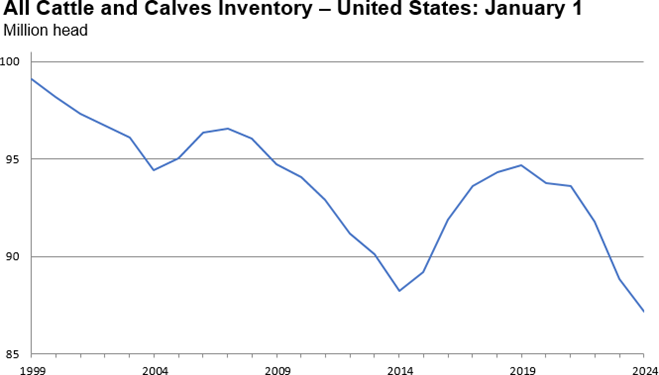
Droughts, Complicated by Climate Change, Result in U.S. Beef Herd Hitting Historic Low
by John McCracken
March 13, 2024

Extract::
(Investigate Midwest) The size of the overall U.S. beef cattle herd has continued to decline since 1975, a trend largely attributed to an increase in global beef production and cattle imports. But at the beginning of 2024, the nation’s inventory of beef cattle hit a 61-year low, according to data from the U.S. Department of Agriculture.

In the nation’s top 10 beef-producing states — responsible for nearly 60% of the country’s beef production — half reported the lowest number of cattle since 1995 as of the beginning of this year, according to an Investigate Midwest analysis of the USDA’s data.

Droughts starting in 2020 are a contributing factor in the nation’s historically low beef inventory, according to USDA research. Nebraska and Missouri — two of the top 10 beef-producing states — experienced the largest decline in the quality of June pastureland since 2020 compared to the other top states, according to an Investigate Midwest analysis of USDA data.

Finding land with plentiful grazing for cattle is difficult in drought years. An analysis of USDA pastureland data shows that grazable Nebraska pastureland shrunk by a third since 2019 during the month of June.

Current research shows climate change has caused more frequent large rainfall events coupled with months of zero precipitation. This volatility has made relying on typical weather patterns and grazing conditions difficult for the nation’s beef producers.
Read more here: https://investigatemidwest.org/2024/03 ... eef-herd/

Image
Source: USDA
Don't mourn, organize.

-Joe Hill
User avatar
caltrek
Posts: 9280
Joined: Mon May 17, 2021 1:17 pm

Re: Food Price Watch Thread

Post by caltrek »

Extreme Heat Drives Up Food Prices. Just How Bad Will It Get?
by Kate Yoder
March 27, 2024

Introduction:
(Grist) Sometimes climate change appears where you least expect it — like the grocery store. Food prices have climbed 25 percent over the past four years, and Americans have been shocked by the growing cost of staples like beef, sugar, and citrus.

While many factors, like supply chain disruptions and labor shortages, have contributed to this increase, extreme heat is already raising food prices, and it’s bound to get worse, according to a recent study published in the journal Communications Earth & Environment. The analysis found that heatflation could drive up food prices around the world by as much as 3 percentage points per year in just over a decade and by about 2 percentage points in North America. For overall inflation, extreme weather could lead to anywhere from a 0.3 to 1.2 percentage point increase each year depending on how many carbon emissions countries pump into the atmosphere.

Though that might sound small, it’s actually “massive,” according to Gernot Wagner, a climate economist at Columbia Business School. “That’s half of the Fed’s overall goal for inflation,” he said, referencing the Federal Reserve’s long-term aim of limiting it to 2 percent. The Labor Department recently reported that consumer prices climbed 3.2 percent over the past 12 months.

The link between heat and rising food prices is intuitive — if wheat starts withering and dying, you can bet flour is going to get more expensive. When Europe broiled in heat waves in 2022, it pushed up food prices that were already soaring due to Russia’s invasion of Ukraine (known as the breadbasket of Europe), researchers at the Europe Central Bank and Potsdam Institute in Germany found in the new study. Europe saw a record-breaking 9.2 percent inflation that year, and the summer heat alone, which hurt soy, sunflower, and maize harvests, might have been responsible for almost a full percentage point of that increase.

To figure out how climate change might drive inflation in the future, the researchers analyzed monthly price indices for goods across 121 countries over the past quarter-century.
Read more of the Grist article here: https://grist.org/economics/heatflatio ... - prices/

For results of the study as published in Nature: https://www.nature.com/articles/s43247-023-01173-x

caltrek's comment: Aside from some plans of dubious benefit to plant trees, Republicans ignore global warming while Democrats recognize it as a threat and seek to actively mitigate the problem. Yet, Republicans are credited with better managing the economy. Go figure.
Don't mourn, organize.

-Joe Hill

User avatar
caltrek
Posts: 9280
Joined: Mon May 17, 2021 1:17 pm

Re: Food Price Watch Thread

Post by caltrek »

World Food Price Index Rebounds from Three-year Low, Says UN Agency
April 5, 2024

Introduction:
(Reuters via The Economic Times) The United Nations food agency's world price index rebounded in March from a three-year low, boosted by increases for vegetable oils, meat and dairy products.

The Food and Agriculture Organization's (FAO) price index, which tracks the most globally traded food commodities, averaged 118.3 points in March, up from a revised 117.0 points the previous month, the agency said on Friday.

The February reading was the lowest for the index since February 2021 and marked a seventh consecutive monthly decline.

International food prices have fallen sharply from a record peak in March 2022 at the start of Russia's full-scale invasion of fellow crop exporter Ukraine.

The FAO's latest monthly reading was 7.7% below the year-earlier level, it said.
Read more here: https://economictimes.indiatimes.com/n ... gn=cppst
Don't mourn, organize.

-Joe Hill
weatheriscool
Posts: 24486
Joined: Sun May 16, 2021 6:16 pm
Contact:

Re: Food Price Watch Thread

Post by weatheriscool »

weatheriscool
Posts: 24486
Joined: Sun May 16, 2021 6:16 pm
Contact:

Re: Food Price Watch Thread

Post by weatheriscool »

Americans are choking on surging fast-food prices. "I can't justify the expense," one customer says
https://www.cbsnews.com/news/mcdonalds- ... es-wendys/

By Khristopher J. Brooks
Updated on: May 9, 2024 / 2:03 PM EDT / CBS News

...

Fast-food prices have shot up over the last decade, according to FinanceBuzz. The personal finance site found that the price of a McDonald's Quarter Pounder with Cheese meal from McDonald's more than doubled in price from $5.39 in 2014 to $11.99 this year.

Other restaurant chains also have jacked up their prices, FinanceBuzz said. Between 2014 and 2024, Popeye's, Jimmy John's and Subway hiked their food prices 86%, 62% and 39%, respectively. The price of a two-piece chicken combo at Popeyes jumped from $6.49 to $11.39 over that period, while an eight-inch club tuna from Jimmy Johns rose from $5.75 to $9.10, according to FinanceBuzz.

Restaurant chains point to rising labor costs as a key factor driving up prices. Across the U.S., 22 states raised their minimum wages in January, although the federal baseline pay remains stuck at $7.25 an hour. In California, fast-food chains with 60 or more locations nationwide are now required to pay their workers a minimum wage of $20 an hour following passage of a new law last fall.

Labor advocates dispute that rising employee wages are to blame for higher fast-food costs. A March analysis of California fast-food restaurants by the Roosevelt Institute, a liberal think tank, noted the industry's record profit margins.

"Our analysis of financial data for the past decade finds increases in fast-food industry operating profits and rising markups, suggesting that affected employers can absorb the increased operating costs associated with a higher industry minimum wage without increasing consumer prices or reducing employment," the report states.

...
User avatar
caltrek
Posts: 9280
Joined: Mon May 17, 2021 1:17 pm

Re: Food Price Watch Thread

Post by caltrek »

GOP Farm Bill Decried as Pro-Corporate, Anti-Family 'Waste of Everyone's Time'
by Jessica Corbett
May 17, 2024

Introduction:
(Common Dreams) Echoing early May criticism of U.S. House Republicans' blueprint for the next Farm Bill, anti-hunger and green groups on Friday fiercely condemned the GOP's discussion draft text of the Farm, Food, and National Security Act of 2024.

Released by U.S. House Committee on Agriculture Chair Glenn "GT" Thompson (R-Pa.), the draft is competing with a Democratic proposal—Senate Agriculture, Nutrition, and Forestry Committee Chair Debbie Stabenow's (D-Mich.) Rural Prosperity and Food Security Act.

While Thomspon claimed that his bill "is the product of extensive feedback from stakeholders and all members of the House, and is responsive to the needs of farm country through the incorporation of hundreds of bipartisan policies," Rep. David Scott (D-Ga.), the panel's ranking member, said that the draft "confirms my worst fears."

"House Republicans plan to pay for the farm bill by taking food out of the mouths of America's hungry children, restricting farmers from receiving the climate-smart conservation funding they so desperately need, and barring the USDA from providing financial assistance to farmers in times of crisis," he warned, referring to the U.S. Department of Agriculture.

The economic impact of the Supplemental Nutrition Assistance Program (SNAP) cuts alone "would be staggering," Scott emphasized. "A $27 billion reduction in food purchasing power would not only increase hunger, but it would also reduce demand for jobs in the agriculture, transportation, manufacturing, and grocery sectors."
Read more here: https://www.commondreams.org/news/2024-farm-bill
Don't mourn, organize.

-Joe Hill
User avatar
citali_
Posts: 77
Joined: Fri Apr 22, 2022 10:06 pm
Location: Rhode Island, USA
Contact:

Re: Food Price Watch Thread

Post by citali_ »

I think it's because they have better food quality now.
weatheriscool wrote: Sun May 12, 2024 4:10 pm Americans are choking on surging fast-food prices. "I can't justify the expense," one customer says
https://www.cbsnews.com/news/mcdonalds- ... es-wendys/

By Khristopher J. Brooks
Updated on: May 9, 2024 / 2:03 PM EDT / CBS News

...

Fast-food prices have shot up over the last decade, according to FinanceBuzz. The personal finance site found that the price of a McDonald's Quarter Pounder with Cheese meal from McDonald's more than doubled in price from $5.39 in 2014 to $11.99 this year.

Other restaurant chains also have jacked up their prices, FinanceBuzz said. Between 2014 and 2024, Popeye's, Jimmy John's and Subway hiked their food prices 86%, 62% and 39%, respectively. The price of a two-piece chicken combo at Popeyes jumped from $6.49 to $11.39 over that period, while an eight-inch club tuna from Jimmy Johns rose from $5.75 to $9.10, according to FinanceBuzz.

Restaurant chains point to rising labor costs as a key factor driving up prices. Across the U.S., 22 states raised their minimum wages in January, although the federal baseline pay remains stuck at $7.25 an hour. In California, fast-food chains with 60 or more locations nationwide are now required to pay their workers a minimum wage of $20 an hour following passage of a new law last fall.

Labor advocates dispute that rising employee wages are to blame for higher fast-food costs. A March analysis of California fast-food restaurants by the Roosevelt Institute, a liberal think tank, noted the industry's record profit margins.

"Our analysis of financial data for the past decade finds increases in fast-food industry operating profits and rising markups, suggesting that affected employers can absorb the increased operating costs associated with a higher industry minimum wage without increasing consumer prices or reducing employment," the report states.

...
User avatar
caltrek
Posts: 9280
Joined: Mon May 17, 2021 1:17 pm

Re: Food Price Watch Thread

Post by caltrek »

The Financialisation of Farmland and the War on Food and Farming
by Colin Todhunter
May 19, 2024

Introduction:
(Janata Weekly) Between 2008 and 2022, land prices nearly doubled throughout the world and tripled in Central-Eastern Europe. In the UK, an influx of investment from pension funds and private wealth contributed to a doubling of farmland prices from 2010-2015. Land prices in the U.S. agricultural heartlands of Iowa quadrupled between 2002 and 2020.

Agricultural investment funds rose ten-fold between 2005 and 2018 and now regularly include farmland as a stand-alone asset class, with U.S. investors having doubled their stakes in farmland since 2020.

Meanwhile, agricultural commodity traders are speculating on farmland through their own private equity subsidiaries, while new financial derivatives are allowing speculators to accrue land parcels and lease them back to struggling farmers, driving steep and sustained land price inflation.

Top-down ‘green grabs’ now account for 20% of large-scale land deals. Government pledges for land-based carbon removals alone add up to almost 1.2 billion hectares, equivalent to total global cropland. Carbon offset markets are expected to quadruple in the next seven years.

These are some of the findings published in the new report ‘Land Squeeze’ by the International Panel of Experts on Sustainable Food Systems (IPES), a non-profit thinktank headquartered in Brussels.
Read more here: https://janataweekly.org/the-financial ... farming/
Don't mourn, organize.

-Joe Hill
User avatar
caltrek
Posts: 9280
Joined: Mon May 17, 2021 1:17 pm

Re: Food Price Watch Thread

Post by caltrek »

HarvestHub App Tackles Supply Chain and Food Insecurity Issues
July 12, 2024

Introduction:
(Eurekalert) The COVID-19 pandemic infiltrated almost every aspect of society and life in 2020, even in ways people wouldn’t have immediately expected. Stores that typically have no problem stocking shelves were struggling to keep pace with the sudden demand for cleaning supplies along with everything from toilet paper to Sriracha chili sauce.

While these issues aren’t as devastating as the larger health ramifications, they did shed new light on supply chain weaknesses and how that system adapts to rapid and vast market shifts. Factory closures and reduced production, increased demand for specific types of goods, labor shortages and transportation hurdles were just some of the many obstacles manufacturers faced in trying to get goods into the the hands of consumers during one of the most-challenging times in global history.

These supply chain problems underscored the importance of building more resilient, flexible and diversified strategies to better withstand unforeseen disruptions.

HarvestHub, a mobile application developed by a team at the National Center for Supercomputing Applications within the Center for Digital Agriculture, will heal COVID-damaged supply chains, help farmers increase production and get food to families in need. The app was recognized at the Farm Credit MarketMaker Innovation Awards ceremony during the 2023 National Agricultural Marketing Summit in Arlington, VA, which awarded outstanding efforts by state and local MarketMaker collaborations around the country that contribute to the development of local and regional food systems and help farmers connect to new market opportunities.

In collaboration with Google and MarketMaker, NCSA helped develop HarvestHub to make it easier for farmers to donate or sell surplus products to local food assistance programs. The app will serve as a tool to support a Farm Bureau-led “Farm to Food Bank” pilot in Illinois and ultimately for all MarketMaker affiliated partners.
Read more here: https://www.eurekalert.org/news-releases/1051287

Here is a link to the National Center for Supercomputing Applications : https://www.ncsa.illinois.edu/

Here is the Center for Digital Agricultural website: https://digitalag.illinois.edu/
Don't mourn, organize.

-Joe Hill
User avatar
caltrek
Posts: 9280
Joined: Mon May 17, 2021 1:17 pm

Re: Food Price Watch Thread

Post by caltrek »

Researchers Predict Fewer, Pricier Strawberries as Temperatures Warm
July 17, 2024

Introduction:
(Eurekalert) Strawberries could be fewer and more expensive because of higher temperatures caused by climate change, according to research from the University of Waterloo.

Using a new method of analysis, the researchers found that a rise in temperature of 3 degrees Fahrenheit could reduce strawberry yields by up to 40 per cent. Strawberries are one of the most lucrative commodities for the economies of California and the United States. The 2022 market for strawberries alone was worth more than US$3 billion.

“This research shows how climate change can directly impact the foods we love, emphasizing the importance of sustainable farming practices to maintain a stable food supply for everyone,” said Dr. Poornima Unnikrishnan, a postdoctoral fellow in the Department of Systems Design Engineering at Waterloo.

Sustainable farming practices could include optimizing irrigation to ensure adequate water supply during heatwaves, using drip irrigation and scheduling operations to avoid peak periods of hot weather as well as using shading plants and installing shade structures to mitigate heat stress.
The research team included Unnikrishnan, Dr. Kumaraswamy Ponnambalam, who is also from Systems Design Engineering at Waterloo, and Dr. Fakhri Karray, from the Mohamed bin Zayed University of Artificial Intelligence in Abu Dhabi. They started their analysis with strawberries because of their popularity and notoriously short shelf life. They say these results suggest potential implications for the availability of all produce imported from California.
Read more here: https://www.eurekalert.org/news-releases/1051705
Don't mourn, organize.

-Joe Hill
Post Reply