Natural History (13.8 billion years BC – 3.3 million BC)

Got something to say about the past? Say it here!
weatheriscool
Posts: 24486
Joined: Sun May 16, 2021 6:16 pm
Contact:

Re: Natural History (13.8 billion years BC – 3.3 million BC)

Post by weatheriscool »

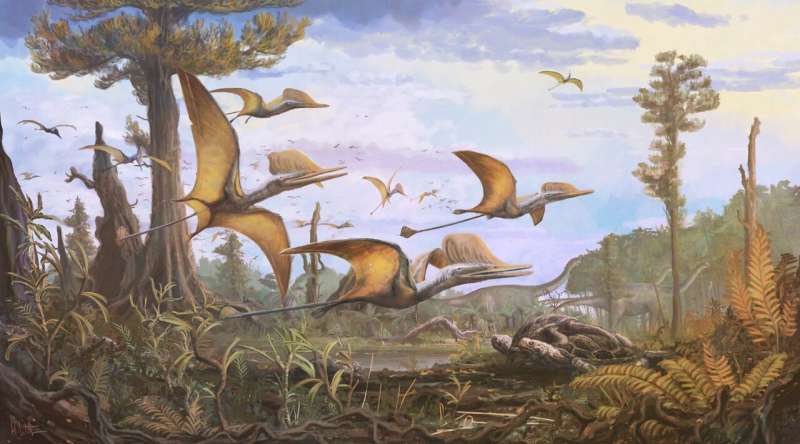
New species of Jurassic pterosaur discovered on the Isle of Skye
https://phys.org/news/2024-02-species-j ... -skye.html
by University of Bristol
A new species of pterosaur from specimens found on the Isle of Skye, Scotland, has been announced by scientists from the Natural History Museum, University of Bristol, University of Leicester, and University of Liverpool.

Image
weatheriscool
Posts: 24486
Joined: Sun May 16, 2021 6:16 pm
Contact:

Re: Natural History (13.8 billion years BC – 3.3 million BC)

Post by weatheriscool »

New species of 65 million year old fossil shark discovered in Alabama
https://phys.org/news/2024-02-species-m ... shark.html
by Pensoft Publishers
A team of scientists has discovered a new fossil shark species from Alabama. The shark is a new species of Palaeohypotodus, which means "ancient small-eared tooth," in reference to the small needle-like fangs present on the sides of the teeth.

It has been named Palaeohypotodus bizzocoi, for the late Dr. Bruce Bizzoco (1949–2022) of Birmingham, Alabama. Bizzoco served as a Dean at Shelton State Community College, archaeologist, and was a longtime volunteer at McWane Science Center. The naming of this species honors Dr. Bizzoco's lifelong commitment to education and the preservation of Alabama's history.
weatheriscool
Posts: 24486
Joined: Sun May 16, 2021 6:16 pm
Contact:

Re: Natural History (13.8 billion years BC – 3.3 million BC)

Post by weatheriscool »

A new study makes the case for asteroid strikes setting in motion global glaciation in the distant past
https://phys.org/news/2024-02-case-aste ... ation.html
by Jim Shelton, Yale University
A research team has picked a side in the "Snowball Earth" debate over the possible cause of planet-wide deep freeze events that occurred in the distant past. According to their new study, these so-called "Snowball" Earth periods, in which the planet's surface was covered in ice for thousands or even millions of years, could have been triggered abruptly by large asteroids that slammed into the Earth.
weatheriscool
Posts: 24486
Joined: Sun May 16, 2021 6:16 pm
Contact:

Re: Natural History (13.8 billion years BC – 3.3 million BC)

Post by weatheriscool »

Larger-than-expected prehistoric mammal species uncovered in Patagonia
https://phys.org/news/2024-02-larger-pr ... vered.html
by Bob Yirka , Phys.org

A multi-institutional team of archaeologists and paleontologists has unearthed and identified a new species of mammal from the Maastrichtian age. In their paper published in the journal Scientific Reports, the researchers note that the mammal was much larger than any other known examples of its kind.

The fossil consists of a femur, tibia, hip and hip socket—enough for the team to identify it as belonging to a group known as Theria, which comprises non-egg-laying mammals. It also was enough to show that the animal was large compared to other mammals of its time. The team named the new creature, Patagomaia chainko. It was excavated in southern Patagonia.
User avatar
caltrek
Posts: 9280
Joined: Mon May 17, 2021 1:17 pm

Re: Natural History (13.8 billion years BC – 3.3 million BC)

Post by caltrek »

weatheriscool wrote: Fri Feb 09, 2024 8:17 pm A new study makes the case for asteroid strikes setting in motion global glaciation in the distant past
https://phys.org/news/2024-02-case-aste ... ation.html
by Jim Shelton, Yale University
A research team has picked a side in the "Snowball Earth" debate over the possible cause of planet-wide deep freeze events that occurred in the distant past. According to their new study, these so-called "Snowball" Earth periods, in which the planet's surface was covered in ice for thousands or even millions of years, could have been triggered abruptly by large asteroids that slammed into the Earth.
For results of the study as presented in Science Advances: https://www.science.org/doi/10.1126/sciadv.adk5489
Don't mourn, organize.

-Joe Hill
weatheriscool
Posts: 24486
Joined: Sun May 16, 2021 6:16 pm
Contact:

Re: Natural History (13.8 billion years BC – 3.3 million BC)

Post by weatheriscool »

Paleontologists discover a 240-million-year-old 'Chinese dragon'
https://phys.org/news/2024-02-paleontol ... ragon.html
by Meike Rech, State Museum of Natural History Stuttgart
An international team of scientists from China, the U.S. and Europe has studied new fossils of the marine reptile Dinocephalosaurus orientalis. This research has made it possible to fully describe the bizarre, very impressive animal for the first time.

Dinocephalosaurus orientalis had an unusually long neck and reminded the researchers of the snake-like representation of dragons in Chinese mythology. The research findings on Dinocephalosaurus orientalis have now been published in the journal Earth and Environmental Science: Transactions of the Royal Society of Edinburgh—just in time for the beginning of the Chinese Year of the Dragon.
User avatar
Time_Traveller
Posts: 3025
Joined: Sun May 16, 2021 4:49 pm
Location: New York City, USA, November 5th 2032 C.E.

Re: Natural History (13.8 billion years BC – 3.3 million BC)

Post by Time_Traveller »

New species of ancient vampire squid unearthed in Luxembourg
FEBRUARY 27, 2024

Image

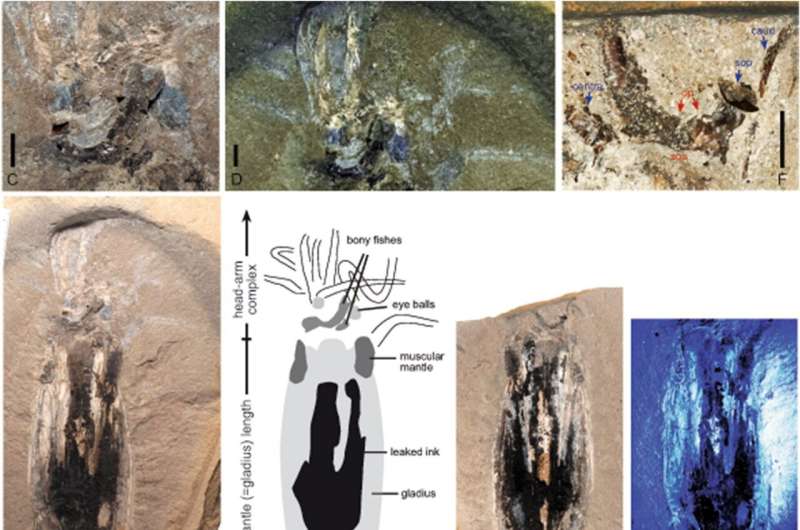
A trio of paleontologists in Germany has found a fossilized vampire squid that they dated to 183 million years ago. In their paper published in the Swiss Journal of Palaeontology, Robert Weis, Ben Thuy and Dirk Fuchs describe where the fossil was found, its condition, and how it compares to modern vampire squids.

Vampire squid (vampyromorphs) are a type of cephalopod—they most resemble squid but are actually related more closely to octopi. Several species of vampyromorphs have been discovered, including several that are extinct. They are known for their bioluminescent organs and long, retractable filaments, a feature that distinguishes them from other squid and octopi.

For this new study, the research team further investigated the fossilized remains of a vampyromorph found at a dig site in Bascharage in 2022 and dated it back to the Early Jurassic. They named the new species Simoniteuthis michaelyi.

The researchers found the fossil to be in excellent condition, and it was a complete specimen, which allowed for a detailed study. They also found that the creature had died while in the middle of consuming two small fish—a rare find for any fossil. It measured 38 centimeters long. They describe the find as exceptional due to its quality of preservation. They were able to study what had once been soft tissue structures, such as eyeballs, and muscle tissue, all in great detail.

Prior research suggests that the vampyromorph lived in the shallows off an island that once existed in what is now the heart of the European mainland. The research team believes that the remarkable degree of preservation of this squid is due to unique conditions at the moment of the creature's death. Water at the bottom of the sea where it ventured would have been poorly oxygenated, causing the creature to suffocate. In addition to killing the squid, it would have prevented other creatures from feeding on its remains, allowing it to become buried in the seafloor, wholly intact.
https://phys.org/news/2024-02-species-a ... rthed.html
“In the quantum multiverse, every choice, every decision you've ever and never made exists in an unimaginably vast ensemble of parallel universes.”
User avatar
Time_Traveller
Posts: 3025
Joined: Sun May 16, 2021 4:49 pm
Location: New York City, USA, November 5th 2032 C.E.

Re: Natural History (13.8 billion years BC – 3.3 million BC)

Post by Time_Traveller »

What ended the 'dark ages' in the early universe? New Webb data just brought us closer to solving the mystery
Mar 2, 2024

About 400,000 years after the Big Bang, the cosmos was a very dark place. The glow of the universe's explosive birth had cooled, and space was filled with dense gas —mostly hydrogen—with no sources of light.

Slowly, over hundreds of millions of years, the gas was drawn into clumps by gravity, and eventually, the clumps grew big enough to ignite. These were the first stars.

At first their light didn't travel far, as much of it was absorbed by a fog of hydrogen gas. However, as more and more stars formed, they produced enough light to burn away the fog by "reionizing" the gas—creating the transparent universe dotted with brilliant points of light we see today.

But exactly which stars produced the light that ended the dark ages and triggered this so-called "epoch of reionization"? In research published in Nature, we used a gigantic cluster of galaxies as a magnifying glass to gaze at faint relics of this time—and discovered that stars in small, faint dwarf galaxies were likely responsible for this cosmic-scale transformation.

What ended the dark ages?

Most astronomers already agreed that galaxies were the main force in reionizing the universe, but it wasn't clear how they did it. We know that stars in galaxies should make a lot of ionizing photons, but these photons need to escape the dust and gas inside their own galaxy to ionize hydrogen out in the space between galaxies.
https://phys.org/news/2024-02-dark-ages ... -webb.html
“In the quantum multiverse, every choice, every decision you've ever and never made exists in an unimaginably vast ensemble of parallel universes.”
User avatar
Time_Traveller
Posts: 3025
Joined: Sun May 16, 2021 4:49 pm
Location: New York City, USA, November 5th 2032 C.E.

Re: Natural History (13.8 billion years BC – 3.3 million BC)

Post by Time_Traveller »

‘Nightmarish’ sea lizard ruled the oceans during time of the dinosaurs
1 hour ago

Image

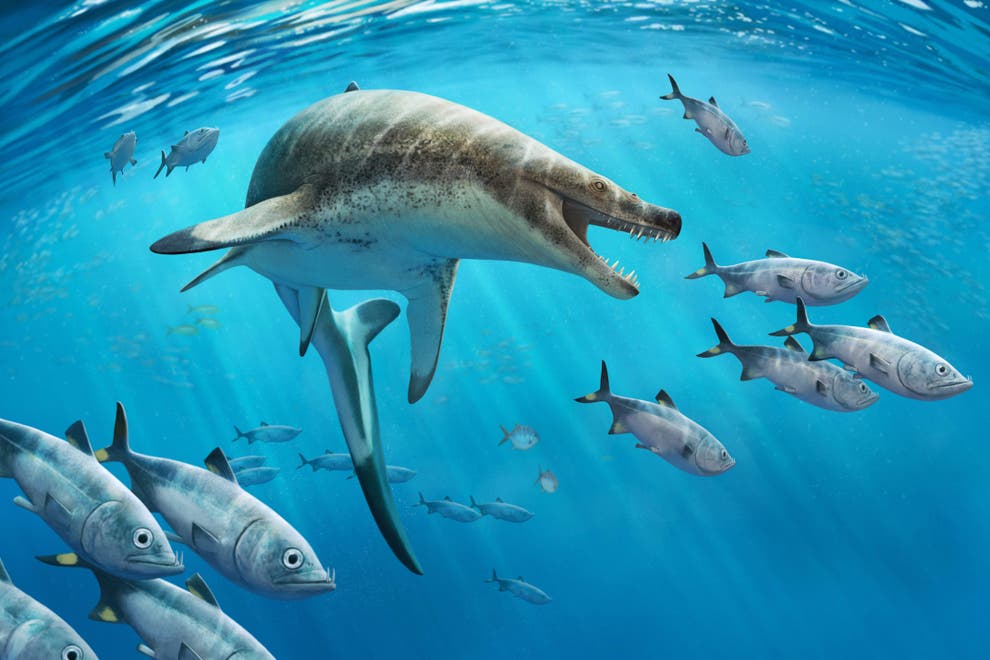
Scientists have discovered remains of a “nightmarish” new sea lizard species with dagger-like teeth that dominated the oceans 66 million years ago.

Khinjaria acuta would have lived alongside dinosaurs, co-existing with behemoths such as Tyrannosaurus and Triceratops.

Around eight metres long – about the same length as an orca – Khinjaria had powerful jaws and long, dagger-like teeth to munch prey, giving it a “nightmarish appearance”, according to researchers.

The team said the creature’s elongated skull and jaw musculature suggests it had “a terrible biting force”.

Khinjaria belongs to a family of giant marine lizards known as mosasaurs, the ancient relatives of today’s Komodo dragons and anacondas.
https://www.independent.co.uk/news/scie ... 07226.html
“In the quantum multiverse, every choice, every decision you've ever and never made exists in an unimaginably vast ensemble of parallel universes.”
User avatar
Time_Traveller
Posts: 3025
Joined: Sun May 16, 2021 4:49 pm
Location: New York City, USA, November 5th 2032 C.E.

Re: Natural History (13.8 billion years BC – 3.3 million BC)

Post by Time_Traveller »

World's earliest forest discovered, scientists say
1 hour ago

Scientists have found what they believe to be the world's earliest known fossilised forest in cliffs on the coast of South West England.

It was discovered in high sandstone cliffs near Minehead, Somerset, close to a Butlin's holiday camp.

Researchers from Cambridge and Cardiff Universities say they are the oldest fossilised trees ever found in Britain and the oldest known forest on Earth.

The trees, known as calamophyton, resemble palm trees.

Described as a kind of 'prototype' of today's trees, the largest were between two and four metres tall.
https://www.bbc.co.uk/news/science-environment-68500649
“In the quantum multiverse, every choice, every decision you've ever and never made exists in an unimaginably vast ensemble of parallel universes.”
weatheriscool
Posts: 24486
Joined: Sun May 16, 2021 6:16 pm
Contact:

Re: Natural History (13.8 billion years BC – 3.3 million BC)

Post by weatheriscool »

The first Europeans reached Ukraine 1.4 million years ago, new study finds

by John Jansen, The Conversation
https://phys.org/news/2024-03-europeans ... years.html
During warm periods in Earth's history, known as interglacials, glaciers the size of continents pulled back to reveal new landscapes. These were new worlds for early humans to explore and exploit, and 1.4 million years ago this was Europe: a Terra nullius unoccupied by humans.

Long before it emerged as the epicenter of global colonialism, Europe was itself colonized for the first time by humans migrating from the east.

A new study, led by a team from the Czech Academy of Sciences and Aarhus University and published this week in Nature, reports the earliest human presence in Europe, at a site on the Tysa River in western Ukraine known as Korolevo.
Buried stone tools at Korolevo, Ukraine

We studied a layer of stone tools left on a river bed by the people who crafted them. These "core-and-flake" tools were made in the Oldowan style, the most primitive form of tool-making, first classified by the palaeoanthropologist Mary Leakey in east Africa. Similar tools have also been found at the oldest known sites of human occupation in Europe, the Levant, and Asia.
weatheriscool
Posts: 24486
Joined: Sun May 16, 2021 6:16 pm
Contact:

Re: Natural History (13.8 billion years BC – 3.3 million BC)

Post by weatheriscool »

70 million year old nearly complete dinosaur found in France.

Titanosaur found intact
Researchers estimated the age of the newly discovered fossil to be around 70 to 72 million years old, but Titanosaurs roamed around on four legs from the Late Jurassic Epoch to the end of the Cretaceous Period, approximately 163.5 million to 66 million years ago. Titanosaurs belong to a larger group of dinosaurs known as sauropods, a family of long-necked herbivores that were some of the largest dinosaurs of their time, according to Britannica.

Remains of Titanosaur fossils are widely unearthed in Europe, but few are discovered in anatomical connection, Boschetto said. Finding a skeleton in this connected state suggests that the body was buried before it had entirely decomposed, leaving “some tissues connecting the bones to one another,” said Matthew Carrano, research geologist and curator of Dinosauria at the Smithsonian Institution National Museum of Natural History.

More at link,
https://www.accuweather.com/en/weather- ... il/1629365
weatheriscool
Posts: 24486
Joined: Sun May 16, 2021 6:16 pm
Contact:

Re: Natural History (13.8 billion years BC – 3.3 million BC)

Post by weatheriscool »

Scientists Discover the World's Oldest Fossilized Forest in Wales
The forest stood some 390 million years ago when life on Earth looked much different than it does today.
By Ryan Whitwam March 11, 2024
Image
https://www.extremetech.com/science/sci ... t-in-wales

Today, about 30% of Earth's surface is covered with forest, but there was a time millions of years ago when trees as we know them didn't exist. Scientists from the UK studying the earliest plants we would recognize as trees have announced an important discovery in their own backyard. The most ancient fossilized forest ever discovered has been unearthed on the north coast of Devon and Somerset in Wales. The researchers say this forest stood about 390 million years ago and could tell us a great deal about plant evolution.
weatheriscool
Posts: 24486
Joined: Sun May 16, 2021 6:16 pm
Contact:

Re: Natural History (13.8 billion years BC – 3.3 million BC)

Post by weatheriscool »

New method finds higher carnivorous dinosaur biodiversity in Kem Kem beds of Morocco
Brand new insights

Simon Wills, a scientific associate at the Natural History Museum who led the research, says, "The use of machine learning to identify theropod teeth has thrown the doors wide open to the ecosystem of the dinosaurs that roamed the Kem Kem 100 million years ago. It was fascinating to see how the powerful tool accurately identified the specimens when combined with traditional methods."

"The process highlights how embracing methods old and new can uncover brand new insights into relatively well-explored areas. I believe we'll see advances beyond what we thought possible in the coming years as our datasets grow, meaning machine learning can reveal more about paleodiversity and ecosystems from even the smallest remains—such as teeth!"
https://phys.org/news/2024-03-method-hi ... rsity.html
User avatar
Time_Traveller
Posts: 3025
Joined: Sun May 16, 2021 4:49 pm
Location: New York City, USA, November 5th 2032 C.E.

Re: Natural History (13.8 billion years BC – 3.3 million BC)

Post by Time_Traveller »

Scientists find skull of enormous ancient dolphin in Amazon
Wed 20 Mar 2024 18.00 GMT

Image

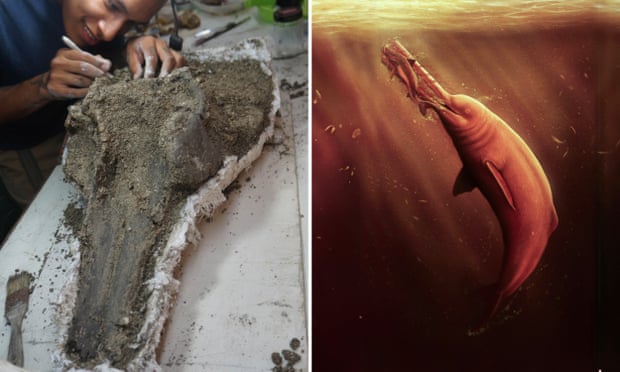
Scientists have discovered the fossilised skull of a giant river dolphin, from a species thought to have fled the ocean and sought refuge in Peru’s Amazonian rivers 16m years ago. The extinct species would have measured up to 3.5 metres long, making it the largest river dolphin ever found.

The discovery of this new species, Pebanista yacuruna, highlights the looming risks to the world’s remaining river dolphins, all of which face similar extinction threats in the next 20 to 40 years, according to the lead author of new research published in Science Advances today. Aldo Benites-Palomino said it belonged to the Platanistoidea family of dolphins commonly found in oceans between 24m and 16m years ago.

Surviving river dolphins were “the remnants of what were once greatly diverse marine dolphin groups”, he said, which were thought to have left the oceans to find new food sources in freshwater rivers.

“Rivers are the escape valve … for the ancient fossil we found, and it is the same for all river dolphins living today.”

Benites-Palomino discovered the fossil in Peru in 2018 when he was still an undergraduate. He is now working on a doctorate at the University of Zurich’s department of paleontology, and says the research paper was delayed by the pandemic.
https://www.theguardian.com/environment ... extinction
“In the quantum multiverse, every choice, every decision you've ever and never made exists in an unimaginably vast ensemble of parallel universes.”
User avatar
Time_Traveller
Posts: 3025
Joined: Sun May 16, 2021 4:49 pm
Location: New York City, USA, November 5th 2032 C.E.

Re: Natural History (13.8 billion years BC – 3.3 million BC)

Post by Time_Traveller »

The 1.6 million-year-old discovery that changes what we know about human evolution
1 day ago

New research has pinpointed the likely time in prehistory when humans first began to speak.

Analysis by British archaeologist Steven Mithen suggests that early humans first developed rudimentary language around 1.6 million years ago – somewhere in eastern or southern Africa.

“Humanity’s development of the ability to speak was without doubt the key which made much of subsequent human physical and cultural evolution possible. That’s why dating the emergence of the earliest forms of language is so important,” Dr Mithen, professor of early prehistory at the University of Reading, told The Independent.

Until recently, most human evolution experts thought humans only started speaking around 200,000 years ago. Professor Mithen’s new research, published this month, suggests that rudimentary human language is at least eight times older. His analysis is based on a detailed study of all the available archaeological, paleo-anatomical, genetic, neurological and linguistic evidence.

When combined, all the evidence suggests that the birth of language occurred as part of a suite of human evolution and other developments between two and 1.5 million years ago.
https://www.independent.co.uk/news/scie ... 17744.html
“In the quantum multiverse, every choice, every decision you've ever and never made exists in an unimaginably vast ensemble of parallel universes.”
User avatar
Time_Traveller
Posts: 3025
Joined: Sun May 16, 2021 4:49 pm
Location: New York City, USA, November 5th 2032 C.E.

Re: Natural History (13.8 billion years BC – 3.3 million BC)

Post by Time_Traveller »

Scientists decode what happened when the moon once ‘turned itself inside out’
4 hours ago

Image

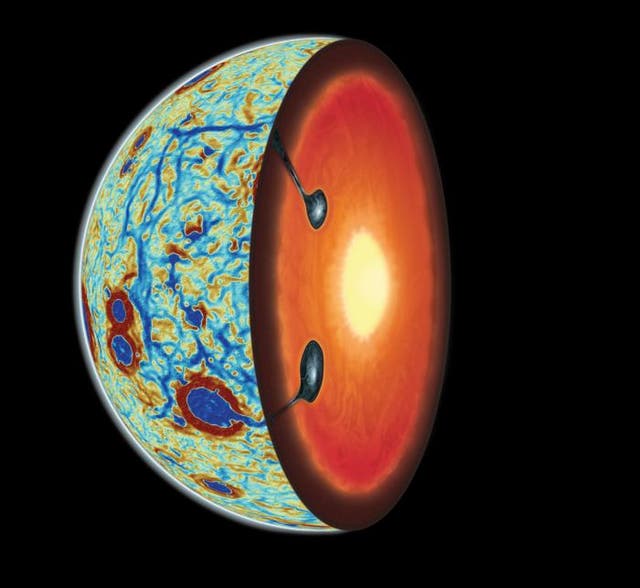
Scientists have finally discovered the sequence of events that likely led to the Earth’s moon turning itself inside out billions of years ago.

Most of what researchers know about the moon’s origin and its geology comes from analysis of rocks collected by Apollo astronauts which show surprisingly high concentrations of titanium.

Researchers suspect that when the moon formed around 4.5 billion years ago when another massive body in the solar system smashed into Earth, it was initially hot and covered by a global magma ocean.

But how it came to be the form that we currently see today when we look up at night has remained a mystery.

As the molten rock gradually cooled, it formed the moon’s mantle and the bright crust, but deeper below, it was wildly out of equilibrium.
https://www.independent.co.uk/space/moo ... 26923.html
“In the quantum multiverse, every choice, every decision you've ever and never made exists in an unimaginably vast ensemble of parallel universes.”
User avatar
Time_Traveller
Posts: 3025
Joined: Sun May 16, 2021 4:49 pm
Location: New York City, USA, November 5th 2032 C.E.

Re: Natural History (13.8 billion years BC – 3.3 million BC)

Post by Time_Traveller »

Enormous ancient sea reptile identified from amateur fossil find
18 minutes ago

Image

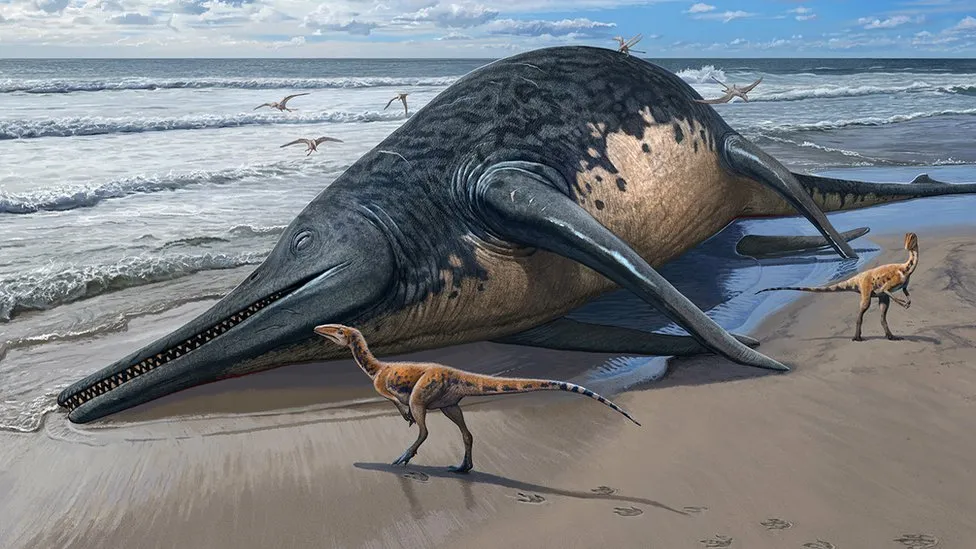
Scientists have identified what was probably the largest marine reptile ever to swim in the seas - a creature longer than two, nose-to-nose buses.

The creature lived around 202 million years ago alongside the dinosaurs.

Its fossilised jawbone was found in 2016 by a fossil hunter on a Somerset beach. In 2020 a father and daughter found a second, very similar jawbone.

Experts now say the fossils are from two giant ichthyosaur reptiles, which could have been 25m long.

That is bigger than a huge pliosaur whose skull was found embedded in Dorset cliffs and was in the David Attenborough documentary the Giant Sea Monster.
https://www.bbc.co.uk/news/science-environment-68831349
“In the quantum multiverse, every choice, every decision you've ever and never made exists in an unimaginably vast ensemble of parallel universes.”
User avatar
wjfox
Site Admin
Posts: 13578
Joined: Sat May 15, 2021 6:09 pm
Location: Essex, UK
Contact:

Re: Natural History (13.8 billion years BC – 3.3 million BC)

Post by wjfox »

Move Over Titanoboa, Fossil Of "Largest Snake To Have Ever Existed" Found In Gujarat

April 19, 2024 10:57 am IST

Scientists have said that a fossil vertebrae unearthed in Gujarat are the remains of the largest snake that ever lived, which was longer than the T-rex. The discovery of 'Vasuki Indicus' was made in 2005 by scientists from IIT-Roorkee and recently confirmed as a giant snake. It establishes India's crucial link in the origin and evolutionary process of various species, especially reptiles. The researchers have discovered 27 vertebrae from the snake, and some of them looks like a large python and would not have been venomous. They estimate the length of the snake to be in the range of 11-15 metres (about 50 feet) and it must have weighed 1 tonne.

The research was published in 'Scientific Reports' on 'Springer Nature' on Thursday.

"Considering its large size, Vasuki was a slow-moving ambush predator that would subdue its prey through constriction like anacondas and pythons. This snake lived in a marshy swamp near the coast at a time when global temperatures were higher than today," Debajit Datta, a postdoctoral researcher in palaeontology at IIT-Roorkee and the lead author of the study, told The Guardian.

The fossil has been named after Vasuki, the snake king associated with Lord Shiva.

https://www.ndtv.com/science/move-over- ... at-5474872


Image
weatheriscool
Posts: 24486
Joined: Sun May 16, 2021 6:16 pm
Contact:

Re: Natural History (13.8 billion years BC – 3.3 million BC)

Post by weatheriscool »

wjfox wrote: Fri Apr 19, 2024 9:25 am Move Over Titanoboa, Fossil Of "Largest Snake To Have Ever Existed" Found In Gujarat

April 19, 2024 10:57 am IST

Scientists have said that a fossil vertebrae unearthed in Gujarat are the remains of the largest snake that ever lived, which was longer than the T-rex. The discovery of 'Vasuki Indicus' was made in 2005 by scientists from IIT-Roorkee and recently confirmed as a giant snake. It establishes India's crucial link in the origin and evolutionary process of various species, especially reptiles. The researchers have discovered 27 vertebrae from the snake, and some of them looks like a large python and would not have been venomous. They estimate the length of the snake to be in the range of 11-15 metres (about 50 feet) and it must have weighed 1 tonne.

The research was published in 'Scientific Reports' on 'Springer Nature' on Thursday.

"Considering its large size, Vasuki was a slow-moving ambush predator that would subdue its prey through constriction like anacondas and pythons. This snake lived in a marshy swamp near the coast at a time when global temperatures were higher than today," Debajit Datta, a postdoctoral researcher in palaeontology at IIT-Roorkee and the lead author of the study, told The Guardian.

The fossil has been named after Vasuki, the snake king associated with Lord Shiva.

https://www.ndtv.com/science/move-over- ... at-5474872

Image
Like I fucking tell people. One day bigger snakes will be found and we know very little of the fossil record. well, here it is.
Post Reply