Natural History (13.8 billion years BC – 3.3 million BC)

Got something to say about the past? Say it here!
User avatar
caltrek
Posts: 9280
Joined: Mon May 17, 2021 1:17 pm

Re: Natural History (13.8 billion years BC – 3.3 million BC)

Post by caltrek »

How a Favorite Dinosaur Food Survived Extinction
by Carl Bates
November 17, 2023

Introduction:
(Fururity) An ancient lineage of plants called cycads, a favored food of grazing dinosaurs, survived extinction by grabbing nitrogen from the air.

The palm-like plants helped sustain dinosaurs and other prehistoric animals during the Mesozoic Era, starting 252 million years ago, by being plentiful in the forest understory.

Like their lumbering grazers, most cycads have gone extinct. Their disappearance from their prior habitats began during the late Mesozoic and continued into the early Cenozoic Era, punctuated by the cataclysmic asteroid impact and volcanic activity that mark the K-Pg boundary 66 million years ago. However, unlike the dinosaurs, somehow a few groups of cycads survived to the present.

A new study, published in the journal Nature Ecology & Evolution, concludes that the cycad species that survived relied on symbiotic bacteria in their roots, which provide them with nitrogen to grow. Just like modern legumes and other plants that use nitrogen fixation, these cycads trade their sugars with bacteria in their roots in exchange for nitrogen plucked from the atmosphere.

What originally interested lead author Michael Kipp is that the tissues of nitrogen-fixing plants can provide a record of the composition of the atmosphere they grew up in. He combines geochemistry with the fossil record to try to understand the Earth’s climate history.

Read more here: https://www.futurity.org/cycads-plants ... urce=rss
Don't mourn, organize.

-Joe Hill
User avatar
caltrek
Posts: 9280
Joined: Mon May 17, 2021 1:17 pm

Re: Natural History (13.8 billion years BC – 3.3 million BC)

Post by caltrek »

Deoxygenation Levels Similar To Today’s Played a Major Role In Marine Extinctions During Major Past Climate Change Event
November 27, 2023

Introduction:
(Eurekalert) Scientists have made a surprising discovery that sheds new light on the role that oceanic deoxygenation (anoxia) played in one of the most devastating extinction events in Earth’s history. Their finding has implications for current day ecosystems – and serves as a warning that marine environments are likely more fragile than apparent.

New research, published today in leading international journal Nature Geosciences, suggests that oceanic anoxia played an important role in ecosystem disruption and extinctions in marine environments during the Triassic–Jurassic mass extinction, a major extinction event that occurred around 200 million years ago.

Surprisingly however, the study shows that the global extent of euxinia (an extreme form of de-oxygenated conditions) was similar to the present day.

Earth’s history has been marked by a handful of major mass extinctions, during which global ecosystems collapsed and species went extinct. All past extinction events appear to have coincided with global climatic and environmental perturbance that commonly led to ocean deoxygenation. Because of this, oceanic anoxia has been proposed as a likely cause of marine extinctions at those times, with the assumption that the more widespread occurrence of deoxygenation would have led to a larger extinction event.

Using chemical data from ancient mudstone deposits obtained from drill-cores in Northern Ireland and Germany, an international research team led by scientists from Royal Holloway (UK), and including scientists from Trinity College Dublin’s School of Natural Sciences (Ireland) as well as from Utrecht University (Netherlands), was able to link two key aspects associated with the Triassic–Jurassic mass extinction.
Read more here: https://www.eurekalert.org/news-releases/1009146
Don't mourn, organize.

-Joe Hill
User avatar
wjfox
Site Admin
Posts: 13585
Joined: Sat May 15, 2021 6:09 pm
Location: Essex, UK
Contact:

Re: Natural History (13.8 billion years BC – 3.3 million BC)

Post by wjfox »

What was it like when the Universe was at its hottest?

November 21, 2023

In the earliest stages of the hot Big Bang, the Universe became filled with incredibly energetic quanta, reaching a temperature of somewhere between 10^20 and 10^30 K or so. Even at the Large Hadron Collider and in high-energy astrophysical environments around neutron stars and black holes, energies and temperatures created in the late-time Universe cannot compare. So what was the Universe like in these early, super-hot stages? Here's what science has to say about the answer.

https://bigthink.com/starts-with-a-bang ... s-hottest/


Image
Credit: Models and Data Analysis Initiative/Duke University
User avatar
caltrek
Posts: 9280
Joined: Mon May 17, 2021 1:17 pm

Re: Natural History (13.8 billion years BC – 3.3 million BC)

Post by caltrek »

Even Without a Meteorite, The Stage Was Set For Dinosaurs to Go Extinct
by Tessa Koumoundouros
November 28, 2023

Introduction:
(Science Alert) The explosive end of non-avian dinosaurs is the most infamous blow to life on Earth. But there's long been hints that the asteroid may not be the main culprit behind this mass extinction, just the most spectacular isolated contribution.

Before this dramatic event, 66 million years ago, toxic winds of change were already brewing in the air.

A new analysis by an international team of researchers has added evidence to claims that the world prior to the asteroid blow was anything but paradise, with measures of sulfur in the atmosphere reaching critical levels.

Together with other studies on levels of mercury, the research provides a signature of volcanic activity strong enough to cause significant climate disruptions.

In 1991, the timing of this volcanic activity had been dismissed as too early to be behind the mass extinction event but more recent studies demonstrate it's possible the timing was close enough to be significant.
Read more of the Science Alert article here: https://www.sciencealert.com/even-with ... -extinct

For a presentation of study results as published in Science Advances: https://www.science.org/doi/10.1126/sciadv.adg8284
Don't mourn, organize.

-Joe Hill
weatheriscool
Posts: 24486
Joined: Sun May 16, 2021 6:16 pm
Contact:

Re: Natural History (13.8 billion years BC – 3.3 million BC)

Post by weatheriscool »

Study illuminates formation of US east coast during break up of supercontinent Pangea
https://phys.org/news/2023-12-illuminat ... inent.html
by Southern Methodist University
A recent study published in the Journal of Geophysical Research: Solid Earth sheds new light on the formation of the East Coast of the United States—a "passive margin," in geologic terms—during the breakup of the supercontinent Pangea and the opening of the Atlantic Ocean around 230 million years ago.

In geology, passive margins are "quiet" areas, locations with minimal faulting or magmatism, where land meets the ocean. Understanding their formation is crucial for many reasons, including that they are stable regions where hydrocarbon resources are extracted and that their sedimentary archive preserves our planet's climate history as far back as millions of years.
weatheriscool
Posts: 24486
Joined: Sun May 16, 2021 6:16 pm
Contact:

Re: Natural History (13.8 billion years BC – 3.3 million BC)

Post by weatheriscool »

Research pieces ancient ecosystems together to reveal new details about the end-Triassic mass extinction
https://phys.org/news/2023-12-pieces-an ... assic.html
by University of Southern California
Startling new insights into the catastrophic impact of one of the most devastating events in Earth's history have been revealed by a team led by researchers with the USC Dornsife College of Letters, Arts and Sciences. More than deepening our understanding of the end-Triassic mass extinction, their findings offer critical lessons for today's environmental challenges.

About 200 million years ago, Earth experienced its fourth major mass extinction event. Triggered by a dramatic rise in greenhouse gases due to volcanic activity, the event led to rapid global warming and a significant shift in the planet's biosphere, ending the Triassic period and launching the Jurassic. Many scientists now believe Earth is in the midst of another mass extinction, driven in large part by similar climate changes.

Earth scientists at USC Dornsife took a unique approach to analyzing the impact of this extinction event on both ocean and land ecosystems, using a novel "ecospace framework" method that categorizes animals beyond just their species. It accounts for ecological roles and behaviors—from flying or swimming predators to grazing herbivores and from ocean seafloor invertebrates to soil-dwelling animals on land.
weatheriscool
Posts: 24486
Joined: Sun May 16, 2021 6:16 pm
Contact:

Re: Natural History (13.8 billion years BC – 3.3 million BC)

Post by weatheriscool »

'Appetite for drumsticks': First prey found in a tyrannosaur stomach

by Daniel Lawler
The Gorgosaurus is a member of the tyrannosaurid family that also includes the T-Rex.

Prey has been discovered inside the stomach of a tyrannosaur skeleton for the first time, scientists said Friday, revealing that the mighty dinosaurs had an "appetite for drumsticks" when they were young.

The skeleton of the Gorgosaurus, a member of the tyrannosaurid family that also includes the T-Rex, sheds light on how these dinosaurs grew from fairly slender juveniles into gigantic, bone-crushing, apex-predator adults, they added.

The Gorgosaurus—which means "dreadful lizard"—was around six years old when it died more than 75 million years ago, according to a new study in the journal Science Advances.

The fossil was discovered in 2009 at the Dinosaur Provincial Park, east of the Canadian city of Calgary. But when they got the skeleton back to the lab, the scientists noticed something strange.

The study's lead author, Francois Therrien of the Royal Tyrrell Museum, told AFP they were amazed to "discover the remains of the last meal of this young tyrannosaur still preserved in place".

What was most surprising, he added, was that the small leg bones sticking out of the tyrannosaur's ribcage belonged to two young, bird-like dinosaurs called Citipes.

Citipes are thought to have had feathers, wings and a beak and walk on two feet, somewhat resembling modern-day cassowaries, Therrien said.
https://phys.org/news/2023-12-appetite- ... omach.html
User avatar
wjfox
Site Admin
Posts: 13585
Joined: Sat May 15, 2021 6:09 pm
Location: Essex, UK
Contact:

Re: Natural History (13.8 billion years BC – 3.3 million BC)

Post by wjfox »

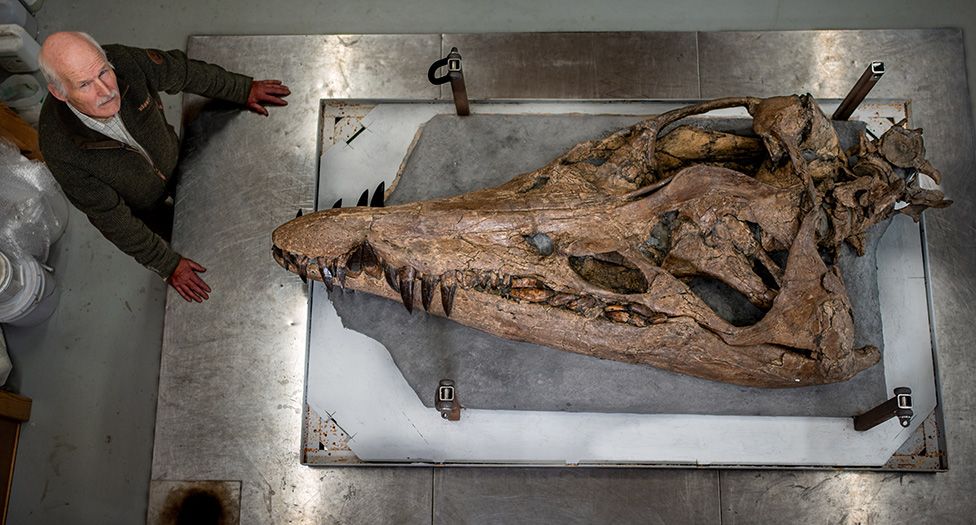
Pliosaur discovery: Huge sea monster emerges from Dorset cliffs

2 hours ago

The skull of a colossal sea monster has been extracted from the cliffs of Dorset's Jurassic Coast.

It belongs to a pliosaur, a ferocious marine reptile that terrorised the oceans about 150 million years ago.

The 2m-long fossil is one of the most complete specimens of its type ever discovered and is giving new insights into this ancient predator.

The skull will be featured in a special David Attenborough programme on BBC One on New Year's Day.

https://www.bbc.co.uk/news/science-environment-67650247


Image
Credit: BBC/Tony Jolliffe
User avatar
caltrek
Posts: 9280
Joined: Mon May 17, 2021 1:17 pm

Re: Natural History (13.8 billion years BC – 3.3 million BC)

Post by caltrek »

72 Million Years Ago, A Monstrous "Blue Dragon" Roamed The Pacific Ocean
Holly Large
December 16, 2023
Introduction:
(IFL Science) If the idea of time traveling to the oceans of the Cretaceous has ever sounded like an appealing idea to you, you might be about to change your mind. Researchers have described a brand-new, 72-million-year-old species of mosasaur, that’s thought to have terrorized the ancient Pacific Ocean.

The study describing the mosasaur came as a result of co-author Akihiro Misaki uncovering a near-complete fossil specimen of the species – named Megapterygius wakayamaensis – whilst hunting for ammonites in Japan’s Wakayama Prefecture. In fact, it’s thought to be the most complete mosasaur skeleton ever found in Japan or the northwestern Pacific.

It took researchers five years to remove the sandstone surrounding the fossil, and they also had to make a cast whilst it was still in situ, in order to provide an accurate record of how all the bones were positioned in the skeleton.

The result of that painstaking work, however, was the discovery of a species unique among mosasaurs, with rear flippers longer than its front ones and a rudder-like tail. “We lack any modern analog that has this kind of body morphology — from fish to penguins to sea turtles,” said co-author Takuya Konishi in a statement. “None has four large flippers they use in conjunction with a tail fin.”

The authors have theorized that the large front fins may have helped the mosasaur with rapid maneuvering, the rear fins with pitch to dive or surface, and the tail for acceleration. “It’s a question just how all five of these hydrodynamic surfaces were used. Which were for steering? Which for propulsion?” Konishi explained. “It opens a whole can of worms that challenges our understanding of how mosasaurs swim.”
Read more here: https://www.iflscience.com/72-million ... ean-72049
Don't mourn, organize.

-Joe Hill
User avatar
wjfox
Site Admin
Posts: 13585
Joined: Sat May 15, 2021 6:09 pm
Location: Essex, UK
Contact:

Re: Natural History (13.8 billion years BC – 3.3 million BC)

Post by wjfox »

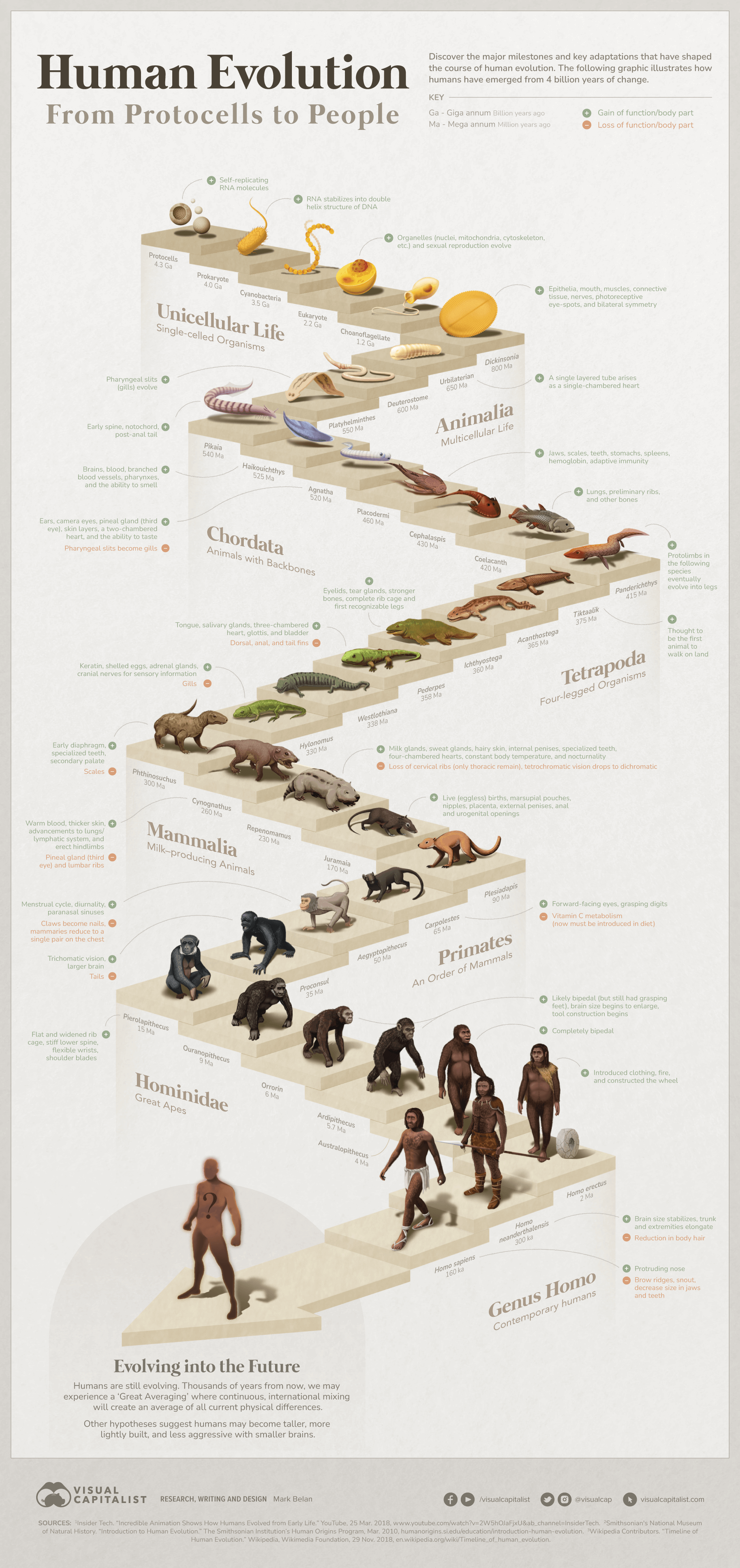
Visualized: The 4 Billion Year Path of Human Evolution

https://www.visualcapitalist.com/path-o ... evolution/


Image
User avatar
wjfox
Site Admin
Posts: 13585
Joined: Sat May 15, 2021 6:09 pm
Location: Essex, UK
Contact:

Re: Natural History (13.8 billion years BC – 3.3 million BC)

Post by wjfox »

User avatar
caltrek
Posts: 9280
Joined: Mon May 17, 2021 1:17 pm

Re: Natural History (13.8 billion years BC – 3.3 million BC)

Post by caltrek »

Earliest Evidence Yet Reveals Photosynthesis Evolved at Least 1.75 Billion Years Ago
by Michele Starr
January 4, 2024

Introduction:
(Science Alert) Tiny fossils that have spent nearly 2 billion years locked up in chunks of ancient rock are giving us the earliest evidence yet for photosynthesis on Earth.

In the McDermott Formation in the desert of northern Australia, tiny structures called thylakoids have been discovered in what are thought to be fossilized cyanobacteria dating back to 1.75 billion years ago.

These structures are found inside the cells of photosynthetic organisms today that contain the pigment chlorophyll, used to absorb the light for photosynthesis.

This means that the microfossils represent the oldest direct evidence for photosynthesis, giving us a new minimum age for the emergence of thylakoid-bearing cyanobacteria, and a new tool for understanding early Earth ecosystems, and how life emerged on our planet.

"Our study provides direct evidence for the presence of metabolically active cyanobacteria performing oxygenic photosynthesis," writes a team led by paleomicrobiologist Catherine Demoulin of the University of Liège.
Read more here: https://www.sciencealert.com/earliest- ... ears-ago
Don't mourn, organize.

-Joe Hill
User avatar
wjfox
Site Admin
Posts: 13585
Joined: Sat May 15, 2021 6:09 pm
Location: Essex, UK
Contact:

Re: Natural History (13.8 billion years BC – 3.3 million BC)

Post by wjfox »

New research shows “Juvenile T. rex” fossils are a distinct species of small tyrannosaur

Wednesday 3 January 2024

A new analysis of fossils believed to be juveniles of T. rex now shows they were adults of a small tyrannosaur, with narrower jaws, longer legs, and bigger arms than T. rex. The species, Nanotyrannus lancensis, was first named decades ago but later reinterpreted as a young T. rex.

The first skull of Nanotyrannus was found in Montana in 1942, but for decades, paleontologists have gone back and forth on whether it was a separate species, or simply a juvenile of the much larger T. rex.

Dr Nick Longrich, from the Milner Centre for Evolution in the Department of Life Sciences at the University of Bath (UK), and Dr Evan Saitta, from the University of Chicago (USA) re-analysed the fossils, looking at growth rings, the anatomy of Nanotyrannus, and a previously unrecognized fossil of a young T. rex.

Measuring the growth rings in Nanotyrannus bones, they showed that they became more closely packed towards the outside of the bone - its growth was slowing. It suggests these animals were nearly full size; not fast-growing juveniles.

Modelling the growth of the fossils showed the animals would have reached a maximum of around 900-1500 kilograms and five metres - about 15 per cent of the size of the giant T. rex, which grew to 8,000 kilograms and nine metres or more.

https://www.bath.ac.uk/announcements/ne ... rannosaur/


Image
Credit Raul Martin
weatheriscool
Posts: 24486
Joined: Sun May 16, 2021 6:16 pm
Contact:

Re: Natural History (13.8 billion years BC – 3.3 million BC)

Post by weatheriscool »

'Giant' predatory worm half a billion years old unearthed in Greenland
By Bronwyn Thompson
January 04, 2024
https://newatlas.com/biology/giant-pred ... greenland/
Scientists have uncovered fossils detailing a new huge predatory worm species thought to have hunted in the Earth’s water column more than 518 million years ago.

Researchers from the University of Bristol's Schools of Earth Sciences and Biological Sciences believe this worm – named Timorebestia, or ‘terror beast’ in Latin – was one of the planet’s earliest carnivorous swimming animals and part of a diverse “dynasty” of predators that until now was unknown to scientists.

"We have previously known that primitive arthropods were the dominant predators during the Cambrian, such as the bizarre-looking anomalocaridids," said Jakob Vinther, a senior author on the study. "However, Timorebestia is a distant, but close, relative of living arrow worms, or chaetognaths. These are much smaller ocean predators today that feed on tiny zooplankton."
User avatar
caltrek
Posts: 9280
Joined: Mon May 17, 2021 1:17 pm

Re: Natural History (13.8 billion years BC – 3.3 million BC)

Post by caltrek »

Study Uncovers Potential Origins of Life in Ancient Hot Springs
January 12, 2024

Introduction:
(Eurekalert) Newcastle University research turns to ancient hot springs to explore the origins of life on Earth.

The research team, funded by the UK’s Natural Environmental Research Council, investigated how the emergence of the first living systems from inert geological materials happened on the Earth, more than 3.5 billion years ago. Scientists at Newcastle University found that by mixing hydrogen, bicarbonate, and iron-rich magnetite under conditions mimicking relatively mild hydrothermal vent results in the formation of a spectrum of organic molecules, most notably including fatty acids stretching up to 18 carbon atoms in length.

Published in the journal Communications Earth & Environment, their findings potentially reveal how some key molecules needed to produce life are made from inorganic chemicals, which is essential to understanding a key step in how life formed on the Earth billions of years ago. Their results may provide a plausible genesis of the organic molecules that form ancient cell membranes, that were perhaps selectively chosen by early biochemical processes on primordial Earth.

Fatty acids in the early stages of life

Fatty acids are long organic molecules that have regions that both attract and repel water that will automatically form cell-like compartments in water naturally and it is these types of molecules that could have made the first cell membranes. Yet, despite their importance, it was uncertain where these fatty acids came from in the early stages of life. One idea is that they might have formed in the hydrothermal vents where hot water, mixed with hydrogen-rich fluids coming from underwater vents mixed with seawater containing CO2.

The group replicated crucial aspects of the chemical environment found in early Earth's oceans and the mixing of the hot alkaline water from around certain types of hydrothermal vents in their laboratory. They found that when hot hydrogen-rich fluids were mixed with carbon dioxide-rich water in the presence of iron-based minerals that were present on the early Earth it created the types of molecules needed to form primitive cell membranes.
Read more of the Eurealert article here: https://www.eurekalert.org/news-releases/1031146

For a technical presentation of study results as presented in Nature: https://www.nature.com/articles/s43247-023-01196-4.pdf
Don't mourn, organize.

-Joe Hill
weatheriscool
Posts: 24486
Joined: Sun May 16, 2021 6:16 pm
Contact:

Re: Natural History (13.8 billion years BC – 3.3 million BC)

Post by weatheriscool »

Megalodons Were Long and Skinny, Not Short and Beefy: Study
The great white may be a poor analog for megalodon.
By Ryan Whitwam January 24, 2024
https://www.extremetech.com/science/meg ... eefy-study
As anyone who grew up on Shark Week can tell you, the megalodon was the biggest, baddest shark to swim the oceans of ancient Earth. However, the image you have in your head of megalodon—a larger and even more toothy version of the modern great white—may not be accurate. A new study claims that in life, megalodon had a totally different body type with a slender frame and even greater total length.

Shark teeth are among the most common marine fossils because these creatures are constantly losing and replacing their chompers. In the case of megalodon, the teeth were the size of butcher knives, which has guaranteed its notoriety millions of years after these super sharks disappeared from Earth's oceans—possibly because of a supernova. Aquariums and museums sometimes display models of reconstructed megalodon jaws, inviting visitors to stand inside them for a photo op.

Most of what we know of megalodon is based on the teeth and jaws—only a few segments of backbone and scales have been discovered, and the rest of a shark's body is cartilage that doesn't fossilize. In the 1990s, scientists used the vertebrae to estimate the size of the extinct shark. In great whites, there's an established ratio between the width of vertebrae and the animal's total length. Based on that, scientists have believed megalodons were around 30 feet long.

The new study, led by Kenshu Shimada at DePaul University and Phillip Sternes from the University of California, reevaluates those fossils and arrives at a different conclusion. This assessment is based on the diameter of the vertebral column. The team claims it's too narrow to support a large shark with the proportions of a great white. Such an animal would be at risk of spinal injuries as it blasted through the water at high speed. Instead, the study suggests a more narrow and elongated body shape.
User avatar
wjfox
Site Admin
Posts: 13585
Joined: Sat May 15, 2021 6:09 pm
Location: Essex, UK
Contact:

Re: Natural History (13.8 billion years BC – 3.3 million BC)

Post by wjfox »

weatheriscool
Posts: 24486
Joined: Sun May 16, 2021 6:16 pm
Contact:

Re: Natural History (13.8 billion years BC – 3.3 million BC)

Post by weatheriscool »

Inner ear of 6-million-year-old ape fossil reveals clues about the evolution of human movement
https://phys.org/news/2024-01-ear-milli ... ossil.html
by New York University
Humans and our closest relatives, living apes, display a remarkable diversity of types of locomotion—from walking upright on two legs to climbing in trees and walking using all four limbs.

While scientists have long been intrigued by the question of how humans' bipedal stance and movement evolved from a quadrupedal ancestor, neither past studies nor fossil records have permitted the reconstruction of a clear and definitive history of the early evolutionary stages that led to human bipedalism
User avatar
caltrek
Posts: 9280
Joined: Mon May 17, 2021 1:17 pm

Re: Natural History (13.8 billion years BC – 3.3 million BC)

Post by caltrek »

Fossilized 350 Million-Year-Old Plant Is Like Nothing You’ve Ever Seen Before
by Eleanor Higgs
February 2, 2024

Introduction:
(IFL Science) While fossilized plants turn up fairly often in the fossil record, they are usually preserved as a trunk or the odd leaf, giving little idea of what the whole tree might have looked like. Newly discovered fossilized trees from New Brunswick, Canada however have enough in the record to reveal that they had a very surprising appearance that has never been seen before.

“The way in which this tree produced hugely long leaves around its spindly trunk, and the sheer number over a short length of trunk, is startling,” said Robert Gastaldo of Colby College in Waterville, Maine in a statement.

Ferns and palm trees are seen in the fossil record – and while this new plant resembles a palm, Sanfordiacaulisis is thought to be 350 million years old, which outdates the existence of palms known in the fossil record by 300 million years. Palm tree leaves usually cluster at the top in small numbers, but the new fossil tree is thought to have had over 250 large leaves not just at the top of the plant but growing around the trunk too.

Sanfordiacaulis preserves more than 250 leaves around its trunk, with each partially preserved leaf extending 1.75 meters from it,” Gastaldo said.

The tree had a trunk of around 16 centimeters (6.2 inches) in diameter, with leaves that started growing around the trunk in a spiral branching pattern with very dense growth, resulting in a voluminous crown at the top of the tree.
Read more here (including illustations): https://www.iflscience.com/fossilized- ... ore-72769
Don't mourn, organize.

-Joe Hill
User avatar
Powers
Posts: 1183
Joined: Fri Apr 07, 2023 7:32 pm
Location: a.k.a Lurking, Member, Lorem Ipsum, ..., --- and ººº.

Re: Natural History (13.8 billion years BC – 3.3 million BC)

Post by Powers »

^^^ That's one ugly reconstruction.
Post Reply