Stars, supernovae, black holes and stellar remnants

Post Reply
User avatar
caltrek
Posts: 9280
Joined: Mon May 17, 2021 1:17 pm

Re: Stars, supernovae, black holes and stellar remnants

Post by caltrek »

A Subtle Symphony of Ripples in Spacetime – Astronomers Use Dead Stars to Measure Gravitational Waves Produced by Ancient Black Holes
by Chris Impey
June 30, 2023

Introduction:
(The Conversation) An international team of astronomers has detected a faint signal of gravitational waves reverberating through the universe. By using dead stars as a giant network of gravitational wave detectors, the collaboration – called NANOGrav – was able to measure a low-frequency hum from a chorus of ripples of spacetime.

I’m an astronomer who studies and has written about cosmology, black holes and exoplanets. I’ve researched the evolution of supermassive black holes using the Hubble Space telescope.

Though members of the team behind this new discovery aren’t yet certain, they strongly suspect that the background hum of gravitational waves they measured was caused by countless ancient merging events of supermassive black holes.

Using dead stars for cosmology

Gravitational waves are ripples in spacetime caused by massive accelerating objects. Albert Einstein predicted their existence in his general theory of relativity, in which he hypothesized that when a gravitational wave passes through space, it makes the space shrink then expand periodically.

Researchers first detected direct evidence of gravitational waves in 2015, when the Laser Interferometer Gravitational-Wave Observatory, known as LIGO, picked up a signal from a pair of merging black holes that had traveled 1.3 billion light-years to reach Earth.

Read more here: https://theconversation.com/a-subtle-s ... es-208815
Don't mourn, organize.

-Joe Hill
weatheriscool
Posts: 24486
Joined: Sun May 16, 2021 6:16 pm
Contact:

Re: Stars, supernovae, black holes and stellar remnants

Post by weatheriscool »

Webb Telescope detects most distant active supermassive black hole
https://phys.org/news/2023-07-webb-tele ... black.html
by University of Texas at Austin
Researchers have discovered the most distant active supermassive black hole to date with the James Webb Space Telescope (JWST). The galaxy, CEERS 1019, existed about 570 million years after the big bang, and its black hole is less massive than any other yet identified in the early universe.

In addition to the black hole in CEERS 1019, the researchers identified two more black holes that are on the smaller side and existed 1 billion and 1.1 billion years after the big bang. JWST also identified eleven galaxies that existed when the universe was 470 million to 675 million years old.
User avatar
caltrek
Posts: 9280
Joined: Mon May 17, 2021 1:17 pm

Re: Stars, supernovae, black holes and stellar remnants

Post by caltrek »

Astronomers Identify the Coldest Star Yet That Emits Radio Waves
July 13, 2023

Introduction:
(Eurekalert) Astronomers at the University of Sydney have shown that a small, faint star is the coldest on record to produce emission at radio wavelength.

The ‘ultracool brown dwarf’ examined in the study is a ball of gas simmering at about 425 degrees centigrade – cooler than a typical campfire – without burning nuclear fuel.

By contrast, the surface temperature of the Sun, a nuclear inferno, is about 5600 degrees.

While not the coldest star ever found, it is the coolest so far analysed using radio astronomy. The findings are published today in The Astrophysical Journal.

Lead author and PhD student in the School of Physics, Kovi Rose, said: “It’s very rare to find ultracool brown dwarf stars like this producing radio emission. That’s because their dynamics do not usually produce the magnetic fields that generate radio emissions detectable from Earth.
Read more here: https://www.eurekalert.org/news-releases/995134
Don't mourn, organize.

-Joe Hill
User avatar
caltrek
Posts: 9280
Joined: Mon May 17, 2021 1:17 pm

Re: Stars, supernovae, black holes and stellar remnants

Post by caltrek »

Astronomers Find a Strange Two-Faced Zombie Star
by Jon Kelvey
July 19, 2023

Introduction:
(Inverse) Until recently, Caltech postdoctoral astronomy researcher Ilaria Caiazzo was merely hunting the skies for the bodies of dead stars. She never expected to discover an exotic, two-faced white dwarf.

”It was quite a serendipitous discovery,” Caiazzo tells Inverse. “We did not expect to find something like this. It was not predicted. It's a new class of [stellar] object.”

White dwarf stars are stellar remnants, the glowing hot remains of a star that has exhausted its thermonuclear fuel supply and blown most of the rest of its mass out into space, leaving the compact former core of the old star. Instead, they glow faintly with residual heat and slowly cool down over time, usually showing compositions of either hydrogen or helium.

Except for the white dwarf ZTF J203349.8+322901.1. While Caiazzo was searching for signs of white dwarfs that may have recently merged together (dim stars that rotated, were magnetized, and varied in brightness), she found ZTF J203349.8+322901.1 — and noticed something weird. It appeared to have one side with a surface consisting of hydrogen, while the other side’s surface consisted of helium.

”I found it because it varies up and down in luminosity and because it looks like a white dwarf and so I thought it was one of those objects,” Caiazzo says. ”Then I took a spectrum and I analyzed it more and realized that it's a completely different class of object.”
Read more here: https://www.inverse.com/science/astron ... bie-star

Don't mourn, organize.

-Joe Hill
User avatar
wjfox
Site Admin
Posts: 13579
Joined: Sat May 15, 2021 6:09 pm
Location: Essex, UK
Contact:

Re: Stars, supernovae, black holes and stellar remnants

Post by wjfox »

caltrek wrote: Thu Jul 20, 2023 2:00 pm Astronomers Find a Strange Two-Faced Zombie Star
by Jon Kelvey
July 19, 2023

...

Read more here: https://www.inverse.com/science/astron ... bie-star

Fascinating discovery.
weatheriscool
Posts: 24486
Joined: Sun May 16, 2021 6:16 pm
Contact:

Re: Stars, supernovae, black holes and stellar remnants

Post by weatheriscool »

Astronomers discover a forming quadruple-star system
https://phys.org/news/2023-08-astronome ... -star.html
by Liu Jia, Chinese Academy of

Recently, the international team ALMA Survey of Orion Planck Galactic Cold Clumps (ALMASOP) led by Prof. Liu Tie from Shanghai Astronomical Observatory (SHAO) of the Chinese Academy of Sciences conducted a high-resolution investigation on 72 dense cores in the Orion Giant Molecular Clouds (GMCs) with the Atacama Large Millimeter/submillimeter Array (ALMA), and discovered a forming quadruple-star system within one core. The result of ALMA observation also revealed ribbon-like dust structures and intricate molecular outflows.

Previously, a widely separated quadruple-star system in its early stage was reported in the journal Nature. The quadruple-star system discovered in this new study, published in The Astrophysical Journal Letters, exhibits more compaction between members and more complex star formation activities, providing a diverse perspective for understanding the formation of multiple-star systems.

It is a well-known fact that approximately half of the stars in the galaxy reside in systems with two or more stars. Knowledge of how multiple-star systems form is essential for building complete theories of star and planet formation. All stars form in the densest gas region of the molecular cloud known as the "dense core."

Previous observation has shown that the more "star babies" are in a stellar system, the smaller the proportion they take up in the whole. For higher-order stellar systems with more than two star-members, how they are formed in dense cores remains ambiguous due to insufficient observations.
weatheriscool
Posts: 24486
Joined: Sun May 16, 2021 6:16 pm
Contact:

Re: Stars, supernovae, black holes and stellar remnants

Post by weatheriscool »

Supersonic tsunamis 3 times as tall as our sun are breaking on a distant 'heartbreak star'
By Keith Cooper
published about 18 hours ago
"Each crash of the star's towering tidal waves releases enough energy to disintegrate our entire planet several hundred times over"


An artist's illustration of two glowing blue stars against the dark background of space, one smaller and one larger. They appear to be connected by a wispy trail of stellar material arising from the larger one.

An artist's illustration of the binary star system producing gargantuan stellar waves. (Image credit: Melissa Weiss, CfA)


A massive stellar behemoth is experiencing violent waves three times as tall as our sun crashing down on its surface. Known as a "heartbeat star," the extreme object also periodically pulses in brightness as the gravity of a close companion stretches it into an oblate shape.

In fact, this particular heartbeat star's immense waves are being raised by that unseen companion as it swoops by on a highly elliptical orbit every 32.8 days. Just like how the moon's gravity serves as the primary source of Earth’s tides by pulling our planet's oceans around with it, the gravity of this heartbeat star's companion whips up material from the stellar body, then drags it around at supersonic speeds to form titanic waves.

The binary star system, known as MACHO 80.7443.1718, resides 169,000 light-years from Earth in the Large Magellanic Cloud. It incorporates a giant, 35-solar-mass primary star and a smaller secondary companion. Though first recognized as having variable brightness in 1990, no other stars that pulsed in this fashion were detected until, one day, NASA's Kepler Space Telescope mission spotted a bunch.

Because the shapes of the larger stars in these systems are distorted, they alternately show their wider and narrower sides to us, leading to brightness pulses mimicking a beating heart. That's why scientists aptly named the stellar breed "heartbeat stars" to begin with.
More:
https://www.space.com/supersonic-tsunam ... break-star
weatheriscool
Posts: 24486
Joined: Sun May 16, 2021 6:16 pm
Contact:

Re: Stars, supernovae, black holes and stellar remnants

Post by weatheriscool »

Most Magnetic Large Star Ever Found Has 4000 Times Stronger Field than Our Sun
August 18, 2023 by Brian Wang
https://www.nextbigfuture.com/2023/08/m ... r-sun.html

Shenar’s astronomy research team used an instrument on the Canada-France-Hawaii Telescope to look for the chemical fingerprints that magnetic fields can leave on a star’s spectrum and found HD45166 has a field strength of 43,000 Gauss. “One-thousand-Gauss magnetic fields are pretty rare amongst massive stars, so 43,000 Gauss is really off the chart,” says Paul Crowther (University of Sheffield, UK), who was not involved in the study. The large scale solar magnetic field near the poles of our Sun is basically dipolar with a strength of about 10 Gauss.

Analyzing HD45166 star’s brightness and motion, they determined that it had a companion star and was 2 times the mass of the sun and not 4 times. They also concluded that HD45166 came from the merger of two smaller stars.

Eventually, Shenar and his colleagues estimate that this star will collapse into a neutron star, and its magnetic field will strengthen as it does so. They think this will create a magnetar.

The cinders of burnt-out massive stars known as neutron stars have magnetic fields 1 trillion times stronger than the Sun’s. As the massive star collapses, its magnetic field lines are packed into a much tighter space, and the field strength increases. But then there are magnetars: These neutron stars have fields 1,000 times stronger again than regular neutron star.
weatheriscool
Posts: 24486
Joined: Sun May 16, 2021 6:16 pm
Contact:

Re: Stars, supernovae, black holes and stellar remnants

Post by weatheriscool »

First observations ever of the outskirts of a supermassive black hole's accretion disk
https://phys.org/news/2023-08-outskirts ... etion.html
by Josie Fenske, NSF's NOIRLab
Nothing can evoke an existential perspective-spiral quite like looking at an image of a galaxy. At first glance, these sublime structures may appear rather serene. But in fact the center of many galaxies is a turbulent environment containing an actively feeding supermassive black hole.

Orbiting these incomprehensibly dense objects are swirling accretion disks of gas and dust, which feed the black hole and emit copious amounts of energy all along the electromagnetic spectrum—from high-energy gamma rays and X-rays, through visible light, to infrared and radio waves.

Studying accretion disks can enhance astronomers' understanding of black holes and the evolution of their host galaxies. Most accretion disks, however, are impossible to directly image because of their extreme distances and relatively small sizes. Instead, astronomers use the spectra of light emitted from within the disk to characterize its size and behavior.

Using this approach, astronomers using the Gemini North telescope, one half of the International Gemini Observatory, operated by NSF's NOIRLab, have made the first detection ever of two near-infrared emission lines in the accretion disk of the galaxy III Zw 002, placing a new limit on the size of these magnificent structures.
weatheriscool
Posts: 24486
Joined: Sun May 16, 2021 6:16 pm
Contact:

Re: Stars, supernovae, black holes and stellar remnants

Post by weatheriscool »

Study hints at the existence of the closest black holes to Earth in the Hyades star cluster
https://phys.org/news/2023-09-hints-clo ... earth.html
by University of Barcelona
A paper published in the journal Monthly Notices of the Royal Astronomical Society hints at the existence of several black holes in the Hyades cluster—the closest open cluster to our solar system—which would make them the closest black holes to Earth ever detected.

The study results from a collaboration between a group of scientists led by Stefano Torniamenti, from the University of Padua (Italy), with the significant participation of with Mark Gieles, ICREA professor at the Faculty of Physics, the Institute of Cosmos Sciences of the University of Barcelona (ICCUB) and the Institute of Space Studies of Catalonia (IEEC), and Friedrich Anders (ICCUB-IEEC).

Specifically, the finding took place during a research stay of the expert Stefano Torniamenti at the ICCUB, one of the research units that make up the IEEC.
weatheriscool
Posts: 24486
Joined: Sun May 16, 2021 6:16 pm
Contact:

Re: Stars, supernovae, black holes and stellar remnants

Post by weatheriscool »

World's first 3D simulations reveal the physics of exotic supernovae
https://phys.org/news/2023-09-world-3d- ... ysics.html
by ASIAA
After years of dedicated research and over 5 million supercomputer computing hours, a team has created the world's first high-resolution 3D radiation hydrodynamics simulations for exotic supernovae. This work is reported in The Astrophysical Journal.

Ke-Jung Chen at Academia Sinica Institute of Astronomy and Astrophysics (ASIAA) in Taiwan, led an international team and used the powerful supercomputers from the Lawrence Berkeley National Laboratory and the National Astronomical Observatory of Japan to make the breakthrough.

Supernova explosions are the most spectacular endings for massive stars, as they conclude their life cycles in a self-destructive manner, instantaneously releasing brightness equivalent to billions of suns, illuminating the entire universe.

During this explosion, heavy elements formed within the star are also ejected, laying the foundation for the birth of new stars and planets and playing a crucial role in the origin of life.

Supernovae are a key interest in modern astrophysics, encompassing numerous important astronomical and physical issues in both theory and observation, holding significant research value.

Over the past half-century, research has provided a relatively comprehensive understanding of supernovae. However, the latest large-scale supernova survey observations are revealing many unusual stellar explosions (exotic supernovae) that challenge and overturn previously established understanding of supernova physics.
User avatar
caltrek
Posts: 9280
Joined: Mon May 17, 2021 1:17 pm

Re: Stars, supernovae, black holes and stellar remnants

Post by caltrek »

Supermassive Black Holes Alter Galactic chemistry
September 15, 2023

Introduction:
(Eurekalert) New research shows that the supermassive black hole at the center of a galaxy can have a direct impact on the chemical distribution of the host galaxy. This provides another piece of the puzzle for understanding how galaxies evolve.

It is well known that active supermassive black holes can produce major changes their host galaxies by heating up and removing the interstellar gas in the galaxy. But the compact sizes of black holes, the long distances from Earth, and obscuration by dust in the galaxies have made it difficult to measure the chemical composition distribution of the gas around an active supermassive black hole.

In this study, an international team of researchers led by Toshiki Saito at the National Astronomical Observatory of Japan and Taku Nakajima at Nagoya University used ALMA (Atacama Large Millimeter/submillimeter Array) to observe the central region of Messier 77 located 51.4 million light-years away in the direction of the constellation Cetus. Messier 77 is a relatively nearby example of a galaxy hosting an active supermassive black hole.

Thanks to ALMA’s high spatial resolution and a new machine learning analysis technique, the team was able to map the distribution of 23 molecules. This is the first survey to objectively depict the distribution of all detected molecules through unbiased observations. The results show that along the path of the bipolar jets emanating near the black hole, molecules commonly found in galaxies such as carbon monoxide (CO) seem to break down, while the concentrations of distinctive molecules such as an isomer of HCN and the cyanide radical (CN) increase. This is direct evidence that supermassive black holes affect not only the large-scale structure, but also the chemical composition of their host galaxies.
Read more of the Eurekalert article here: https://www.eurekalert.org/news-releases/1001703

For a technical presentation of the results of the study as presented in The Astrophysical Journal: https://iopscience.iop.org/article/10. ... 57/ace4c7
Don't mourn, organize.

-Joe Hill
weatheriscool
Posts: 24486
Joined: Sun May 16, 2021 6:16 pm
Contact:

Re: Stars, supernovae, black holes and stellar remnants

Post by weatheriscool »

weatheriscool
Posts: 24486
Joined: Sun May 16, 2021 6:16 pm
Contact:

Re: Stars, supernovae, black holes and stellar remnants

Post by weatheriscool »

weatheriscool
Posts: 24486
Joined: Sun May 16, 2021 6:16 pm
Contact:

Re: Stars, supernovae, black holes and stellar remnants

Post by weatheriscool »

weatheriscool
Posts: 24486
Joined: Sun May 16, 2021 6:16 pm
Contact:

Re: Stars, supernovae, black holes and stellar remnants

Post by weatheriscool »

User avatar
wjfox
Site Admin
Posts: 13579
Joined: Sat May 15, 2021 6:09 pm
Location: Essex, UK
Contact:

Re: Stars, supernovae, black holes and stellar remnants

Post by wjfox »

First evidence of spinning black hole detected by scientists

Wed 27 Sep 2023 18.31 BST

Astronomers have captured the first direct evidence of a black hole spinning, providing new insights into the universe’s most enigmatic objects.

The observations focus on the supermassive black hole at the centre of the neighbouring Messier 87 galaxy, whose shadow was imaged by the Event Horizon Telescope. Like many supermassive black holes, M87 features powerful jets that are launched from the poles at close to the speed of light into intergalactic space.

Scientists have predicted that the rotation of a black hole powers these cosmic jets, but until now direct evidence was elusive.

“After the success of black hole imaging in this galaxy with the Event Horizon Telescope, whether this black hole is spinning or not has been a central concern among scientists,” said Dr Kazuhiro Hada, of the national astronomical observatory of Japan and co-author. “Now anticipation has turned into certainty. This monster black hole is indeed spinning.”

M87 is located 55m light years from the Earth and harbours a black hole 6.5bn times more massive than the Sun. Just beyond the black hole is an accretion disk of gas and dust, swirling on the precipice of the cosmic sinkhole. Some of this material is destined to fall into the black hole, disappearing for ever. But a fraction will be ejected out from the poles of the black hole at more than 99.99% of the speed of light.

https://www.theguardian.com/science/202 ... scientists
User avatar
wjfox
Site Admin
Posts: 13579
Joined: Sat May 15, 2021 6:09 pm
Location: Essex, UK
Contact:

Re: Stars, supernovae, black holes and stellar remnants

Post by wjfox »

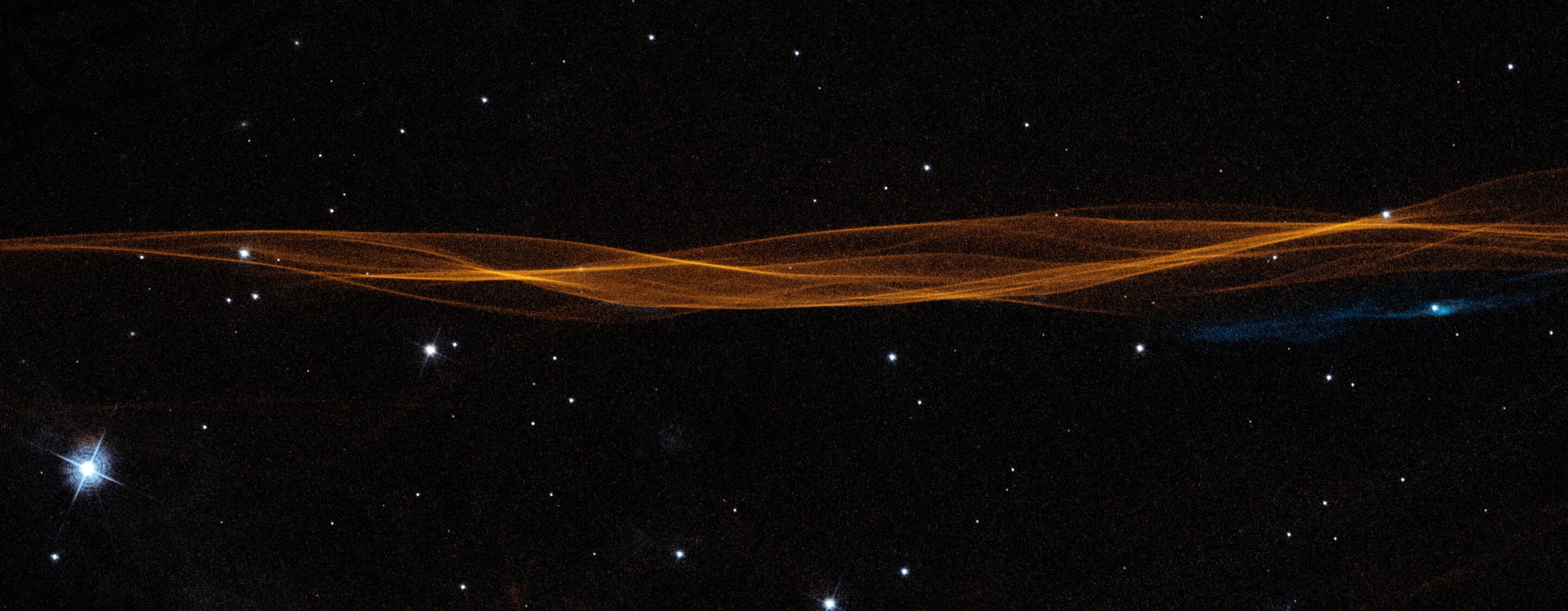
Living on the edge: Supernova bubble expands in new Hubble time-lapse movie

September 28, 2023

Though a doomed star exploded some 20,000 years ago, its tattered remnants continue racing into space at breakneck speeds—and NASA's Hubble Space Telescope has caught the action.

The nebula, called the Cygnus Loop, forms a bubble-like shape that is about 120 light-years in diameter. The distance to its center is approximately 2,600 light-years. The entire nebula has a width of six full moons as seen on the sky.

Astronomers used Hubble to zoom into a very small slice of the leading edge of this expanding supernova bubble, where the supernova blast wave plows into surrounding material in space. Hubble images taken from 2001 to 2020 clearly demonstrate how the remnant's shock front has expanded over time, and they used the crisp images to clock its speed.

By analyzing the shock's location, astronomers found that the shock hasn't slowed down at all in the last 20 years, and is speeding into interstellar space at over half a million miles per hour—fast enough to travel from Earth to the moon in less than half an hour. While this seems incredibly fast, it's actually on the slow end for the speed of a supernova shock wave. Researchers were able to assemble a "movie" from Hubble images for a close-up look at how the tattered star is slamming into interstellar space.

"Hubble is the only way that we can actually watch what's happening at the edge of the bubble with such clarity," said Ravi Sankrit, an astronomer at the Space Telescope Science Institute in Baltimore, Maryland. "The Hubble images are spectacular when you look at them in detail. They're telling us about the density differences encountered by the supernova shocks as they propagate through space, and the turbulence in the regions behind these shocks."

[see link below for movie]

https://phys.org/news/2023-09-edge-supe ... movie.html


Image
Credit: NASA, ESA, Ravi Sankrit (STScI)
User avatar
caltrek
Posts: 9280
Joined: Mon May 17, 2021 1:17 pm

Re: Stars, supernovae, black holes and stellar remnants

Post by caltrek »

Strange Rare Star Explosion Spied by Hubble Where It Shouldn't Be
by Dr. Alfredo Carpineti
October 6, 2023

Introduction:
(IFL Science) For the last five years, astronomers have been spotting peculiar stellar explosions that don’t behave like any other known. These rare events are known as Luminous Fast Blue Optical Transients (LFBOT) – you may even remember the first one, nicknamed the "Cow" (AT2018cow). Already strange, they just got stranger as Hubble has observed one happening where it definitely shouldn't be.

LFBOTS are among the brightest visible events in the universe but they are very rare; on average, just one a year has been discovered since 2018. They are similar to supernovae or gamma-ray bursts, becoming incredibly bright but they fade away in a matter of days, unlike supernovae that take weeks or months.

The best explanation for them has been considered a special type of supernova from extremely massive stars. These LFBOTs happen in the spiral arms of star-forming galaxies, which is exactly where massive stars would live their extremely short lives. So imagine astronomers' surprise when they tracked one of these events with Hubble and found it happening in intergalactic space.

AT2023fhn, nicknamed the "Finch”, has all the characteristics of the other handful of LFBOT discovered so far apart from its location inexplicably in the empty space between two galaxies. It's about 50,000 light-years from the large spiral galaxy and about 15,000 light-years from the small galaxy.
"The more we learn about LFBOTs, the more they surprise us," said lead author Ashley Chrimes, a European Space Agency Research Fellow, in a statement. "We've now shown that LFBOTs can occur a long way from the center of the nearest galaxy, and the location of the Finch is not what we expect for any kind of supernova."
Read more here: https://www.iflscience.com/strange-rar ... e-71007
Don't mourn, organize.

-Joe Hill
User avatar
caltrek
Posts: 9280
Joined: Mon May 17, 2021 1:17 pm

Re: Stars, supernovae, black holes and stellar remnants

Post by caltrek »

Supermassive Black Holes Posses A Strange Mechanism That Prevents Overeating
by Kiona Smith
November 2, 2023

Introduction:
(Inverse) We think of supermassive black holes as gorging cosmic monsters, swallowing up anything that gets too close, but according to a recent study, the supermassive black hole at the heart of a nearby galaxy called Circinus is actually a very picky eater.

Astrophysicist Takuma Izumi, of the National Astrophysical Observatory of Japan, and his colleagues used ALMA to take the highest-resolution look yet at the center of Circinus, and they found that the black hole only consumes about 3 percent of the gas that falls toward it. Radiation — released by material racing faster and faster as it spirals toward the supermassive black hole — pushes the rest of the gas back into the galaxy in fast-moving, turbulent streams. The researchers published their work in the journal Science.

Izumi and his colleagues used the Atacama Large Millimeter/submillimeter Array — 66 radio telescope antennas in the highlands of Chile — to map the flow of gas in the innermost region of the Circinus galaxy, 13.05 million light years away.

Specifically, they watched the innermost 1 percent of the galaxy, spanning a distance from about 325 light years to about 32.5 light years from the supermassive black hole., which is about 1.7 million times more massive than our Sun. That’s such a narrow area that it’s hard to see in much detail, but ALMA’s array of radio dishes let Izumi and his colleagues watch the action with about 1.6 to 8.5 light-year resolution. And what they saw was the black hole shoving away most of the gas that fell toward it.

The ALMA data revealed a messy, chaotic disk of gas swirling around the black hole. As gas falls inward from farther out in the galaxy, it ends up in what’s called an accretion disk: a spiral of material swirling around the black hole, accelerated to tremendous speeds by the black hole’s powerful gravity.
Read more here: https://www.inverse.com/science/superm ... -galaxy
Don't mourn, organize.

-Joe Hill
Post Reply