
Google AI and DeepMind News and Discussions
Google AI and DeepMind News and Discussions
And remember my friend, future events such as these will affect you in the future
-
MelanieWi1l
- Posts: 3
- Joined: Tue May 25, 2021 9:29 am
- Contact:
Re: Google DeepMind News and Discussions
Performance and generalization yes but a very important aspect is also HOW it does things. So here are some additional details of what the paper is about:
Those alphago like agents used to have an external game simulator (to process the move they actually commit to play) and an internal simulator (to process the move they are browsing during the search to decide the best option). A game simulator does several things:
-you cannot play illegal move with it.
-it gives you the dynamic answer of rules to a move, like by example capturing the stones your move is actually capturing.
-it gives you a terminal status: "this is a win, loss, draw state".
The breakthrough of MuZero is that it has NO internal simulator of the game given, it should learn it's own representation of a game state and of game dynamic when "playing in it's head during search" (but still have an external simulator to process the moves it commit to play, so which is called only once by move of a game of a training session)
So basically MuZero could:
-read illegal moves as a possibility.
-badly process the dynamic of it's move (like it could forgot to capture the stones actually captured by it's move as long as this happens in it's head during search)
-miss that the game is ended (keep reading after a terminal state of the game).
So it's basically what every beginner in chess go through as the beginning of their learning process. Yet it still manages to learn a quite perfect and optimized model of the game, and use it to master the game itself.
Those alphago like agents used to have an external game simulator (to process the move they actually commit to play) and an internal simulator (to process the move they are browsing during the search to decide the best option). A game simulator does several things:
-you cannot play illegal move with it.
-it gives you the dynamic answer of rules to a move, like by example capturing the stones your move is actually capturing.
-it gives you a terminal status: "this is a win, loss, draw state".
The breakthrough of MuZero is that it has NO internal simulator of the game given, it should learn it's own representation of a game state and of game dynamic when "playing in it's head during search" (but still have an external simulator to process the moves it commit to play, so which is called only once by move of a game of a training session)
So basically MuZero could:
-read illegal moves as a possibility.
-badly process the dynamic of it's move (like it could forgot to capture the stones actually captured by it's move as long as this happens in it's head during search)
-miss that the game is ended (keep reading after a terminal state of the game).
So it's basically what every beginner in chess go through as the beginning of their learning process. Yet it still manages to learn a quite perfect and optimized model of the game, and use it to master the game itself.
Re: Google DeepMind News and Discussions
DeepMind AGI paper adds urgency to ethical AI
( An overview of where we are with AI in June 2021)
( An overview of where we are with AI in June 2021)
We are not ready for artificial general intelligence
Despite assurances from stalwarts that AGI will benefit all of humanity, there are already real problems with today’s single-purpose narrow AI algorithms that calls this assumption into question. According to a Harvard Business Review story, when AI examples from predictive policing to automated credit scoring algorithms go unchecked, they represent a serious threat to our society. A recently published survey by Pew Research of technology innovators, developers, business and policy leaders, researchers, and activists reveals skepticism that ethical AI principles will be widely implemented by 2030. This is due to a widespread belief that businesses will prioritize profits and governments continue to surveil and control their populations. If it is so difficult to enable transparency, eliminate bias, and ensure the ethical use of today’s narrow AI, then the potential for unintended consequences from AGI appear astronomical.
And that concern is just for the actual functioning of the AI. The political and economic impacts of AI could result in a range of possible outcomes, from a post-scarcity utopia to a feudal dystopia. It is possible too, that both extremes could co-exist. For instance, if wealth generated by AI is distributed throughout society, this could contribute to the utopian vision. However, we have seen that AI concentrates power, with a relatively small number of companies controlling the technology. The concentration of power sets the stage for the feudal dystopia.
Perhaps less time than thought
The DeepMind paper describes how AGI could be achieved. Getting there is still some ways away, from 20 years to forever, depending on the estimate, although recent advances suggest the timeline will be at the shorter end of this spectrum and possibly even sooner. I argued last year that GPT-3 from OpenAI has moved AI into a twilight zone, an area between narrow and general AI. GPT-3 is capable of many different tasks with no additional training, able to produce compelling narratives, generate computer code, autocomplete images, translate between languages, and perform math calculations, among other feats, including some its creators did not plan. This apparent multifunctional capability does not sound much like the definition of narrow AI. Indeed, it is much more general in function.
Even so, today’s deep-learning algorithms, including GPT-3, are not able to adapt to changing circumstances, a fundamental distinction that separates today’s AI from AGI. One step towards adaptability is multimodal AI that combines the language processing of GPT-3 with other capabilities such as visual processing. For example, based upon GPT-3, OpenAI introduced DALL-E, which generates images based on the concepts it has learned. Using a simple text prompt, DALL-E can produce “a painting of a capybara sitting in a field at sunrise.” Though it may have never “seen” a picture of this before, it can combine what it has learned of paintings, capybaras, fields, and sunrises to produce dozens of images. Thus, it is multimodal and is more capable and general, though still not AGI.
And remember my friend, future events such as these will affect you in the future
Re: Google DeepMind News and Discussions
And remember my friend, future events such as these will affect you in the future
Re: Google DeepMind News and Discussions
[2106.13884] Multimodal Few-Shot Learning with Frozen Language Models
Starspawn0's comments: Deepmind. I think I might have posted the tweet thread to this before. It's *amazing*. It's like the kind of thing you would expect from GPT-4 -- super-fast / few-shot learning of new visual-and-text combined skills.
So what do we expect from GPT-4?? We might expect it to have few-shot capability, whereby you can show it an image, and then teach it a new task on-the-fly. For example, maybe it's an analogy task: {image} is to X as Y is to ....? [fill in the blank], and it quickly learns to output Z (where Z is the correct answer). Or, you can maybe teach it to play chess -- you show it a board, and say, "white to move," and it gives a decent move. Maybe you need to give it a few examples, first, so that it gets the idea of what you want it to do -- just like the few-shot learning in GPT-3; except here it's with text and images combined.
What's missing is the image-synthesis. That's what OpenAI's DallE is all about. If you combine what DallE can deliver with the model in this Deepmind paper, and then scale it up way, way up, you'll have something mind-blowing. So, take that chess example: instead of you always supplying the board for it to decide the next move, it could also generate the board! A sufficiently powerful version of this would literally allow you to create a chess game on-the-fly, just by giving it a few examples.
You could even make up a whole new board game, and teach it how to play with some examples, and then it would maybe do a passable, amateur-level job as your opponent -- and would even generate subsequent game boards for you.
Just think of the business applications. You could show it some graphs and ask if there is anything that "stands out", and it might generate a paragraph or two -- and it would use its world-knowledge about other companies, industries, supply chains, and so on, to give a plausible answer.
Or maybe you're a student in a chemistry class. You took some hand-written notes about some of the molecules the teacher drew at the board. You could show it one of your drawings, and ask it some questions about it. Maybe you made a mistake, and ask it to correct -- and it will do that, similar to doing "grammar correction".
Addendum: Take a look at the example in Figure 1. It's amazing that it knew to map Macaulay Culkin's scream pose to a scream emoji. Look also at Figure 4 -- learns on the fly.
I haven't read it through that deeply yet, but it doesn't seem they are revealing what language model they used -- I could be totally wrong, though. They say, on page 13 in A.2:
Starspawn0's comments: Deepmind. I think I might have posted the tweet thread to this before. It's *amazing*. It's like the kind of thing you would expect from GPT-4 -- super-fast / few-shot learning of new visual-and-text combined skills.
So what do we expect from GPT-4?? We might expect it to have few-shot capability, whereby you can show it an image, and then teach it a new task on-the-fly. For example, maybe it's an analogy task: {image} is to X as Y is to ....? [fill in the blank], and it quickly learns to output Z (where Z is the correct answer). Or, you can maybe teach it to play chess -- you show it a board, and say, "white to move," and it gives a decent move. Maybe you need to give it a few examples, first, so that it gets the idea of what you want it to do -- just like the few-shot learning in GPT-3; except here it's with text and images combined.
What's missing is the image-synthesis. That's what OpenAI's DallE is all about. If you combine what DallE can deliver with the model in this Deepmind paper, and then scale it up way, way up, you'll have something mind-blowing. So, take that chess example: instead of you always supplying the board for it to decide the next move, it could also generate the board! A sufficiently powerful version of this would literally allow you to create a chess game on-the-fly, just by giving it a few examples.
You could even make up a whole new board game, and teach it how to play with some examples, and then it would maybe do a passable, amateur-level job as your opponent -- and would even generate subsequent game boards for you.
Just think of the business applications. You could show it some graphs and ask if there is anything that "stands out", and it might generate a paragraph or two -- and it would use its world-knowledge about other companies, industries, supply chains, and so on, to give a plausible answer.
Or maybe you're a student in a chemistry class. You took some hand-written notes about some of the molecules the teacher drew at the board. You could show it one of your drawings, and ask it some questions about it. Maybe you made a mistake, and ask it to correct -- and it will do that, similar to doing "grammar correction".
Addendum: Take a look at the example in Figure 1. It's amazing that it knew to map Macaulay Culkin's scream pose to a scream emoji. Look also at Figure 4 -- learns on the fly.
I haven't read it through that deeply yet, but it doesn't seem they are revealing what language model they used -- I could be totally wrong, though. They say, on page 13 in A.2:
They trained their own GPT-2??The pretrained transformer language model we used has a GPT-like architecture [29]. It consists of a series of identical residual layers, each comprised of a self-attention operation followed by a positionwise MLP. The only deviation from the architecture described as GPT-2 is the use of relative position encodings [36]. Our seven billion parameter configuration used 32 layers, with each hidden layer having a channel dimensionality of 4096 hidden units. The attention operations use 32 heads each with key/value size dimensionality of 128, and the hidden layer of each MLP had 16384 hidden units. The 400 million parameter configuration used 12 layers, 12 heads, hidden dimensionality of 1536, and 6144 units in the MLP hidden layers.
And remember my friend, future events such as these will affect you in the future
Re: Google DeepMind News and Discussions
DeepMind uses AI to tackle neglected deadly diseases
Artificial intelligence is to be used to tackle the most deadly parasitic diseases in the developing world, tech company DeepMind has announced.
The London-based Alphabet-owned lab will work with the Drugs for Neglected Diseases initiative (DNDI) to treat Chagas disease and Leishmaniasis.
Scientists spend years in laboratories mapping protein structures.
But last year, DeepMind's AlphaFold program was able to achieve the same accuracy in a matter of days.
And remember my friend, future events such as these will affect you in the future
Re: Google DeepMind News and Discussions
Google’s Supermodel: DeepMind Perceiver is a step on the road to an AI machine that could process anything and everything
Arguably one of the premiere events that has brought AI to popular attention in recent years was the invention of the Transformer by Ashish Vaswani and colleagues at Google in 2017. The Transformer led to lots of language programs such as Google's BERT and OpenAI's GPT-3 that have been able to produce surprisingly human-seeming sentences, giving the impression machines can write like a person.
Now, scientists at DeepMind in the U.K., which is owned by Google, want to take the benefits of the Transformer beyond text, to let it revolutionize other material including images, sounds and video, and spatial data of the kind a car records with LiDAR.
The Perceiver, unveiled this week by DeepMind in a paper posted on arXiv, adapts the Transformer with some tweaks to let it consume all those types of input, and to perform on the various tasks, such as image recognition, for which separate kinds of neural networks are usually developed.
And remember my friend, future events such as these will affect you in the future

Re: Google DeepMind News and Discussions
I can't help but think this is Proto AGI although I am sure it isn't as you are not hyping it up as such.Yuli Ban wrote: ↑Fri Jul 09, 2021 2:47 am Google’s Supermodel: DeepMind Perceiver is a step on the road to an AI machine that could process anything and everythingArguably one of the premiere events that has brought AI to popular attention in recent years was the invention of the Transformer by Ashish Vaswani and colleagues at Google in 2017. The Transformer led to lots of language programs such as Google's BERT and OpenAI's GPT-3 that have been able to produce surprisingly human-seeming sentences, giving the impression machines can write like a person.
Now, scientists at DeepMind in the U.K., which is owned by Google, want to take the benefits of the Transformer beyond text, to let it revolutionize other material including images, sounds and video, and spatial data of the kind a car records with LiDAR.
The Perceiver, unveiled this week by DeepMind in a paper posted on arXiv, adapts the Transformer with some tweaks to let it consume all those types of input, and to perform on the various tasks, such as image recognition, for which separate kinds of neural networks are usually developed.
"The Perceiver, unveiled this week by DeepMind in a paper posted on arXiv, adapts the Transformer with some tweaks to let it consume all those types of input, and to perform on the various tasks, such as image recognition, for which separate kinds of neural networks are usually developed."
I assumed this is Proto AGI as it is a transformer that can consume multiple types of input and do multiple tasks what is it missing?
Even if it isn't one I think this AI is general in some form meaning AI with generality us now going to be developed at a compounding rate.
Human level AGI feels truly near now it feels like the beginning of the end, before the singularity (or as you have said extreme but predictable change not singularity).
Re: Google DeepMind News and Discussions
It's certainly interesting, but it's still got a ways to go in terms of performance.
And remember my friend, future events such as these will affect you in the future
Re: Google DeepMind News and Discussions
Researchers match DeepMind’s AlphaFold2 protein folding power with faster, freely available model
DeepMind stunned the biology world late last year when its AlphaFold2 AI model predicted the structure of proteins (a common and very difficult problem) so accurately that many declared the decades-old problem “solved.” Now researchers claim to have leapfrogged DeepMind the way DeepMind leapfrogged the rest of the world, with RoseTTAFold, a system that does nearly the same thing at a fraction of the computational cost. (Oh, and it’s free to use.)
AlphaFold2 has been the talk of the industry since November, when it blew away the competition at CASP14, a virtual competition between algorithms built to predict the physical structure of a protein given the sequence of amino acids that make it up. The model from DeepMind was so far ahead of the others, so highly and reliably accurate, that many in the field have talked (half-seriously and in good humor) about moving on to a new field.
But one aspect that seemed to satisfy no one was DeepMind’s plans for the system. It was not exhaustively and openly described, and some worried that the company (which is owned by Alphabet/Google) was planning on more or less keeping the secret sauce to themselves — which would be their prerogative but also somewhat against the ethos of mutual aid in the scientific world.
And remember my friend, future events such as these will affect you in the future
Re: Google DeepMind News and Discussions
"Highly accurate protein structure prediction with AlphaFold"
Proteins are essential to life, and understanding their structure can facilitate a mechanistic understanding of their function. Through an enormous experimental effort, the structures of around 100,000 unique proteins have been determined, but this represents a small fraction of the billions of known protein sequences. Structural coverage is bottlenecked by the months to years of painstaking effort required to determine a single protein structure. Accurate computational approaches are needed to address this gap and to enable large-scale structural bioinformatics. Predicting the 3-D structure that a protein will adopt based solely on its amino acid sequence, the structure prediction component of the ‘protein folding problem’, has been an important open research problem for more than 50 years. Despite recent progress, existing methods fall far short of atomic accuracy, especially when no homologous structure is available. Here we provide the first computational method that can regularly predict protein structures with atomic accuracy even where no similar structure is known. We validated an entirely redesigned version of our neural network-based model, AlphaFold, in the challenging 14th Critical Assessment of protein Structure Prediction (CASP14), demonstrating accuracy competitive with experiment in a majority of cases and greatly outperforming other methods. Underpinning the latest version of AlphaFold is a novel machine learning approach that incorporates physical and biological knowledge about protein structure, leveraging multi-sequence alignments, into the design of the deep learning algorithm.
And remember my friend, future events such as these will affect you in the future
Re: Google DeepMind News and Discussions
And remember my friend, future events such as these will affect you in the future
Re: Google DeepMind News and Discussions
DeepMind says it will release the structure of every protein known to science
Back in December 2020, DeepMind took the world of biology by surprise when it solved a 50-year grand challenge with AlphaFold, an AI tool that predicts the structure of proteins. Last week the London-based company published full details of that tool and released its source code.
Now the firm has announced that it has used its AI to predict the shapes of nearly every protein in the human body, as well as the shapes of hundreds of thousands of other proteins found in 20 of the most widely studied organisms, including yeast, fruit flies, and mice. The breakthrough could allow biologists from around the world to understand diseases better and develop new drugs.
And remember my friend, future events such as these will affect you in the future
Re: Google DeepMind News and Discussions
Generally capable agents emerge from open-ended play
starspawn0:
In recent years, artificial intelligence agents have succeeded in a range of complex game environments. For instance, AlphaZero beat world-champion programs in chess, shogi, and Go after starting out with knowing no more than the basic rules of how to play. Through reinforcement learning (RL), this single system learnt by playing round after round of games through a repetitive process of trial and error. But AlphaZero still trained separately on each game — unable to simply learn another game or task without repeating the RL process from scratch. The same is true for other successes of RL, such as Atari, Capture the Flag, StarCraft II, Dota 2, and Hide-and-Seek. DeepMind’s mission of solving intelligence to advance science and humanity led us to explore how we could overcome this limitation to create AI agents with more general and adaptive behaviour. Instead of learning one game at a time, these agents would be able to react to completely new conditions and play a whole universe of games and tasks, including ones never seen before.
Today, we published "Open-Ended Learning Leads to Generally Capable Agents," a preprint detailing our first steps to train an agent capable of playing many different games without needing human interaction data. We created a vast game environment we call XLand, which includes many multiplayer games within consistent, human-relatable 3D worlds. This environment makes it possible to formulate new learning algorithms, which dynamically control how an agent trains and the games on which it trains. The agent’s capabilities improve iteratively as a response to the challenges that arise in training, with the learning process continually refining the training tasks so the agent never stops learning. The result is an agent with the ability to succeed at a wide spectrum of tasks — from simple object-finding problems to complex games like hide and seek and capture the flag, which were not encountered during training. We find the agent exhibits general, heuristic behaviours such as experimentation, behaviours that are widely applicable to many tasks rather than specialised to an individual task. This new approach marks an important step toward creating more general agents with the flexibility to adapt rapidly within constantly changing environments.
starspawn0:
This is one of the tasks I wrote once before it would be nice to see brain data applied to. In an old post of mine, I wondered: could one use brain data to build a game-playing agent that can do decently on a new game out-of-the-box? You see, humans can be shown a new game, and if they have some game-playing experience, can do an ok job in the first try -- e.g. they won't die immediately; won't run into enemies; will predict where the enemies are moving, using physical commonsense reasoning; infer what a goal might be; and so on. That's a much, much harder problem than training an agent to solve any particular game. It requires something closer to AGI than we've seen in game-playing AIs in the past.
I would say this is as much a breakthrough and shock as GPT-3 (and GPT-2). Scale this up and use more real-world tasks (instead of games), and you could probably make something that genuinely seems intelligent, if put in a robot body and allowed to interact with the world. Add in some language capability, and you're going to have something that needs to be watched carefully!
....
The success of this work will lead to even larger attempts by other groups. The perceived risk in attempting something like this is now a lot lower. Before this work, some teams might have had the same idea, but then thought, "Ahh... probably won't work. And if we try, we'll have wasted large numbers of hours and millions of dollars, with little to show for it, except marginally better game-playing agents. Could we really make this work?..." and the doubt and skepticism set in.
And remember my friend, future events such as these will affect you in the future
Re: Google DeepMind News and Discussions
And remember my friend, future events such as these will affect you in the future
Re: Google DeepMind News and Discussions
And remember my friend, future events such as these will affect you in the future
Re: Google DeepMind News and Discussions
And remember my friend, future events such as these will affect you in the future
Re: Google DeepMind News and Discussions
How DeepMind Is Reinventing the Robot
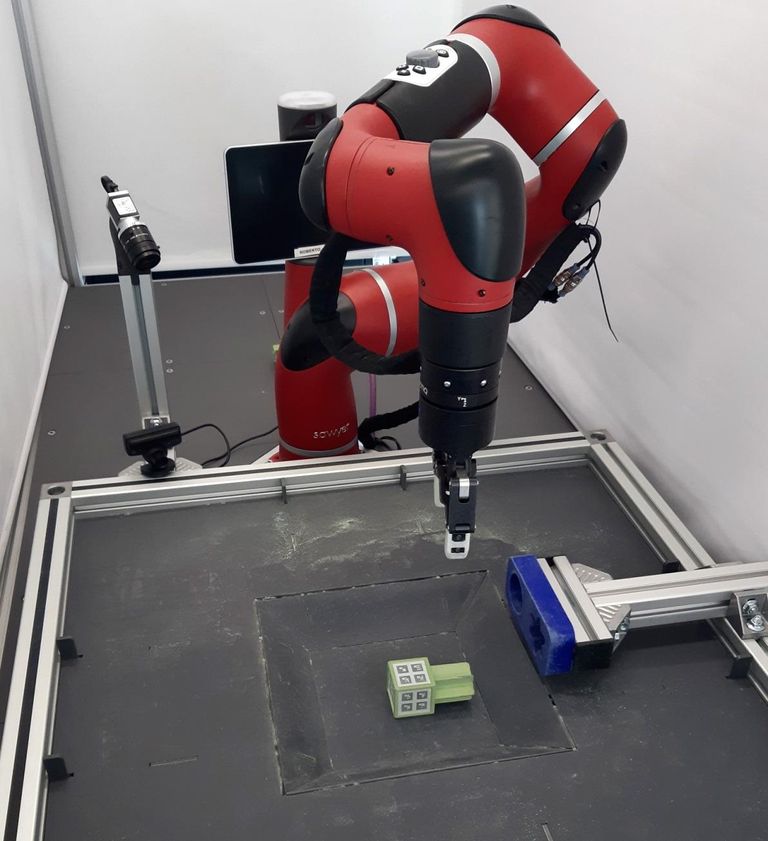
Pushing a star-shaped peg into a star-shaped hole may seem simple, but it was a minor triumph for one of DeepMind's robots.
DEEPMIND
ARTIFICIAL INTELLIGENCE has reached deep into our lives, though you might be hard pressed to point to obvious examples of it. Among countless other behind-the-scenes chores, neural networks power our virtual assistants, make online shopping recommendations, recognize people in our snapshots, scrutinize our banking transactions for evidence of fraud, transcribe our voice messages, and weed out hateful social-media postings. What these applications have in common is that they involve learning and operating in a constrained, predictable environment.
But embedding AI more firmly into our endeavors and enterprises poses a great challenge. To get to the next level, researchers are trying to fuse AI and robotics to create an intelligence that can make decisions and control a physical body in the messy, unpredictable, and unforgiving real world. It's a potentially revolutionary objective that has caught the attention of some of the most powerful tech-research organizations on the planet. "I'd say that robotics as a field is probably 10 years behind where computer vision is," says Raia Hadsell, head of robotics at DeepMind, Google's London-based AI partner. (Both companies are subsidiaries of Alphabet.)
Even for Google, the challenges are daunting. Some are hard but straightforward: For most robotic applications, it's difficult to gather the huge data sets that have driven progress in other areas of AI. But some problems are more profound, and relate to longstanding conundrums in AI. Problems like, how do you learn a new task without forgetting the old one? And how do you create an AI that can apply the skills it learns for a new task to the tasks it has mastered before?
Success would mean opening AI to new categories of application. Many of the things we most fervently want AI to do—drive cars and trucks, work in nursing homes, clean up after disasters, perform basic household chores, build houses, sow, nurture, and harvest crops—could be accomplished only by robots that are much more sophisticated and versatile than the ones we have now.
Beyond opening up potentially enormous markets, the work bears directly on matters of profound importance not just for robotics but for all AI research, and indeed for our understanding of our own intelligence.
Let's start with the prosaic problem first...
Pushing a star-shaped peg into a star-shaped hole may seem simple, but it was a minor triumph for one of DeepMind's robots.
DEEPMIND
And remember my friend, future events such as these will affect you in the future
Re: Google DeepMind News and Discussions
DeepMind’s latest trick? Predicting the weather
After mastering Go and StarCraft, DeepMind is taking its AI into another challenging arena: predicting the weather. The Alphabet-owned company has been quietly working with the Met Office over the past few years, and today, they report the fruits of their collaboration in the journal Nature. In short, DeepMind has devised a new machine learning model that can predict whether it’s going to rain within the next couple of hours.
This type of weather forecasting is known as precipitation nowcasting: predicting rainfall on a very short timescale, up to two hours before a downpour. Today's weather forecasts are pretty nifty at predicting rain further ahead in the future, from six hours to about a couple weeks ahead. But any sooner than that is where blind spots appear, and that’s where machine learning can bridge a much-needed gap.
A deluge of rain isn’t just an annoyance for someone who just got their hair done. Being able to foretell heavy rain in advance is crucial for everyday but important situations such as road safety, air traffic control and early-warning systems for flooding. The unfolding climate crisis also means that extreme weather events, such as heavy rainstorms or flooding, will only become more frequent. The ability to predict rainfall better and faster is pretty important for making quick decisions in these situations: halting a train or evacuating a building, for example.
The Met Office relies on radar imagery to predict when the heavens will open up. Radar works by sending a beam into the atmosphere, and then timing how long it takes to reflect, which tells you how much moisture there is in the atmosphere. The more moisture there, the more rain there will be. The data are then sent to the Met Office HQ, where they are processed to get a picture of the precipitation over the UK. DeepMind’s model was trained on radar imagery from the UK between the years 2016 and 2018, to then be able to reliably predict what will happen in an hour or two into the future.
And remember my friend, future events such as these will affect you in the future