Venus News and Discussions

weatheriscool
Posts: 24486
Joined: Sun May 16, 2021 6:16 pm
Contact:

Venus News and Discussions

Post by weatheriscool »

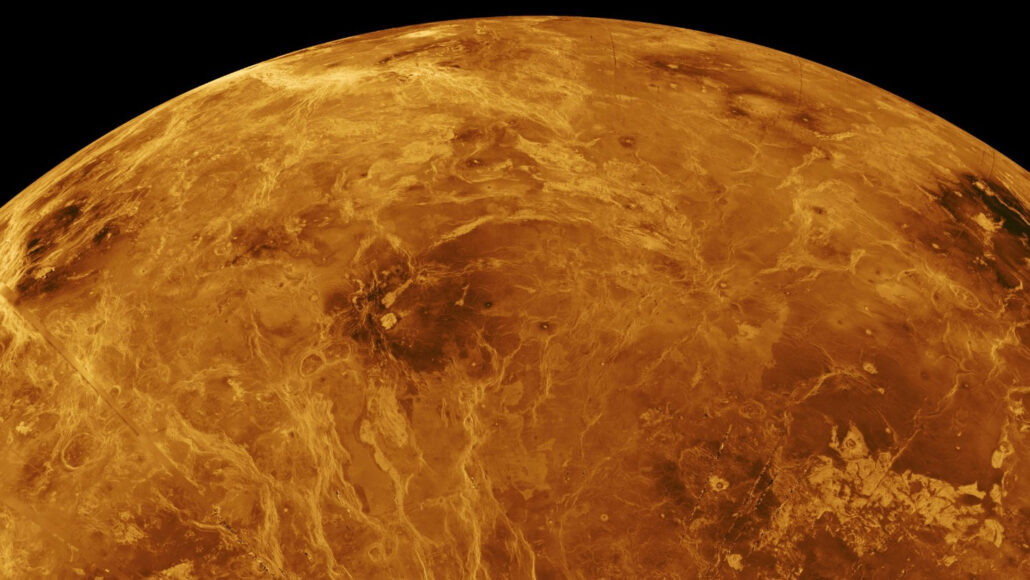
NASA’s Magellan Data Reveals Volcanic Activity on Venus

Image
https://www.nasa.gov/feature/jpl/nasa-s ... y-on-venus
In a first, scientists have seen direct evidence of active volcanism on Earth’s twin, setting the stage for the agency’s VERITAS mission to investigate.

Direct geological evidence of recent volcanic activity has been observed on the surface of Venus for the first time. Scientists made the discovery after poring over archival radar images of Venus taken more than 30 years ago, in the 1990s, by NASA’s Magellan mission. The images revealed a volcanic vent changing shape and increasing significantly in size in less than a year.

Scientists study active volcanoes to understand how a planet’s interior can shape its crust, drive its evolution, and affect its habitability. One of NASA’s new missions to Venus will do just that. Led by the agency’s Jet Propulsion Laboratory in Southern California, VERITAS – short for Venus Emissivity, Radio science, InSAR, Topography, And Spectroscopy – will launch within a decade. The orbiter will study Venus from surface to core to understand how a rocky planet about the same size as Earth took a very different path, developing into a world covered in volcanic plains and deformed terrain hidden beneath a thick, hot, toxic atmosphere.

“NASA’s selection of the VERITAS mission inspired me to look for recent volcanic activity in Magellan data,” said Robert Herrick, a research professor at the University of Alaska Fairbanks and member of the VERITAS science team, who led the search of the archival data. “I didn’t really expect to be successful, but after about 200 hours of manually comparing the images of different Magellan orbits, I saw two images of the same region taken eight months apart exhibiting telltale geological changes caused by an eruption.”

The search and its conclusions are described in a new study published in the journal Science. Herrick also presented the findings at the 54th Lunar and Planetary Science Conference in the Woodlands, Texas, on March 15.

User avatar
wjfox
Site Admin
Posts: 13580
Joined: Sat May 15, 2021 6:09 pm
Location: Essex, UK
Contact:

Re: Venus News and Discussions

Post by wjfox »

:(


User avatar
ººº
Posts: 359
Joined: Fri Sep 16, 2022 3:54 am

Re: Venus News and Discussions

Post by ººº »

wjfox wrote: Thu Mar 16, 2023 10:50 am :(


In their defense I will say that Mars and the moons of Jupiter have higher priority.
caltrek wrote: Thu Mar 16, 2023 2:55 pm NASA’s New Moon Spacesuits are Straight Out of Science Fiction — Literally
by Kiona Smith
March 15, 2023

Introduction:
(Inverse) NASA just unveiled its new Lunar Surface Suit, the spacesuit that Artemis III astronauts will wear on the Moon.
At NASA’s Johnson Space Center, an engineer from contractor Axiom Space paraded onstage and waved to the gathered crowd in the new Lunar Surface Suit, whose sharp-looking black, orange, and blue color scheme was designed by Esther Marquis, the costume designer who created the spacesuits for alternate-history space show For All Mankind.

On an actual mission, the suit will be mostly white — visibility is key for astronauts, which is why EVA suits tend to be white, and the pressure suits worn during launch and re-entry tend to be bright orange. But NASA and Axiom clearly wanted to make a splash today, and that’s no surprise. The Lunar Surface Suit is a critical piece of hardware for the Artemis program, and it’s NASA’s first new spacesuit design in more than 40 years.
“We have not had a new suit since the suits that we designed for the Space Shuttle, and those suits are currently in use on the Space Station,” says Johnson Space Center director Vanessa Wyche as part of the announcement.

Engineers at Johnson Space Center spent almost a decade designing and testing early versions of the spacesuit, as well as developing a list of stringent requirements for safety, heating and cooling, mobility, and dust resistance. And now it’s in the hands of engineers at contractor Axiom Space, who will produce the final product. They’ll also own it — NASA’s brand-new spacesuit won’t actually be NASA property.
Read more here: https://www.inverse.com/science/check- ... face-suit

Image
NASA
weatheriscool
Posts: 24486
Joined: Sun May 16, 2021 6:16 pm
Contact:

Re: Venus News and Discussions

Post by weatheriscool »

Scientists share 'comprehensive' map of volcanoes on Venus—all 85,000 of them
https://phys.org/news/2023-03-scientist ... usall.html
by Washington University in St. Louis

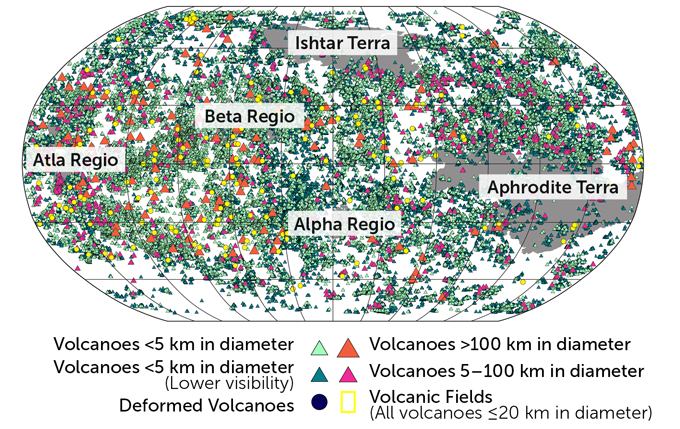
Intrigued by reports of recent volcanic eruptions on Venus? WashU planetary scientists Paul Byrne and Rebecca Hahn want you to use their new map of 85,000 volcanoes on Venus to help locate the next active lava flow. Their study was posted online ahead of print in Journal of Geophysical Research: Planets.

"This paper provides the most comprehensive map of all volcanic edifices on Venus ever compiled," said Byrne, an associate professor of earth and planetary sciences in Arts & Sciences at Washington University in St. Louis. "It provides researchers with an enormously valuable database for understanding volcanism on that planet—a key planetary process, but for Venus is something about which we know very little, even though it's a world about the same size as our own."

Byrne and Hahn used radar imagery from NASA's Magellan mission to Venus to catalog volcanoes across Venus at a global scale. Their resulting database contains 85,000 volcanoes, about 99% of which are less than 3 miles (5 km) in diameter.

"Since NASA's Magellan mission in the 1990s, we've had numerous major questions about Venus' geology, including its volcanic characteristics," Byrne said.

"But with the recent discovery of active volcanism on Venus, understanding just where volcanoes are concentrated on the planet, how many there are, how big they are, etc., becomes all the more important—especially since we'll have new data for Venus in the coming years."
weatheriscool
Posts: 24486
Joined: Sun May 16, 2021 6:16 pm
Contact:

Re: Venus News and Discussions

Post by weatheriscool »

Venus has almost 50 times as many volcanoes as previously thought
A new map boosts the count of fiery formations to about 85,000
The surface of Venus
https://www.sciencenews.org/article/ven ... canoes-map
Scientists recently discovered that Venus is volcanically active. Now, a new map of the planet does not so much answer the question “Where are there volcanoes on Venus?” as “Where are there not volcanoes on Venus?”

Image
By Maria Temming

11 hours ago
The hellscape of Venus is riddled with even more volcanoes than scientists thought.

Using radar images taken by NASA’s Magellan spacecraft in the 1990s, researchers cataloged about 85,000 volcanoes strewn across the Venusian surface. That’s nearly 50 times as many volcanoes as past surveys counted. Planetary scientists Rebecca Hahn and Paul Byrne of Washington University in St. Louis debuted the map in the April JGR Planets.

Such a thorough inventory of volcanism on Venus could offer clues about the planet’s interior, such as hot spots of magma production, Byrne says. And with the recent discovery that Venus is volcanically active, the map could also help pinpoint places to look for new eruptions (SN: 3/15/23).
Image
weatheriscool
Posts: 24486
Joined: Sun May 16, 2021 6:16 pm
Contact:

Re: Venus News and Discussions

Post by weatheriscool »

A Fiery Surprise: Magellan Spacecraft Uncovers Signs of Active Volcanism on Venus

https://scitechdaily.com/a-fiery-surpri ... -on-venus/
By American Association for the Advancement of Science (AAAS) April 15, 2023
Maat Mons Venus Volcano
Researchers analyzing Magellan spacecraft radar images discovered a changing volcanic vent on Venus, providing new evidence of active volcanism on the planet.

Researchers have identified evidence they interpret as active volcanism on the surface of Venus, according to a new analysis of radar images from the Magellan spacecraft. The images reveal a vent that changed shape on Venus, which they believe points to ongoing volcanic activity there.

Many volcanoes have been identified on the surface of Venus, but evidence of recent volcanic activity on the planet has been lacking. As a result, it was unknown whether the prominent volcanic features of Venus’ geologically young surface are a product of ongoing active volcanism or relics of ancient volcanic activity that has since ceased.

Although no volcano has been observed erupting on Venus, some previous research has suggested that ongoing volcanic activity might occur in various regions across the planet’s surface. However, geodynamic models of the planet produce different predictions for the current level of Venusian volcanism.
User avatar
Time_Traveller
Posts: 3025
Joined: Sun May 16, 2021 4:49 pm
Location: New York City, USA, November 5th 2032 C.E.

Re: Venus News and Discussions

Post by Time_Traveller »

1st private Venus mission delayed until at least 2025
published 1 day ago

The first private mission to Venus won't launch this year after all.

The Rocket Lab mission, which was initially set to launch last month, has been delayed until at least January 2025, TechCrunch reported.

"Our focus right now is on delivering customer missions as a priority," a Rocket Lab spokesperson told the website, without offering a detailed explanation for the delay. January 2025 was the original backup launch window for the Venus probe, according to the MIT Technology Review.

Rocket Lab announced its planned Venus mission in August 2020, then fleshed out its architecture in a paper published in the journal Aerospace two years later. The primary goal is to investigate the Venusian atmosphere to search for conditions needed for life to exist.

Venus, the hottest planet in the solar system, is generally considered a hellscape, with surface temperatures hot enough to melt lead. But some clues have emerged indicating that microbial life might be able to exist high in Venus' skies, where conditions are more Earth-like.
https://www.space.com/rocket-lab-privat ... =space.com
“In the quantum multiverse, every choice, every decision you've ever and never made exists in an unimaginably vast ensemble of parallel universes.”
User avatar
wjfox
Site Admin
Posts: 13580
Joined: Sat May 15, 2021 6:09 pm
Location: Essex, UK
Contact:

Re: Venus News and Discussions

Post by wjfox »

Life on Venus? Intriguing molecule phosphine spotted in planet's clouds again

By Robert Lea
published 3 days ago

The Venus phosphine saga continues.

In September 2020, a team of scientists led by Jane Greaves of Cardiff University in Wales reported the detection of phosphine, a possible indicator of life, in the clouds of Venus. The announcement sparked a heated debate and a surge of follow-up studies, which have generally failed to spot the intriguing molecule in the Venusian atmosphere.

Now there's a new twist. Speaking at the Royal Astronomical Society's National Astronomy Meeting 2023 in Cardiff this week, Greaves revealed the discovery of phosphine deeper in the atmosphere of Venus than it had been spotted before. Using the James Clark Maxwell Telescope (JCMT) at the Mauna Kea Observatory in Hawaii, Greaves and her colleagues delved into the atmosphere of Venus, down to the top and even the middle of the planet's clouds.

The team thinks that the phosphine could be coming from lower in Venus' atmosphere. But, as Greaves pointed out in the talk, the real question is, What does the phosphine mean? Could it be evidence of alien life on Venus?

Greaves said that, on Earth, phosphine is generated by microorganisms living in a very low-oxygen environment. She explained that phosphine is generally not made in other ways on our planet, as Earth lacks an abundance of "loose" hydrogen. This suggests that phosphine, if detected on other worlds, is a potential biosignature.

https://www.space.com/venus-clouds-phos ... nce-debate


Image
Image credit: NASA/ Robert Lea
weatheriscool
Posts: 24486
Joined: Sun May 16, 2021 6:16 pm
Contact:

Re: Venus News and Discussions

Post by weatheriscool »

who's to say that something new couldn't be alive on Venus? I mean something that lives off co2. I wouldn't discount it. I think life could also be on europa. I think in both cases is far more likely then mars.
User avatar
wjfox
Site Admin
Posts: 13580
Joined: Sat May 15, 2021 6:09 pm
Location: Essex, UK
Contact:

Re: Venus News and Discussions

Post by wjfox »

Cool idea, and he's right about that "sweet spot" in Venus' atmosphere.

But the timing for this announcement literally couldn't be worse. lol.

-----

OceanGate's cofounder wants to send 1,000 people to a floating colony on Venus by 2050, and says we shouldn't stop pushing the limits of innovation

Jul 28, 2023, 4:47 PM BST

Guillermo Söhnlein has been unexpectedly thrust into the limelight in the wake of the Titan submersible tragedy.

The cofounder of OceanGate Expeditions has been grappling with questions about the company's ill-fated trip to the Titanic shipwreck on June 18, which killed five people, including former colleague and friend Stockton Rush.

The sub is thought to have imploded within hours of its descent, raising concerns about OceanGate's approach to innovation and safety.

But OceanGate is not Söhnlein's only venture. The businessman's latest — and possibly grandest — endeavor is to send 1,000 humans to live in Venus' atmosphere by 2050.

[...]

Söhnlein doesn't see why humanity shouldn't attempt to live on the planet. He points to research that suggests there is a sliver of the Venusian atmosphere about 30 miles from the surface where humans could theoretically survive because temperatures are lower and pressure is less intense.

https://www.businessinsider.com/oceanga ... ?r=US&IR=T


Image
Credit: BOLD Community/NASA
User avatar
Time_Traveller
Posts: 3025
Joined: Sun May 16, 2021 4:49 pm
Location: New York City, USA, November 5th 2032 C.E.

Re: Venus News and Discussions

Post by Time_Traveller »

wjfox wrote: Sat Jul 29, 2023 10:51 am Cool idea, and he's right about that "sweet spot" in Venus' atmosphere.

But the timing for this announcement literally couldn't be worse. lol.

-----

OceanGate's cofounder wants to send 1,000 people to a floating colony on Venus by 2050, and says we shouldn't stop pushing the limits of innovation

Jul 28, 2023, 4:47 PM BST

Guillermo Söhnlein has been unexpectedly thrust into the limelight in the wake of the Titan submersible tragedy.

The cofounder of OceanGate Expeditions has been grappling with questions about the company's ill-fated trip to the Titanic shipwreck on June 18, which killed five people, including former colleague and friend Stockton Rush.

The sub is thought to have imploded within hours of its descent, raising concerns about OceanGate's approach to innovation and safety.

But OceanGate is not Söhnlein's only venture. The businessman's latest — and possibly grandest — endeavor is to send 1,000 humans to live in Venus' atmosphere by 2050.

[...]

Söhnlein doesn't see why humanity shouldn't attempt to live on the planet. He points to research that suggests there is a sliver of the Venusian atmosphere about 30 miles from the surface where humans could theoretically survive because temperatures are lower and pressure is less intense.

https://www.businessinsider.com/oceanga ... ?r=US&IR=T


Image
Credit: BOLD Community/NASA
In my opinion, we should be fixing the problems on Earth at the moment and wouldn't trust OceanGate with anything too.
“In the quantum multiverse, every choice, every decision you've ever and never made exists in an unimaginably vast ensemble of parallel universes.”
User avatar
wjfox
Site Admin
Posts: 13580
Joined: Sat May 15, 2021 6:09 pm
Location: Essex, UK
Contact:

Re: Venus News and Discussions

Post by wjfox »

When will the first human mission to Venus take place?

lower 25% … 2048
median … 2073
upper 75% … Not ≤ 2075

https://www.metaculus.com/questions/670 ... -to-venus/
Vakanai
Posts: 534
Joined: Thu Apr 28, 2022 10:23 pm

Re: Venus News and Discussions

Post by Vakanai »

Time_Traveller wrote: Sat Jul 29, 2023 11:27 am In my opinion, we should be fixing the problems on Earth at the moment and wouldn't trust OceanGate with anything too.
We could and honestly should do both in my opinion - try to undo the damage we've caused to earth and try to become a multiplanetary species. Not so we have an out in case we can't or won't fix our mess, but because we should push space exploration and space colonization as a desirable thing anyways, while also pushing for saving our planet and combating climate change. But we definitely should not be trusting OceanGate with any of it, because that's a one way ticket to kill people (even if the people killed were only billionaires, what with the uber wealthy feeling more and more like some malign malevolent evil subspecies of humans more and more these days).
Then again maybe we should push for the wealthy to live in Venus via OceanGate tech...might be the best way to save earth!
weatheriscool
Posts: 24486
Joined: Sun May 16, 2021 6:16 pm
Contact:

Re: Venus News and Discussions

Post by weatheriscool »

Does lightning strike on Venus? Maybe not, study suggests
https://phys.org/news/2023-10-lightning-venus.html
by Daniel Strain, University of Colorado at Boulder
Venus may be a (slightly) gentler place than some scientists give it credit for.

In new research, space physicists at CU Boulder have jumped into a surprisingly long-running debate in solar system science: Does lightning strike on the second planet from the sun?

The team's results add strong new evidence suggesting that, no, you probably wouldn't see bolts of lightning flashing from Venus' thick, acidic clouds—or, at least, not very often.

"There's been debate about lightning on Venus for close to 40 years," said Harriet George, lead author of the new study and a postdoctoral researcher at the Laboratory for Atmospheric and Space Physics (LASP). "Hopefully, with our newly available data, we can help to reconcile that debate."
weatheriscool
Posts: 24486
Joined: Sun May 16, 2021 6:16 pm
Contact:

Re: Venus News and Discussions

Post by weatheriscool »

Venus had Earth-like plate tectonics billions of years ago, study suggests
https://phys.org/news/2023-10-venus-ear ... lions.html
by Brown University
Venus, a scorching wasteland of a planet according to scientists, may have once had tectonic plate movements similar to those believed to have occurred on early Earth, a new study found. The finding sets up tantalizing scenarios regarding the possibility of early life on Venus, its evolutionary past and the history of the solar system.

Writing in Nature Astronomy, a team of scientists led by Brown University researchers describes using atmospheric data from Venus and computer modeling to show that the composition of the planet's current atmosphere and surface pressure would only have been possible as a result of an early form of plate tectonics, a process critical to life that involves multiple continental plates pushing, pulling and sliding beneath one another.

On Earth, this process intensified over billions of years, forming new continents and mountains, and leading to chemical reactions that stabilized the planet's surface temperature, resulting in an environment more conducive to the development of life.

Venus, on the other hand, Earth's nearest neighbor and sister planet, went in the opposite direction and today has surface temperatures hot enough to melt lead. One explanation is that the planet has always been thought to have what's known as a "stagnant lid," meaning its surface has only a single plate with minimal amounts of give, movement and gases being released into the atmosphere.

The new paper posits that this wasn't always the case. To account for the abundance of nitrogen and carbon dioxide present in Venus' atmosphere, the researchers conclude that Venus must have had plate tectonics sometime after the planet formed, about 4.5 billion to 3.5 billion years ago. The paper suggests that this early tectonic movement, like on Earth, would have been limited in terms of the number of plates moving and in how much they shifted. It also would have been happening on Earth and Venus simultaneously.

"One of the big picture takeaways is that we very likely had two planets at the same time in the same solar system operating in a plate tectonic regime—the same mode of tectonics that allowed for the life that we see on Earth today," said Matt Weller, the study's lead author who completed the work while he was a postdoctoral researcher at Brown and is now at the Lunar and Planetary Institute in Houston.

This bolsters the possibility of microbial life on ancient Venus and shows that at one point the two planets—which are in the same solar neighborhood, are about the same size, and have the same mass, density and volume—were more alike than previously thought before diverging.
weatheriscool
Posts: 24486
Joined: Sun May 16, 2021 6:16 pm
Contact:

Re: Venus News and Discussions

Post by weatheriscool »


Sample Return from the Surface of Venu
s
January 10, 2024 by Brian Wang
https://www.nextbigfuture.com/2024/01/s ... venus.html
A NASA NIAC phase 1 grant has been given to Geoffrey Landis to develop innovative concepts for a sample return from the surface of Venus. The project description is vague.

At 450°C and 92 atmosphere pressure, the surface of Venus is the most hostile environment to explore in the solar system. This project will pioneer a new approach to return a sample from the surface of Venus. The approach will merge an innovative carbon monoxide rocket technology to make propellant from the Venus atmosphere with innovations in high-temperature surface systems and solar aircraft.

The pressure at the bottom of the Earth’s ocean is about 1070 atmospheres.

Landis had a NASA NIAC grant to investigate the use of laser- and particle-beam pushed sails for propulsion for interstellar flight. In 2002 Landis addressed the annual convention of the American Association for the Advancement of Science on the possibilities and challenges of interstellar travel in what was described as the first serious discussion of how mankind will one day set sail to the nearest star. He went on to describe a star ship with a diamond sail, a few nanometres thick, powered by solar energy, which could achieve “10 per cent of the speed of light”.
weatheriscool
Posts: 24486
Joined: Sun May 16, 2021 6:16 pm
Contact:

Re: Venus News and Discussions

Post by weatheriscool »

Gravitational wave, Venus missions get European green light
https://phys.org/news/2024-01-gravitati ... e_vignette

The European Space Agency gave the green light to two missions on Thursday, one to detect ripples in spacetime called gravitational waves and another to probe the secrets of Earth's closest neighboring planet Venus.

The Laser Interferometer Space Antenna (LISA) will become the first mission to study gravitational waves from space, with a planned 2035 launch on an Ariane 6 rocket, the ESA said in a statement.

The mission will comprise three spacecraft that will trail Earth as it orbits the sun, forming an equilateral triangle in space.

Each side of the triangle will be 2.5 million kilometers, over which the three spacecraft will exchange laser beams.
weatheriscool
Posts: 24486
Joined: Sun May 16, 2021 6:16 pm
Contact:

Re: Venus News and Discussions

Post by weatheriscool »

Life might survive the sulfuric acid clouds of Venus, new experiments find
By Michael Irving
March 24, 2024
https://newatlas.com/space/life-survive ... id-clouds/
Venus may be a hellscape by our standards, but there’s a chance that some forms of life could evolve there. A new MIT study has now found that the building blocks of life are surprisingly stable in highly concentrated sulfuric acid – which Venus’ clouds happen to be made of.

Thick cloud cover gave early science fiction writers free reign to imagine the surface of Venus as a paradise, but as technology improved science fact once again ruined the party. It’s a dry, hot, pressure-cooker of a planet, with surface temperatures of up to 464 °C (867 °F) – hot enough to melt lead – and air pressure equivalent to being 900 m (3,000 ft) beneath the sea. Throw in clouds of sulfuric acid and a suffocating atmosphere of 96% carbon dioxide, and Venusian real estate is starting to look pretty cheap.

While many alien hopefuls might cast their eye towards Mars, or moons like Europa, Enceladus and Titan, Venus has clawed its way back into the headlines in recent years. Conditions are thought to be more hospitable at altitudes between about 48 and 60 km (30 and 37 miles) above the surface, where the temperature and pressure drops and there’s more water around. Intriguingly, that’s about the altitude where strange dark patches have been spotted drifting through the Venusian clouds, with optical signatures suspiciously similar to a bacteria species here on Earth.
weatheriscool
Posts: 24486
Joined: Sun May 16, 2021 6:16 pm
Contact:

Re: Venus News and Discussions

Post by weatheriscool »

weatheriscool
Posts: 24486
Joined: Sun May 16, 2021 6:16 pm
Contact:

Re: Venus News and Discussions

Post by weatheriscool »

Recent and extensive volcanism discovered on Venus

by David Appell , Phys.org
A new analysis of data collected on Venus more than 30 years ago suggests the planet may currently be volcanically active.

A research group from Italy led by David Sulcanese of the Università d'Annunzio in Pescara, Italy, has used data from a radar mapping of Venus's surface taken in the early 1990s to search for volcanic lava flow, finding it in two regions.

The discovery suggests that volcanic activity may be currently active and more widespread than was previously thought, supporting previous indirect evidence that there is volcanic activity on Venus.

The work is published in the journal Nature Astronomy.

Venus is sometimes called "Earth's twin sister." Though only slightly smaller than Earth, its CO2-dominated atmosphere has a massive greenhouse effect that bakes its surface at about 465°C (870°F).
https://phys.org/news/2024-05-extensive ... venus.html
Post Reply