Space News and Discussions

User avatar
wjfox
Site Admin
Posts: 13588
Joined: Sat May 15, 2021 6:09 pm
Location: Essex, UK
Contact:

Re: Space News and Discussions

Post by wjfox »

weatheriscool
Posts: 24505
Joined: Sun May 16, 2021 6:16 pm
Contact:

Re: Space News and Discussions

Post by weatheriscool »

Successful hypothermia in nonhuman primate paves the way for future application in human torpor during spaceflight
https://phys.org/news/2022-12-successfu ... paves.html
by Chinese Academy of Sciences

Hibernation is a state adopted by certain mammals as an adaptation to adverse winter conditions. Typical features of hibernation include greatly reduced metabolic activity and lowered body temperature.

As warm-blooded animals, primates (except lemurs) do not naturally hibernate or even experience torpor. But can we manipulate the body temperature of primates and make them fall into a hypometabolic state or even artificial hibernation?

A research team led by Dr. Wang Hong and Dr. Dai Ji from the Shenzhen Institute of Advanced Technology (SIAT) of the Chinese Academy of Sciences has recently reported the first reliable hypothermia in nonhuman primates caused by activating a group of hypothalamic neurons.

The study was published in The Innovation.
User avatar
wjfox
Site Admin
Posts: 13588
Joined: Sat May 15, 2021 6:09 pm
Location: Essex, UK
Contact:

Re: Space News and Discussions

Post by wjfox »

User avatar
wjfox
Site Admin
Posts: 13588
Joined: Sat May 15, 2021 6:09 pm
Location: Essex, UK
Contact:

Re: Space News and Discussions

Post by wjfox »

India’s 1st human space flight to be launched in end of 2024: Centre

Updated on Dec 22, 2022 12:30 AM IST

India’s first human space flight, Gaganyaan, is targeted to be launched in 2024, the Union government told the parliament on Wednesday.

In a written reply to a question in the Lok Sabha on Wednesday, Jitendra Singh, minister of state (independent charge) of science and technology, atomic energy and space , said the crewed Gaganyaan mission—H1 mission—is being targeted to be launched in the fourth quarter of 2024.

“In view of the paramount importance of crew safety, two test vehicle missions are planned before the ‘H1’ mission to demonstrate the performance of crew escape system and parachute-based deceleration system for different flight conditions,” Singh’s reply read.

Singh said the uncrewed ‘G1’ mission is targeted to be launched in the last quarter of 2023 followed by the second uncrewed ‘G2’ mission in the second quarter of 2024, before the final human space flight ‘H1’ mission in the fourth quarter of 2024.

https://www.hindustantimes.com/india-ne ... 11273.html
User avatar
ººº
Posts: 359
Joined: Fri Sep 16, 2022 3:54 am

Re: Space News and Discussions

Post by ººº »

wjfox wrote: Wed Dec 28, 2022 9:06 am India’s 1st human space flight to be launched in end of 2024: Centre

Updated on Dec 22, 2022 12:30 AM IST

India’s first human space flight, Gaganyaan, is targeted to be launched in 2024, the Union government told the parliament on Wednesday.

In a written reply to a question in the Lok Sabha on Wednesday, Jitendra Singh, minister of state (independent charge) of science and technology, atomic energy and space , said the crewed Gaganyaan mission—H1 mission—is being targeted to be launched in the fourth quarter of 2024.

“In view of the paramount importance of crew safety, two test vehicle missions are planned before the ‘H1’ mission to demonstrate the performance of crew escape system and parachute-based deceleration system for different flight conditions,” Singh’s reply read.

Singh said the uncrewed ‘G1’ mission is targeted to be launched in the last quarter of 2023 followed by the second uncrewed ‘G2’ mission in the second quarter of 2024, before the final human space flight ‘H1’ mission in the fourth quarter of 2024.

https://www.hindustantimes.com/india-ne ... 11273.html
Fourth one? (Not counting the ISS)
weatheriscool
Posts: 24505
Joined: Sun May 16, 2021 6:16 pm
Contact:

Re: Space News and Discussions

Post by weatheriscool »

First results from LHAASO place tighter constraints on dark matter's lifetime
https://phys.org/news/2022-12-results-l ... -dark.html
by Liu Jia, Chinese Academy of Sciences

Scientists from the Large High Altitude Air Shower Observatory (LHAASO) have presented roughly 1.5 years of observational data, calculating new limits on the lifetime of heavy dark matter particles that have masses between 105 and 109 giga-electron volts.

The study, titled "Constraints on heavy decaying dark matter from 570 days of LHAASO observations," was recently published in Physics Review Letters.

The gravitational model of the Milky Way shows that there is a very high density of dark matter in the galactic center, and the gamma rays produced by the decay of this dark matter will radiate from the galactic center to the surroundings for hundreds of light-years or even thousands of light-years. However, for a long time, the observation of ultra-high-energy gamma rays produced by heavy dark matter has been complicated by the presence of other background radiation.
User avatar
caltrek
Posts: 9282
Joined: Mon May 17, 2021 1:17 pm

Re: Space News and Discussions

Post by caltrek »

This Simple Video Shows How Far You Could Throw a Ball on Other Planets

by Morgan McFall-Johnsen
December 28, 2022

Introduction:
(Science Alert) Imagine throwing a baseball. Easy, right? Maybe you've already done it a few times. Now imagine throwing a baseball on the Moon.

Maybe you've seen enough videos of astronauts bouncing around up there to have an idea. Here's a clearer picture, though: On the Moon you could throw that ball clean over the 186-foot-tall Leaning Tower of Pisa.

OK, now picture you're on Saturn. That's a bit harder to imagine, isn't it? Nobody has been there, much less taken video.

Thankfully, astronomer James O'Donoghue did all the math and made his own video, showing a ball throw on each planet, plus Pluto and the Moon. Take a look below:


Read more here: https://www.sciencealert.com/this-simp ... r-planets
Don't mourn, organize.

-Joe Hill
User avatar
caltrek
Posts: 9282
Joined: Mon May 17, 2021 1:17 pm

Re: Space News and Discussions

Post by caltrek »

We May Be Able to Find Life on Enceladus Without Even Landing
by Michele Starr
January 4, 2023

Introduction:
(Science Alert) Saturn's moon Enceladus is one of the Solar System's prime extraterrestrial locations for life to thrive. It harbors a global salty ocean that internal heating theoretically keeps at temperatures hospitable to an alien marine ecosystem.

Detecting that life, however, is not such an easy matter. The moon is enclosed by a shell of ice that's estimated to be 5 kilometers thick (3.1 miles) at its thinnest point, and the ocean below it is 10 kilometers deep. This would pose a huge enough challenge here on Earth, never mind a moon half a Solar System away.

But we may not need to go to all the effort of drilling through Enceladus's shell after all. A new study finds that we ought to be able to detect life on the icy moon in the plumes of salty water that erupt from its surface – even if there's not all that much life there.
Read more here: https://www.sciencealert.com/we-may-be ... n-landing
Don't mourn, organize.

-Joe Hill
User avatar
wjfox
Site Admin
Posts: 13588
Joined: Sat May 15, 2021 6:09 pm
Location: Essex, UK
Contact:

Re: Space News and Discussions

Post by wjfox »

User avatar
wjfox
Site Admin
Posts: 13588
Joined: Sat May 15, 2021 6:09 pm
Location: Essex, UK
Contact:

Re: Space News and Discussions

Post by wjfox »

Image
weatheriscool
Posts: 24505
Joined: Sun May 16, 2021 6:16 pm
Contact:

Re: Space News and Discussions

Post by weatheriscool »

Chinese Rocket Launch Boosts Startup’s Bid to Be Nation’s SpaceX
A Chinese rocket startup successfully put five satellites into orbit Monday, marking the start of an ambitious launch schedule for 2023 that could give the Beijing-based company an edge in the race to build a Chinese competitor to Elon Musk’s Space Exploration Technologies Corp.
https://www.bloomberg.com/news/articles ... ify%20wall
User avatar
caltrek
Posts: 9282
Joined: Mon May 17, 2021 1:17 pm

Re: Space News and Discussions

Post by caltrek »

Massive Volcanic Outburst Detected on Jupiter's Hellish Moon Io
by Michele Starr
January 10 , 2023

Introduction:
(Science Alert) The most powerful volcanic eruptions in the Solar System occur not on Earth, but on Io, a sulfurous moon orbiting the planet Jupiter.

And now, researchers from the Planetary Science Institute (PSI) in the US have noticed a recent outburst that's been surprisingly productive, even for a hellish world like Io.

In the space around Jupiter, a torus of plasma created and fed by Io's volcanic emissions grew significantly richer between July and September of last year and persisted until December, showing the moon underwent a spate of volcanic activity that released a huge amount of material.

For something that's just a little bit bigger than Earth's Moon, Io is an absolute beast of volcanism. It's bristling with volcanoes, with around 150 of the 400 known volcanoes erupting at any given time, creating vast lakes of molten lava.

This is all down to its relationship with Jupiter: Io orbits on an elliptical path, resulting in variations in the gravitational pull that change the shape of the moon as it swings around the planet.
Read more here: https://www.sciencealert.com/massive-v ... h-moon-io
Don't mourn, organize.

-Joe Hill
User avatar
wjfox
Site Admin
Posts: 13588
Joined: Sat May 15, 2021 6:09 pm
Location: Essex, UK
Contact:

Re: Space News and Discussions

Post by wjfox »

User avatar
wjfox
Site Admin
Posts: 13588
Joined: Sat May 15, 2021 6:09 pm
Location: Essex, UK
Contact:

Re: Space News and Discussions

Post by wjfox »

Light pollution: Huge fall in stars that can be seen with naked eye

8 hours ago

The number of stars that people can see with the naked eye has reduced dramatically over the last decade.

The cause is "Skyglow" from artificial lighting - the brightness of that glow has increased every year since 2011.

Dr Christopher Kyba, a scientist from the German Research Centre for Geosciences in Potsdam, told the BBC: "Our view of the stars is disappearing".

He and his colleagues published this discovery in the journal Science.

It is the conclusion of 12 years of amateur astronomers and citizen scientists going out at night to count the stars.

The change in stars' visibility that people reported - by submitting their star counts to an online project called Globe at Night - was equivalent to an almost 10% annual increase in sky brightness every year.

That means, the scientists say, that a child born in an area where 250 stars were visible, would probably see fewer than 100 stars in the same location 18 years later.

https://www.bbc.co.uk/news/science-environment-64321824


Image
weatheriscool
Posts: 24505
Joined: Sun May 16, 2021 6:16 pm
Contact:

Re: Space News and Discussions

Post by weatheriscool »

Jupiter Quietly Takes Crown for Most Moons, With New Tally of 92

The orbits of a dozen new small worlds circling the gas giant have recently been published.

Feb. 2, 2023 11:24 a.m. PT

https://www.cnet.com/science/space/jupi ... lly-of-92/
Some planets seem to have it all. Jupiter is the largest in the solar system, spotting a distinctive and fashionable red spot, subtle but elegant rings and dozens of moons.

As if that wasn't enough, it looks as though Jupiter has 12 more small moons in its orbit, bringing the total number of natural satellites within its grasp to a whopping 92.

Astronomer Scott Sheppard from the Carnegie Institution for Science in Washington, DC, reported observations of the system over the last two years that reveal a dozen new moons. The International Astronomical Union's Minor Planet Center has quietly been publishing the orbits of the new, unnamed moons in recent weeks, giving their existence the stamp of confirmation from humanity's officialdom on the matter.
User avatar
Time_Traveller
Posts: 3025
Joined: Sun May 16, 2021 4:49 pm
Location: New York City, USA, November 5th 2032 C.E.

Re: Space News and Discussions

Post by Time_Traveller »

A dwarf planet beyond Neptune has a mysterious ring that astronomers can't explain
about 5 hours ago

Image

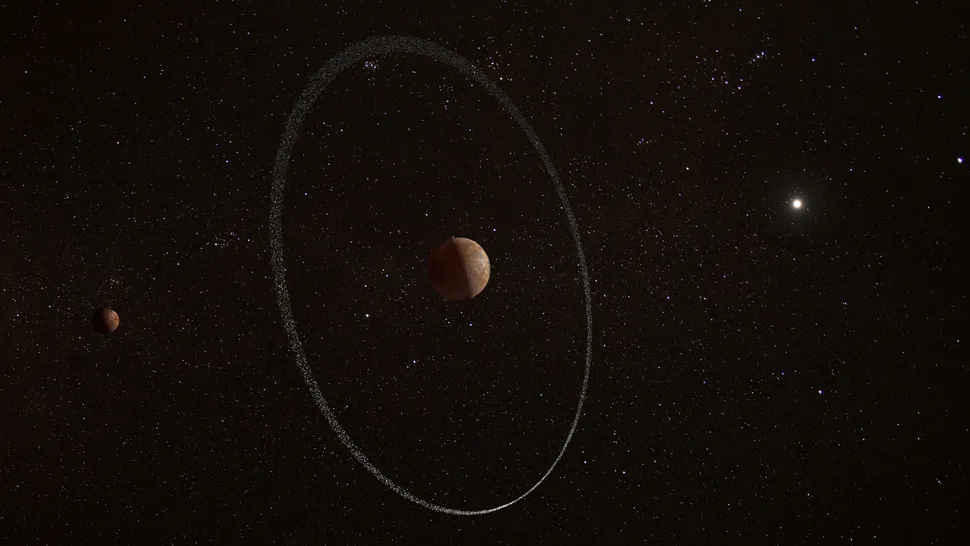
A mini-planet orbiting in the frigid outer reaches of the solar system has a Saturn-like ring of dust and debris that defies the rules of physics, a new study has revealed.

The planet in question is called Quaoar and it's the seventh largest of the known dwarf planets of which Pluto is the king. Discovered in 2002 and about 697 miles wide (1,121 kilometers), Quaoar is one of the so-called trans-Neptunian objects, small planets orbiting beyond the solar system's outermost planet Neptune.

Residing in the Kuiper Belt, the doughnut-shaped ring of rocky and icy debris in the outer solar system, Quaoar is a proud owner of its own moon, the 100-mile-wide (160 km) Weywot. And a recent observation campaign revealed that it also has a ring of material in its orbit.

That by itself wouldn't be so special. The gas giant Saturn is known to possess a whole series of rings. Jupiter, Neptune and Uranus also have some. One other trans-Neptunian object — Haumea — has been found to have a ring, and the space rock Chariklo that orbits between Saturn and Uranus also has one. So what exactly sets Quaoar's ring apart?
https://www.space.com/mysterious-ring-a ... ium=social
“In the quantum multiverse, every choice, every decision you've ever and never made exists in an unimaginably vast ensemble of parallel universes.”
weatheriscool
Posts: 24505
Joined: Sun May 16, 2021 6:16 pm
Contact:

Re: Space News and Discussions

Post by weatheriscool »

weatheriscool
Posts: 24505
Joined: Sun May 16, 2021 6:16 pm
Contact:

Re: Space News and Discussions

Post by weatheriscool »

Hubble captures the start of a new spoke season on Saturn
https://phys.org/news/2023-02-hubble-ca ... aturn.html
by Claire Andreoli, NASA's Goddard Space Flight Center
New images of Saturn from NASA's Hubble Space Telescope herald the start of the planet's "spoke season" surrounding its equinox, when enigmatic features appear across its rings. The cause of the spokes, as well as their seasonal variability, has yet to be fully explained by planetary scientists.

Like Earth, Saturn is tilted on its axis and therefore has four seasons, though because of Saturn's much larger orbit, each season lasts approximately seven Earth years. Equinox occurs when the rings are tilted edge-on to the Sun. The spokes disappear when it is near summer or winter solstice on Saturn. (When the Sun appears to reach either its highest or lowest latitude in the northern or southern hemisphere of a planet.)

As the autumnal equinox of Saturn's northern hemisphere on May 6, 2025, draws near, the spokes are expected to become increasingly prominent and observable.
weatheriscool
Posts: 24505
Joined: Sun May 16, 2021 6:16 pm
Contact:

Re: Space News and Discussions

Post by weatheriscool »

Nanotechandmorefuture
Posts: 478
Joined: Fri Sep 17, 2021 6:15 pm
Location: At the moment Miami, FL

Re: Space News and Discussions

Post by Nanotechandmorefuture »

Time_Traveller wrote: Wed Feb 08, 2023 8:54 pm A dwarf planet beyond Neptune has a mysterious ring that astronomers can't explain
about 5 hours ago

Image

A mini-planet orbiting in the frigid outer reaches of the solar system has a Saturn-like ring of dust and debris that defies the rules of physics, a new study has revealed.

The planet in question is called Quaoar and it's the seventh largest of the known dwarf planets of which Pluto is the king. Discovered in 2002 and about 697 miles wide (1,121 kilometers), Quaoar is one of the so-called trans-Neptunian objects, small planets orbiting beyond the solar system's outermost planet Neptune.

Residing in the Kuiper Belt, the doughnut-shaped ring of rocky and icy debris in the outer solar system, Quaoar is a proud owner of its own moon, the 100-mile-wide (160 km) Weywot. And a recent observation campaign revealed that it also has a ring of material in its orbit.

That by itself wouldn't be so special. The gas giant Saturn is known to possess a whole series of rings. Jupiter, Neptune and Uranus also have some. One other trans-Neptunian object — Haumea — has been found to have a ring, and the space rock Chariklo that orbits between Saturn and Uranus also has one. So what exactly sets Quaoar's ring apart?
https://www.space.com/mysterious-ring-a ... ium=social
A real life Halo system. That should spark more questions of what the hell happened in just our solar cluster.
Post Reply