Asteroids, Comets, and Meteors

User avatar
caltrek
Posts: 9280
Joined: Mon May 17, 2021 1:17 pm

Re: Asteroids, Comets, and Meteors

Post by caltrek »

We Might Have Underestimated the Size of the Asteroid Behind Earth's Largest Crater
by David Nield
September 28, 2022

Introduction:
(Science Alert)The Vredefort crater in South Africa is the largest of its kind on Earth, estimated to stretch as far as 300 kilometers (more than 180 miles) from rim to rim. Walking non-stop, it would take a good two-and-a-half days to make it from one side to the other.

The scars left by an asteroid collision some two billion years ago have long since been all but scoured away by the elements, leaving room for speculation over its true scale and the forces that created it. Now new research based on what's thought to be a more accurate simulation of the impact event suggests that the object that made the crater was larger than previously believed.

Earlier estimates put the asteroid at 15 kilometers (9.3 miles) in diameter, traveling at a velocity of 15 kilometers per second.

This latest analysis suggests the object responsible for the crater was closer to 20 to 25 kilometer across, traveling at a velocity of 15 to 20 kilometers per second in the moments before impact.

"Understanding the largest impact structure that we have on Earth is critical," says astrophysicist Natalie Allen, from Johns Hopkins University in Baltimore.
Read more of the Science Alert article here: https://www.sciencealert.com/we-might- ... st-crater

A lengthier presentation of the analytical findings as published in the Journal of Geophysical Research: Planets can be accessed here: https://agupubs.onlinelibrary.wiley.com ... 22JE007186

Don't mourn, organize.

-Joe Hill
User avatar
caltrek
Posts: 9280
Joined: Mon May 17, 2021 1:17 pm

Re: Asteroids, Comets, and Meteors

Post by caltrek »

Scientists Identify Potential Source of 'Shock-darkened' Meteorites, with Implications for Hazardous Asteroid Deflection
October 4, 2022

Introduction:
(EurkAlert) When the Chelyabinsk fireball exploded across Russian skies in 2013, it littered Earth with a relatively uncommon type of meteorite. What makes the Chelyabinsk meteorites and others like them special is their dark veins, created by a process called shock darkening. Yet, planetary scientists have been unable to pinpoint a nearby asteroid source of these kinds of meteorites – until now.

In a new paper published in the Planetary Science Journal, University of Arizona scientists identified an asteroid named 1998 OR2 as one potential source of shock-darkened meteorites. The near-Earth asteroid is about 1 1/2 miles wide and made a close approach to Earth in April 2020. When pieces of asteroids break off into space and then land on Earth, they are considered meteorites.

"Shock darkening is an alteration process caused when something impacts a planetary body hard enough that the temperatures partially or fully melt those rocks and alter their appearance both to the human eye and in our data," said lead study author Adam Battle, a UArizona graduate student studying planetary science. "This process has been seen in meteorites many times but has only been seen on asteroids in one or two cases way out in the main asteroid belt, which is found between Mars and Jupiter."
Read more here: https://www.eurekalert.org/news-releases/966838
Don't mourn, organize.

-Joe Hill
weatheriscool
Posts: 24486
Joined: Sun May 16, 2021 6:16 pm
Contact:

Re: Asteroids, Comets, and Meteors

Post by weatheriscool »

NASA spaceship deflected asteroid in test to save Earth
https://phys.org/news/2022-10-nasa-spac ... earth.html
by Issam AHMED
Dirmorphos' egg-like shape and craggy, boulder-dotted surface finally came into clear view in the last few moments before DART's impact.

NASA on Tuesday said it had succeeded in deflecting an asteroid in a historic test of humanity's ability to stop an incoming cosmic object from devastating life on Earth.

The fridge-sized Double Asteroid Redirection Test (DART) impactor deliberately smashed into the moonlet asteroid Dimorphos on September 26, pushing it into a smaller, faster orbit around its big brother Didymos, said NASA chief Bill Nelson.

"DART shortened the 11 hour 55 minute orbit to 11 hours and 23 minutes," he said. Speeding up Dimorphos' orbital period by 32 minutes exceeded NASA's own expectation of 10 minutes.

"We showed the world that NASA is serious as a defender of this planet," added Nelson.
User avatar
raklian
Posts: 1981
Joined: Sun May 16, 2021 4:46 pm
Location: North Carolina

Re: Asteroids, Comets, and Meteors

Post by raklian »

To know is essentially the same as not knowing. The only thing that occurs is the rearrangement of atoms in your brain.
User avatar
caltrek
Posts: 9280
Joined: Mon May 17, 2021 1:17 pm

Re: Asteroids, Comets, and Meteors

Post by caltrek »

^^^More on that:

NASA Knocked an Asteroid Off Course (And Now It Has a Tail)
by Issam Ahmed
October 12, 2022

Extract:
(Science Alert)

Pseudo-comet

In the days that followed, astronomers rejoiced in stunning images of matter spreading out thousands of miles – pictures collected by Earth and space telescopes, as well as a tiny companion satellite that traveled to the zone with DART.

Thanks to its temporary new tail, Dimorphos has turned into a man-made comet.

But quantifying just how well the test worked required an analysis of light patterns from ground telescopes, which took a few weeks to become apparent.

The binary asteroid system, which was around 6.8 million miles (11 million kilometers) from Earth at impact, is visible only as a single dot from the ground.

The dot's brightness changes as Dimorphos passes in front of Didymos, which is significantly bigger at half a mile wide.
Read more here: https://www.sciencealert.com/success-n ... as-a-tail
Don't mourn, organize.

-Joe Hill
User avatar
caltrek
Posts: 9280
Joined: Mon May 17, 2021 1:17 pm

Re: Asteroids, Comets, and Meteors

Post by caltrek »

Unusual Asteroid Keeps Spinning Faster, and We Don't Know Why
by Michele Starr
October 17, 2022

Introduction:
(Science Alert) The near-Earth asteroid responsible for the spectacular annual Geminids meteor shower has been caught doing something really unexpected.

Scientists studying the shifting light of 3200 Phaethon have concluded the rocky body is spinning faster and faster on its axis, shaving off around 4 milliseconds every year. That might not seem like a lot, but asteroid spins don't usually change at all.

Figuring out why Phaethon is behaving this way could give us new insight into a class of asteroids considered "potentially hazardous" – skimming past Earth as they orbit the Sun.

Phaethon currently poses no danger to Earth, but at 5.8 kilometers (3.6 miles) across it's large enough to cause no small amount of pain were it to hypothetically hit. What's more, the asteroid's path brings it close enough that enough of a change in its 524-day orbit could cause us to rethink our concerns.

It's also an oddball. The asteroid's orbit dips in close to the Sun like a comet's, for example. It also has a dusty tail, and happens to be one of just two asteroids that produce meteor showers (mostly those come from comets too).
Read more here: https://www.sciencealert.com/this-unus ... -know-why
Don't mourn, organize.

-Joe Hill
User avatar
caltrek
Posts: 9280
Joined: Mon May 17, 2021 1:17 pm

Re: Asteroids, Comets, and Meteors

Post by caltrek »

NASA’s Psyche Mission to a Metal-rich Asteroid is Back on the Books for October 2023
by Aria Alamalhodaei
October 28, 2022

Introduction:
(TechCrunch) NASA said Friday that its Psyche mission (named after the asteroid the mission is targeting) has been rescheduled to October next year. The news comes just a few months after the agency announced that it would definitively miss its planned 2022 launch attempt. The delayed schedule is due to late delivery of key components of the spacecraft, including the flight software and testing equipment. The launch window for this year concluded on October 11.

NASA conducted an internal review to determine whether the mission could launch next year, in addition to a separate independent review commissioned by the agency to examine the failures that led to missing the launch window. It appears that the review determined that next year’s launch is a go.

While the launch window has changed, NASA said the flight profile will be similar: The spacecraft will use Martian gravity in 2026 to propel the spacecraft toward the asteroid Psyche. If the mission does move forward next year, the spacecraft is targeted to arrive at the asteroid in August 2029.

The mission, which is being led by Arizona State University, will explore the metal asteroid dubbed “Psyche” located between Mars and Jupiter. It was chosen for exploration because scientists believe it is the nickel-iron core of an earlier planet, making it a rich target for understanding how our own planet came to exist. Folks with asteroid mining ambitions, of course, undoubtedly also have their interest piqued.

Total mission costs, including launch, are $985 million; of that, $717 million had been spent as of June. Two additional projects were scheduled to launch with Psyche: a NASA mission called Janus, to explore a twin binary asteroid system, and a technology demonstration of high-data-rate laser communication data. The latter has already been integrated with the Psyche spacecraft and will launch with it, but NASA is still exploring options for Janus.
Read more here: https://techcrunch.com/2022/10/28/nasa ... ber-2023/
Don't mourn, organize.

-Joe Hill
User avatar
caltrek
Posts: 9280
Joined: Mon May 17, 2021 1:17 pm

Re: Asteroids, Comets, and Meteors

Post by caltrek »

Largest Potentially Hazardous Asteroid Detected in Eight Years
October 31, 2022

Extract::
(EurekAlert) Twilight observations with the US Department of Energy-fabricated Dark Energy Camera at Cerro Tololo Inter-American Observatory in Chile, a Program of NSF's NOIRLab, have enabled astronomers to spot three near-Earth asteroids (NEA) hiding in the glare of the Sun. These NEAs are part of an elusive population that lurks inside the orbits of Earth and Venus. One of the asteroids is the largest object that is potentially hazardous to Earth to be discovered in the last eight years.

By taking advantage of the brief yet favorable observing conditions during twilight, however, the astronomers found an elusive trio of NEAs. One is a 1.5-kilometer-wide asteroid called 2022 AP7, which has an orbit that may someday place it in Earth’s path. The other asteroids, called 2021 LJ4 and 2021 PH27, have orbits that safely remain completely interior to Earth’s orbit. Also of special interest to astronomers and astrophysicists, 2021 PH27 is the closest known asteroid to the Sun. As such, it has the largest general-relativity effects [1] of any object in our Solar System and during its orbit its surface gets hot enough to melt lead.

“Our twilight survey is scouring the area within the orbits of Earth and Venus for asteroids,” said Scott S. Sheppard, an astronomer at the Earth and Planets Laboratory of the Carnegie Institution for Science and the lead author of the paper describing this work. “So far we have found two large near-Earth asteroids that are about 1 kilometer across, a size that we call planet killers.”

“There are likely only a few NEAs with similar sizes left to find, and these large undiscovered asteroids likely have orbits that keep them interior to the orbits of Earth and Venus most of the time,” said Sheppard. “Only about 25 asteroids with orbits completely within Earth’s orbit have been discovered to date because of the difficulty of observing near the glare of the Sun.”

Finding asteroids in the inner Solar System is a daunting observational challenge.
Read more here: https://www.eurekalert.org/news-releases/969606
Don't mourn, organize.

-Joe Hill
User avatar
caltrek
Posts: 9280
Joined: Mon May 17, 2021 1:17 pm

Re: Asteroids, Comets, and Meteors

Post by caltrek »

Collapsed Observatory Issues Final Asteroid Warning After Fatal Collapse
by Brandon Specktor
October 31, 2022

Introduction:
(Science Alert) After collapsing into pieces in December 2020, the mighty Arecibo Observatory has a final parting gift for humanity – and it's a doozy.

Using data collected by Arecibo between December 2017 and December 2019, scientists have released the largest radar-based report on near-Earth asteroids ever published.

The report, published September 22 in The Planetary Science Journal, includes detailed observations of 191 near-Earth asteroids, including nearly 70 that are deemed "potentially hazardous" – that is, large asteroids with orbits that bring them within 4.65 million miles (7.5 million kilometers) of Earth, or roughly 20 times the average distance between Earth and the Moon.

Fortunately, none of these newly described asteroids pose an immediate threat to Earth; according to NASA, our planet is safe from deadly asteroid impacts for at least the next 100 years.

Further extract:
Arecibo's career ended abruptly in December 2020, after two critical support cables snapped, leading to the complete collapse of the telescope.
Read more of the Science Alert article here: https://www.sciencealert.com/destroyed ... -collapse
Don't mourn, organize.

-Joe Hill
User avatar
caltrek
Posts: 9280
Joined: Mon May 17, 2021 1:17 pm

Re: Asteroids, Comets, and Meteors

Post by caltrek »

Scientists Are Drawing Up Plans to Intercept an Interstellar Object
by Andy Tomaswick
November 11, 2022

Introduction:
(Universe Today) We finally have the technological means to detect interstellar objects. We've detected two in the last few years, 'Oumuamua and 2I/Borisov, and there are undoubtedly more out there. As such, there's been a lot of interest in developing a mission that could visit one once we detect it. But what would such a mission look like? Now, a draft paper from a team of primarily American scientists has taken a stab at answering that question and moved us one step closer to launching such a mission.

Part of what makes an interstellar visitor mission interesting is that interstellar visitors are so weird. Borisov acted like a typical comet once it entered the Solar System, but 'Oumuamua was a different beast entirely.

It never developed a cometary tail, as many scientists expected it to. It also exhibited acceleration that didn't seem to be accounted for by radiative or other means, leading some prominent scientists to claim it might have even been an alien probe.

The best way to combat such fanciful claims is to closely examine them. And to do that, we have to have a mission that can catch it. But first, we would have to see it, and astronomers are already working on that.

The Vera C Rubin Observatory Legacy Survey of Space and Time (LSST) will be able to detect somewhere between 1-10 interstellar objects about the same size as 'Oumuamua every year, according to the authors' calculations.
Read more here: https://www.universetoday.com/158609/w ... to-visit/
Don't mourn, organize.

-Joe Hill
User avatar
caltrek
Posts: 9280
Joined: Mon May 17, 2021 1:17 pm

Re: Asteroids, Comets, and Meteors

Post by caltrek »

NASA Predicted Where Small Asteroid Hit Earth Hours In Advance
by Dr Alfredo Carpineti, PhD.
November 25, 2022

Introduction:
(IFL Science) A small asteroid burned over the sky of Ontario, Canada, one week ago. No known damages were caused, as is often the case with such small objects – but the event was a perfect testing ground for NASA’s Scout impact hazard assessment system. Asteroid 2022 WJ1 was discovered on the evening of November 18, and burned through the atmosphere just a few hours later.

Detection and tracking are crucial aspects of planetary defense, and the efforts are focused on dangerous asteroids. However, it is always good to test systems in a real-life scenario. Posing no threat, 2022 WJ1 was just one meter across (three feet). It was observed only 3.5 hours before impact, but NASA was able to track it and predict where it was going to burn.

“The planetary defense community really demonstrated their skill and readiness with their response to this short-warning event,” Kelly Fast, Near-Earth Object Observations program manager for the Planetary Defense Coordination Office (PDCO) at NASA Headquarters in Washington, said in a statement. “Such harmless impacts become spontaneous real-world exercises and give us confidence that NASA’s planetary defense systems are capable of informing the response to the potential for a serious impact by a larger object.”

The NASA-funded Catalina Sky Survey discovered the asteroid. Seven minutes later, Scout knew that there was one chance in four that it would impact somewhere between Mexico and the Atlantic Ocean off the coast of North America.

Conclusion:
The discovery bodes well for more serious threats. This is only the sixth asteroid that has been tracked in space before hitting Earth.
Read more here: https://www.iflscience.com/nasa-predic ... ce-66386
Don't mourn, organize.

-Joe Hill
User avatar
caltrek
Posts: 9280
Joined: Mon May 17, 2021 1:17 pm

Re: Asteroids, Comets, and Meteors

Post by caltrek »

A Fireball That Exploded Over Canada Has Been Traced to a Very Unexpected Origin
by Michelle Starr
December14 , 2022

Introduction:
(Science Alert) Earth is under constant bombardment from space. Dust, pebbles, and chunks of rock fall into our atmosphere on a daily basis, sometimes burning up spectacularly in a blazing streak across the sky.

These bolides, or fireballs, are typically larger pieces of asteroid or comet that have broken off their parent body and wound up falling into Earth's gravity well.

But scientists have ascertained that one such fireball that exploded over Canada last year is not the usual kind of meteor. Based on its trajectory across the sky, a team has traced the object all the way through the Solar System to a starting point in the Oort Cloud – a vast sphere of icy objects far, far beyond the orbit of Pluto.

It's not extremely unusual for material from the Oort Cloud to be ejected and sent inwards towards the Sun. However, this one burned up and exploded in a manner that said it was made of rock, not the chunk of frozen ammonia, methane, and water we might expect of an Oort Cloud object.

It's a discovery that suggests our understanding of the Oort Cloud could use a little tweaking.
Read more here: https://www.sciencealert.com/a-firebal ... ed-origin

Don't mourn, organize.

-Joe Hill
User avatar
caltrek
Posts: 9280
Joined: Mon May 17, 2021 1:17 pm

Re: Asteroids, Comets, and Meteors

Post by caltrek »

NASA and HAARP Conclude Asteroid Experiment
December 29, 2022

Introduction:
(EurekAlert) A powerful transmitter in remote Alaska sent long wavelength radio signals into space Tuesday with the purpose of bouncing them off an asteroid to learn about its interior.

The asteroid, 2010 XC15, is estimated to be about 500 feet across and is passing by Earth at two lunar distances, which is twice the distance between the Earth and the moon.

Results of Tuesday’s experiment at the High-frequency Active Auroral Research Program research facility at Gakona could aid efforts to defend Earth from larger asteroids that could cause significant damage.

“We will be analyzing the data over the next few weeks and hope to publish the results in the coming months,” said Mark Haynes, lead investigator on the project and a radar systems engineer at NASA’s Jet Propulsion Laboratory in Southern California. “This experiment was the first time an asteroid observation was attempted at such low frequencies.

“This shows the value of HAARP as a potential future research tool for the study of near-Earth objects,” he said.
Read more here: https://www.eurekalert.org/news-releases/975449
Don't mourn, organize.

-Joe Hill
User avatar
wjfox
Site Admin
Posts: 13579
Joined: Sat May 15, 2021 6:09 pm
Location: Essex, UK
Contact:

Re: Asteroids, Comets, and Meteors

Post by wjfox »

Asteroid 2023 BU: Space rock to pass closer than some satellites

9 hours ago

You definitely shouldn't panic but there is a biggish asteroid about to pass by Earth in the coming hours.

About the size of a minibus, the space rock, known as 2023 BU, will whip over the southern tip of South America just after midnight GMT.

With a closest expected approach of 3,600km (2,200 miles), it counts as a close shave.

And it illustrates how there are still asteroids of significant size lurking near Earth that remain to be detected.

This one was only picked up last weekend by amateur astronomer Gennadiy Borisov, who operates from Nauchnyi in Crimea, the peninsula that Russia seized from Ukraine in 2014.

https://www.bbc.com/news/science-environment-64411469


Image
User avatar
caltrek
Posts: 9280
Joined: Mon May 17, 2021 1:17 pm

Re: Asteroids, Comets, and Meteors

Post by caltrek »

JWST Has Accidentally Detected a Tiny Asteroid 'Hidden' Between Mars and Jupiter
by Michele Starr
February 7, 2023

Introduction:
(Science Alert) Failed observations of a specific target using the JWST have resulted in something way more interesting.

In the belt of asteroids that drifts between Mars and Jupiter, the space telescope spotted a previously unknown, and exceptionally tiny, asteroid. The yet-unnamed chunk of rock measures just 100 to 200 meters (328 to 656 feet) across and is quite probably the smallest object yet picked up by the JWST.

It's not only a magnificent demonstration of the JWST's capabilities, it suggests those capabilities can be harnessed to better categorize the millions of pieces of rubble lurking in the Main Belt.

"We – completely unexpectedly – detected a small asteroid in publicly available MIRI calibration observations," says astronomer Thomas Müller of the Max Planck Institute for Extraterrestrial Physics in Germany.

"The measurements are some of the first MIRI measurements targeting the ecliptic plane and our work suggests that many new objects will be detected with this instrument."
Read more here: https://www.sciencealert.com/jwst-has- ... d-jupiter
Don't mourn, organize.

-Joe Hill
User avatar
wjfox
Site Admin
Posts: 13579
Joined: Sat May 15, 2021 6:09 pm
Location: Essex, UK
Contact:

Re: Asteroids, Comets, and Meteors

Post by wjfox »

New NASA DART Data Prove Viability of Asteroid Deflection as Planetary Defense Strategy

/ 1 March 2023 /

Four studies co-authored by UMD astronomers offer new insight into how deflection missions can protect the planet from future Earth-bound asteroids and comets.

NASA’s Double Asteroid Redirection Test (DART) was Earth’s first attempt at launching a spacecraft to intentionally collide with and deflect an asteroid as a planetary defense technique. On September 26, 2022, the DART spacecraft collided with a small asteroid moon called Dimorphos, which orbits a larger asteroid called Didymos. Neither asteroid posed a threat to Earth, but they represented similar celestial bodies that could one day approach and endanger the planet.

In four papers published in the journal Nature on March 1, 2023, the DART team—which includes University of Maryland astronomers—detailed DART’s successful impact, the possible physics behind the collision, observations of the resulting debris ejected from the asteroid and calculations of Dimorphos’ orbital changes. The findings confirm the feasibility of redirecting near-Earth objects like asteroids as a planetary defense measure.

“We can’t stop hurricanes or earthquakes yet, but we ultimately learned that we can prevent an asteroid impact with sufficient time, warning and resources,” said Derek Richardson, a professor of astronomy at UMD and a DART investigation working group lead. “With sufficient time, a relatively small change in an asteroid’s orbit would cause it to miss the Earth, preventing large-scale destruction from occurring on our planet.”

https://cmns.umd.edu/news-events/news/n ... e-strategy


Image
Dimorphos (pictured left), a small asteroid moon, orbits a larger asteroid called Didymos (right). Photo courtesy of NASA/Johns Hopkins APL.
User avatar
wjfox
Site Admin
Posts: 13579
Joined: Sat May 15, 2021 6:09 pm
Location: Essex, UK
Contact:

Re: Asteroids, Comets, and Meteors

Post by wjfox »

User avatar
wjfox
Site Admin
Posts: 13579
Joined: Sat May 15, 2021 6:09 pm
Location: Essex, UK
Contact:

Re: Asteroids, Comets, and Meteors

Post by wjfox »

User avatar
caltrek
Posts: 9280
Joined: Mon May 17, 2021 1:17 pm

Re: Asteroids, Comets, and Meteors

Post by caltrek »

Asteroid Analysis Reveals Prebiotic Compounds
by Jeff Hecht
March 21, 2023

Introduction:
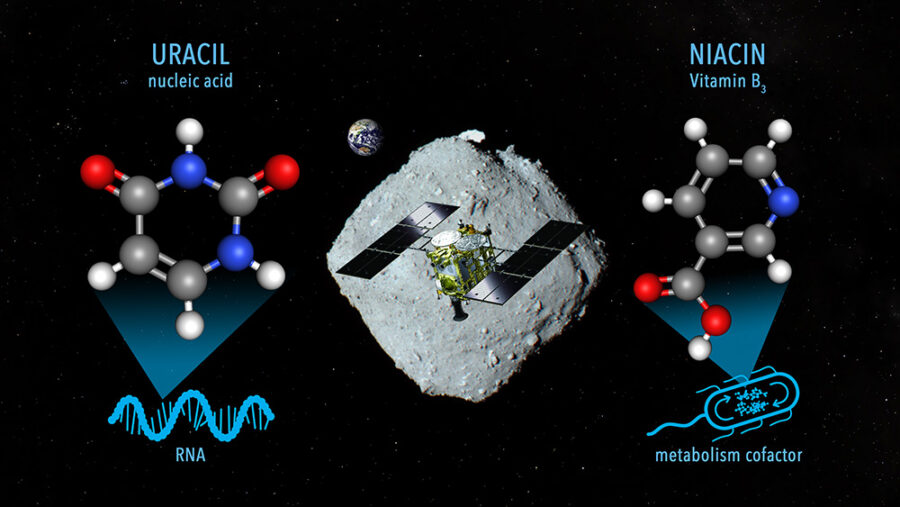
(Sky and Telescope) Analysis of tiny samples from the near-Earth asteroid 162173 Ryugu has yielded uracil, one of the four nucleobases in RNA and a stepping stone on the path to life. It bolsters the case that space may have provided compounds vital in the evolution of life on Earth.

A decade ago, researchers studying meteorites found several compounds considered precursors to life. And last year, Yasuhiro Oba (Hokkaido University, Japan) and colleagues used a more sensitive technique to detect additional compounds essential for life in meteorites. Evidence seemed to show that chemical reactions in the young solar system might have produced the building blocks of life, which meteorites then delivered to Earth.

However, meteorites are far from pristine. They pick up contaminants from the air, water, and heating as they fall through the atmosphere. The acid test is to collect pristine samples from asteroids while they still orbit in space. The samples that Japan’s Hayabusa 2 probe carefully collected during its visit to Ryugu should have very little or no terrestrial contamination, strengthening the case for an extraterrestrial origin for any prebiotic materials found.

Hayabusa 2 collected 5.4 grams from two spots on Ryugu and delivered them to Earth on December 6, 2020. Early studies showed the samples contained many organic compounds. That led Oba's group to analyze two 10-milligram samples using the same sensitive technique they had used earlier on meteorites. The technique can detect nucleic acid bases at levels down to parts per trillion in small samples.

Now, they report in Nature Communications that uracil is present at a level of parts per billion in both Ryugu samples. While this concentration is different than they’d previously found in meteorites, Oba says that might be because the parent bodies of the meteorites and of Ryugu underwent different levels of aqueous alteration and other processes. They also detected niacin (vitamin B3) as well as other organic molecules, but they didn’t find any other nucleobases.
Read more here: https://skyandtelescope.org/astronomy- ... ompounds/

For the report as presented in Nature Communications: https://www.nature.com/articles/s41467-023-36904-3


Image
A conceptual image shows uracil and vitamin B3; Hayabusa 2 brought back samples from Ryugu containing both of these prebiotic compounds.
NASA Goddard / JAXA / Dan Gallagher
Don't mourn, organize.

-Joe Hill
User avatar
Time_Traveller
Posts: 3025
Joined: Sun May 16, 2021 4:49 pm
Location: New York City, USA, November 5th 2032 C.E.

Re: Asteroids, Comets, and Meteors

Post by Time_Traveller »

Rare green comet is passing by Earth for the first time in 50,000 years
April 12, 2023

A green comet that has just been discovered is going to fly past our Pale Blue Dot and could possibly be seen with the unaided eye.

NASA and CalTech’s Jet Propulsion Laboratory predicted that the green comet C/2022 E3 (ZTF), which is named, would initially approach the Sun before circling back towards Earth between January 12 and February 2.

The comet will be visible in the early sky around the end of January for skywatchers in the Northern Hemisphere, according to a JPL article. Beginning in early February, observers in the Southern Hemisphere should be able to view it.

The greatest viewing time, according to Space.com, is on January 21 during the new moon, when the sky would be very black without the Moon’s illumination.

The JPL says that although comets are notoriously unpredictable, if this one maintains its present brightness trend, it will be simple to identify with binoculars and may even become visible to the unassisted eye under dark skies.

Image
https://stunning.sci-nature.com/2023/04 ... h.html?m=1
“In the quantum multiverse, every choice, every decision you've ever and never made exists in an unimaginably vast ensemble of parallel universes.”
Post Reply