
8th July 2022
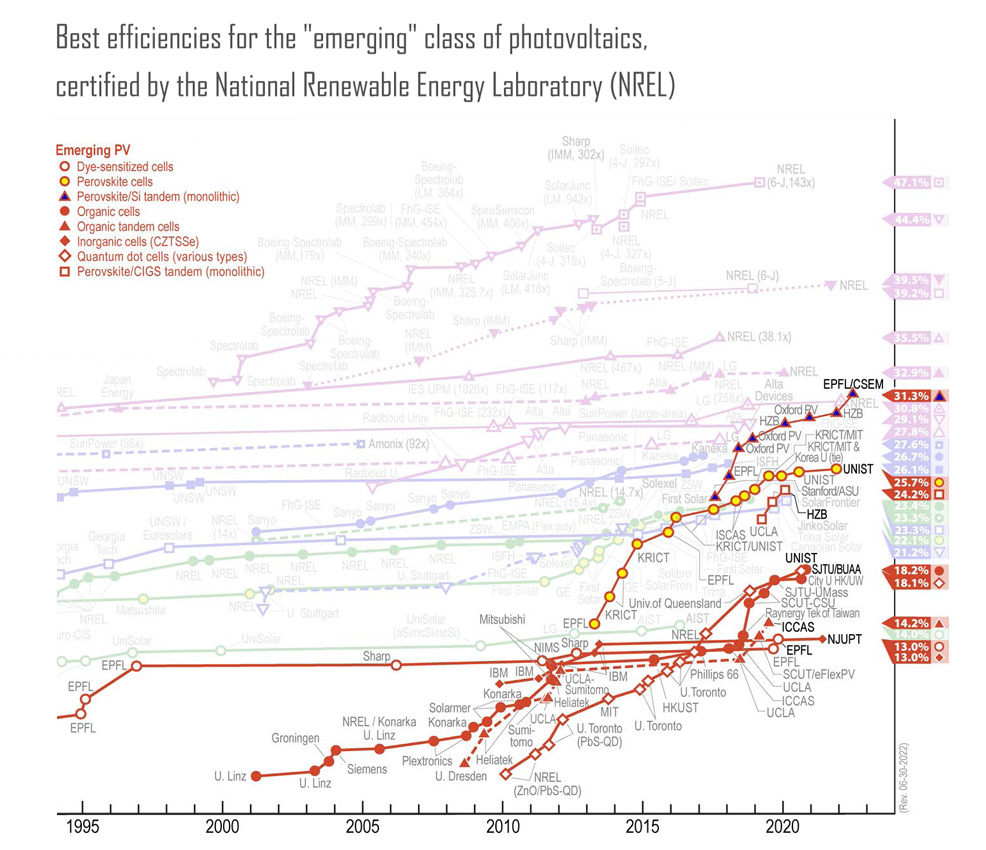
The first tandem perovskite-silicon solar cells to exceed 30% efficiency have been independently certified.
https://www.futuretimeline.net/blog/202 ... meline.htm

https://www.latimes.com/business/story/ ... ing-dangerRecycling solar panels isn’t a simple process. Highly specialized equipment and workers are needed to separate the aluminum frame and junction box from the panel without shattering it into glass shards. Specialized furnaces are used to heat panels to recover silicon. In most states, panels are classified as hazardous materials, which require expensive restrictions on packaging, transport and storage.
Orben said the economics of the process don’t make a compelling case for recycling.
Only about $2 to $4 worth of materials are recovered from each panel. The majority of processing costs are tied to labor, and Orben said even recycling panels at scale would not be more economical.
Most research on photovoltaic panels is focused on recovering solar-grade silicon to make recycling economically viable.
That skews the economic incentives against recycling. The National Renewable Energy Laboratory estimated that it costs roughly $20 to $30 to recycle a panel versus $1 to $2 to send it to a landfill.
Read more here: https://www.eurekalert.org/news-releases/958803(EurekAlert)) Solar roofing panels which are greener, lighter, cheaper and flexible, and which can be printed on the steel used in buildings, are the focus of a new three-year research collaboration between Swansea experts and Tata Steel UK.
The solar roofs would enable buildings to generate, store and release their own secure supply of electricity. This would reduce reliance on fossil fuel energy such as gas, and ease pressure on the National Grid, especially as surplus power generated by a building can be used to charge up electric vehicles.
The concept is called "Active Buildings" and it has already been shown to work. Two “Active Buildings” have been in operation successfully on the Swansea University campus for several years. The aim of the new research is to explore the potential of this technology further and speed up the process of turning it into products for industry to manufacture.
The collaboration was launched with the signing of a Memorandum of Understanding at the University’s Bay campus, where the Active Buildings are located. It is the latest chapter in a longstanding partnership between Swansea University and Tata Steel.
Solar energy is crucial in the shift towards clean, green power. In just one hour enough solar energy falls on the earth to meet the energy needs of the entire world for a year.
Read more here: https://www.eurekalert.org/news-releases/958823(EurekAlert) Researchers at the Karlsruhe Institute of Technology (KIT) have developed a prototype for fully scalable all-perovskite tandem solar modules. These modules have an efficiency of up to 19.1 percent with an aperture area of 12.25 square centimeters. This result, the first of its kind reported worldwide, was made possible by improving efficiency with optimized light paths, high-throughput laser scribing, and the use of established industrial coating methods. The researchers present their results in the journal Nature Energy. (DOI: 10.1038/s41560-022-01059-w)
As a readily available and versatile energy source, sunlight plays a key role in the transition from fossil fuels to renewable sources and in an independent energy supply. Solar cells convert sunlight into electricity. In recent years, solar cells made of perovskite semiconductors have shown great promise thanks to their high efficiency and low production costs. But the efficiency of an individual perovskite cell is still limited in spite of enormous progress. This limitation can be overcome by stacking two solar cells with different band gaps. The band gap is a material characteristic that determines the part of the incident spectrum that a solar cell absorbs to generate electricity.
Efficiency Boost from Stacking
Tandem solar cells use a broader range of the spectrum and generate more electricity, making them more efficient. Perovskite solar cells with a tunable band gap are ideal tandem partners not only for solar cells made of other materials but also for all-perovskite tandem solar cells. They feature low-cost production, solution-based processing methods, mechanical flexibility, and the freedom to combine cells with different perovskite band gaps. Researchers expect all-perovskite tandem solar cells to gain a high market share in the future if they can satisfy requirements for stability and scalability. Scalability means that new designs can be applied at larger scales and in mass production.
This brings me back to the days when I was paid to attend meetings regarding waste management. In particular, implementing AB 939 (see: https://riversideca.gov/publicworks/tra ... r%20means.).funkervogt wrote: ↑Thu Jul 14, 2022 1:59 pm Solar panels are about to create a huge waste problem as they reach the end of their lives.
https://www.latimes.com/business/story/ ... ing-dangerRecycling solar panels isn’t a simple process. Highly specialized equipment and workers are needed to separate the aluminum frame and junction box from the panel without shattering it into glass shards. Specialized furnaces are used to heat panels to recover silicon. In most states, panels are classified as hazardous materials, which require expensive restrictions on packaging, transport and storage.
Orben said the economics of the process don’t make a compelling case for recycling.
Only about $2 to $4 worth of materials are recovered from each panel. The majority of processing costs are tied to labor, and Orben said even recycling panels at scale would not be more economical.
Most research on photovoltaic panels is focused on recovering solar-grade silicon to make recycling economically viable.
That skews the economic incentives against recycling. The National Renewable Energy Laboratory estimated that it costs roughly $20 to $30 to recycle a panel versus $1 to $2 to send it to a landfill.
Read more here: https://www.eurekalert.org/news-releases/958862(EurekAlert) Researchers have designed a fuel production system that uses water, carbon dioxide (CO2), and sunlight to produce aviation fuel. They have implemented the system in the field, and the design, publishing July 20 in the journal Joule, could help the aviation industry become carbon neutral.
“We are the first to demonstrate the entire thermochemical process chain from water and CO2 to kerosene in a fully-integrated solar tower system,” says Aldo Steinfeld (@solarfuels), a professor from ETH Zurich and the corresponding author of the paper. Previous attempts to produce aviation fuels through the use of solar energy have mostly been performed in the laboratory.
The aviation sector is responsible for about 5% of global anthropogenic emissions causing climate change. It relies heavily on kerosene, or jet fuel, which is a liquid hydrocarbon fuel typically derived from crude oil. Currently, no clean alternative is available to power long-haul commercial flights at the global scale.
“With our solar technology, we have shown that we can produce synthetic kerosene from water and CO2 instead of deriving it from fossil fuels. The amount of CO2 emitted during kerosene combustion in a jet engine equals that consumed during its production in the solar plant,” Steinfeld says. “That makes the fuel carbon neutral, especially if we use CO2 captured directly from the air as an ingredient, hopefully in the not-too-distant future.”
As a part of the European Union’s SUN-to-LIQUID project, Steinfeld and his colleagues have developed a system that uses solar energy to produce drop-in fuels, which are synthetic alternatives to fossil-derived fuels such as kerosene and diesel. The solar-made kerosene is fully compatible with the existing aviation infrastructure for fuel storage, distribution, and end use in jet engines, Steinfeld says. It can also be blended with fossil-derived kerosene, he adds.
Read more here: https://www.iflscience.com/near-invisi ... -64541(IFL Science) A see-through solar cell has been successfully fabricated by researchers at Tohoku University in Japan. It’s powerful – albeit tiny – and it might be coming to a building near you.
…
(T)he team from Tohoku University has…developed a “near-invisible” solar cell, or NISC – engineers don’t have time to waste on extra syllables – that lets nearly 80 percent of light through. Theoretically, it could be placed anywhere, from the windows in your house to the screen on your smartphone – or even the skin on your body.
“Transparent solar cells (TSCs) have attracted considerable attention as they can overcome the limitations of traditional non-transparent solar cells,” explain the Tohoku researchers in a paper describing the study, recently published in Nature Scientific Reports.
“We successfully fabricated an NISC using ITO [indium tin oxide, one of the most widely used transparent conducting oxides] and monolayer tungsten disulfide […] as transparent electrodes, and photoactive layer, respectively.”
Using these materials – plus a thin layer of tungsten oxide between the ITO and the tungsten disulfide – the team made a solar cell that beats other transparent cells by several orders of magnitude.
Read more here: https://cleantechnica.com/2022/07/20/c ... review/(CleanTechnica) GoSun has been tapping into the power of the sun to sustainably power our lives for years, starting with their solar thermal-powered oven. They have expanded their lineup significantly in recent years, building a complementary kit of gear to enable a whole host of off-grid adventures.
Disclaimer: GoSun sent us the Chillest free of charge for the purposes of this review.
They sent us the GoSun Chillest – a full-sized 45 liter electric cooler that comes with an integrated battery. Imagine rolling out to a day at the beach or park with your family and food and not having to stop at the store for ice. You whip out your cooler full of food and drinks and plug it into a solar panel and just like that, your food will stay cold or frozen essentially forever.
The temperature is adjustable from -4F to 68F (-20C to 20C) so you can choose whether you want your drinks cold or completely frozen, depending on what you’re doing. It has a little LCD display to tell you what’s going on and a few buttons to change things around. In my experience, it’s just enough to let you do what you need to do without overcomplicating things.
In addition to the solar, you can also plug it in at home to a standard AC outlet or even a 12 volt automotive outlet using the included adapters. For folks in an RV or similar off-grid setup, the Chillest can also run on 24 volt power or directly off of a portable power station.
The energy transition is well underway as solar demand blazes higher.
Rob Barnett, a senior clean energy analyst at Bloomberg, forecasted that solar capacity installations are on track to grow by 30% globally this year and see sustained double-digit growth in 2023 through 2025.
“At the end of the day, the global solar picture is just staggering at this point," Barnett told Yahoo Finance Live (video above). "We are on track to install something like 250 gigawatts of solar capacity this year. I know most folks don't think in gigawatts, but that is a very large amount. It's more than the installed capacity of a number of European countries.”
A perovskite solar cell developed by engineers at the University of California San Diego brings researchers closer to breaking the ceiling on solar cell efficiency, suggests a study published Aug. 10 in Nature.
The new solar cell is a lead-free low-dimensional perovskite material with a superlattice crystal structure—a first in the field. What's special about this material is that it exhibits efficient carrier dynamics in three dimensions, and its device orientation can be perpendicular to the electrodes. Materials in this particular class of perovskites have so far only exhibited such dynamics in two dimensions—a perpendicularly orientated solar cell has never been reported.
Thanks to its specific structure, this new type of superlattice solar cell reaches an efficiency of 12.36%, which is the highest reported for lead-free low-dimensional perovskite solar cells (the previous record holder's efficiency is 8.82%). The new solar cell also has an unusual open-circuit voltage of 0.967 V, which is higher than the theoretical limit of 0.802 V. Both results have been independently certified.
The open-circuit voltage is a solar cell property that contributes to its efficiency, so this new solar cell "may have the potential to break the theoretical efficiency limit of current solar cells," said study senior author Sheng Xu, a professor of nanoengineering at the UC San Diego. "This might one day allow us to achieve higher efficiency with more electricity from existing solar panels, or generate the same amount of electricity from smaller solar panels at lower costs."
Read more here: https://www.eurekalert.org/news-releases/961676(EurekAlert) The DGIST (President Kuk Yang) Thin Film Solar Cell Research Center (Chairman Gang Jin-gyu) worked with Professor Kim Se-yoon of the Department of New Material Engineering at Kyungnam University (President Park Jae-gyu) to investigate the cause of pore formation, a problem in CZTS thin-film solar cells, which are eco-friendly general-purpose thin-film solar cells. It was announced on the 12th (Tuesday) that it developed a technology to overcome this problem.
□ “Solar cells,” which generate electricity by converting light energy from the sun into electrical energy, are sustainable new renewable energy and can be easily found in everyday life. Among them, CZTS thin film is easy to mass-produce because it uses copper, tin, and zinc as its main materials, which are inexpensive and have little toxicity. In addition, due to its bending property, it can be applied to various fields. In 2019, the DGIST Thin Film Solar Cell Research Center developed a solar cell with the world's highest power conversion efficiency of 12.6%. However, it still needs a solution to various defects such as pores of various sizes generated near the lower electrode (pore defects).
□ The DGIST Thin Film Solar Cell Research Center and the research team led by Kim Se-yoon from Kyungnam University investigated the cause of pore formation under the absorption layer, which is a problem with CZTS thin-film solar cells. It has greater significance because it is a technology that can control pore defects using a relatively simple principle. The CZTS absorber layer is produced by coating copper, zinc, and tin in random order and then reacting them with sulfur and selenium at high temperatures. At this time, it was confirmed that large pores were not formed when zinc was coated first. This is a source technology that can suppress pore formation and is expected to further increase the power generation efficiency of CZTS-based thin film solar cells.
□ DGIST Senior Researcher Kim Dae-hwan said, “As major achievements of this study, we presented a new pore inhibition model different from the ordinary model and developed a technology that can inhibit pore formation defects in a simple way.”
Additional extract:(EurekAlert) Researchers have developed floating ‘artificial leaves’ that generate clean fuels from sunlight and water, and could eventually operate on a large scale at sea.
The researchers, from the University of Cambridge, designed ultra-thin, flexible devices, which take their inspiration from photosynthesis – the process by which plants convert sunlight into food. Since the low-cost, autonomous devices are light enough to float, they could be used to generate a sustainable alternative to petrol without taking up space on land.
Outdoor tests of the lightweight leaves on the River Cam – near iconic Cambridge sites including the Bridge of Sighs, the Wren Library and King’s College Chapel – showed that they can convert sunlight into fuels as efficiently as plant leaves.
This is the first time that clean fuel has been generated on water, and if scaled up, the artificial leaves could be used on polluted waterways, in ports or even at sea, and could help reduce the global shipping industry’s reliance on fossil fuels. The results are reported in the journal Nature.
Read more here: https://www.eurekalert.org/news-releases/961713Tests of the new artificial leaves showed that they can split water into hydrogen and oxygen, or reduce CO2 to syngas. While additional improvements will need to be made before they are ready for commercial applications, the researchers say this development opens whole new avenues in their work.
A solar-cell module that mitigates cell-to-module losses has been developed by KAUST researchers following a rethink of the module's optical design and how it should be stacked.
Research laboratories around the world are working to constantly improve the efficiency of solar cells. But using these devices in the real world represents an extra challenge. For example, solar cells need to be incorporated into modules that can protect the sensitive materials from harsh environments. These modules can reduce the power conversion efficiency, thus losing the performance gains so diligently won in the laboratory.
Lujia Xu, Stefaan De Wolf and their KAUST colleagues have constructed a more efficient solar-cell module with an enhanced optical design. The solar cells used by the team were made of a combination of two light-absorbing semiconductors: one silicon and the other made from a perovskite material. Silicon is now a well-established material in solar cell manufacture. And while perovskites are an emerging material, adding a thin layer on top of the silicon has already been shown to improve performance with an acceptable increase in cost.
These so-called perovskite–silicon tandem solar cells have previously exhibited efficiencies in optical-to-electrical power conversion as high as 30%. And theoretical modeling has indicated it could go as high as 45%. But when the KAUST team put their tandem solar cells into a module, they found that the efficiency dropped from 28.9% to 25.7%. Their module was made by sandwiching the solar cells between two glass sheets, with the inside filled with thermoplastic polyurethane to encapsulate the solar cells.
Tandem solar cells (TSCs), stacks of p-n junctions based on semiconductors with different bandgaps, are a highly promising energy solution that could help to reduce carbon emissions. Perovskites, earth-abundant materials with a tunable bandgap, high charge-carrier mobilities, advantageous optoelectronic properties and long carrier diffusion lengths, could be particularly valuable for creating low-cost and highly power-efficient TSCs for large-scale implementations.
To fabricate efficient all-perovskite TSCs, engineers need to be able to grow high-quality and uniform perovskite absorbers through crystallization processes. Absorbers are semiconducting layers inside solar cells that absorb photons (i.e., light particles) and excite electrons to create photocurrent from sunlight. So far, however, a universal and effective process to prepare perovskite absorbers for TSCs is still lacking.
Researchers at Soochow University and Sichuan University have recently devised a new strategy to create high-quality perovskite absorbers with grains in the micrometer scale and prolonged carrier lifetimes. This strategy, introduced in a paper published in Nature Energy, is based on a close-space annealing (CSA) process, a heat-based technique that can be used to change a material's chemical properties.
"Controllable crystallization plays a crucial role in the formation of high-quality perovskites," Changlei Wang and his colleagues wrote in their paper. "Here, we report a universal CSA strategy that increases grain size, enhances crystallinity and prolongs carrier lifetimes in low-bandgap (low-Eg) and wide-bandgap (wide-Eg) perovskite films."
Remarkably, the CSA strategy devised by Wang and his colleagues is universal, as it can be applied to perovskites with various bandgaps to produce high-quality absorbers with enlarged grains and longer carrier lifetimes. As part of their recent study, the team demonstrated its generalizability by successfully using it to prepare absorbers based on perovskites with different chemical compositions.
Kesterite Cu2ZnSn(S,Se)4 is an emerging and promising green photovoltaic material, as it is abundant on Earth, does not harm the environment, and has a stable structure, a great tunability and advantageous optoelectronic properties. Despite their qualities, solar cells based on kesterite typically have poor power conversion efficiencies, which hinder their commercialization and large-scale implementation.
Researchers at the University of New South Wales in Sydney have recently carried out a study aimed at better understanding the mechanisms that promote microscopic carrier losses in kesterite solar cells, reducing their efficiencies. Their findings, published in Nature Energy, could ultimately help to facilitate the large-scale implementation of this promising class of solar cells.
"The research community has encountered a grand challenge in improving the performance of kesterite solar cells which is associated with the unprecedented complexity of the material system as well as the carrier loss mechanisms," Jianjun Li, one of the researchers who carried out the study, told TechXplore. "It has been a long debate as to which carrier loss mechanism is dominating in current state-of-the-art kesterite solar cells."
Understanding the mechanisms underpinning carrier loss in specific types of solar cells is an essential step in their development and commercialization. The key objective of the recent work by Li and his colleagues was to identify the dominant loss mechanisms in state-of-the-art kesterite solar cells. The researchers also wanted to devise a framework that would allow them and other teams to dynamically analyze the dominant loss mechanisms in solar cells based on different emerging polycrystalline thin films, including kesterite as well as antimony chalcogenides, perovskites, and other materials.
Read more of the EurekAlert article here: https://www.eurekalert.org/news-releases/962812(EurekAlert) Solar cells are vital for the green energy transition. They can be used not only on rooftops and solar farms but also for powering autonomous vehicles, such as planes and satellites. However, photovoltaic solar cells are currently heavy and bulky, making them difficult to transport to remote locations off-grid, where they are much needed.
In a collaboration led by Imperial College London, alongside researchers from Cambridge, UCL, Oxford, Helmholtz-Zentrum Berlin in Germany, and others, researchers have produced materials that can absorb comparable levels of sunlight as conventional silicon solar cells, but with 10,000 times lower thickness.
The material is sodium bismuth sulfide (NaBiS2), which is grown as nanocrystals and deposited from solution to make films 30 nanometers in thickness. NaBiS2 is comprised of nontoxic elements that are sufficiently abundant in the earth’s crust for use commercially. For example, bismuth-based compounds are used as a nontoxic lead replacement in solder, or in over-the-counter stomach medicine.
Yi-Teng Huang, PhD student at the University of Cambridge and co-first author, commented: “We have found a material that absorbs light more strongly than conventional solar cell technologies and can be printed from an ink. This technology has potential for making lightweight solar cells which can be easily transported or used in aerospace applications.”
Researchers at the University of Toronto and the Barcelona Institute of Science and Technology have recently created new solution-processed perovskite photodetectors that exhibit remarkable efficiencies and response times. These photodetectors, introduced in a paper published in Nature Electronics, have a unique design that prevents the formation of defects between its different layers.
"There is growing interest in 3D range imaging for autonomous driving and consumer electronics," Edward H. Sargent told TechXplore. "We have worked as a team for years on finding new materials that enable light sensing technologies such as next-generation image sensors and striving to take these in a direction that could have a commercial and societal impact."
Photodetectors, sensing devices that detect or respond to light, can have numerous highly valuable applications. For instance, they can be integrated in robotic systems, autonomous vehicles, consumer electronics, environmental sensing technology, fiber optic communication systems and security systems.
"In these applications, fast photodetection is required in wavelength ranges beyond human vision," Amin Morteza Najarian said. "Silicon, the legacy approach—and ideal for electronic readout—does not on its own unite high efficiency with high-speed, as a result of its indirect bandgap, a property of silicon's band structure that produces weak absorption (hence a need for thick silicon) in the near infrared."
Solar panels, also known as photovoltaics, rely on semiconductor devices, or solar cells, to convert energy from the sun into electricity.
To generate electricity, solar cells need an electric field to separate positive charges from negative charges. To get this field, manufacturers typically dope the solar cell with chemicals so that one layer of the device bears a positive charge and another layer a negative charge. This multilayered design ensures that electrons flow from the negative side of a device to the positive side—a key factor in device stability and performance. But chemical doping and layered synthesis also add extra costly steps in solar cell manufacturing.
Now, a team of researchers led by scientists at DOE's Lawrence Berkeley National Laboratory (Berkeley Lab), in collaboration with UC Berkeley, have demonstrated a unique workaround that offers a simpler approach to solar cell manufacturing: A crystalline solar material with a built-in electric field—a property enabled by what scientists call "ferroelectricity." The material was reported earlier this year in the journal Science Advances.
The new ferroelectric material—which is grown in the lab from cesium germanium tribromide (CsGeBr3 or CGB)—opens the door to an easier approach to making solar cell devices. Unlike conventional solar materials, CGB crystals are inherently polarized, where one side of the crystal builds up positive charges and the other side builds up negative charges, no doping required.