

James Webb Space Telescope (JWST)



Re: James Webb Space Telescope (JWST)
Source of description: https://www.nasa.gov/webbfirstimagesThis landscape of “mountains” and “valleys” speckled with glittering stars is actually the edge of a nearby, young, star-forming region called NGC 3324 in the Carina Nebula. Captured in infrared light by NASA’s new James Webb Space Telescope, this image reveals for the first time previously invisible areas of star birth.
Called the Cosmic Cliffs, Webb’s seemingly three-dimensional picture looks like craggy mountains on a moonlit evening. In reality, it is the edge of the giant, gaseous cavity within NGC 3324, and the tallest “peaks” in this image are about 7 light-years high. The cavernous area has been carved from the nebula by the intense ultraviolet radiation and stellar winds from extremely massive, hot, young stars located in the center of the bubble, above the area shown in this image.
Don't mourn, organize.
-Joe Hill
-Joe Hill
Re: James Webb Space Telescope (JWST)
Read more here: https://www.whitehouse.gov/briefing-roo ... telescope/
Don't mourn, organize.
-Joe Hill
-Joe Hill
Re: James Webb Space Telescope (JWST)
Why the New James Webb Space Telescope Images are Such a Big Deal
by Brian Resnick
July 12, 2022
Introduction:
by Brian Resnick
July 12, 2022
Introduction:
Read more here: https://www.vox.com/science-and-healt ... asa-jwst(Vox) Last year, before the launch of the James Webb Space Telescope, I wrote: “the largest space telescope in history is about to blow our minds.”
Consider this mind blown. NASA has finally revealed its first images from the space-based observatory. These images are decades in the making, and come after years of delays and budgets being blown. But they do not disappoint. Consider this very first image released by the space agency on Monday:
(See image posted by W.J. Fox on July 12, 2022. The post immediately preceding the image titled Hot Gas Exoplanet Wasp-96 – Atmosphere Composition)
What makes this image so mind-blowing is how small it is, and how large it is, at the same time.
It’s small in the sense that this image represents only a teensy tiny portion of the night sky. Imagine you are holding out a grain of sand at arm’s length. The area of sky that grain covers — that’s the size of the area captured in the above image.
But it’s huge in the sense that nearly every object in this image is a galaxy (besides the bright spiky starbursts, which are stars in the foreground). Think about that: In every pinprick of sky, there are thousands and thousands of galaxies, at least.
Don't mourn, organize.
-Joe Hill
-Joe Hill
-
funkervogt

- Posts: 1370
- Joined: Mon May 17, 2021 3:03 pm
Re: James Webb Space Telescope (JWST)
Comparison photos show how much sharper the James Webb telescope is than the Hubble telescope.
https://www.dailymail.co.uk/sciencetech ... ubble.html
https://www.dailymail.co.uk/sciencetech ... ubble.html
-
Lorem Ipsum
- Posts: 117
- Joined: Tue May 24, 2022 4:51 pm

Re: James Webb Space Telescope (JWST)
The Webb Team Just Stealthily Dropped a Picture of Jupiter, And We Can't Stop Staring
July 13, 2022
Introduction:
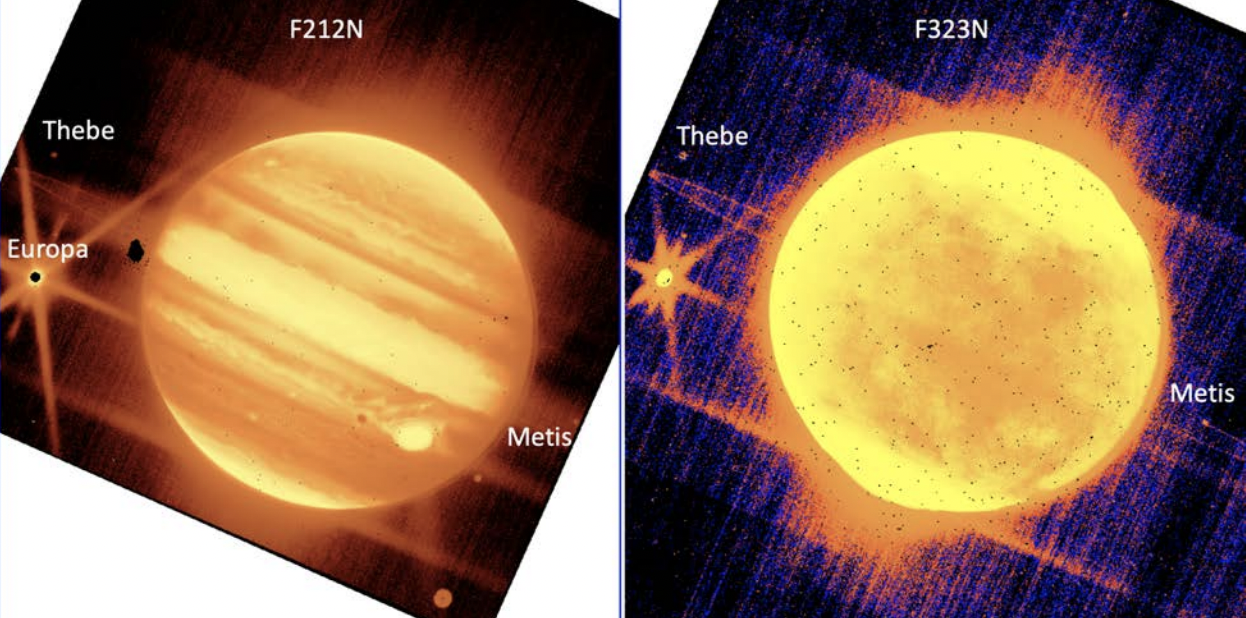
Above: The image on the left was taken by the JWST Near-Infrared Camera using a filter that highlights short wavelengths. The image on the right is taken with a filter that highlights long wavelengths of light.
Photo credit: (NASA, ESA, CSA, and STScI)
July 13, 2022
Introduction:
Read more here: https://www.sciencealert.com/webb-actu ... staring(Science Alert) This morning we were in a frenzy over a sneaky side-glimpse of a galaxy revealed in the first full-color James Webb Space Telescope (JWST) images.
But if you thought that was wild, then wait for this: it turns out JWST has also dropped some stealthy images of Jupiter! And they're ridiculously beautiful.
These images, taken while JWST was being tested, were provided in the JWST commissioning report.
The images, which you can see in greater detail below, show Jupiter and its rings as well as three of its moons: Europa, Thebe, and Metis.
- umm who else saw this in the commissioning report document??
https://t.co/AzwQCf6rat pic.twitter.com/nq13fxdsAM
— Erin M. May, PhD (@_astronomay) July 12, 2022


Above: The image on the left was taken by the JWST Near-Infrared Camera using a filter that highlights short wavelengths. The image on the right is taken with a filter that highlights long wavelengths of light.
Photo credit: (NASA, ESA, CSA, and STScI)
Don't mourn, organize.
-Joe Hill
-Joe Hill
Re: James Webb Space Telescope (JWST)
Webb Accidentally Spied a Stunning Side View of a Galaxy in Its First Image Drop
July 13, 2022
Introduction:
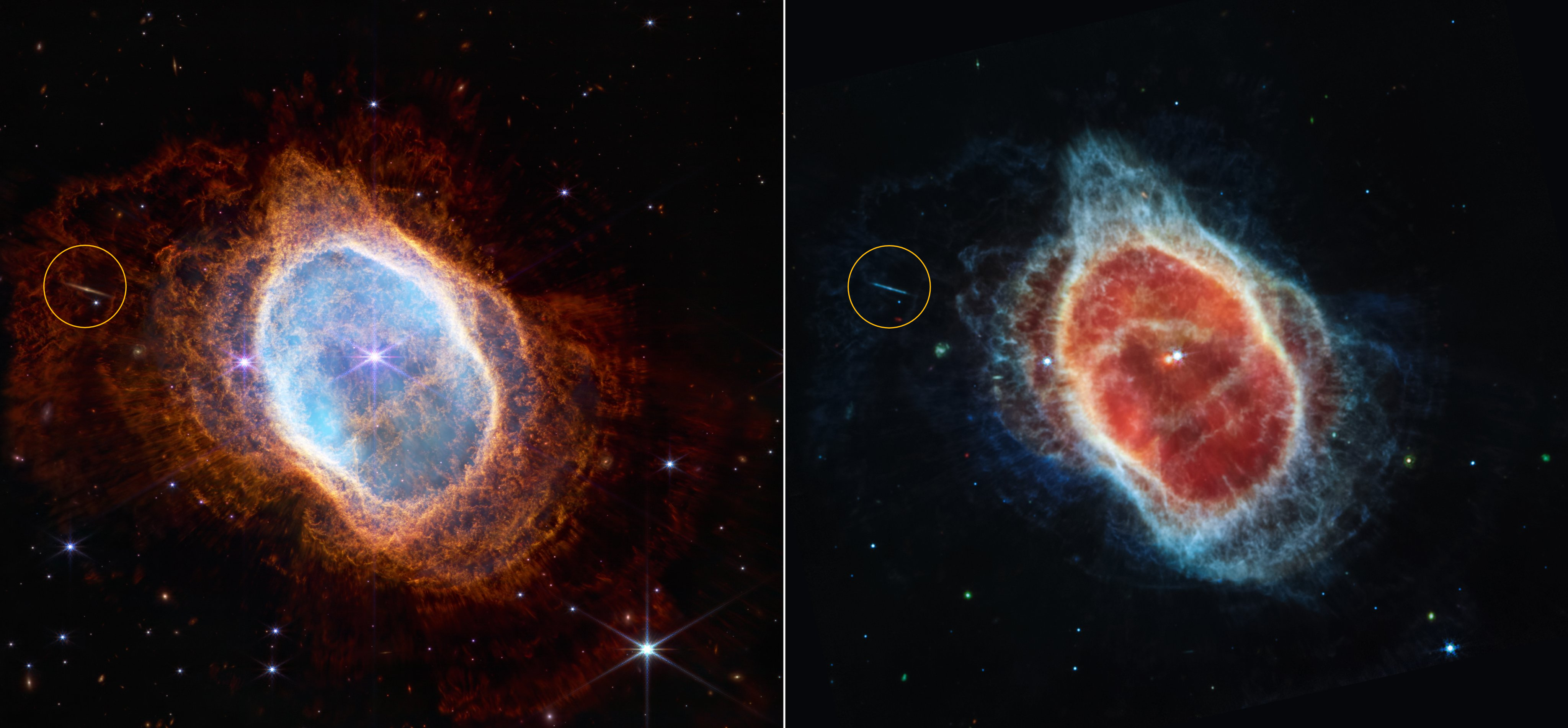
Southern Ring Nebula images with the side-view galaxy circled.
(NASA, ESA, CSA, and STScI)
July 13, 2022
Introduction:
Read more here: https://www.sciencealert.com/webb-acc ... age-drop(Science Alert) If you're still geeking out over the first release of full-color James Webb Space Telescope images, you're not alone. This week we were treated with the very first image unveiling, shortly followed by four other brand new images that show our Universe in never-before-seen detail – and we've hardly been able to stop staring at them.
But there's one very important detail we missed at first glance!
Located stealthily in the upper left of the Southern Ring Nebula images is what looks like a streak of light – but is actually a side view of a galaxy.
"I made a bet that said 'It's part of the nebula'," said NASA astronomer Karl Gordon during the image reveal, Business Insider reports. "I lost the bet, because then we looked more carefully at both NIRcam [Near-Infrared Camera] and MIRI [Mid-Infrared Instrument] images, and it's very clearly an edge-on galaxy."
Not only does it look cool, but this perspective should allow astronomers to study how stars are distributed throughout the galaxy.
Southern Ring Nebula images with the side-view galaxy circled.
(NASA, ESA, CSA, and STScI)
Don't mourn, organize.
-Joe Hill
-Joe Hill
-
funkervogt
- Posts: 1370
- Joined: Mon May 17, 2021 3:03 pm
Re: James Webb Space Telescope (JWST)
That's weird. I don't know how that happened. Here's the link again:
https://www.dailymail.co.uk/sciencetech ... ubble.html
-
weatheriscool
- Posts: 26094
- Joined: Sun May 16, 2021 6:16 pm
- Contact:
Re: James Webb Space Telescope (JWST)
Webb begins hunt for the first stars and habitable worlds
https://phys.org/news/2022-07-webb-star ... orlds.html
by Issam Ahmed and Lucie Aubourg
https://phys.org/news/2022-07-webb-star ... orlds.html
by Issam Ahmed and Lucie Aubourg
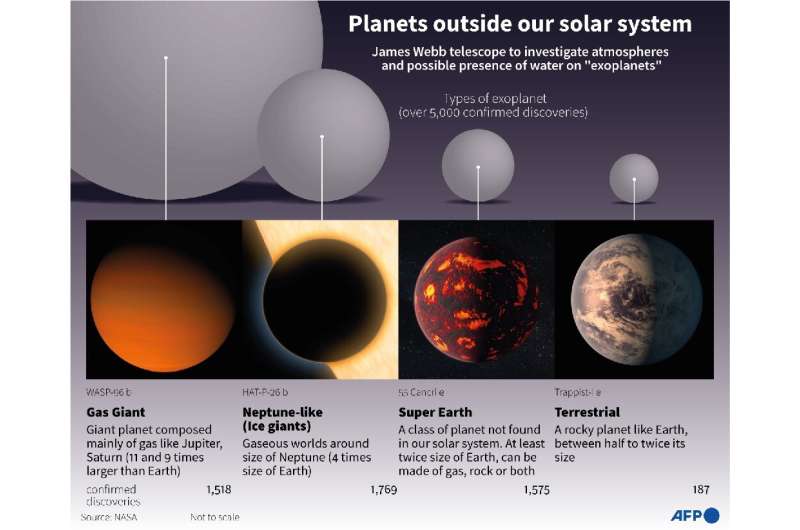
Graphic on the different types of "exoplanets" which the new James Webb telescope will be investigating to determine the composition of their atmospheres and the presence of water.
The first stunning images from the James Webb Space Telescope were revealed this week, but its journey of cosmic discovery has only just begun.
Here is a look at two early projects that will take advantage of the orbiting observatory's powerful instruments.
The first stars and galaxies
One of the great promises of the telescope is its ability to study the earliest phase of cosmic history, shortly after the Big Bang 13.8 billion years ago.
The more distant objects are from us, the longer it takes for their light to reach us, and so to gaze back into the distant universe is to look back in the deep past.
"We're going to look back into that earliest time to see the first galaxies that formed in the history of the universe," explained Space Telescope Science Institute astronomer Dan Coe, who specializes in the early universe.
Last edited by weatheriscool on Fri Jul 15, 2022 7:08 am, edited 1 time in total.
Re: James Webb Space Telescope (JWST)
An astrophysicist explains the first JWST science images
Re: James Webb Space Telescope (JWST)
Why Stars Look Spiky in Images from the James Webb Space Telescope
by Mary Beth Griggs
July 15, 2022
Introduction:
by Mary Beth Griggs
July 15, 2022
Introduction:
Read more here: https://www.theverge.com/23220109/jame ... ion-spike(The Verge) Stars in the new images from the James Webb Space Telescope look sharper than they did before. And I’m not just talking about the image quality, which is astounding. I’m talking about the fact that many of the bright stars in the images have very distinct Christmas-ornament-looking spikes or, as one of my colleagues put it, “It looks like a J.J. Abrams promo poster, and I love it.”
But this isn’t a case of too much lens flare. Those are diffraction spikes, and if you look closely, you’ll see that all bright objects in the JWST images have the same eight-pointed pattern. The brighter the light, the more prominent the feature. Dimmer objects like nebulae or galaxies don’t tend to see quite as much of this distortion.
This pattern of diffraction spikes is unique to JWST. If you compare images taken by the new telescope to images taken by its predecessor, you’ll notice that Hubble only has four diffraction spikes to JWST’s eight. (Two of JWST’s spikes can be very faint, so it sometimes appears as though there are six.)
(See linked article for Twitter feed)
The shape of the diffraction spikes is determined by the telescope’s hardware, so let’s start with a quick refresher of the important bits. Both Hubble and JWST are reflecting telescopes, which means that they collect light from the cosmos using mirrors. Reflecting telescopes have a large primary mirror that gathers the light and reflects it back to a smaller secondary mirror. The secondary mirror on space telescopes helps guide that light toward the science instruments that turn it into all the cool images and data we’re seeing now.
Both the primary and secondary mirrors contribute to the diffraction spikes but in slightly different ways. Light diffracts, or bends, around objects like mirror edges. So the shape of the mirror itself can result in these spikes of light as light interacts with the edges of the mirror. In Hubble’s case, the mirror was round, so it didn’t add to the spikiness. But JWST has hexagonal mirrors that result in an image with six diffraction spikes.
Don't mourn, organize.
-Joe Hill
-Joe Hill
Re: James Webb Space Telescope (JWST)
We are ready for the next interstellar object:
https://www.inverse.com/science/jwst-in ... ar-objects
https://www.inverse.com/science/jwst-in ... ar-objects
Because astronomers could spot an interstellar object at any moment, this particular study is part of NASA’s Target of Opportunity program. This program allows teams studying time-sensitive phenomena, like supernovae or interstellar objects, to interrupt Webb’s regularly scheduled programming with as little lead time as three days. This particular study falls under the category of “Disruptive Target of Opportunity,” meaning that Webb could focus its gaze on an incoming interstellar object within two weeks of discovery.
Re: James Webb Space Telescope (JWST)
The James Webb Space Telescope May Have Just Found Its First Supernova
by Kiona Smith
July 28, 2022
Introduction:
by Kiona Smith
July 28, 2022
Introduction:
Read more here: https://www.inverse.com/science/the-we ... supernova(Inverse) ASTRONOMERS spotted something unusual happening in a distant galaxy in recent images from the James Webb Space Telescope — something that wasn’t there when Hubble last looked at the same galaxy.
"We suspect it's a supernova," astronomer Mike Engesser of the Space Telescope Science Institute (STScI) tells Inverse. Finding short-lived cosmic events like supernovae isn’t what Webb was designed to do, but the newly-operational space telescope seems to be full of surprises. And this one could open the door for looking for the death throes of the universe's first generations of massive stars.
WHAT’S NEW – Engesser and his colleagues say the bright object is probably the first supernova spotted by the Webb Telescope. It's extremely bright compared to the rest of the galaxy, for one thing. And Webb observed the galaxy, called SDSS.J141930.11+5251593, twice, five days apart; the object dimmed, just slightly, over those five days — classic supernova behavior.
"We would need more time series data to make a determination, but the data we do have does match that of a supernova, so it's a very good candidate," says Engesser.
Don't mourn, organize.
-Joe Hill
-Joe Hill