Mars News and Discussions

Post Reply
User avatar
wjfox
Site Admin
Posts: 13586
Joined: Sat May 15, 2021 6:09 pm
Location: Essex, UK
Contact:

Re: Mars News and Discussions

Post by wjfox »

User avatar
wjfox
Site Admin
Posts: 13586
Joined: Sat May 15, 2021 6:09 pm
Location: Essex, UK
Contact:

Re: Mars News and Discussions

Post by wjfox »

weatheriscool
Posts: 24488
Joined: Sun May 16, 2021 6:16 pm
Contact:

Re: Mars News and Discussions

Post by weatheriscool »

Mars Reconnaissance Orbiter releasing one of its last rainbow-colored maps
https://phys.org/news/2022-06-mars-reco ... lored.html
by Jet Propulsion Laboratory
Scientists are about to get a new look at Mars, thanks to a multicolored 5.6-gigapixel map. Covering 86% of the Red Planet's surface, the map reveals the distribution of dozens of key minerals. By looking at mineral distribution, scientists can better understand Mars' watery past and can prioritize which regions need to be studied in more depth.

The first portions of this map were released by NASA's Planetary Data System. Over the next six months, more will be released, completing one of the most detailed surveys of the Martian surface ever made. (Read more about these map segments.)

NASA's Mars Reconnaissance Orbiter, or MRO, has been mapping minerals on the Red Planet for 16 years, with its Compact Reconnaissance Imaging Spectrometer for Mars, or CRISM.

Using detectors that see visible and infrared wavelengths, the CRISM team has previously produced high-resolution mineral maps that provide a record of the formation of the Martian crust and where and how it was altered by water. These maps have been crucial to helping scientists understand how lakes, streams, and groundwater shaped the planet billions of years ago. NASA has also used CRISM's maps to select landing sites for other spacecraft, as with Jezero Crater, where NASA's Perseverance rover is exploring an ancient river delta.

Tadasuke

Re: Mars News and Discussions

Post by Tadasuke »

A very sane view on the prospect of Mars colonization:

I agree with him. And I also agree with his videos on Elon's hyperloop idea.
User avatar
Yuli Ban
Posts: 5194
Joined: Sun May 16, 2021 4:44 pm

Re: Mars News and Discussions

Post by Yuli Ban »

It's basically why I say we have to automate space colonization. Send up the machines first, then send humans. It goes against our 20th-century pulp visions of rugged space pioneers living off the fat of the land, carving out their own space and hand-crafting whole towns and cities on other worlds with their own blood, sweat, and tears... but so does a lot of the reality of the Future™. I mean we COULD do it that way if we just desperately wanted to and to prove that we could do it, but it makes no sense to pursue that route if genuine colonization is our goal.

I suppose my issue with Elon Musk's vision is that he's all in on that being the optimal route to do it.
And remember my friend, future events such as these will affect you in the future
weatheriscool
Posts: 24488
Joined: Sun May 16, 2021 6:16 pm
Contact:

Re: Mars News and Discussions

Post by weatheriscool »

NASA experiment suggests need to dig deep for evidence of life on Mars
https://phys.org/news/2022-06-nasa-deep ... -mars.html
by Bill Steigerwald, NASA's Goddard Space Flight Center
According to a new NASA laboratory experiment, rovers may have to dig about 6.6 feet (two meters) or more under the Martian surface to find signs of ancient life because ionizing radiation from space degrades small molecules such as amino acids relatively quickly.

Amino acids can be created by life and by non-biological chemistry. However, finding certain amino acids on Mars would be considered a potential sign of ancient Martian life because they are widely used by terrestrial life as a component to build proteins. Proteins are essential to life, as they are used to make enzymes that speed up or regulate chemical reactions, and to make structures.

"Our results suggest that amino acids are destroyed by cosmic rays in the Martian surface rocks and regolith at much faster rates than previously thought," said Alexander Pavlov of NASA's Goddard Space Flight Center in Greenbelt, Maryland. "Current Mars rover missions drill down to about two inches (around five centimeters). At those depths, it would take only 20 million years to destroy amino acids completely. The addition of perchlorates and water increases the rate of amino acid destruction even further." A period of 20 million years is a relatively brief amount of time because scientists are looking for evidence of ancient life on the surface that would have been present billions of years ago when Mars was more like Earth.
User avatar
caltrek
Posts: 9280
Joined: Mon May 17, 2021 1:17 pm

Re: Mars News and Discussions

Post by caltrek »

Martian Rocks Collected By Curiosity Contain Key Ingredient Of Life
by Katy Evans
June 29, 2022

Introduction:
(IFL Science) The search for signs of life on Mars is starting to pay off. Rock samples collected by the Curiosty rover appear to show signs of a key component of life as we know it.

This doesn’t mean Curiosity just stumbled across little green men on Mars (it would be bigger news), but scientists studying the rover’s samples measured the total organic carbon – a key component in the molecules of life – in Martian rocks for the first time.

“Total organic carbon is one of several measurements [or indices] that help us understand how much material is available as feedstock for prebiotic chemistry and potentially biology,” said Jennifer Stern of NASA’s Goddard Space Flight Center in a statement.

“We found at least 200 to 273 parts per million of organic carbon. This is comparable to or even more than the amount found in rocks in very low-life places on Earth, such as parts of the Atacama Desert in South America, and more than has been detected in Mars meteorites.”

Organic carbon is carbon bound to a hydrogen atom and is a prerequisite for organic molecules, which are created and used by all known life forms. However, it can also be created by non-living sources, like volcanoes, or come from meteorites, which Curiosity's Earthly counterparts suspect may be the culprit here.
Read more here: https://www.iflscience.com/martian-roc ... ife-64252
Don't mourn, organize.

-Joe Hill
User avatar
wjfox
Site Admin
Posts: 13586
Joined: Sat May 15, 2021 6:09 pm
Location: Essex, UK
Contact:

Re: Mars News and Discussions

Post by wjfox »

User avatar
wjfox
Site Admin
Posts: 13586
Joined: Sat May 15, 2021 6:09 pm
Location: Essex, UK
Contact:

Re: Mars News and Discussions

Post by wjfox »

User avatar
caltrek
Posts: 9280
Joined: Mon May 17, 2021 1:17 pm

Re: Mars News and Discussions

Post by caltrek »

The Mars Express Delivers Truly Epic Views of The Solar System's Biggest Canyon
by Michele Starr
July 22, 2022

Introduction:
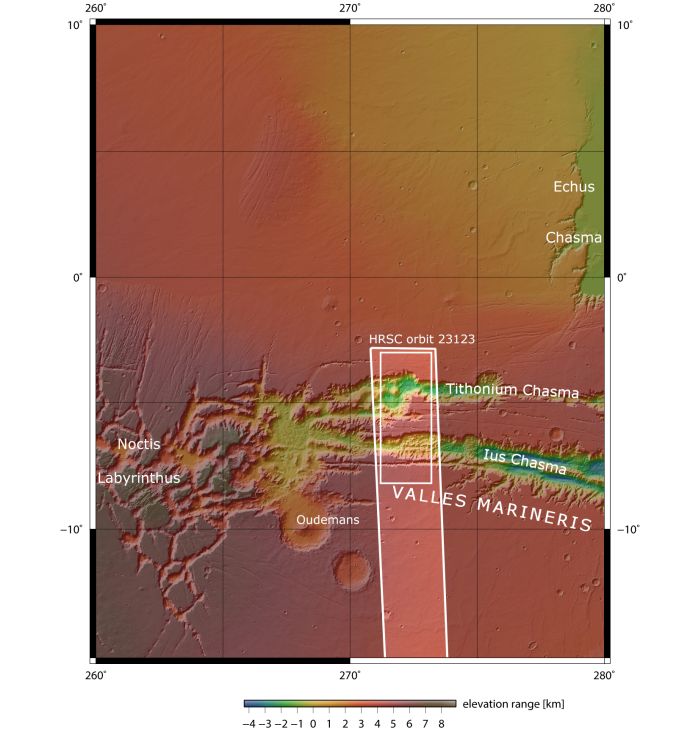
(Science Alert) he biggest known canyon in the Solar System is getting the star treatment in new images from the European Space Agency's Mars Express orbiter.

As it whooshed by in Martian orbit, the spacecraft captured a pair of gouges in the planet's surface that make up part of the Valles Marineris, a system of canyons known as the Grand Canyon of Mars.

The Martian Grand Canyon, however, makes the Earth version seem like a canyon for ants.

At 4,000 kilometers (2,485 miles) long and 200 miles wide, Valles Marineris is almost 10 times longer and 20 times wider than the vast canyon system found in North America. Earth has nothing that comes even close to comparing to Valles Marineris, which makes the feature intensely interesting to planetary scientists.

The segment images by Mars Express include sections of two chasmata, Ius on the left and Tithonium on the right. Close study of the details of these incredible natural structures can help scientists understand Mars' geology and geological history.
Read more here: https://www.sciencealert.com/a-spacecr ... d-canyon

Image
The location of the two chasmata.
NASA/MGS/MOLA Science Team
Don't mourn, organize.

-Joe Hill
weatheriscool
Posts: 24488
Joined: Sun May 16, 2021 6:16 pm
Contact:

Re: Mars News and Discussions

Post by weatheriscool »

NASA marks 25 years since Pathfinder touched down on Mars
https://phys.org/news/2022-07-nasa-year ... -mars.html
by Jet Propulsion Laboratory
When a daring team of engineers put a lander and the first rover on the Red Planet a quarter century ago, they changed how the world explores.

On a July evening in 1997, Jennifer Trosper drove home from work at NASA's Jet Propulsion Laboratory holding a picture of the Martian surface to her steering wheel. Earlier that day, the agency's Pathfinder mission had landed on Mars encased in protective air bags and taken the image of the red, rubbly landscape that transfixed her.

"As I was on the freeway, I had that image on my steering wheel and kept looking at it," Trosper said, reminiscing. "I probably should have been looking more closely at the road."
NASA’s Sojourner Mars rover is seen on the 22nd Martian day, or sol, of the Pathfinder mission near a location nicknamed “The Dice” (three small rocks behind the rover) and a rock nicknamed “Yogi.” Credit: NASA/JPL

Given that Trosper was the mission's flight director, her excitement was understandable. Not only had Pathfinder landed on Mars, a feat all its own, but it had done so at a fraction of the cost and time required of previous Mars missions. And, the next day, the team was set to change the course of Mars exploration forever: They had sent instructions to Pathfinder to extend a ramp so that history's first Mars rover, Sojourner, could roll down onto the planet's surface.
weatheriscool
Posts: 24488
Joined: Sun May 16, 2021 6:16 pm
Contact:

Re: Mars News and Discussions

Post by weatheriscool »

10 years since landing, NASA's Curiosity Mars rover still has drive
https://phys.org/news/2022-08-years-nas ... rover.html
by Jet Propulsion Laboratory
Despite signs of wear, the intrepid spacecraft is about to start an exciting new chapter of its mission as it climbs a Martian mountain.

Ten years ago today, a jetpack lowered NASA's Curiosity rover onto the Red Planet, beginning the SUV-size explorer's pursuit of evidence that, billions of years ago, Mars had the conditions needed to support microscopic life.

Since then, Curiosity has driven nearly 18 miles (29 kilometers) and ascended 2,050 feet (625 meters) as it explores Gale Crater and the foothills of Mount Sharp within it. The rover has analyzed 41 rock and soil samples, relying on a suite of science instruments to learn what they reveal about Earth's rocky sibling. And it's pushed a team of engineers to devise ways to minimize wear and tear and keep the rover rolling: In fact, Curiosity's mission was recently extended for another three years, allowing it to continue among NASA's fleet of important astrobiological missions.
User avatar
caltrek
Posts: 9280
Joined: Mon May 17, 2021 1:17 pm

Re: Mars News and Discussions

Post by caltrek »

NASA’s Perseverance Rover Picks Up Rocks That May Hold Secrets to Life on Mars
by Alanna Madden
August 25, 2022

Introduction:
(Courthouse News) — Since touching down on Mars in February 2021, NASA's car-sized Perseverance rover has driven 1.8 miles, transmitted thousands of images and collected around 35 rock and soil samples that could reveal whether life existed on the red planet.

In a study published Thursday in the journal Science, NASA researchers document the surface of Mars within Jezero crater, a large circular formation thought to be a previous lake with, potentially, signs of ancient microbial life.

“We went to the location of Jezero crater because we can see from orbit clear indication that there was once a very large lake here,” said lead author Ken Farley, who heads a team of 550 scientists for NASA’s Mars 2020 mission. How big of a lake, you ask? Roughly 25 miles in diameter and 328 feet deep. “It’s a very big lake, even by Earth standards,” said Farley.

NASA landed on the floor the crater expecting to find sedimentary rocks that might indicate whether organisms lived in the lake. But what Farley’s team found was igneous and olivine-rich rocks — and lots of it.

Igneous rocks are crystalized by high-temperature magma and they are significant to researchers because they are datable. But to do so, NASA must first develop a way to retrieve these rock samples from Perseverance — which utilizes a drill to collect samples within sterile, sealed tubes — and bring them back to Earth.
Read more here: https://www.courthousenews.com/nasas-p ... -on-mars/
Don't mourn, organize.

-Joe Hill
User avatar
caltrek
Posts: 9280
Joined: Mon May 17, 2021 1:17 pm

Re: Mars News and Discussions

Post by caltrek »

First Underground Radar Images from Mars Perseverance Rover Reveal Some Surprises
August 25, 2022

Introduction:
(EurekAlert) After a tantalizing year-and-a-half wait since the Mars Perseverance Rover touched down on our nearest planetary neighbor, new data is arriving — and bringing with it a few surprises.

The rover, which is about the size of car and carries seven scientific instruments, has been probing Mars’ 30-mile-wide Jezero crater, once the site of a lake and an ideal spot to search for evidence of ancient life and information about the planet’s geological and climatic past.

In a paper published today in the journal Science Advances, a research team led by UCLA and the University of Oslo reveals that rock layers beneath the crater’s floor, observed by the rover’s ground-penetrating radar instrument, are unexpectedly inclined. The slopes, thicknesses and shapes of the inclined sections suggest they were either formed by slowly cooling lava or deposited as sediments in the former lake.

Perseverance is currently exploring a delta on the western edge of the crater, where a river once fed the lake, leaving behind a large deposit of dirt and rocks it picked up along its course. As the rover gathers more data, the researchers hope to clear up the complex history of this part of the Red Planet.

“We were quite surprised to find rocks stacked up at an inclined angle,” said David Paige, a UCLA professor of Earth, planetary and space sciences and one of the lead researchers on the Radar Imager for Mars Subsurface Experiment, or RIMFAX. “We were expecting to see horizontal rocks on the crater floor. The fact that they are tilted like this requires a more complex geologic history. They could have been formed when molten rock rose up towards the surface, or, alternatively, they could represent an older delta deposit buried in the crater floor.”
Read more here: https://www.eurekalert.org/news-releases/962925
Don't mourn, organize.

-Joe Hill
User avatar
wjfox
Site Admin
Posts: 13586
Joined: Sat May 15, 2021 6:09 pm
Location: Essex, UK
Contact:

Re: Mars News and Discussions

Post by wjfox »

User avatar
caltrek
Posts: 9280
Joined: Mon May 17, 2021 1:17 pm

Re: Mars News and Discussions

Post by caltrek »

Talk About Moxie: Machine Has Success Creating Oxygen on Mars
by Kendra Leon
August 31, 2022

Introduction:
(Courthouse News) — A lunchbox-sized instrument can create a small tree’s worth of oxygen on Mars.

Researchers from multiple institutions, including NASA’s Jet Propulsion Laboratory, collaborated the study published Wednesday in Science Advances focused on the MIT-led Mars Oxygen In-Situ Resource Utilization Experiment, or MOXIE.

MOXIE’s small size allowed it to fit on NASA’s Perseverance rover and to run for short periods of time. To reduce thermal stress, MOXIE's startup and shutdown times depend on the rover’s exploration schedule and mission responsibilities.

Touching down with the rover on the red planet in February 2021, researchers report that by the end of that same year MOXIE had produced oxygen on seven experimental runs. According to the study, each run tested a variety of atmospheric conditions such as day and night through Mars’ different seasons.

“The atmosphere of Mars is far more variable than Earth,” MOXIE deputy principal investigator Jeffrey Hoffman, a professor in MIT’s Department of Aeronautics and Astronautics, said in a statement accompanying the study. “The density of the air can vary by a factor of two through the year, and the temperature can vary by 100 degrees. One objective is to show we can run in all seasons.”


Read more here: https://www.courthousenews.com/talk-ab ... -on-mars/
Don't mourn, organize.

-Joe Hill
User avatar
caltrek
Posts: 9280
Joined: Mon May 17, 2021 1:17 pm

Re: Mars News and Discussions

Post by caltrek »

NASA’s Insight Lander Finds Tropical Mars is Dry
by Jeff Hecht
August 26 , 2022

Introduction:
(Sky & Telescope) Evidence for water ice exists at the poles of Mars and even at mid-latitudes, but new evidence suggests “tropical” Mars (near the equator) is dry. The find has implications for past habitability and future human missions to Mars.

Hardly any traces of the vanished oceans of Mars remain in the Red Planet's tropics. The velocity of seismic waves recorded by the seismometer in NASA's InSight lander reveal few traces of the subsurface ice that has been found at higher latitudes, says oceanographer Vashan Wright (University of California, San Diego). Wright led the study published August 9th in Geophysical Research Letters.

We now know ancient ocean and rivers sculpted the Martian landscape — and that some of this water remains in the form of kilometers-deep ice atop the poles. Water ice is not stable at lower latitudes, but in recent decades researchers have found some ice, which froze during colder epochs, preserved under the surface. Water that evaporated can also leave behind deposits of clays and soluble minerals on ancient rocks; the Osiris-Rex spacecraft discovered similar traces of past water on asteroid 101955 Bennu.

Hidden ices and minerals deposited by water can offer important insight into the history of Mars and the possibility that life might once have evolved on it. NASA is also searching for existing ice and water deposits to help supply future human expeditions to the Red Planet. Although ice is abundant at the poles, conditions there are too harsh for humans, so NASA is focusing on lower latitudes where ice may be below the surface.

Last year, the Mars Subsurface Water Ice Mapping (SWIM) project reported that shallow ice deposits are plentiful at high and mid latitudes. The team gathered indirect evidence using neutron spectroscopy, heat-flow measurements, geomorphic analysis, radar mapping, and radar composition analysis. The most definitive evidence came from recent impacts that exposed bright white areas of previously buried ice.
Read more here: https://skyandtelescope.org/astronomy- ... s-is-dry/
Don't mourn, organize.

-Joe Hill
weatheriscool
Posts: 24488
Joined: Sun May 16, 2021 6:16 pm
Contact:

Re: Mars News and Discussions

Post by weatheriscool »

NASA's Perseverance rover investigates geologically rich Mars terrain
https://phys.org/news/2022-09-nasa-pers ... -rich.html
by Jet Propulsion Laboratory
NASA's Perseverance rover is well into its second science campaign, collecting rock-core samples from features within an area long considered by scientists to be a top prospect for finding signs of ancient microbial life on Mars. The rover has collected four samples from an ancient river delta in the Red Planet's Jezero Crater since July 7, bringing the total count of scientifically compelling rock samples to 12.

"We picked the Jezero Crater for Perseverance to explore because we thought it had the best chance of providing scientifically excellent samples—and now we know we sent the rover to the right location," said Thomas Zurbuchen, NASA's associate administrator for science in Washington. "These first two science campaigns have yielded an amazing diversity of samples to bring back to Earth by the Mars Sample Return campaign."

Twenty-eight miles (45 kilometers) wide, Jezero Crater hosts a delta—an ancient fan-shaped feature that formed about 3.5 billion years ago at the convergence of a Martian river and a lake. Perseverance is currently investigating the delta's sedimentary rocks, formed when particles of various sizes settled in the once-watery environment. During its first science campaign, the rover explored the crater's floor, finding igneous rock, which forms deep underground from magma or during volcanic activity at the surface.
weatheriscool
Posts: 24488
Joined: Sun May 16, 2021 6:16 pm
Contact:

Re: Mars News and Discussions

Post by weatheriscool »

The number of ancient Martian lakes might have been dramatically underestimated by scientists
https://phys.org/news/2022-09-ancient-m ... tists.html
by The University of Hong Kong
Lakes are bodies of water fed by rainfall, snowmelt, rivers and groundwater, through which, Earth is teeming with life. Lakes also contain critical geologic records of past climates. Though Mars is a frozen desert today, scientists have shown that Mars contains evidence of ancient lakes that existed billions of years ago, which could contain evidence for ancient life and climate conditions on the red planet. Through a meta-analysis of years of satellite data that shows evidence for lakes on Mars, Dr. Joseph MICHALSKI, a geologist in the Department of Earth Sciences, The University of Hong Kong (HKU) proposed that scientists might have dramatically underestimated the number of ancient Martian lakes that once existed.

Michalski and the international team recently published their results in Nature Astronomy, which describe a global analysis of ancient Martian lakes. "We know of approximately 500 ancient lakes deposited on Mars, but nearly all the lakes we know about are larger than 100 km2," explains Michalski. "But on Earth, 70% of the lakes are smaller than this size, occurring in cold environments where glaciers have retreated. These small-sized lakes are difficult to identify on Mars by satellite remote sensing, but many small lakes probably did exist. It is likely that at least 70% of Martian lakes have yet to be discovered." Scientists monitor these small lakes on Earth in order to understand climate change. The missing small lakes on Mars might also contain critical information about past climates.
weatheriscool
Posts: 24488
Joined: Sun May 16, 2021 6:16 pm
Contact:

Re: Mars News and Discussions

Post by weatheriscool »

Mars is mighty in first Webb observations of Red Planet
https://phys.org/news/2022-09-mars-migh ... lanet.html
by Margaret W. Carruthers, Space Telescope Science Institute

NASA's James Webb Space Telescope captured its first images and spectra of Mars Sept. 5. The telescope, an international collaboration with ESA (European Space Agency) and CSA (Canadian Space Agency), provides a unique perspective with its infrared sensitivity on our neighboring planet, complementing data being collected by orbiters, rovers, and other telescopes.

Webb's unique observation post nearly a million miles away at the sun-Earth Lagrange point 2 (L2) provides a view of Mars's observable disk (the portion of the sunlit side that is facing the telescope). As a result, Webb can capture images and spectra with the spectral resolution needed to study short-term phenomena like dust storms, weather patterns, seasonal changes, and in a single observation, processes that occur at different times (daytime, sunset, and nighttime) of a Martian day.

Because it is so close, the Red Planet is one of the brightest objects in the night sky in terms of both visible light, which human eyes can see, and the infrared light that Webb is designed to detect. This poses special challenges to the observatory, which was built to detect the extremely faint light of the most distant galaxies in the universe. Webb's instruments are so sensitive that without special observing techniques, the bright infrared light from Mars is blinding, causing a phenomenon known as "detector saturation." Astronomers adjusted for Mars's extreme brightness by using very short exposures, measuring only some of the light that hit the detectors, and applying special data analysis techniques.
Post Reply