Exoplanets – worlds of other suns

Post Reply
weatheriscool
Posts: 24487
Joined: Sun May 16, 2021 6:16 pm
Contact:

Re: Exoplanets – worlds of other suns

Post by weatheriscool »

Team finds younger exoplanets are better candidates when looking for other Earths
https://phys.org/news/2022-05-team-youn ... arths.html
by Southwest Research Institute

As the scientific community searches for worlds orbiting nearby stars that could potentially harbor life, new Southwest Research Institute-led research suggests that younger rocky exoplanets are more likely to support temperate, Earth-like climates.

In the past, scientists have focused on planets situated within a star's habitable zone, where it is neither too hot nor too cold for liquid surface water to exist. However, even within this so-called "Goldilocks zone," planets can still develop climates inhospitable to life. Sustaining temperate climates also requires a planet have sufficient heat to power a planetary-scale carbon cycle. A key source of this energy is the decay of the radioactive isotopes of uranium, thorium and potassium. This critical heat source can power a rocky exoplanet's mantle convection, a slow creeping motion of the region between a planet's core and crust that eventually melts at the surface. Surface volcanic degassing is a primary source of CO2 to the atmosphere, which helps keep a planet warm. Without mantle degassing, planets are unlikely to support temperate, habitable climates like the Earth's.
weatheriscool
Posts: 24487
Joined: Sun May 16, 2021 6:16 pm
Contact:

Re: Exoplanets – worlds of other suns

Post by weatheriscool »

Kepler and the Behemoth: Three Mini-Neptunes in a 40 Million Year Old Association
https://arxiv.org/abs/2205.01112
Stellar positions and velocities from Gaia are yielding a new view of open cluster dispersal. Here we present an analysis of a group of stars spanning Cepheus to Hercules, hereafter the Cep-Her complex. The group includes four Kepler Objects of Interest: Kepler-1643 b (2.32±0.14 Earth-radii, 5.3 day orbital period), KOI-7368 b (2.22±0.12 Earth-radii, 6.8 days), KOI-7913 Ab (2.34±0.18 Earth-radii, 24.2 days), and Kepler-1627 Ab (3.85±0.11 Earth-radii, 7.2 days). The latter Neptune-sized planet is in part of the Cep-Her complex called the δ Lyr cluster (Bouma et al. 2022). Here we focus on the former three systems, which are in other regions of the association. Based on kinematic evidence from Gaia, stellar rotation periods from TESS, and spectroscopy, these three objects are also approximately 40 million years (Myr) old. More specifically, we find that Kepler-1643 is 46+9−7 Myr old, based on its membership in a dense sub-cluster of the complex called RSG-5. KOI-7368 and KOI-7913 are 36+10−8 Myr old, and are in a diffuse region that we call CH-2. Based on the transit shapes and high resolution imaging, all three objects are most likely planets, with false positive probabilities of 6×10⁻⁹, 4×10⁻³, and 1×10⁻⁴ for Kepler-1643, KOI-7368, and KOI-7913 respectively. These planets demonstrate that mini-Neptunes with sizes of approximately 2 Earth radii exist at ages of 40 million years.
weatheriscool
Posts: 24487
Joined: Sun May 16, 2021 6:16 pm
Contact:

Re: Exoplanets – worlds of other suns

Post by weatheriscool »

Dynamics of ocean worlds likely controlled by their rotation
https://phys.org/news/2022-05-dynamics- ... ation.html
by Morgan Rehnberg, American Geophysical Union
Discovering that many of the large moons in the outer solar system may host significant subsurface oceans of liquid water has been a key advance in planetary science. These moons represent some of the most promising habitats for life beyond Earth, but their hidden nature makes direct study difficult.

These oceans appear to be tens or even hundreds of kilometers deep, bounded at the top by a thick, icy shell and at the bottom by a source of geothermal heating. A key element to understanding their nature is to deduce the patterns of ocean circulation, because it is the ocean that transports heat, salt, and potential biosignatures to the surface, where they could be detected by future space missions.

Although some previous studies have simulated the dynamics of subsurface oceans, those calculations have relied on parameters that are poorly constrained by observations. In a new study published in the Journal of Geophysical Research: Planets, Bire et al pursued a novel approach by casting their simulations in terms of a dimensionless number—the natural Rossby number, which is a ratio of buoyancy flux, moon rotation rate, and ocean depth—for which observational constraints do exist.
weatheriscool
Posts: 24487
Joined: Sun May 16, 2021 6:16 pm
Contact:

Re: Exoplanets – worlds of other suns

Post by weatheriscool »

Astronomers will train James Webb Telescope's high-precision spectrographs on two intriguing rocky exoplanets
https://phys.org/news/2022-05-astronome ... ision.html
by Space Telescope Science Institute
With its mirror segments beautifully aligned and its scientific instruments undergoing calibration, NASA's James Webb Space Telescope is just weeks away from full operation. Soon after the first observations are revealed this summer, Webb's in-depth science will begin.

Among the investigations planned for the first year are studies of two hot exoplanets classified as "super-Earths" for their size and rocky composition: the lava-covered 55 Cancri e and the airless LHS 3844 b. Researchers will train Webb's high-precision spectrographs on these planets with a view to understanding the geologic diversity of planets across the galaxy, and the evolution of rocky planets like Earth.

Super-hot super-earth 55 Cancri e

55 Cancri e orbits less than 1.5 million miles from its sun-like star (one twenty-fifth of the distance between Mercury and the sun), completing one circuit in less than 18 hours. With surface temperatures far above the melting point of typical rock-forming minerals, the day side of the planet is thought to be covered in oceans of lava.
weatheriscool
Posts: 24487
Joined: Sun May 16, 2021 6:16 pm
Contact:

Re: Exoplanets – worlds of other suns

Post by weatheriscool »

Super-Earth exoplanet orbiting nearby star discovered
https://phys.org/news/2022-06-super-ear ... -star.html
by Tomasz Nowakowski , Phys.org
An international team of astronomers reports the discovery of a new super-Earth exoplanet orbiting a nearby M-dwarf star known as Ross 508. The newly found alien world, which received designation Ross 508 b, turns out to be at least four times more massive than our planet. The finding was detailed in a paper published May 24 on arXiv.org.

"Super-Earths" are planets more massive than Earth but not exceeding the mass of Neptune. Although the term "super-Earth" refers only to the mass of the planet, it is also used by astronomers to describe planets bigger than Earth but smaller than the so-called "mini-Neptunes" (with a radius between two to four Earth radii).

Now, astronomers led by Hiroki Harakawa of the Subaru Telescope have discovered a new planet of the super-Earth class. Using the InfraRed Doppler (IRD) instrument on the Subaru 8.2-m telescope, they conducted radial velocity (RV) measurements of Ross 508—an M dwarf of spectral type M4.5, located some 36.5 light years away.

"We showed that the M4.5 dwarf Ross 508 has a significant RV periodicity at 10.75 days with possible aliases at 1.099 and 0.913 days. This periodicity has no counterpart in photometry or stellar activity indicators, but is well-fit by a Keplerian orbit due to a new planet, Ross 508 b," the researchers explained.

The newly found exoplanet Ross 508 b has a minimum mass of four Earth masses and orbits its host every 10.75 days at a distance of about 0.053 AU from it. According to the astronomers, this indicates an orbit-averaged insolation of about 1.4 times the Earth's value, placing this planet near the inner edge of Ross 508's habitable zone.

The exact orbital eccentricity of Ross 508 b is still unknown and further studies on this could provide important information about the planet's origin. The researchers suppose that Ross 508 b may have formed beyond the snow line (about 0.16 AU) and undergone inward Type I migration. They noted that even if the eccentricity of a migrating alien world is initially high, it can be damped by the force exerted on the planet by density waves.
weatheriscool
Posts: 24487
Joined: Sun May 16, 2021 6:16 pm
Contact:

Re: Exoplanets – worlds of other suns

Post by weatheriscool »

User avatar
caltrek
Posts: 9280
Joined: Mon May 17, 2021 1:17 pm

Re: Exoplanets – worlds of other suns

Post by caltrek »

Don't mourn, organize.

-Joe Hill
weatheriscool
Posts: 24487
Joined: Sun May 16, 2021 6:16 pm
Contact:

Re: Exoplanets – worlds of other suns

Post by weatheriscool »

A new third planet and the dynamical architecture of the HD33142 planetary system
Based on recently-taken and archival HARPS, FEROS and HIRES radial velocities (RVs), we present evidence for a new planet orbiting the first ascent red giant star HD33142 (with an improved mass estimate of 1.52±0.03 M⊙), already known to host two planets. We confirm the Jovian mass planets HD33142 b and c with periods of Pb = 330.0+0.4−0.4 d and Pc = 810.2+3.8−4.2 d and minimum dynamical masses of mbsini = 1.26+0.05−0.05 MJup and mcsini = 0.89+0.06−0.05 MJup. Furthermore, our periodogram analysis of the precise RVs shows strong evidence for a short-period Doppler signal in the residuals of a two-planet Keplerian fit, which we interpret as a third, Saturn-mass planet with mdsini = 0.20+0.02−0.03 MJup on a close-in orbit with an orbital period of Pd =89.9+0.1−0.1 d. We study the dynamical behavior of the three-planet system configurations with an N-body integration scheme, finding it long-term stable with the planets alternating between low and moderate eccentricities episodes. We also performed N-body simulations, including stellar evolution and second-order dynamical effects such as planet-stellar tides and stellar mass-loss on the way to the white dwarf phase. We find that planets HD33142 b, c and d are likely to be engulfed near the tip of the red giant branch phase due to tidal migration. These results make the HD33142 system an essential benchmark for the planet population statistics of the multiple-planet systems found around evolved stars.
https://arxiv.org/abs/2206.03899
weatheriscool
Posts: 24487
Joined: Sun May 16, 2021 6:16 pm
Contact:

Re: Exoplanets – worlds of other suns

Post by weatheriscool »

TESS Hunt for Young and Maturing Exoplanets (THYME) VII : Membership, rotation, and lithium in the young cluster Group-X and a new young exoplanet
https://arxiv.org/abs/2206.06254
Quote :
The public, all-sky surveys Gaia and TESS provide the ability to identify new young associations and determine their ages. These associations enable study of planetary evolution by providing new opportunities to discover young exoplanets. A young association was recently identified by Tang et al. and F{ü}rnkranz et al. using astrometry from Gaia (called "Group-X" by the former). In this work, we investigate the age and membership of this association; and we validate the exoplanet TOI 2048 b, which was identified to transit a young, late G dwarf in Group-X using photometry from TESS. We first identified new candidate members of Group-X using Gaia EDR3 data. To infer the age of the association, we measured rotation periods for candidate members using TESS data. The clear color--period sequence indicates that the association is the same age as the 300±50 Myr-old NGC 3532. We obtained optical spectra for candidate members that show lithium absorption consistent with this young age. Further, we serendipitously identify a new, small association nearby Group-X, which we call MELANGE-2. Lastly, we statistically validate TOI 2048 b, which is 2.1±0.2 \rearth\ radius planet on a 13.8-day orbit around its 300 Myr-old host star.
weatheriscool
Posts: 24487
Joined: Sun May 16, 2021 6:16 pm
Contact:

Re: Exoplanets – worlds of other suns

Post by weatheriscool »

Gaia DR3 is out! And we've got extrasolar planets. 215 from transit, 74 from astrometry, 10 from RV.


NAMING OF GAIA'S EXOPLANET CANDIDATES
The naming of the exoplanet candidates follows these three methods:

Astrometric detection: Gaia-ASOI-#
Photometric transit: Gaia-TROI-#
Radial velocity: Gaia-RVOI-#


Link to detected planets and candidates.
https://www.cosmos.esa.int/documents/29 ... 4699871498
User avatar
wjfox
Site Admin
Posts: 13585
Joined: Sat May 15, 2021 6:09 pm
Location: Essex, UK
Contact:

Re: Exoplanets – worlds of other suns

Post by wjfox »

Discovery Alert: Two New, Rocky Planets in the Solar Neighborhood

June 15, 2022

The discovery: NASA’s TESS mission has found two rocky worlds orbiting the relatively bright, red dwarf star HD 260655, only 33 light-years away. The new planets, HD 260655 b and HD 260655 c, are among the closest-known rocky planets yet found outside our solar system that astronomers can observe crossing the faces of their stars.

Key facts: Using NASA’s orbiting planet hunter, the Transiting Exoplanet Survey Satellite (TESS), scientists discovered sibling planets in Earth’s size-range that are prime candidates for atmospheric investigation. And the discovery comes at an ideal moment: The giant James Webb Space Telescope, soon to deliver its first science images, can examine the atmospheres of exoplanets – planets beyond our solar system – to search for water, carbon molecules and other components. Learning more about the atmospheres of rocky planets will help scientists understand the formation and development of worlds like our own.

Details: Both planets are “super-Earths” – terrestrial worlds like ours, only bigger. Planet b is about 1.2 times as big around as Earth, planet c 1.5 times. In this case, however, neither world is likely to support life. The temperature on planet b, nearest to the star, is estimated at 816 degrees Fahrenheit (435 Celsius), planet c 543 Fahrenheit (284 Celsius), though actual temperature depends on the presence and nature of possible atmospheres.

Still, the science team that discovered the planets says they are well worth further investigation. At 33 light-years, they are relatively close to us, and their star, though smaller than ours, is among the brightest in its class. These and other factors raise the likelihood that the Webb telescope, and perhaps even the Hubble Space Telescope, could capture data from the star’s light shining through these planets’ atmospheres. Such light can be spread into a spectrum, revealing the fingerprints of molecules within the atmosphere itself.

Both planets rate in the top 10 candidates for atmospheric characterization among all terrestrial exoplanets so far discovered, the team says. That places them in the same category as one of the most famous planetary systems: the seven roughly Earth-sized planets around a star called TRAPPIST-1. The TRAPPIST-1 worlds and several other rocky exoplanets are already on the list of observation targets for the Webb telescope.

https://exoplanets.nasa.gov/news/1706/d ... ghborhood/


Image
weatheriscool
Posts: 24487
Joined: Sun May 16, 2021 6:16 pm
Contact:

Re: Exoplanets – worlds of other suns

Post by weatheriscool »

Kepler-1928 b...
https://arxiv.org/abs/2206.08383
Transit Hunt for Young and Maturing Exoplanets (THYME) VIII: a Pleiades-age association harboring two transiting planetary systems from Kepler
Young planets provide a window into the early stages and evolution of planetary systems. Ideal planets for such research are in coeval associations, where the parent population can precisely determine their ages. We describe a young association (MELANGE-3) in the Kepler field, which harbors two transiting planetary systems (Kepler-1928 and Kepler-970). We identify MELANGE-3 by searching for kinematic and spatial overdensities around Kepler planet hosts with high levels of lithium. To determine the age and membership of MELANGE-3, we combine new high-resolution spectra with archival light curves, velocities, and astrometry of stars near Kepler-1928 spatially and kinematically. We use the resulting rotation sequence, lithium levels, and color-magnitude diagram of candidate members to confirm the presence of a coeval 105±10 Myr population. MELANGE-3 may be part of the recently identified Theia 316 stream. For the two exoplanet systems, we revise the stellar and planetary parameters, taking into account the newly-determined age. Fitting the 4.5 yr Kepler light curves, we find that Kepler-1928 b is a 2.0±0.1R⊕ planet on a 19.58-day orbit, while Kepler-970 b is a 2.8±0.2R⊕ planet on a 16.73-day orbit. Kepler-1928 was previously flagged as an eclipsing binary, which we rule out using radial velocities from APOGEE and statistically validate the signal as planetary in origin. Given its overlap with the Kepler field, MELANGE-3 is valuable for studies of spot evolution on year timescales, and both planets contribute to the growing work on transiting planets in young stellar associations.
User avatar
caltrek
Posts: 9280
Joined: Mon May 17, 2021 1:17 pm

Re: Exoplanets – worlds of other suns

Post by caltrek »

I suppose that the following article fits this thread, although you might need to think of the exoplanets in the past tense. Even then, exoplanets are just one possible explanation of the observed events.

A Strange White Dwarf With a Chaotic Past
by Govert Schilling
June 16, 2022

Introduction:
(Sky & Telescope) What’s stranger than stones raining down onto a hot white dwarf star? Adding chunks of ice to the mix.

G238-44, a puny white dwarf at a distance of 86 light-years, is accreting two very different kind of objects simultaneously, Ted Johnson (University of California, Los Angeles) told the 240th meeting of the American Astronomical Society in Pasadena, California, on Wednesday. “This has never been observed before,” he says.

White dwarfs are the compact remains of low-mass stars that first balloon into red giants — a fate that awaits our own Sun some 5 billion years from now. The red giant phase wreaks havoc with orderly planetary systems. Close-in planets may be devoured, while the orbits of more distant worlds become jumbled.

After the giant star blows away its outer layers into a planetary nebula, a roughly Earth-size (but still solar mass) white dwarf remains. Observations of many white dwarfs show signs of atmospheric “pollution”: unexpected amounts of elements heavier than helium. Their existence indicates that when collisions disrupt the orbits of asteroid-like bodies in the white dwarf system, their rocky debris rains down onto the star.

So what’s so strange about G238-44? It’s the chemical composition of the pollution on its surface, as measured by NASA’s Far Ultraviolet Spectroscopic Explorer (FUSE), the Keck Telescope in Hawai’i, and the Hubble Space Telescope. The relative abundances of 10 heavy elements (carbon, nitrogen, oxygen, magnesium, aluminum, silicon, phosphorus, sulfur, calcium, and iron) don’t match the composition of any known solar system object.
Read more here: https://skyandtelescope.org/astronomy- ... aotic-past
Don't mourn, organize.

-Joe Hill
weatheriscool
Posts: 24487
Joined: Sun May 16, 2021 6:16 pm
Contact:

Re: Exoplanets – worlds of other suns

Post by weatheriscool »

Long-term liquid water also on non-Earth-like planets?
https://phys.org/news/2022-06-long-term ... anets.html
by University of Bern
Life on Earth began in the oceans. In the search for life on other planets, the potential for liquid water is therefore a key ingredient. To find it, scientists have traditionally looked for planets similar to our own. Yet, long-term liquid water does not necessarily have to occur under similar circumstances as on Earth. Researchers of the University of Bern and the University of Zurich, who are members of the National Centre of Competence in Research (NCCR) PlanetS, report in a study published in the journal Nature Astronomy, that favorable conditions might even occur for billions of years on planets that barely resemble our home planet at all.

Primordial greenhouses

"One of the reasons that water can be liquid on Earth is its atmosphere," study co-author Ravit Helled, Professor of Theoretical Astrophysics at the University of Zurich and a member of the NCCR PlanetS explains. "With its natural greenhouse effect, it traps just the right amount of heat to create the right conditions for oceans, rivers and rain," says the researcher.

Earth's atmosphere used to be very different in its ancient history, however. "When the planet first formed out of cosmic gas and dust, it collected an atmosphere consisting mostly of Hydrogen and Helium—a so-called primordial atmosphere," Helled points out. Over the course of its development, however, Earth lost this primordial atmosphere.
weatheriscool
Posts: 24487
Joined: Sun May 16, 2021 6:16 pm
Contact:

Re: Exoplanets – worlds of other suns

Post by weatheriscool »

Update on the possible directly imaged planet candidate at Alpha Cen A. Not confirmation, but an independent analysis of the data also detects it.

Efficiently combining Alpha CenA multi-epoch high-contrast imaging data. Application of K-Stacker to the 80 hrs NEAR campaign
https://arxiv.org/abs/2207.02137
weatheriscool
Posts: 24487
Joined: Sun May 16, 2021 6:16 pm
Contact:

Re: Exoplanets – worlds of other suns

Post by weatheriscool »

There's a program with JWST+MIRI coming soon, may be a planet will be confirmed ?

https://www.stsci.edu/jwst/phase2-public/1618.pdf
weatheriscool
Posts: 24487
Joined: Sun May 16, 2021 6:16 pm
Contact:

Re: Exoplanets – worlds of other suns

Post by weatheriscool »

NASA helps decipher how some distant planets have clouds of sand
Image
by Jet Propulsion Laboratory
https://phys.org/news/2022-07-nasa-deci ... louds.html
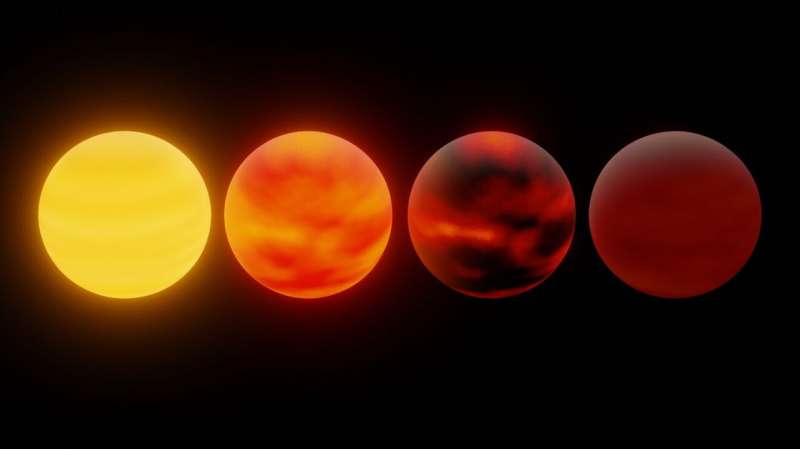
Most clouds on Earth are made of water, but beyond our planet they come in many chemical varieties. The top of Jupiter's atmosphere, for example, is blanketed in yellow-hued clouds made of ammonia and ammonium hydrosulfide. And on worlds outside our solar system, there are clouds composed of silicates, the family of rock-forming minerals that make up over 90% of Earth's crust. But researchers haven't been able to observe the conditions under which these clouds of small dust grains form.

A new study appearing in the Monthly Notices of the Royal Astronomical Society provides some insight: The research reveals the temperature range at which silicate clouds can form and are visible at the top of a distant planet's atmosphere. The finding was derived from observations by NASA's retired Spitzer Space Telescope of brown dwarfs—celestial bodies that fall in between planets and stars—but it fits into a more general understanding of how planetary atmospheres work.
Last edited by weatheriscool on Fri Jul 15, 2022 7:02 am, edited 1 time in total.
weatheriscool
Posts: 24487
Joined: Sun May 16, 2021 6:16 pm
Contact:

Re: Exoplanets – worlds of other suns

Post by weatheriscool »

Webb reveals steamy atmosphere of distant planet in detail
https://phys.org/news/2022-07-webb-reve ... stant.html

Image
by NASA

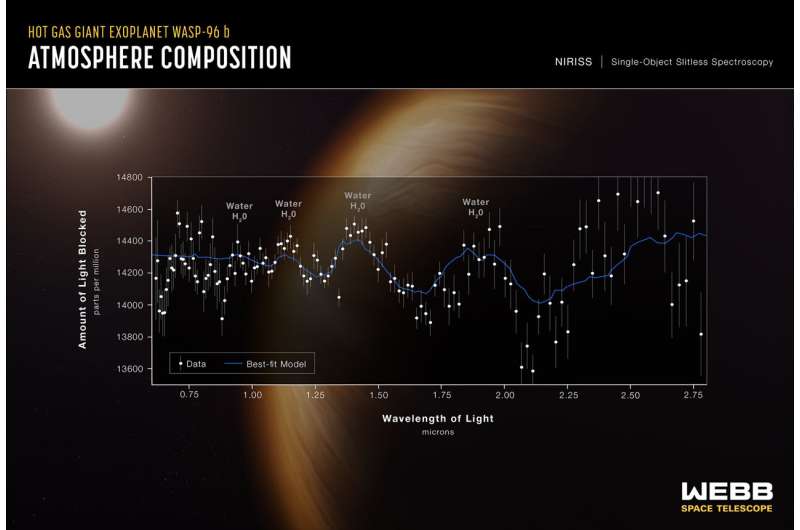
NASA's James Webb Space Telescope has captured the distinct signature of water, along with evidence for clouds and haze, in the atmosphere surrounding a hot, puffy gas giant planet orbiting a distant Sun-like star.

The observation, which reveals the presence of specific gas molecules based on tiny decreases in the brightness of precise colors of light, is the most detailed of its kind to date, demonstrating Webb's unprecedented ability to analyze atmospheres hundreds of light-years away.

While the Hubble Space Telescope has analyzed numerous exoplanet atmospheres over the past two decades, capturing the first clear detection of water in 2013, Webb's immediate and more detailed observation marks a giant leap forward in the quest to characterize potentially habitable planets beyond Earth.

WASP-96 b is one of more than 5,000 confirmed exoplanets in the Milky Way. Located roughly 1,150 light-years away in the southern-sky constellation Phoenix, it represents a type of gas giant that has no direct analog in our solar system. With a mass less than half that of Jupiter and a diameter 1.2 times greater, WASP-96 b is much puffier than any planet orbiting our Sun. And with a temperature greater than 1000°F, it is significantly hotter. WASP-96 b orbits extremely close to its Sun-like star, just one-ninth of the distance between Mercury and the Sun, completing one circuit every 3½ Earth-days.
User avatar
wjfox
Site Admin
Posts: 13585
Joined: Sat May 15, 2021 6:09 pm
Location: Essex, UK
Contact:

Re: Exoplanets – worlds of other suns

Post by wjfox »

User avatar
caltrek
Posts: 9280
Joined: Mon May 17, 2021 1:17 pm

Re: Exoplanets – worlds of other suns

Post by caltrek »

The Webb Telescope’s Search for Life in Space May take Longer than Expected
by Georgina Torbet
July 16, 2022

Introduction:
(Inverse) ONE OF THE AIMS of the James Webb Space Telescope is a profound one: To search for habitable exoplanets, where one day we could look for evidence of life beyond our own planet. But habitability is no simple matter, and finding another “Earth-like” planet might be more complicated than you imagine.

Around 40 light years away lies a remarkable star system. The TRAPPIST-1 system became world-famous five years ago when NASA announced it and several partners had discovered a whole bevy of Earth-sized planets orbiting within the habitable zone of a single star. Since then, astronomers have been desperate to learn more about these nearby worlds which could be like our planet.

Enter the James Webb Space Telescope, which will investigate the TRAPPIST-1 system in its first cycle of research programs. The research will aim to see if the planets in the TRAPPIST-1 system have atmospheres and, in the long term, to set up the process of looking for biosignatures that could indicate if life were present on any of the planets.

But there are many challenges when it comes to understanding worlds that are different from ours. Recent modeling work shows that it isn’t just a planet’s distance from its star or its composition that affects its climate: The distribution of land across a planet’s surface also significantly impacts its potential habitability.
Read more here: https://www.inverse.com/science/jwst- ... ntauri-b
Don't mourn, organize.

-Joe Hill
Post Reply