Mars News and Discussions

User avatar
caltrek
Posts: 9280
Joined: Mon May 17, 2021 1:17 pm

Re: Mars News and Discussions

Post by caltrek »

A Mars Colony Could be a Hydrogen Factory, Providing Propellant for the Inner Solar System
by Andy Tomaswick
October 28, 2021

https://www.universetoday.com/153121/a- ... ore-153121

Introduction:
(Universe Today) There are lots of potential uses for a Mars colony. It could be a research outpost, mining colony, or even a possible second home if something happens to go drastically wrong on our first one. But it could also be a potential source of what is sure to be one of the most valuable elements in the space economy – hydrogen.

A new paper from Dr. Mikhail Shubov at the University of Massachusetts Lowell discussing just such an eventuality. Hydrogen is useful in myriad applications. From creating water to exploding as rocket fuel, the most abundant element in the universe sure has many uses. The problem is it’s relatively hard to get access to in the broader solar system.

There is plenty of it in Jupiter or even the Sun, but extracting that light of a material from those enormous gravity wells is not particularly cost-effective. Smaller orbital bodies, such as asteroids, have some water that could be used as a hydrogen source, but they are not large enough to provide all of the solar system’s needs.

One particular place in the solar system does have an abundant potential source of hydrogen and a relatively weak gravity well – Mars. Admittedly the hydrogen on the Red Planet is in water form. However, hydrolysis is a fairly common reaction that requires power and has the added benefit of producing pure oxygen, which is valuable in its own right.
Conclusion:
No matter the solution selected to get the valuable rocket fuel back home, Dr. Shubov’s argument of how such a hydrogen export system could work. We’re still very far from any need for such a hydrogen market, even on Earth, let alone in space. But that will never stop some dreamers from coming up with scenarios that could fundamentally alter the economics of the solar system.

Don't mourn, organize.

-Joe Hill
weatheriscool
Posts: 24488
Joined: Sun May 16, 2021 6:16 pm
Contact:

Re: Mars News and Discussions

Post by weatheriscool »

China is planning a complex Mars sample return mission
by Andrew Jones — November 4, 2021
https://spacenews.com/china-is-planning ... n-mission/
HELSINKI — China is working on a complex mission to collect Mars rock samples and deliver them to Earth by building on the successes of recent moon and Mars missions.

The mission, likely to be named Tianwen-2, could launch as soon as 2028 with the goal of returning samples around 2030. Such a mission has never before been attempted.

A presentation from Zhang Rongqiao, chief designer of the Tianwen-1 mission, at deep space forum in Shenzhen Oct. 18 indicates a shift in mission profile from a single-launch to using two launches within the same launch window.

Earlier statements on the mission suggested using a single future Long March 9 super heavy-lift rocket. Instead the mission will likely use the established Long March 3B and Long March 5 launch vehicles.

Zhang’s presentation indicates the Long March 3B will launch a lander and ascent vehicle within an aeroshell attached to a propulsion module, with the orbiter and reentry capsule to be launched by the Long March 5.

China’s ambition to carry out the unprecedented mission has been stated previously and was included in the China National Space Administration’s plans for development across 2021-2025.

The mission is understood to have recently passed a milestone review and could, potentially, deliver to Earth the first samples of rock sampled from Mars. Such a mission would have tremendous scientific value, providing insights in the composition and geology of Mars and possibly even evidence of life such as fossils or biosignatures.

However there is a leading competitor in what could be seen as a race to Mars and back.

NASA and ESA are already collaborating to conduct a Mars sample return mission. The Perseverance rover touched down on Mars in February and in September collected the first samples for potential later delivery to Earth.
User avatar
wjfox
Site Admin
Posts: 13586
Joined: Sat May 15, 2021 6:09 pm
Location: Essex, UK
Contact:

Re: Mars News and Discussions

Post by wjfox »

User avatar
caltrek
Posts: 9280
Joined: Mon May 17, 2021 1:17 pm

Re: Mars News and Discussions

Post by caltrek »

NASA Engineers Expected Their Mars Helicopter to Crash After 5 Liftoffs. It Just Landed its 15th Flight.
by Morgan McFall-Johnsen
November 9, 2021

https://www.msn.com/en-us/news/technolo ... 8hpW6OyJTI

Introduction:
(Business Insider via MSN)
  • NASA sent its Ingenuity helicopter to Mars with no guarantee that it would successfully fly.
  • But it has flown higher, farther, and faster than engineers had hoped.
  • NASA said Ingenuity would likely crash by flight five, but it just landed safely for the 15th time.
NASA employees had a moonshot idea as they were building the Perseverance rover: What if it carried a little helicopter to Mars?

Engineers didn't know if a helicopter would work on Mars. It would be hard to lift off in air with 1% the density of Earth's atmosphere. That's the equivalent of flying at three times the height of Mount Everest. But NASA hoped to prove it was possible through a technology demonstration.
Don't mourn, organize.

-Joe Hill
weatheriscool
Posts: 24488
Joined: Sun May 16, 2021 6:16 pm
Contact:

Re: Mars News and Discussions

Post by weatheriscool »

Using blocks dropped from Perseverance and measured by InSight to learn more about Martian surface
https://phys.org/news/2021-11-blocks-pe ... rface.html
by Bob Yirka , Phys.org
An international team of space researchers has learned more about the density of the Martian surface by analyzing data from the Mars InSight lander that was received during Perseverance's descent. In their paper published in the journal Nature Astronomy, the group describes their study of seismic data from InSight as Perseverance dropped heavy blocks during its descent.

One of the ways that planetary scientists learn more about the makeup of other planets is by studying seismic activity—waves from such activity can provide clues to the density of different parts of a planet. In this new effort, the researchers noted that gathering seismic data from extraterrestrial events such as asteroids striking the surface of a planet is difficult as they are so random. But they also noted that the Perseverance mission offered a unique opportunity—as part of its descent earlier this year, the rover's landing craft dropped two tungsten blocks—each weighing approximately 77.5kg to the surface below. The blocks were dropped to help with the craft's lift-to-drag ratio.
weatheriscool
Posts: 24488
Joined: Sun May 16, 2021 6:16 pm
Contact:

Re: Mars News and Discussions

Post by weatheriscool »

NASA's Curiosity rover sends a picture postcard from Mars
https://phys.org/news/2021-11-nasa-curi ... tcard.html
by Jet Propulsion Laboratory
An artistic interpretation of Curiosity's view high up on a Martian mountain was created by mission team members who were stunned by the sweeping landscape.

NASA's Curiosity rover captured a remarkable image from its most recent perch on the side of Mars' Mount Sharp. The mission team was so inspired by the beauty of the landscape, they combined two versions of the black-and-white images from different times of the day and added colors to create a rare postcard from the Red Planet.

Curiosity captures a 360-degree view of its surroundings with its black-and-white navigation cameras each time it completes a drive. To make the resulting panorama easier to send to Earth, the rover keeps it in a compressed, low-quality format. But when the rover team saw the view from Curiosity's most recent stopping point, the scene was just too pretty not to capture it in the highest quality that the navigation cameras are capable of.

Many of the rover's most stunning panoramas are from the color Mastcam instrument, which has far higher resolution than the navigation cameras. That's why the team added colors of their own to this latest image. The blue, orange, and green tints are not what the human eye would see; instead, they represent the scene as viewed at different times of day.
User avatar
caltrek
Posts: 9280
Joined: Mon May 17, 2021 1:17 pm

Re: Mars News and Discussions

Post by caltrek »

^^^I presume that, as a product of NASA and the California Institute of Technology, the photo is public domain:

Image
At 8.30pm and 4.10pm Mars-time, Curiosity captured two separate images of the scene as it looked back down the slopes of Mount Sharp. The two mosaics were sent back to Earth, where the Curiosity team combined them, adding color to highlight how the different light conditions at the different times of day highlight landscape features.

The blue color represents the morning light, the orange represents the afternoon, and where both scenes were combined, the team tinted the image green.
Source: https://www.sciencealert.com/this-pictu ... -could-cry
Don't mourn, organize.

-Joe Hill
User avatar
caltrek
Posts: 9280
Joined: Mon May 17, 2021 1:17 pm

Re: Mars News and Discussions

Post by caltrek »

NASA Finds Ancient Lava Flows Below Mars Surface
by Passant Rabbie
November 22, 2021

https://www.inverse.com/science/mars-lava-flows-insight (See also WeatherIsCool's post of November 11, 2021)

Introduction
(Inverse) BEFORE THE NASA INSIGHT LANDER plunged through Mars’ atmosphere and parachuted its way down to the planet’s surface, scientists were already pretty familiar with the surface of Mars, but not what was on the inside.

“We've got 15 years of information about the surface, we've measured the topography, the atmosphere, the magnetic field — but we really haven't had any understanding of what it's made out of,” Bruce Banerdt, principal investigator of InSight Mission, tells Inverse. “Understanding the basic building blocks of the planet has been pretty much guesswork up until now.”

InSight was packed with a host of instruments to look deep into Mars. A new discovery found deep layers of lava flows dating back billions of years.

Mars’ ancient volcanic activity can help scientists put together the events of its potentially habitable past and understand Earth’s evolutionary past as well.

A team of planetary scientists including Barendt published their findings in a paper released Monday in the journal Nature Communications.
Don't mourn, organize.

-Joe Hill
weatheriscool
Posts: 24488
Joined: Sun May 16, 2021 6:16 pm
Contact:

Re: Mars News and Discussions

Post by weatheriscool »

Planetary scientist suggests loss of water to space on Mars may be tied to lower atmospheric factors
https://phys.org/news/2021-12-planetary ... -mars.html
by Bob Yirka , Phys.org
Planetary scientist Erdal Yiğit, with George Mason University, has published a Perspective piece in the journal Science suggesting that upper atmospheric interactions with solar wind cannot fully explain the loss of surface water on Mars. In his paper, he suggests three other major factors need to be taken into consideration as well: gravity waves, convection and dust storms.

Planetary scientists generally agree that there used to be a lot of water on the surface of Mars, and they also agree that the surface water was slowly lost to space in the form of hydrogen over the course of billions of years. Prior research has suggested that water molecules were torn apart by sunlight in the lower Martian atmosphere, resulting in the hydrogen from the water drifting off into space. In his paper, Yiğit suggests that there is still insufficient evidence to suggest that the water loss was so straightforward.

He suggests that there were other factors at play as well, noting that recent experiments have shown that water in the Martian atmosphere could have been carried directly into the upper atmosphere, where it would have been torn apart before drifting into space. This new evidence suggests things must have been happening in the lower atmosphere to push the water into the upper atmosphere. Yiğit suggests it could have been a combination of things, such as low altitude convection currents, dust storms or gravity waves.
weatheriscool
Posts: 24488
Joined: Sun May 16, 2021 6:16 pm
Contact:

Re: Mars News and Discussions

Post by weatheriscool »

Water detected below Martian surface, researchers say
The water was found using the ExoMars Trace Gas Orbiter's FREND instrument
By Julia Musto | Fox News
https://www.foxnews.com/science/water-b ... 2Q_xs5QVdQ

"Significant amounts of water" have been found beneath the surface of Mars.

The European Space Agency (ESA) and Russian space agency Roscosmos' ExoMars Trace Gas Orbiter reportedly spotted the water at the Valles Maineris canyon system.

EXISTENCE OF MARS LAKE, FLOODS CONFIRMED BY NASA'S PERSEVERANCE TEAM

In a release, ESA said that the water was detected using the Trace Gas Orbiter's (TGO) Fine Resolution Epithermal Neutron Detector (FREND) instrument, which has the ability to detect hydrogen in the uppermost meter of the planet’s soil.
User avatar
caltrek
Posts: 9280
Joined: Mon May 17, 2021 1:17 pm

Re: Mars News and Discussions

Post by caltrek »

Marsquakes Reveal the Ultra Metal Nature of the Red Planet Core
by Elana Spivack
December 26, 2021

https://www.inverse.com/science/mars-core

Introduction:
(Inverse) MARS SCIENCE DISCOVERIES can be so superficial — the search for water caches, terrestrial sampling, and other technical marvels tend to take place on the surface of the Red Planet (or a little above it). But while NASA’s Perseverance rover scoots around in Mars’s dust and gravel, there’s plenty deep within the planet itself that’s worth learning about, too. Like the fact that Mars’ inner core is perhaps the most metal place on the entire planet.

THE DISCOVERY — Earlier this year, three papers published in the journal Science confirmed that Mars’ core is made of molten metal. The finding came as a result of recording Marsquakes — the Martian equivalent of earthquakes here on Earth.

Mark Panning, the JPL project scientist for NASA’s InSight lander, and his colleagues drew from seismometer data to find the thickness and potential structure of the planet’s crust, the temperature of the planet’s mantle, and make the first direct seismological confirmation of the planet’s core — hence the trio of papers.

HOW THEY DID IT — Scientists know about Earth’s insides as a result of seismology — basically studying earthquakes and other internal rumblings as a means to peer at the processes driving them — but this method hasn’t really been an option for researchers studying other planets until very recently.

Then in 2018, a seismometer landed on Mars as part of the NASA InSight (Interior Exploration using Seismic Investigations, Geodesy and Heat Transport) mission — and it has been recording Marsquakes ever since.
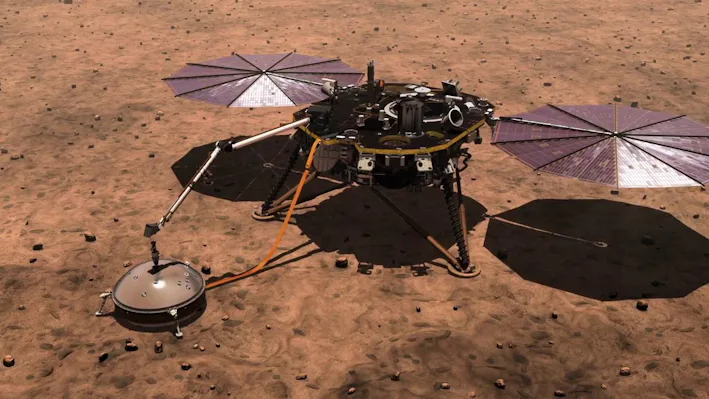
Image
InSight and its tiny “mole” heat probe friend are seen in this illustration.
NASA
Don't mourn, organize.

-Joe Hill
User avatar
raklian
Posts: 1981
Joined: Sun May 16, 2021 4:46 pm
Location: North Carolina

Re: Mars News and Discussions

Post by raklian »

:lol: :lol:

And no, your Internet connection isn't dropping.

To know is essentially the same as not knowing. The only thing that occurs is the rearrangement of atoms in your brain.
User avatar
wjfox
Site Admin
Posts: 13586
Joined: Sat May 15, 2021 6:09 pm
Location: Essex, UK
Contact:

Re: Mars News and Discussions

Post by wjfox »

weatheriscool
Posts: 24488
Joined: Sun May 16, 2021 6:16 pm
Contact:

Re: Mars News and Discussions

Post by weatheriscool »

Widespread megaripple activity found on Martian north pole area
https://phys.org/news/2022-01-widesprea ... -pole.html
by Planetary Science Institute

Megaripples, intermediate-scale bedforms caused by the action of the wind, have been studied extensively and thought to be largely inactive relics of past climates, save for a few exceptions. A new paper by Planetary Science Institute Research Scientist Matthew Chojnacki shows that abundant megaripple populations were identified across the north polar region of Mars and were found to be migrating with dunes and ripples.

Megaripples on Mars are about 1 to 2 meters tall and have 5 to 40 meter spacing, where their size falls between ripples that are about 40 centimeters tall with 1 to 5 meter spacing and dunes that can reach hundreds of meters in height with spacing of 100 to 300 meters. Whereas the megaripples' migration rates are slow in comparison (average of 0.13 meters per Earth year), some of the nearby ripples were found to migrate an average equivalent of 9.6 meters per year over just 22 days in northern summer—unprecedented rates for Mars. These high rates of sand movement help explain the megaripple activity.
User avatar
Kevin_Hall
Posts: 7
Joined: Mon Jan 17, 2022 6:25 pm

Re: Mars News and Discussions

Post by Kevin_Hall »

Ingenuity Mars Helicopter failed the 19th flight attempt, though it had managed to capture this image
"Imagination is more important than knowledge. Knowledge is limited. Imagination encircles the world", - Einstein.
weatheriscool
Posts: 24488
Joined: Sun May 16, 2021 6:16 pm
Contact:

Re: Mars News and Discussions

Post by weatheriscool »

Confirming liquid water beneath Martian south polar cap
https://phys.org/news/2022-01-liquid-be ... polar.html
by Southwest Research Institute
A Southwest Research Institute scientist measured the properties of ice-brine mixtures as cold as -145 degrees Fahrenheit to help confirm that salty water likely exists between grains of ice or sediment under the ice cap at Mars' south pole. Laboratory measurements conducted by SwRI geophysicist Dr. David Stillman support oddly bright reflections detected by the MARSIS subsurface sounding radar aboard ESA's Mars Express orbiter.

With a 130-foot antenna, MARSIS flies over the planet, bouncing radio waves over a selected area and then receiving and analyzing the echoes or reflections. Any near-surface liquid water should send a strong bright signal, whereas the radar signal for ice and rock would be much smaller.

Because conventional models assume the Mars south polar cap experiences temperatures much lower than the melting point of water, many scientists have questioned the presence of liquid water. Clay, hydrated salts and saline ices have been proposed as potential explanations for the source of the bright basal reflections. The Italian-led team investigating the proposed phenomena used previously published data, simulations and new laboratory measurements.

"Lakes of liquid water actually exist beneath glaciers in Arctic and Antarctic regions, so we have Earth analogs for finding liquid water below ice," said Stillman, a specialist in detecting water in any format—liquid, ice or absorbed—on planetary bodies and co-author of a paper describing these findings. "The exotic salts that we know exist on Mars have amazing 'antifreeze' properties allowing brines to remain liquid down to -103 degrees Fahrenheit. We studied these salts in our lab to understand how they would respond to radar."
User avatar
Lurking
Posts: 108
Joined: Mon May 17, 2021 3:26 am
Location: Internet Antiquarian

Re: Mars News and Discussions

Post by Lurking »

weatheriscool wrote: Wed Jan 26, 2022 9:01 am Confirming liquid water beneath Martian south polar cap
https://phys.org/news/2022-01-liquid-be ... polar.html
by Southwest Research Institute
Time to explore?
Internet used to be an escape from the real world.
Now the real world is an escape from internet.
User avatar
wjfox
Site Admin
Posts: 13586
Joined: Sat May 15, 2021 6:09 pm
Location: Essex, UK
Contact:

Re: Mars News and Discussions

Post by wjfox »

NASA’s MRO Finds Water Flowed on Mars Longer Than Previously Thought

Jan. 26, 2022

Caltech researchers used the Mars Reconnaissance Orbiter to determine that surface water left salt minerals behind as recently as 2 billion years ago.

Mars once rippled with rivers and ponds billions of years ago, providing a potential habitat for microbial life. As the planet’s atmosphere thinned over time, that water evaporated, leaving the frozen desert world that NASA’s Mars Reconnaissance Orbiter (MRO) studies today.

It’s commonly believed that Mars’ water evaporated about 3 billion years ago. But two scientists studying data that MRO has accumulated at Mars over the last 15 years have found evidence that reduces that timeline significantly: Their research reveals signs of liquid water on the Red Planet as recently as 2 billion to 2.5 billion years ago, meaning water flowed there about a billion years longer than previous estimates.

[...]

The discovery raises new questions about how long microbial life could have survived on Mars, if it ever formed at all. On Earth, at least, where there is water, there is life.

https://www.jpl.nasa.gov/news/nasas-mro ... ly-thought


Image
User avatar
wjfox
Site Admin
Posts: 13586
Joined: Sat May 15, 2021 6:09 pm
Location: Essex, UK
Contact:

Re: Mars News and Discussions

Post by wjfox »

User avatar
raklian
Posts: 1981
Joined: Sun May 16, 2021 4:46 pm
Location: North Carolina

Re: Mars News and Discussions

Post by raklian »

Read the thread to know what the plan is for Persevere now.

To know is essentially the same as not knowing. The only thing that occurs is the rearrangement of atoms in your brain.
Post Reply