
|
|
|
|
|
|
2200-2225
Humanity begins travelling between the stars
The first quarter of the 23rd century marks a defining shift in humanity's relationship with interstellar space. During this pivotal era, interstellar travel progresses beyond isolated probes and experimental flybys to become a sustained and increasingly ambitious enterprise. Further advances in antimatter production, storage, and propulsion transform what had once been a purely theoretical possibility into an active domain of exploration. Global antimatter output – having stood at a single gram a century earlier – rises into the tens of kilotonnes per year, enabling vastly greater power densities.*
Robotic spacecraft continue to form the backbone and numerical majority of interstellar missions during this period. Highly autonomous probes depart in growing numbers for nearby star systems, accelerating to significant fractions of light speed and carrying ever more sophisticated imaging, spectroscopy, and in-situ analysis equipment. Unlike the more lightweight probes of the 22nd century, most now hold enough antimatter to perform deceleration manoeuvres on arrival, allowing extended surveys of exoplanets, debris disks, and other features in the local stellar neighbourhood. Through these missions, the space between stars becomes an increasingly familiar and well-characterised region; no longer an abstract gulf.
Far more significant, however, is the beginning of crewed journeys beyond the Solar System – one of the most ambitious and unprecedented developments in human space exploration since the Apollo missions of the 20th century. Much has changed since those early days of space travel, when human crews relied on delicate habitats, constant resupply, and fragile biological bodies to survive beyond Earth. By the early 23rd century, advances in biotechnological augmentation, artificial intelligence, and synthetic substrates have created new forms of human presence, much more capable of enduring radiation, vacuum, and the challenge of multi-decade isolation. As such, these expeditions rarely carry unmodified biological humans. Instead, crews typically consist of heavily upgraded individuals, long-duration hibernators, synthetic humanoids, and post-biological minds operating on resilient computational substrates.
Antimatter provides the thrust, shielding, power supply, and redundancy needed to sustain conscious presence across voyages of tens of trillions of kilometres. Advanced psychological support systems – including full-immersion virtual realities, adaptive cognitive companions, and carefully designed social architectures – help crews remain mentally resilient during the long passage between stars.

In a small number of cases, these missions extend beyond exploration alone. Coordinated fleets of robotic cargo vessels precede or accompany crewed arrivals, delivering habitat modules, industrial equipment, and autonomous infrastructure. Some of these efforts aim explicitly at self-sustaining settlement, driven by ideological, scientific, or cultural motivations. Such settlements rely on closed-loop manufacturing and recycling, digital or synthetic populations, and long resupply intervals measured in decades, reducing – but not eliminating – dependence on external support.
At this stage, most remain provisional footholds rather than mature colonies – experimental attempts to establish long-term presence, testing whether human and human-derived intelligence can endure, adapt, and persist beyond the Solar System.
During the first quarter of the 23rd century, most high-value targets lie in the Sun's immediate neighbourhood, within about 15 light-years for crewed expeditions and early settlement attempts, and farther afield for robotic flybys. This keeps travel times within a humanly meaningful horizon while still reaching a surprisingly rich sample of nearby stellar environments.
Prime destinations include the Alpha Centauri system, especially Proxima Centauri b, alongside other close red dwarfs with temperate, terrestrial-class candidates such as GJ 273 (Luyten's Star),* Wolf 1061,* GJ 1002,* and Teegarden's Star.* These systems are prioritised not only for their potential habitability, but because their proximity enables repeated missions, long-baseline monitoring, and progressively deeper surveys to confirm surface conditions and the long-term stability required for any serious foothold beyond the Solar System.
Despite the revolutionary advances flowing from antimatter, interstellar travel remains a highly complex, expensive, and carefully managed affair. Dust impacts, radiation exposure, and long-term system reliability continue to impose constraints on mission design. Other, unforeseen risks elude detection by even the most sophisticated human and AI planners, revealing how little experience exists at truly interstellar scales. This leads to at least one notable mission failure.
Yet each decade brings further refinements in shielding, autonomy, and propulsion. What once seemed a speculative ambition now stands as the opening chapter of a much longer story, as humanity – in many evolving forms – begins the gradual expansion beyond its home star.

Comparison of the habitable zones within GJ 1002 and the Solar System. Credit: Alejandro Suárez Mascareño (IAC) / NASA
2200
Traditional employment is becoming obsolete
The average citizen today is likely to spend the vast majority of their time in a virtual reality of some kind. Physical society and culture still exist – but most eschew them, in favour of the Godlike abilities they can experience online. It is very rare to meet a friend or colleague in person now. You are far more likely to encounter a form of artificial intelligence today, than you are a living, breathing human. Urban centres have become eerily deserted, with most people to be found in their homes* – or in digital libraries and entertainment venues – engaged in complex simulations that offer perfect recreations of the real world. To observers from earlier centuries, these virtual environments would appear truly dazzling in their speed and complexity, with an almost unimaginable level of detail, creativity and ingenuity.
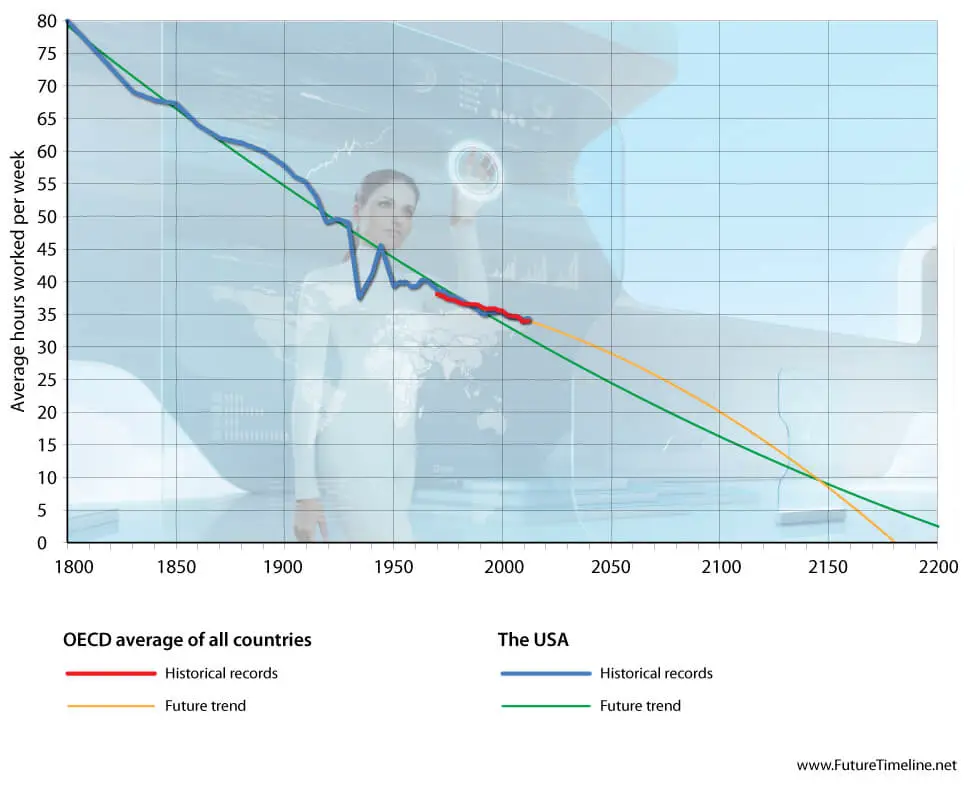
A trend which began during the Industrial Revolution has now reached its ultimate conclusion. Working hours had gradually declined over the centuries, thanks to a combination of technology, automation, improvements in working conditions and employee rights, changing labour demands and a shift in the cultural zeitgeist. By 2050, the average person in a developed country was employed for under 30 hours per week and this fell to 20 hours by 2100.* Working hours continued to fall in the 22nd century as machines – including life-like androids – took on ever more complex and sophisticated roles.
As humans began to enhance their cognitive abilities, the nature of work itself was changing. More and more people were moving from "drudge" jobs into their own personal, creative and intellectual pursuits. The line between work and play was beginning to blur. Some roles, for example, were now taking the form of extremely challenging "games", based on subjective anomalies and problems resulting from discoveries for which AI programs were unable to offer adequate explanations. Alongside this, average spending on various household items and utilities, when measured as a percentage of disposable income, was steadily declining.*
By 2200, this trend is complete. In most countries, basic items such as food, energy and clothing are now essentially free, with little or no need for the average person to work in order to acquire them. Recent advances in replicator technology provide an abundance of resources – eliminating famine, disease and the need for war. Literally everything has been automated, digitised and made easier. Take the emergency services, for example. Hospital visits are rarely required now, as practically everything a person needs in terms of treatment is available at home, or within their own body. Police forces are dominated by robots and, in any case, physical crimes have been largely eradicated. Firefighters are no longer needed, since they are robotic too, while building regulations and nanotechnology materials can prevent most fires occurring in the first place.
This process of falling employment was, of course, by no means a smooth transition. It caused profound economic and political disruption throughout the 21st and 22nd centuries. By 2200, however, the world has fully adapted to these changes and is entering a period of artistic and cultural splendour the likes of which have never been seen before. Whether as explorers in space, or designers of entire new worlds in cyberspace, humans are free to pursue their greatest dreams and personal aspirations – unshackled from the confines of traditional economic and monetary systems.*
2210
A global rewilding effort is underway
Human activity in the 19th through 22nd centuries led to catastrophic damage of the natural world. Of the approximately 30 million known species of flora and fauna, more than half were lost as a result of pollution, climate change, deforestation, mining, agriculture, urban sprawl, overfishing and hunting. Extinctions on this scale had occurred only five times previously in Earth's history.
Various wars, nuclear attacks, industrial accidents and nanotechnology experiments also played a role in making large tracts of the world essentially lifeless. Permanent damage was done to countless habitats. The Amazon rainforest, perhaps the most egregious example, shrank to become mostly desert by 2100. Meanwhile, ocean acidification caused by rising CO2 levels resulted in the decimation of coral reefs. The Arctic became devoid of ice during summer months, while melting in Greenland, Iceland, West Antarctica and elsewhere led to sea level rises of nearly two metres by the 22nd century.
All of this occurred despite an in-depth scientific knowledge of the processes underway. Long term sustainability and sensible management of resources were sacrificed in favour of short-term profits, political influence and personal gain. By the time most governments began to enact serious measures, it was already too late.
Biodiversity fell away to such an extent that, for those born in the late 20th century, the planet became unrecognisable. Younger generations growing up in this new world found themselves bitterly resentful at what their predecessors had allowed to happen. Many in Asia, Africa and South America would never get to experience a real forest, or come face to face with animals larger than a domestic dog, or witness the range of colourful and exotic species that were commonplace before – except in zoos, or virtual reality. Older members of society came to be vilified. Some nations even organised "crimes against nature" trials, leading to the conviction of former politicians and fossil fuel executives.

By the 23rd century, however, technology was advancing to a whole new magnitude of power and possibilities. Superintelligent entities were now dominating business and government, formulating policies to benefit everybody rather than the few. Meanwhile, a new and gigantic system of orbital infrastructure was being planned, allowing man to directly control the Earth's climate. Consumer devices were also becoming available that could reproduce food and other items without needing to plunder natural resources.
An idea began to emerge that quickly gained momentum. It would require an international, concerted effort over a number of generations, but it had support from across the political spectrum.
"Pre-Holocene Rewilding" had been discussed in the past and even attempted on a small scale, but global versions lacked the necessary consensus mainly due to the costs, technical challenges and social issues. However, the enormous wealth and prosperity now emerging on Earth – along with perfection of certain biotechnologies – meant that such a megaproject was becoming feasible.
In essence, it would involve the recreation of extinct animals and plants, brought back to life by a combination of fossil records, DNA samples, computer models and molecular engineering. Once grown or reproduced in sufficient numbers, these would be distributed back to their original native environments: as close as possible to how they lived prior to human industry. They would then be managed in such a way that people could cause them no harm – and vice versa.
This rewilding effort became the single largest environmental project in history. Entire deserts were transformed back into lush edens, fed by artificial rain and other forms of weather control. Vast areas of abandoned wasteland became rich ecosystems teaming with life; even ancient megafauna such as mammoths. Toxic lakes and rivers were made clean. The oceans were de-acidified, cooled and made habitable once again to countless fish, molluscs, crustaceans, and other aquatic invertebrates. Urban sprawl in cities was dramatically reversed and scaled back, with a focus instead on highly compact vertical structures.
Slowly, the Earth recovered. Humanity had reached an equilibrium with its surroundings. Though it would take another few decades, the final elements were falling into place to ensure the future preservation of biodiversity.
2220
Moore's Law is reaching its physical limit
One of the notable technological milestones of the early 23rd century is the perfection of traditional computer substrates, which are now becoming the densest and most efficient allowed by the laws of physics. This has been accomplished by super AI, working to create subatomic matrices at unimaginably tiny scales. Some of the ultra-compact designs now being used incorporate diamondoid-like materials and fractalised structures, with recursive properties for encoding information at levels far below even femtotechnology.
A computing device with a mass of one kilogram (roughly equivalent to a conventional laptop circa 2020) can today perform a maximum of 5.425 × 1050 operations per second.* This is 33 orders of magnitude greater than a state-of-the-art supercomputer of two centuries earlier.**
One of the major problems – which had vexed even the greatest of the super AI minds – was the issue of heat management. In early 21st century terms, generating such a vast amount of computational power would produce the equivalent of a thermonuclear explosion. However, technical considerations for this and other challenges were eventually solved, based on new physics.
By 2220, this form of "computronium" has been largely perfected for mainstream use, although experiments continue with certain exotic forms of matter, attempting to eke out further gains in performance and energy efficiency. Much of the Solar System is being turned into "smart" rocks, with neural networks embedded throughout asteroids and on the surfaces of moons, for example.
© Goku4501 – Dreamstime.com
2227-2247
Pluto is closer to the Sun than Neptune
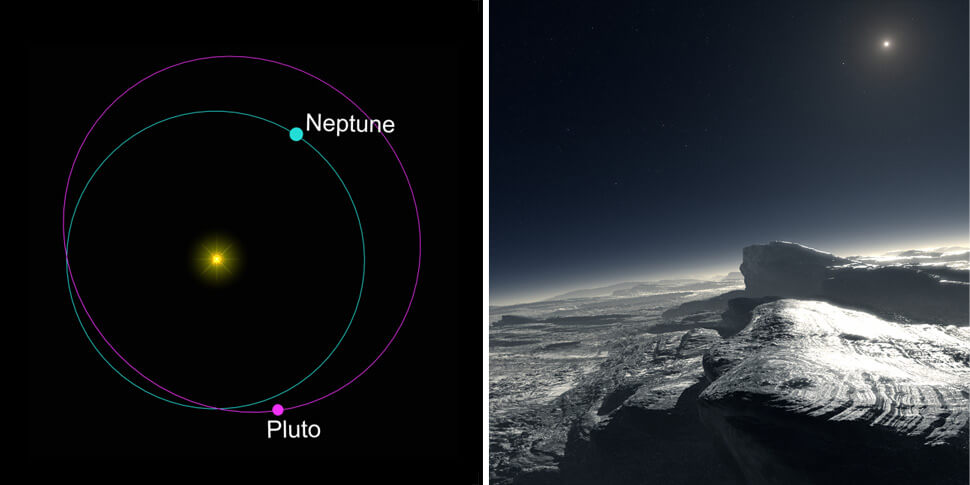
Pluto takes 248 Earth years to go once around the Sun. Its orbital characteristics are substantially different from other planets, which follow nearly circular orbits around the Sun close to a flat reference plane called the ecliptic. In contrast, Pluto's orbit is moderately inclined relative to the ecliptic and moderately eccentric (elliptical). This means that for periods of 20 years, it comes closer to the Sun than Neptune. The last time this occurred was from 1979 to 1999; it happens again between 2227 and 2247.*
As Pluto moves closer to the Sun, ice on its surface begins to warm slightly and sublime ("evaporate" from solid to gas, without passing through an intermediate liquid phase). This forms a thin atmosphere that consists mostly of nitrogen (N2), methane (CH4), and carbon monoxide (CO). At between 6.5 and 24 μbar, it is roughly one million to 100,000 times less than Earth's atmospheric pressure. As it moves away from the Sun, the gases cool and the atmosphere begins to refreeze again, eventually disappearing completely as temperatures reach a low of -240°C (-400°F).
It is now three centuries since the dwarf planet's discovery in 1930. Both Pluto and its five moons have been thoroughly explored and studied in complete detail – the focus has shifted from scientific analysis, to resource exploitation. While lacking the precious metals and minerals found in the asteroid fields and elsewhere, Pluto nevertheless holds useful quantities of frozen nitrogen and water.* In addition to surface operations, the interior of the world is being transformed with large-scale automation and robotics drilling down.
Despite Pluto's orbit appearing to cross that of Neptune when viewed from directly above, the two objects' orbits are aligned so that they can never collide or even approach closely. They are always separated by at least 17 AU. The next time Pluto moves closer to the Sun than Neptune will be in the year 2475.
Credit: NASA
2240
Christianity is fading from American culture
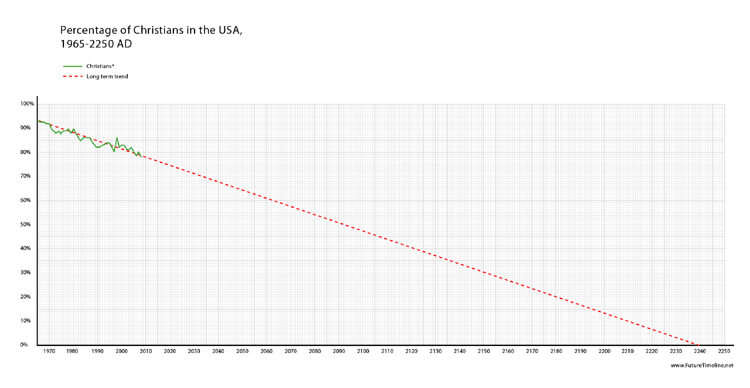
After centuries of decline, Christianity is on the verge of disappearing from American culture. The vast majority of the US population is now atheist or agnostic.* This same trend was witnessed in Europe at a far earlier date. However, religion was so deeply embedded in the American psyche that it took substantially longer to reach this stage.
Click to enlarge.
« 2199 |
⇡ Back to top ⇡ |
2250 » |
If you enjoy our content, please consider sharing it:
References
1 Extrapolated from long-term trend in antimatter production capacity. See 2130.
2 Luyten's Star,
Wikipedia:
https://en.wikipedia.org/wiki/Luyten%27s_Star
Accessed 31st December 2025.
3 Wolf 1061,
Wikipedia:
https://en.wikipedia.org/wiki/Wolf_1061
Accessed 31st December 2025.
4 Two potentially Earth-like planets found 16 light years away,
Future Timeline blog:
https://futuretimeline.net/blog/2023/01/9-earth-like-planets-future-timeline.htm
Accessed 31st December 2025.
5 Teegarden's Star c,
NASA:
https://science.nasa.gov/exoplanet-catalog/teegardens-star-c/
Accessed 31st December 2025.
6 Worldwide decline in physical activity,
Future Timeline Blog:
https://www.futuretimeline.net/blog/2012/06/16-2.htm
Accessed 27th April 2014.
7 See 2099.
8 Spending on food at home, cars, clothing, household furnishings and housing and utilities, as a share of disposable functional income, 1950-2012, US Bureau of Economic Analysis:
https://www.futuretimeline.net/23rdcentury/images/spending.jpg
Accessed 27th April 2014.
9 The Neutral Zone,
Star Trek TNG:
https://www.youtube.com/watch?v=pzqW0YaN2ho
Accessed 27th April 2014.
10 "We'll get there in a couple of centuries..."
See Life 3.0,
Penguin Books:
https://www.penguin.co.uk/books/288/288272/life-3-0/9780141981802.html
Accessed 19th November 2018.
11 Ultimate physical limits to computation,
Nature:
https://www.nature.com/articles/35023282
Accessed 19th November 2018.
12 TOP500 List - November 2018,
TOP500.org:
https://www.top500.org/list/2018/11/
Accessed 19th November 2018.
13 Pluto,
Wikipedia:
https://en.wikipedia.org/wiki/Pluto
Accessed 19th July 2015.
14 Internal structure of Pluto,
Wikipedia:
https://en.wikipedia.org/wiki/File:Internal_Structure_of_Pluto.jpg
Accessed 19th July 2015.
15 This
Easter, Smaller Percentage of Americans Are Christian - Americans more
likely now than in previous decades to say they have no religious identity,
Gallup:
http://www.gallup.com/poll/117409/easter-smaller-percentage-americans-christian.aspx
Accessed 11th February 2009.
 |
|||||||||||||||||||||||||||||||
|
Latest predictions |
Timeline » 21st century |
Blogs » AI & Robotics |
Features » |
About us
|
|||||||||||||||||||||||||||
|
|
|||||||||||||||||||||||||||||||


