
![[+]](https://www.futuretimeline.net/images/buttons/expand-symbol.gif)
|
|
|
|
|
|
2041-2046
Japan experiences a major volcanic eruption
In the early 21st century, Japan was among the most geologically energetic regions on Earth, with frequent earthquakes and 110 active volcanoes – nearly 10% of the total number in the world. This country was 70% mountainous and positioned on the so-called "Ring of Fire" in a zone of extreme crustal instability at the junction of four tectonic plates: the Pacific, Philippine, Eurasian and North American plates.
At the southwestern corner of Japan was Sakurajima, an active composite volcano (stratovolcano) and former island. The lava flows of an earlier eruption in 1914 had caused the former island to be connected with Osumi Peninsula. This eruption was the most powerful in Japan of the 20th century and generated substantial lava flows that lasted for months. The island grew, engulfing several smaller islands nearby, and eventually became connected to the mainland by a narrow bridge of land. Parts of Kagoshima Bay became shallower, and tides were affected, becoming higher. At least 58 people were killed by the disaster.
Sakurajima lay inactive for the next 44 years. In 1955, it started to become more prominent, with small explosions on a regular basis. This continued into the early 21st century. A number of more significant eruptions began to occur during the 2010s. In August 2015, Japan's meteorological agency issued a level 4 emergency warning, urging residents to prepare for evacuation. This happened again in February 2016.
Less than four miles from the base of the volcano lay Kagoshima, the largest city in the prefecture by some margin. There was increasing concern that a much bigger eruption was due, posing a serious threat to the 605,000 inhabitants of Kagoshima. Research published in September 2016 combined GPS deformation measurements with other geophysical data and 3D computer models, to reconstruct the magma plumbing system under the Aira Caldera – the enormous cauldron-like depression surrounding Kagoshima Bay. This study found that magma was being supplied to the system at a faster rate than was being erupted from Sakurajima, causing the ground to swell as the reservoir expanded below the surface. A volume of 14 million cubic metres was being added each year, equivalent to 3.5 times the size of London's Wembley Stadium.
Based on the rate and volume of magma supply and accumulation below ground, it was calculated that a major eruption would take place at some point between 2041 and 2046.* Sure enough, Sakurajima undergoes a spectacular explosion during this time, the biggest since the 1914 event, with a major lava flow and substantial amounts of ash and debris raining down on the city. Thankfully, preparations have been made for this, minimising casualties and allowing the city to recover more easily.*
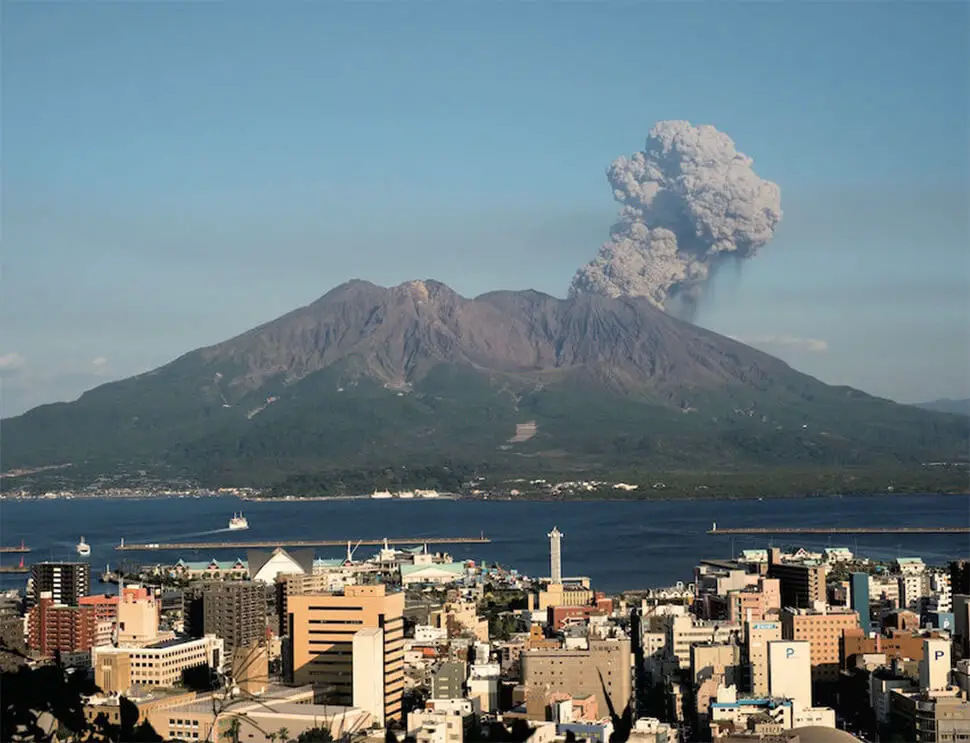
Credit: Sakurajima Volcano Research Centre
2041
The majority of new passenger cars feature L3+ autonomy
By 2041, autonomous vehicle technology has passed a major milestone, with more than half of the world's new passenger cars now being equipped with Level 3 or higher (L3+) autonomy.*
This follows decades of gradual advancement from earlier, simpler systems. Levels 1 and 2 first entered commercial production in the late 1990s to mid-2000s, with pioneering examples such as Mercedes-Benz's radar-based 'Distronic', as well as early attempts at lane-changing technology by Honda and other companies. These began to evolve from luxury options to more standard features, gaining widespread availability during the 2010s and early 2020s. Requiring continuous driver supervision, they helped familiarise the public with automation and laid the groundwork for regulatory acceptance of more advanced systems.
Higher-end car models, like the Mercedes-Benz S-Class sedan, had begun to integrate Level 3 autonomy.* Vehicles at this level demonstrated the ability to drive themselves without human intervention in many scenarios, particularly on motorways and clearly marked roads, significantly reducing the stress of commuting and long-distance travel, as well as improving road safety. Drivers could disengage from active driving for extended periods, although they would need to remain available to resume control if prompted by an alert.
Level 3 systems became available in a wider range of cars, with mainstream adoption during the 2030s, driven by falling technology costs, improvements in artificial intelligence and machine vision, advanced sensors, and supportive government regulations.
The first Level 4 cars – capable of fully self-driving under most conditions – had emerged as far back as the early 2020s. Waymo, for example, operated its robotaxi services in Phoenix, San Francisco, and Los Angeles during that time, although these vehicles were not sold or leased directly to individual consumers for personal use. More widespread adoption of consumer-oriented Level 4 passenger cars would take another 15 to 20 years, although Level 3 vehicles still dominated the market during this period.
Globally, more than half of new cars are Level 3 or higher by the early 2040s. Safety improvements have been substantial, with road fatalities decreasing sharply in regions adopting these and other automotive technologies. Traffic flow is now noticeably smoother in cities, and reduced congestion is contributing positively to economic productivity, air quality, and overall quality of life. Countries such as China and those across Europe have embraced these technologies enthusiastically, with China achieving 90% adoption by 2040, Europe 79%, Japan 73%, and the United States around 65%.
However, the transition has not been entirely smooth. For many years, public trust in autonomous car technology remained fragile, with high-profile incidents involving experimental or early commercial systems triggering widespread media attention and criticism. These setbacks led to stricter oversight, while fuelling debates around liability, ethics, and the readiness of AI to handle unpredictable real-world scenarios. Particular concerns emerged around safety – especially in rare but challenging "edge cases" involving unusual weather conditions, construction zones, or unpredictable pedestrian behaviour. Exponential improvements in AI-driven prediction models and extensive testing in diverse environments have largely mitigated such risks by 2041, enabling the latest cars to match or exceed human-level driver skills and helping to restore and maintain consumer confidence.
Over time, public attitudes have shifted, with older generations gradually warming to self-driving cars, while younger people – already accustomed to automation – view them as a normal part of daily life. Cultural acceptance has varied by region; European and Asian markets are especially open to the technology, encouraged by dense urban environments where autonomous driving significantly eases congestion and parking problems. In contrast, regions like North America have seen comparatively slower adoption, influenced by cultural attachments to driving and a strong tradition of car ownership.
The concurrent global rise in electric vehicles has also facilitated the widespread integration of autonomous technology. Electric platforms provide more efficient power management and spacious vehicle layouts that better accommodate the necessary sensors and computational hardware for self-driving capabilities, accelerating the combined adoption of electric and autonomous cars.
Meanwhile, the first Level 5 vehicles – capable of full autonomy under all conditions without any human intervention – have just begun to emerge in limited pilot programmes and niche applications. Although their market share remains negligible in 2041, they are expected to follow an accelerated growth trajectory over the next two decades, building on the solid foundation laid by Levels 3 and 4.

Oil spills in the Niger Delta have been cleaned up
The Niger Delta is the delta of the Niger River that drains into the Gulf of Guinea off the coast of Nigeria. For millions of years, organic sediments were deposited from the river into the Atlantic, which became crude oil. During the early 21st century, this region was among the world's top oil and gas exploration hotspots.
The first drilling operations began in the 1950s, undertaken by multinational corporations that provided Nigeria with the necessary technology and financial resources for extraction. In 1971, Nigeria joined the Organisation of Petroleum Exporting Countries (OPEC). From 1975 onwards, the Delta region accounted for more than 75% of the country's export earnings. Nigeria became Africa's biggest producer of petroleum and was ranked among the top 10 nations globally in terms of proven reserves. At its peak, nearly 2.5 million barrels were being extracted a day.* It was estimated that 35 billion barrels lay waiting to be discovered, enough to last several decades.
However, the Niger Delta became a centre of controversy over pollution, corruption and human rights violations. Many citizens of Nigeria felt exploited and unable to see the economic benefits of oil companies in the state. Production was affected by political instability and sporadic supply disruptions, attacks on infrastructure and crude oil theft, as local groups sought a share of the wealth. Most of the oil fields were small and scattered. Nearly 160 were found across Nigeria – of which 78 (almost half) lay in the Delta. As a result of the numerous small fields, an extensive pipeline network had been engineered to transport the crude oil and this was vulnerable to sabotage. Many sections of pipeline were also poorly maintained and badly aging. Pipeline explosions killed thousands of people and left many others with serious burn injuries in the 1990s and 2000s.
Oil spills were frequent in the region and often devastating to communities based around fishing and farming. A report by the United Nations (UN) found that in one community, families were drinking from wells containing benzene, a known carcinogen, at 900 times the recommended levels. The Nigerian National Petroleum Corporation reported an average of 300 individual spills annually. However, as this amount did not take into account "minor" spills, the World Bank argued that the true quantity of petroleum spilled into the environment could be as much as ten times the officially claimed amount.
In addition, gas flaring was a major issue and contributed vast volumes of air pollution and greenhouse gases. Much of the excess waste from the Delta was immediately burned, or flared, at a rate of approximately 70 million m³ per day – enough fuel to provide the combined annual natural gas consumption of Germany and France. Despite regulations introduced to outlaw this practice, it continued for decades at many drill sites.
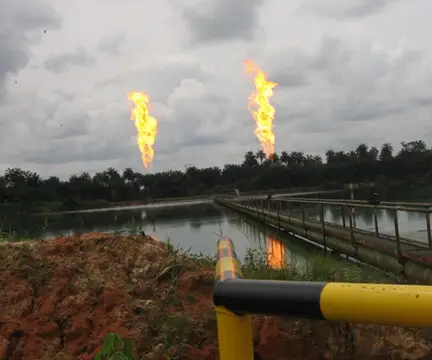
As the largest wetland in Africa, the Delta was an incredibly rich ecosystem containing one of the highest concentrations of biodiversity on the planet and supporting abundant flora and fauna, arable terrain and a wide variety of crops. The numerous oil spills and gas flaring in much of the Delta were taking a heavy toll on the environment. Pollution was affecting the air, water, soils, animals, vegetation and even physical structures.
Ken Saro-Wiwa – a Nigerian writer, TV producer, and environmental activist – brought attention to these problems by leading a nonviolent campaign against the degradation of land and waters by the multinational petroleum industry, especially Royal Dutch Shell. He was also an outspoken critic of the Nigerian government, which he viewed as reluctant to enforce regulations on foreign companies operating in the area. He led the Movement for the Survival of the Ogoni People (MOSOP), an indigenous group living in the Delta. In 1993, MOSOP organised peaceful marches of 300,000 Ogoni people, more than half of their population, drawing international attention to their plight.
Shell withdrew from Ogoniland, in a major victory for the local residents. However, Nigeria's government had recently occupied the region militarily and took decisive action against what it saw as an increasing threat. Thousands of Ogoni people were tortured and killed, and dozens of villages destroyed. Ken Saro-Wiwa himself was tried by a special military tribunal at the peak of his non-violent campaign and charged with masterminding the murder of Ogoni chiefs at a pro-government meeting, in a trial widely criticised by human rights organisations.*
In 1995, he was hanged, along with eight other activists, by the military dictatorship of General Abacha. Many of the supposed witnesses later admitted they had been bribed by the government to support the criminal allegations. Two witnesses who testified that Saro-Wiwa was involved in the murders later recanted, stating that they were offered money and jobs with Shell to give false testimony, in the presence of Shell's lawyer. The executions provoked international outrage and resulted in Nigeria's suspension from the Commonwealth of Nations.
Saro-Wiwa's death was a major setback for the environmental movements, but their efforts to seek justice and compensation would continue over the subsequent two decades with ongoing lawsuits and other actions. While social and political unrest persisted into the early 21st century, Nigeria moved to a more democratic, civilian federal system. In 2011, a UN report was funded in part by Shell after a request by Nigeria's government. This stated that Nigeria's Ogoniland would take 30 years to fully recover from the damage it had sustained, at a cost of $1bn.* Then, in 2013, a Dutch court ruled that Shell was liable for pollution in the region. The company was sued repeatedly by local communities with claims running into many millions of dollars.

A major breakthrough in resolving the situation was finally achieved when the Nigerian government – in partnership with oil companies – agreed to act on the recommendations of the UN report. In 2016, a full-scale cleanup and restoration plan was officially launched by President Buhari. This initiative, lasting for approximately 25 years,* would start with $200m of funding over a period of five years, focussed on a 1,000 sq mile (2,600 sq km) area of land and water near Port Harcourt, the capital and largest city of Rivers State. A factory would be constructed to process and clean tens of thousands of tons of contaminated soil. Alongside this, a mass replanting of mangroves would be undertaken.
After this initial phase, the project would gradually expand over the next 20 years with more funding and resources. This would fully restore all of the remaining land, creeks, fishing grounds, mangroves, swamps and other areas devastated by Shell, the national oil firm and other fossil fuel companies. Thousands of jobs would be created for engineers, manual workers, project managers and inspectors. In addition to ecological repair, a side benefit would be that young people in the Ogoni region (many of whom had rebelled against and sabotaged the oil infrastructure) could now be put to work doing productive and rewarding tasks. In the medium to longer term, it was hoped that a healthier environment would create a more socially and politically stable region – leading to economic progress and sustainable development. This would improve the overall living standards of Nigeria, one of the most rapidly growing countries in terms of population.
The plan was not without its problems, of course, with ongoing conflicts in the region, alongside concerns over corruption. However, there was a certain momentum and inevitability to the process, as oil production was declining regardless of any cleanup operations. Solar was becoming so cheap and widespread that it rapidly gained a foothold in many African nations including Nigeria, forming a substantial percentage of energy capacity within just a few decades. By the early 2040s, restoration efforts in the Niger Delta have been largely completed, while economic diversification has allowed Nigeria to transition away from its older fossil fuel industries and to attract foreign investment in new areas.
Nigeria is now facing an even greater threat, however, in the form of climate change. Between the years 1900 and 2000, average annual rainfall in the country declined by 10%, from 1400mm to 1255mm. This trend continued in the 21st century and has dropped another 5% to below 1200mm by 2041. The next challenge for Nigeria – and indeed much of Africa – is to increase its access to water. Thankfully, new technologies such as nanofiltration and other extraction techniques are now making this easier. Although Nigeria still faces environmental problems and overpopulation, its outlook is less doom-laden than some had previously feared. Africa as a whole is becoming an increasingly important part of the global economy.
Orbital solar power is commercially feasible
After decades of development, energy generated from space-based solar power is now being added to many grids. This concept has been around since the 1970s – but advances in nanotechnology and transmission efficiency have only recently made it both commercially and technically feasible.**
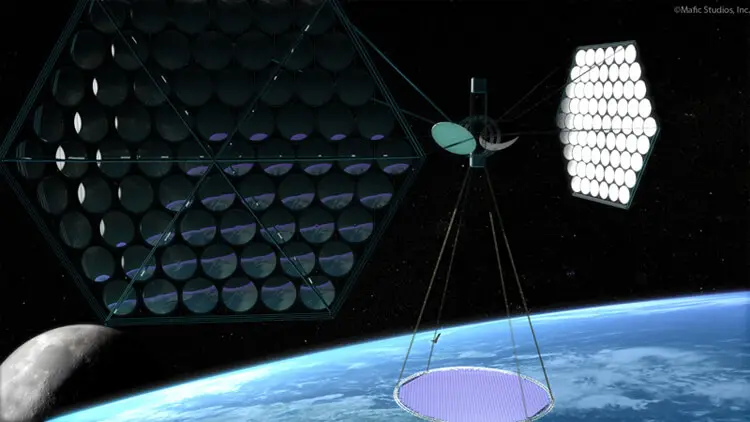
The system involves placing several large satellites into geosynchronous Earth orbit. Initially, this is financed and carried out jointly by government agencies and private corporations. Very large, nanotech-based surfaces on each satellite's solar array (typically 1 to 3 kilometres in size) capture the energy of sunlight, which is then beamed down to Earth via microwaves or lasers. Large collecting dishes on the ground receive the energy and convert it to useable electricity. There are several benefits to this approach:
• Higher collection rate: In space, transmission of solar energy is unaffected by the filtering effects of atmospheric gases. Consequently, collection in orbit is 144% of the maximum attainable on Earth's surface.
• Longer collection period: High above the Earth, orbiting satellites can be exposed to a consistently high degree of solar radiation, generally for 24 hours per day, whereas ground-based panels are restricted to around 12 hours per day at most.
• Elimination of weather concerns: Orbiting satellites reside well outside any atmospheric gases, cloud cover, wind, rain and other potential weather events.
• Elimination of plant and wildlife interference.
• Redirectable power transmission: Satellites can direct power on demand to different surface locations based on geographical baseload or peak load power needs.
The climate benefits from orbital solar power as well, since there are no greenhouse gas emissions (though the energy beamed down to earth is eventually lost as heat). These projects are initially expensive though, due to the hostility of the space environment. Panels require high-strength shielding to protect against space junk* and their huge surface areas can make them vulnerable to incoming debris. Some of the more hi-tech stations feature nanotechnology-based composites that can self-heal. Degradation of the solar panels comes close to making them uneconomical at first, though further advances in technology later solve this issue.
Though far from a perfect beginning, space-based solar power grows to become a hugely successful industry in the late 21st and 22nd century. Satellites also begin to appear in orbit around the Moon and Mars, greatly boosting the energy available on manned bases. It continues to grow around Earth for almost two centuries, until virtually all of the sunlight falling on the planet is being captured and harvested in some way.*
Launch of the Habitable Worlds Observatory
The James Webb Space Telescope (JWST), the successor to Hubble, began full operations in 2022. With a projected lifetime of around 20 years, the JWST would itself be succeeded in the early 2040s.
Shortly after the JWST's launch, NASA revealed plans for a trio of next-generation space telescopes. Known as the New Great Observatories, these would be developed over the next 20-30 years, building on the experience of previous missions.
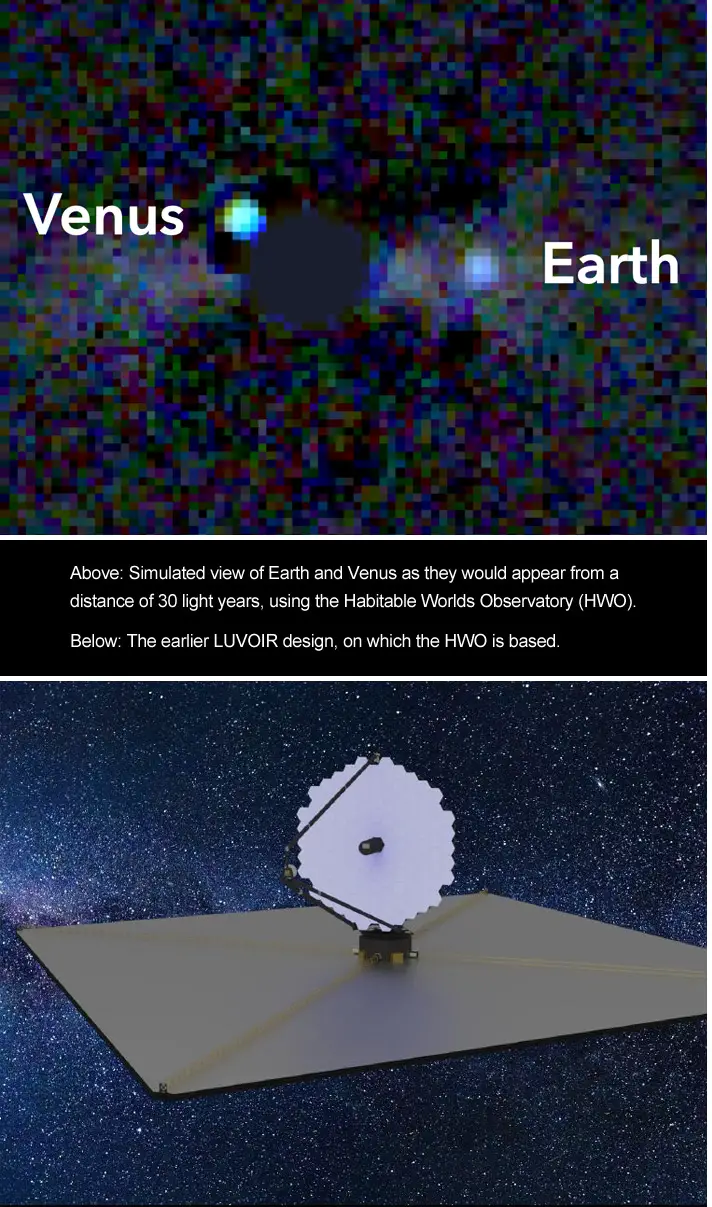
The first of these – called the Habitable Worlds Observatory (HWO) – had a projected launch date of 2041. Some scientists had sought an accelerated schedule and a substantial increase in the budget for astrophysics. However, cost pressures led to its budget staying roughly in line with inflation and the mission start remained on track for the early 2040s.
Prior to the HWO, two earlier concepts had been studied – the similarly-named Habitable Exoplanet Observatory (HabEx) with a 4-metre diameter mirror, and the Large Ultraviolet Optical Infrared Surveyor (LUVOIR) with two options at 8 m and 15.1 m, respectively. For comparison, the JWST had a 6.5 m primary mirror, while Hubble's measured 2.4 m. Due to their costs being too high, NASA eventually dropped both versions of LUVOIR. The agency instead proposed the same design as LUVOIR, but scaled down to 6.5 m, making it the same as the JWST but 63% larger than HabEx.
Regardless of its size, the HWO is far more powerful and sophisticated than earlier telescopes, with orders of magnitude leaps in capability. Operating at ultraviolet, visible, and near-infrared wavelengths, it can perform direct imaging of planets. As its name implies, those in the habitable zone (where water can exist in liquid form) are the primary targets for study. While direct imaging in the past had focused on gas giants, often at great distances from a star, the HWO is the first telescope able to capture direct images of Earth-like planets in orbits similar to the terrestrial planets of our own Solar System.
The HWO's mirror is so smooth and perfectly shaped that its surface precision is achieved down to a level of 1 picometre – a trillionth of a metre – compared with billionths of a metre for the JWST. Its coronagraph (used for blocking the stars) is better than any previous instrument by a factor of 100, able to suppress the glare of starlight that is 10 billion times brighter than planets, thus revealing worlds in much greater detail.*
By measuring the spectra of these planets, the HWO can determine their atmospheric content and confirm the presence of water on the surface, while also looking for gases that may indicate biological activity, such as oxygen or ozone.
The HWO, like the JWST, sits in an orbit known as L2, about 1.5 million km (0.9 million mi) from Earth. But unlike the JWST, it can undergo maintenance and upgrades if needed in the future, extending its mission timeline. As well as direct imaging of Earth-like planets, it performs general astrophysics. The HWO is followed by New Great Observatories with far-infrared and X-ray capabilities launched in 2047 and 2051, respectively.*
Completion of the W350 tower in Tokyo
The W350 tower is a 70-storey, 350m (1,150 ft) skyscraper built by Sumitomo Forestry in Tokyo, Japan. The building is highly unusual in that its structure consists largely of wood. It is the tallest such building of its kind in the world and over six times taller than Brock Commons – the previous record holder at the time of its announcement – a 53m (174 ft) wooden residence in Vancouver, Canada.* The W350 is also taller than Tokyo Tower (one of the city's most famous landmarks that opened in 1958) and is therefore a major addition to the skyline.
The building contains a mix of hotel, office, residential and retail space. It is covered in greenery, flooded with natural light and features open-air balconies that continue around all four sides, creating a healthy living environment for the occupants. Unlike concrete and steel buildings (which are responsible for 8% and 5% of carbon emissions, respectively), wooden buildings store carbon. The W350 tower removes 100,000 tons of CO2 from the atmosphere.
W350 is part of an emerging trend in eco-architecture that is becoming far more prominent around this time, now that environmental considerations are being brought to the fore.* At the time of its announcement, the total cost was about 600bn yen ($5.6bn), twice that of a conventional skyscraper of the same size. However, advances in technology led to reductions in the project's cost, along with improvements in fire resistance. Its completion date is 2041 – timed to coincide with the 350th anniversary of Sumitomo Forestry.**
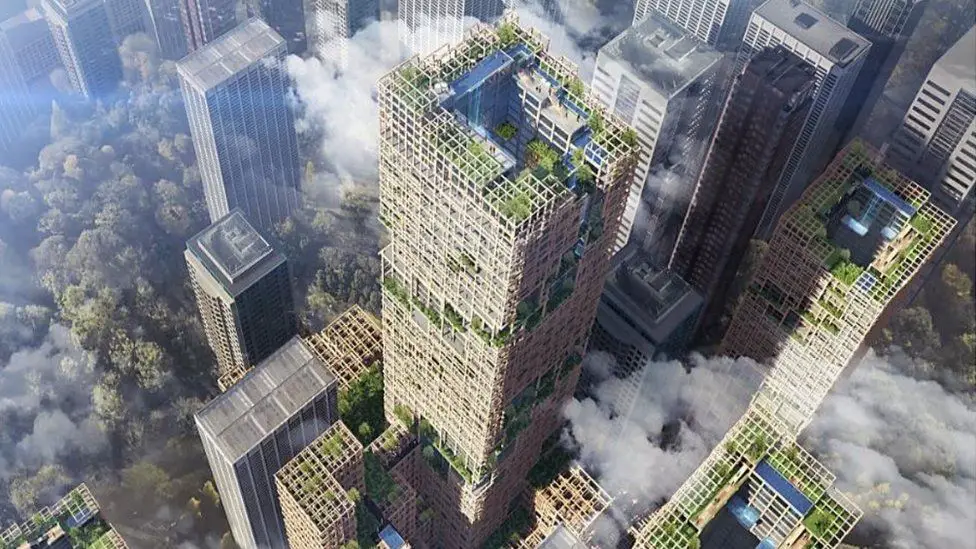
Credit: Sumitomo Forestry
Sound Transit 3 is completed in Washington
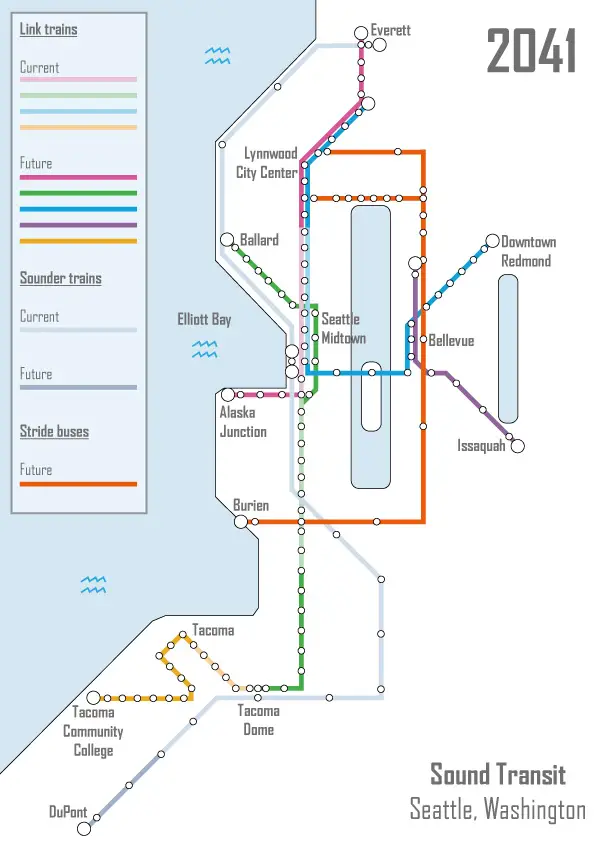
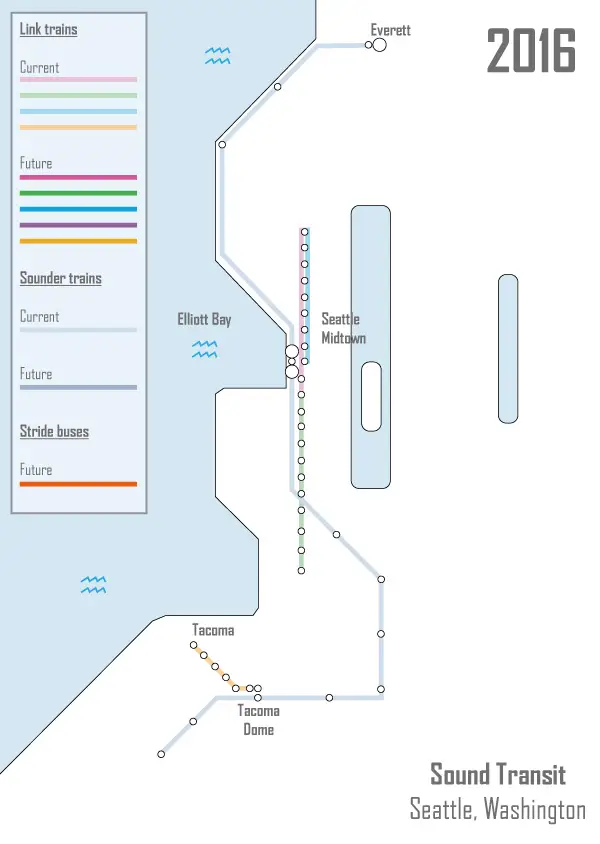
Sound Transit 3 is one of the largest upgrades of a public transport system in U.S. history. The $54 billion megaproject involves a major expansion of bus and commuter train lines in and around Seattle, Washington, over a period of 25 years from 2016 to 2041.*
In the years prior to this development, Seattle had established itself as a major hub for technology and entrepreneurs, home to the likes of Amazon, Blue Origin, Microsoft, and Starbucks. Between 2010 and 2020, its population increased by over 20%, making it one of the fastest growing cities in the country. Long term forecasts indicated that Seattle's metropolitan area population of 4 million in 2020 would reach 5.8 million by 2050, with a 36% increase in jobs.
To enable public transport services to cope with future demand, the regional transit authority began comprehensive planning studies and identified those areas most in need of improvement, as well as opportunities for new train and bus routes. The proposals would require $27.7 billion in new local taxes raised during the 25-year construction phase, plus $11 billion in bonds, with additional funding from sources including federal grants, as well as surplus revenues from the earlier Sound Transit 2. In total, the agency estimated that its plan would cost the average adult in the district approximately $169 more annually. Estimates for full repayment of the bonds ranged from 2048 to 2068.
A ballot measure on Sound Transit 3, held during the November 2016 elections in Seattle, Washington, resulted in approval from a majority (54%) of the public. Voters in Pierce County (south of Seattle) rejected the measure, but King (the county of Seattle) and Snohomish (to the north) voted in favour.
Under the Sound Transit 3 plan, the region's Link light rail more than quadruples in length – from 42 km (26 mi) to 187 km (116 mi), with a near-tripling of stations from 25 to 70. Several new lines are created, boosting capacity, and extending the existing system into suburban areas, with 226 new trains running for 20 hours per day, and every three to six minutes during peak hours.
The first section – Redmond Technology to Downtown Redmond – opens in 2024. Other sections become operational in later years, including Downtown Seattle to West Seattle in 2030. The final section, South Kirkland to Issaquah via Bellevue, is opened in 2041.
The existing Sounder commuter rail service is also expanded, adding two new stations, and increasing capacity to serve 40% more riders on the south line from 2036 onwards.
Sound Transit 3 creates new bus rapid transit lines on Interstate 405 (running north to south) and State Route 518 (running east to west). This provides a faster and more reliable bus service every 10 minutes during peak hours, with connections to light rail stations. Other improvements include easier transit access via direct bicycling and walking routes, as well as expanded parking and drop-off areas.
When completed in 2041, Sound Transit 3 is a transformational project for Seattle and the wider state. It defines how the city and its metropolitan area grows for the next 50 to 100 years.
Click to toggle between years:
| 2016 | 2041 |
Cases of lung cancer have spiked in New York
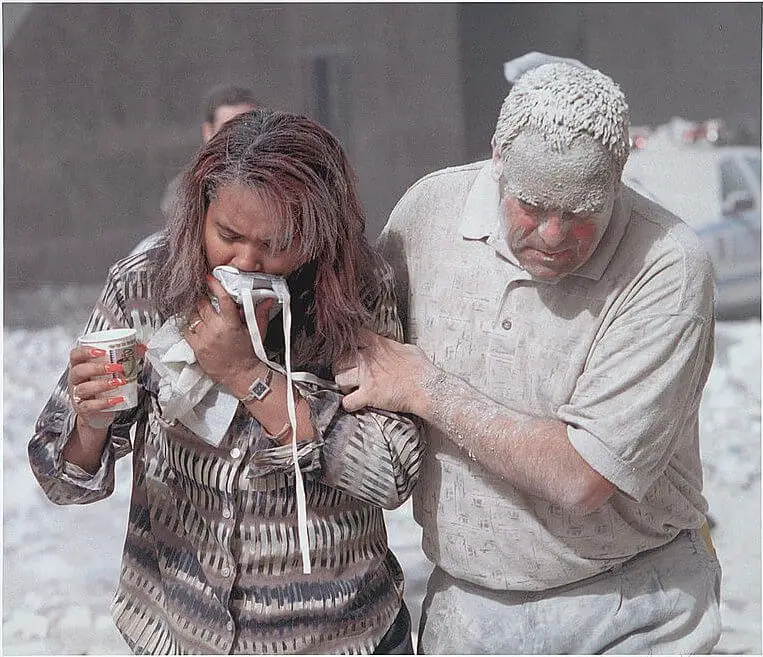
During the terrorist attacks in New York on 11th September 2001, the twin towers of the World Trade Centre collapsed into a pile of rubble. A huge volume of debris was pulverised and scattered over the surrounding area. This included 400 tons of asbestos within each tower. Asbestos was banned in New York in 1972, shortly after the construction of each tower. Mid-way through their completion, it was known that a ban would be coming into force in the near future. Nevertheless, the decision was made to retain the hazardous material throughout 20 floors of the buildings.
It was estimated that 410,000 people – more than one in twenty of the city's population – were exposed to asbestos and other toxic substances embedded in the towers' drywall, insulation, fireproofing and steel structures. The massive cloud of smoke, dust and debris released from Ground Zero affected mainly emergency crews and other rescuers, along with those responsible for clearing the site. However, many others were exposed too, including those in the immediate vicinity who were unable to flee the clouds in time, and local residents living or working nearby.
In the months and years following the attacks, growing numbers of New Yorkers reported symptoms of Ground Zero respiratory illnesses. The dust and debris had been "wildly toxic", according to one air pollution expert. Studies found more than 2,500 contaminants from the towers: 50% in non-fibrous material and construction debris; 40% from glass and other fibres; 9.2% in cellulose; and 0.8% from the deadly asbestos, as well as lead and mercury. There were also unprecedented levels of dioxins and PAHs from the fires which burned for three months. Many of the dispersed substances (asbestos, crystalline silica, lead, cadmium, polycyclic aromatic hydrocarbons) were carcinogenic; others led to kidney, heart, liver and nervous system deterioration. A case report funded by the Centers for Disease Control and Prevention (CDC) and the National Institute for Occupational Safety and Health (NIOSH) identified carbon nanotubes in dust samples and in the lungs of several 9/11 responders.
This led to increasing numbers of debilitating illnesses among the surviving rescue and recovery workers, as well as some residents, students and workers of Lower Manhattan and nearby Chinatown. In 2006, it was reported that dozens of recovery personnel had developed cancer – with doctors and epidemiologists confirming these cases as linked to the Ground Zero exposure. The following year, the pulmonary fibrosis death of NYPD member Cesar Borja was reported.
In 2010, a study of 5,000 rescue workers found that all had impaired lung functions, with an average impairment of 10%. Up to 40% of these workers were reporting persistent symptoms and 1,000 of the group studied were on "permanent respiratory disability." Another study in December 2012 showed that incidences for prostate cancer, thyroid cancer, and multiple myeloma were significantly elevated among the rescue and recovery workers. More and more deaths were being reported as linked to 9/11, along with lost pregnancies numbering at least ten. Many people were filing lawsuits to seek monetary compensation. There were psychological effects too, in addition to physical problems: studies were finding that exposure to the attacks was a predictor for the development of post-traumatic stress disorder (PTSD).
Longer term, new health impacts emerged. For some illnesses related to asbestos exposure, the full effects and symptoms would not be felt for decades. This was the case with certain types of cancer, such as mesothelioma and lung cancer. By 2021, a significant uptick in cases was being observed and this trend continued to worsen, reaching a peak in 2041 – a full four decades after the 9/11 attacks.* Although some advances have been made in treating lung cancer by now, survival rates have improved at a slower pace than most other types of cancer.*
« 2040 |
⇡ Back to top ⇡ |
2042 » |
If you enjoy our content, please consider sharing it:
References
1 Japan's Sakurajima volcano due for major eruption within 30 years, say scientists, BBC News:
http://www.bbc.co.uk/news/world-asia-37358316
Accessed 24th February 2017.
2 Magma accumulation highlights growing threat from Japanese volcano, University of Bristol:
http://www.bristol.ac.uk/news/2016/september/japanese-volcano.html
Accessed 24th February 2017.
3 Partially autonomous cars forecast to comprise 10% of new vehicle sales by 2030, Goldman Sachs:
https://www.goldmansachs.com/insights/articles/partially-autonomous-cars-forecast-to-comprise-10-percent-of-new-vehicle-sales-by-2030
Accessed 18th April 2025.
4 See 2022.
5 Nigeria, EIA:
https://www.eia.gov/beta/international/analysis.cfm?iso=NGA
Accessed 10th March 2017.
6 Death of Ken Saro-Wiwa, YouTube:
https://www.youtube.com/watch?v=I9Gwf8UcgS0
Accessed 10th March 2017.
7 Nigeria Ogoniland oil clean-up 'could take 30 years', BBC News:
http://www.bbc.co.uk/news/world-africa-14398659
Accessed 10th March 2017.
8 Niger delta oil spill clean-up launched – but could take quarter of a century, The Guardian:
https://www.theguardian.com/global-development/2016/jun/02/niger-delta-oil-spill-clean-up-launched-ogoniland-communities-1bn
Accessed 10th March 2017.
9 IAA says 'Yes We Can' to power plants in orbit, PhysOrg:
http://www.physorg.com/news/2011-11-iaa-power-orbit.html
Accessed 21st February 2012.
10 Japan Plans To Launch Solar Power Station In Space By 2040, Space Daily:
http://www.spacedaily.com/news/ssp-01a.html
Accessed 21st February 2012.
11 See 2030.
12 See 2250.
13 NASA unveils initial plan for multibillion-dollar telescope to find life on alien worlds, Science:
https://www.science.org/content/article/nasa-unveils-initial-plan-multibillion-dollar-telescope-find-life-alien-worlds
Accessed 31st January 2023.
14 NASA prepares next steps in development of future large space telescope, SpaceNews:
https://spacenews.com/nasa-prepares-next-steps-in-development-of-future-large-space-telescope/
Accessed 31st January 2023.
15 World's tallest wooden skyscraper planned in Tokyo, CNBC:
https://www.cnbc.com/2018/02/20/worlds-tallest-wooden-skyscraper-japan.html
Accessed 20th February 2018.
16 See 2050.
17 70 Story tallest timber tower tipped for Tokyo, treehugger:
https://www.treehugger.com/green-architecture/70-story-tallest-timber-tower-tipped-tokyo.html
Accessed 20th February 2018.
18 New Development Concept W350 Plan for Wooden High-Rise Building, Sumitomo Forestry:
http://sfc.jp/english/news/pdf/20180214_e_01.pdf
Accessed 20th February 2018.
19 Sound Transit 3, Official website:
http://soundtransit3.org/
Accessed 1st December 2022.
20 Asbestos, 9/11 and the World Trade Center, The Mesothelioma Center:
https://www.asbestos.com/world-trade-center/
Accessed 21st February 2017.
21 When will cancer be cured?, Future Timeline Blog:
https://www.futuretimeline.net/blog/2013/04/1.htm
Accessed 21st February 2017.
 |
|||||||||||||||||||||||||||||||
|
Latest predictions |
Timeline » 21st century |
Blogs » AI & Robotics |
Features » |
About us
|
|||||||||||||||||||||||||||
|
|
|||||||||||||||||||||||||||||||


