
![[+]](https://www.futuretimeline.net/images/buttons/expand-symbol.gif)
|
|
|
|
|
|
2039
The first generation of epigenetic rejuvenation therapies
During the 2010s and 2020s, researchers began making serious strides towards understanding and treating aspects of the aging process. Some of the areas witnessing progress included telomere extension, senescent cell clearance, mitochondrial repair, and regenerative medicine. Among them, epigenetic rejuvenation emerged as one of the more promising fields.
Epigenetics – a term coined by British scientist Conrad Waddington in 1942 – involves the study of how our genes are turned on and off, without altering the DNA sequence itself, via mechanisms such as DNA methylation and histone modification. These processes have increasingly damaging consequences as a person ages.
In 2013, scientists discovered the epigenetic clock, a way of measuring biological age by tracking DNA methylation levels. This provided a more accurate measure of an organism's age than merely chronological age. Researchers began attempting to "reset" this clock by using transcription factors – a set of proteins able to turn specific genes "on" or "off" by binding to nearby DNA – capable of reprogramming adult cells back to a youthful, pluripotent state.
Early experiments with transcription factors, particularly the Yamanaka factors, showed immense promise in rejuvenating cells.* However, safety concerns arose due to the risk of cancer. The process of reprogramming cells involved significant changes in gene expression, potentially triggering uncontrolled cell growth and tumour formation unless precisely regulated. To address these risks, researchers began working to refine the combinations of factors used, aiming to achieve the rejuvenating effects while minimising the danger of cancer and other adverse effects.
The identification of suitable transcription factors received a major boost in 2023 when scientists began using transformer models and graph neural networks to understand the relationships between genes in real cells in the wet lab. This allowed researchers to create virtual versions of these interactions and see how well they correlated with real-world cells. The discovery process, now made 300 times faster, generated many millions of results within just a few years. This led to mouse model experiments, followed by the start of human clinical trials.
By 2039, the first successful trial data has been published, confirming the safety and efficacy of epigenetic rejuvenation in humans.* These results demonstrate significant improvements in biological age markers and a reduction in age-related diseases. While not a perfect cure, this represents a major leap forward in extending healthy lifespans.
During the 2040s, epigenetic rejuvenation will become more widely available to the public, offering a partial reversal for certain aspects of aging – such as improved skin elasticity, better mobility and joint function, and resilience against cardiovascular and neurodegenerative diseases. As ongoing research continues to build on and refine these treatments, the potential for even more comprehensive anti-aging solutions draws closer. Whole-body rejuvenation moves from science fiction to science fact during the second half of the century, heralding a world in which age-related decline is a thing of the past.

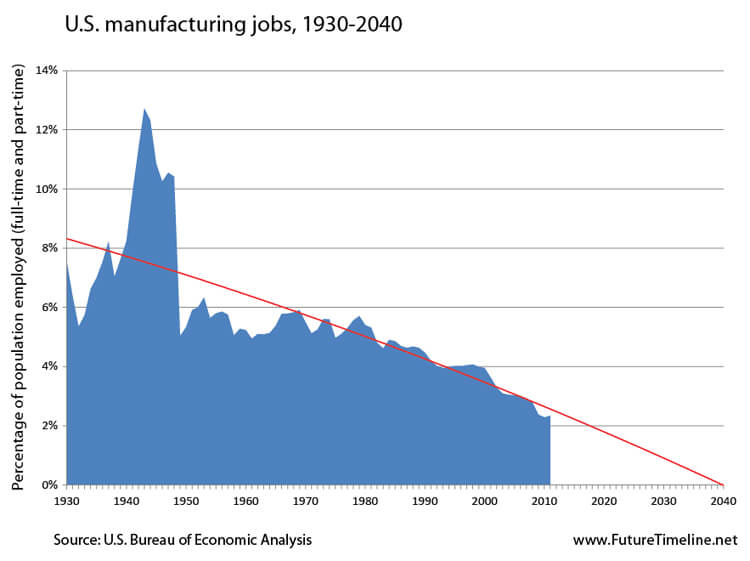
Manufacturing jobs have largely disappeared in the West
In the United States and most other developed nations, manufacturing has gone the same way as agriculture – vitally important, yet employing very few people. Robots, automation and 3D printing, now sufficiently perfected after decades of development, have taken over a wide range of roles once performed by humans.*** As China and other emerging nations make the transition to service-based economies, they too will experience this trend in the not-too-distant future.
Australia's national symbol, the koala, faces extinction
By this date, the koala population in Australia has dwindled to almost nothing, due to the combined impacts of drought, disease, climate change and and loss of natural habitat.* Only those in captivity now remain.

Extreme heatwaves are commonplace in the U.S.
The previous five decades were all the hottest on record – each surpassing the last. Extreme heatwaves are now having a serious impact on agricultural yields and human health. This is a particular problem in the American West. From 2030 to 2039, most areas of Utah, Colorado, Arizona and New Mexico have at least seven summers equal to the hottest season ever recorded between 1951 and 1999. The hottest daily temperatures of the year from 1980 to 1999 have become twice as frequent. There are persistent, drier conditions around the country, with substantial reductions in soil moisture and an accompanying rise in forest fires.*

Credit: dl91m
High-speed rail connects Sydney and Newcastle
Australia's first true intercity high-speed railway now connects Sydney with Newcastle and the Central Coast. Trains reach speeds of up to 320 km/h on parts of the dedicated route, cutting the Newcastle–Sydney journey to around one hour, compared with more than two and a half hours on the old conventional service. The Central Coast is now only around 30 minutes from either city, creating a much more closely integrated urban and economic region.
The project had followed decades of proposals for high-speed rail along Australia's eastern seaboard. Momentum had increased during the 2020s with the creation of the High Speed Rail Authority and an A$500 million federal commitment to planning and corridor protection. Infrastructure Australia – the federal government's independent infrastructure adviser – had subsequently identified 2037 for completion between Newcastle and the Central Coast, followed by an extension to Sydney Central in 2039.* The Newcastle–Sydney section had been estimated to cost around A$60 billion, including trains, stations, signalling and a new manufacturing facility, with private investment expected to provide part of the funding.
The new railway is transforming commuting patterns and business links along the Sydney–Newcastle corridor. Newcastle and the Central Coast have become viable locations for many workers needing regular access to central Sydney, while companies gain access to a much larger labour market. Faster journeys are supporting tourism, regional investment and housing development, while reducing pressure on congested roads and freeing capacity on parts of the conventional rail network. Earlier assessments had projected almost 100,000 new jobs, up to 160,000 new homes and a boost of around A$250 billion to the Australian economy over 50 years.*
A new generation of electric high-speed trains operates on the route, manufactured in Australia using technology and expertise drawn from established international high-speed rail systems. Climate resilience had been identified as a major design issue while the project was still being developed during the 2020s. The line incorporates extensive protection against the hotter and more volatile climate conditions of the mid-21st century, including enhanced track and equipment monitoring, heat-resistant infrastructure, improved drainage and flood protection, as well as systems for managing bushfire risks.
Further expansion of the network is now underway. High-speed services are expected to reach Western Sydney International Airport in 2042,* completing the 194 km first stage of the network. Of this total, 115 km runs through tunnels, alongside 41 km of surface track and 38 km of bridges and viaducts. Later phases will extend the network north towards Brisbane and south through Canberra to Melbourne. The Sydney–Melbourne connection is expected to be completed during the 2060s,* eventually forming part of a high-speed rail corridor spanning much of Australia's eastern seaboard.
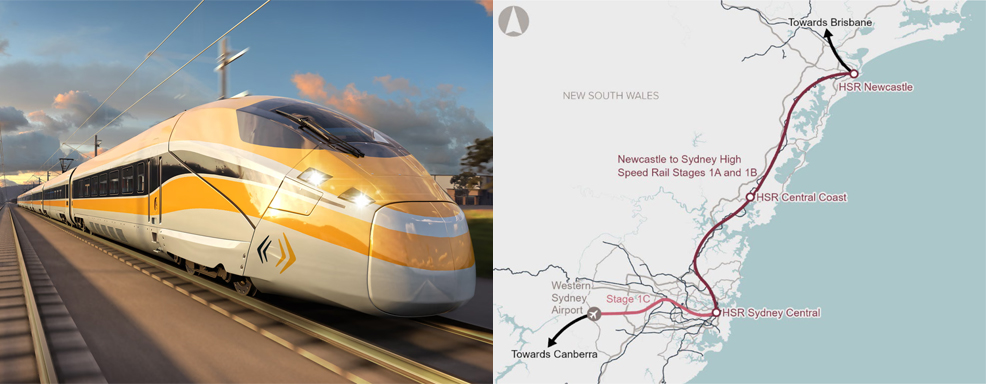
Credit: High Speed Rail Authority (artist's impression) / Infrastructure Australia
« 2038 |
⇡ Back to top ⇡ |
2040 » |
If you enjoy our content, please consider sharing it:
References
1 Age of skin cells reversed by 30 years, Future Timeline Blog:
https://futuretimeline.net/blog/2022/04/8-age-of-skin-cells-reversed-by-30-years.htm
Accessed 27th July 2024.
2 First generation of anti-aging treatments may arrive before 2040, Future Timeline Blog:
https://www.futuretimeline.net/videos/98-reverse-aging-2040.htm
Accessed 27th July 2024.
3 Table 6.4A-D. Full-Time and Part-Time Employees by Industry (A), National Income and Product Accounts Tables, US Bureau of Economic Analysis:
https://apps.bea.gov/iTable/?reqid=19&step=2&isuri=1&categories=survey
Accessed 27th December 2023.
4 Rethink Robotics aims to revolutionise manufacturing with humanoid robot, Future Timeline Blog:
https://www.futuretimeline.net/blog/2012/09/18.htm
Accessed 13th June 2013.
5 How Technology Is Destroying Jobs, MIT Technology Review:
https://www.technologyreview.com/2013/06/12/178008/how-technology-is-destroying-jobs/
Accessed 11th June 2020.
6 Koalas 'extinct within 30 years' after chlamydia outbreak, The
Telegraph:
http://www.telegraph.co.uk/news/worldnews/australiaandthepacific/australia/6537179/Koalas-extinct-within-30-years-after-chlamydia-outbreak.html
Accessed 12th November 2009.
7 Heat waves and extremely high temperatures could be commonplace in
the U.S. by 2039, Stanford study finds, Stanford News Service:
http://news.stanford.edu/pr/2010/pr-extreme-heat-study-070810.html
Accessed 19th August 2010.
8 The $135BN Bullet Train That Could Save Australia, YouTube:
https://www.youtube.com/watch?v=ljFDc3Tx4Rs
Accessed 17th August 2026.
9 Newcastle to Sydney in 1 hour - Albanese Government lays foundation for high-speed rail in Australia, Ministers for Infrastructure, Transport, Regional Development, Communications, Sport and the Arts:
https://minister.infrastructure.gov.au/c-king/media-release/newcastle-sydney-1-hour
Accessed 17th August 2026.
10 High Speed Rail Newcastle to Sydney, Infrastructure Australia:
https://www.infrastructureaustralia.gov.au/sites/default/files
For archived version, see:
https://www.futuretimeline.net/21stcentury/pdfs/IA Stage 3 Evaluation Report_HSR Sydney-Newcastle.pdf
Accessed 17th August 2026.
11 The Bullet Train That Could Save Australia, The B1M:
https://www.theb1m.com/video/the-bullet-train-that-could-save-australia
Accessed 17th August 2026.
 |
|||||||||||||||||||||||||||||||
|
Latest predictions |
Timeline » 21st century |
Blogs » AI & Robotics |
Features » |
About us
|
|||||||||||||||||||||||||||
|
|
|||||||||||||||||||||||||||||||


