Exploration of the gas giants

Post Reply
weatheriscool
Posts: 24486
Joined: Sun May 16, 2021 6:16 pm
Contact:

Exploration of the gas giants

Post by weatheriscool »

Pretty much Jupiter, Saturn, Uranus, and Neptune images and other stuff. Post breaking news and big news in the general space thread but this thread like the mars, venus and moon ones is for smaller stuff or even for second copies of big stuff,.

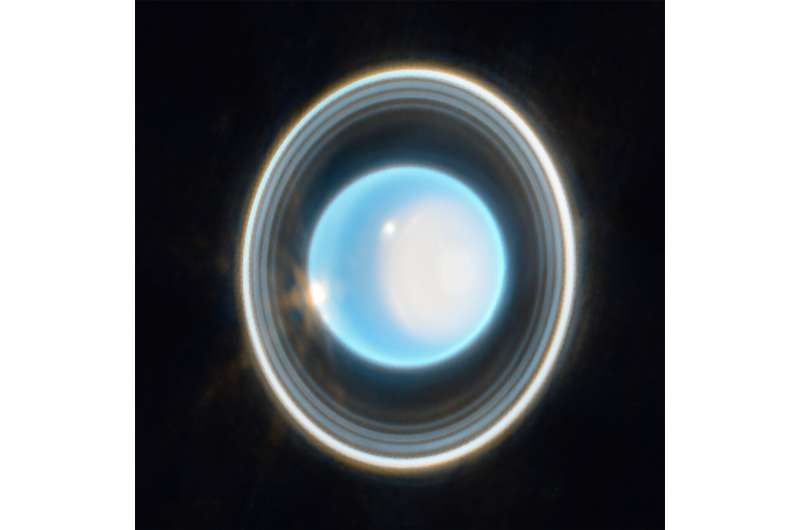
Webb adds another ringed world with new image of Uranus
https://phys.org/news/2023-04-webb-worl ... ranus.html
Image

by NASA
Following in the footsteps of the Neptune image released in 2022, the NASA/ESA/CSA James Webb Space Telescope has taken a stunning image of the solar system's other ice giant, the planet Uranus. The new image features dramatic rings as well as bright features in the planet's atmosphere.

The Webb data demonstrate the observatory's unprecedented sensitivity by revealing the faintest dusty rings, which have only ever been imaged by two other facilities: the Voyager 2 spacecraft as it flew past the planet in 1986, and the Keck Observatory with advanced adaptive optics.

The seventh planet from the sun, Uranus is unique: it rotates on its side, at a nearly 90-degree angle from the plane of its orbit. This causes extreme seasons since the planet's poles experience many years of constant sunlight followed by an equal number of years of complete darkness. (Uranus takes 84 years to orbit the sun.)

Currently, it is late spring at the northern pole, which is visible here; Uranus's northern summer will be in 2028. In contrast, when Voyager 2 visited Uranus it was summer at the south pole. The south pole is now on the 'dark side' of the planet, out of view and facing the darkness of space.

This infrared image from Webb's Near-Infrared Camera (NIRCam) combines data from two filters at 1.4 and 3.0 microns, shown here in blue and orange, respectively. The planet displays a blue hue in the resulting representative-color image.
weatheriscool
Posts: 24486
Joined: Sun May 16, 2021 6:16 pm
Contact:

Re: Exploration of the gas giants

Post by weatheriscool »

Launch of Europe's 1st-ever Jupiter probe is just a week away
By Mike Wall
published about 9 hours ago

https://www.space.com/europe-first-jupi ... h-one-week

The European Space Agency's (ESA) Jupiter Icy Moons Explorer probe, or JUICE for short, is scheduled to lift off atop an Ariane 5 rocket from Europe's Spaceport in Kourou, French Guiana at 8:15 a.m. EDT (1215 GMT) on April 13.

You can watch the launch here at Space.com when the time comes, courtesy of ESA.
Image
superfishy
Posts: 9
Joined: Tue Jul 19, 2022 1:26 pm

Re: Exploration of the gas giants

Post by superfishy »

According to NASA (https://pds.nasa.gov/ds-view/pds/viewMi ... _NAME=JUNO), we'll have two close flybys of Io in December 2023 and February 2024 from Juno during its extended mission. Both from less than 1500km from the surface.

Satellite PJ CA Time(UTC) Altitude(km)

Europa 37 : 2021-10-16 08:46:28 (2021-289) 81360
Europa 40 : 2022-02-24 18:15:43 (2022-055) 46982
Io 41 : 2022-04-09 11:43:39 (2022-099) 105820
Io 43 : 2022-07-05 04:55:57 (2022-186) 86131
Europa 45 : 2022-09-29 09:36:29 (2022-272) 355
Io 47 : 2022-12-14 23:16:09 (2022-348) 63743
Io 49 : 2023-03-01 01:32:07 (2023-060) 51522
Io 51 : 2023-05-16 03:10:08 (2023-136) 35556
Io 53 : 2023-07-31 04:57:16 (2023-212) 22203
Io 55 : 2023-10-15 06:47:22 (2023-288) 11641
Io 57 : 2023-12-30 08:36:01 (2023-364) 1498
Io 58 : 2024-02-03 17:48:36 (2024-034) 1497

Io 60 : 2024-04-09 04:58:04 (2024-100) 17346
Io 65 : 2024-09-20 15:54:42 (2024-264) 124146
Io 67 : 2024-11-25 05:35:34 (2024-330) 85734
Io 72 : 2025-05-08 18:14:06 (2025-128) 92656
User avatar
wjfox
Site Admin
Posts: 13578
Joined: Sat May 15, 2021 6:09 pm
Location: Essex, UK
Contact:

Re: Exploration of the gas giants

Post by wjfox »

Mission to Jupiter's icy moons poised for launch
  • The European Space Agency is set to launch its Jupiter Icy Moons Explorer (Juice) mission to study the gas giant and its major moons
  • The Ariane 5 rocket is scheduled to lift off from the ESA's spaceport in French Guiana at 13:15 BST (09:15 local time)
  • Scientists say it will take eight years for the satellite to reach its final destination
  • The spacecraft will use a gravitational sling-shot technique around Earth and Venus to give it enough energy to reach Jupiter
  • The £1.4bn (€1.6bn) probe could tell us whether Jupiter's major moons - Ganymede, Callisto and Europa - have conditions to support simple life
https://www.bbc.co.uk/news/live/science ... t-65258309


Image
User avatar
wjfox
Site Admin
Posts: 13578
Joined: Sat May 15, 2021 6:09 pm
Location: Essex, UK
Contact:

Re: Exploration of the gas giants

Post by wjfox »

Lift off re-scheduled for tomorrow.
User avatar
wjfox
Site Admin
Posts: 13578
Joined: Sat May 15, 2021 6:09 pm
Location: Essex, UK
Contact:

Re: Exploration of the gas giants

Post by wjfox »

Successful lift-off! :)

https://www.bbc.co.uk/news/live/science ... t-65258309

Arrival expected in 2031.
weatheriscool
Posts: 24486
Joined: Sun May 16, 2021 6:16 pm
Contact:

Re: Exploration of the gas giants

Post by weatheriscool »

Awesome and wonderful news. We'll learn more about the moons of jupiter. I wish it had a europa drone that want down to the planet and into the ocean. ;)
User avatar
Powers
Posts: 1183
Joined: Fri Apr 07, 2023 7:32 pm
Location: a.k.a Lurking, Member, Lorem Ipsum, ..., --- and ººº.

Re: Exploration of the gas giants

Post by Powers »

weatheriscool
Posts: 24486
Joined: Sun May 16, 2021 6:16 pm
Contact:

Re: Exploration of the gas giants

Post by weatheriscool »

Icy moonquakes: Surface shaking could trigger landslides
https://phys.org/news/2023-04-icy-moonq ... lides.html

Image
by Jet Propulsion Laboratory
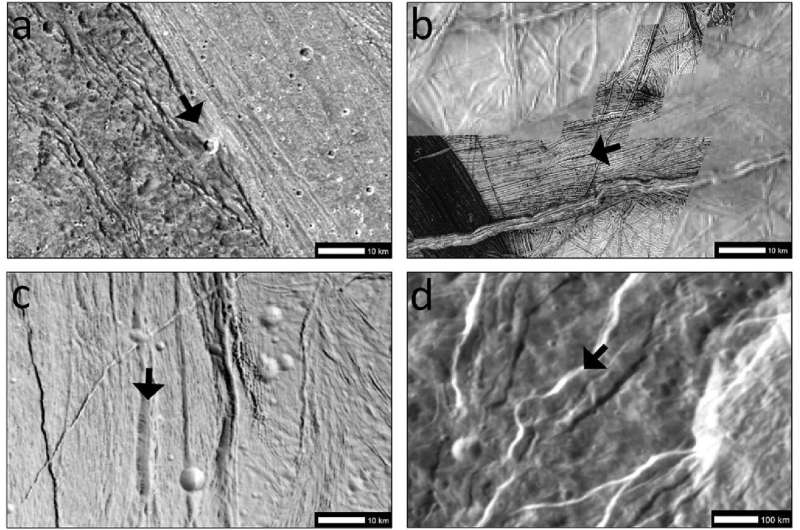
A new NASA study offers an explanation of how quakes could be the source of the mysteriously smooth terrain on moons circling Jupiter and Saturn.

Many of the ice-encrusted moons orbiting the giant planets in the far reaches of our solar system are known to be geologically active. Jupiter and Saturn have such strong gravity that they stretch and pull the bodies orbiting them, causing moonquakes that can crack the moons' crusts and surfaces. New research shows for the first time how these quakes may trigger landslides that lead to remarkably smooth terrain.

The study, published in Icarus, outlines the link between quakes and landslides, shedding new light on how icy moon surfaces and textures evolve.

On the surfaces of icy moons such as Europa, Ganymede, and Enceladus, it's common to see steep ridges surrounded by relatively flat, smooth areas. Scientists have theorized that these spots result from liquid that flows out of icy volcanoes. But how that process works when the surface temperatures are so cold and inhospitable to fluids has remained a mystery.

A simple explanation outlined in the study doesn't involve liquid on the surface. Scientists measured the dimensions of the steep ridges, which are believed to be tectonic fault scarps (like those on Earth)—steep slopes caused when the surface breaks along a fault line and one side drops. By applying the measurements to seismic models, they estimated the power of past m
oonquakes and found they could be strong enough to lift debris that then falls downhill, where it spreads out, smoothing the landscape.
User avatar
wjfox
Site Admin
Posts: 13578
Joined: Sat May 15, 2021 6:09 pm
Location: Essex, UK
Contact:

Re: Exploration of the gas giants

Post by wjfox »

weatheriscool
Posts: 24486
Joined: Sun May 16, 2021 6:16 pm
Contact:

Re: Exploration of the gas giants

Post by weatheriscool »

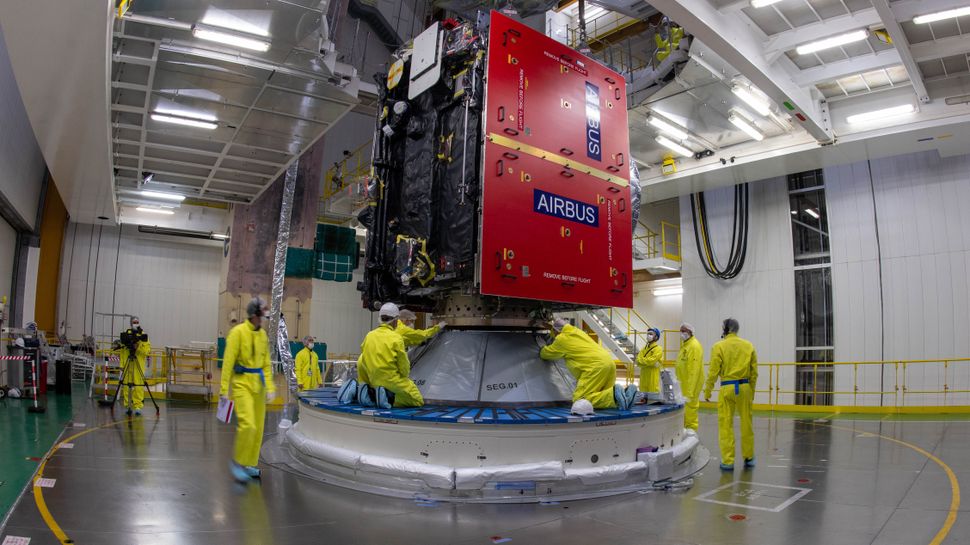
ESA’s Jupiter Icy Moons Explorer (Juice) Gets Wings
Image
https://scitechdaily.com/esas-jupiter-i ... ets-wings/
By European Space Agency (ESA) April 19, 2023
Juice Gets Wings

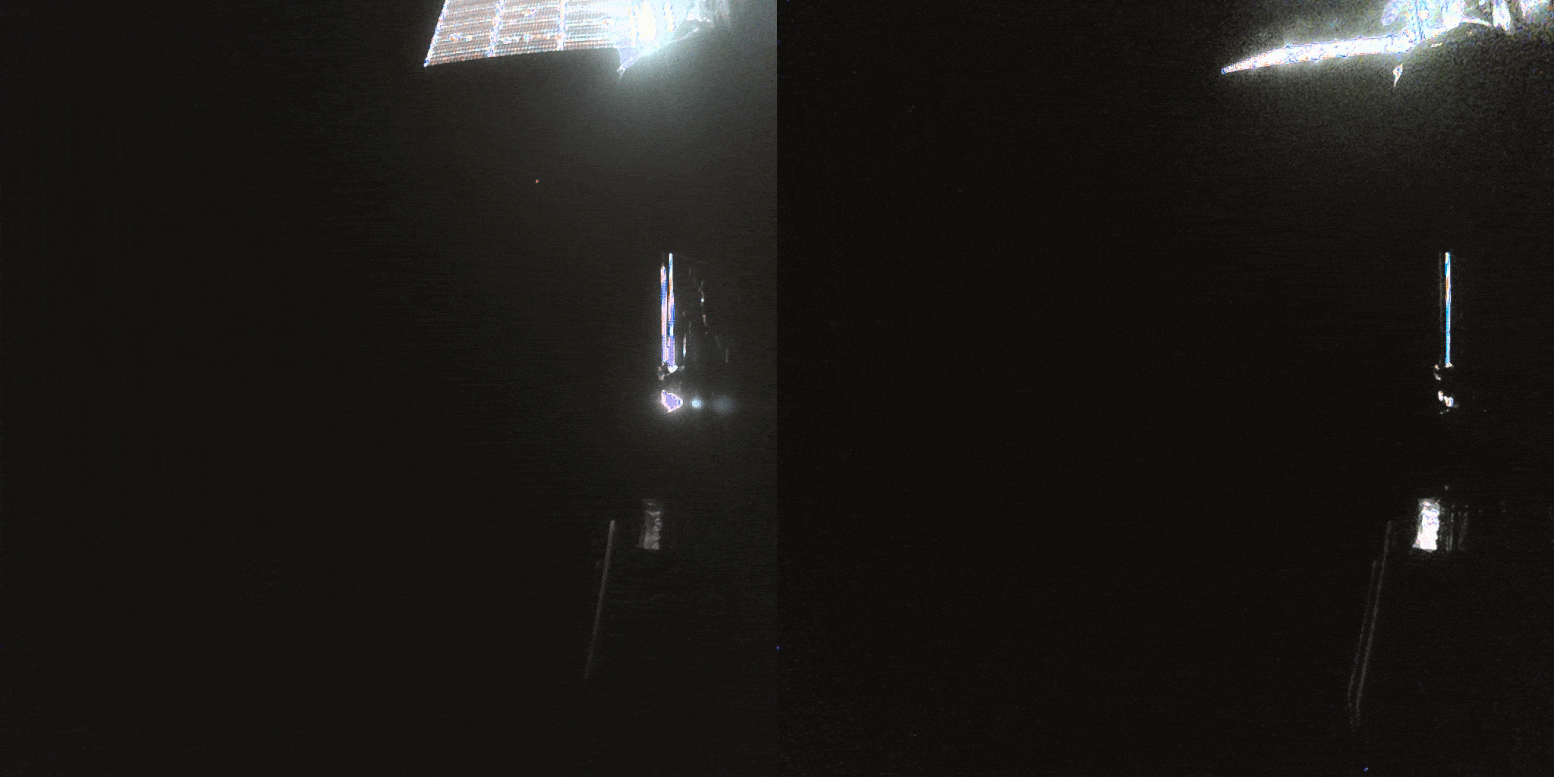
This pair of images captures the rotation of the Jupiter Icy Moons Explorer’s solar arrays during their deployment after launch on April 14. The first image was taken at 15:28 CEST during solar array panel deployment. The second image was taken at 15:32 CEST, and shows the panels having rotated into their 70 degree position, just a few seconds before the deployment sequence was confirmed to have completed. Credit: ESA/Juice/JCAM, CC BY-SA 3.0 IGO

After a successful launch on April 14 on an Ariane 5 rocket from Europe’s Spaceport in Kourou, the European Space Agency (ESA) Jupiter Icy Moons Explorer (Juice) captured this pair of images captures the rotation of the Jupiter Icy Moons Explorer’s solar arrays during their deployment

The images were taken by Juice monitoring camera 1 (JMC1), which is located on the front of the spacecraft and looks diagonally up into a field of view that will eventually see deployed antennas, and depending on their orientation, part of one of the solar arrays. Because of the acute viewing angle of the camera, only part of the array is seen, in this case p
art of the distinctive cross-shape pattern of one of the solar panels.
weatheriscool
Posts: 24486
Joined: Sun May 16, 2021 6:16 pm
Contact:

Re: Exploration of the gas giants

Post by weatheriscool »

Study of Uranus' large moons shows four may hold water
https://phys.org/news/2023-05-uranus-large-moons.html
Image
by JPL/NASA
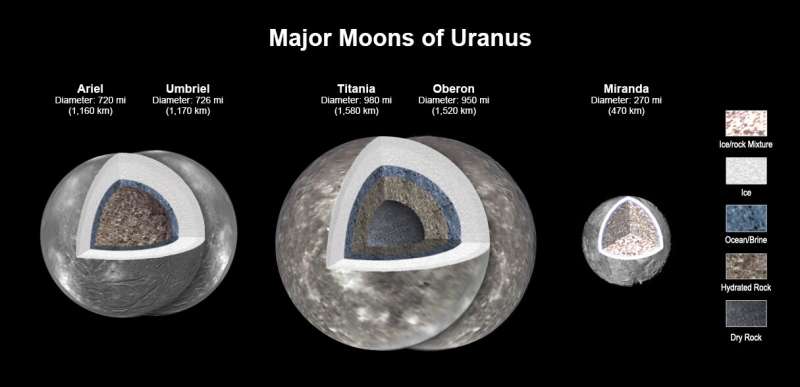
Re-analysis of data from NASA's Voyager spacecraft, along with new computer modeling, has led NASA scientists to conclude that four of Uranus' largest moons likely contain an ocean layer between their cores and icy crusts. Their study is the first to detail the evolution of the interior makeup and structure of all five large moons: Ariel, Umbriel, Titania, Oberon, and Miranda. The work suggests four of the moons hold oceans that could be dozens of miles deep.

In all, at least 27 moons circle Uranus, with the four largest ranging from Ariel, at 720 miles (1,160 kilometers) across, to Titania, which is 980 miles (1,580 kilometers) across. Scientists have long thought that Titania, given its size, would be most likely to retain internal heat, caused by radioactive decay. The other moons had previously been widely considered too small to retain the heat necessary to keep an internal ocean from freezing, especially because heating created by the gravitational pull of Uranus is only a minor source of heat.

The National Academies' 2023 Planetary Science and Astrobiology Decadal Survey prioritized exploring Uranus. In preparation for such a mission, planetary scientists are focusing on the ice giant to bolster their knowledge about the mysterious Uranus system. Published in the Journal of Geophysical Research: Planets, the new work could inform how a future mission might investigate the moons, but the paper also has implications that go beyond Uranus, said lead author Julie Castillo-Rogez of NASA's Jet Propulsion Laboratory in Southern California.

"When it comes to small bodies—dwarf planets and moons—planetary scientists previously have found evidence of oceans in several unlikely places, including the dwarf planets Ceres and Pluto, and Saturn's moon Mimas," she said. "So there are mechanisms at play that we don't fully understand. This paper investigates what those could be and how they are relevant to the many bodies in the solar system that could be rich in water but have limited internal heat."
weatheriscool
Posts: 24486
Joined: Sun May 16, 2021 6:16 pm
Contact:

Re: Exploration of the gas giants

Post by weatheriscool »

This is so awesome I am posting another report on it showing more information!


NASA Finds Four More Moon Oceans in the Solar System so About 20 Water Objects in the Solar System
May 10, 2023 by Brian Wang
https://www.nextbigfuture.com/2023/05/n ... stemm.html
Image
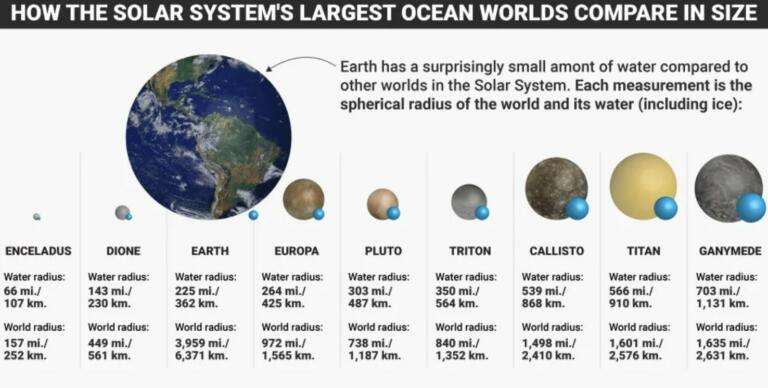
Re-analysis of data from NASA’s Voyager spacecraft, along with new computer modeling, has led NASA scientists to conclude that four of Uranus’ largest moons likely contain an ocean layer between their cores and icy crusts. Their study is the first to detail the evolution of the interior makeup and structure of all five large moons: Ariel, Umbriel, Titania, Oberon, and Miranda. The work suggests four of the moons hold oceans that could be dozens of miles deep.

Cold surface oceans or lakes are found on two worlds, Earth and Saturn’s moon Titan. Lava lakes are found on Earth and Jupiter’s moon Io. Subsurface oceans or seas occur on the other Galilean moons of Jupiter, Saturn’s moons Titan and Enceladus, and are suspected to exist on the some of Saturn’s other moons, the asteroid Ceres, the larger trans-Neptunian objects, and ice planets in planetary systems.
weatheriscool
Posts: 24486
Joined: Sun May 16, 2021 6:16 pm
Contact:

Re: Exploration of the gas giants

Post by weatheriscool »

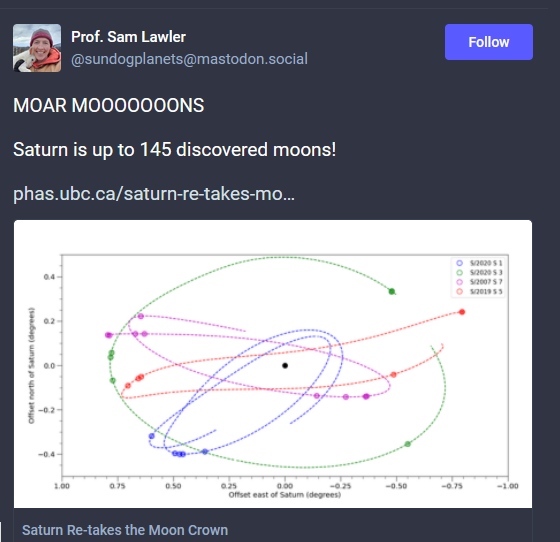
Saturn Re-takes the Moon Crown
Prof. Sam Lawler
@[email protected]
Follow

MOAR MOOOOOOONS

Saturn is up to 145 discovered moons!

https://phas.ubc.ca/saturn-re-takes-mo

Image
weatheriscool
Posts: 24486
Joined: Sun May 16, 2021 6:16 pm
Contact:

Re: Exploration of the gas giants

Post by weatheriscool »

Juice’s RIME antenna breaks free
https://www.esa.int/Science_Exploration ... reaks_free

More than three weeks after efforts began to deploy Juice’s ice-penetrating Radar for Icy Moons Exploration (RIME) antenna, the 16-metre-long boom has finally escaped its mounting bracket.

During the first attempt to extend the folded-up antenna, only the first segments of each half were deployed. Flight controllers suspected that a tiny stuck pin jammed the other segments in place.

Fortunately, the flight control teams at ESA’s mission control centre in Darmstadt had lots of ideas up their sleeves.

To try to shift the pin, they shook Juice using its thrusters, then they warmed Juice with sunlight. Every day the RIME antenna was showing signs of movement, but no full release.

On 12 May RIME was finally jolted into life when the flight control team fired a mechanical device called a ‘non-explosive actuator’ (NEA), located in the jammed bracket. This delivered a shock that moved the pin by a matter of millimetres and allowed the antenna to unfold.
Nanotechandmorefuture
Posts: 478
Joined: Fri Sep 17, 2021 6:15 pm
Location: At the moment Miami, FL

Re: Exploration of the gas giants

Post by Nanotechandmorefuture »

weatheriscool wrote: Wed May 10, 2023 11:07 pm This is so awesome I am posting another report on it showing more information!


NASA Finds Four More Moon Oceans in the Solar System so About 20 Water Objects in the Solar System
May 10, 2023 by Brian Wang
https://www.nextbigfuture.com/2023/05/n ... stemm.html
Image
Re-analysis of data from NASA’s Voyager spacecraft, along with new computer modeling, has led NASA scientists to conclude that four of Uranus’ largest moons likely contain an ocean layer between their cores and icy crusts. Their study is the first to detail the evolution of the interior makeup and structure of all five large moons: Ariel, Umbriel, Titania, Oberon, and Miranda. The work suggests four of the moons hold oceans that could be dozens of miles deep.

Cold surface oceans or lakes are found on two worlds, Earth and Saturn’s moon Titan. Lava lakes are found on Earth and Jupiter’s moon Io. Subsurface oceans or seas occur on the other Galilean moons of Jupiter, Saturn’s moons Titan and Enceladus, and are suspected to exist on the some of Saturn’s other moons, the asteroid Ceres, the larger trans-Neptunian objects, and ice planets in planetary systems.
Life on planets may be a little underground I guess? Even the bacteria would be an amazing thing to find.
weatheriscool
Posts: 24486
Joined: Sun May 16, 2021 6:16 pm
Contact:

Re: Exploration of the gas giants

Post by weatheriscool »

New study puts a definitive age on Saturn's rings: They're really young
https://phys.org/news/2023-05-definitiv ... young.html
by University of Colorado at Boulder
A new study led by physicist Sascha Kempf at the University of Colorado Boulder has delivered the strongest evidence yet that Saturn's rings are remarkably young—potentially answering a question that has boggled scientists for well over a century.

The research, published May 12 in the journal Science Advances, pegs the age of Saturn's rings at no more than 400 million years old. That makes the rings much younger than Saturn itself, which is about 4.5 billion years old.

"In a way, we've gotten closure on a question that started with James Clerk Maxwell," said Kempf, associate professor in the Laboratory for Atmospheric and Space Physics (LASP) at CU Boulder.

The researchers arrived at that closure by studying what might seem like an unusual subject: dust.

Kempf explained that tiny grains of rocky material wash through Earth's solar system on an almost constant basis. In some cases, this flux can leave behind a thin layer of dust on planetary bodies, including on the ice that makes up Saturn's rings.
weatheriscool
Posts: 24486
Joined: Sun May 16, 2021 6:16 pm
Contact:

Re: Exploration of the gas giants

Post by weatheriscool »

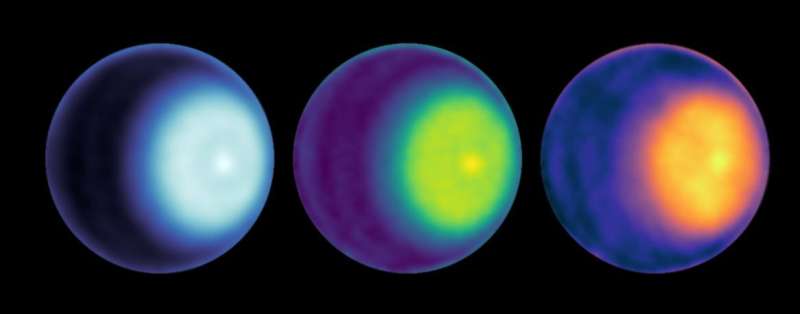
Scientists make first observation of a polar cyclone on Uranus
https://phys.org/news/2023-05-scientist ... ranus.html
Image
by NASA

Scientists used ground-based telescopes to get unprecedented views, thanks to the giant planet's position in its long orbit around the sun.

For the first time, NASA scientists have strong evidence of a polar cyclone on Uranus. By examining radio waves emitted from the ice giant, they detected the phenomenon at the planet's north pole. The findings confirm a broad truth about all planets with substantial atmospheres in our solar system: Whether the planets are composed mainly of rock or gas, their atmospheres show signs of a swirling vortex at the poles.

Scientists have long known that Uranus' south pole has a swirling feature. NASA's Voyager 2 imaging of methane cloud tops there showed winds at the polar center spinning faster than over the rest of the pole. Voyager's infrared measurements observed no temperature changes, but the new findings, published in Geophysical Research Letters, do.
weatheriscool
Posts: 24486
Joined: Sun May 16, 2021 6:16 pm
Contact:

Re: Exploration of the gas giants

Post by weatheriscool »

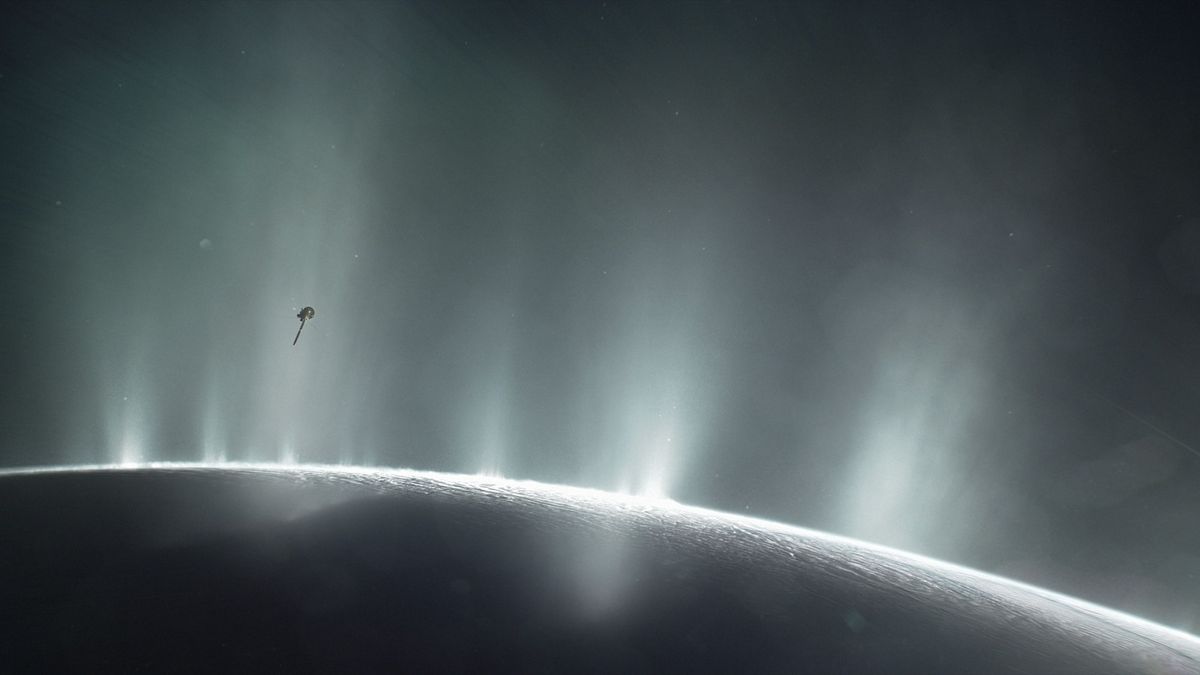
James Webb telescope discovers gargantuan geyser on Saturn's moon, blasting water hundreds of miles into space
Image
By Isobel Whitcomb published 5 minutes ago
The James Webb Space Telescope caught Saturn's icy moon Enceladus spraying a 'huge plume' of watery vapor far into space — and that plume may contain chemical ingredients for life.

Scientists caught Saturn's icy moon Enceladus spraying a "huge plume" of watery vapor far into space — and that plume likely contains many of the chemical ingredients for life.

Scientists detailed the eruption — glimpsed by the James Webb Space Telescope (JWST) in November 2022 — at a conference at the Space Telescope Science Institute in Baltimore on May 17.

"It's immense," Sara Faggi, a planetary astronomer at NASA's Goddard Space Flight Center, said at the conference, according to Nature.com. According to Faggi, a full research paper on the massive plume is pending.

This isn't the first time scientists have seen Enceladus spout water, but the new telescope's wider perspective and higher sensitivity showed that the jets of vapor shoot much farther into space than previously realized — many times deeper, in fact, than the width of Enceladus itself. (Enceladus has a diameter of about 313 miles, or 504 kilometers.)
More:
https://www.livescience.com/space/extra ... into-space
weatheriscool
Posts: 24486
Joined: Sun May 16, 2021 6:16 pm
Contact:

Re: Exploration of the gas giants

Post by weatheriscool »

Post Reply