Physics News and Discussions

weatheriscool
Posts: 24516
Joined: Sun May 16, 2021 6:16 pm
Contact:

Re: Physics News and Discussions

Post by weatheriscool »

Altermagnetism: New form of magnetism discovered in common materials
By Michael Irving
February 19, 2024
Image
https://newatlas.com/science/altermagne ... iscovered/
Scientists have confirmed the existence of a strange new form of magnetism. Hiding right under our noses, the team says that “altermagnetism” can be found in everyday materials and could have major technological uses.

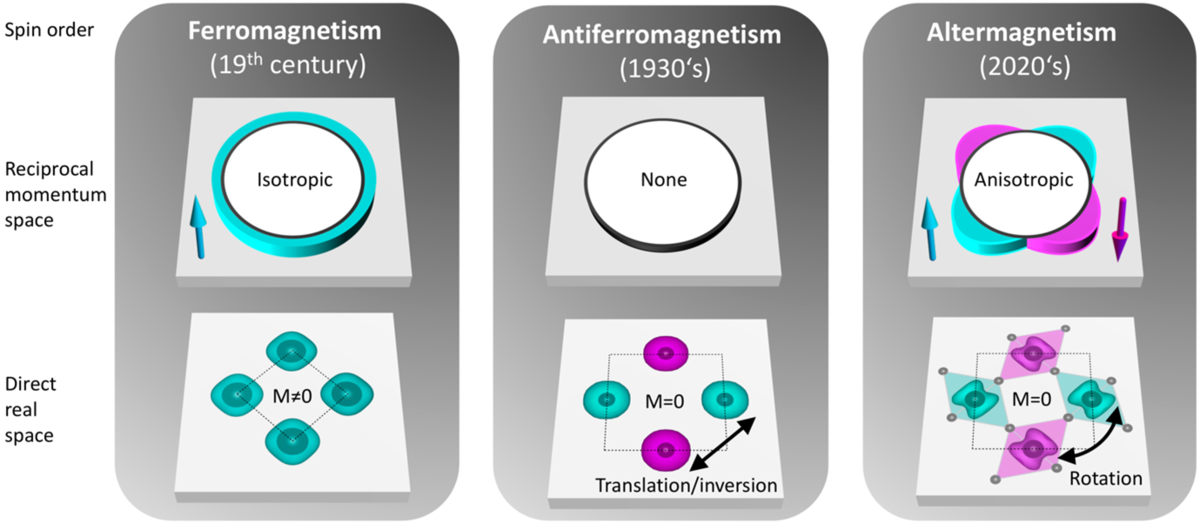
The most familiar form of magnetism – the kind that keeps your kids’ terrible artworks pinned to your fridge – is what’s called ferromagnetism. The effect is produced when the spins of the electrons in the material all spin in the same direction. Another major branch is known as antiferromagnetism, which arises when electron spins alternate direction from their neighbors. Other forms include diamagnetism, paramagnetism and ferrimagnetism, which are all born from different mechanisms.

But now, a brand new form of magnetism has been discovered. It’s been dubbed altermagnetism, and it features a weird mix of properties from other types of the phenomenon – its electrons spin in alternating directions, like antiferromagnets, which means it doesn’t produce magnetization. But the material’s energy bands also have alternating spins from neighboring

bands.
weatheriscool
Posts: 24516
Joined: Sun May 16, 2021 6:16 pm
Contact:

Re: Physics News and Discussions

Post by weatheriscool »

A new phase of matter: Physicists achieve first demonstration of non-Abelian anyons in a quantum processor
https://phys.org/news/2024-02-phase-phy ... antum.html
by Anne J. Manning, Harvard Gazette
Our physical, 3D world consists of just two types of particles: bosons, which include light and the famous Higgs boson; and fermions—the protons, neutrons, and electrons that comprise all the "stuff," present company included.

Theoretical physicists like Ashvin Vishwanath, Harvard's George Vasmer Leverett Professor of Physics, don't like to limit themselves to just our world, though. In a 2D setting, for instance, all kinds of new particles and states of matter would become possible.

Vishwanath's team used a powerful machine called a quantum processor to make, for the first time, a brand-new phase of matter called non-Abelian topological order. Previously recognized in theory only, the team demonstrated synthesis and control of exotic particles called non-Abelian anyons, which are neither bosons nor fermions, but something in between.
weatheriscool
Posts: 24516
Joined: Sun May 16, 2021 6:16 pm
Contact:

Re: Physics News and Discussions

Post by weatheriscool »

Scientists closer to finding quantum gravity theory after measuring gravity on microscopic level
https://phys.org/news/2024-02-scientist ... heory.html
by University of Southampton
Scientists are a step closer to unraveling the mysterious forces of the universe after working out how to measure gravity on a microscopic level.

Experts have never fully understood how the force that was discovered by Isaac Newton works in the tiny quantum world. Even Einstein was baffled by quantum gravity and, in his theory of general relativity, said there is no realistic experiment that could show a quantum version of gravity.

But now physicists at the University of Southampton, working with scientists in Europe, have successfully detected a weak gravitational pull on a tiny particle using a new technique.

They claim it could pave the way to finding the elusive quantum gravity theory.

The experiment, published in Science Advances, used levitating magnets to detect gravity on microscopic particles—small enough to border on the quantum realm.

Lead author Tim Fuchs, from the University of Southampton, said the results could help experts find the missing puzzle piece in our picture of reality.

He added, "For a century, scientists have tried and failed to understand how gravity and quantum mechanics work together. Now we have successfully measured gravitational signals at a smallest mass ever recorded, it means we are one step closer to finally realizing how it works in tandem.
weatheriscool
Posts: 24516
Joined: Sun May 16, 2021 6:16 pm
Contact:

Re: Physics News and Discussions

Post by weatheriscool »

Laser-focused look at spinning electrons shatters world record for precision
https://phys.org/news/2024-02-laser-foc ... world.html
by Matt Cahill, Thomas Jefferson National Accelerator Facility
Scientists are getting a more detailed look than ever before at the electrons they use in precision experiments.

Nuclear physicists with the U.S. Department of Energy's Thomas Jefferson National Accelerator Facility have shattered a nearly 30-year-old record for the measurement of parallel spin within an electron beam—or electron beam polarimetry, for short. The achievement sets the stage for high-profile experiments at Jefferson Lab that could open the door to new physics discoveries.
weatheriscool
Posts: 24516
Joined: Sun May 16, 2021 6:16 pm
Contact:

Re: Physics News and Discussions

Post by weatheriscool »

New maser in a 'shoebox' promises portable precision
https://phys.org/news/2024-03-maser-sho ... ision.html
by Daan Arroo, Wern Ng and Kayleigh Brewer, Imperial College London - Department of Materials
Researchers in Imperial College London's Department of Materials have developed a new portable maser that can fit the size of a shoebox.

Imperial College London pioneered the discovery of room-temperature solid-state masers in 2012, highlighting their ability to amplify extremely faint electrical signals and demonstrate high-frequency stability. This was a significant discovery because microwave signals can pass through the Earth's atmosphere more easily than other wavelengths of light. Additionally, microwaves have the capability to penetrate through the human body, a feat not achievable by lasers.

Masers have extensive applications in telecommunications systems—everything from mobile phone networks to satellite navigation systems. They also have a key role in advancing quantum computing and improving medical imaging techniques, like MRI machines. They are typically large, bulky, stationary equipment found only in research laboratories.
weatheriscool
Posts: 24516
Joined: Sun May 16, 2021 6:16 pm
Contact:

Re: Physics News and Discussions

Post by weatheriscool »

General Atomics is working on a "small, commercial particle accelerator"
By Michael Franco
March 02, 2024
https://newatlas.com/physics/small-comm ... celerator/
Using off-the-shelf industrial parts, a team of researchers from the public and private sectors has created a prototype of a small particle accelerator that could have a big impact bringing the technology forward for commercial applications.

If you're familiar with particle accelerators, you know that they're big. And expensive. And they take a long time to build. At the core of CERN's Large Hadron Collider, for example, is a 27-kilometer-long (17 miles) magnet-studded ring. That facility took about 10 years to bring online and had a price tag in the US$5 billion range. Yet, the idea of using excited electrons, the "product" of particle accelerators, could have applications that reach outside of such a purely research-oriented facility if only a way to produce them using more compact and affordable machinery existed.

That was the thinking that drove scientists from a range of facilities, including the US Department of Energy's Thomas Jefferson National Accelerator Facility and energy and defense company General Atomics, to look for ways to make a more affordable, compact electron beam particle accelerator. They succeeded thanks to two new innovations.
weatheriscool
Posts: 24516
Joined: Sun May 16, 2021 6:16 pm
Contact:

Re: Physics News and Discussions

Post by weatheriscool »

Study shows that the ATLAS detector can measure the flux of high-energy supernova neutrinos
https://phys.org/news/2024-03-atlas-det ... nergy.html
by Ingrid Fadelli , Phys.org
High-energy neutrinos are extremely rare particles that have so far proved very difficult to detect. Fluxes of these rare particles were first detected by the IceCube Collaboration back in 2013.

Recent papers featured in Physical Review D and The Astrophysical Journal Letters found that nearby supernovae, especially Galactic ones, would be promising sources of high-energy neutrinos. This has inspired new studies exploring the possibility of detecting neutrinos originating from these sources using large particle collider detectors, such as the ATLAS detector at CERN.

Researchers at Harvard University, University of Nevada and Pennsylvania State University recently demonstrated that the ATLAS detector can measure the flux of high-energy supernova neutrinos. Their new paper, published in Physical Review Letters, could inspire future efforts aimed at detecting fluxes of high-energy neutrinos.

"Carlos A. Argüelles, Ali Kheirandish and I met each other at the KITP workshop in Santa Barbara, and figured out that high-energy supernova neutrinos are promising targets for not only large neutrino detectors but also particle physics detectors," Kohta Murase, co-author of the paper, told Phys.org. "Collider detectors such as ATLAS of LHC can be much better than neutrino detectors such as IceCube to study the properties of neutrinos (flavors, antineutrinos, new physics etc.)."
weatheriscool
Posts: 24516
Joined: Sun May 16, 2021 6:16 pm
Contact:

Re: Physics News and Discussions

Post by weatheriscool »

New research suggests that our universe has no dark matter
https://phys.org/news/2024-03-universe-dark.html
by Bernard Rizk, University of Ottawa
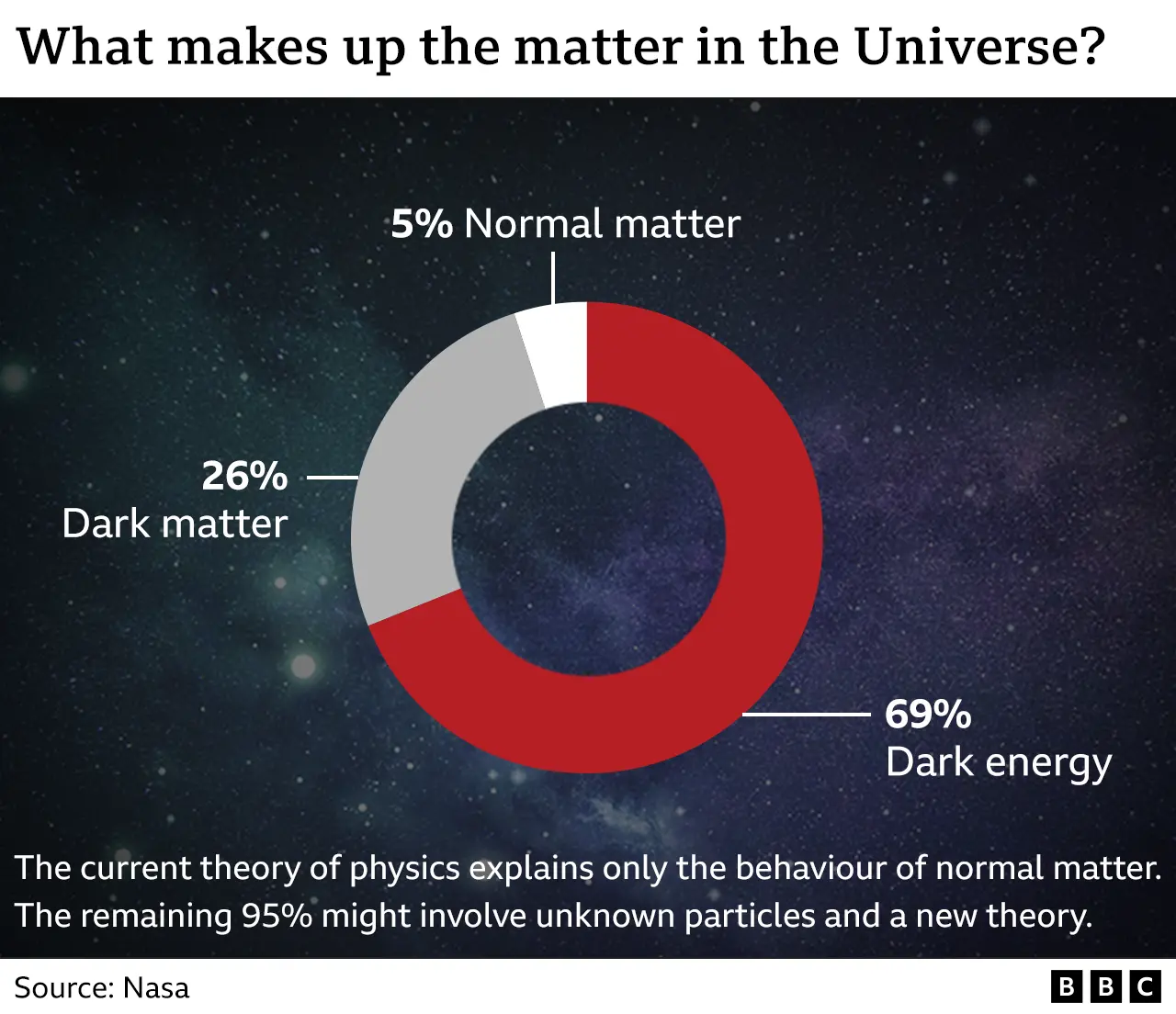
The current theoretical model for the composition of the universe is that it's made of normal matter, dark energy and dark matter. A new University of Ottawa study challenges this.

A study, published today in The Astrophysical Journal, challenges the current model of the universe by showing that, in fact, it has no room for dark matter.

In cosmology, the term "dark matter" describes all that appears not to interact with light or the electromagnetic field, or that can only be explained through gravitational force. We can't see it, nor do we know what it's made of, but it helps us understand how galaxies, planets and stars behave.

Rajendra Gupta, a physics professor at the Faculty of Science, used a combination of the covarying coupling constants (CCC) and "tired light" (TL) theories (the CCC+TL model) to reach this conclusion.

This model combines two ideas—about how the forces of nature decrease over cosmic time and about light losing energy when it travels a long distance. It's been tested and has been shown to match up with several observations, such as about how galaxies are spread out and how light from the early universe has evolved.
weatheriscool
Posts: 24516
Joined: Sun May 16, 2021 6:16 pm
Contact:

Re: Physics News and Discussions

Post by weatheriscool »

Breakthrough in melting point prediction: 100-year-old physics problem solved
https://phys.org/news/2024-03-breakthro ... oblem.html
by Queen Mary, University of London


A longstanding problem in physics has finally been cracked by Professor Kostya Trachenko of Queen Mary University of London's School of Physical and Chemical Sciences. His research, published in Physical Review E, unveils a general theory for predicting melting points, a fundamental property whose understanding has baffled scientists for over a century.
weatheriscool
Posts: 24516
Joined: Sun May 16, 2021 6:16 pm
Contact:

Re: Physics News and Discussions

Post by weatheriscool »

Quantum tornado mimics black holes' warped spacetime in the lab
By Michael Franco
March 21, 2024
https://newatlas.com/physics/quantum-to ... ack-holes/
As anyone who's ever seen a science fiction movie knows, whipping up a black hole in a laboratory doesn't seem like such a good idea.

But that didn't stop researchers in England who wanted to see if they could create something in the lab that would serve as a black hole analog and give them greater insights into the way spacetime curves near the galactic gravity gobblers.

So researchers from the University of Nottingham (UN), King's College London, and Newcastle University turned to vortices in fluids, which can, in some ways, mimic the way matter swirls around a black hole in space.

In particular, they decided to see if they could improve upon a previous method invented at UN's Black Hole Laboratory in which a vortex in a specially designed water bath shed light on a particular phenomenon known to occur around black holes known as superradiance. (You can watch that experiment in the following video from UN.)
weatheriscool
Posts: 24516
Joined: Sun May 16, 2021 6:16 pm
Contact:

Re: Physics News and Discussions

Post by weatheriscool »

Putting a new spin on 1T phase tantalum disulfide: Scientists uncover a hidden electronic state
https://phys.org/news/2024-03-1t-phase- ... tists.html
by Denise Yazak, Brookhaven National Laboratory
Research often unfolds as a multistage process. The solution to one question can spark several more, inspiring scientists to reach further and look at the larger problem from several different perspectives. Such projects can often be the catalyst for collaborations that leverage the expertise and capabilities of different teams and institutions as they grow.

For half a century, scientists have delved into the mysteries of 1T phase tantalum disulfide (1T-TaS2), an inorganic layered material with some intriguing quantum properties, like superconductivity and charge density waves (CDW).

To unlock the complex structure and behavior of this material, researchers from the Jozef Stefan Institute in Slovenia and Université Paris-Saclay in France reached out to experts utilizing the Pair Distribution Function (PDF) beamline at the National Synchrotron Light Source II (NSLS-II), a U.S. Department of Energy (DOE) Office of Science User Facility located at DOE's Brookhaven National Laboratory, to learn more about the material's structure.
User avatar
Time_Traveller
Posts: 3025
Joined: Sun May 16, 2021 4:49 pm
Location: New York City, USA, November 5th 2032 C.E.

Re: Physics News and Discussions

Post by Time_Traveller »

Cern: Scientists search for mysterious ghost particles
7 hours ago

Image

Some physicists have long suspected that mysterious 'ghost' particles in the world around us could greatly advance our understanding of the true nature of the Universe.

Now scientists think they've found a way to prove whether or not they exist.

Europe's centre for particle research, Cern, has approved an experiment designed to find evidence for them.

The new instrument will be a thousand times more sensitive to such particles than previous devices.

It will smash particles into a hard surface to detect them instead of against each other like Cern's main device the Large Hadron Collider (LHC).
https://www.bbc.co.uk/news/science-environment-68631692
“In the quantum multiverse, every choice, every decision you've ever and never made exists in an unimaginably vast ensemble of parallel universes.”
weatheriscool
Posts: 24516
Joined: Sun May 16, 2021 6:16 pm
Contact:

Re: Physics News and Discussions

Post by weatheriscool »

The world is one step closer to secure quantum communication on a global scale
https://phys.org/news/2024-03-world-clo ... lobal.html
by University of Waterloo
Researchers at the University of Waterloo's Institute for Quantum Computing (IQC) have brought together two Nobel prize-winning research concepts to advance the field of quantum communication.

Scientists can now efficiently produce nearly perfect entangled photon pairs from quantum dot sources. The research, "Oscillating photonic Bell state from a semiconductor quantum dot for quantum key distribution," was published in Communications Physics

Entangled photons are particles of light that remain connected, even across large distances, and the 2022 Nobel Prize in Physics recognized experiments on this topic. Combining entanglement with quantum dots, a technology recognized with the Nobel Prize in Chemistry in 2023, the IQC research team aimed to optimize the process for creating entangled photons, which have a wide variety of applications, including secure communications.
weatheriscool
Posts: 24516
Joined: Sun May 16, 2021 6:16 pm
Contact:

Re: Physics News and Discussions

Post by weatheriscool »

First observation of photons-to-taus in proton–proton collisions
https://phys.org/news/2024-03-photons-t ... sions.html
by CERN
In March 2024, the CMS collaboration announced the observation of two photons creating two tau leptons in proton–proton collisions. It is the first time that this process has been seen in proton–proton collisions, which was made possible by using the precise tracking capabilities of the CMS detector. It is also the most precise measurement of the tau's anomalous magnetic moment and offers a new way to constrain the existence of new physics.

The tau, sometimes called tauon, is a peculiar particle in the family of leptons. In general, leptons, together with quarks, make up the "matter" content of the Standard Model (SM). The tau was only discovered in the late 1970s at SLAC, and its associated neutrino—the tau neutrino—completed the tangible matter part upon its discovery in 2000 by the DONUT collaboration at Fermilab.
weatheriscool
Posts: 24516
Joined: Sun May 16, 2021 6:16 pm
Contact:

Re: Physics News and Discussions

Post by weatheriscool »

Unlocking visible femtosecond fiber oscillators: An advance in laser science
https://phys.org/news/2024-03-visible-f ... vance.html
by SPIE
The emergence of ultrafast laser pulse generation, marking a significant milestone in laser science, has triggered incredible progress across a wide array of disciplines, encompassing industrial applications, energy technologies, life sciences, and beyond. Among the various laser platforms that have been developed, fiber femtosecond oscillators, esteemed for their compact design, outstanding performance and cost-effectiveness have become one of the mainstream technologies for femtosecond pulse generation.

However, their operating wavelengths are predominantly limited to the infrared region, spanning from of 0.9-3.5 μm, which has, in turn, restricted their applicability in numerous applications that require light sources at visible wavelengths (390-780 nm). Expanding compact femtosecond fiber oscillators into new visible wavelengths has long been a challenging yet fervently pursued goal in laser science.
weatheriscool
Posts: 24516
Joined: Sun May 16, 2021 6:16 pm
Contact:

Re: Physics News and Discussions

Post by weatheriscool »

weatheriscool
Posts: 24516
Joined: Sun May 16, 2021 6:16 pm
Contact:

Re: Physics News and Discussions

Post by weatheriscool »

Romania center explores world's most powerful laser
https://phys.org/news/2024-03-romania-c ... erful.html
by Anne BEADE
The Romania research center houses the world's most powerful laser beam.

"Ready? Signal sent!" In the control room of a research center in Romania, engineer Antonia Toma activates the world's most powerful laser, which promises revolutionary advances in everything from the health sector to space.

The laser at the center, near the Romanian capital Bucharest, is operated by French company Thales, using Nobel prize-winning inventions.

France's Gerard Mourou and Donna Strickland of Canada won the 2018 Nobel Physics Prize for harnessing the power of lasers for advanced precision instruments in corrective eye surgery and in industry.
weatheriscool
Posts: 24516
Joined: Sun May 16, 2021 6:16 pm
Contact:

Re: Physics News and Discussions

Post by weatheriscool »

Researchers reveal evidence of transition from ergodic toward ergodic breaking dynamics
https://phys.org/news/2024-04-reveal-ev ... amics.html
by University of Science and Technology of China
A collaborative research team has reported experimental evidence of a transition from ergodic toward ergodic breaking dynamics in driven-dissipative Rydberg atomic gases. The results were published in Science Advances.

Many-body systems often relax to an equilibrium state because of ergodicity, such that an observable becomes invariant with time. In the case of robust equilibrium, the observable rapidly seeks new fixed points in phase space. However, there are exceptions, for example, in integrable and many-body localized systems, where broken ergodicity can inhibit system equilibrium and thermalization.

The study of ergodic breaking is instructive for market collapse and recovery in finance, brain epilepsy in neural networks, and early warning of critical leaps in complex systems. Rydberg atoms with long-range interactions serve as ideal many-body systems to study nonergodic many-body dynamics. In a system of driven-dissipative Rydberg atoms, the system will have a non-equilibrium long-time phase oscillation due to the aggregation of Rydberg atoms.
weatheriscool
Posts: 24516
Joined: Sun May 16, 2021 6:16 pm
Contact:

Re: Physics News and Discussions

Post by weatheriscool »

100 kilometers of quantum-encrypted transfer
https://phys.org/news/2024-04-kilometer ... ypted.html
by Technical University of Denmark
Researchers at DTU have successfully distributed a quantum-secure key using a method called continuous variable quantum key distribution (CV QKD). The researchers have managed to make the method work over a record 100 km distance—the longest distance ever achieved using the CV QKD method. The advantage of the method is that it can be applied to the existing Internet infrastructure.

Quantum computers threaten existing algorithm-based encryptions, which currently secure data transfers against eavesdropping and surveillance. They are not yet powerful enough to break them, but it's a matter of time. If a quantum computer succeeds in figuring out the most secure algorithms, it leaves an open door to all data connected via the internet. This has accelerated the development of a new encryption method based on the principles of quantum physics.

But to succeed, researchers must overcome one of the challenges of quantum mechanics—ensuring consistency over longer distances. Continuous variable quantum key distribution has so far worked best over short distances.

"We have achieved a wide range of improvements, especially regarding the loss of photons along the way. In this experiment, published in Science Advances, we securely distributed a quantum-encrypted key 100 kilometers via fiber optic cable. This is a record distance with this method," says Tobias Gehring, an associate professor at DTU, who, together with a group of researchers at DTU, aims to be able to distribute quantum-encrypted information around the world via the internet.
weatheriscool
Posts: 24516
Joined: Sun May 16, 2021 6:16 pm
Contact:

Re: Physics News and Discussions

Post by weatheriscool »

Post Reply