Natural History (13.8 billion years BC – 3.3 million BC)

Got something to say about the past? Say it here!
User avatar
caltrek
Posts: 9378
Joined: Mon May 17, 2021 1:17 pm

Re: Natural History (13.8 billion years BC – 3.3 million BC)

Post by caltrek »

Scientists Uncover a Multibillion-year Epic Written Into the Chemistry of Life
May 28, 2024

Introduction:
(Eurekalert) The origin of life on Earth has long been a mystery that has eluded scientists. A key question is how much of the history of life on Earth is lost to time. It is quite common for a single species to "phase out" using a biochemical reaction, and if this happens across enough species, such reactions could effectively be "forgotten" by life on Earth. But if the history of biochemistry is rife with forgotten reactions, would there be any way to tell? This question inspired researchers from the Earth-Life Science Institute (ELSI) at the Tokyo Institute of Technology, and the California Institute of Technology (CalTech) in the USA. They reasoned that forgotten chemistry would appear as discontinuities or "breaks" in the path that chemistry takes from simple geochemical molecules to complex biological molecules.

The early Earth was rich in simple compounds such as hydrogen sulfide, ammonia, and carbon dioxide – molecules not usually associated with sustaining life. But, billions of years ago, early life relied on these simple molecules as a raw material source. As life evolved, biochemical processes gradually transformed these precursors into compounds still found today. These processes represent the earliest metabolic pathways.

In order to model the history of biochemistry, ELSI researchers – Specially Appointed Associate Professor Harrison B. Smith, Specially Appointed Associate Professor Liam M. Longo and Associate Professor Shawn Erin McGlynn, in collaboration with Research Scientist Joshua Goldford from CalTech – needed an inventory of all known biochemical reactions, to understand what types of chemistry life is able to perform. They turned to the Kyoto Encyclopedia of Genes and Genomes database, which has catalogued more than 12,000 biochemical reactions. With reactions in hand, they began to model the stepwise development of metabolism.

Read more here: https://www.eurekalert.org/news-releases/1045545
Don't mourn, organize.

-Joe Hill
User avatar
caltrek
Posts: 9378
Joined: Mon May 17, 2021 1:17 pm

Re: Natural History (13.8 billion years BC – 3.3 million BC)

Post by caltrek »

Origins of Welsh Dragons Finally Exposed by Experts
May 30, 2024

Introduction:
(Eurekalert) A large fossil discovery has helped shed light on the history of dinosaurs in Wales.

Until recently, the land of the dragon didn’t have any dinosaurs. However, in the last ten years, several dinosaurs have been reported, but their life conditions were not well known. In a new study by a team from the University of Bristol and published in Proceedings of the Geologists’ Association, important details have been revealed for the first time.

They found that early Welsh dinosaurs from over 200 million year ago lived on a tropical lowland beside the sea. Dinosaur trackways are known from Barry and other sites nearby, showing that dinosaurs had walked across the warm lowlands.

The discovery was made at Lavernock Point, close to Cardiff and Penarth, where the cliffs of dark-coloured shales and limestones document ancient shallow seas. At several levels, there are accumulations of bones, including the remains of fish, sharks, marine reptiles and occasionally, dinosaurs.
Former student of the Bristol MSc in Palaeobiology Owain Evans led the study. He explained: “The bone bed paints the picture of a tropical archipelago, which was subjected to frequent storms, that washed material from around the surrounding area, both in land and out at sea, into a tidal zone. This means that from just one fossil horizon, we can reconstruct a complex ecological system, with a diverse array of marine reptiles like ichthyosaurs, plesiosaurs and placodonts in the water, and dinosaurs on land.
Read more here: https://www.eurekalert.org/news-releases/1046497
Don't mourn, organize.

-Joe Hill
weatheriscool
Posts: 24930
Joined: Sun May 16, 2021 6:16 pm
Contact:

Re: Natural History (13.8 billion years BC – 3.3 million BC)

Post by weatheriscool »

World's oldest skin preserved in extraordinarily rare fossil find
By Michael Irving
June 01, 2024
https://newatlas.com/biology/worlds-old ... -dinosaur/
Scientists have discovered the oldest known skin fossils, dating back long before the dinosaurs. The samples, found in a cave in Oklahoma, USA, show that reptile scales haven’t changed much in the last 286 million years.

The majority of fossils we see in museums are skeletons, and the reason is pretty simple: bones don’t decompose very quickly, so they have more time to fossilize. Soft tissues like skin, muscle and organs usually rot away or are eaten by scavengers soon after death, so we don’t find those often.

But under the right circumstances, it can happen. Bury it quickly enough in just the right medium and you can end up with a feathered dinosaur tail preserved in amber, a 133-million-year-old brain pickled in a bog, and a nodosaur still sporting skin and scales that looks like it’s just taking a nap.
weatheriscool
Posts: 24930
Joined: Sun May 16, 2021 6:16 pm
Contact:

Re: Natural History (13.8 billion years BC – 3.3 million BC)

Post by weatheriscool »

New vestiges of the first life on Earth discovered in Saudi Arabia
https://phys.org/news/2024-05-vestiges- ... rabia.html
by Arianna Soldati, Geological Society of America
Stromatolites are the earliest geological record of life on Earth. These curious biotic structures are made of algae carpets growing toward the light and precipitating carbonates. After their first appearance 3.48 Ga ago, stromatolites dominated the planet as the sole living carbonate factory for almost three billion years.

Stromatolites are also partially responsible for the Great Oxygenation Event, which drastically changed the composition of our atmosphere by introducing oxygen. That oxygen initially wiped out stromatolites' competition, enabling their prominence in the Archean and early Proterozoic environment. However, as more life forms adapted their metabolism to an oxygenated atmosphere, stromatolites started to decline, popping up in the geologic record only after mass extinctions or in difficult environments.
User avatar
caltrek
Posts: 9378
Joined: Mon May 17, 2021 1:17 pm

Re: Natural History (13.8 billion years BC – 3.3 million BC)

Post by caltrek »

New Dinosaur Species Found in Zimbabwe
by Gregory Filiano
June 4, 2024

Introduction:
(Futurity) A completely new sauropodomorph dinosaur has been identified in Zimbabwe. The discovery is only the fourth dinosaur species discovered in that country.

Long-necked herbivorous dinosaurs are known as sauropodomorphs. They were a group of mainly bipedal dinosaurs that lived some 210 million years ago in the Late Triassic.

Kimberley (Kimi) Chapelle, assistant professor in the anatomical sciences department in the Renaissance School of Medicine at Stony Brook University, is part of the international team of scientists that discovered and identified the find, named Musankwa sanyatiensis.

The discovery of Musankwa sanyatiensis is particularly significant as it is the first dinosaur to be named from the Mid-Zambezi Basin of northern Zimbabwe in more than 50 years. The fossil follows only these previous dinosaur discoveries in the region: Syntarsus rhodesiensis in 1969, Vulcanodon karibaensis in 1972, and Mbiresaurus raathi in 2022.

Musankwa sanyatiensis is represented by the remains of a single hind leg, including its thigh, shin, and ankle bones.
Read more here: https://www.futurity.org/sauropodomorp ... ource=rss
Don't mourn, organize.

-Joe Hill
User avatar
wjfox
Site Admin
Posts: 13745
Joined: Sat May 15, 2021 6:09 pm
Location: Essex, UK
Contact:

Re: Natural History (13.8 billion years BC – 3.3 million BC)

Post by wjfox »

weatheriscool
Posts: 24930
Joined: Sun May 16, 2021 6:16 pm
Contact:

Re: Natural History (13.8 billion years BC – 3.3 million BC)

Post by weatheriscool »

246-million-year-old giant sea lizard is oldest to be found in the region
By Bronwyn Thompson
June 18, 2024
https://newatlas.com/biology/nothosaur-sea-reptile/
A single vertebra dug out of a boulder in a stream below a mountain in New Zealand in 1978 has now been found to have belonged to the oldest known sea reptile in the Southern Hemisphere, where no record of these huge beasts had existed until now. It dates back 246 million years, making it the oldest ever found in the region.

Paleontologists from Uppsala University in Sweden, as well as Norway, NZ, Australia and East Timor made this discovery when analyzing a collection of fossils that lacked accurate identification. Through analysis and phylogenic work, the team placed this piece of vertebra as one belonging to a nothosaur, who inhabited the southern polar coast in the super-ocean of Panthalassa.

"The nothosaur found in New Zealand is over 40 million years older than the previously oldest known sauropterygian fossils from the Southern Hemisphere," said Benjamin Kear from The Museum of Evolution at Uppsala University and lead author on the study. "We show that these ancient sea reptiles lived in a shallow coastal environment teeming with marine creatures within what was then the southern polar circle."
weatheriscool
Posts: 24930
Joined: Sun May 16, 2021 6:16 pm
Contact:

Re: Natural History (13.8 billion years BC – 3.3 million BC)

Post by weatheriscool »

User avatar
caltrek
Posts: 9378
Joined: Mon May 17, 2021 1:17 pm

Re: Natural History (13.8 billion years BC – 3.3 million BC)

Post by caltrek »

508-Million-Year-Old “Pompeii” Trilobite Fossils Show Never-Before-Seen Features
by Rachael Funnel
June 28, 2024

Introduction:
(IFL Science) Trilobites that date back 508 million years have been found preserved in volcanic matter, revealing never-before-seen details in 3D form. Their fossilization was so rapid that tiny shells have been preserved in situ, and soft tissues including mouthparts and internal organs can still be seen.

The trilobites were entombed in pyroclastic flow, which is the hot, dense material that comes hurtling out of volcanoes sometimes reaching speeds as high as 200 meters (656 feet) per second. Typically, it burns up any life in its path, but that can change in a marine setting.

“The surface of the sea on which the ash flowed would have been lethally hot and, yes, would have incinerated animals at the shallowest depths,” study co-author Dr Greg Edgecombe of the Natural History Museum, London, told IFLScience. “The ash would have mixed with seawater as it picked up and entrained the trilobites, which were living on the sea bottom. This mixing through a column of seawater must have cooled the ash sufficiently.”

Collected in the High Atlas of Morocco, the ancient wonders have been nicknamed “Pompeii” trilobites due to their remarkable preservation in the ash. They’re incredibly old, but they aren’t the oldest trilobites ever found.

At around 508 million years old, they’re younger than the oldest trilobites, which date back to about 521 million years old. There are also older trace fossils in the form of burrows, called Rusophycus, that are thought to be the work of trilobites and exceed 528 million years in age.
Read more here: https://www.iflscience.com/508-million ... es-74868


Don't mourn, organize.

-Joe Hill
weatheriscool
Posts: 24930
Joined: Sun May 16, 2021 6:16 pm
Contact:

Re: Natural History (13.8 billion years BC – 3.3 million BC)

Post by weatheriscool »

Giant swamp monster was a top predator before the dinosaurs
By Michael Irving
July 04, 2024
https://newatlas.com/biology/gaiasia-je ... p-monster/
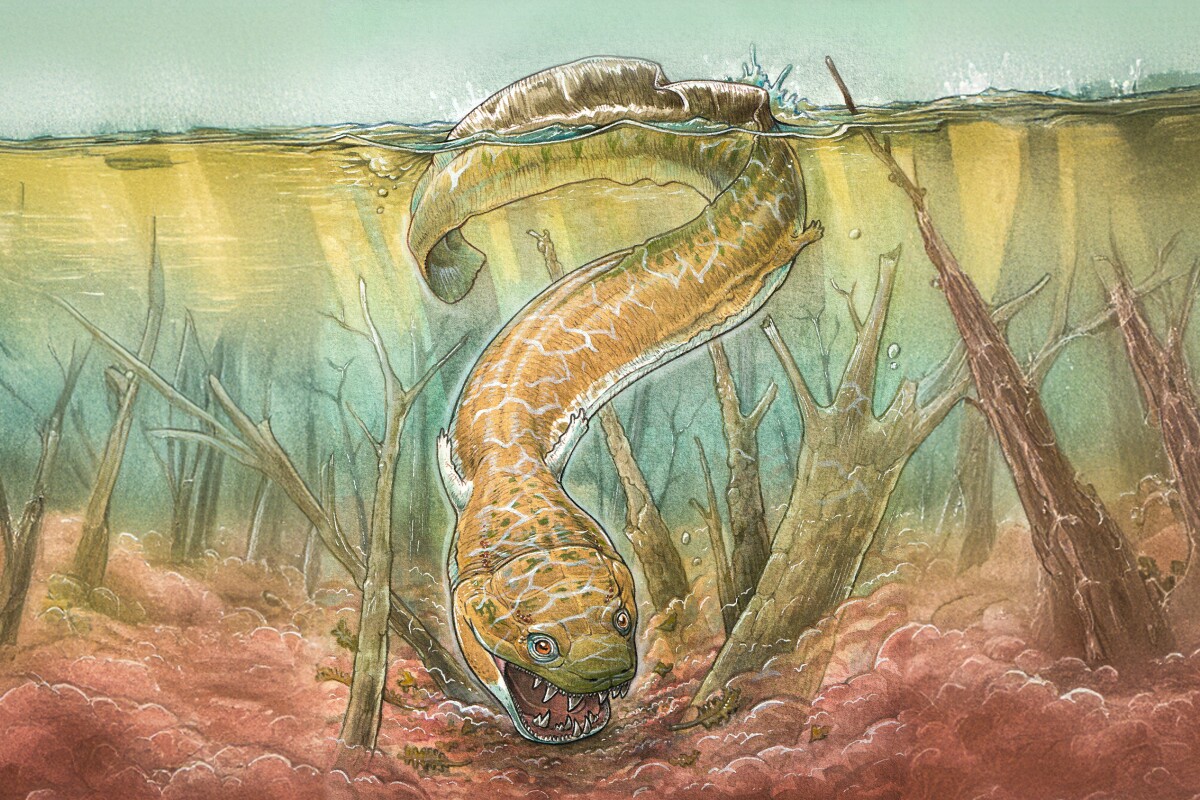
Long before dinosaurs roamed the Earth, another giant predator claimed the top spot in its environment. Meet Gaiasia, a huge salamander-like creature that stalked the Permian swamps.

In case you’re picturing a cute little axolotl, Gaiasia jennyae was anything but. This ancient amphibian measured about 2.5 m (8.2 ft) long, and judging by the skull and jaw structure it could have chomped down on even large prey that wandered too close.
Image
“Gaiasia jennyae was considerably larger than a person, and it probably hung out near the bottom of swamps and lakes,” said Jason Pardo, co-lead author of the study. “It’s got a big, flat, toilet seat-shaped head, which allows it to open its mouth and suck in prey. It has these huge fangs, the whole front of the mouth is just giant teeth. It’s a big predator, but potentially also a relatively slow ambush predator.”
weatheriscool
Posts: 24930
Joined: Sun May 16, 2021 6:16 pm
Contact:

Re: Natural History (13.8 billion years BC – 3.3 million BC)

Post by weatheriscool »

Archaeologists report earliest evidence for plant farming in east Africa
https://phys.org/news/2024-07-archaeolo ... -east.html
by Washington University in St. Louis

A trove of ancient plant remains excavated in Kenya helps explain the history of plant farming in equatorial eastern Africa, a region long thought to be important for early farming but where scant evidence from actual physical crops has been previously uncovered.

In a study published in the Proceedings of the Royal Society B, archaeologists from Washington University in St. Louis, the University of Pittsburgh and their colleagues report the largest and most extensively dated archaeobotanical record from interior east Africa.

Up until now, scientists have had virtually no success in gathering ancient plant remains from east Africa and, as a result, have had little idea where and how early plant farming got its start in the large and diverse area comprising Kenya, Tanzania and Uganda.
User avatar
Powers
Posts: 1183
Joined: Fri Apr 07, 2023 7:32 pm
Location: a.k.a Lurking, Member, Lorem Ipsum, ..., --- and ººº.

Re: Natural History (13.8 billion years BC – 3.3 million BC)

Post by Powers »

weatheriscool wrote: Wed Jul 10, 2024 12:00 am Archaeologists report earliest evidence for plant farming in east Africa
https://phys.org/news/2024-07-archaeolo ... -east.html
by Washington University in St. Louis

A trove of ancient plant remains excavated in Kenya helps explain the history of plant farming in equatorial eastern Africa, a region long thought to be important for early farming but where scant evidence from actual physical crops has been previously uncovered.

In a study published in the Proceedings of the Royal Society B, archaeologists from Washington University in St. Louis, the University of Pittsburgh and their colleagues report the largest and most extensively dated archaeobotanical record from interior east Africa.

Up until now, scientists have had virtually no success in gathering ancient plant remains from east Africa and, as a result, have had little idea where and how early plant farming got its start in the large and diverse area comprising Kenya, Tanzania and Uganda.
In particular, the remnants of cowpea discovered at Kakapel rock shelter and directly dated to 2,300 years ago constitute the earliest documented arrival of a domesticated crop—and presumably of farming lifeways—to eastern Africa. Cowpea is assumed to have originated in west Africa and to have arrived in the Lake Victoria basin concurrent with the spread of Bantu-speaking peoples migrating from central Africa, the study authors said.
firestar464
Posts: 7393
Joined: Wed Oct 12, 2022 7:45 am

Re: Natural History (13.8 billion years BC – 3.3 million BC)

Post by firestar464 »

A new species of extinct crocodile relative rewrites life on the Triassic coastline

https://phys.org/news/2024-07-species-e ... -life.html
User avatar
caltrek
Posts: 9378
Joined: Mon May 17, 2021 1:17 pm

Re: Natural History (13.8 billion years BC – 3.3 million BC)

Post by caltrek »

Research Reveals the Most Complete Dinosaur Discovered in the UK in a Century
July 10, 2024

Introduction:
(Eurekalert) The most complete dinosaur discovered in this country in the last 100 years, with a pubic hip bone the size of a ‘dinner plate’, has been described in a new paper published today.

The specimen, which is around 125 million years old, was found in the cliffs of Compton Bay on the Isle of Wight in 2013 by fossil collector Nick Chase, before he tragically died of cancer.

Jeremy Lockwood, a retired GP and University of Portsmouth PhD student, helped with the dinosaur’s excavation and has spent years analysing the 149 different bones that make up the skeleton.

Jeremy determined that the skeleton represented a new genus and species, which he named Comptonatus chasei in tribute to Nick.

Jeremy said: “Nick had a phenomenal nose for finding dinosaur bones - he really was a modern-day Mary Anning. He collected fossils daily in all weathers and donated them to museums. I was hoping we’d spend our dotage collecting together as we were of similar ages, but sadly that wasn’t to be the case.
Read more here: https://www.eurekalert.org/news-releases/1050945
Don't mourn, organize.

-Joe Hill
User avatar
caltrek
Posts: 9378
Joined: Mon May 17, 2021 1:17 pm

Re: Natural History (13.8 billion years BC – 3.3 million BC)

Post by caltrek »

University of Bristol Study Finds Life on Earth Emerged 4.2 Billion Years Ago
by Michelle Starr
July 12, 2024

Introduction:
(Science Alert) Once upon a time, Earth was barren. Everything changed when, somehow, out of the chemistry available early in our planet's history, something started squirming – processing available matter to survive, to breed, to thrive.

What that something was, and when it first squirmed, have been burning questions that have puzzled humanity probably for as long as we've been able to ask "what am I?"

Now, a new study has found some answers – and life emerged surprisingly early.

By studying the genomes of organisms that are alive today, scientists have determined that the last universal common ancestor (LUCA), the first organism that spawned all the life that exists today on Earth, emerged as early as 4.2 billion years ago.

Earth, for context, is around 4.5 billion years old. That means life first emerged when the planet was still practically a newborn.
Read more here: https://www.sciencealert.com/gobsmacki ... ears-ago
Don't mourn, organize.

-Joe Hill
User avatar
caltrek
Posts: 9378
Joined: Mon May 17, 2021 1:17 pm

Re: Natural History (13.8 billion years BC – 3.3 million BC)

Post by caltrek »

Clues Hint Newly Discovered Dinosaur Lived Underground
by Tracey Peake
July 12, 2024

Introduction:
(Futurity) A newly discovered ancestor of Thescelosaurus shows evidence that these animals spent at least part of their time in underground burrows.

The new species contributes to a fuller understanding of life during the mid-Cretaceous—both above and below ground.

The new dinosaur, Fona [/Foat’NAH/] herzogae lived 99 million years ago in what is now Utah. At that time, the area was a large floodplain ecosystem sandwiched between the shores of a massive inland ocean to the east and active volcanoes and mountains to the west. It was a warm, wet, muddy environment with numerous rivers running through it.

Paleontologists from North Carolina State University and the North Carolina Museum of Natural Sciences unearthed the fossil—and other specimens from the same species—in the Mussentuchit Member of the Cedar Mountain Formation, beginning in 2013. The preservation of these fossils, along with some distinguishing features, alerted them to the possibility of burrowing.

Fona was a small-bodied, plant-eating dinosaur about the size of a large dog with a simple body plan. It lacks the bells and whistles that characterize its highly ornamented relatives such as horned dinosaurs, armored dinosaurs, and crested dinosaurs. But that doesn’t mean Fona was boring.
Read more here: https://www.futurity.org/new-dinosaur- ... -3238272/
Don't mourn, organize.

-Joe Hill
User avatar
Time_Traveller
Posts: 3025
Joined: Sun May 16, 2021 4:49 pm
Location: New York City, USA, November 5th 2032 C.E.

Re: Natural History (13.8 billion years BC – 3.3 million BC)

Post by Time_Traveller »

Rare fossils reveal secrets of mammal evolution
3 hours ago

Image

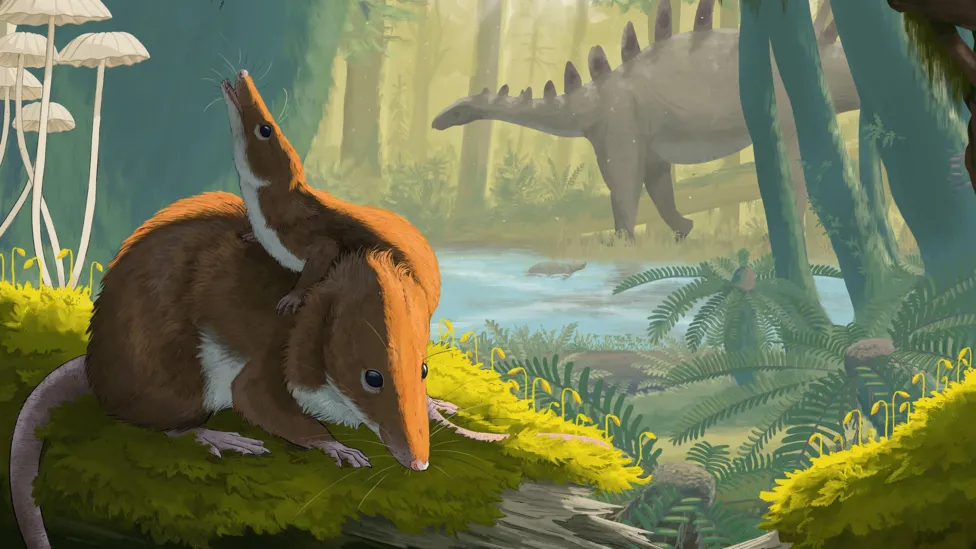
Two incredibly rare fossils found on Scotland's Isle of Skye are rewriting our understanding of how mammals evolved.

While modern small mammals live as little as a year, one of the first to roam the earth, alongside dinosaurs, could reach seven years and beyond, scientists have discovered.

Only a handful of fossils of the primitive shrew-like mammal, Krusatodon, have ever been found, including two exceptionally complete skeletons of a juvenile and an adult from Skye.

By studying fossils of the earliest mammals, scientists hope to unlock the secrets of how they rose to become super successful animals occupying every habitat on the planet.

The researchers used hi-tech X-ray imaging to peer through rock and study growth patterns in the teeth of the two fossils, much like counting tree rings.
https://www.bbc.co.uk/news/articles/c0xj65nelv0o
“In the quantum multiverse, every choice, every decision you've ever and never made exists in an unimaginably vast ensemble of parallel universes.”
User avatar
wjfox
Site Admin
Posts: 13745
Joined: Sat May 15, 2021 6:09 pm
Location: Essex, UK
Contact:

Re: Natural History (13.8 billion years BC – 3.3 million BC)

Post by wjfox »

Tyrannosaurus rex could have been even bigger than previously thought, study suggests

Wednesday 24 July 2024 23:06, UK

Tyrannosaurus rex could have been even bigger than previously thought, new research suggests.

Scientists now believe the dinosaur could have been 70% heavier and 25% longer.

The largest of the species may have weighed roughly 15 tonnes instead of 8.8, and measured 15 metres instead of 12.

Dr Jordan Mallon, of the Canadian Museum of Nature in Ottawa, said scientists "really have no idea from the fossil record about the absolute sizes they might have reached".

"It's fun to think about a 15 tonne T. rex, but the implications are also interesting from a biomechanical or ecological perspective," he added.

https://news.sky.com/story/tyrannosauru ... s-13184470


Image
User avatar
Time_Traveller
Posts: 3025
Joined: Sun May 16, 2021 4:49 pm
Location: New York City, USA, November 5th 2032 C.E.

Re: Natural History (13.8 billion years BC – 3.3 million BC)

Post by Time_Traveller »

Half-a-billion-year-old slug with spikes reveals origins of molluscs
Thursday 1 August 2024 18:59, UK

Image

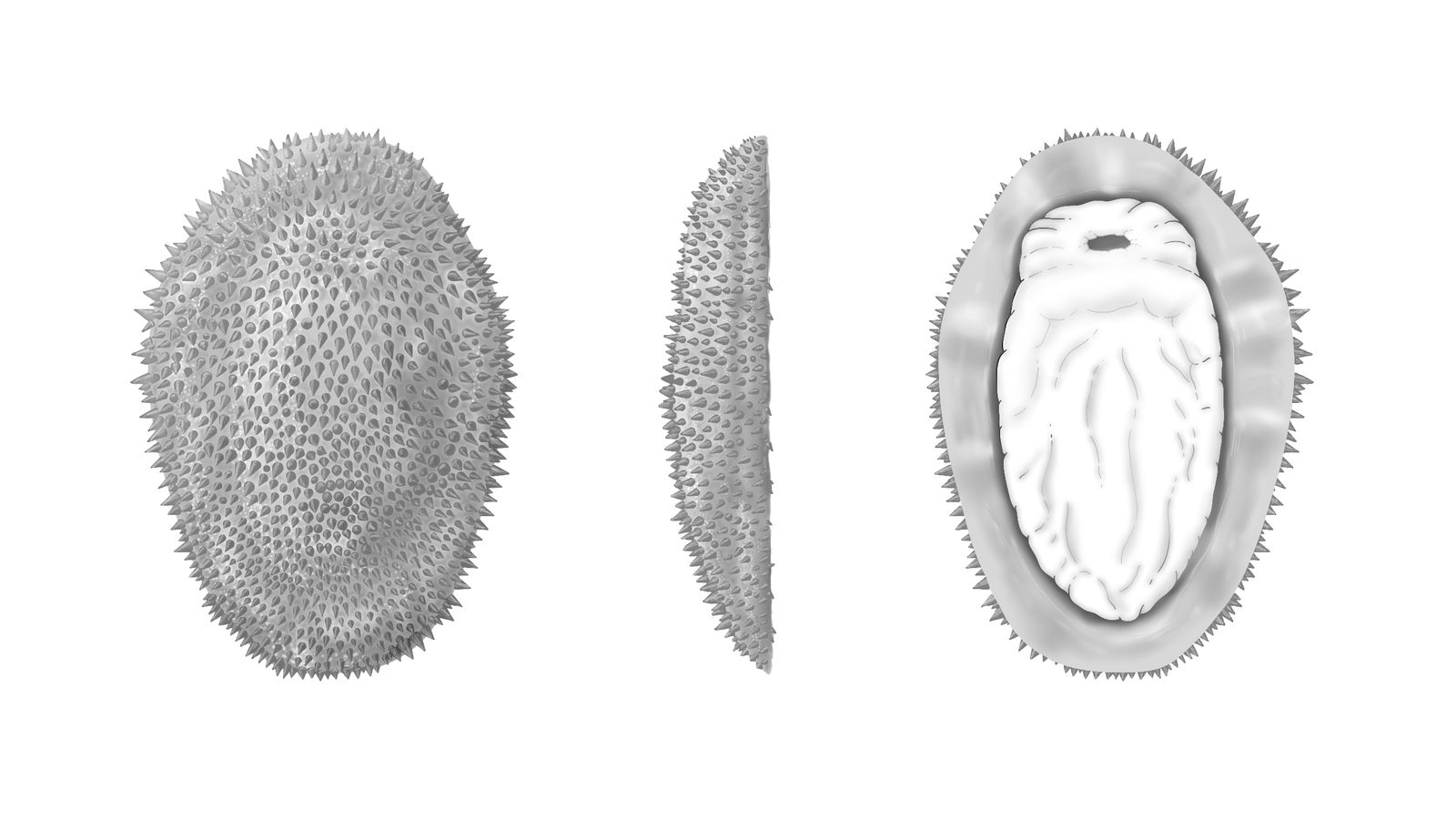
The discovery of a half-a-billion-year-old slug with spines has shed light on the origins of animals like oysters and octopuses, researchers have said.

The new fossil, called Shishania aculeata, reveals that the earliest molluscs (animals that do not have a backbone) were flat, shell-less slugs covered in a protective spiny armour.

Underneath, the animal was made up of a muscular foot, like that of a slug, and would have used it to crawl across the seabed, experts suggest in a new study.

The species was found in well-preserved fossils from eastern Yunnan Province in southern China and dates back to a geological period called the early Cambrian, approximately 514 million years ago.

Unlike most molluscs, Shishania did not have a shell that covered its body, suggesting that it represents a very early stage in the evolution of the animal.
https://news.sky.com/story/half-a-billi ... s-13188853
“In the quantum multiverse, every choice, every decision you've ever and never made exists in an unimaginably vast ensemble of parallel universes.”
User avatar
Time_Traveller
Posts: 3025
Joined: Sun May 16, 2021 4:49 pm
Location: New York City, USA, November 5th 2032 C.E.

Re: Natural History (13.8 billion years BC – 3.3 million BC)

Post by Time_Traveller »

Complex life on Earth began around 1.5 billion years earlier than thought, study claims
Monday 29 July 2024 11:42, UK

Image

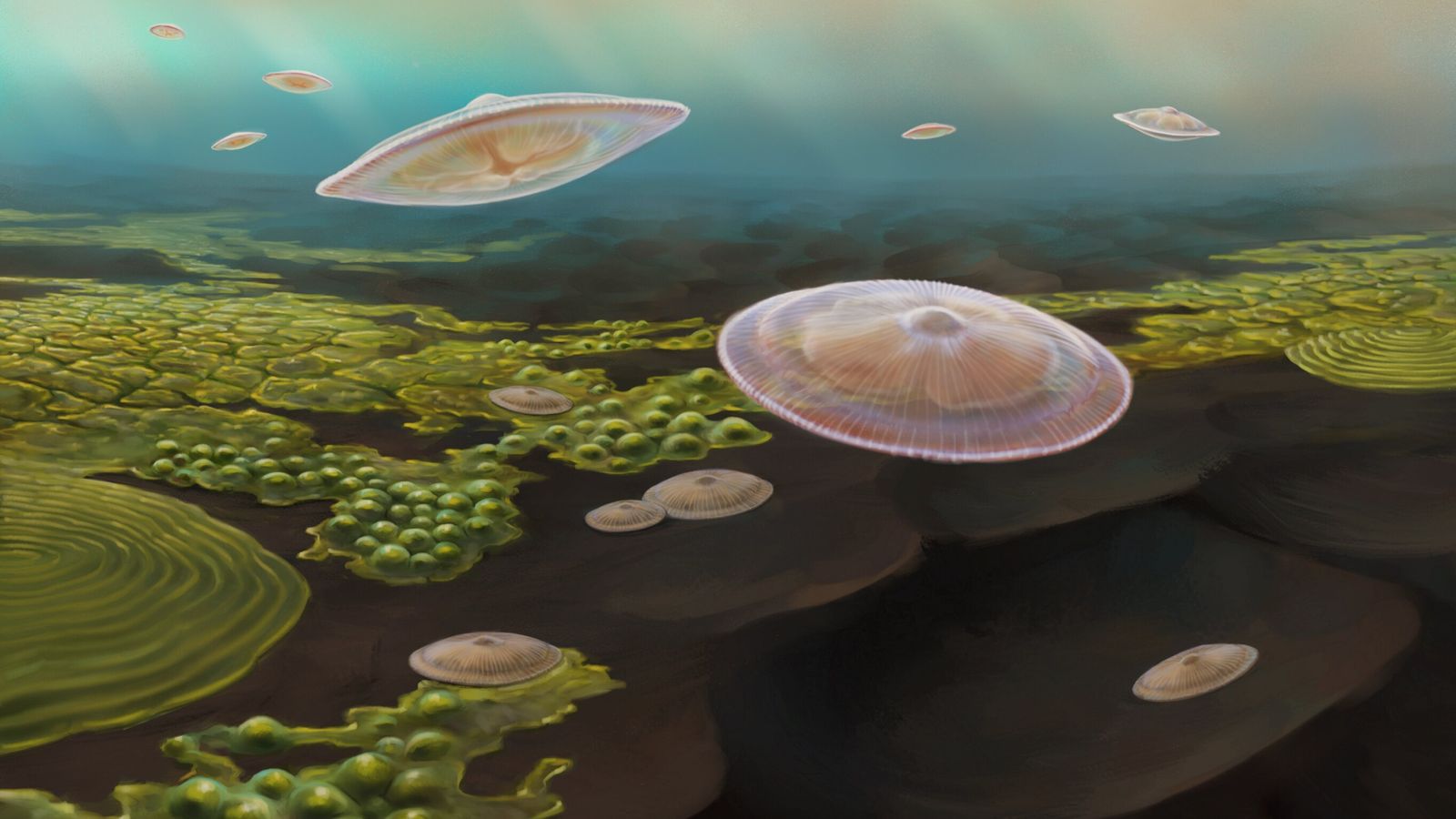
Complex life on Earth began around 1.5 billion years earlier than thought, according to a new study.

Scientists were broadly of the view that animals first emerged on Earth 635 million years ago, but the latest study, led by a research team at Cardiff University, has found signs of a much earlier ecosystem.

The ecosystem was found in the Franceville Basin near Gabon.

The study uncovers environmental evidence of the very first experiments in the evolution of complex life.

It describes an episode of unique underwater volcanic activity after two continents collided.
https://news.sky.com/story/complex-life ... s-13186690
“In the quantum multiverse, every choice, every decision you've ever and never made exists in an unimaginably vast ensemble of parallel universes.”
Post Reply