https://www.sciencealert.com/a-human-ge ... -cave-dirt13 JULY 2021
A cup of mud that has been buried beneath the floor of a cave for millennia has just yielded up the genome of an ancient human.
Analysis reveals traces of a woman who lived 25,000 years ago, before the last Ice Age; and, although we don't know much about her, she represents a significant scientific achievement: the feasibility of identifying ancient human populations even when there are no bones to recover.
The sample also yielded DNA from wolf and bison species, which an international team of scientists were able to place in the context of their population histories.
"Our results," they wrote in their paper, "provide new insights into the Late Pleistocene genetic histories of these three species and demonstrate that direct shotgun sequencing of sediment DNA, without target enrichment methods, can yield genome-wide data informative of ancestry and phylogenetic relationships."
The recovery of ancient DNA has typically relied rather a lot on bones, and luck. First, you need the bones to have survived, and survived intact enough to preserve DNA over many thousands of years.
Human Prehistory (3.3 million years BC – 3500 BC)
-
Time_Traveller

- Posts: 3025
- Joined: Sun May 16, 2021 4:49 pm
- Location: New York City, USA, November 5th 2032 C.E.
Re: Human Prehistory (3.3 million years BC – 3500 BC)
The Genome of a Human From an Unknown Population Has Been Recovered From Cave Dirt
“In the quantum multiverse, every choice, every decision you've ever and never made exists in an unimaginably vast ensemble of parallel universes.”
-
Time_Traveller
- Posts: 3025
- Joined: Sun May 16, 2021 4:49 pm
- Location: New York City, USA, November 5th 2032 C.E.
Re: Human Prehistory (3.3 million years BC – 3500 BC)
Morocco team hails stone age tool site dating back 1.3m years
https://www.theguardian.com/world/2021/ ... -13m-yearsWed 28 Jul 2021
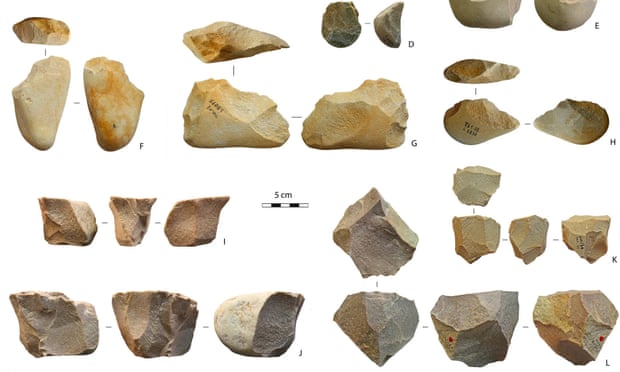
Archaeologists in Morocco have announced the discovery of north Africa’s oldest stone age hand-axe manufacturing site, dating back 1.3m years, an international team has reported.
The find pushes back by hundreds of thousands of years the start date in north Africa of the Acheulian stone-tool industry, associated with the human ancestor Homo erectus, researchers told journalists in Rabat on Wednesday.
The discovery was made during excavations at a quarry on the outskirts of Morocco’s economic capital, Casablanca.
This “contributes to enriching the debate on the emergence of the Acheulian in Africa,” said Abderrahim Mohib, the co-director of the Franco-Moroccan prehistory of Casablanca programme.
“In the quantum multiverse, every choice, every decision you've ever and never made exists in an unimaginably vast ensemble of parallel universes.”
-
weatheriscool
- Posts: 25737
- Joined: Sun May 16, 2021 6:16 pm
- Contact:
Re: Human Prehistory (3.3 million years BC – 3500 BC)
Remains of ancient dogs found among early human ancestral remains in Georgia
https://phys.org/news/2021-07-ancient-d ... stral.html
by Bob Yirka , Phys.org
https://phys.org/news/2021-07-ancient-d ... stral.html
by Bob Yirka , Phys.org
A team of researchers from Italy, Spain and Georgia has found the remains of ancient hunting dogs at a dig site in what is now modern Georgia. In their paper published in the journal Scientific Reports, the group describes the fossils they found, their attempts to classify them and the possibility of the dogs interacting with early human ancestors.
Prior research has shown that a type of ancient hunting dog evolved millions of years ago in parts of Asia and then migrated into parts of Europe and Africa. Prior evidence also has shown that the dogs were quite large and likely engaged in social behaviors such as pack hunting. Prior research has also led to the discovery of the remains of ancient human ancestors near the Georgian village of Dmanisi—the oldest ever found outside of Africa. In this new study, the researchers found evidence of the hunting dogs living in the vicinity of the human ancestors at Dmanisi approximately 1.8 million years ago.

Re: Human Prehistory (3.3 million years BC – 3500 BC)
Mapping the Biography of an Ancient Wooly Mammoth
by Tessa Koumoundouros
August 12, 2021
[https://www.sciencealert.com/researcher ... oth-s-tusk][/url]
Extract:
by Tessa Koumoundouros
August 12, 2021
[https://www.sciencealert.com/researcher ... oth-s-tusk][/url]
Extract:
(Science Alert) Like rings of a tree, each tusk layer records another page of the mammoth's life, written in the language of atoms.
To decipher this diary, University of Alaska paleoecologist Matthew Wooller, Druckenmiller, and colleagues used ~340,000 measurements of strontium isotopes that the ancient mammoth incorporated into its tusks from food and the environment.
Unique ratios between the isotopes of strontium (87Sr/86Sr) provide fingerprints of locations that change little across the millennia, the researchers explain. Alaskan isotope location data has been mapped from the teeth of rodents that generally stay in one location their entire life.
Comparing the mammoth's strontium and oxygen isotope data to this map, the researchers were able to obtain information on the mammoth's movements, down to the incredible resolution of a week.
…
The mammoth seems to have frequented different areas during different stages of its life. The 10 cm (approx. 4 inch) tusk tip shows it spent the first year of its life in the Yukon River basin in interior Alaska, moving very little.
Don't mourn, organize.
-Joe Hill
-Joe Hill
-
Time_Traveller
- Posts: 3025
- Joined: Sun May 16, 2021 4:49 pm
- Location: New York City, USA, November 5th 2032 C.E.
Re: Human Prehistory (3.3 million years BC – 3500 BC)
Ancient woman's DNA challenges scientists' long-held theories about early humans
https://news.sky.com/story/ancient-woma ... s-12391892Friday 27 August 2021
Archaeologists have analysed DNA found in the remains of a woman who died 7,200 years ago in Indonesia - challenging previous theories around the migration of early humans.
The remains of the teenager, nicknamed Besse, were discovered in the Leang Panninge cave on Sulawesi in 2015.
It is believed to be the first time ancient human DNA has been discovered in Wallacea, a group of islands between mainland Asia and Australia.
Archaeologists excavate at Leang Panninge cave on Sulawesi. Pic: Leang Panninge Research Project
Scientists previously thought a group called Austronesians had spread East Asian genes through Wallacea around 3,500 years ago.
But the discovery of Besse suggests people with East Asian genes may have been there long before that.
“In the quantum multiverse, every choice, every decision you've ever and never made exists in an unimaginably vast ensemble of parallel universes.”
-
weatheriscool
- Posts: 25737
- Joined: Sun May 16, 2021 6:16 pm
- Contact:
Re: Human Prehistory (3.3 million years BC – 3500 BC)
Scientists find evidence of humans making clothes 120,000 years ago
https://www.theguardian.com/science/202 ... -years-ago
Last modified on Thu 16 Sep 2021 12.18 EDT
https://www.theguardian.com/science/202 ... -years-ago
Last modified on Thu 16 Sep 2021 12.18 EDT
From the medieval fashion for pointy shoes to Victorian waist-squeezing corsets and modern furry onesies, what we wear is a window to our past.
Now researchers say they have found some of the earliest evidence of humans using clothing in a cave in Morocco, with the discovery of bone tools and bones from skinned animals suggesting the practice dates back at least 120,000 years.
Dr Emily Hallett, of the Max Planck Institute for the Science of Human History in Germany, the first author of the study, said the work reinforced the view that early humans in Africa were innovative and resourceful.
An exhibit shows the life of a neanderthal family in the Neanderthal Museum in Krapina, Croatia
Who invented clothes? A Palaeolithic archaeologist answers
Read more
“Our study adds another piece to the long list of hallmark human behaviours that begin to appear in the archaeological record of Africa around 100,000 years ago,” she said.
Re: Human Prehistory (3.3 million years BC – 3500 BC)
Newly Reviewed Evidence Suggests Humans Were in North America 21,000 Years Ago
by David Wells
September 23, 2021
https://www.courthousenews.com/new-evid ... years-ago/
Introduction: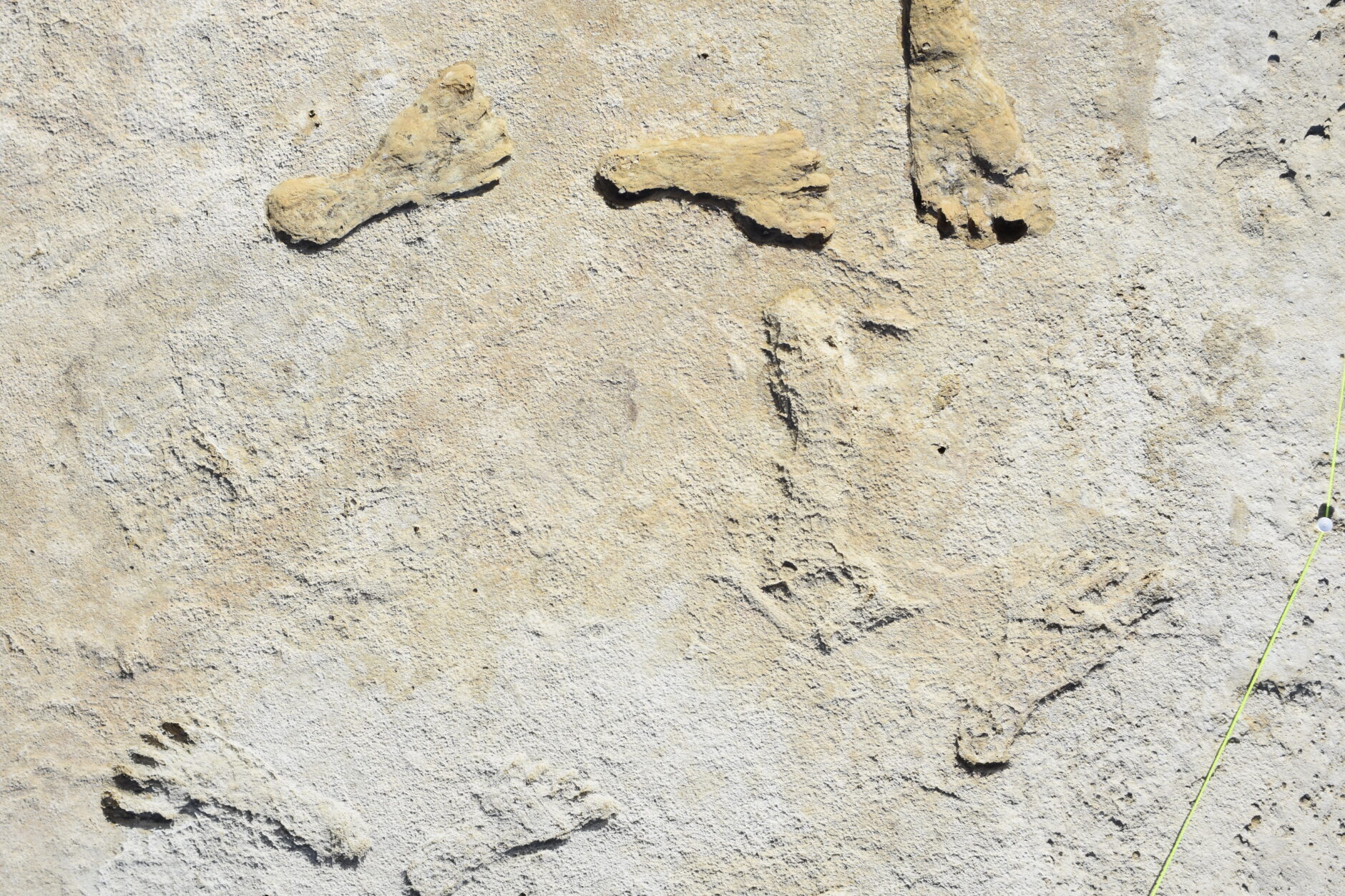
Fossil footprints found in White Sands National Park in New Mexico.
National Park Service, USGS and Bournemouth University
by David Wells
September 23, 2021
https://www.courthousenews.com/new-evid ... years-ago/
Introduction:
(Courthouse News) — New research on fossil footprint evidence suggests that humans were present in North America earlier than previously believed.
Researchers led by Matthew Bennett, a geographer at England’s Bournemouth University, studied a series of human fossil footprints found in an ancient lakebed in White Sands National Park, located in New Mexico. Their findings will be released in an article to be published Friday in the peer-reviewed academic journal Science. An advance copy provided to Courthouse News detailed the evidence that humans were in North America during the last ice age.
The footprints are roughly 21,000 to 23,000 years old and show that human arrival in southern North America predates the time before glacial advances of the last ice age shut off travel between Asia and North America via the Bering land bridge, which connected Alaska and Siberia.
Fossil footprints found in White Sands National Park in New Mexico.
National Park Service, USGS and Bournemouth University
Don't mourn, organize.
-Joe Hill
-Joe Hill
Re: Human Prehistory (3.3 million years BC – 3500 BC)
Humans Domesticated Dangerous Cassowary Bird Thousands of Years Before Chickens, Study Finds
by Jon Parton
September 27, 2021
https://www.courthousenews.com/humans-d ... udy-finds/
Introduction: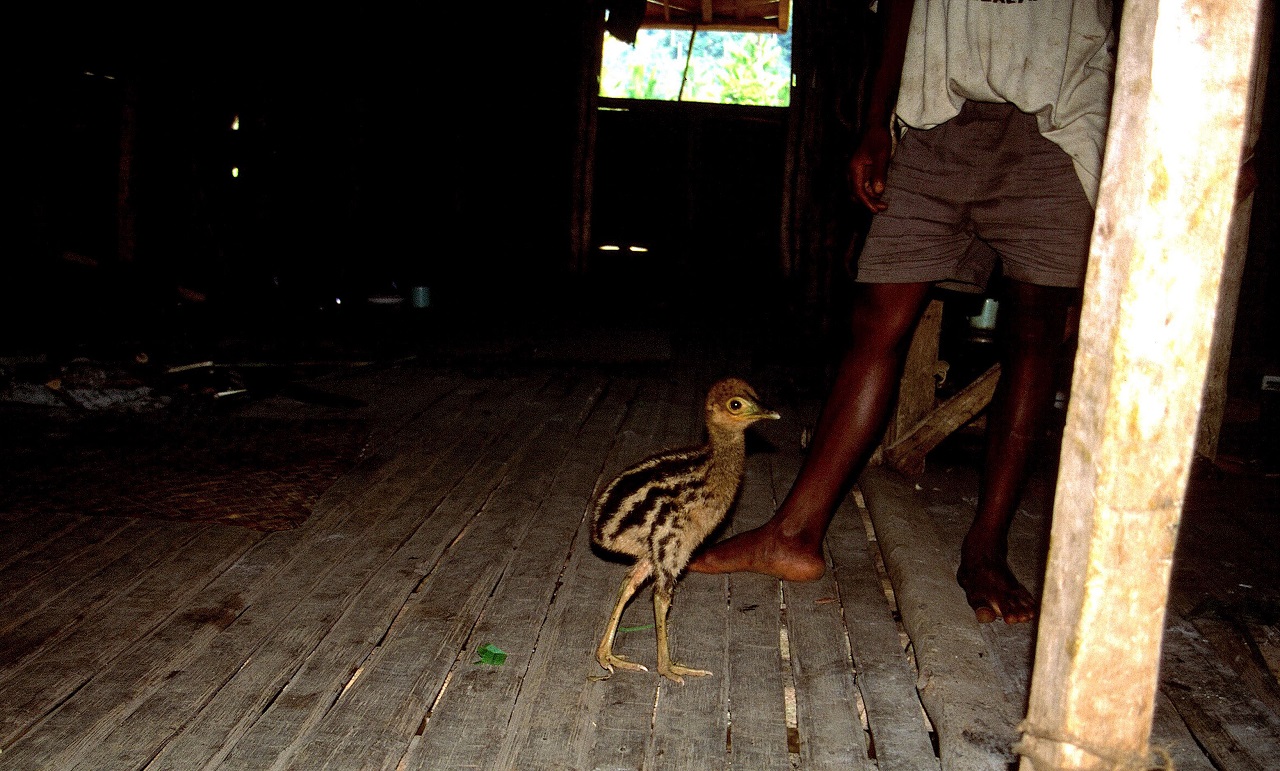
A modern day cassowary chick.
Credit: Andy Mack
by Jon Parton
September 27, 2021
https://www.courthousenews.com/humans-d ... udy-finds/
Introduction:
(Courthouse News) — Long before humans domesticated chickens, they had tamed the much larger and dangerous cassowary bird, according to new research released Monday.
"This behavior that we are seeing is coming thousands of years before domestication of the chicken," said Kristina Douglass, assistant professor of anthropology and African studies at Penn State, in a statement. "And this is not some small fowl, it is a huge, ornery, flightless bird that can eviscerate you. Most likely the dwarf variety that weighs 20 kilos (44 pounds)."
In the study published in the journal Proceedings of the National Academy of Sciences, an international research team estimates humans in New Guinea domesticated the birds starting around 18,000 years ago. The scientists relied on ancient cassowary eggshells to estimate the developmental stage of the embryos when the eggs were cracked open.
“The data presented here may represent the earliest indication of human management of the breeding of an avian taxon anywhere in the world, preceding the early domestication of chicken and geese by several millennia," the study states.
The researchers said cassowaries “bear more resemblance to velociraptors than most domesticated birds.”
A modern day cassowary chick.
Credit: Andy Mack
Don't mourn, organize.
-Joe Hill
-Joe Hill
-
weatheriscool
- Posts: 25737
- Joined: Sun May 16, 2021 6:16 pm
- Contact:
Re: Human Prehistory (3.3 million years BC – 3500 BC)
Israeli archaeologists discover ancient winemaking complex
Source: AP
Read more: https://apnews.com/article/science-busi ... b1e13ba184
Source: AP
By TSAFRIR ABAYOV
YAVNE, Israel (AP) — Israeli archaeologists on Monday said they have unearthed a massive ancient winemaking complex dating back some 1,500 years.
The complex, discovered in the central town of Yavne, includes five wine presses, warehouses, kilns for producing clay storage vessels and tens of thousands of fragments and jars, they said.
Israel’s Antiquities Authority said the discovery shows that Yavne was a wine-making powerhouse during the Byzantine period. Researchers estimate the facility could produce some 2 million liters (over 520,000 gallons) of wine a year.
Jon Seligman, one of the directors of the excavation, said the wine made in the area was known as “Gaza” wine and exported across the region. The researchers believe the Yavne location was the main production facility for the label.
Read more: https://apnews.com/article/science-busi ... b1e13ba184
Re: Human Prehistory (3.3 million years BC – 3500 BC)
Archeologists Discover Early Use of Tobacco
by Tara Yarlagadda
October 11, 2021
https://www.inverse.com/science/ancient ... overy-utah
Introduction:
by Tara Yarlagadda
October 11, 2021
https://www.inverse.com/science/ancient ... overy-utah
Introduction:
(INVERSE) TWELVE THOUSAND YEARS AGO, a group of hunter-gatherers huddled around a hearth on a rare patch of dry space within what is today the Great Salt Lake Desert in Utah, seeking rest and refuge.
They carried with them the seeds of a plant that would go on to become one of the most profitable — and deadliest — drugs in human history: tobacco.
According to new research, where these individuals gathered — now known as the Wishbone hearth site — is the site of the earliest known use of tobacco. Its existence also suggests the use of tobacco goes back thousands of years earlier than scientists realized.
These findings were published Monday in the journal Nature Human Behavior.
“We now know that Indigenous peoples in the Americas have been using tobacco for much of time since they arrived,” Daron Duke, lead author on the study and principal of the Far Western Anthropological Research Group, tells Inverse.
Last edited by caltrek on Sun Nov 07, 2021 7:07 pm, edited 1 time in total.
Don't mourn, organize.
-Joe Hill
-Joe Hill
-
weatheriscool
- Posts: 25737
- Joined: Sun May 16, 2021 6:16 pm
- Contact:
Re: Human Prehistory (3.3 million years BC – 3500 BC)
Humans did not cause woolly mammoths to go extinct—climate change did: study
https://phys.org/news/2021-10-humans-wo ... imate.html
by University of Cambridge
https://phys.org/news/2021-10-humans-wo ... imate.html
by University of Cambridge
For five million years, woolly mammoths roamed the earth until they vanished for good nearly 4,000 years ago—and scientists have finally proved why.
The hairy cousins of today's elephants lived alongside early humans and were a regular staple of their diet—their skeletons were used to build shelters, harpoons were carved from their giant tusks, artwork featuring them is daubed on cave walls, and 30,000 years ago, the oldest known musical instrument, a flute, was made out of a mammoth bone.
Now the hotly debated question about why mammoths went extinct has been answered—geneticists analyzed ancient environmental DNA and proved it was because when the icebergs melted, it became far too wet for the giant animals to survive because their food source—vegetation—was practically wiped out.
The 10-year research project, published in Nature today, was led by Professor Eske Willerslev, a Fellow of St John's College, University of Cambridge, and director of The Lundbeck Foundation GeoGenetics Centre, University of Copenhagen.
The team used DNA shotgun sequencing to analyze environmental plant and animal remains—including urine, feces and skin cells—taken from soil samples painstakingly collected over a period of 20 years from sites in the Arctic where mammoth remains were found. The advanced new technology means scientists no longer have to rely on DNA samples from bones or teeth to gather enough genetic material to recreate a profile of ancient DNA. The same technique has been used during the pandemic to test the sewage of human populations to detect, track and analyze COVID-19.

Re: Human Prehistory (3.3 million years BC – 3500 BC)
Comet's Intense Heat Turned Sand to Glass in Chile 12,000 Years Ago
by Kevin Stacey
November 5, 2021
https://www.futurity.org/comets-glass-h ... t-2651392/
Introduction:
by Kevin Stacey
November 5, 2021
https://www.futurity.org/comets-glass-h ... t-2651392/
Introduction:
(Futurity) Around 12,000 years ago, something scorched a vast swath of the Atacama Desert in Chile with heat so intense that it turned the sandy soil into widespread slabs of silicate glass. Now, researchers know what caused the inferno.
In a study in Geology, researchers show that samples of the desert glass contain tiny fragments with minerals often found in rocks of extraterrestrial origin.
Those minerals closely match the composition of material returned to Earth by NASA’s Stardust mission, which sampled the particles from a comet called Wild 2. The researchers conclude that those mineral assemblages are likely the remains of an extraterrestrial object—most likely a comet—that streamed down after the explosion that melted the sandy surface below.
“This is the first time we have clear evidence of glasses on Earth that were created by the thermal radiation and winds from a fireball exploding just above the surface,” says Pete Schultz, a professor emeritus in Brown University’s earth, environmental and planetary sciences department.
“To have such a dramatic effect on such a large area, this was a truly massive explosion. Lots of us have seen bolide fireballs streaking across the sky, but those are tiny blips compared to this.”
Don't mourn, organize.
-Joe Hill
-Joe Hill
-
weatheriscool
- Posts: 25737
- Joined: Sun May 16, 2021 6:16 pm
- Contact:
Re: Human Prehistory (3.3 million years BC – 3500 BC)
Fossil of a hominid child who died almost 250,000 years ago discovered in South Africa
hominid child
hominid child
https://arkeonews.net/fossil-of-a-homin ... U4KzlLiBBI
A team of international and South African researchers uncovered the fossil remains of an early hominid kid who died almost 250,000 years ago in a cave in South Africa.
Children’s fossilized remains are uncommon because their bones are too thin and fragile to survive for eons.
The self-proclaimed Cradle of Humankind, designated a UNESCO World Heritage Site in 1999, is a series of limestone caverns located approximately 50 kilometers (30 miles) northwest of Johannesburg. The most recent discovery was discovered around 30 meters (100 feet) below the earth).
The researchers revealed the finding of a partial skull and teeth of a Homo Naledi kid who died over 250,000 years ago when it was between the ages of four and six. According to the statement made Thursday, the remains were discovered in a secluded portion of the cave, which suggests that the person was deliberately deposited there, maybe as a form of tomb.
-
weatheriscool
- Posts: 25737
- Joined: Sun May 16, 2021 6:16 pm
- Contact:
Re: Human Prehistory (3.3 million years BC – 3500 BC)
Humans hastened the extinction of the wooly mammoth
https://phys.org/news/2021-11-humans-ha ... mmoth.html
by Crispin Savage, University of Adelaide
https://phys.org/news/2021-11-humans-ha ... mmoth.html
by Crispin Savage, University of Adelaide
New research shows that humans had a significant role in the extinction of wooly mammoths in Eurasia, occurring thousands of years later than previously thought.
An international team of scientists led by researchers from the University of Adelaide and University of Copenhagen, has revealed a 20,000-year pathway to extinction for the wooly mammoth.
"Our research shows that humans were a crucial and chronic driver of population declines of wooly mammoths, having an essential role in the timing and location of their extinction," said lead author Associate Professor Damien Fordham from the University of Adelaide's Environment Institute.
"Using computer models, fossils and ancient DNA we have identified the very mechanisms and threats that were integral in the initial decline and later extinction of the wooly mammoth."
Signatures of past changes in the distribution and demography of wooly mammoths identified from fossils and ancient DNA show that people hastened the extinction of wooly mammoths by up to 4,000 years in some regions.
-
weatheriscool
- Posts: 25737
- Joined: Sun May 16, 2021 6:16 pm
- Contact:
Re: Human Prehistory (3.3 million years BC – 3500 BC)
New species of iguanodontian dinosaur discovered from Isle of Wight
https://phys.org/news/2021-11-species-i ... wight.html
by Taylor & Francis
https://phys.org/news/2021-11-species-i ... wight.html
by Taylor & Francis
Scientists from the Natural History Museum and University of Portsmouth have described a new genus and species of dinosaur from a specimen found on the Isle of Wight.
Following on from a new species of ankylosaur, new species of therapod and two new species of spinosaur dinosaurs, Brighstoneus simmondsi is the latest in a host of new dinosaur species described by Museum scientists in recent weeks.
The new dinosaur is an iguanodontian, a group that also includes the iconic Iguanodon and Mantellisaurus. Until now, iguanodontian material found from the Wealden Group (representing part of the Early Cretaceous period) on the Isle of Wight has usually been referred to as one of these two dinosaurs—with more gracile fossil bones assigned to Mantellisaurus and the larger and more robust material assigned to Iguanodon.
However, when Dr. Jeremy Lockwood—a Ph.D. student at the Museum and University of Portsmouth—was examining the specimen, he came across several unique traits that distinguished it from either of these other dinosaurs.
"For me, the number of teeth was a sign," Dr. Lockwood says. "Mantellisaurus has 23 or 24, but this has 28. It also had a bulbous nose, whereas the other species have very straight noses. Altogether, these and other small differences made it very obviously a new species."
-
weatheriscool
- Posts: 25737
- Joined: Sun May 16, 2021 6:16 pm
- Contact:
Re: Human Prehistory (3.3 million years BC – 3500 BC)
Mammoth Bone Pendant May Be Oldest Jewelry Of Its Kind
0 Shares
25 Nov 2021, 16:00
https://www.iflscience.com/editors-blog ... iVRoN0yohw
A broken ivory pendant found in a Polish cave has been dated as 41,500 years old, making it the oldest ivory jewelry from Eurasia. It is also the oldest example of an ornament decorated with puncture marks in a looping curve, which may represent an early tally sheet, like notches on a belt. If so, this would indicate the object could be the earliest indication we have found of mathematics or astronomy, a key turning point in human culture.
Several items made from mammoth tusks have been found in Europe and Asia that are marked with curving lines of holes. Although these may have been purely decorative, it is suspected they represented something much more significant for human development: counting. Suggestions include tallies of hunting success or an analemma marking the Moon's movements across the sky.
Unfortunately, however, most of these were found and moved when dating methods were less advanced – attempts to measure their ages have given contradictory answers. The discovery in 2010 of a pendant at Stajinia Cave in southern Poland provided an opportunity to change that. A study published in Scientific Reports places its timing close to the time when Homo Sapiens arrived in Europe and before reliable dates for anything similar.
Re: Human Prehistory (3.3 million years BC – 3500 BC)
Loss of Huge Mammals Led to rise of Wildfires
by Bill Hathaway
December 3, 2021
https://www.futurity.org/mammals-extinc ... s-2665162/
Introduction:
by Bill Hathaway
December 3, 2021
https://www.futurity.org/mammals-extinc ... s-2665162/
Introduction:
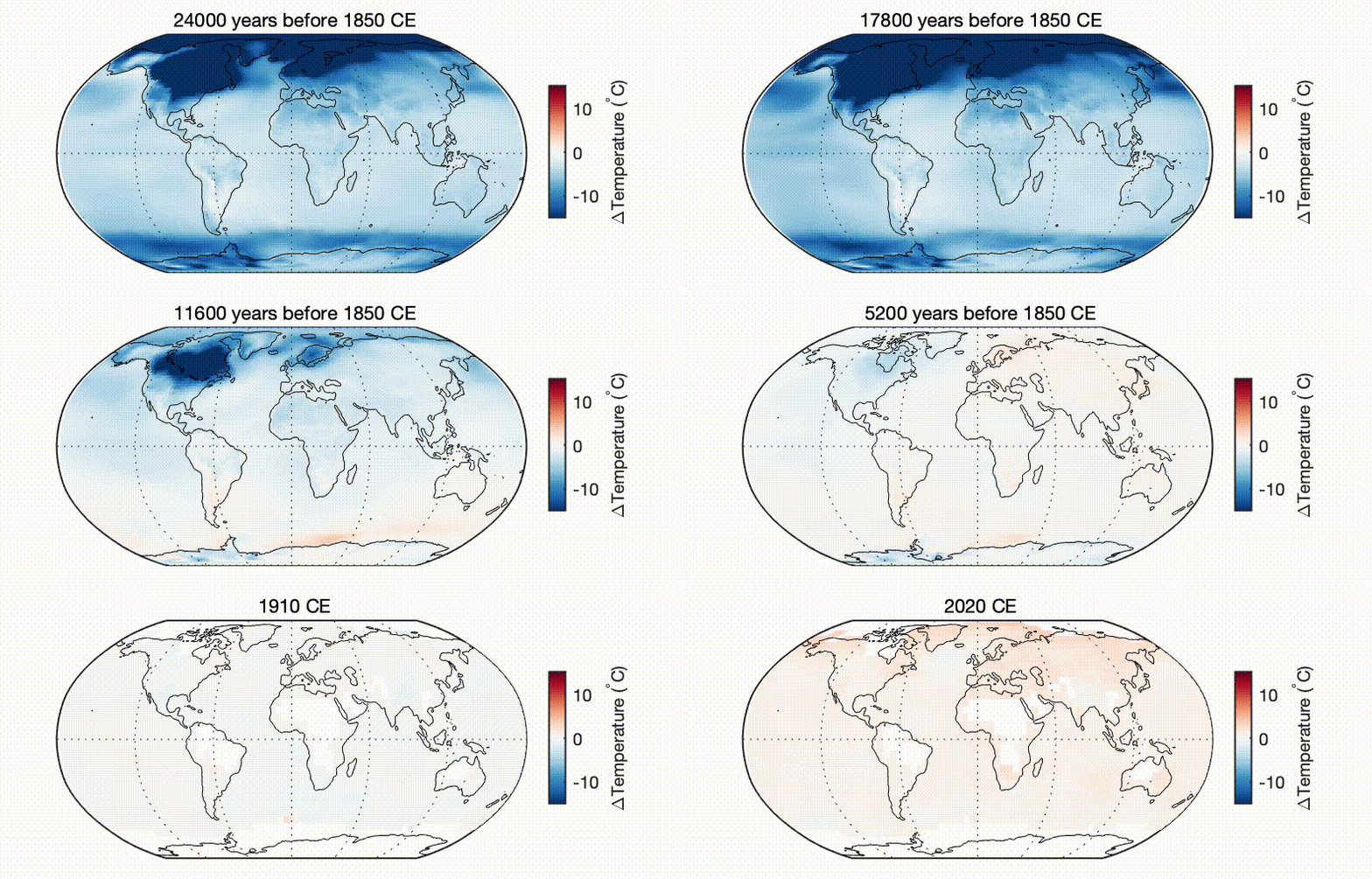
The article goes to explain that a key factor is thought to be lessened fuel reduction from reduced grazing.(Futurity) The extinction of iconic grazing mammals like woolly mammoth, giant bison, and ancient horses triggered a dramatic increase in fire activity in the world’s grasslands, according to a new study.
From 50,000 years to 6,000 years ago, many of the world’s largest animals went extinct. For the new study, researchers compiled lists of extinct large mammals and their approximate dates of extinctions across four continents.
The data showed that South America lost the most grazers (83% of all species), followed by North America (68%). These losses were significantly higher than in Australia (44%) and Africa (22%).
The researchers then compared these findings with records of fire activity as revealed in lake sediments. Using charcoal records from 410 global sites, which provided a historical record of regional fire activity across continents, they found that fire activity increased after the megagrazer extinctions.
Continents that lost more grazers (South America, then North America) saw larger increases in fire extent, whereas continents that saw lower rates of extinction (Australia and Africa) saw little change in grassland fire activity.
Don't mourn, organize.
-Joe Hill
-Joe Hill
Re: Human Prehistory (3.3 million years BC – 3500 BC)
Brazil Is Home to Prehistoric Underground Tunnels Created by Giant Ground Sloths
by Jessica Stewart
December 2, 2021
https://mymodernmet.com/paleoburrow-giant-ground-sloth/
Introduction:
by Jessica Stewart
December 2, 2021
https://mymodernmet.com/paleoburrow-giant-ground-sloth/
Introduction:
(MyModernMet) While you may have heard of underground cities built by humans, what about huge tunnels dug by giant prehistoric sloths? Though it may sound outlandish, it's actually what one finds across southern Brazil. Known as paleoburrows, these enormous tunnels can measure up to 2,000 feet long and over six feet tall. Shockingly, the existence of these caves was relatively unknown until a Brazilian geologist noticed something while driving down the highway.
In the early 2000s, Professor Heinrich Frank of the University of Rio Grande do Sul was driving by a construction site when something caught his eye. There was a strange hole that had been revealed by the site's excavators and Frank couldn't help wonder where it led. A few weeks later he made his way back and entered the hole. Crawling down the 15-foot-long opening, he noticed claw marks across the ceiling of the cave.
Given his expertise, he knew that no natural phenomenon would create a cave with those characteristics. And though he'd never heard of a paleoburrow, he did conclude that it must have been dug out by a large animal. So what is a paleoburrow? Defined as a shelter excavated by a now-extinct animal from the prehistoric era, it's believed that the Brazilian tunnels were created by giant ground sloths or armadillos.
Once Professor Frank got a taste of one tunnel, he went looking for more and was shocked to see just how many were laying in plain sight. By using Google and examining photos people post, he's been able to document over 1,500 paleoburrows
Don't mourn, organize.
-Joe Hill
-Joe Hill