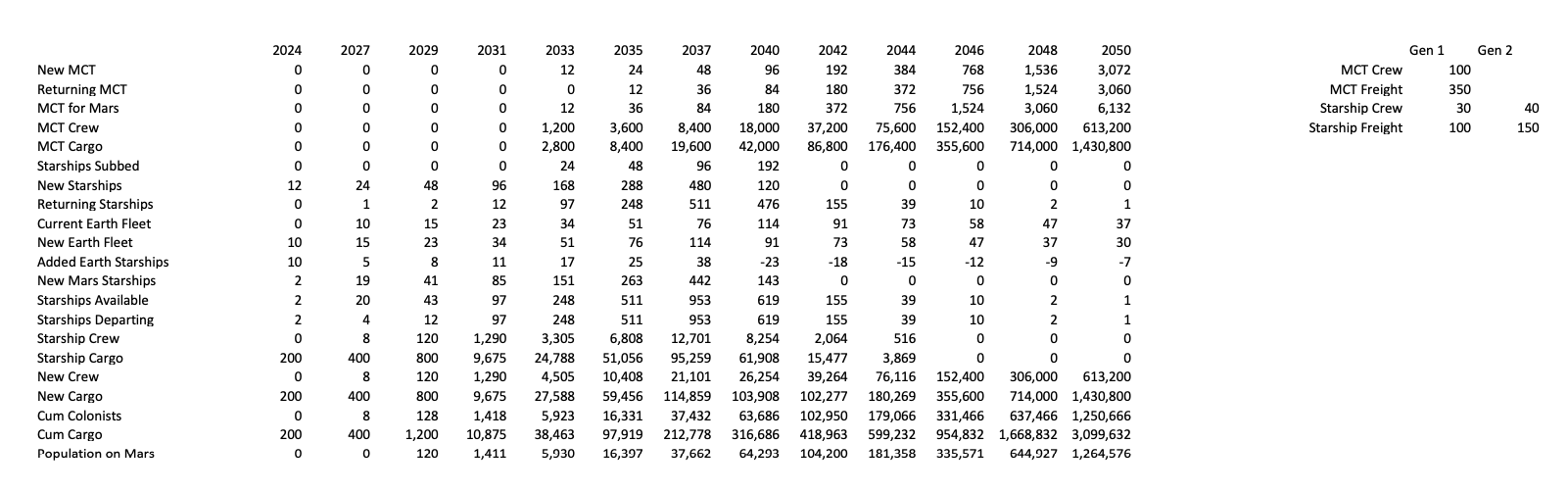
Timeline of a Mars Settlement
Posted: Wed Apr 26, 2023 4:23 pm
Part I: Starships
It looks to be the case that a fully-reusable, superheavy launch vehicle is going to be operational this year or next. As everyone on this forum is aware, this spacecraft, which is to have 1,000 cubic metres of habitable volume and a throw-weight of 100-150MT, is fit for the purpose of establishing a permanent human settlement on Mars.
To envision how this capability might be employed, let's begin with two scaffolding schedules. The first schedule lists the dates of windows for Hohmann transfer orbits from Earth to Mars:
The approximate dates for a Hohmann transfer departing Earth for Mars:
21st November - 12th December, 2024
25th January - 14th February, 2027
27th March - 15th April, 2029
29th May - 16th June, 2031
30th July - 17th August, 2033
29th September - 17th October, 2035
28th November - 16th December, 2037
30th January - 17th February, 2040
The second, much more speculative list, has to deal with the production rate of Starships between now and 2040. To tackle this problem, we'll have to extrapolate based on Musk's stated aspirations and from proxy industries. In 2020, SpaceX iterated through 14 starship prototypes (SN3-17). Musk has stated that he aspirationally wishes SpaceX to produce a starship every 72 hours in the future -- around 120 per year. The primary bottleneck in Starship production is currently the rate at which raptor engines can be produced. The current Starship design is built on six raptors; future designs are intended to contain nine. Thus, building 120 Starships per year will require between 730 and 1095 raptors per year. Additional raptors will be required for the superheavy boost stages, though significantly fewer boosters will be required.
The 730 figure fits with the stated intention to build a raptor every 12 hours. On the surface, this may seem like an ambitious production rate, but let's consider the production rate of the Boeing 737 MAX and its CFM LEAP turbofan. In January of 2022, Boeing produced 27 aircraft for the month (a production rate of 324 aircraft per annum, requiring 648 turbofans). The 737 MAX production line was intended to grow to 47 aircraft per month (564 per annum) in Q1 2023, but fate intercepted that plan. For 2023, Airbus had set a production target of 65 A320s per month (780 per annum), to aspirationally grow to 75 aircraft per month (900 per annum) thereafter.
If the airliner industry is taken as a suitable proxy, then the production figures Musk has floated for the 50+ metre Starship are within normal. Let's also consider the production rate of Tesla vehicles as a far looser proxy for raptor production. Between 2013 and 2020, Tesla doubled its delivery of EVs every two years, now surpassing a million vehicles per annum. While a $230,000 Raptor 2 and an electric 4WD / sedan might not appear to be very analogous at the outset, this comparison is less related to the products themselves, as opposed to the factories and the Musk Group's experience with high-volume production of complex goods.
Thus, I will take three assumptions and plug them into a formula to estimate the number of Starships that might be available to service Mars by 2040.
(1) Every Orbital Window (OW), SpaceX will double Starship production each OW (every 26 months)
(2) Production will be arbitrarily capped at 1,040 vehicles per OW (equivalent to 40 per month).
(3) The 2024 production figure will be taken as one Starship per month (12 per annum). This is lower than the 2020 figure, but higher than the 2021 or 2022 figures.
We therefore arrive at the following figures for new-build starships:
2024: 12
2027: 24
2029: 48
2031: 96
2033: 192
2035: 384
2037: 768
2040: 1,040 (capped).
But this does not capture the entire fleet departing Earth during each orbital window. Starship is intended to operate on a circuit between the two planets so that the total fleet might accrete over time more quickly than simple new-build production figures would assume. So the question arises: "can Starships on Mars arrive back at Earth in time for the next Hohmann transfer orbit window, so that they can be added to the fleet that year?"
To answer this, we must list the Hohmann windows departing Mars for Earth.
3rd July - 22nd July, 2026
3rd August - 22nd August, 2028
4th September - 23rd September, 2030
4th October - 23rd October, 2032
4th November - 23rd November, 2034
5th December - 24th December, 2036
6th January - 25th January, 2039
We can see that the opening of a Hohmann window for a Mars-to-Earth journey comes roughly 7-8 months before the closure of an Earth-to-Mars window. This is cutting it close, but on account of the large ΔV budget available to a fully-fuelled Starship (which I am confident will be increased as the years roll on), I have decided to include returned Starships from the previous OW to the mix. However, early travellers to Mars are expected to hold onto their Starships for additional pressurised living space or for the steel in the hulls. Contrarily, the draw of large regolith sample returns might prove irresistible. So let's consider the very first manned mission.
I will select 2027 as the year for the first manned mission. This assumes that an unmanned expedition might be launched in the December 2024 window, which verifies a suitable landing site for the first visitors. In 2024, four starships depart for Mars -- two carrying an international payload of public and private scientific equipment, and two Starships carrying critical life support systems and spare parts (MOXIE reactors, a sabatier reactor, consumables, spare solar arrays, the raptors built into the vehicles themselves etc).
In 2027, four more starships launch -- two filled with important cargo necessary to host a crew for two years, and two carrying consumables and the crew itself. I won't specify a number of crew members for the 2027 mission, but we should assume the number will be small.
The reusability of Starship presents a funny quirk for the program. If the colonisation of Mars turns out to be a secondary market for SpaceX (and this is a dubious assumption considering the volume of public moneys that might be made available for a launch provider that can deliver an arbitrarily large payload to Mars), servicing Earth orbit and Artemis should require a distinct minority of new-build Starships. The rapid turnaround time for a Starship servicing Earthly customers means a small fleet might satisfy not only the demand generated by Starlink, but all launch customers on Earth (including Artemis). Thus, we may end up seeing the bulk of new-build starships being constructed for the express purpose of delivering payload to Mars. In the 2020's, it may be Government customers and private enterprises that foot the bill. As capacity grows, that may shift in favour of private citizens purchasing one-way-tickets to the tune of the average American net worth.
To generate a schedule of the total number of Starships available to launch in any given OW, I will assume that 90% of Starships return to Earth and join new-builds in the next departure. I will also assume that in any given OW, only 5 additional Starships will be added to the fleet reserved to service Earth orbit. Note that in the 2020's, these assumptions must be modified to account for ad hoc factors relevant to the first three missions. Thus:
2024:
(a) 12 New Builds
(b) 0 Returned
(c) 5 Starships servicing Earth
(d) 7 Available for launch (12 minus the 5 reserved for customers)
(e) 4 Actually launched (unmanned)
(f) 3 Non-reserved Starships not sent to Mars
2027:
(a) 24 New Builds
(b) 0 Returned
(c) 10 Starships servicing Earth
(d) 22 Available for launch (24 minus 5 reserved for customers, plus 3 that were not sent to Mars in 2024)
(e) 4 Actually launched
(f) 18 Non-reserved Starships not sent to Mars (15 Starships plus 3 from the previous OW)
2029:
(a) 48 New Builds
(b) 1 Returned (sample return)
(c) 15 Starships servicing Earth
(d) 62 Available for launch (48 minus 5 reserved for Earth, plus 18 that have not been sent to Mars)
(e) 20 Actually launched
(f) 42 Non-reserved Starships not sent to Mars (62 available for launch minus 20 launched)
2031:
(a) 96 New Builds
(b) 18 Returned
(c) 20 Starships servicing Earth
(d) 151 Available for launch (96 minus 5 reserves, plus 18 returned, plus 42 not previously launched).
(e) 151 Actually launched
2033:
(a) 192 New Builds
(b) 136 Returned
(c) 25 Starships servicing Earth
(d) 323 Available for launch (192 minus 5 reserves, plus 136 returned)
(e) 323 Actually launched
2035:
(a) 384 New Builds
(b) 291 Returned
(c) 30 Starships servicing Earth
(d) 670 Available for launch (384 minus 5 reserves, plus 291 returned)
(e) 670 Actually launched
2037:
(a) 768 New Builds
(b) 603 Returned
(c) 35 Starships servicing Earth
(d) 1,371 Available for launch (768 minus 5 reserves, plus 603 returned)
(e) 1,371 Actually Launched
Sum of Starships landed on Mars by 2038: 2,543.
This is clearly a rather dramatic figure. Let me explain some of the thinking behind my assumed figures for Actually Launched in any given year. In 2027, I assume that SpaceX permits only two Starships to carry crew aboard for the inaugural landing because I expect these to be a small and hand-selected astronauts drawn from a specialist SpaceX training program and likely astronauts drawn from NASA's (then ongoing) Artemis program. Having verified that this is possible, I imagine a substantially larger group may be hand-picked from the public for the follow-on mission in a vein similar to Dear Moon (crazy tourists, effectively) in conjunction with paying customers from space agencies, wealthy enthusiasts, and perhaps SpaceX-trained technicians tasked with the pragmatic job of establishing a base.
In 2031, I've assumed that tickets go on sale to private individuals who have watched the previous two landings over the past four years, and decide (for whatever reason) to go. From there, each consecutive window and the normalisation of space colonisation in the minds of the world's populations (it would be difficult over six years to not come to grips with the new reality) spurs on a growing (yet infinitesimal per capita) pool of applicants.
It is difficult to estimate properly the passenger-to-cargo ratio. In the past, Musk has floated the figure of 10 tonnes per passenger. For lack of a good proxy, I will stick to this. Thus, I'll assume an average passenger count per Starship of 13, accompanied by 130 tonnes of payload. That is not to say that every Starship carries precisely 13 crew and 130 tonnes of payload -- perhaps ≈half of starships will carry 30 passengers and the other ≈half are dedicated freight carriers (making better use of the un-crewed vehicle's cavernous fairing). After 2,543 launches, this would equate to a little over 33,000 settlers and 330,590 tonnes of supplies and equipment.
How is SpaceX expected to launch hundreds, or even a thousand Starships to orbit to take advantage of a two-week orbital window?
Answer: not all at once.
I am assuming that Starships will be parked in orbit over the course of the year / two-years leading up to the OW opening. These parked Starships will have no crew aboard. While in orbit, they will be tanked gradually by a steady (but manageable) cadence of refuelling missions. Only once the OW approaches will crewed launches ferry passengers up to the waiting (and fuelled) starships. Crew will become acquainted with life aboard their vessel, the life-support systems will be tested, and any issues that may arise can be resolved with a more relaxed schedule. When the OW opens, ships will perform their Mars-Transfer burns one-by-one so that a steady stream of Starships depart Earth orbit in sequence.
If 323 Starships depart Earth orbit between the 30th of July and the 17th of August 2033 (19 days / 456 hours), then that equates to less than one Starship per hour. I imagine the night's sky will look rather brilliant from the ground for those two weeks every two years.
It looks to be the case that a fully-reusable, superheavy launch vehicle is going to be operational this year or next. As everyone on this forum is aware, this spacecraft, which is to have 1,000 cubic metres of habitable volume and a throw-weight of 100-150MT, is fit for the purpose of establishing a permanent human settlement on Mars.
To envision how this capability might be employed, let's begin with two scaffolding schedules. The first schedule lists the dates of windows for Hohmann transfer orbits from Earth to Mars:
The approximate dates for a Hohmann transfer departing Earth for Mars:
21st November - 12th December, 2024
25th January - 14th February, 2027
27th March - 15th April, 2029
29th May - 16th June, 2031
30th July - 17th August, 2033
29th September - 17th October, 2035
28th November - 16th December, 2037
30th January - 17th February, 2040
The second, much more speculative list, has to deal with the production rate of Starships between now and 2040. To tackle this problem, we'll have to extrapolate based on Musk's stated aspirations and from proxy industries. In 2020, SpaceX iterated through 14 starship prototypes (SN3-17). Musk has stated that he aspirationally wishes SpaceX to produce a starship every 72 hours in the future -- around 120 per year. The primary bottleneck in Starship production is currently the rate at which raptor engines can be produced. The current Starship design is built on six raptors; future designs are intended to contain nine. Thus, building 120 Starships per year will require between 730 and 1095 raptors per year. Additional raptors will be required for the superheavy boost stages, though significantly fewer boosters will be required.
The 730 figure fits with the stated intention to build a raptor every 12 hours. On the surface, this may seem like an ambitious production rate, but let's consider the production rate of the Boeing 737 MAX and its CFM LEAP turbofan. In January of 2022, Boeing produced 27 aircraft for the month (a production rate of 324 aircraft per annum, requiring 648 turbofans). The 737 MAX production line was intended to grow to 47 aircraft per month (564 per annum) in Q1 2023, but fate intercepted that plan. For 2023, Airbus had set a production target of 65 A320s per month (780 per annum), to aspirationally grow to 75 aircraft per month (900 per annum) thereafter.
If the airliner industry is taken as a suitable proxy, then the production figures Musk has floated for the 50+ metre Starship are within normal. Let's also consider the production rate of Tesla vehicles as a far looser proxy for raptor production. Between 2013 and 2020, Tesla doubled its delivery of EVs every two years, now surpassing a million vehicles per annum. While a $230,000 Raptor 2 and an electric 4WD / sedan might not appear to be very analogous at the outset, this comparison is less related to the products themselves, as opposed to the factories and the Musk Group's experience with high-volume production of complex goods.
Thus, I will take three assumptions and plug them into a formula to estimate the number of Starships that might be available to service Mars by 2040.
(1) Every Orbital Window (OW), SpaceX will double Starship production each OW (every 26 months)
(2) Production will be arbitrarily capped at 1,040 vehicles per OW (equivalent to 40 per month).
(3) The 2024 production figure will be taken as one Starship per month (12 per annum). This is lower than the 2020 figure, but higher than the 2021 or 2022 figures.
We therefore arrive at the following figures for new-build starships:
2024: 12
2027: 24
2029: 48
2031: 96
2033: 192
2035: 384
2037: 768
2040: 1,040 (capped).
But this does not capture the entire fleet departing Earth during each orbital window. Starship is intended to operate on a circuit between the two planets so that the total fleet might accrete over time more quickly than simple new-build production figures would assume. So the question arises: "can Starships on Mars arrive back at Earth in time for the next Hohmann transfer orbit window, so that they can be added to the fleet that year?"
To answer this, we must list the Hohmann windows departing Mars for Earth.
3rd July - 22nd July, 2026
3rd August - 22nd August, 2028
4th September - 23rd September, 2030
4th October - 23rd October, 2032
4th November - 23rd November, 2034
5th December - 24th December, 2036
6th January - 25th January, 2039
We can see that the opening of a Hohmann window for a Mars-to-Earth journey comes roughly 7-8 months before the closure of an Earth-to-Mars window. This is cutting it close, but on account of the large ΔV budget available to a fully-fuelled Starship (which I am confident will be increased as the years roll on), I have decided to include returned Starships from the previous OW to the mix. However, early travellers to Mars are expected to hold onto their Starships for additional pressurised living space or for the steel in the hulls. Contrarily, the draw of large regolith sample returns might prove irresistible. So let's consider the very first manned mission.
I will select 2027 as the year for the first manned mission. This assumes that an unmanned expedition might be launched in the December 2024 window, which verifies a suitable landing site for the first visitors. In 2024, four starships depart for Mars -- two carrying an international payload of public and private scientific equipment, and two Starships carrying critical life support systems and spare parts (MOXIE reactors, a sabatier reactor, consumables, spare solar arrays, the raptors built into the vehicles themselves etc).
In 2027, four more starships launch -- two filled with important cargo necessary to host a crew for two years, and two carrying consumables and the crew itself. I won't specify a number of crew members for the 2027 mission, but we should assume the number will be small.
The reusability of Starship presents a funny quirk for the program. If the colonisation of Mars turns out to be a secondary market for SpaceX (and this is a dubious assumption considering the volume of public moneys that might be made available for a launch provider that can deliver an arbitrarily large payload to Mars), servicing Earth orbit and Artemis should require a distinct minority of new-build Starships. The rapid turnaround time for a Starship servicing Earthly customers means a small fleet might satisfy not only the demand generated by Starlink, but all launch customers on Earth (including Artemis). Thus, we may end up seeing the bulk of new-build starships being constructed for the express purpose of delivering payload to Mars. In the 2020's, it may be Government customers and private enterprises that foot the bill. As capacity grows, that may shift in favour of private citizens purchasing one-way-tickets to the tune of the average American net worth.
To generate a schedule of the total number of Starships available to launch in any given OW, I will assume that 90% of Starships return to Earth and join new-builds in the next departure. I will also assume that in any given OW, only 5 additional Starships will be added to the fleet reserved to service Earth orbit. Note that in the 2020's, these assumptions must be modified to account for ad hoc factors relevant to the first three missions. Thus:
2024:
(a) 12 New Builds
(b) 0 Returned
(c) 5 Starships servicing Earth
(d) 7 Available for launch (12 minus the 5 reserved for customers)
(e) 4 Actually launched (unmanned)
(f) 3 Non-reserved Starships not sent to Mars
2027:
(a) 24 New Builds
(b) 0 Returned
(c) 10 Starships servicing Earth
(d) 22 Available for launch (24 minus 5 reserved for customers, plus 3 that were not sent to Mars in 2024)
(e) 4 Actually launched
(f) 18 Non-reserved Starships not sent to Mars (15 Starships plus 3 from the previous OW)
2029:
(a) 48 New Builds
(b) 1 Returned (sample return)
(c) 15 Starships servicing Earth
(d) 62 Available for launch (48 minus 5 reserved for Earth, plus 18 that have not been sent to Mars)
(e) 20 Actually launched
(f) 42 Non-reserved Starships not sent to Mars (62 available for launch minus 20 launched)
2031:
(a) 96 New Builds
(b) 18 Returned
(c) 20 Starships servicing Earth
(d) 151 Available for launch (96 minus 5 reserves, plus 18 returned, plus 42 not previously launched).
(e) 151 Actually launched
2033:
(a) 192 New Builds
(b) 136 Returned
(c) 25 Starships servicing Earth
(d) 323 Available for launch (192 minus 5 reserves, plus 136 returned)
(e) 323 Actually launched
2035:
(a) 384 New Builds
(b) 291 Returned
(c) 30 Starships servicing Earth
(d) 670 Available for launch (384 minus 5 reserves, plus 291 returned)
(e) 670 Actually launched
2037:
(a) 768 New Builds
(b) 603 Returned
(c) 35 Starships servicing Earth
(d) 1,371 Available for launch (768 minus 5 reserves, plus 603 returned)
(e) 1,371 Actually Launched
Sum of Starships landed on Mars by 2038: 2,543.
This is clearly a rather dramatic figure. Let me explain some of the thinking behind my assumed figures for Actually Launched in any given year. In 2027, I assume that SpaceX permits only two Starships to carry crew aboard for the inaugural landing because I expect these to be a small and hand-selected astronauts drawn from a specialist SpaceX training program and likely astronauts drawn from NASA's (then ongoing) Artemis program. Having verified that this is possible, I imagine a substantially larger group may be hand-picked from the public for the follow-on mission in a vein similar to Dear Moon (crazy tourists, effectively) in conjunction with paying customers from space agencies, wealthy enthusiasts, and perhaps SpaceX-trained technicians tasked with the pragmatic job of establishing a base.
In 2031, I've assumed that tickets go on sale to private individuals who have watched the previous two landings over the past four years, and decide (for whatever reason) to go. From there, each consecutive window and the normalisation of space colonisation in the minds of the world's populations (it would be difficult over six years to not come to grips with the new reality) spurs on a growing (yet infinitesimal per capita) pool of applicants.
It is difficult to estimate properly the passenger-to-cargo ratio. In the past, Musk has floated the figure of 10 tonnes per passenger. For lack of a good proxy, I will stick to this. Thus, I'll assume an average passenger count per Starship of 13, accompanied by 130 tonnes of payload. That is not to say that every Starship carries precisely 13 crew and 130 tonnes of payload -- perhaps ≈half of starships will carry 30 passengers and the other ≈half are dedicated freight carriers (making better use of the un-crewed vehicle's cavernous fairing). After 2,543 launches, this would equate to a little over 33,000 settlers and 330,590 tonnes of supplies and equipment.
How is SpaceX expected to launch hundreds, or even a thousand Starships to orbit to take advantage of a two-week orbital window?
Answer: not all at once.
I am assuming that Starships will be parked in orbit over the course of the year / two-years leading up to the OW opening. These parked Starships will have no crew aboard. While in orbit, they will be tanked gradually by a steady (but manageable) cadence of refuelling missions. Only once the OW approaches will crewed launches ferry passengers up to the waiting (and fuelled) starships. Crew will become acquainted with life aboard their vessel, the life-support systems will be tested, and any issues that may arise can be resolved with a more relaxed schedule. When the OW opens, ships will perform their Mars-Transfer burns one-by-one so that a steady stream of Starships depart Earth orbit in sequence.
If 323 Starships depart Earth orbit between the 30th of July and the 17th of August 2033 (19 days / 456 hours), then that equates to less than one Starship per hour. I imagine the night's sky will look rather brilliant from the ground for those two weeks every two years.