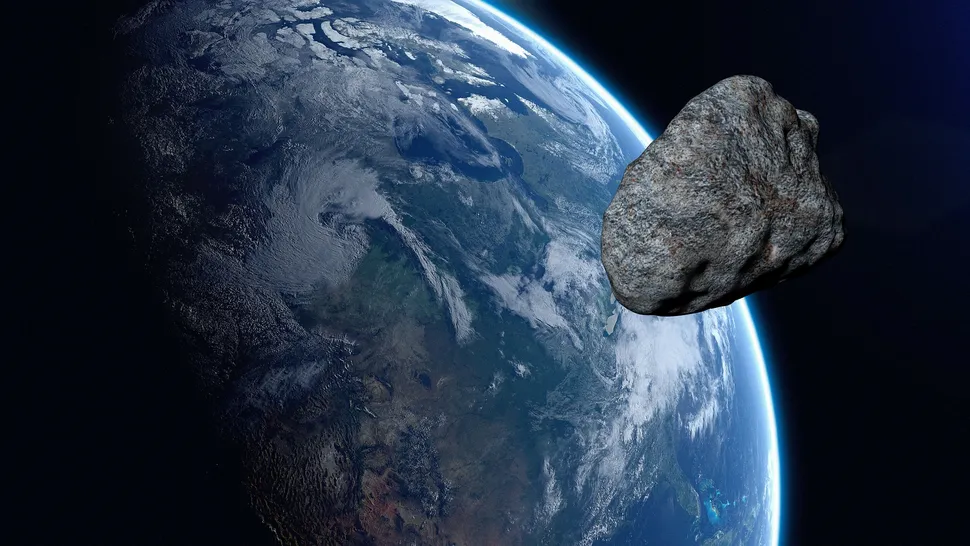
Asteroid The Size Of A Grand Piano Strikes Earth And We Knew Exactly Where And When Says NASA
Mar 15, 2022,03:02pm
Some said it was the size of a stepladder. Others said it was more like half the size of a giraffe. Either way, on March 11, 2022 at 21:22 UTC a tiny asteroid struck the ocean 300 miles/470 kilometers off Norway’s Jan Mayen Island.
Did the 6 1/2 feet/2 meters-wide asteroid—about the size of a grand piano and officially called 2022 EB5—slip through the surveillance net?
No, says NASA, who claims its discovery a mere two hours before it struck the Artic Ocean marks the fifth time that any asteroid has been observed before impacting into the atmosphere.
Asteroid 2022 EB5 was observed 14 times during 40 minutes by K. Sarneczky at the Piszkéstető Observatory in northern Hungary, who reported it to the Minor Planet Center.
NASA’s “Scout” impact hazard assessment system then calculated its trajectory, revealed it to be destined to strike Earth’s atmosphere, and thus alerted both the Center for Near Earth Object Studies (CNEOS) and NASA’s Planetary Defense Coordination Office.
NASA's Hubble Space Telescope has determined the size of the largest icy comet nucleus ever seen by astronomers. The estimated diameter is approximately 80 miles across, making it larger than the state of Rhode Island. The nucleus is about 50 times larger than found at the heart of most known comets. Its mass is estimated to be a staggering 500 trillion tons, a hundred thousand times greater than the mass of a typical comet found much closer to the Sun.
For the past 30 years, the star β Pictoris has fascinated astronomers because it enables them to observe a planetary system in the process of formation. It is made up of at least two young planets, and also contains comets, which were detected as early as 1987. These were the first comets ever observed around a star other than the sun.
Now, an international research team headed by Alain Lecavelier des Etangs, CNRS researcher at the Institut d'Astrophysique de Paris (CNRS/Sorbonne Université), has discovered 30 such exocomets and determined the size of their nuclei, which vary between 3 and 14 kilometers in diameter. The scientists were also able to estimate the size distribution of the objects, i.e., the proportion of small comets to large ones. This is the first time this distribution has been measured outside our solar system, and it is strikingly similar to that of comets orbiting the sun. It shows that, just like the comets of the solar system, the exocomets of β Pictoris were shaped by a series of collisions and breakups. This work sheds new light on the origin and evolution of comets in planetary systems. Since a part of Earth's water probably originated in comets, scientists are seeking to understand their impact on the characteristics of planets.
Re: Asteroids, Comets, and Meteors
Posted: Thu Jun 16, 2022 2:20 pm
by caltrek
European Space Agency Gives Green Light on its Comet Interceptor Mission by Laurence Tognetti
June 14, 2022
Introduction:
(Universe Today) Comets, with their long, beautiful, bright tails of ice, are some of the most spectacular sightings in the night sky. This was most apparent when Comet NEOWISE passed by Earth in the summer of 2020, dazzling viewers from all over the planet while being mainly visible in the northern hemisphere. Even though the sky might look the same night after night, comets are a humble reminder that the universe is a very active and beautiful place.
Comets are remnants of a time long past, and by long past we mean a very long past, as they are frozen leftovers from the formation of the solar system. While we are fortunate to see them as dazzling spectacles, they don’t start off this way. Comets are snowballs of frozen gases, rock, and dust orbiting in the edge of the solar system known as the Kuiper Belt where it is hypothesized that billions of comets likely exist. Every so often, one of their orbits brings it close to the Sun where it heats up and spews all that frozen dust and gas into a tail that stretches away from the Sun for millions of miles.
But what about comets that come from outside the solar system? Are they also frozen leftovers from the formation of another solar system like our own? These questions only became greater when our solar system was visited by ‘Oumuamua in 2017, which was the first known interstellar object to visit our solar system. While only visible from Earth for 11 days before it exited our solar system, scientists were able to determine that it was much longer that it was wide, possibly by a factor of five to ten. While this cigar-shaped planetary body is possibly gone forever, questions remain about its origin and composition. But what if were able to visit other interstellar comets that pay a visit to our neck of the galactic woods?
This past week, the European Space Agency (ESA) ‘adopted’ plans for a mission to visit a pristine comet or other interstellar object just starting its journey into the inner solar system and was appropriately named Comet Interceptor…while the mission is led by ESA, it will have support from the Japanese Space Agency (JAXA).
Dirt Scooped from Asteroid Ryugu Yields First Discoveries
by Louise Lerner
June 10, 2022
Introduction:
(Futurity) After a six-year journey, a plucky spacecraft called Hayabusa2 zinged back into Earth’s atmosphere in late 2020 and landed deep in the Australian outback. When researchers from the Japanese space agency JAXA opened it, they found its precious payload sealed and intact: a handful of dirt that Hayabusa2 managed to scoop off the surface of a speeding asteroid.
Scientists have now begun to announce the first results from the analysis of this extraordinary sample. What they found suggests that this asteroid is a piece of the same stuff that coalesced into our sun four-and-a-half billion years ago.
“We previously only had a handful of these rocks to study, and all of them were meteorites that fell to Earth and were stored in museums for decades to centuries, which changed their compositions,” says geochemist Nicolas Dauphas, one of the three University of Chicago researchers who worked with a Japan-led team of scientists to analyze the fragments.
“Having pristine samples from outer space is simply incredible. They are witnesses from parts of the solar system that we have not otherwise explored.”
In 2018, Hayabusa2 landed atop a moving asteroid named Ryugu and collected particles from above and below its surface. After spending a year and a half orbiting the asteroid, it returned to Earth with a sealed capsule containing about five grams of dust and rock. Scientists around the world have been eagerly anticipating the unique sample—one that could help redefine our understanding of how planets evolve and how our solar system formed.
When NASA's OSIRIS-REx spacecraft collected samples from asteroid Bennu's surface in 2020, forces measured during the interaction provided scientists with a direct test of the poorly understood near-subsurface physical properties of rubble-pile asteroids. Now, a Southwest Research Institute-led study has characterized the layer just below the asteroid's surface as composed of weakly bound rock fragments containing twice the void space as the overall asteroid.
"The low gravity of rubble-pile asteroids such as Bennu weakens its near-subsurface by not compressing the upper layers, minimizing the influence of particle cohesion," said SwRI's Dr. Kevin Walsh, lead author of a paper about this research published in the journal Science Advances. "We conclude that a low-density, weakly bound subsurface layer should be a global property of Bennu, not just localized to the contact point."
Fitting its designation as a "rubble-pile asteroid," Bennu is a spheroidal collection of rock fragments and debris 1,700 feet in diameter and held together by gravity. It is thought to have been formed after a collision involving a larger main-asteroid-belt object. Rocks are scattered across its heavily cratered surface, indicating that it has had a rough-and-tumble existence since being liberated from its much larger parent asteroid some millions or billions of years ago.
Re: Asteroids, Comets, and Meteors
Posted: Tue Jul 12, 2022 8:08 am
by Nanotechandmorefuture
caltrek wrote: ↑Thu Jun 16, 2022 4:25 pm Dirt Scooped from Asteroid Ryugu Yields First Discoveries
by Louise Lerner
June 10, 2022
Introduction:
(Futurity) After a six-year journey, a plucky spacecraft called Hayabusa2 zinged back into Earth’s atmosphere in late 2020 and landed deep in the Australian outback. When researchers from the Japanese space agency JAXA opened it, they found its precious payload sealed and intact: a handful of dirt that Hayabusa2 managed to scoop off the surface of a speeding asteroid.
Scientists have now begun to announce the first results from the analysis of this extraordinary sample. What they found suggests that this asteroid is a piece of the same stuff that coalesced into our sun four-and-a-half billion years ago.
“We previously only had a handful of these rocks to study, and all of them were meteorites that fell to Earth and were stored in museums for decades to centuries, which changed their compositions,” says geochemist Nicolas Dauphas, one of the three University of Chicago researchers who worked with a Japan-led team of scientists to analyze the fragments.
“Having pristine samples from outer space is simply incredible. They are witnesses from parts of the solar system that we have not otherwise explored.”
In 2018, Hayabusa2 landed atop a moving asteroid named Ryugu and collected particles from above and below its surface. After spending a year and a half orbiting the asteroid, it returned to Earth with a sealed capsule containing about five grams of dust and rock. Scientists around the world have been eagerly anticipating the unique sample—one that could help redefine our understanding of how planets evolve and how our solar system formed.
When NASA's OSIRIS-REx spacecraft collected samples from asteroid Bennu's surface in 2020, forces measured during the interaction provided scientists with a direct test of the poorly understood near-subsurface physical properties of rubble-pile asteroids. Now, a Southwest Research Institute-led study has characterized the layer just below the asteroid's surface as composed of weakly bound rock fragments containing twice the void space as the overall asteroid.
"The low gravity of rubble-pile asteroids such as Bennu weakens its near-subsurface by not compressing the upper layers, minimizing the influence of particle cohesion," said SwRI's Dr. Kevin Walsh, lead author of a paper about this research published in the journal Science Advances. "We conclude that a low-density, weakly bound subsurface layer should be a global property of Bennu, not just localized to the contact point."
Fitting its designation as a "rubble-pile asteroid," Bennu is a spheroidal collection of rock fragments and debris 1,700 feet in diameter and held together by gravity. It is thought to have been formed after a collision involving a larger main-asteroid-belt object. Rocks are scattered across its heavily cratered surface, indicating that it has had a rough-and-tumble existence since being liberated from its much larger parent asteroid some millions or billions of years ago.
Dude I think the governments especially here in the USA, at least, have far more advanced space technology than they are saying. NASA does have security clearances after all since it is a government organization. I just find it incredible for them to land these probes on fast moving rocks and go under their surfaces to collect fresh reliable samples. I do not believe simple radio wave transmissions can account for all this. Its a great feat of course!
Re: Asteroids, Comets, and Meteors
Posted: Thu Jul 14, 2022 6:01 pm
by wjfox
China’s Deep Space Radar May Have Military Uses
July 13, 2022
China has started building what it calls “the world’s most far-reaching radar” in the country’s southwest – a facility that could also have a military purpose, an analyst warned.
Chinese broadcaster CGTN said the new high-definition deep-space active observation facility code-named “China Fuyan,” or “Facetted Eye” for its resemblance to an insect’s eye, is being built in Chongqing Municipality.
The radar system would help “better safeguard Earth” by boosting “the country’s defense capabilities against near-Earth asteroids as well as its sensing capability for the Earth-Moon system,” the state-run broadcaster said.
The Fuyan will have distributed radars with over 20 large antennas, capable of carrying out high-definition observation of asteroids within 150 million kilometers of Earth, according to CGTN.
“If the radar is designed to observe asteroids, it would generally possess the basic capabilities for space surveillance, meaning, the ability to distinguish objects detected in space, and hence track them,” said Collin Koh, Research Fellow at the S. Rajaratnam School of International Studies in Singapore.
China plans asteroid deflection test in 2026: reports
published about 1 hour ago
China knows which asteroid it will target to test planetary defense techniques in the 2020s.
The China National Space Administration plans to work at potentially hazardous asteroid 2020 PN1 in a mission now due to launch in 2026, according to a Space News report Tuesday (July 12). Earlier this year, China appeared to be targeting 2025.
Further details were revealed in a Chinese-language lecture by Long Lehao, chief designer of China's Long March rocket series.
"A slide presented by Long indicates that the impactor mission will launch in 2026 on a Long March 3B rocket," the SpaceNews report said. "The mission will include a separate impactor and orbiter. The former will impact near-Earth object 2020 PN1 with the latter spacecraft making observations."
The kinetic asteroid defense mission appears to be similar to NASA's Double Asteroid Redirection Test (DART) due to arrive at its own destination around September. NASA plans to send a kinetic impactor to a moonlet, Dimorphos at speeds of 4.1 miles per second (6.6 km/s), to try to alter its orbit around asteroid Didymos.
An Asteroid Skipping Like A Stone Over Water Left A Rich Legacy by Steven Luntz
July 21, 2022
Introduction:
(IFL Science) The recent discovery of numerous lumps of metal-rich stones near Aletai, Xinjiang, puzzled geologists. Instead of being clumped together, the rocks rich in iron, copper, and gold are distributed in a long thin line stretching 430 kilometers (260 miles) and are clearly of extraterrestrial origin. To explain their distribution, scientists are proposing an asteroid came in at such a shallow angle that, rather than forming a single impact crater, it skipped over the Earth's atmosphere before falling in, like a flat stone bouncing over water.
Returning space missions must carefully tune the angle at which they hit the atmosphere, the window famously made narrower for Apollo 13 due to damage to the heat shield. Come in too steeply and the craft will burn up, too shallow and it will bounce off the atmosphere and wander endlessly in space. Asteroids experience something similar, although lacking parachutes there is no safety window in between.
With just the right entry angle, however, the asteroid could bounce off the atmosphere, losing some of its energy in the process. This would slow it down, leading to a subsequent entry a few hundred kilometers further along its path. There was no known evidence of this occurring, however, until the publication in Science Advances (https://www.science.org/doi/10.1126/sciadv.abm8890) of a study of the Aletai deposits.
Fireball spotted shooting across Northern Ireland sky
1 hour ago
The moment a fireball raced across the sky over Northern Ireland has been captured on camera.
Hundreds of people reported seeing the "shooting star" above Northern Ireland and Scotland on Wednesday night.
Joe McNeill from Dunmurry in west Belfast said it was "absolutely amazing".
The UK Meteor Network said it began receiving reports of the fireball at 22:00 on Wednesday.
Scientists are using video footage captured by the public to work out whether the object travelling across the night sky was a meteor or space junk, and where it came from.