Stars, supernovae, black holes and stellar remnants

User avatar
wjfox
Site Admin
Posts: 13576
Joined: Sat May 15, 2021 6:09 pm
Location: Essex, UK
Contact:

Re: Stars, supernovae, black holes and stellar remnants

Post by wjfox »

weatheriscool
Posts: 24486
Joined: Sun May 16, 2021 6:16 pm
Contact:

Re: Stars, supernovae, black holes and stellar remnants

Post by weatheriscool »

Scientists map gusty winds in a far-off neutron star system
https://phys.org/news/2023-04-scientist ... -star.html
by Massachusetts Institute of Technology
An accretion disk is a colossal whirlpool of gas and dust that gathers around a black hole or a neutron star like cotton candy as it pulls in material from a nearby star. As the disk spins, it whips up powerful winds that push and pull on the sprawling, rotating plasma. These massive outflows can affect the surroundings of black holes by heating and blowing away the gas and dust around them.

At immense scales, "disk winds" can offer clues to how supermassive black holes shape entire galaxies. Astronomers have observed signs of disk winds in many systems, including accreting black holes and neutron stars. But to date, they've only ever glimpsed a very narrow view of this phenomenon.

Now, MIT astronomers have observed a wider swath of winds, in Hercules X-1, a system in which a neutron star is drawing material away from a sun-like star. This neutron star's accretion disk is unique in that it wobbles, or "precesses," as it rotates. By taking advantage of this wobble, the astronomers have captured varying perspectives of the rotating disk and created a two-dimensional map of its winds, for the first time.

The new map reveals the wind's vertical shape and structure, as well as its velocity—around hundreds of kilometers per second, or about a million miles per hour, which is on the milder end of what accretion disks can spin up.
weatheriscool
Posts: 24486
Joined: Sun May 16, 2021 6:16 pm
Contact:

Re: Stars, supernovae, black holes and stellar remnants

Post by weatheriscool »

First Y brown dwarf binary system discovered

by Tomasz Nowakowski , Phys.org
https://phys.org/news/2023-04-brown-dwarf-binary.html
Using the Near Infrared Camera (NIRCam) onboard the James Webb Space Telescope (JWST), an international team of astronomers has discovered the first known binary system composed of two Y-type brown dwarfs. The finding was reported in a research paper published March 29 on the arXiv pre-print repository.

Brown dwarfs are intermediate substellar objects between planets and stars with masses below the hydrogen burning limit—about 80 Jupiter masses. One subclass of brown dwarfs (with effective temperatures lower than 500 K) is known as Y dwarfs, and represents the coolest and least luminous substellar objects so far detected.

WISE J033605.05−014350.4 (or W0336 for short) is a nearby brown dwarf of spectral type Y0 detected in 2012 with NASA's Wide-field Infrared Survey Explorer (WISE). The object is located some 32.7 light years away in the constellation Eridanus and has an effective temperature of about 460 K.

Now, new observations conducted by a group of astronomers led by Per Calissendorf of the University of Michigan in Ann Arbor, unveiled the presence of a companion object to W0336. The brown dwarf was observed in September 2022 as part of a JWST Cycle 1 GO program—a survey of 20 Y dwarfs.

"We report the discovery of the first brown dwarf binary system with a Y dwarf primary, WISE J033605.05−014350.4, observed with NIRCam on JWST with the F150W and F480M filters. We employed an empirical point spread function binary model to identify the companion, located at a projected separation of 0.''084, position angle of 295 degrees, and with contrast of 2.8 and 1.8 magnitudes in F150W and F480M, respectively," the researchers wrote in the paper.
weatheriscool
Posts: 24486
Joined: Sun May 16, 2021 6:16 pm
Contact:

Re: Stars, supernovae, black holes and stellar remnants

Post by weatheriscool »

Metal-poor stars are more life-friendly, suggests study
https://phys.org/news/2023-04-metal-poo ... endly.html
by Max Planck Society

Stars that contain comparatively large amounts of heavy elements provide less favorable conditions for the emergence of complex life than metal-poor stars, as scientists from the Max Planck Institutes for Solar System Research and for Chemistry as well as from the University of Göttingen have now found.

The team showed how the metallicity of a star is connected to the ability of its planets to surround themselves with a protective ozone layer. Crucial to this is the intensity of the ultraviolet light that the star emits into space, in different wavelength ranges. The study provides scientists searching the sky with space telescopes for habitable star systems with important clues as to where this endeavor could be particularly promising.

It also suggests a startling conclusion: as the universe ages, it becomes increasingly unfriendly to the emergence of complex life on new planets.

In the search for habitable or even inhabited planets orbiting distant stars, researchers have in the past years increasingly focused on the gas envelopes of these worlds. Do observational data show evidence of an atmosphere? Does it perhaps even contain gases such as oxygen or methane, which on Earth are produced almost exclusively as metabolic products of lifeforms?
User avatar
wjfox
Site Admin
Posts: 13576
Joined: Sat May 15, 2021 6:09 pm
Location: Essex, UK
Contact:

Re: Stars, supernovae, black holes and stellar remnants

Post by wjfox »

Astronomers capture first image of jet being launched from edge of black hole

Wed 26 Apr 2023 16.56 BST

Astronomers have captured the first image showing a powerful jet being launched from the edge of a black hole’s event horizon into intergalactic space.

The observations of the black hole at the centre of the galaxy Messier 87 (M87) could help reveal how black hole jets, which are among the brightest objects in the universe, are created.

“We know that jets are ejected from the region surrounding black holes, but we still do not fully understand how this actually happens,” said Dr Ru-Sen Lu, the lead author of the Shanghai Astronomical Observatory.

“To study this directly we need to observe the origin of the jet as close as possible to the black hole.”

https://www.theguardian.com/science/202 ... black-hole


Image
weatheriscool
Posts: 24486
Joined: Sun May 16, 2021 6:16 pm
Contact:

Re: Stars, supernovae, black holes and stellar remnants

Post by weatheriscool »

Study finds J0049−2525 is the most massive pulsating white dwarf
https://phys.org/news/2023-05-j00492525 ... dwarf.html
by Tomasz Nowakowski , Phys.org
Astronomers have conducted photometric observations of a white dwarf known as J004917.14−252556.81. Results of the observational campaign detected photometric variability of this object, making J004917.14−252556.81 the most massive pulsating white dwarf known to date. The finding is reported in a paper published April 18 in Monthly Notices of the Royal Astronomical Society.

White dwarfs (WDs) are stellar cores left behind after a star has exhausted its nuclear fuel. Although their atmospheres are mainly composed of hydrogen or helium, between 25% and 50% of all known white dwarfs show traces of metals in their spectra. In general, the majority of WDs have primary spectral classification DA—they showcase hydrogen-dominated atmospheres.

Located some 325 light years away, J004917.14−252556.81 (or J0049−2525 for short) is a DA white dwarf with an effective temperature of 13,020 K and an estimated mass of approximately 1.3 solar masses. Previous studies have suggested that J0049−2525 may be a pulsating WD of the ZZ Ceti type, however, due to the lack of time-series photometric data, it was difficult to confirm this hypothesis.

That is why a team of astronomers led by Mukremin Kilic of the University of Oklahoma in Norman, Oklahoma, decided to conduct time-series photometric observations of J0049−2525. For this purpose, they employed the Apache Point Observatory (APO) in New Mexico and the Gemini South telescope in Chile.
User avatar
wjfox
Site Admin
Posts: 13576
Joined: Sat May 15, 2021 6:09 pm
Location: Essex, UK
Contact:

Re: Stars, supernovae, black holes and stellar remnants

Post by wjfox »

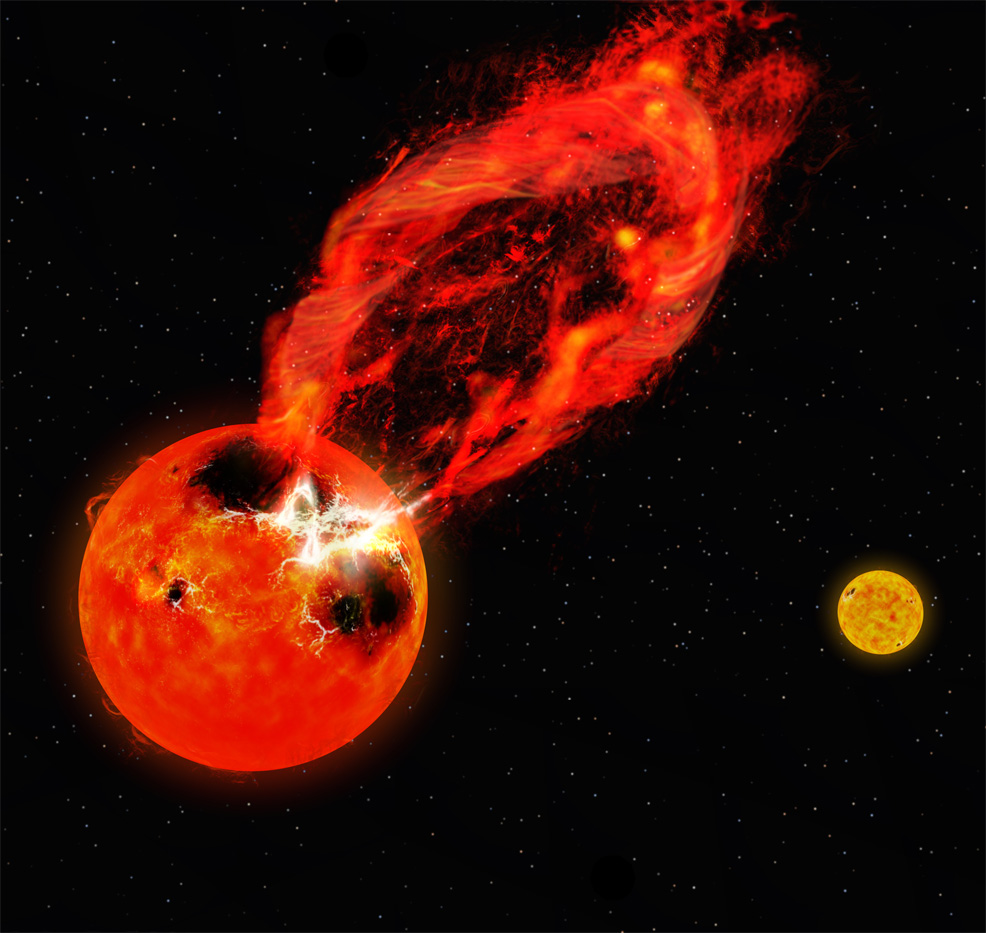
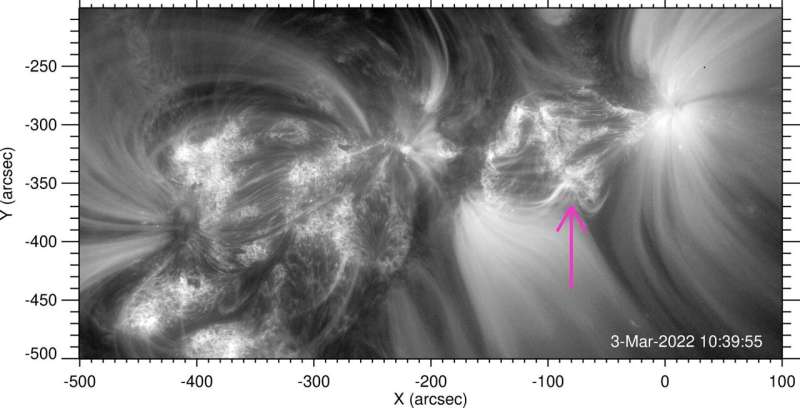
Star "superflare" is one of largest ever seen

6th May 2023

A giant flare in the binary star system V1355 Orionis is one of the largest ever observed in the history of astronomy.

Read more: https://www.futuretimeline.net/blog/202 ... rflare.htm


Image
User avatar
wjfox
Site Admin
Posts: 13576
Joined: Sat May 15, 2021 6:09 pm
Location: Essex, UK
Contact:

Re: Stars, supernovae, black holes and stellar remnants

Post by wjfox »

Astronomers solve a 60-year mystery of quasars – the most powerful objects in the Universe

26 April 2023

Scientists have unlocked one of the biggest mysteries of quasars – the brightest, most powerful objects in the Universe – by discovering that they are ignited by galaxies colliding.

First discovered 60 years ago, quasars can shine as brightly as a trillion stars packed into a volume the size of our solar system. In the decades since they were first observed, one of the biggest mysteries puzzling experts has been what could trigger such powerful activity. New work led by scientists at the Universities of Hertfordshire and Sheffield has now revealed that they are the consequence of galaxies crashing together.

The collisions were discovered when researchers, using deep imaging observations from the Isaac Newton Telescope in La Palma, observed the presence of distorted structures in the outer regions of the galaxies that are home to quasars.

Most galaxies have supermassive black holes at their centres, lurking in the nuclei. They also contain prodigious amounts of gas – but most of the time this gas is orbiting at large distances from the galaxy centres, out of reach of the black holes. Collisions between galaxies drive the gas towards the black hole at the galaxy centre; just before the gas is consumed by the black hole, it releases prodigious amounts of energy in the form of radiation, resulting in the characteristic quasar brilliance.

The ignition of a quasar can have dramatic consequences for entire galaxies – it can drive the rest of the gas out of the galaxy, which prevents it from forming new stars for billions of years into the future.

https://www.herts.ac.uk/about-us/news-a ... e-universe


Image
Image credit: ESO-M Kornmesser
User avatar
caltrek
Posts: 9280
Joined: Mon May 17, 2021 1:17 pm

Re: Stars, supernovae, black holes and stellar remnants

Post by caltrek »

A Supermassive Black Hole Ripped Apart a Star and Wore Its Remains Like a Scarf
by Kiona Smith
May 10, 2023

Introduction:
(Inverse) Astronomers recently watched a supermassive black hole rip apart an unwary star much like our Sun.

Just before a star falls into a black hole, the tremendous gravity of the black hole pulls the star apart and stretches it into a thin stream of blazing hot gas. Astronomers call this act of cosmic destruction a tidal disruption event. The gas wraps around the black hole, forming what’s called an accretion disk; it’s as if the black hole is wearing the star’s skin as a battle trophy before finally swallowing it up. As the gas spirals inward, it heats up and emits enough light to be visible even against the bright light of an entire galaxy.

A team of astronomers led by University of Turku astronomer Yannis Liodakis recently caught a supermassive black hole in a nearby galaxy in the act of ripping apart a star. The spaghettified plasma that had once been a Sun-like star didn’t behave in quite the way Liodakis and his colleagues expected, though — which sheds some light on how much we still have to learn about the huge, violent things that happen at the edge of a black hole.

They published their findings in the journal Science.

FISHING EXPEDITION

Liodakis and his colleagues were on a fishing expedition when they spotted the bright flare of light from a galaxy roughly a billion light years away. A “fishing expedition” is what Liodakis calls just looking into space to see what’s out there — it’s space, after all, so there’s bound to be something cool happening — and it’s a rare opportunity for astronomers.

Read more here: https://www.inverse.com/science/this-i ... t-a-star
Don't mourn, organize.

-Joe Hill
User avatar
caltrek
Posts: 9280
Joined: Mon May 17, 2021 1:17 pm

Re: Stars, supernovae, black holes and stellar remnants

Post by caltrek »

Astronomers Reveal the Largest Cosmic Explosion Ever Seen
May 11, 2023

Introduction:
(Eurekalert) A team of astronomers led by the University of Southampton have uncovered the largest cosmic explosion ever witnessed.
The explosion is more than ten times brighter than any known supernova (exploding star) and three times brighter than the brightest tidal disruption event, where a star falls into a supermassive black hole.

The explosion, known as AT2021lwx, has currently lasted over three years, compared to most supernovae which are only visibly bright for a few months. It took place nearly 8 billion light years away, when the universe was around 6 billion years old, and is still being detected by a network of telescopes.

The researchers believe that the explosion is a result of a vast cloud of gas, possibly thousands of times larger than our sun, that has been violently disrupted by a supermassive black hole. Fragments of the cloud would be swallowed up, sending shockwaves through its remnants, as well as into a large dusty ‘doughnut’ surrounding the black hole. Such events are very rare and nothing on this scale has been witnessed before.

Last year, astronomers witnessed the brightest explosion on record - a gamma-ray burst known as GRB 221009A. While this was brighter than AT2021lwx, it lasted for just a fraction of the time, meaning the overall energy released by the AT2021lwx explosion is far greater.

Read more here: https://www.eurekalert.org/news-releases/988665
Don't mourn, organize.

-Joe Hill
User avatar
caltrek
Posts: 9280
Joined: Mon May 17, 2021 1:17 pm

Re: Stars, supernovae, black holes and stellar remnants

Post by caltrek »

Surprise Magnetic Signal May Finally Solve The Mystery of Fast Radio Bursts
by Shi Dai
May 12, 2023

Introduction:
(Science Alert) Fast radio bursts – intense, milliseconds-long flashes of radio energy from outer space – have puzzled astronomers since they were first spotted in 2007. A single burst can emit as much energy in its brief life as the Sun does in a few days.

The great majority of the short-lived pulses originate outside our Milky Way galaxy. We don't know what produces most of them, or how.

In new research published in Science, we observed a repeating fast radio burst for more than a year and discovered signs it is surrounded by a strong but highly changeable magnetic field.

Our results suggest the source of this cosmic explosion may be a binary system made up of a neutron star whirling through winds of dense, magnetized plasma produced by a massive companion star or even a black hole.

Read more here: https://www.sciencealert.com/surprise- ... o-bursts
Don't mourn, organize.

-Joe Hill
weatheriscool
Posts: 24486
Joined: Sun May 16, 2021 6:16 pm
Contact:

Re: Stars, supernovae, black holes and stellar remnants

Post by weatheriscool »

Biggest cosmic explosion ever seen: 100x the width of our solar system
By Michael Irving
May 14, 2023
https://newatlas.com/space/biggest-cosm ... ever-seen/
Astronomers have captured the biggest cosmic explosion ever detected. About 100 times bigger than the solar system and two trillion times brighter than the Sun at its peak, the mysterious miasma has remained visible for three years.

The universe is full of extreme events – stars go supernova with some regularity, black holes swallow objects with powerful burps, and cosmic collisions give off so much energy they distort the very fabric of space and time.

But this new event is more energetic than anything else ever seen. Designated somewhat anticlimactically as AT2021lwx, the explosion has been visible since 2020 in the constellation Vulpecula, about 8 billion light-years away.

It was first detected by the Zwicky Transient Facility (ZTF) and then the Asteroid Terrestrial-impact Last Alert System (ATLAS), both of which are designed to pick up signals from space that change in brightness over time. Usually this includes things like supernova going off or asteroids and comets whizzing around, but this was obviously something different.

“We came upon this by chance, as it was flagged by our search algorithm when we were searching for a type of supernova,” said Dr Philip Wiseman, lead researcher on the study. “Most supernovae and tidal disruption events only last for a couple of months before fading away. For something to be bright for two plus years was immediately very unusual.”
weatheriscool
Posts: 24486
Joined: Sun May 16, 2021 6:16 pm
Contact:

Re: Stars, supernovae, black holes and stellar remnants

Post by weatheriscool »

Latest research provides scientists close-up views of energetic particle jets ejected from the sun
https://phys.org/news/2023-05-latest-sc ... getic.html
Image
by Southwest Research Institute
Southwest Research Institute (SwRI) scientists observed the first close-ups of a source of energetic particles expelled from the sun, viewing them from just half an astronomical unit (AU), or about 46.5 million miles. The high-resolution images of the solar event were provided by ESA's Solar Orbiter, a sun-observing satellite launched in 2020.

"In 2022, the Solar Orbiter detected six recurrent energetic ion injections. Particles emanated along the jets, a signature of magnetic reconnection involving field lines open to interplanetary space," said SwRI's Dr. Radoslav Bucik, the lead author of a new study published this month in Astronomy & Astrophysics Letters. "The Solar Orbiter frequently detects this type of activity, but this period showed very unusual elemental compositions."

In one ion injection, the intensity of the rare isotope Helium-3 exceeded the amount of hydrogen, the most abundant element on the sun, and the levels of iron were similar to the isotope Helium-4, the second most abundant element on the sun. In another injection two days later, the amount of Helium-3 had significantly decreased to an almost negligible amount.

"Our analysis shows that the elemental and spectral variations in recurrent injections are associated with the shape of the jet, the size of the jet source and the distribution of the underlying photospheric field that evolved over time," Bucik said. "We believe that understanding the variability in recurrent events from a single source sheds light on the acceleration mechanism in solar flares."

The observations made by Solar Orbiter are unique as the propagation effects that can affect abundances could be minimal near the sun. The distance of just 0.5 AU has given the scientific team a remarkably detailed view of solar events.
weatheriscool
Posts: 24486
Joined: Sun May 16, 2021 6:16 pm
Contact:

Re: Stars, supernovae, black holes and stellar remnants

Post by weatheriscool »

James Webb Telescope finds evidence of 'celestial monster' stars the size of 10,000 suns lurking at the dawn of time


By Ben Turner published about 5 hours ago
The James Webb Space Telescope has found key chemical fingerprints of supermassive stars just 440 million years after the Big Bang.


Globular clusters like this one contain hundreds of thousands to millions of stars -- including some of the oldest in the universe. (Image credit: NASA Goddard)

The James Webb Space Telescope (JWST) has discovered the first evidence that millions of supermassive stars up to 10,000 times the mass of the sun may be hiding at the dawn of the universe.

Born just 440 million years after the Big Bang, the stars could shed light on how our universe was first seeded with heavy elements. Researchers, who dubbed the giant stars "celestial monsters," published their findings May 5 in the journal Astronomy and Astrophysics.

"Today, thanks to the data collected by the James Webb Space Telescope, we believe we have found a first clue of the presence of these extraordinary stars," lead study author Corinne Charbonnel, an astronomy professor at the University of Geneva in Switzerland, said in a statement.

The researchers found chemical traces of the gigantic stars inside globular clusters — clumps of tens of thousands to millions of tightly packed stars, many of which are among the most ancient to have ever formed in our universe. Roughly 180 globular clusters dot our Milky Way galaxy and, because they are so old, serve astronomers as windows through time into the earliest years of our universe.
More:
https://www.livescience.com/space/cosmo ... wn-of-time
weatheriscool
Posts: 24486
Joined: Sun May 16, 2021 6:16 pm
Contact:

Re: Stars, supernovae, black holes and stellar remnants

Post by weatheriscool »

Strange star system may hold first evidence of an ultra-rare 'dark matter star'
By Paul Sutter published 23 May 2023
In a distant star system, a sunlike star orbits an invisible object that may be the first example of a 'boson star' made of dark matter, new research suggests.

Astronomers long thought that a peculiar star system observed by the European Space Agency's Gaia satellite was a simple case of a star orbiting a black hole. But now, two astronomers are challenging that claim, finding that the evidence suggests something far stranger: possibly, a never-before-seen type of star made of invisible dark matter. Their research, which has yet to be peer-reviewed, was published April 18 on the preprint server arXiv.

The system itself consists of a sunlike star and, well, something else. The star weighs a little less than the sun (0.93 solar mass) and has roughly the same chemical abundance as our star. Its mysterious companion is much more massive — around 11 solar masses. The objects orbit each other at a distance of 1.4 astronomical units, about the distance at which Mars orbits the sun, making a complete orbit every 188 days.

What could that dark companion be? One possibility is that it's a black hole. While that would easily fit the bill in terms of the orbital observations, that hypothesis has challenges. Black holes form from the deaths of very massive stars, and for this situation to arise, a sunlike star would have to form in companionship with one of those monsters. While not outright impossible, that scenario requires an extraordinary amount of fine-tuning to make the match happen and to keep these objects in orbit around each other for millions of years.

So perhaps that dark orbital companion is something much more exotic, as researchers propose in the new study. Maybe, they suggest, it's a clump of dark matter particles.
More:
https://www.livescience.com/space/black ... atter-star
weatheriscool
Posts: 24486
Joined: Sun May 16, 2021 6:16 pm
Contact:

Re: Stars, supernovae, black holes and stellar remnants

Post by weatheriscool »

Black hole evaporation: Theoretical study proves Stephen Hawking partially correct
https://phys.org/news/2023-06-black-hol ... ephen.html
by Radboud University Nijmegen
New theoretical research by Michael Wondrak, Walter van Suijlekom and Heino Falcke of Radboud University has shown that Stephen Hawking was right about black holes, although not completely. Due to Hawking radiation, black holes will eventually evaporate, but the event horizon is not as crucial as had been believed. Gravity and the curvature of spacetime cause this radiation too. This means that all large objects in the universe, like the remnants of stars, will eventually evaporate.

Using a clever combination of quantum physics and Einstein's theory of gravity, Stephen Hawking argued that the spontaneous creation and annihilation of pairs of particles must occur near the event horizon (the point beyond which there is no escape from the gravitational force of a black hole).

A particle and its anti-particle are created very briefly from the quantum field, after which they immediately annihilate. But sometimes a particle falls into the black hole, and then the other particle can escape: Hawking radiation. According to Hawking, this would eventually result in the evaporation of black holes.
User avatar
caltrek
Posts: 9280
Joined: Mon May 17, 2021 1:17 pm

Re: Stars, supernovae, black holes and stellar remnants

Post by caltrek »

The Birth of a Black Hole Created the Brightest Space Explosion Ever Seen
by Michele Starr
June 8, 2023

Introduction:
(Science Alert) A record-breaking space explosion that lit up the sky with the most power we've ever seen was caused by a structured jet carrying massive amounts of exploded star guts pointing directly at Earth, scientists have determined.

The gamma-ray burst GRB 221009A, detected in October of last year, was so bright that our instruments struggled to measure it. But when the first hints of it came through, scientists scrambled to point telescopes in its direction, and with the wealth of data collected, an international team of scientists has finally figured out how the supernova generated such a powerful kaboom.

GRB 221009A, nicknamed the BOAT (for Brightest of All Time), was the result of the death of a massive star a relatively close 2.4 billion light-years away, collapsing down into a black hole after expelling its outer envelope. The gamma-ray burst produced by this collapse contained a narrow, structured jet surrounded by a wider outflow of gas.

This is unexpected; our current models predict that the explosion would produce just a jet. The findings have implications for our understanding of the formation of black holes, and how the brightest explosions in the Universe take place.

"GRB 221009A represents a massive step forward in our understanding of gamma-ray bursts, and demonstrates that the most extreme explosions do not obey the standard physics assumed for garden variety gamma-ray bursts," says astronomer Brendan O'Connor of George Washington University, lead author on the new paper.

Read more here: https://www.sciencealert.com/astronome ... ver-seen


Don't mourn, organize.

-Joe Hill
User avatar
Time_Traveller
Posts: 3025
Joined: Sun May 16, 2021 4:49 pm
Location: New York City, USA, November 5th 2032 C.E.

Re: Stars, supernovae, black holes and stellar remnants

Post by Time_Traveller »

This collapsed star is turning into an gigantic diamond before our eyes
published 1 day ago

Scientists have discovered a star that is in the process of crystallizing into a celestial diamond.

The star is a white dwarf — the shriveled husk of a sun-like star that burned off most of its fuel before collapsing. For stars with cores made mostly of metallic oxygen and carbon, the cooling process that follows the collapse into a white dwarf will ultimately result in the star crystallizing into a giant diamond. However, this process is so slow that researchers don't think any star in the universe has actually become an enormous orb of bling; scientists estimate such a transition would take one quadrillion years, and the universe is only 13.6 billion years old. (A quadrillion is a thousand trillions, and a trillion is a thousand billions.)

Now, though, researchers think they've found a star that is at the early stages of this transition. The star, dubbed HD 190412 C, is about 104 light-years away in a quadruple star system called HD 190412. The researchers calculated the star's temperature — about 11,420 degrees Fahrenheit (6,300 degrees Celsius) — which puts it into the range of a crystallizing white dwarf. Because the system has other stars that have not yet collapsed into the white dwarf state, the researchers were able to use those still-burning star compositions to determine how much metal is in the white dwarf's core. They also calculated the star's age at about 4.2 billion years.
https://www.space.com/collapsed-star-gi ... ents-61780
“In the quantum multiverse, every choice, every decision you've ever and never made exists in an unimaginably vast ensemble of parallel universes.”
weatheriscool
Posts: 24486
Joined: Sun May 16, 2021 6:16 pm
Contact:

Re: Stars, supernovae, black holes and stellar remnants

Post by weatheriscool »

User avatar
caltrek
Posts: 9280
Joined: Mon May 17, 2021 1:17 pm

Re: Stars, supernovae, black holes and stellar remnants

Post by caltrek »

Astronomers Capture Space-Squishing Echoes of Merging Supermassive Black Holes
by Kiona Smith
June 28, 2023

Introduction:
(Inverse) There’s a monster lurking at the center of every galaxy, millions of miles wide and millions of times more massive than our Sun: a supermassive black hole. When two of these cosmic leviathans meet, they fall into a million-year death spiral that ends in a dramatic merger.

The motion of these cosmic leviathans creates long, low-frequency waves in the fabric of spacetime, called nanohertz gravitational waves.

Astronomers just measured these extremely low-frequency gravitational waves for the first time — by turning a whole quadrant of our galaxy into a giant astronomical instrument.

“We’re using a gravitational wave detector the size of the galaxy that’s made out of exotic stars, which just blows my mind,” says the National Radio Astronomy Observatory’s Scott Ransom in a statement.

The U.S.-based NANOGrav collaboration published their findings in a series of papers in The Astrophysical Journal Letters. Other research groups based in Australia, China, Europe, and India made the same discovery independently and are publishing their own papers at the same time. You can read the papers here https://iopscience.iop.org/article/10. ... al-waves
Don't mourn, organize.

-Joe Hill
Post Reply