Space News and Discussions

weatheriscool
Posts: 24514
Joined: Sun May 16, 2021 6:16 pm
Contact:

Re: Space News and Discussions

Post by weatheriscool »

NASA asteroid mission on hold due to late software delivery
https://phys.org/news/2022-06-nasa-aste ... -late.html
By SETH BORENSTEIN
NASA put an asteroid mission on hold Friday, blaming the late delivery of its own navigation software.

The Psyche mission to a strange metal asteroid of the same name was supposed to launch this September or October. But the agency's Jet Propulsion Lab was several months late delivering its software for navigation, guidance and control—a crucial part of any spacecraft. Engineers "just ran out of time" to test it, officials said Friday.

Now the space agency is going to step back, and an independent review will look at what went wrong, when the spacecraft could launch again and even if it should go ahead, NASA planetary sciences chief Lori Glaze said.

NASA has already spent $717 million on Psyche and its projected total cost, including the rocket to launch it, is $985 million. The small car-sized spacecraft was originally supposed to arrive at its asteroid in 2026 after a journey of more than 1 billion miles.

Now that the software has been delivered, there's no known problems with the spacecraft except "we just haven't been able to test it," said Lindy Elkins-Tanton, the Psyche mission lead scientist.

User avatar
caltrek
Posts: 9283
Joined: Mon May 17, 2021 1:17 pm

Re: Space News and Discussions

Post by caltrek »

Flashes From Neutron Star Tidal Waves May Signal Impending Mergers
by Paul Sutter
June 26, 2022

Extract:
(Space.com) (A) new method for observing the exotic behavior of neutron stars (is described in an article) published in May in the preprint database arXiv, (and) focuses on the neutron star oceans, which, besides free electrons and neutrons, can also contain carbon, oxygen and iron. Although the oceans are relatively shallow compared with the entire depth of the neutron star, they are the outermost layer (not including an incredibly thin "atmosphere") and the part of the neutron star that most readily reacts to the outside universe.

In particular, the researchers found that these shallow oceans can support tides, just as oceans do on Earth. But raising a tide on a neutron star requires a lot more gravitational pull to overcome all that extreme gravity. Tides on neutron stars appear only when the neutron star is close enough to a massive, dense object, like another neutron star or a black hole.

Thankfully, these kinds of binary pairs are relatively common, as stars tend to form in multiple systems and then go on through their life cycles, eventually leaving behind combinations of black holes and neutron stars.

When a neutron star begins to merge with another neutron star or a black hole, the objects spend a few years slowly spiraling in toward each other. As they orbit, gravitational waves carry energy away from the system, pulling the couple closer. Eventually, in the final moments, the merger is over in a matter of seconds.

But before that happens, the orbiting companion can raise a series of resonant tides on the neutron star. Those tides can maintain frequencies of up to 100 megahertz and carry up to a whopping 10^29 joules of energy. To give you a sense of just how awesome that number is, every year all of humanity uses a mere 10^20 joules. A single neutron star resonant tidal wave has more energy than the entire output of the sun shining for 10,000 years.
Read more here: https://www.space.com/neutron-star-mer ... al-waves

For the actual arXiv article, which is a more technical discussion: https://arxiv.org/abs/2205.13541
Don't mourn, organize.

-Joe Hill
weatheriscool
Posts: 24514
Joined: Sun May 16, 2021 6:16 pm
Contact:

Re: Space News and Discussions

Post by weatheriscool »

The star that survived a supernova
https://phys.org/news/2022-06-star-surv ... rnova.html
By Sandy Seale and Harrison Tasoff, University of California - Santa Barbara
A supernova is the catastrophic explosion of a star. Thermonuclear supernovae, in particular, signal the complete destruction of a white dwarf star, leaving nothing behind. At least that's what models and observations suggested.

So when a team of astronomers went to look at the site of the peculiar thermonuclear supernova SN 2012Z with the Hubble Space Telescope, they were shocked to discover that the star had survived the explosion. Not only had it survived—the star was even brighter after the supernova than it had been before.

First author Curtis McCully, a postdoctoral researcher at UC Santa Barbara and Las Cumbres Observatory, published these findings in an article in The Astrophysical Journal and presented them at a press conference at the 240th meeting of the American Astronomical Society. The puzzling results give us new information about the origins of some of the most common, yet mysterious, explosions in the universe.
wow, this is weird! :shock:
User avatar
wjfox
Site Admin
Posts: 13588
Joined: Sat May 15, 2021 6:09 pm
Location: Essex, UK
Contact:

Re: Space News and Discussions

Post by wjfox »

User avatar
caltrek
Posts: 9283
Joined: Mon May 17, 2021 1:17 pm

Re: Space News and Discussions

Post by caltrek »

New Fossil Galaxy Discovery Could Answer Important Questions About the History of the Universe
June 30, 2022

Introduction:
(EurekAlert) The fossil, which was uncovered via a systematic visual search of legacy survey images using the Mayall 4-metre telescope, led by Dr David Martinez Delgado, could teach scientists about how galaxies form and confirm their understanding of cosmology and dark matter.

Dr Michelle Collins, an astronomer at the University of Surrey, UK and lead author of the paper announcing this discovery said:
“We have found a new, extremely faint galaxy whose stars formed very early in the history of the Universe. This discovery marks the first time a galaxy this faint has been found around Andromeda using an astronomical survey that wasn't specifically designed for the task.”

Named ‘Pegasus V,’ the dwarf galaxy is located on the outskirts of Andromeda and appears as just a few sparse stars hidden in the sky.

The discovery was made in collaboration with NSF NOIRLab and the International Gemini Observatory.
Read more here: https://www.eurekalert.org/news-releases/957530
Don't mourn, organize.

-Joe Hill
User avatar
caltrek
Posts: 9283
Joined: Mon May 17, 2021 1:17 pm

Re: Space News and Discussions

Post by caltrek »

Space Health: Resistance Training Exercises Could Help Limit Bone Loss During Spaceflight
June 30, 2022

Introduction:
(EurekAlert) Astronauts that have returned after spaceflights over three months may show signs of incomplete bone recovery even after one year on Earth, but adding in more resistance-based exercises during spaceflight may help limit bone loss. The small study, published in Scientific Reports, on 17 international astronauts found that while the shinbone partially recovers, the sustained bone losses after one year are equivalent to ten years of normal age-related bone loss on Earth.

Steven Boyd and colleagues imaged 17 astronauts (14 male, three female) before spaceflight, at return to Earth, and after six and 12 months of recovery. They conducted bone scans on the tibia (shinbone) and radius (forearm) to calculate the resistance of the bone to fracture (failure load), bone mineral in the bone tissue, and tissue thickness. The authors also recorded exercises such as cycling, treadmill running and deadlifting completed by astronauts in-flight and post-flight
.
One year after flight the median results for 16 of the astronauts showed incomplete recovery of the shinbone. Median shinbone failure load, measuring bone strength, was reduced by 152.0 newtons from 10,579 newtons at pre-flight to 10,427 newtons after one year. Total bone mineral density reduced by 4.5 milligrams per cubic centimeter compared to pre-flight levels of 326.8 mg/cm3. Measures of the forearm across all astronauts did not differ at 12 months’ recovery compared to pre-flight.

The authors observed that astronauts on missions longer than six months (a total of eight astronauts) had substantially less bone recovery. In astronauts on missions over six months the median shinbone failure load reduced by 333.9 newtons after one year compared to pre-flight, while in astronauts on missions shorter than six months (nine astronauts) the failure load reduced by 79.9 newtons. Similar differences were found for total bone mineral density in the shinbone. Altogether, nine of the astronauts (seven from long missions) did not fully recover shinbone total bone mineral density after 12 months.

Across all astronauts, those who completed greater amounts of in-flight deadlift training, relative to their individual training pre-flight, were identified as part of those who recovered tibia bone mineral density. The authors propose that as well as currently used exercise routines, a jumping resistance-based exercise that provides high-impact dynamic loads on the legs may help prevent bone loss and promote the formation of bone on spaceflight missions.
Read more here: https://www.eurekalert.org/news-releases/957254
Don't mourn, organize.

-Joe Hill
User avatar
Time_Traveller
Posts: 3025
Joined: Sun May 16, 2021 4:49 pm
Location: New York City, USA, November 5th 2032 C.E.

Re: Space News and Discussions

Post by Time_Traveller »

Surprise 'fossil galaxy' spotted near mighty Andromeda
About 6 hours ago

An amateur astronomer found a fossilized surprise in the well-studied sky near the bright Andromeda Galaxy.

Skywatcher Giuseppe Donatiello spotted an ultra-faint dwarf galaxy, now dubbed Pegasus V, in archival data from a U.S. Department of Energy camera designed to hunt for dark energy. Intrigued astronomers who heard about his observations then studied the region using a bigger Hawaiian telescope, called Gemini North. Scientists now think that Pegasus V might be a "fossil" of the first galaxies, packed with very old stars.

"This discovery marks the first time a galaxy this faint has been found around the Andromeda Galaxy using an astronomical survey that wasn't specifically designed for the task," Michelle Collins, an astronomer at the University of Surrey in the United Kingdom who led the new research, said in a statement(opens in new tab) from the National Science Foundation's National Optical-Infrared Astronomy Research Laboratory (NOIRLab), which operates Gemini North.

Pegasus V (in circle) is an ultra-faint dwarf galaxy found on the fringes of the famous Andromeda Galaxy, M31. The discovery was announced June 30, 2022. (Image credit: International Gemini Observatory/NOIRLab/NSF/AURA Acknowledgment: Image processing: T.A. Rector (University of Alaska Anchorage/NSF’s NOIRLab), M. Zamani (NSF’s NOIRLab) & D. de Martin (NSF’s NOIRLab))
The galaxy was first detected in data gathered by the Víctor M. Blanco 4-meter Telescope at the Cerro Tololo Inter-American Observatory in Chile. Donatiello was taking part in a search for Andromeda dwarf galaxies conducted by David Martinez-Delgado from the Instituto de Astrofísica de Andalucía, Spain, when his sharp eyes spotted Perseus V.

The new find, which contains only very small amounts of heavy elements, must therefore be a particularly old galaxy, the scientists argue.
https://www.space.com/fossil-dwarf-gala ... -andromeda
“In the quantum multiverse, every choice, every decision you've ever and never made exists in an unimaginably vast ensemble of parallel universes.”
User avatar
wjfox
Site Admin
Posts: 13588
Joined: Sat May 15, 2021 6:09 pm
Location: Essex, UK
Contact:

Re: Space News and Discussions

Post by wjfox »

"Largest interior volume in a standalone spacecraft. Ever."

https://www.gravitics.space/
User avatar
raklian
Posts: 1981
Joined: Sun May 16, 2021 4:46 pm
Location: North Carolina

Re: Space News and Discussions

Post by raklian »

This is what the most powerful rocket in history looks like underneath. :shock:

To know is essentially the same as not knowing. The only thing that occurs is the rearrangement of atoms in your brain.
User avatar
wjfox
Site Admin
Posts: 13588
Joined: Sat May 15, 2021 6:09 pm
Location: Essex, UK
Contact:

Re: Space News and Discussions

Post by wjfox »

World’s oldest trees reveal the largest solar storm in history

June 29, 2022

While humanity reckons with many problems here on Earth — war, political turmoil, an ongoing pandemic, all alongside the energy, climate, and water crises — it’s important to remember just how relentless the Universe can be. While earthquakes, tornadoes, volcanoes, hurricanes and other natural disasters haven’t exactly ceased in the meantime, there’s a looming threat for which we’re completely unprepared: a solar storm. Without any mitigations, widespread electrical fires and power station failures could come with damages costing trillions of dollars, impacting the lives of of billions.

Historically, the largest recorded solar event occurred back in 1859: the Carrington event. But more than a millennium prior to that, an even stronger cosmic event struck Earth. We know this because, back in the years spanning 774-775, there was a tremendous spike in the presence of carbon-14 in Earth’s atmosphere, and the evidence is found in tree rings all across the world. After a full decade investigating the possible causes of this spike, the scientific conclusion we’ve reached is that the Sun was to blame. A solar storm from more than 1200 years ago may have been the most powerful one recorded in natural history. The Earth, as a result, may be at an even greater risk from a worst-case solar storm than anyone thought possible.

https://bigthink.com/starts-with-a-bang ... lar-storm/


Image
Credit: Asimmetrie/INFN
weatheriscool
Posts: 24514
Joined: Sun May 16, 2021 6:16 pm
Contact:

Re: Space News and Discussions

Post by weatheriscool »

A new method for predicting the 11-year solar cycle strength

by Skolkovo Institute of Science and Technology
https://phys.org/news/2022-07-method-ye ... ength.html
Scientists from Skoltech and their colleagues from the University of Graz & the Kanzelhöhe Observatory (Austria), Hvar Observatory (Croatia), and the Belgian Solar-Terrestrial Center of Excellence—SILSO, Royal Observatory of Belgium presented a new method to predict the strength of the 11-year solar cycle. The results are important for anticipating and mitigating space weather effects on astronauts, pilots and modern technological systems both in space and on Earth. The study will be published in Astronomy & Astrophysics.

The sun is the source of powerful explosions that can affect astronauts and modern technologies in space and on Earth. At the beginning of the 17th century, Galileo Galilei directed his telescope to the sun and discovered sunspots. In the 19th century, it became clear that sunspots appear and disappear with a certain periodicity, on average, every 11 years. Sunspots are now regularly monitored by more than 80 observatories across the world and researchers have compiled continuous sunspot records for over four centuries, which is the longest scientific experiment in the history of humanity.
weatheriscool
Posts: 24514
Joined: Sun May 16, 2021 6:16 pm
Contact:

Re: Space News and Discussions

Post by weatheriscool »

Scientists discover how first quasars in universe formed
https://phys.org/news/2022-07-scientist ... verse.html
by University of Portsmouth

The mystery of how the first quasars in the universe formed—something that has baffled scientists for nearly 20 years—has now been solved by a team of astrophysicists whose findings are published in Nature.

The existence of more than 200 quasars powered by supermassive black holes less than a billion years after the Big Bang had remained one of the outstanding problems in astrophysics because it was never fully understood how they formed so early.

The team of experts led by Dr. Daniel Whalen from the University of Portsmouth have found that the first quasars naturally formed in the violent, turbulent conditions of rare reservoirs of gas in the early universe.

Dr. Whalen, from the University's Institute of Cosmology and Gravitation, said: "This discovery is particularly exciting because it has overturned 20 years of thought on the origin of the first supermassive black holes in the universe.
weatheriscool
Posts: 24514
Joined: Sun May 16, 2021 6:16 pm
Contact:

Re: Space News and Discussions

Post by weatheriscool »

Two new rotating radio transients discovered by astronomers
https://phys.org/news/2022-07-rotating- ... omers.html
by Tomasz Nowakowski , Phys.org
Using the Pushchino Radio Astronomy Observatory (PRAO), Russian astronomers have carried out a search for rotating radio transients (RRATs). In a recently published paper on the arXiv pre-print server, they report the detection of two new RRATs as part of this observational campaign.

RRATs are a subclass of pulsars characterized by sporadic emission. First objects of this type were identified in 2006 as sporadically appearing dispersed pulses, with frequencies varying from several minutes to several hours. However, the nature of these transients is still unclear. In general, it is assumed that they are ordinary pulsars that experience strong pulses.

So far, only slightly more than 100 RRATs have been found, therefore astronomers are interested in detecting new such transients in order to characterize them and to improve our knowledge about their nature.

Now, a team of astronomers led by PRAO's Sergey Tyul'bashev reports the discovery of two new RRATs—designated J1550+09 and J2047+13. The finding was made with the Large Phased Array at PRAO with a channel width of 78 kHz and a readout time of 12.5 milliseconds. The observations were conducted simultaneously in 96 spatial beams at declinations from -7 to +42 degrees.

"The large effective area of the radio telescope, which is approximately 45,000 m2, provides high fluctuation sensitivity, which makes it possible to search for RRATs," the researchers explained.
weatheriscool
Posts: 24514
Joined: Sun May 16, 2021 6:16 pm
Contact:

Re: Space News and Discussions

Post by weatheriscool »

Dark matter: Our review suggests it's time to ditch it in favor of a new theory of gravity
https://phys.org/news/2022-07-dark-ditc ... avity.html
by Indranil Banik, The Conversation

We can model the motions of planets in the Solar System quite accurately using Newton's laws of physics. But in the early 1970s, scientists noticed that this didn't work for disk galaxies—stars at their outer edges, far from the gravitational force of all the matter at their center—were moving much faster than Newton's theory predicted.

This made physicists propose that an invisible substance called "dark matter" was providing extra gravitational pull, causing the stars to speed up—a theory that's become hugely popular. However, in a recent review my colleagues and I suggest that observations across a vast range of scales are much better explained in an alternative theory of gravity proposed by Israeli physicist Mordehai Milgrom in 1982 called Milgromian dynamics or Mond—requiring no invisible matter.

Mond's main postulate is that when gravity becomes very weak, as occurs at the edge of galaxies, it starts behaving differently from Newtonian physics. In this way, it is possible to explain why stars, planets and gas in the outskirts of over 150 galaxies rotate faster than expected based on just their visible mass. But Mond doesn't merely explain such rotation curves, in many cases, it predicts them.
weatheriscool
Posts: 24514
Joined: Sun May 16, 2021 6:16 pm
Contact:

Re: Space News and Discussions

Post by weatheriscool »

Machine learning identifies crater that ejected famous Martian rock
https://phys.org/news/2022-07-machine-c ... rtian.html
by Curtin University
New Curtin-led research has pinpointed the exact home of the oldest and most famous Martian meteorite for the first time ever, offering critical geological clues about the earliest origins of Mars.

Using a multidisciplinary approach involving a machine learning algorithm, the new research—published today in Nature Communications—identified the particular crater on Mars that ejected the so-called Black Beauty meteorite, weighing 320 grams, and paired stones, which were first reported as being found in northern Africa in 2011.

The researchers have named the specific Mars crater after the Pilbara city of Karratha, located more than 1,500km north of Perth in Western Australia, which is home to one of the oldest terrestrial rocks.

Lead author Dr. Anthony Lagain, from Curtin's Space Science and Technology Center in the School of Earth and Planetary Sciences, said the exciting discovery offered never-before-known details about the Martian meteorite NWA 7034, known as "Black Beauty," which is widely studied across the globe. Black Beauty is the only brecciated Martian sample available on Earth, meaning it contains angular fragments of multiple rock types cemented together which is different from all other Martian meteorites that contain single rock types.
weatheriscool
Posts: 24514
Joined: Sun May 16, 2021 6:16 pm
Contact:

Re: Space News and Discussions

Post by weatheriscool »

A new measurement record for strongest magnetic field in universe
https://phys.org/news/2022-07-strongest ... verse.html
by Chinese Academy of Sciences
Neutron stars have the strongest magnetic fields in the universe, and the only way to measure their surface magnetic field directly is to observe the cyclotron absorption lines in their X-ray energy spectra. The Insight-HXMT team has recently discovered a cyclotron absorption line with an energy of 146 keV in the neutron star X-ray binary Swift J0243.6+6124, corresponding to a surface magnetic field of more than 1.6 billion Tesla. After direct measurement of the strongest magnetic field in the universe at about 1 billion Tesla in 2020, the world records for the highest energy cyclotron absorption line and direct measurement of the strongest magnetic field in the universe have been broken.

The findings, obtained jointly by the Key Laboratory for Particle Astrophysics at the Institute of High Energy Physics (IHEP) of the Chinese Academy of Sciences and the Institute for Astronomy and Astrophysics, Kepler Center for Astro and Particle Physics, University of Tübingen (IAAT), were published on June 28 in Astrophysical Journal Letters (ApJL). Dr. Kong Lingda, Prof. Zhang Shu, and Prof. Zhang Shuangnan from IHEP are the corresponding authors of the paper. Dr. Victor Doroshenko and Prof. Andrea Santangelo from the University of Tübingen significantly contributed to the discovery.
User avatar
caltrek
Posts: 9283
Joined: Mon May 17, 2021 1:17 pm

Re: Space News and Discussions

Post by caltrek »

Researchers Capture the First Example of an Extremely Bright, and Fast-evolving Astronomical Event in the Distant Universe

July 14, 2022

Introduction:
((EurekAlert) A team of astronomers have discovered a mysterious short-duration astronomical event, or transient, that is as bright as a superluminous supernova, but evolving much faster, reports a study in The Astrophysical Journal Letters published on July 12.

The universe is full of energetic transient phenomena, astronomical events that occur over a short period of time. For example, most massive stars end their lives by exploding spectacularly, known as a supernova, a major type of transients. In order to understand the origin of these transient phenomena, various time-domain surveys have been carried out in the past few decades. As more and more transients have been discovered, researchers began noticing some new transient types in recent years.

To figure out the nature of various transient phenomena, an international transient survey project called "MUltiband Subaru Survey for Early-phase Supernovae" (MUSSES), led by Ji-an Jiang, a former Kavli Institute for the Physics and Mathematics of the Universe (Kavli IPMU) Project Researcher (currently postdoctoral fellow at the National Astronomical Observatory of Japan (NAOJ)) attempt to catch various fast-evolving transients within one day of their occurrence, using the most powerful survey facility in the world, the Hyper Suprime-Cam (HSC) mounted on the 8.2-m Subaru telescope.

By carrying out consecutive Subaru/HSC observations in December 2020, 20 fast-evolving transients have been discovered, and one of them, MUSSES2020J (AT 2020afay), caught Jiang's attention.

"MUSSES2020J was discovered with very low brightness on December 11 in 2020, and its brightness showed significant brightening during our observation. More surprisingly, the fast light curve evolution and very high redshift of the transient confirmed by follow-up observations indicate that the brightness of MUSSES2020J was about 50 times higher, while the rising phase was much shorter than those of normal supernovae, which indeed show high similarity to a recently discovered peculiar transient, AT 2018cow. We suggest calling these extreme transients as Fast Blue Ultraluminous Transient (FBUT). So far only a handful of them have been discovered, and we had never seen one soon after its occurrence due to their extremely fast evolution. Thanks to the high-cadence survey mode and the excellent performance of Subaru/HSC, we were able to perfectly catch this amazing phenomenon for the first time. The early multiband light-curve data bring some unique information to understand the origin of these amazing transients," said first author Jiang.
Read more here: https://www.eurekalert.org/news-releases/958794

Caltrek’s comment: In reading this, I just had a thought for a futuristic science fiction story. What if such events were caused by wars between highly advanced civilizations?

Alternatively, I would think that such naturally occuring events might be very bad news for nearby advanced civilizations, or for any nearby planets (or moons etc.) harboring life forms.
Don't mourn, organize.

-Joe Hill
weatheriscool
Posts: 24514
Joined: Sun May 16, 2021 6:16 pm
Contact:

Re: Space News and Discussions

Post by weatheriscool »

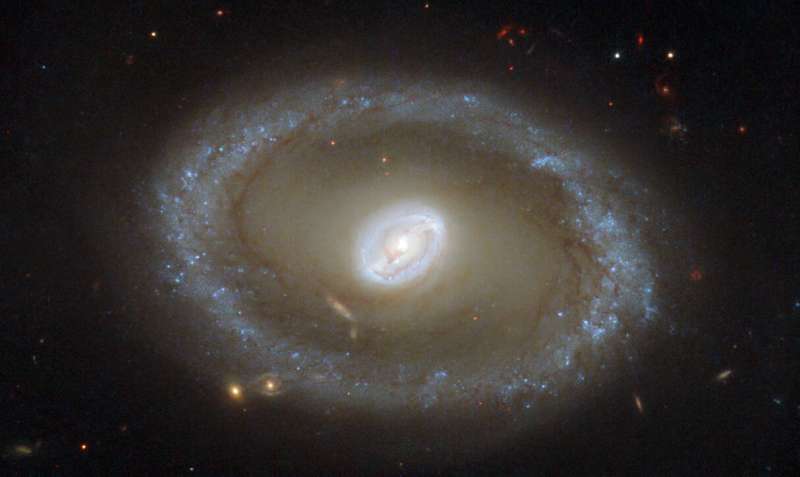
Human and machine intelligence work together to find 40,000 ring galaxies
https://phys.org/news/2022-07-human-mac ... axies.html
by Royal Astronomical Society

Image
Human and machine intelligence worked together to find 40,000 ring galaxies, scientists at the National Astronomy Meeting will announce this week. Dr. Mike Walmsley of the University of Manchester and the Galaxy Zoo collaboration will present the new work, describing how this "cyborg" approach measured the shapes of millions of galaxies.

Galaxies live a chaotic life. Collisions with other galaxies and bursts of energy from supermassive black holes disrupt the colors and orbits of billions of stars, leaving tell-tale markers that volunteers search for on the Galaxy Zoo website. But understanding exactly which cosmic events lead to which markers requires millions of measured images—more than humans could ever search.

To help, Dr. Mike Walmsley used a decade of Galaxy Zoo volunteer measurements (totaling more than 96 million clicks) to create an automatic assistant—a new AI algorithm. The algorithm, affectionately named "Zoobot," can not only accurately predict what volunteers would say but understands where it might be mistaken.
User avatar
funkervogt
Posts: 1365
Joined: Mon May 17, 2021 3:03 pm

Re: Space News and Discussions

Post by funkervogt »

Dmitry Rogozin, the bellicose director of the Russian space agency Roscosmos who has railed against NASA and its western space allies over sanctions imposed in the wake of Russia's invasion of Ukraine, is stepping down under orders from President Vladimir Putin, the Russian news agency Tass reported Friday.

Rogozin, who once derisively joked that NASA would need trampolines to get its astronauts to space without Russian help and who later said the United States would need "broomsticks" to reach orbit without Russian rocket engines, will be replaced by Deputy Prime Minister Yuri Borisov.
https://www.cbsnews.com/news/russian-sp ... int-crews/
User avatar
wjfox
Site Admin
Posts: 13588
Joined: Sat May 15, 2021 6:09 pm
Location: Essex, UK
Contact:

Re: Space News and Discussions

Post by wjfox »

Post Reply