https://www.space.com/exoplanet-massive ... D3voBzNjlMpublished 2 days ago
Astronomers have discovered a massive extrasolar planet, or "exoplanet," orbiting an ultracool dwarf star that is way too small to host such a world, challenging scientists' models of how planets and planetary systems are born.
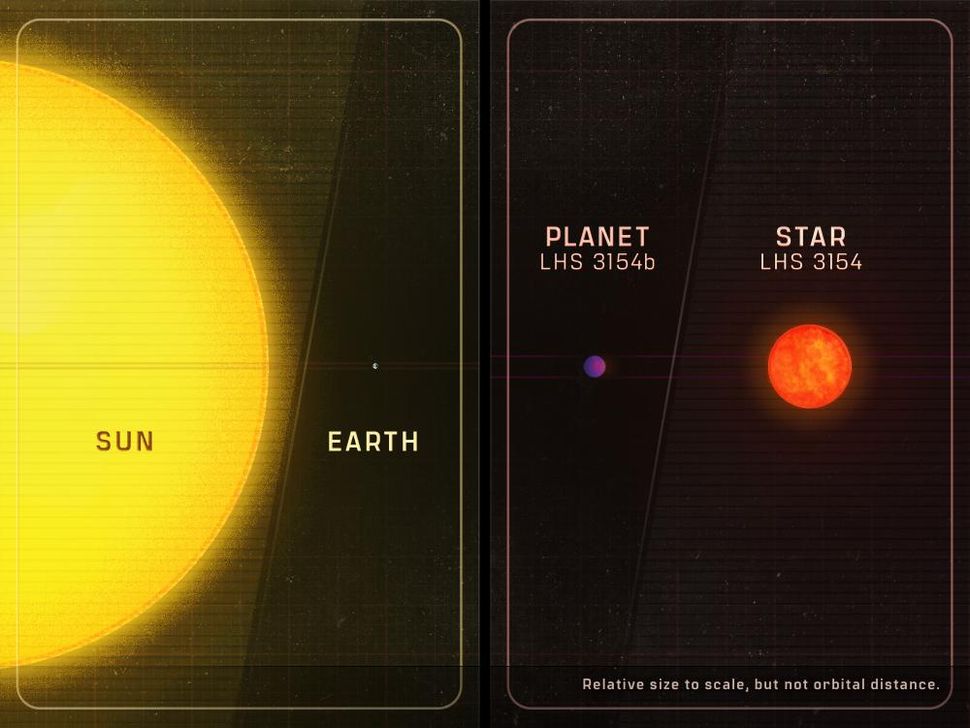
The planet in question, designated LHS 3154 b, is 13 times as massive as Earth, meaning that it has a mass similar to the solar system ice giant Neptune, yet it closely orbits a tiny dwarf star, which is nine times less massive than the sun.
This means the ratio between the Neptune-like world and its parent star — LHS 3154, which is located around 51 light-years away — is 100 times greater than the mass ratio between Earth and the sun, something researchers didn’t think was possible. This is the first time a planet with such a great mass has been found around one of the universe’s more diminutive stars.
"This discovery really drives home the point of just how little we know about the universe," research co-author and Penn State University Verne M. Willaman Professor of Astronomy and Astrophysics, Suvrath Mahadevan, said in a statement. "We wouldn’t expect a planet this heavy around such a low-mass star to exist."
Exoplanets – worlds of other suns
-
Time_Traveller

- Posts: 3025
- Joined: Sun May 16, 2021 4:49 pm
- Location: New York City, USA, November 5th 2032 C.E.
Re: Exoplanets – worlds of other suns
This 'forbidden' exoplanet is way too massive for its star
“In the quantum multiverse, every choice, every decision you've ever and never made exists in an unimaginably vast ensemble of parallel universes.”
-
weatheriscool
- Posts: 26101
- Joined: Sun May 16, 2021 6:16 pm
- Contact:
Re: Exoplanets – worlds of other suns
New warm Jupiter exoplanet discovered
https://phys.org/news/2023-12-jupiter-exoplanet.html
by Tomasz Nowakowski , Phys.org
https://phys.org/news/2023-12-jupiter-exoplanet.html
by Tomasz Nowakowski , Phys.org
An international team of astronomers has discovered a new warm Jupiter exoplanet orbiting a distant G-type star. The newfound alien world, designated TOI-4515 b, is similar in size to Jupiter but about two times more massive than it. The finding was detailed in a paper published Nov. 20 on the pre-print server arXiv.
TESS is currently performing a survey of approximately 200,000 of the brightest nearby stars with the main goal of searching for transiting exoplanets. So far, it has identified nearly 7,000 candidate exoplanets (TESS Objects of Interest, or TOI), of which 402 have been confirmed.
Warm Jupiters are gas giant planets with orbital periods between 10 and 200 days. This makes them challenging targets for transit detection and radial velocity (RV) follow-up studies compared to their shorter-orbit counterparts, dubbed hot Jupiters.
Now, a group of astronomers led by Ilaria Carleo of the University of La Laguna, Spain, reports the discovery of a new warm Jupiter—with an orbital period of approximately 15.26 days. Using TESS, they identified a transit signal in the light curve of TOI-4515—a G-star slightly smaller and less massive than the sun, located some 632 light years away.
-
firestar464
- Posts: 8408
- Joined: Wed Oct 12, 2022 7:45 am
-
weatheriscool
- Posts: 26101
- Joined: Sun May 16, 2021 6:16 pm
- Contact:

Re: Exoplanets – worlds of other suns
The Youngest Planetary Disks Ever Seen
by Evan Gough
January 10, 2024
Introduction:
by Evan Gough
January 10, 2024
Introduction:
Read more here: https://www.universetoday.com/165155/t ... ver-seen/(Universe Today) How long does planet formation take? Maybe not as long as we thought, according to new research. Observations with the Atacama Large Millimetre/submillimetre Array (ALMA) show that planet formation around young stars may begin much earlier than scientists thought.
These new results were presented at the American Astronomical Society’s 243rd Meeting. Cheng-Han Hsieh, a Ph.D. candidate at Yale, presented the new observations. “ALMA’s early observations of young protoplanetary disks have revealed many beautiful rings and gaps, possible formation sites of planets,” he said. “I wondered when these rings and gaps started to appear in the disks.”
Hsieh is referring to the well-known ALMA images of protoplanetary disks that have been making news for a few years now. These images show the protoplanetary disks around young stars with gaps that scientists think are where planets are forming.
ALMA captured these high-resolution images of nearby protoplanetary disks in 2018 as part of its Disk Substructures at High Angular Resolution Project (DSHARP). The gaps indicate where planets are forming and ‘sweeping’ their lanes of material. Credit: ALMA (ESO/NAOJ/NRAO), S. Andrews et al.; NRAO/AUI/NSF, S. Dagnello
But this earlier image and ones like it are images of Class 2 disks. The new images from ALMA are part of the CAMPOS (Corona australis, Aquila, chaMaeleon, oPhiuchus north, Ophiuchus, and Serpens) survey, named after the molecular clouds studied in the survey. They show Class 0 and Class 1 disks, which are younger. The Classes refer to the age of the stars that host the disks. In fact, at these young ages, they’re not even called stars; they’re called young stellar objects (YSOs.)
Don't mourn, organize.
-Joe Hill
-Joe Hill
-
weatheriscool
- Posts: 26101
- Joined: Sun May 16, 2021 6:16 pm
- Contact:
Re: Exoplanets – worlds of other suns
Astronomers Discover Earth-Sized Planet That's Half Lava
HD 63433 d is the smallest confirmed exoplanet younger than 500 million years old.
By Ryan Whitwam January 15, 2024
HD 63433 d is the smallest confirmed exoplanet younger than 500 million years old.
By Ryan Whitwam January 15, 2024
https://www.extremetech.com/science/ast ... -half-lavaThe universe is teeming with planets, and although we've only spotted a tiny fraction of them, science is always advancing. Our catalog of several thousand exoplanets has a new entry today, an Earth-like world with the snazzy designation HD 63433 d. However, the only thing Earth-like about this planet is its size. In every other way, it's the furthest thing from home, with hellish temperatures and one hemisphere that is an endless sea of lava. Still, it's small and rocky, and we don't spot many of those.
Astronomers have probed the HD 63433 system in the past, discovering a pair of planets (HD 63433 c and HD 63433 b) several times larger than Earth, putting them in the range of a small Neptune. While most of the known exoplanets were discovered by the dearly departed Kepler Space Telescope, more recent finds come from the Transiting Exoplanet Survey Satellite (TESS). While Kepler could scan distant stars, TESS was designed to gather more data about nearby exoplanets that orbit bright stars. HD 63433 is about 73 light-years from Earth, which is very close in the grand scheme.
-
weatheriscool
- Posts: 26101
- Joined: Sun May 16, 2021 6:16 pm
- Contact:
Re: Exoplanets – worlds of other suns
TESS discovers nine new 'hot Jupiters'
https://phys.org/news/2024-01-tess-hot-jupiters.html
by Tomasz Nowakowski , Phys.org
https://phys.org/news/2024-01-tess-hot-jupiters.html
by Tomasz Nowakowski , Phys.org
Using NASA's Transiting Exoplanet Survey Satellite (TESS), an international team of astronomers has discovered nine new "hot Jupiter" exoplanets. One of the newly detected alien worlds is almost four times more massive than Jupiter. The finding was presented in a paper published January 11 on the pre-print server arXiv.
TESS is conducting a survey of about 200,000 of the brightest stars near the sun with the aim of searching for transiting exoplanets—ranging from small, rocky worlds to gaseous giants. So far, it has identified over 7,000 candidate exoplanets (TESS Objects of Interest, or TOI), of which 415 have been confirmed.
Now, a group of astronomers led by Jack Schulte of the Michigan State University confirmed another nine planets monitored by TESS. They report that transit signals have been detected in the light curves of nine distant stars. The planetary nature of these signals was confirmed later by ground-based imaging and spectroscopic observations.
-
weatheriscool
- Posts: 26101
- Joined: Sun May 16, 2021 6:16 pm
- Contact:
Re: Exoplanets – worlds of other suns
Exoplanet Atmosphere Shows Chemical Consistent With Possible Alien Life
January 17, 2024 by Brian Wang
https://www.nextbigfuture.com/2024/01/e ... -life.html
January 17, 2024 by Brian Wang
https://www.nextbigfuture.com/2024/01/e ... -life.html
A few months ago, Nextbigfuture reported that NASA’s James Webb Space Telescope (JWST) observed a planet, K2-18, showing the presence of chemicals that indicate possible life. The carbon-bearing molecules including methane and carbon dioxide. Webb’s discovery adds to recent studies suggesting that K2-18 could be a Hycean exoplanet, one which has the potential to possess a hydrogen-rich atmosphere and a water ocean-covered surface.
These findings, including low ammonia, suggest an ocean under a hydrogen-rich atmosphere on K2-18, an exoplanet 8.6 times Earth’s mass, orbiting the dwarf star K2-18 in the habitable zone, 120 light-years away.
JWST has detected signs of methane and carbon dioxide in the atmosphere of K2-18. It’s a discovery that could help reshape the way we think about the search for life beyond Earth, and take our understanding of sub-Neptunes to the next level.
-
weatheriscool
- Posts: 26101
- Joined: Sun May 16, 2021 6:16 pm
- Contact:
Re: Exoplanets – worlds of other suns
Wolf 327b: A new member of the pack of ultra-short-period super-Earths around M dwarfs
https://arxiv.org/abs/2401.12150
TOI-2266 b: a keystone super-Earth at the edge of the M dwarf radius valley
https://arxiv.org/abs/2401.11879
https://arxiv.org/abs/2401.12150
TOI-2266 b: a keystone super-Earth at the edge of the M dwarf radius valley
https://arxiv.org/abs/2401.11879
-
weatheriscool
- Posts: 26101
- Joined: Sun May 16, 2021 6:16 pm
- Contact:
Re: Exoplanets – worlds of other suns
JWST/NIRCam Transmission Spectroscopy of the Nearby Sub-Earth GJ 341b
https://arxiv.org/abs/2401.06043
https://arxiv.org/abs/2401.06043
-
weatheriscool
- Posts: 26101
- Joined: Sun May 16, 2021 6:16 pm
- Contact:
Re: Exoplanets – worlds of other suns
JWST Directly Images Giant Planet Candidates Around Two Metal-Polluted White Dwarf Stars
https://arxiv.org/abs/2401.13153
https://arxiv.org/abs/2401.13153
-
weatheriscool
- Posts: 26101
- Joined: Sun May 16, 2021 6:16 pm
- Contact:
Re: Exoplanets – worlds of other suns
Hubble finds water vapor in small exoplanet's atmosphere
https://phys.org/news/2024-01-hubble-va ... e_vignette
by European Space Agency
https://phys.org/news/2024-01-hubble-va ... e_vignette
by European Space Agency
Astronomers using the NASA/ESA Hubble Space Telescope observed the smallest exoplanet where water vapor has been detected in its atmosphere. At only approximately twice Earth's diameter, the planet GJ 9827d could be an example of potential planets with water-rich atmospheres elsewhere in our galaxy.
GJ 9827d was discovered by NASA's Kepler Space Telescope in 2017. It completes an orbit around a red dwarf star every 6.2 days. The star, GJ 9827, lies 97 light-years from Earth in the constellation Pisces.
"This would be the first time that we can directly show through an atmospheric detection that these planets with water-rich atmospheres can actually exist around other stars," said team member Björn Benneke of the Université de Montréal. "This is an important step toward determining the prevalence and diversity of atmospheres on rocky planets."
-
weatheriscool
- Posts: 26101
- Joined: Sun May 16, 2021 6:16 pm
- Contact:
Re: Exoplanets – worlds of other suns
Astronomers analyze masses, orbital properties and atmospheric features of six exoplanets
https://phys.org/news/2024-01-astronome ... heric.html
by University of California, Irvine
https://phys.org/news/2024-01-astronome ... heric.html
by University of California, Irvine
A recently discovered solar system with six confirmed exoplanets and a possible seventh is boosting astronomers' knowledge of planet formation and evolution. Relying on a globe-spanning arsenal of observatories and instruments, a team led by researchers at the University of California, Irvine has compiled the most precise measurements yet of the exoplanets' masses, orbital properties and atmospheric characteristics.
-
weatheriscool
- Posts: 26101
- Joined: Sun May 16, 2021 6:16 pm
- Contact:
Re: Exoplanets – worlds of other suns
New Wolf in the pack: Astronomers discover an ultra-short-period super-Earth
https://phys.org/news/2024-01-wolf-astr ... eriod.html
by Tomasz Nowakowski , Phys.org
https://phys.org/news/2024-01-wolf-astr ... eriod.html
by Tomasz Nowakowski , Phys.org
Using NASA's Transiting Exoplanet Survey Satellite (TESS), an international team of astronomers has discovered a new ultra-short-period exoplanet. The newfound alien world, designated Wolf 327 b, is slightly larger and about 2.5 times more massive than the Earth. The finding was reported in a paper published January 22 on the pre-print server arXiv.
To date, TESS has identified over 7,000 candidate exoplanets (TESS Objects of Interest, or TOI), of which 415 have been confirmed so far. Since its launch in April 2018, the spacecraft has been conducting a survey of about 200,000 of the brightest stars near the sun with the aim of searching for transiting exoplanets—ranging from small, rocky worlds to gaseous giants.
-
weatheriscool
- Posts: 26101
- Joined: Sun May 16, 2021 6:16 pm
- Contact:
Re: Exoplanets – worlds of other suns
Neptune-like exoplanets can be cloudy or clear: New findings suggest the reason why
https://phys.org/news/2024-02-neptune-e ... loudy.html
by Brendan Lynch, University of Kansas
https://phys.org/news/2024-02-neptune-e ... loudy.html
by Brendan Lynch, University of Kansas
The study of "exoplanets," the sci-fi-sounding name for all planets in the cosmos beyond our own solar system, is a fairly new field. Mainly, exoplanet researchers like those in the ExoLab at the University of Kansas use data from space-borne telescopes such as the Hubble Space Telescope and Webb Space Telescope. Whenever news headlines offer findings of "Earth-like" planets or planets with the potential to support humanity, they're talking about exoplanets within our own Milky Way.
-
weatheriscool
- Posts: 26101
- Joined: Sun May 16, 2021 6:16 pm
- Contact:
Re: Exoplanets – worlds of other suns
Astronomers Find Potentially Habitable Super-Earth in Nearby Solar System
The planet is just 1.5 times Earth's diameter, orbiting its star every 19 Earth days.
By Ryan Whitwam February 5, 2024
https://www.extremetech.com/science/ast ... lar-system
The planet is just 1.5 times Earth's diameter, orbiting its star every 19 Earth days.
By Ryan Whitwam February 5, 2024
https://www.extremetech.com/science/ast ... lar-system
Astronomers have detected a new super-Earth a mere 137 light-years away, and it's smack in the middle of the star's habitable zone. That's quite close in the grand scheme, and we have NASA's Transiting Exoplanet Survey Satellite (TESS) to thank. This world is bigger than Earth, but astronomers think there's a good chance it's rocky and ideal for observation with instruments like the James Webb Space Telescope.
The newly confirmed exoplanet is known as TOI-715b. It's only about 1.5 times the Earth's diameter but three times as massive. It orbits TOI-715 in just 19 days, which probably seems awfully close for a potentially habitable world. That's because TOI-715 is a small, cool red dwarf. These stars are the most common type in the Milky Way, and closely orbiting planets are easier to detect by transits. A single dip in brightness can be anything. Astronomers can only pick out potential exoplanet signatures after detecting a pattern of transits.
Because TOI-715b orbits so quickly, its transits are more visible and easier to track. NASA says red dwarf systems like this may be our best bet for identifying habitable worlds, and this is not the first super-Earth found orbiting a red dwarf. Finding a truly Earth-like world that orbits larger, brighter stars would take a long time with current technology. If TESS were looking at the Sun from a great distance, it might catch Earth's transit by luck, but it'd have to wait a year just to have a chance to see another. Building that data into even a preliminary exoplanet candidate would take multiple years. Other detection methods, like radial velocity, have similar limitations.
-
weatheriscool
- Posts: 26101
- Joined: Sun May 16, 2021 6:16 pm
- Contact:
Re: Exoplanets – worlds of other suns
Teegarden's Star revisited: A nearby planetary system with at least three planets
https://arxiv.org/abs/2402.00923
https://arxiv.org/abs/2402.00923
-
weatheriscool
- Posts: 26101
- Joined: Sun May 16, 2021 6:16 pm
- Contact:
Re: Exoplanets – worlds of other suns
TESS and ESPRESSO discover a super-Earth and a mini-Neptune orbiting the K-dwarf TOI-238
https://arxiv.org/abs/2402.04113
https://arxiv.org/abs/2402.04113
-
weatheriscool
- Posts: 26101
- Joined: Sun May 16, 2021 6:16 pm
- Contact:
-
firestar464
- Posts: 8408
- Joined: Wed Oct 12, 2022 7:45 am
Re: Exoplanets – worlds of other suns
Possible atmospheric destruction of a potentially habitable exoplanet
https://phys.org/news/2024-02-atmospher ... lanet.html
https://phys.org/news/2024-02-atmospher ... lanet.html